Global Change and Entrepreneurial Opportunity Surrounding Japanese Startups in 2025
This article was machine-translated from Japanese by AI (Claude). It may contain errors. Read the original Japanese article.
Just about this time last year, in June 2024, I wrote an article titled "To Stop the "Beginning of the End" of Japan's Startup Boom."

In that article, noting that the startup ecosystem has not been generating sufficient economic returns relative to the amount of venture investment Japan has made so far, I argued that it is important to encourage bigger challenges going forward.
Perhaps that sense was already shared, because even in the February 2025 "Startup Policy" materials from the Ministry of Economy, Trade and Industry (METI), the agenda seems to have shifted clearly to "from quantity to quality (from broadening the base to raising the height)."
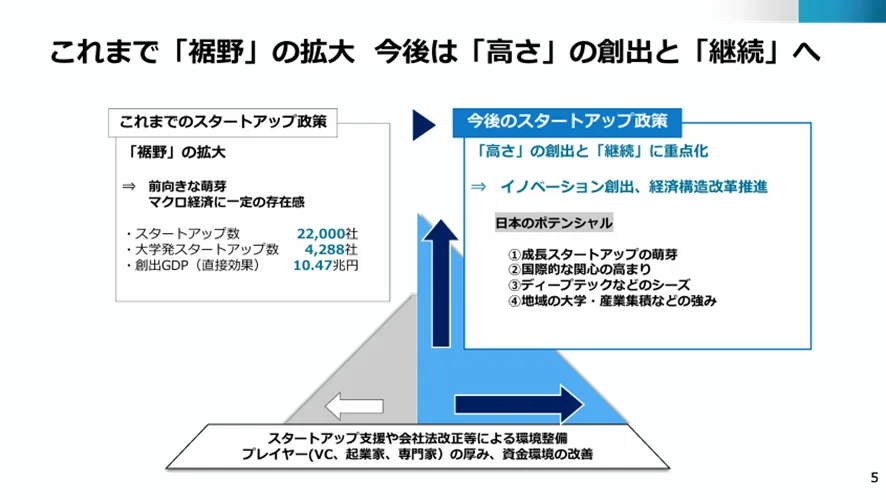
https://www.meti.go.jp/shingikai/sankoshin/sangyo_gijutsu/innovation/pdf/006_05_00.pdf
Personally, I think this direction is a good one. Once a correct and meaningful goal has been set, all that remains is to think through and carry out the path to reach it, so I am hopeful that the agenda has become this.
However, in 2025, just after such a goal was set, it seems to me that society, both in Japan and abroad, which forms the foundation of startups' economic activity, has changed greatly as a whole and is growing increasingly unstable.
When the framework and rules of society change, the relative position and meaning of the players within it change as well. Then the role expected of startups will also differ from what it has been until now.
The problem of investment returns across the startup ecosystem that I wrote about last year was, after all, an internal issue of the ecosystem. It is an issue that should be solved in its own right, but if the society surrounding us is changing, we need rather to turn our eyes to that external environment.
And that change is both a threat and an opportunity.
Moreover, if startups are entities that grow by actively using the uncertainty that change brings, it would be better to regard this great change as an opportunity for Japan's startup ecosystem.
Having recognized these changes in the environment, I think it is time to think anew about "where Japanese startups are positioned in a changing society (or which position they will proactively take)" and "how Japan's startup ecosystem will fulfill its responsibilities in this newly emerging society."
These days, the talk is mainly about changes in technology centered on AI and their impact on business. But I think we should widen that view a little and talk more about the changes in the world and in the domestic economy and industry surrounding startups, and in the society around them. This is especially so within a startup ecosystem that aims for high-growth startups.
So, after organizing the challenges the startup ecosystem faces as of 2025, I would like to put together in this article what I personally think now: that if Japanese startups recognize the changes in the social environment surrounding them and face the world's problems head-on, there may be a good opportunity for Japanese startups.
- Changes and Challenges Surrounding Japan's Startup Ecosystem
- Startups Abroad Beginning to Respond to Social Demands
- What Is the Significance of Future "Japanese Startups" for Japanese Society?
- Countermeasures
- Conclusion
Changes and Challenges Surrounding Japan's Startup Ecosystem
First, I would like to organize the changes and challenges by taking up three major points.
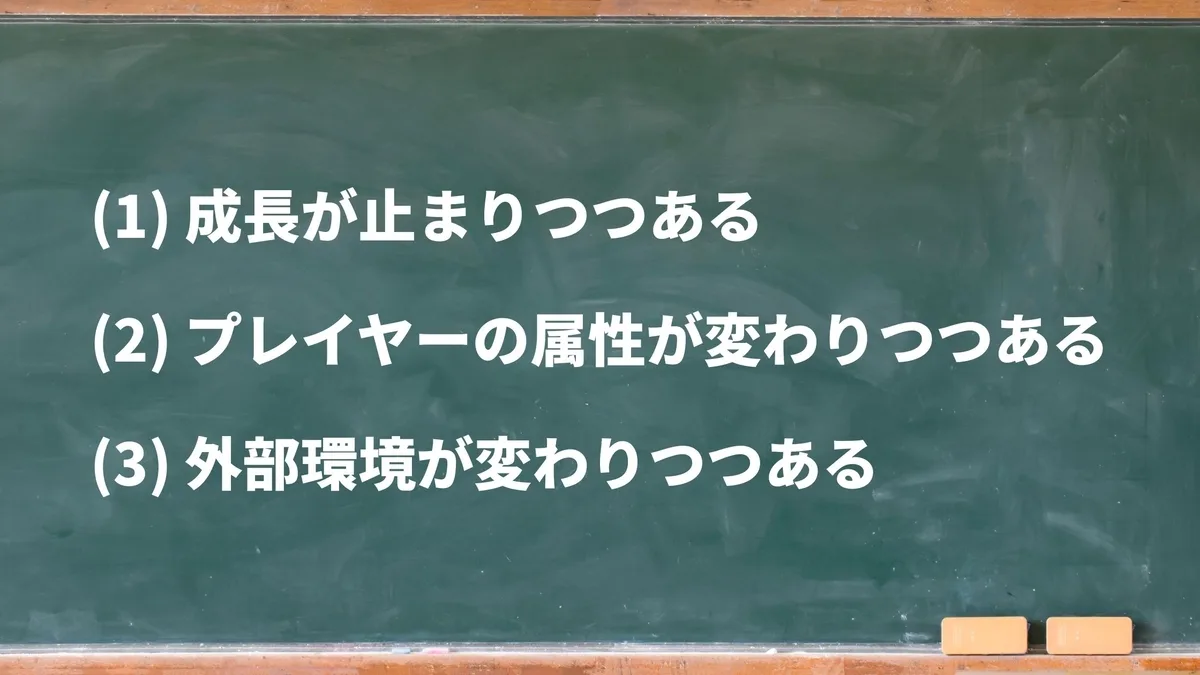
- (1) The growth of the startup ecosystem is coming to a halt
- (2) Startups are becoming, relatively speaking, part of the establishment
- (3) Society, the external environment of startups, is changing
(1) Japan's Startup Ecosystem Ages and Stops Growing
Until now, Japanese startups have enjoyed the expectations and freedom that come with being in a dawn period, and have been nurtured by society, which held the expectation that "if you leave the young people free, new innovation will emerge."
It was not only that the result of innovation was expected. There was also an aspect in which the very liveliness peculiar to youth, the cheerful and fun-looking bustle, was valued against the backdrop of the perception of the era as the "Lost 20 or 30 Years." There was hope and expectation that "something might come out of it."
Riding the wave of large-scale, long-term monetary easing worldwide in the 2010s, the startup ecosystem has grown over the past decade. It can be said that these 10 to 15 years were, for startups as entities, the period in which they came to be recognized to a certain extent as members of society through the efforts of the predecessors involved in the startup ecosystem.
On the other hand, looking back, if you ask whether we have been delivering returns on the investment and expectations, we are still only halfway there.
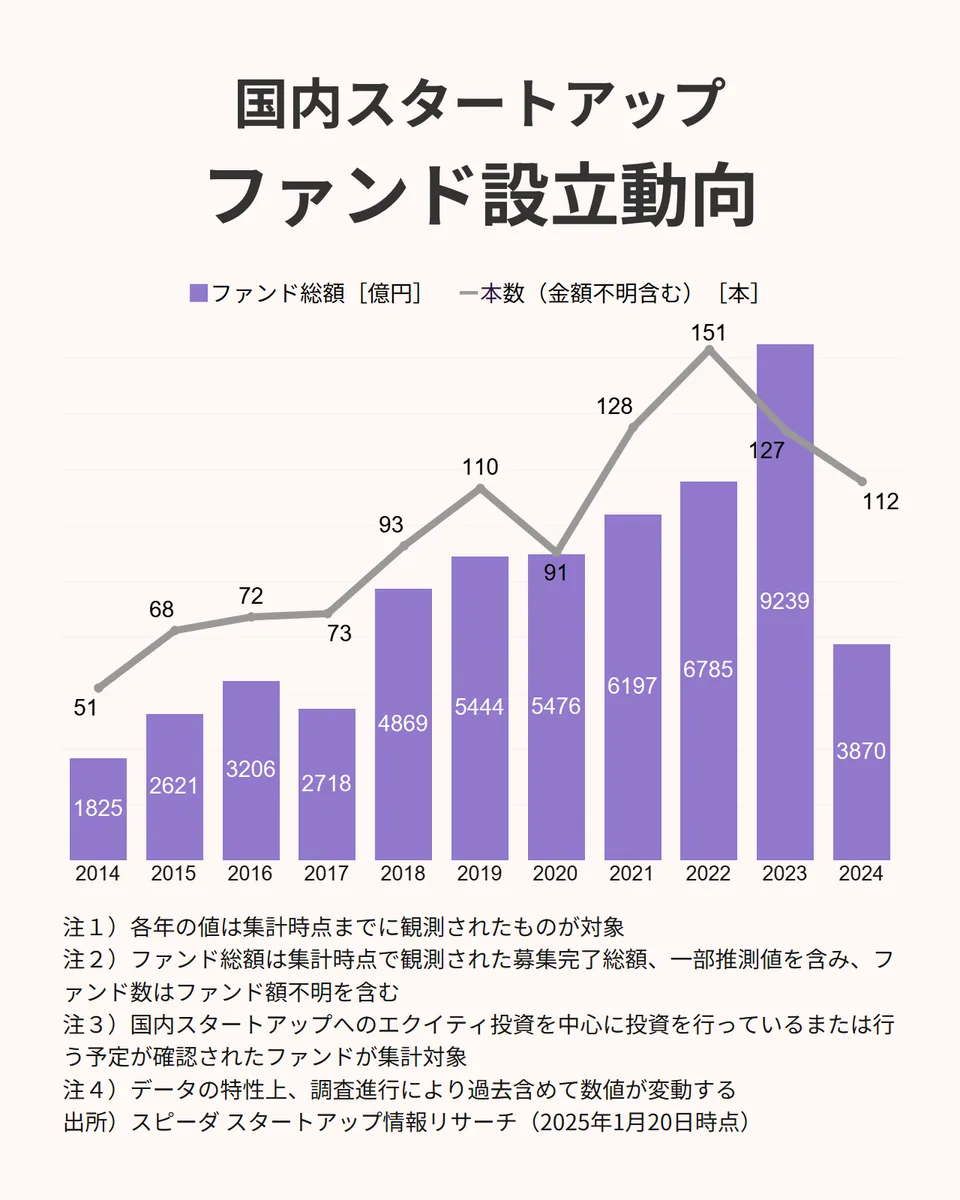
About 25 years have passed since 1999, when the Tokyo Stock Exchange Mothers market (now the Growth market) was established; more than a decade has passed since the startup boom driven by the internet and smartphones arrived; and political resources have also been invested. In the midst of this growth, both the number of companies and the amount of funds raised are now beginning to stagnate somewhat. (Such stagnation is also common with individual startups.)
The amount of VC funds formed in 2024, which is also a leading indicator of VC investment over the next two to three years, has also fallen considerably.
I feel that the boom in "open innovation," which was one of the reasons startups drew attention in ways other than economic returns, is also subsiding. There may be a certain kind of "fatigue" as well.
Looking at prospective entrepreneurs and students, their interest seems to be returning to small businesses.
Viewing the whole in this way, expectations toward startups seem to be thinning somewhat and stagnating. To break through that, we need to take on big challenges, and signs of this are appearing, but looking at the situation underfoot, growth is showing some signs of fading.
(2) Startups Becoming Part of the Establishment
Over the past few years, startups have drawn attention and expectations, and political and social resources (including attention from the media) have been poured into startups and supported them.
At the same time, I think backlash against startups has also become visible. For example, people who run small businesses ask, "Why are only the people who take investment from VCs, who compete with other people's money, being fussed over?"
That is not all. Fifteen years ago, "venture companies" were things done by outsiders, and nobody could tell whether they would amount to anything. But over the past decade or so, "venture companies" have given way to the word "startups," and while taking on a new look, many highly educated elites have entered the ecosystem, and the makeup of the players has changed as well.
The software industry used to be called one of the "3Ks" (a Japanese shorthand for jobs that are dirty, dangerous, and demanding), yet it has now become a high-paying field even in Japan, and within it, startups have also come to pay relatively high salaries.
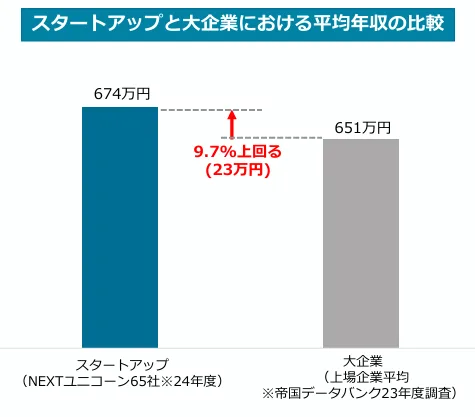
https://www.meti.go.jp/shingikai/sankoshin/sangyo_gijutsu/innovation/pdf/006_03_00.pdf
That attention gathers and the base thickens is a good thing for the ecosystem, but it also means that startups have become easy targets for envy.
If, while receiving various kinds of support, startups play the "game" of being a startup and deliver only an economic impact so small that just a few executives make a decent profit, a certain number of citizens will begin to hold mixed feelings about it.
Moreover, entrepreneurship already tends to be seen as "flashy" and "frivolous," and tends to attract unpleasant feelings (though there are many sincere and decent people, so there is plenty of misunderstanding and prejudice). On top of that, looking overseas, headwinds against tech (software) have begun to blow, and society's trust in it is declining.
In addition, in Japan, startups have continued over the past few years to enjoy preferential treatment close to politics, which makes it all the more so.
Not only in Japan, people involved in startups seem to be gradually coming to be seen not as outsiders but as part of the elite or the establishment.
Even so, if as a whole we are not delivering economic impact and not carrying out anything that carries social responsibility, there is a real risk of provoking strong backlash from society.
(3) Changes in the External Environment Surrounding Startups
Recently, news about politics and the economy, centered on the United States, has been causing a stir in Japan more and more often. Conflicts between nations are also arising one after another. In Japan too, a Taiwan contingency is constantly being discussed.
Looking at domestic society, in addition to inflation and rice shortages, parties that call for the exclusion of foreigners or make extreme claims are gaining momentum. It seems to me that society within Japan is also becoming unstable.
As uncertainty from tariffs and conflicts grows, it is quite conceivable that the large corporations and CVCs, which have a distinctive presence in Japan's startup ecosystem, will further hold back on investing and on LP commitments.
Not only in the economic sense of investment, the mood of society will also change.
If society, in Japan and abroad, grows unstable from here and people's lives become increasingly harsh, dissatisfaction will build up and society will lose its slack. If that happens, it is also expected that support and investment will find it harder to gather for an endeavor as uncertain as a startup. In particular, among startups, "high-return but failure-prone endeavors" that aim for "height" will become more difficult.
Summary of the Challenges
As described above, amid these three changes,
- (1) The growth of the startup ecosystem is coming to a halt
- (2) Startups are becoming, relatively speaking, part of the establishment
- (3) Society, the external environment of startups, is changing
it seems to me that startups, already regarded as "dubious," are becoming more likely to draw backlash from many people.
Startups Abroad Beginning to Respond to Social Demands
In response to these movements in society, American startups appear to have been the first to start changing their positioning.
For example, a16z's American Dynamism (security and defense) and Y Combinator's Techno-Industrialist (manufacturing) set themes aligned with the agendas of the nation and society, and recruit startups with modern social significance.
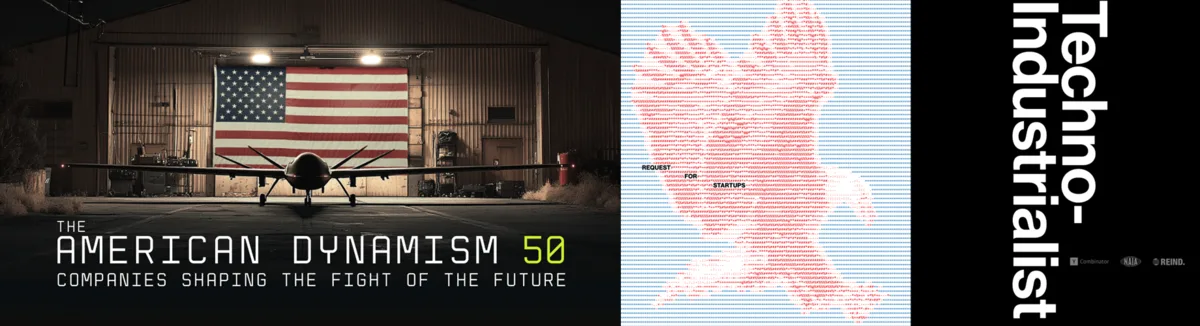
https://a16z.com/american-dynamism-50-2025/ & https://www.ycombinator.com/techno-industrialist
By giving it the meaning (at least on the surface) not merely of "creating innovation using tech" but of "creating innovation using tech for the nation," this also looks like a movement to position startups in society in a form different from before.
Indeed, if startups can solve such problems, they will earn recognition not only of their economic value but also of their social value.
That is a value different again from the conventional value of startups. If startups can contribute there, I think they will gain further trust, money will flow in, and this will lead to the ecosystem's next growth. And even if there is a temporary stagnation in terms of economic returns, I think they will continue to retain society's trust.
What Is the Significance of Future "Japanese Startups" for Japanese Society?
If society's instability is going to increase in Japan from here on, I think the startup ecosystem in Japan needs a similar movement.
That is, on the premise of delivering economic returns, to make clear what significance startups have for domestic society.
For the past decade, the positioning was that of a group that brings about the DX of society and companies using SaaS and the like. But I think that whether the same positioning is fine for the next 10 to 15 years is a somewhat different question.
Although there are still opportunities in the shift from on-premises to the cloud, software has spread considerably and many people can now build it. It has also become clear that the domestic Japanese market and the enablement of Japanese companies alone put a limit on startup growth.
Moreover, the special era in which "starting a business with IT = a high-growth startup" were lumped together has ended. Even when IT is used, it has come to be recognized that entrepreneurship offers the choices of both startups and small businesses, and I also feel that each path is branching off and differentiating quite clearly.
In fact, there are other options now.
For example, what if startups solved problems of energy and transportation? What if they solved social issues? What if they created new industries? What if they succeeded in starting businesses in heavy domains that involve hardware and the like? What if, even while using software, they rebuilt industries in a software-native way? What if they could stabilize a destabilizing society?
In the recent arguments in defense of US megafunds, there was an interesting article, and it should be possible to bring about large changes that rebuild industries from here.
And if we can create the genuine social impact and the dynamism within society that arise from such activities, and contribute to the nation and society, startups will be able to continue securing a certain social role.
More concretely, I think we should increase activities that are conscious of the following (even if not everyone does so), or rather that stakeholders with this awareness should come together and send out a message.
Countermeasures
(A) Increase and Explain Initiatives That Contribute to the Stability of Domestic Society
First, it seems to me that we need to clearly aim to properly solve the problems of domestic society.
That means producing examples of economic success, and also building businesses that broadly benefit Japanese society. For example, businesses that can seriously and substantially resolve the labor shortage, which has become a pressing issue, or businesses that rebuild industries and raise their added value.
Especially now, when the establishment and the elite, who are highly educated, expected to deliver (and easily blamed), are taking on startups, it seems to me that we must be conscious of noblesse oblige and run businesses that fulfill responsibility head-on, or at the very least show that intention.
(I also think that activities that solve major problems and problems of social systems in non-market domains are important for this.)
There is innovation born from freedom and individual will (Will), but there is also innovation born from responsibility and social demand (Must).
Thinking this way, I believe that by thinking anew about what kind of businesses would truly have impact on Japanese society, the startup ecosystem will become able to achieve greater things, and will be able to fulfill the accountability owed for the support it has received so far.
(B) Tackle Global Challenges and Contribute to the Harmony of International Society
By solving the world's problems, a company can become a global company. There are still many problems, such as healthcare and climate change, that can be solved using the power of markets. I believe we should continue to approach these.
While these problems remain, the shape of the world is changing and new problems are also erupting. Amid this, Japan can still maintain relative stability, and amid the confrontation between the US and China, it is also becoming a geopolitical linchpin.
Considering these circumstances, it means that if we can create businesses from Japan that are meaningful on a global scale now, Japanese products and businesses can be sold to many countries and can contribute to the stability of each part of the world. For example, in the past few days, shipbuilding has been a lively topic.
That opportunities are coming around to the country of Japan also means that opportunities are coming around to Japanese startups.
In shipbuilding, for example, if we were to create a software-native Japanese shipbuilding company from scratch today, it would be difficult, but it would also be a very large opportunity if it succeeded.
To break through the stagnation of Japan's startup ecosystem and make it a still larger ecosystem, we need big challenges and successes. And right now, various problems are arising around the world.
I also think that the opportunity to solve them is open to Japan. For example, I hear that interest in the Asian region, which has lost its place amid US-China confrontation, is beginning to turn toward Japan as well, and I too have been talking more often with foundations overseas over the past year.
If we begin now to build what the world needs, and Japan can become indispensable to the world 10 to 15 years from now, Japan will prosper and should also be able to help the harmony of the world.
In a sense, changes in the world are also an opportunity.
I believe that if Japanese startups can contribute to the harmony of the world at this timing, they can have greater social significance. For that, we must at least aim for it.
(C) Act with the Awareness That We Have Become Adults, with the Standing That Comes with It
Some in the startup world praise "dubiousness," but I think that praising dubiousness itself is somewhat off the mark.
It would be fine if that dubiousness arose because of a gap with reality after raising lofty ideals, or because we are drawing a big dream that is not yet realized. But mere dubiousness (suspiciousness and doubtfulness) is not a good thing in any way.
And if society becomes unstable from here, it is easy to imagine that the world will no longer have the slack to tolerate "dubiousness," and that it will become difficult to enjoy freedom.
For boys and girls who are objects of protection, that might still be forgiven. However, Japan's startup ecosystem, in human terms, has finished the childhood and adolescence in which it was an object of protection, and is entering a youth in which it searches for its identity, or even the prime of adulthood beyond it.
If so, I think the time has come to fulfill our economic and social responsibilities, to think about our own position and role, and to convey our meaning to society more properly than ever before.
Furthermore, now that various kinds of slack are being lost from the world, adults must work hard so that the next generation and young people can enjoy a certain kind of freedom.
In that sense, I think that especially the people of the generation above startups must take on the challenge of fulfilling their responsibilities and duties properly, actively appeal to the social meaning of startups, and take on the task of securing freedom for the next generation.
I think that trying to accomplish something big is also trying to take on big responsibility toward society. I do not think everyone needs to do it, but it seems to me that we need to keep reconsidering whether at least some people are taking on such responsibility, or at the very least whether we are aiming for it.
Conclusion
As society changes, I have been saying that by thinking anew about what role startups should have in Japanese society over the medium to long term, and by taking action, there is an opportunity for startups to become meaningful entities in the new society.
That means answering for ourselves the question "what role do startups have for society?" and also means where we find our own identity (or how we want to be).
In such a situation, though it is not quite Andy Grove's question, when I consider "If we were to build a startup ecosystem from scratch with the knowledge we have now, what would we do?", it seems to me that various opportunities are coming around to Japan's startup ecosystem today.
One option is, I believe, to raise high ideals, confront large and serious problems, and try to achieve social significance head-on.
Looking toward 2040, think about the industries and businesses that Japan and the world will need, and lay the groundwork for them. There are not many players who can do that.
If we can give the right answer to that question, I think it may be possible to multiply social impact by ten, impact that is not merely a matter of the number or quantity of startups. This is especially so in the current world situation.
Without a goal, one will not even think about methods, but if one sets a meaningful, high goal, one comes to think of various means of execution. If so, all that remains is to set a goal and somehow work out the path toward it.
Looking around me, a good number of startups and investors with such great social significance and aspiration have emerged. I find that reassuring, but I still think their number is not enough, and I do not think there has been enough discussion to arrive at answers.
We need more initiatives and messages that turn their eyes more to the problems of the world and the country, speak of ideals and significance, seriously create industries, change industries, and generate a truly good influence on society.
To increase the number of such people, I think we must discuss in the open not only "how to do entrepreneurship well" (= How), but also what thinking we are using to try to contribute to society, and how we are trying to bring a good impact to society and industry in an honest way (of course, after making the effort to deliver economic returns).
When society changes, the importance of economic returns also changes, and so does the meaning of social impact. Going beyond the era of "doing entrepreneurship and business well," I feel that what is being asked now is whether we can become entities that truly lead the nation's change, including industrial policy.
While facing the serious agendas of the nation head-on, without falling into excessive nationalism or xenophobia, we plant seeds toward the new form of global solidarity and markets that comes next, and also contribute to the realization of world peace and the resolution of humanity's problems. Holding such large discussions and trying to find answers is what we should do. By increasing such initiatives among ourselves, I think the ecosystem as a whole will gain its next trust and freedom.
It may be grandiose. But being able to do so is both a strength and a role of startups.
Since March 2025, I have written several articles that connect to this one. Some people responded to them, which I am glad of.
I hope that together with such people, we can earnestly believe in and plan to create new industries or rebuild industries toward 2040 and 2050, and move forward, and that we can discuss with everyone in the startup world who shares that will, think of answers, execute them, and produce results.
(Although this is written for startups, I do think that such a discussion also applies to large corporations and the consulting industry, which carry a certain responsibility. I think it would be good if such discussions arose in each industry.)
Related Articles