Beyond Design Thinking 🎨🧠: Toward a Grand Design 🗺️
This article was machine-translated from Japanese by AI (Claude). It may contain errors. Read the original Japanese article.
Summary by NotebookLM
In Japan today, it seems to me that people in many places are increasingly being asked to draw up a "long-term, big-picture vision."
Startups are one example. In today's startup ecosystem, founders are expected to build larger companies. As a result, they are also starting to be asked to draw up a big vision from the very early stages of founding a company.
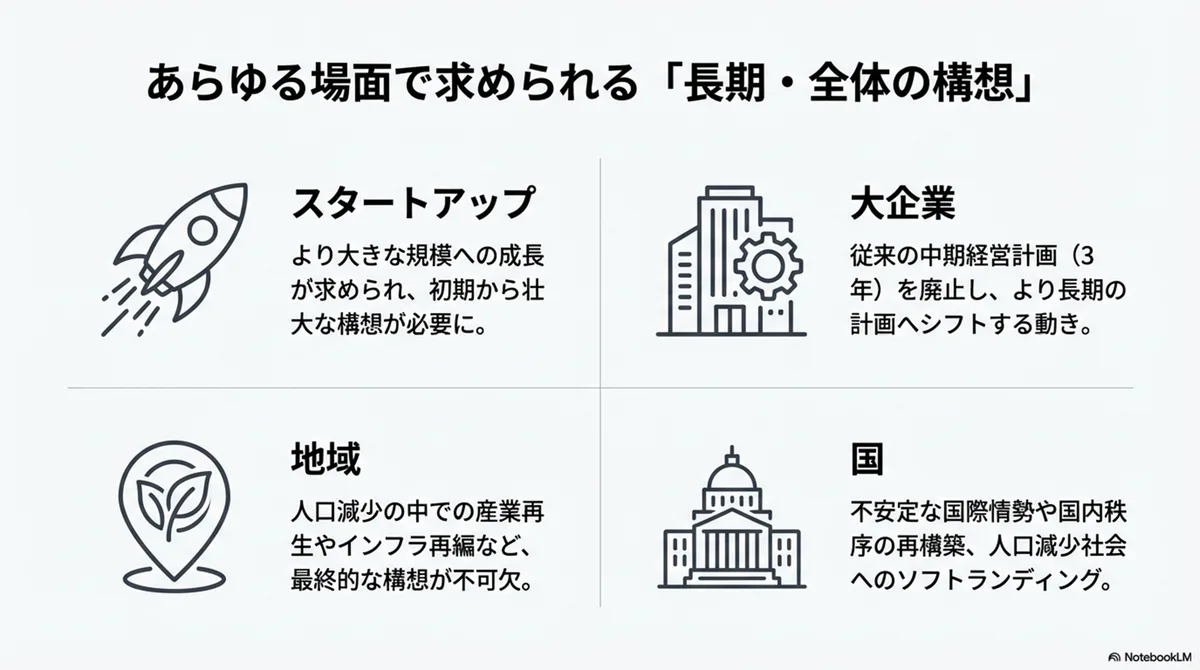
Among established companies, too, some large corporations have abolished their medium-term management plans, which traditionally spanned three years, and a few have begun shifting to longer-term plans so that they can bring about bigger change.
It is not only business. Regions need long-term plans as well. When we ask, "What should we do about the local industry as the population declines?" or "What should we do with the site of a former factory?" and try to take action, what we need is an ultimate vision and a plan for change over the long term. Without such a vision, it becomes hard even to take the first step toward change, and what is more, the situation worsens over time and the options we can take dwindle.
The same goes for nations. International affairs are growing unstable, and as we have to form an order different from the international order we have had until now, the need to think about which direction to head in is increasing. And the root of that international instability is the instability of each country's domestic order, which we also have to think about. How to achieve a soft landing for a shrinking population likewise requires a medium- to long-term plan.
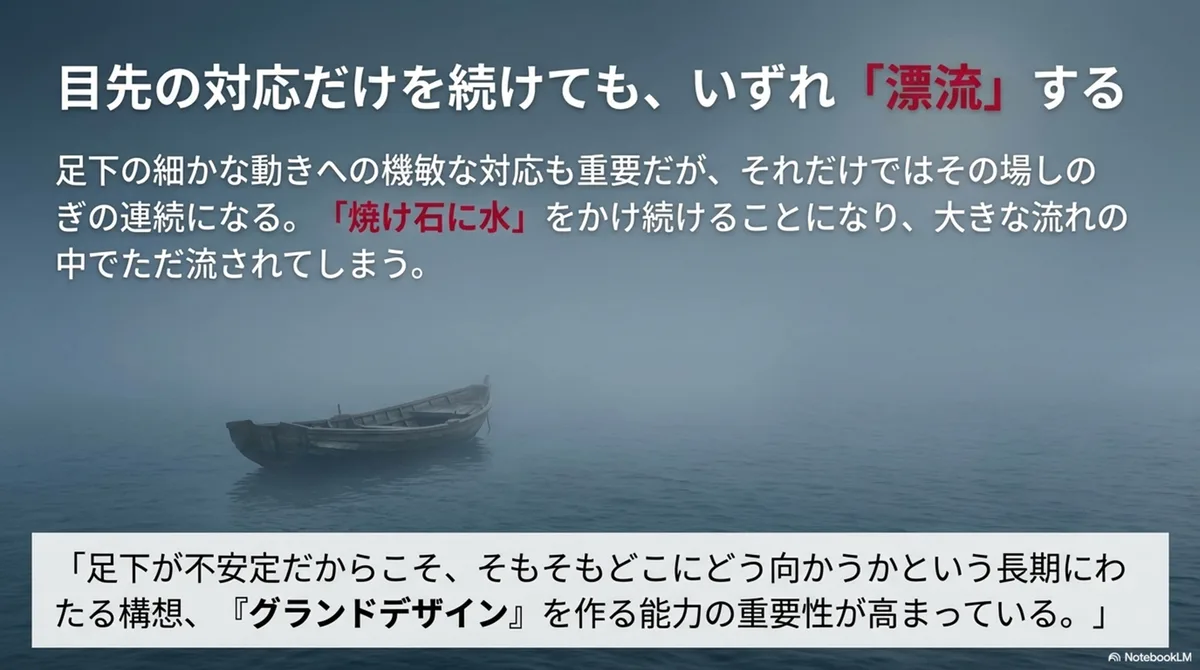
In each of these cases, we can respond nimbly to the small movements at our feet. But if we only keep doing that, we will end up making one stopgap response after another, pouring water on hot stones again and again. As a result, wouldn't we simply be swept along by the larger current and end up adrift?
Rather, precisely because the ground beneath our feet is unstable, I think the ability to create a long-term vision of where and how we are headed in the first place, that is, a "grand design,"1 is becoming more important.
- The 2010s (1) - An era focused on solving immediate problems and optimizing
- The 2010s (2) - An era of "transformation" without a grand design, relying on tools and methods
- Toward a long-term grand design, not design thinking
- Methodologies for thinking about a grand design
- The "grand design of society" that is needed
The 2010s (1) - An era focused on solving immediate problems and optimizing
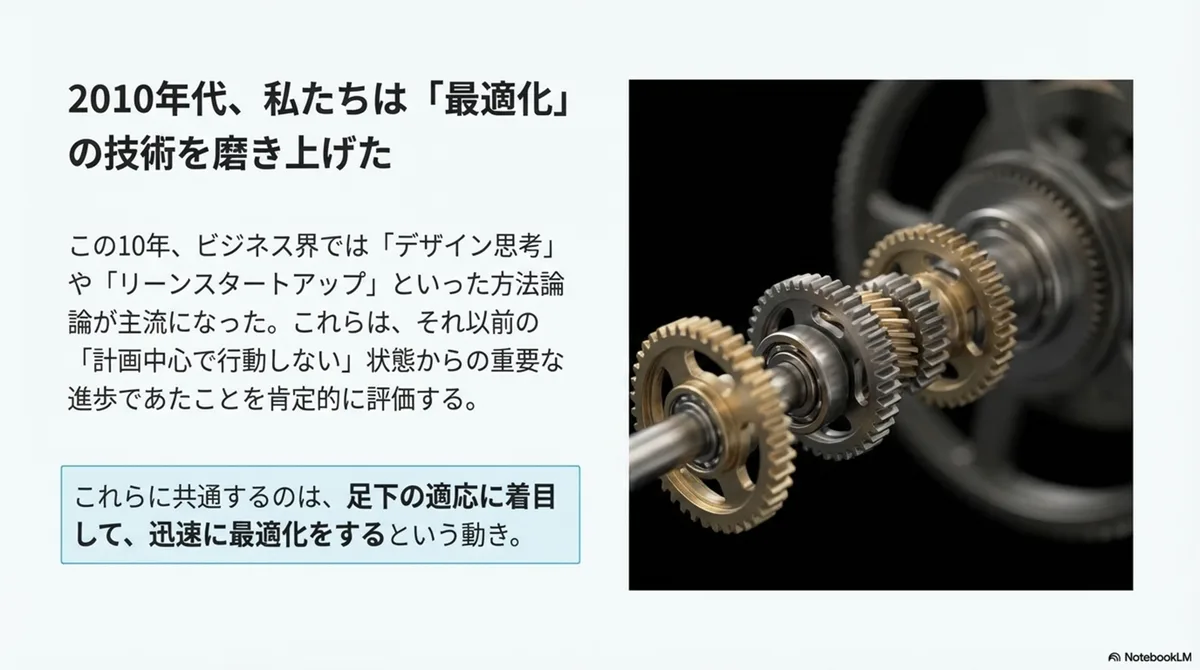
Over the past decade or so, the word "design" has come into common use even in the business world. Methodologies such as "design thinking" have also been discussed in the field of new business development.
Design to date, and design thinking in particular, has centered on solving relatively micro, short-term problems with an emphasis on empathy. What was discussed also tended to lean toward methodology and process, such as techniques for empathy, prototyping, and interdisciplinarity.
The Lean Startup methodology, which became popular around the same time, also seemed to draw attention mainly as a way to solve micro-level problems and find local optima, and effectuation, too, tended to be taken as emphasizing what one can do right where one stands (although that is not the case if you read the methodology as a whole). As for Agile, what was mainly talked about (out in the world) seemed to be the importance of adapting in the short term and with agility, rather than over the long term.
What these have in common is a movement to focus on adapting to what is at our feet and optimize quickly.
Compared with the earlier habit of focusing on plans and taking no action, this emphasis on action is also important. But I also think that, because so much attention went to such methods, attention did not turn to deciding the direction that should be their foundation, or to drawing a grand design itself.
The 2010s (2) - An era of "transformation" without a grand design, relying on tools and methods
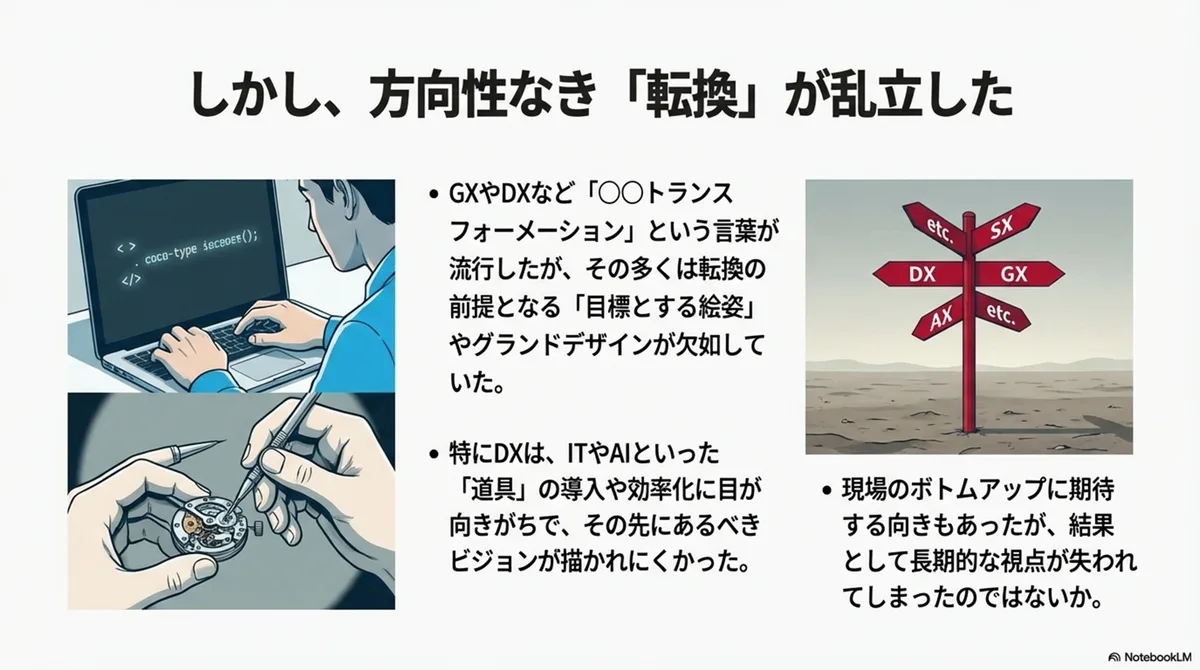
Amid the attention on such methods, "transformation" such as GX and DX was talked about, and it was also an age in which we often heard phrases of the form "○○ transformation." I even suspect that by now "○X" terms exist for every letter of the alphabet.
But transformation is by nature something that focuses on process and method. If one is going to bring about a transformation, its premise should be a target picture, a grand design. Yet without that grand design, there were cases, I think, in which "transformation" without direction, or just "transformation" itself, was what was being shouted about.
DX in particular, where the "tools" such as IT and AI were clear, tended to have all eyes on its methods and efficiency gains, and it was unfortunate that attention did not easily go to drawing the picture beyond. Also, combined with the design thinking methodology that drew attention at the same time, there may have been those who expected plans to emerge bottom-up from the front lines.
But I also think that, as a result, we stopped thinking much about the long term and the direction we ought to take.
Toward a long-term grand design, not design thinking
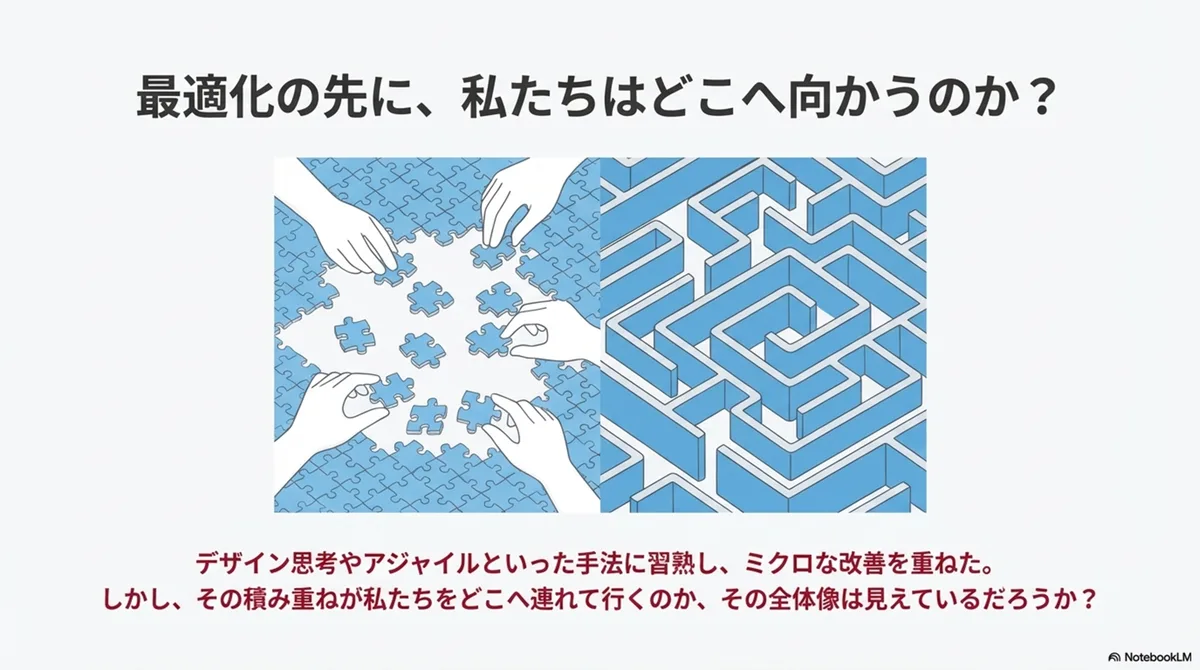
Over the past decade, methodologies for solving the problems in front of us have become more refined. They matter too, but meanwhile, what should be done before detailed optimization, such as drawing up and evaluating a long-term vision of where we are headed in the first place, has rarely been discussed.
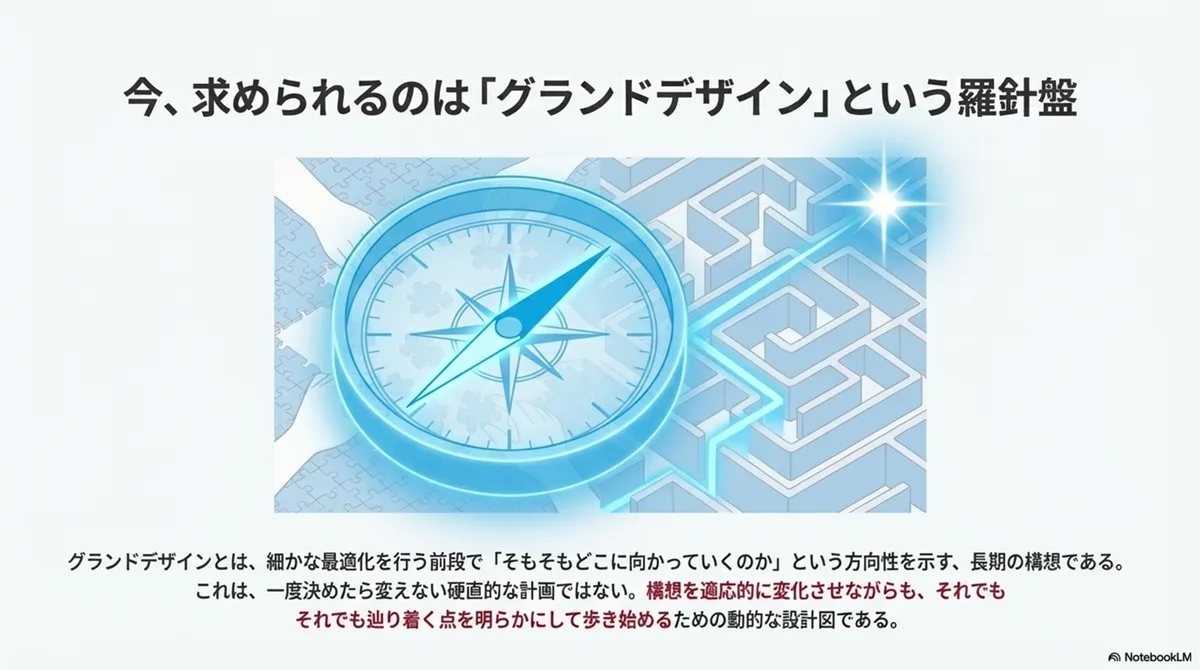
Now, however, when all sorts of transformations and reconstructions are being called for, I think the importance of drawing a long-term "grand design," rather than such small-scale design and methodology, is rising anew.
Of course, there have been many things called grand designs until now. But in the "way of making a grand design" common in Japan, quite often people are asked to contribute ideas bottom-up, and these are gathered, sorted into categories, and presented as the grand design. This is a method that hurts no one, but it is also a method that makes it hard to bring about major change, and one in which the direction and the message tend to be unclear.
If so, I think we need to make the case for the importance of grand design now, and to think about how to create one.
I am not saying that we should plan everything in advance and proceed exactly as planned. It is a proposal that, if you have not drawn up a vision at all, you start by drawing one, and then, while changing the vision adaptively, still make clear the point you will arrive at, and begin to walk.
This is especially so because the number of people involved in such grand designs is also increasing.
(1) There are more occasions to draw one up
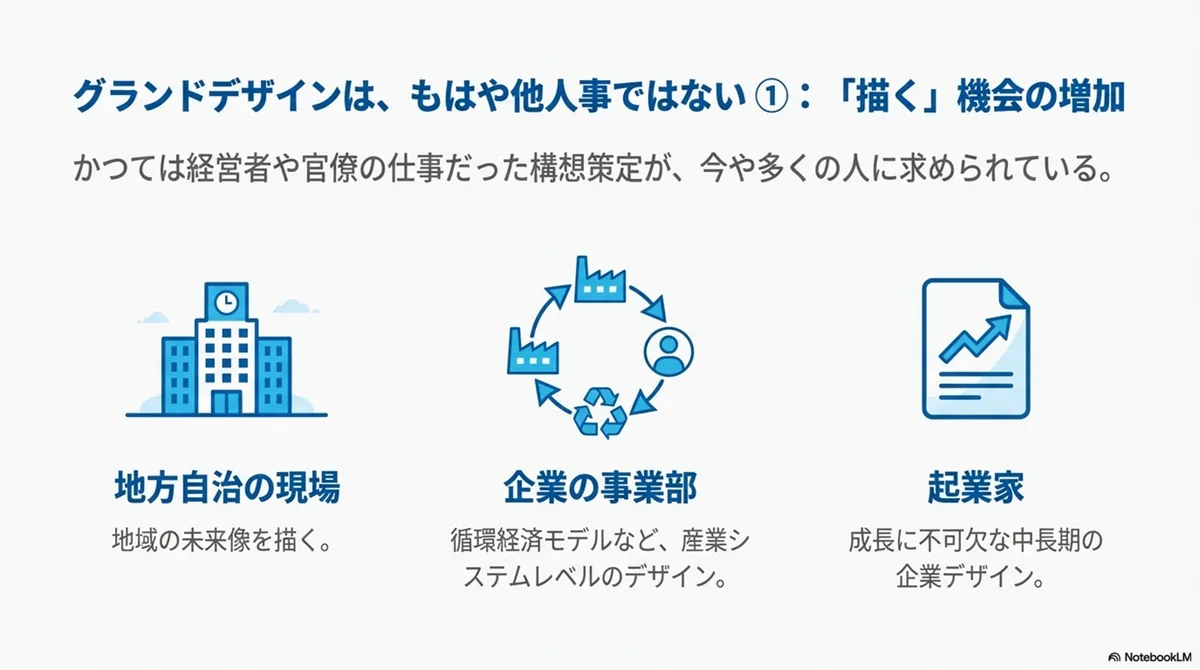
Traditionally, thinking about such grand designs was the job of executives, politicians, and bureaucrats in Kasumigaseki, but I feel that these days many more people are beginning to be asked for the ability to draw up such grand designs.
For example, as in the regional example above, it is needed at the level of local government on the ground, and I think there are also more situations in which it is needed in each business unit within a company. When thinking about a circular economy model, for instance, a grand design of the industrial system becomes necessary.
The same goes for entrepreneurs. If you aim for growth, you cannot grow without a medium- to long-term grand design for the company, and you will also run into trouble with things like hiring.
(2) There will also be more occasions to evaluate one
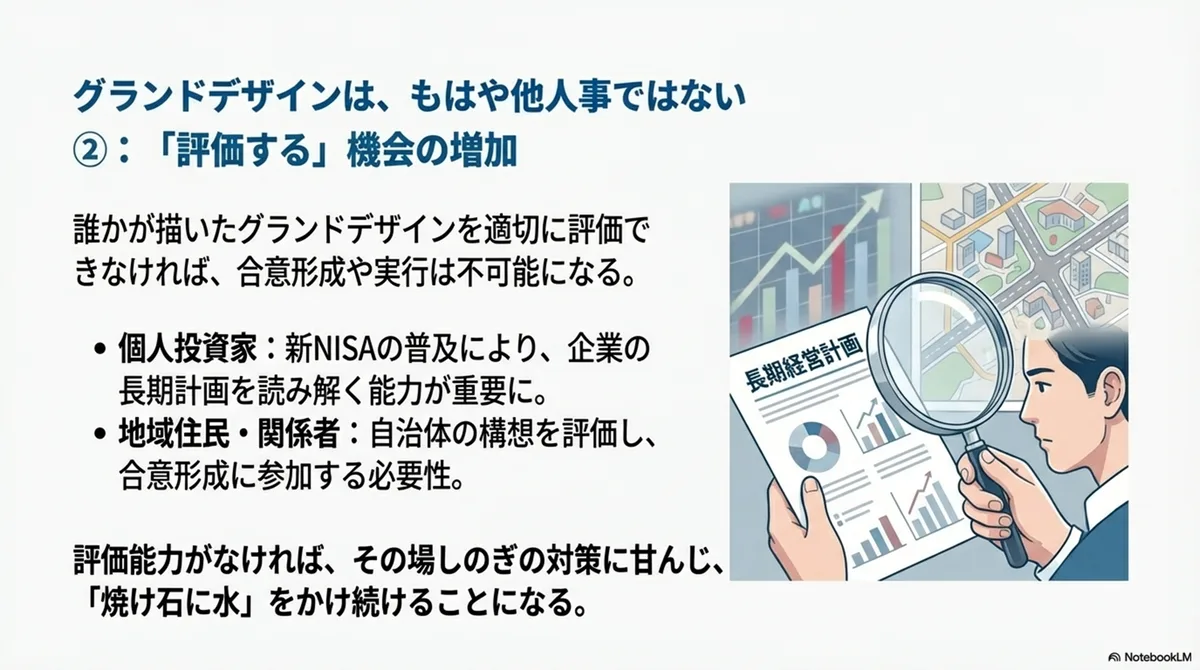
It is not only that the job of drawing up such visions is increasingly landing at the front-line level. If the tide of transformation and reconstruction rises, more and more people will also have occasions to evaluate a grand design that someone else has drawn.
In business terms, as the number of individual investors in Japan has grown under the influence of NISA and the like, the ability to read and interpret each company's long-term plan when choosing where to invest has become more important (especially because the individual investors who have increased under the new NISA tend toward long-term investing).
Also, even if a grand design is drawn up for a region or the like, if many people cannot evaluate it appropriately, we cannot reach agreement and cannot carry it out.
If we lack the ability to evaluate a grand design, or the ability to endorse or improve it, we will end up taking only stopgap measures and keep "pouring water on hot stones." That water (financial resources) is also finite, and will eventually run out.
In both of the above respects, I believe many of us have more and more occasions to engage with grand designs.
Methodologies for thinking about a grand design
When trying to think about that grand design, there were few suitable methodologies. People barely mention things like "backcasting" and "wild imagining," but the concrete methodology for them seems to be missing.
On the other hand, an extreme argument also appears: since the future is unknowable, "just try it anyway."
Presumably there is a gradient between the two, and there are methodologies usable in a variety of settings. I think that going forward we will need to make them concrete.
I have tried to summarize this somewhat in the book "Hypothesis-Driven Action" too (though I made it somewhat geared toward the front lines), and I think that by combining existing ways of thinking, drawing a grand design has become easier.
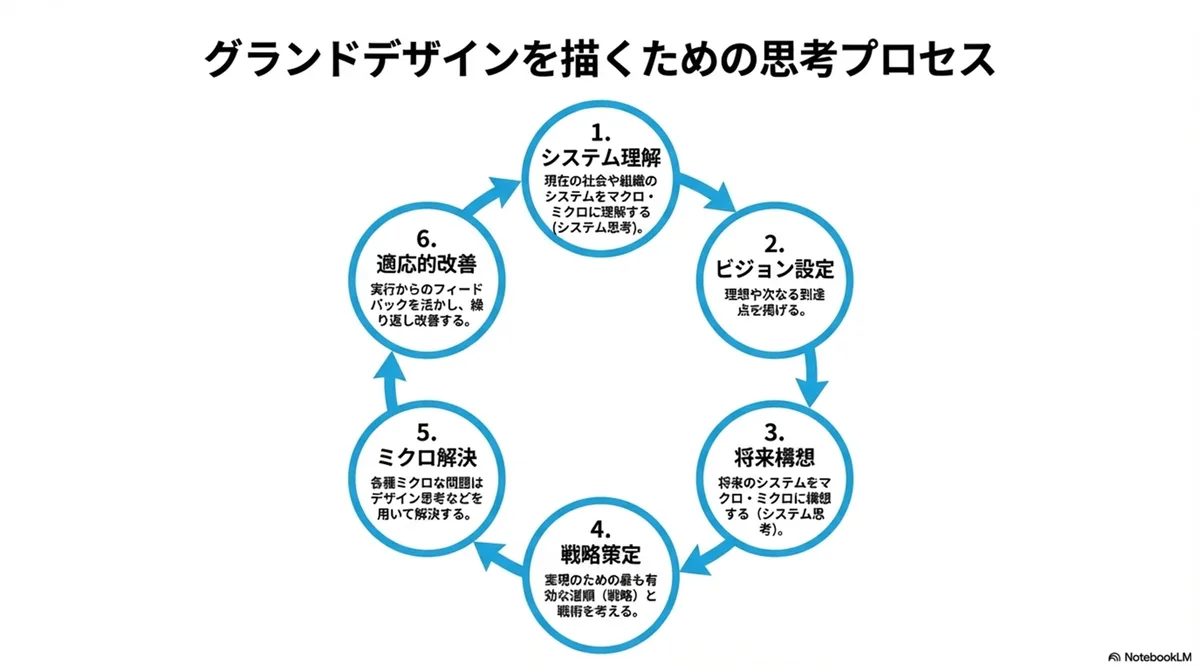
For example, a procedure like the following:
- Understand the current social and organizational systems at both macro and micro levels (systems thinking),
- Set out the next destination, such as a vision or an ideal,
- Envision the future system at both macro and micro levels (systems thinking),
- Think through the most effective route (strategy) and tactics for realizing it,
- Solve the various micro-level problems using design thinking and the like,
- Use feedback from execution to improve adaptively, over and over
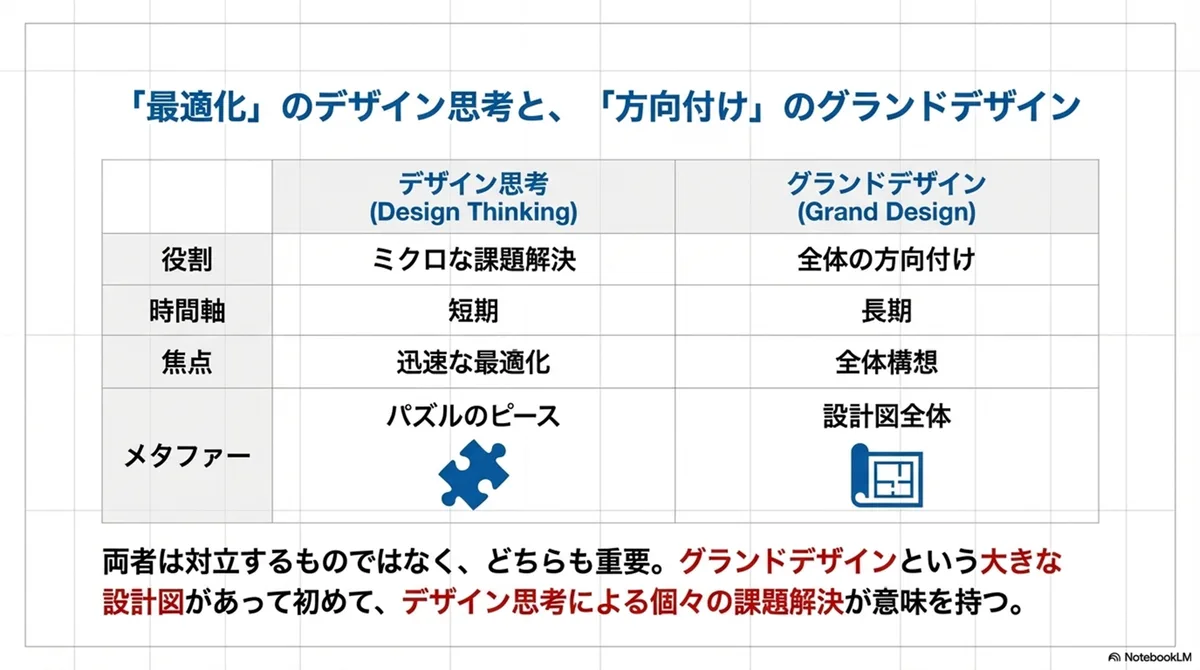
(Note: I have deliberately talked about design and grand design in comparison, but I think both are important.)
It is certainly true that conceiving such grand designs has become harder than in the not-so-distant past. The points to look at have become finer and more complex, so the information needed has increased. Uncertainty is high and change is fast, so there is also the aspect that it is hard to settle on a vision.
But I think these can still be overcome by mobilizing knowledge and will. If we increase the elements that go into drawing a grand design, connect those elements to one another, and think while moving back and forth between the concrete and the abstract, we can produce a grand design hypothesis to a certain degree. And in the end, the will to take the leap is needed.
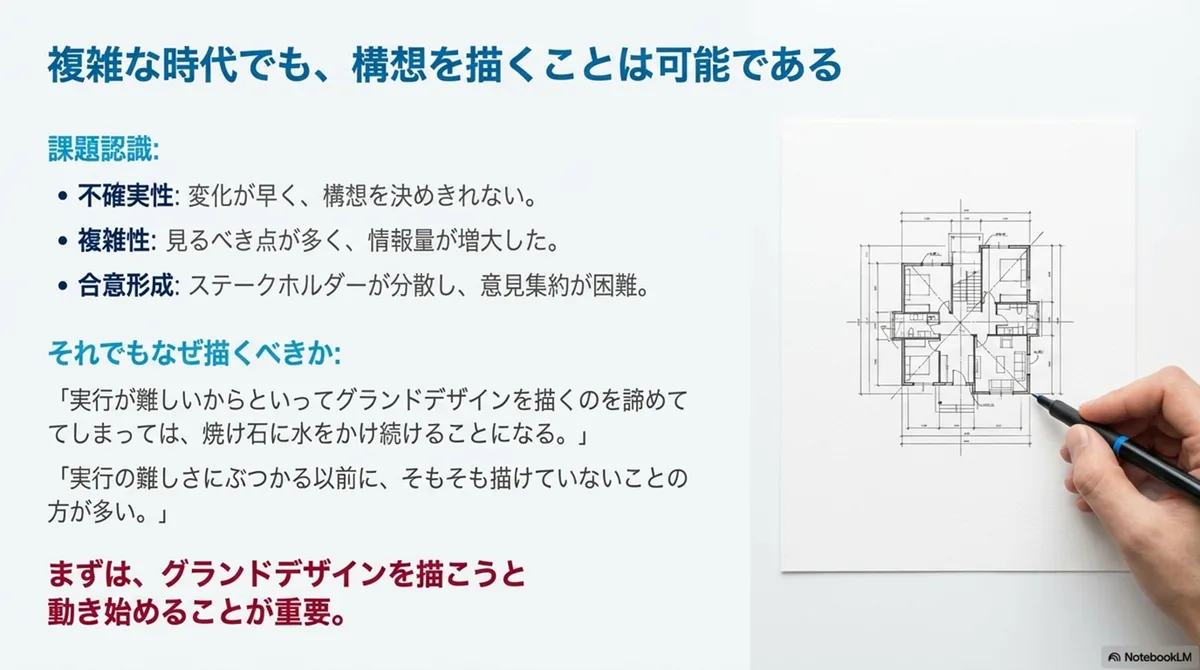
Of course, even if a grand design is decided, there is the point that carrying it out is difficult.
There are also challenges in moving things forward: intermediary organizations such as industry associations and neighborhood associations once took on the work of consolidating opinions, but they have weakened and stakeholders have become dispersed, making agreement harder to reach. I think these too need to be covered within the methods of execution (I wrote about some of this in "Implementing the Future" and elsewhere).
Still, if we give up on drawing a grand design just because execution is hard, we will keep pouring water on hot stones, and I think there are more cases where, before running into the difficulty of execution, people have not even drawn a grand design in the first place.
So I think it is better to first start moving toward drawing a grand design.
The "grand design of society" that is needed
What I think is especially necessary is a grand design for society (including local communities) and industry.
Yet when I look at elections in Japan, although there is discussion of responding to immediate hardships and needs, and of making government more efficient (and those matter too), I do not often sense a grand design beyond them. It may also be that single issues are easier to appeal with and easier to win votes with.
But if we are to carry out truly necessary transformations, starting with social security and GX, then at the national level we need a grand design that goes beyond individual ministries and agencies. This is because a complex design is needed, one that has to consider industry, employment, health, the environment, and more at the same time.
In an individualized society, I think it is a situation in which it is hard to say "everyone, we're heading this way," as in the old Remodeling the Japanese Archipelago plan, and now that short formats such as short posts and short videos have become the mainstream media, it is also hard to hold complex discussions.
Still, looking abroad, I think movements to draw such grand designs are emerging. In the United States, the New Right seems to be starting to put its ideas together, and the liberal side too is trying to put forward a somewhat comprehensive grand design like Abundance, rather than solving individual issues. There is probably a sense of crisis that things would be bad if they did not.
Ideally, it should be drawn by people close to the public sphere, such as politicians and civil servants, but national and local governments are exhausted by labor shortages and by handling immediate problems on the ground, and I think they are becoming unable to grasp things down to the details.
So I think it would be better for private-sector people and citizens who have a front line to step closer and think about the medium and long term. This is because people who have live ammunition and real examples can also put forward hope more easily.
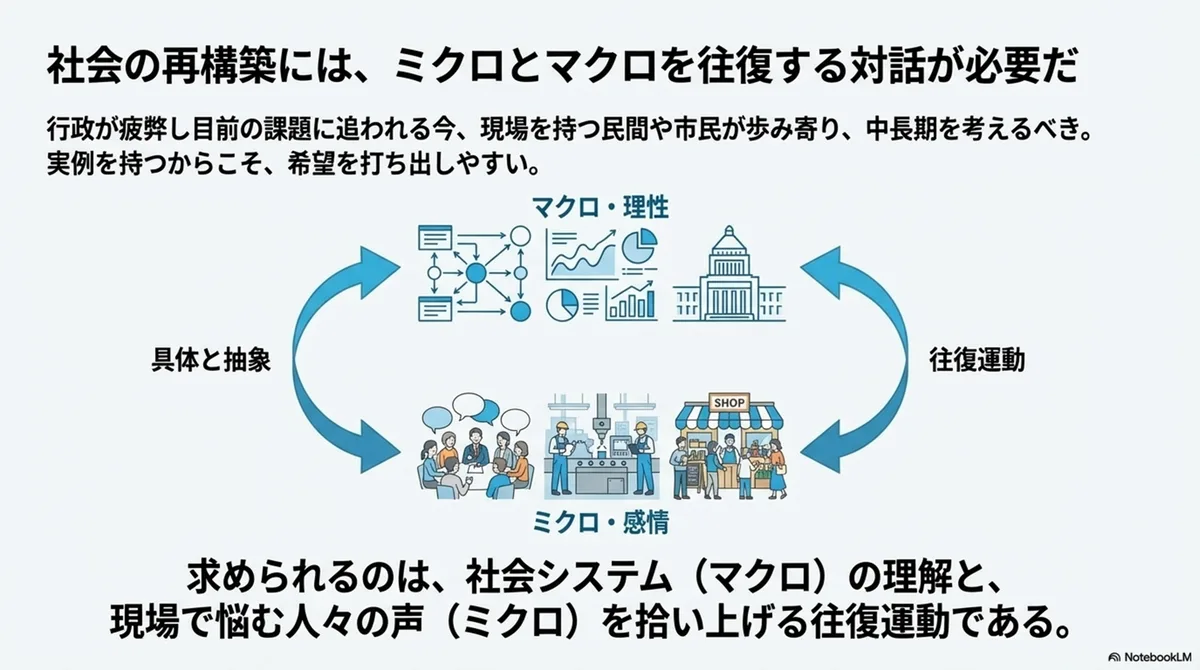
However, for that, it is not enough simply to say whatever comes to mind; knowledge is needed. Beyond understanding social and industrial systems, we will need to pick up the voices of the people who are struggling and agonizing on the ground.
I hope that as many people as possible will take part in this kind of effort, moving back and forth between micro and macro, concrete and abstract, reason and emotion.
Japan, too, now needs rebuilding in a number of areas.
I hope there will be more discussion of grand designs, meaning the picture that lies beyond that rebuilding and the path to reach it, and I personally intend to spend more time creating and discussing such grand designs. I would love to talk with people nearby who are thinking about such things.
Appendix
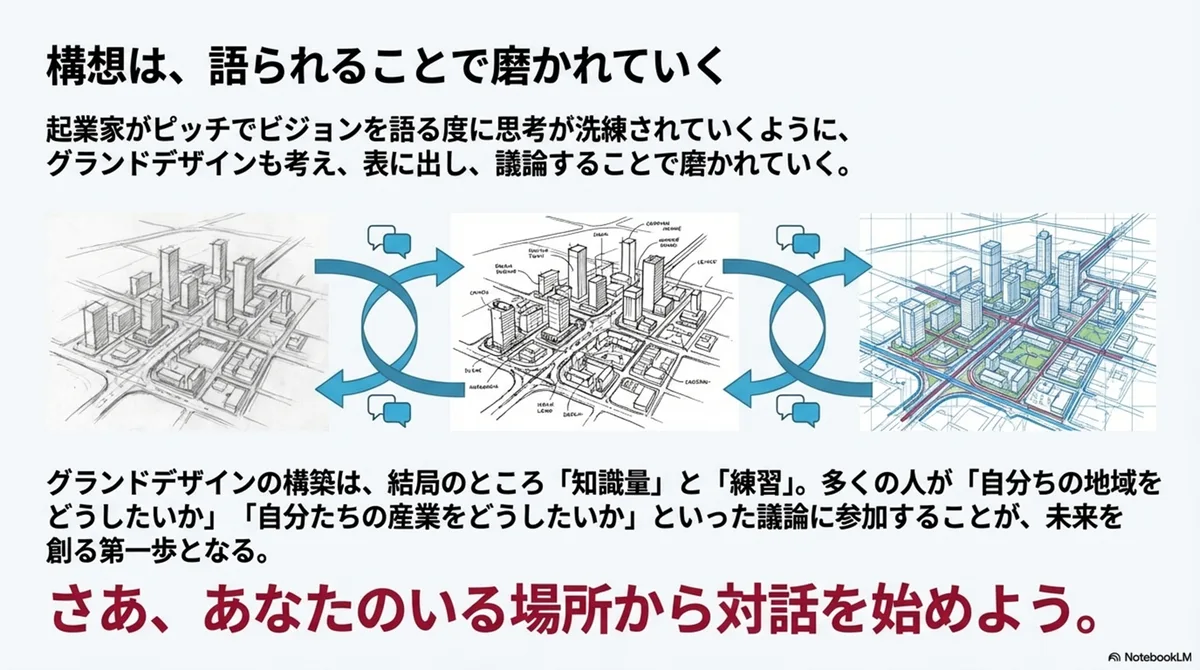
The more you think about building such a grand design, and the more you put it out in public, the more refined it tends to become. It is like how each time an entrepreneur talks about their mission and vision in a pitch, it becomes practice in thinking and gets refined.
In the end this too comes down to the amount of knowledge and practice, so I hope more people will take up discussions such as "What do we want to do with our region?" and "What do we want to do with our industry?"
Footnotes
-
"Grand design" is a phrase that exists in English too, but in the English-speaking world I think it is more often called a master plan or a blueprint. ↩