Solving 1% of Humanity's and a Nation's Problems
This article was machine-translated from Japanese by AI (Claude). It may contain errors. Read the original Japanese article.
The world and Japan face several major problems. If we can solve such major problems on a large scale, that is, if we can build a business that contributes greatly to the problems of the world and society, we can earn financial returns.
At the Breakthrough Energy Summit, organized by Bill Gates and others, I heard again and again that "we will not invest unless the solution can cut 1% of the 51 billion tons per year," and it made me feel anew that "size" is what matters.
Unless the problem you take on is large, and unless your solution can solve most of that problem (or has the potential to solve most of it), the world will not pay attention, and it will be hard to obtain resources such as money.
However, I had felt that the "size" being asked for often goes beyond what many people imagine, and that it is hard to get across.
Then I thought that the "1%" in "we will not invest unless the solution can cut 1% of the 51 billion tons per year" might be quite a good way of expressing size. It is not so large as to solve everything, yet 1% of the world's or Japan's problems is still a very large problem.
For example, for global problems:
- Cut 1% of annual GHG emissions
- Extend healthy human life expectancy by 1%
- Enable 1% more people to receive an education
These would be problems of considerable scale.
For Japan's national problems:
- Replace 1% of Japan's labor supply
- Create a company or industry that raises Japan's GDP by 1%
- Raise Japan's energy self-sufficiency rate by 1%
- Raise Japan's food self-sufficiency rate by 1%
That is about the range, I think. If these can be achieved, they would lead to a very large business.
Example: The Working-Age Population
Let's look at this more concretely. For example, what is certain to come in Japan is a labor shortage. It is said that by 2040 there will be a shortfall of 11 million in labor supply.
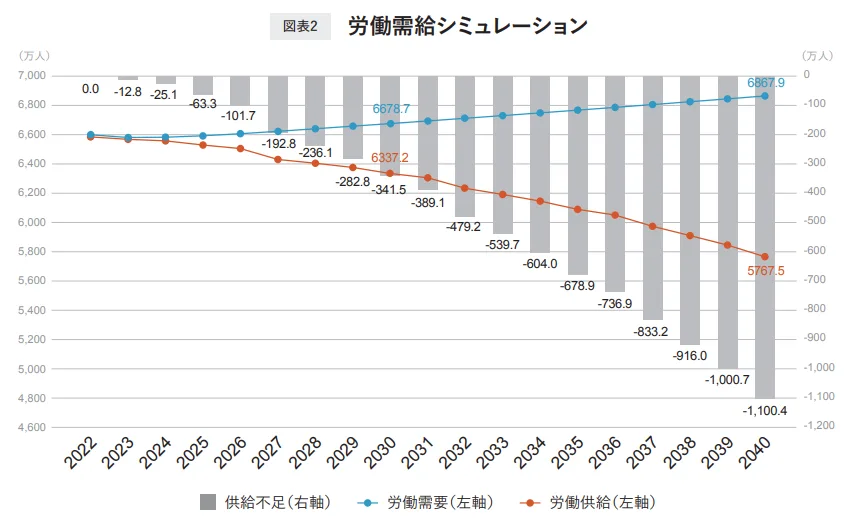
https://www.works-i.com/research/report/item/forecast2040.pdf
There is also the aspect that the population declines and consumers decrease, but the problem is that as older people retire, labor supply shrinks while they remain as consumers, so the balance between labor demand and labor supply breaks down. In particular, demand for services that sustain daily life, such as construction, retail, logistics, education, healthcare, and nursing care, is expected to stay the same or grow beyond what it is today.
As a result, "workers decrease sharply compared with consumers," and most employment is tied up in services that sustain daily life. And once workers can no longer be assigned to jobs that drive innovation, society as a whole is left "barely able to keep daily life running," falling into a vicious cycle in which it cannot undertake new initiatives.
At present the gap is effectively covered by immigration, but given the effects of the weak yen and the declining birthrate across Asia, we do not know whether we will be able to keep relying on workers from abroad.
The question is how we can create innovations that reduce the number of people needed to provide services while maintaining the service level of the services that sustain daily life.
Raising labor mobility and aiming for optimal allocation of people through recruiting services are also important, but if people will be overwhelmingly short in supply, this is no longer a problem that those measures alone can solve. Moreover, the problems that software "alone" can solve are limited. I think we have no choice but to change the underlying way things are done, or to skillfully introduce things like robots.
If 11 million people will be missing in 2040, then 1% of that, demanding innovation that "makes 100,000 jobs unnecessary by 2040," seems about the right size for a problem and its solution.
How difficult that is becomes easy to grasp if you look at the number of employed persons by industry.
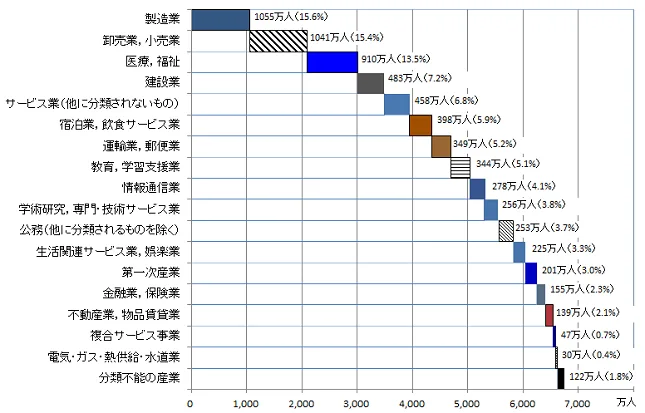
https://www.jil.go.jp/kokunai/statistics/chart/html/g0004.html
If 100 such initiatives succeed, we can avoid the labor supply shortage. But not all of them will succeed, so perhaps what we need is something like 300 initiatives, starting now, that each aim to make 100,000 jobs unnecessary, of which 100 succeed.
In any case, "Does this service lead not merely to efficiency gains but to a path that can replace 100,000 jobs in Japan?" is, though quite difficult, a good criterion for investors and supporters, and entrepreneurs, too, can consider whether they can solve 1% of a major problem when setting their business goals. As a sense of scale, 1% does not seem like a bad number.
Summary
This is by no means to say that small efforts are meaningless. They certainly have meaning. But it is also true that the more broadly we can solve a problem, the greater the value that is created. And I think it is human nature to want to bet on that possibility.
For a startup to grow rapidly, it must ultimately solve a major problem, and when estimating the appropriate scale for that, "solving 1% of humanity's and a nation's problems" seems like a good sense of scale. That was the point of this post.