"Society" and "Solving Social Problems" for Students
This article was machine-translated from Japanese by AI (Claude). It may contain errors. Read the original Japanese article.
The word "shakai" (society) was not originally a Japanese word. It is said to be a newly coined term created in the Meiji era to translate the word "society."
The word "society" is said to have two main meanings:
- Human relationships in a narrow range (e.g., companions, friends, groups, clubs)
- Human relationships in a broad range (e.g., the public, the community, the nation, the world)
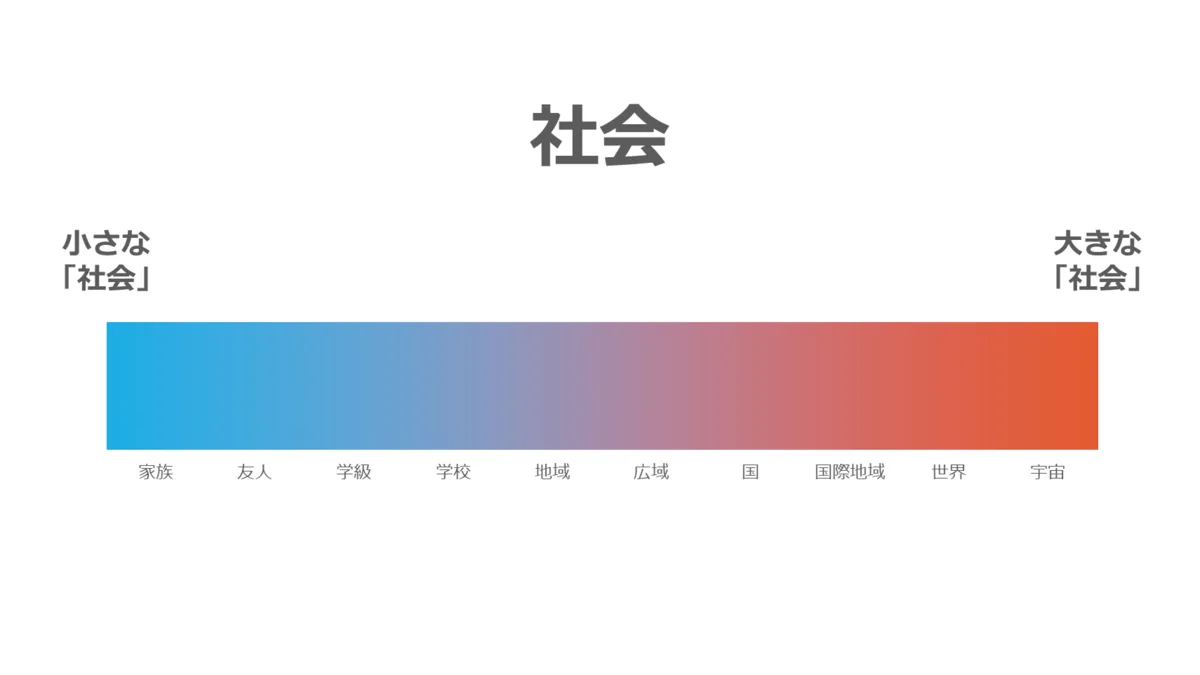
When people in Japan today hear the word "shakai," what comes to mind may be the more abstract, broader sense of society, the "big society," so to speak, but originally the word also carried the meaning of a "small society." It may be better to think of small societies and big societies as existing along a gradient.
In school education and entrepreneurship education, "solving social problems" has come to be mentioned frequently. I think the "social problems" imagined in that context are pulled along by the everyday use of the word "society," and are assumed to be problems in society in the broader, abstract sense.
However, if we trace the word back to its origin, problems in a smaller "society" are also perfectly legitimate social problems. Moreover, I think the "society" that students can genuinely feel differs by developmental stage. For example, something like the following:
Developmental stage | Frame of society |
Lower elementary school | Family, relatives, friends |
Upper elementary school | Class, school |
Junior high school | School, club activities |
High school | Region (wide area), the internet |
University | Japan, the world, academia |
Working adults | Company, market, world |
For example, when elementary school students solve a problem of their own class, which is a society, by some means, or solve a problem of the school, which is a society, by lobbying to change a rule (a school regulation), that too can be called solving a "social problem" in this sense.
When we try to encourage the solving of social problems in entrepreneurship education, I believe what we should do is to give each student the experience of solving a tangible "social problem" matched to the "society" they perceive, and to have them look toward the "society" of the next developmental stage, which stretches them just a little.
Conversely, if we tell elementary school students to "solve a social problem," try to make them solve problems of business (the market) or the world, and ask them to come up with something that contributes to the SDGs and the like, we end up urging them to solve problems of a "society" that they have no real sense of.
That may have the effect of getting them to look toward a "larger society," but it would then become necessary to start by explaining what "society" is in the first place. And when people try to take on social problems without that understanding or sense of reality, I think they tend to bring up superficial problems they have heard about in the news and the like.
Furthermore, the more abstract the society in question, the harder the problems are to solve, so they cannot gain the experience of achievement of having "solved a problem." As a result, I think many people will not gain self-efficacy, and their learning will become thin.
It depends on "what the educational purpose is," but if the purpose is to develop qualities and abilities, I think that starting with solving problems of a familiar, tangible "society" matched to the students' developmental stage and their perception of "society," creating an environment in which students can easily gain experiences of achievement, and, while they cultivate self-efficacy, having them gradually (or from time to time) look toward the problems of the market and of society in the broader sense, would also increase the number of students who become interested in solving social problems.