Business Entrepreneurs, Social Entrepreneurs, Intrapreneurs, Policy Entrepreneurs, Civic Entrepreneurs... Entrepreneurship Education in an Age That Calls for Many Kinds of "X Entrepreneurs"
This article was machine-translated from Japanese by AI (Claude). It may contain errors. Read the original Japanese article.
The number of people called "X entrepreneurs" ("X + entrepreneur" in English) is growing.
For example, there are the following kinds of "X entrepreneurs."
- (Commercial) entrepreneurs — People who start a business as a commercial venture. When people say "entrepreneur" in general, this is who they usually mean.
- (Startup) entrepreneurs — Entrepreneurs who try to build companies that grow rapidly in a short time (startups). This is a kind of commercial entrepreneurship, but I list it separately because the activity differs somewhat: they often raise funds through equity investment from VCs rather than loans, and they often aim for an IPO.
- Social entrepreneurs — People who start businesses to solve social issues that the market has difficulty solving, or issues that fall through the gaps of state protection. They are entrepreneurs who often create organizations such as NPOs and carry out their business activities through them. In recent years, however, entrepreneurial activity that aims to solve social issues while being a joint-stock company has also become popular, as with zebra companies and benefit corporations. It is also said that social entrepreneurs do fundraising to sustain their organizations while also doing "issue-raising" (raising awareness of problems).
- Intrapreneurs — People who undertake new initiatives or new businesses within an existing company. They are also called intrapreneurs.
- Policy entrepreneurs — People who solve social issues by advocating for the implementation of policies. They are called policy entrepreneurs. For startups, an IPO is one milestone; for policy entrepreneurs, it is sometimes said that a policy being enshrined in law or included in the government's Basic Policy on Economic and Fiscal Management and Reform is a comparable milestone. Individual citizens working to realize a policy are sometimes called policy entrepreneurs, and politicians and bureaucrats who craft ambitious policies are sometimes also described as entrepreneurs in this field.
- Civic entrepreneurs — People who start ventures for groups smaller than "society," such as community activities and community building. The concept seems to have originally had a strong economic aspect and to have emerged from the context of community business, but recently I think it is understood more broadly as people who start ventures across civic activities in general. They are called Civic Entrepreneurs.
- Institutional entrepreneurs — A concept discussed on the basis of institutional organization theory: people who mobilize resources to create new institutions or transform existing ones. They are called Institutional Entrepreneurs.
- Local entrepreneurs — Entrepreneurs who are rooted in a locality and run small businesses and the like are sometimes called Local Entrepreneurs. In Japan, I think this is close to what is known as "local ventures."
- Rural entrepreneurs — Centered on, among local areas, especially rural and countryside regions. They are sometimes called Rural Entrepreneurs. The concept seems to come up especially in the context of developing countries, but I think it could be applied to town revitalization in depopulated areas of Japan.
- Academic entrepreneurs — Called Academic Entrepreneurs. In many cases this refers to people who start businesses using academic results. That said, researchers are in the first place entrepreneurial in the sense that they make new discoveries in cutting-edge fields with high uncertainty, and people who establish a new field of research through their work could also be called "entrepreneurs."
Some of these are hardly mature as concepts, but the fact that so many such terms have emerged suggests that an entrepreneurial role is being demanded in each domain. And because society will keep changing, "people who start new ventures" will continue to be in demand.
And individuals with entrepreneurial abilities become sought-after people in each of these domains.
If an individual has the ability to become a commercial entrepreneur, they can provide value in the market and earn compensation as an individual without depending on a company. If they have the abilities of an intrapreneur, they will be in high demand in the labor market. If they can become a social entrepreneur or a civic entrepreneur, they will be able to solve social problems while also creating a place for themselves as a citizen.
By nurturing many such entrepreneurial people, we can expect more value to be created, social issues to become easier to solve, and more people to enjoy better lives. In fact, Negri and Hardt, famous for Empire and Multitude, touch on the entrepreneurial activity of the multitude in their recent book Assembly, arguing that entrepreneurial ability is necessary for the autonomous organization of social cooperation.
In an environment where terms like these "X entrepreneurs" are often heard, it seems a natural course of events that attention is turning to entrepreneurship education.
From Business Entrepreneur Education to Broader Entrepreneurship Education
On the other hand, however, entrepreneurship education so far has mainly designed its courses for the field of business, that is, on the premise of commercial entrepreneurs, with the writing of business plans and marketing methods as the main content. Yet I do not think this knowledge can be carried over as it is to other kinds of "X entrepreneurs."
Moreover, this content has a strong flavor of "entrepreneurship for making money" and "entrepreneurship for self-help," and I think that for that reason it is sometimes shunned or meets with pushback. In particular, commercial entrepreneur education tends to be delivered on the hidden premise of "teaching the knowledge needed to survive as an individual in a society governed by strong, neoliberal market principles," and I am concerned that in the process it may cause learners to internalize neoliberal ways of thinking and risk excessively legitimizing the yardsticks of the market and money.
Although the yardstick of the capital market is itself valid, excessive internalization of it would lead to a tendency to relatively undervalue things of worth that lie outside the market, such as culture, scholarship, and peace of mind. It could also lead to underestimating problems the market has difficulty solving, such as the poverty and inequality that governments and NPOs tackle, and might even hinder the emergence of "X entrepreneurs" other than commercial ones. The market and money are important, but things outside the market must also be important to society.
Of course, those who seek business education should be offered conventional business-oriented entrepreneurship education. But in more public school education, in order to produce a wide variety of "X entrepreneurs" — entrepreneurship for mutual aid and cooperative support, entrepreneurship for collaboration, policy entrepreneurship to build public-support mechanisms — I think it would be better to step away somewhat from commercial entrepreneur education, to consider more neutral and broader entrepreneurship education, and to shift the direction of discussion toward education that develops the qualities and abilities common to other "X entrepreneurs" as well.
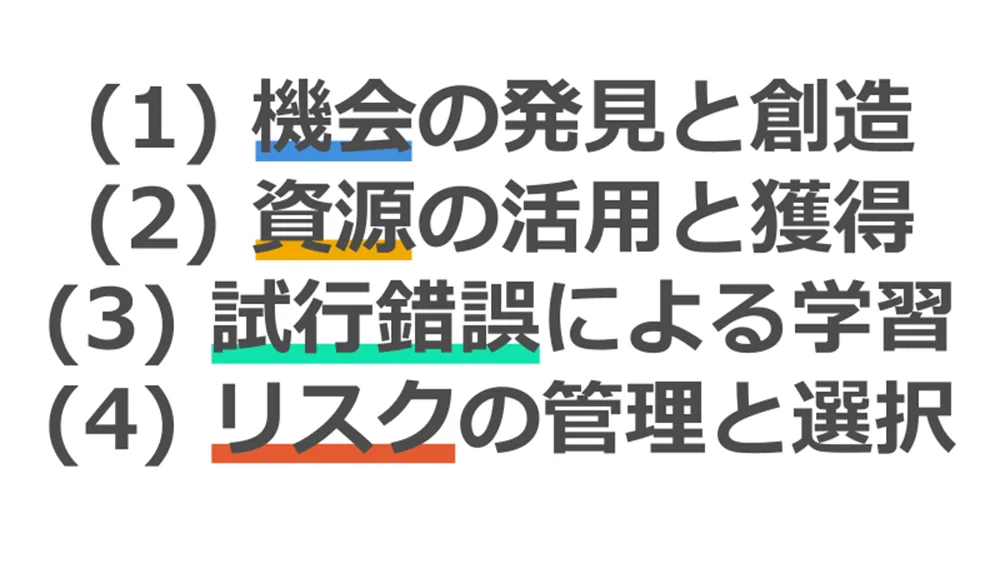
That calls for considering what qualities and abilities are common to "X entrepreneurs" (entrepreneurs). I will examine this in detail in another article, so I do not cover it in this one.
Entrepreneurship Education to Promote the Acceptance of New Things
There is one more point: I think entrepreneurship education also has the aspect of making people more receptive to new things.
When you try something new yourself, you come to understand how hard it is. Then you can also understand how hard it is for the people around you who are taking on new initiatives, and doesn't that make you more inclined than before to support or help them?
This is only a weak hypothesis that has yet to be verified, but I think entrepreneurship education may also have this effect of speeding up the rate at which new things are accepted (though this needs verification).
That is exactly why I think it would be better for more learners to be exposed to entrepreneurship education.
Even then, though, clinging too much to commerce-based entrepreneurship education would provoke pushback, and could even produce the negative effects described above. Considering this too, I think that if entrepreneurship education is conceived with a scope not limited to business, it would bring more benefits to society.