Entrepreneurship and 'Entrepreneurial Capacity': The Qualities and Competencies Entrepreneurship Education Should Cultivate
This article was machine-translated from Japanese by AI (Claude). It may contain errors. Read the original Japanese article.
Entrepreneurship is a word often translated as "entrepreneurial spirit" or "spirit of enterprise."
Because of the nuance of the word "spirit," some people seem to think that entrepreneurship education is "education that fosters the spirit or mindset that entrepreneurs have." This also tends to invite questions such as "Can it really be taught?" and "Is it a good thing to intervene in people's spirit?"
However, the "-ship" in the original English is a word that indicates a state or an ability. The nuance of the English word entrepreneurship is by no means only about spiritualism or mindset. The word entrepreneurship also includes the aspect of abilities that can be acquired, such as qualities and competencies (not only humanity and the like, but also knowledge and skills, thinking and expression abilities, and so on).
For example, another well-known "-ship" is leadership. And when teaching leadership, it is usual that people do not simply end with spiritualism but also talk about skills and knowledge. Many skills and much knowledge can be acquired later on.
In other words, when thinking about entrepreneurship education, it is better to see it not as only a matter of the spiritual part but as having parts that can be acquired and taught, and this makes more constructive discussion possible.
If we cling to spiritualism, the kind of education that may backfire will probably spread, such as "if you bring in entrepreneurs or social entrepreneurs and convey their passion, the spirit will change."
I think we should move away from such spiritualist education and discuss more actively how to develop abilities and qualities effectively. In fact, a number of studies suggest that such abilities related to entrepreneurial capacity, and the resulting entrepreneurial performance, can be developed through education.
Given this background and the original meaning of entrepreneurship, there is also an argument that entrepreneurship should be translated not as "entrepreneurial spirit" or "spirit of enterprise" but as "entrepreneurial capacity". Personally, too, I think that understanding entrepreneurship as entrepreneurial capacity would cause less misunderstanding.
Of course, I do think that mindset and attitude are components of entrepreneurship. And precisely because such attitudes become hard to change after a certain developmental stage, I believe that if we are going to do entrepreneurship education, education at a young age is important.
What Are Qualities and Competencies?
So what are the qualities and competencies that make up entrepreneurial capacity, that is, the qualities and competencies that should be fostered in entrepreneurship education?
To think about that, we first need to think about qualities and competencies.
The term qualities and competencies (shitsu, nōryoku) used in Japan seems to be treated as almost synonymous with what is called "competency" in English. Competency is, I think, generally understood as "the knowledge, skills, and attitudes needed to do a particular thing better (Knowledge, Skill, Attitude, or KSA)."
The word competency also comes up often in the field of entrepreneurship education, and developing competencies is one of the aims of education. Then, how to conduct entrepreneurship education becomes the question: "What knowledge, skills, and attitudes related to entrepreneurship should be acquired, and how?"
What Is Entrepreneurship?
Next, we need to think about what entrepreneurship is in the first place.
At present, this differs from author to author. Gedeon's report collects and lists a truly wide variety of definitions. Words that appear frequently among them include "opportunity," "risk," and "resources."
In 2016, the Ministry of Education, Culture, Sports, Science and Technology defined the entrepreneurial spirit as "a spirit of challenge, creativity, inquisitiveness, and the like," and entrepreneurial qualities and competencies as "information gathering and analysis skills, judgment, execution ability, leadership, communication skills, and the like." However, many of these words rarely appear even when looking at overseas literature, so the definition looks highly original.
In 2016, the EU put together a competency framework for entrepreneurship, the European Entrepreneurship Competence Framework, or EntreComp for short.
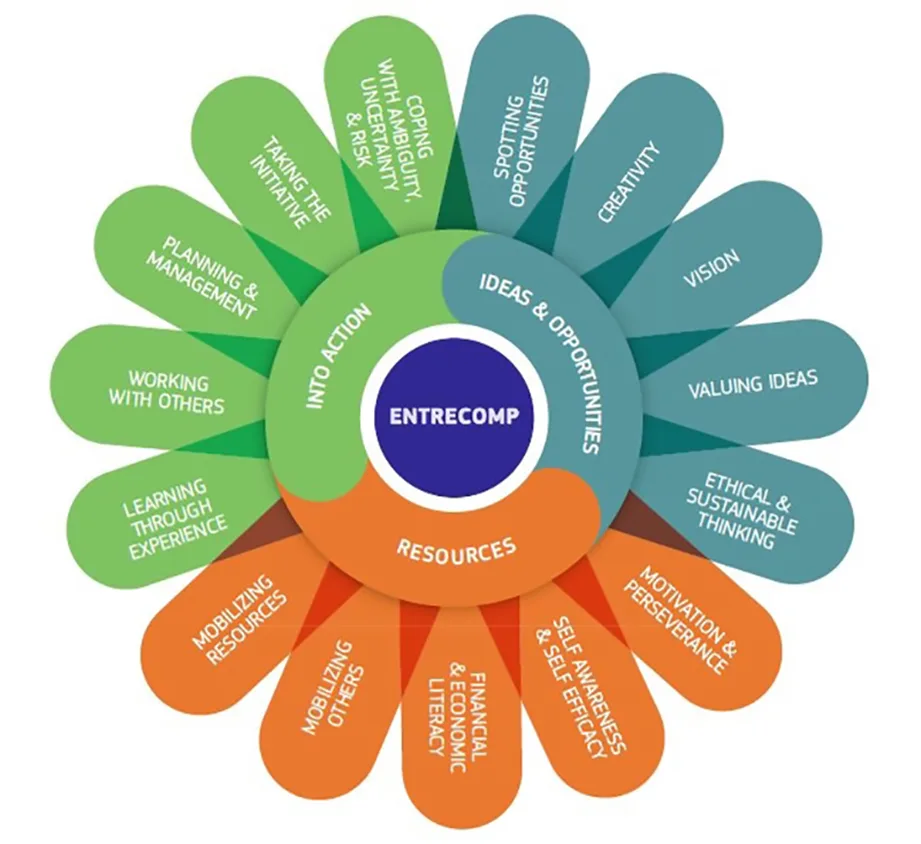
EntreComp defines entrepreneurial competence as "the capacity to act upon opportunities and ideas and to transform them into financial, cultural, or social value for others," and divides it in detail into 15 competences and 8 levels. Broadly, the 15 fall into three areas: "Ideas and opportunities," "Resources," and "Into action." Shown in a diagram, these look like the following.
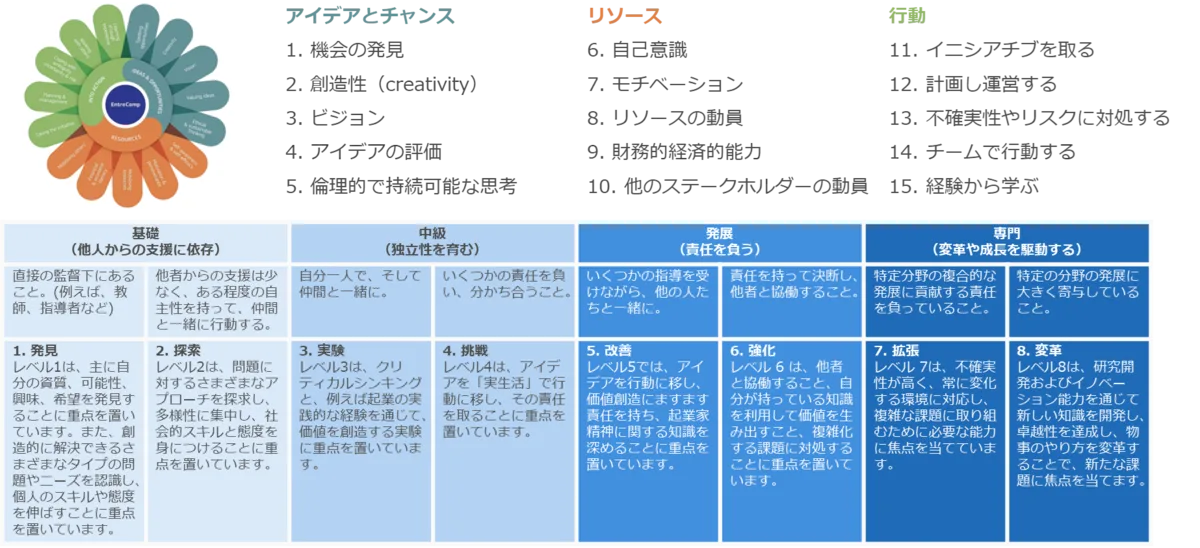
EntreComp includes concepts such as "opportunities" and "resources" that appear frequently in past research on entrepreneurship. It also includes "action," which relates to effectuation, a topic that has recently drawn attention in research on expert entrepreneurs. Furthermore, it is built on a broad rather than a narrow view of entrepreneurship, so I think it is a good base for thinking.
Four Qualities and Competencies to Cultivate in Entrepreneurship Education
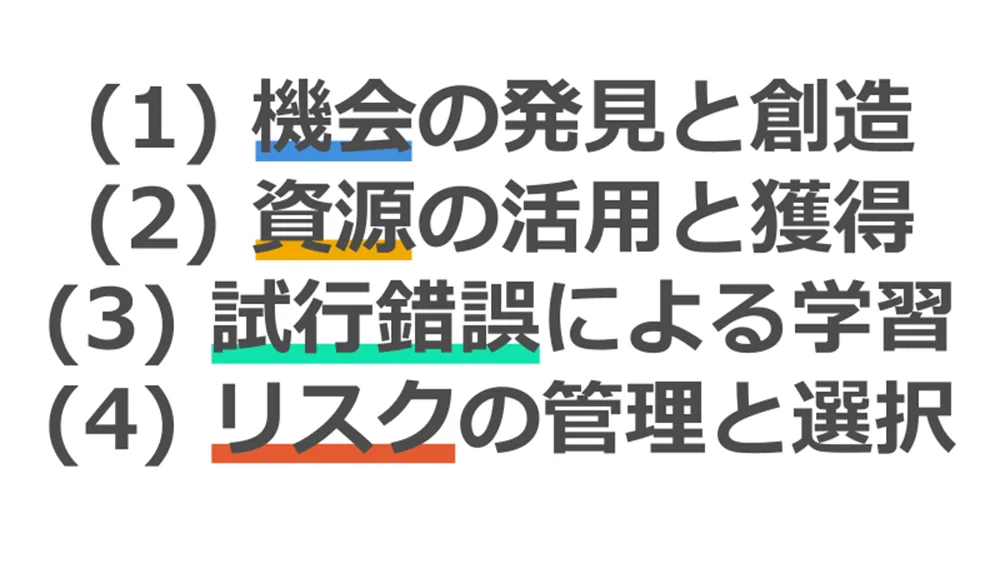
On that basis, the qualities and competencies that I currently think should be cultivated in "entrepreneurship education" are the following four (though they may change after further consideration and discussion; this is only my view at present).
- Discovering and creating opportunities
- Utilizing and acquiring resources
- Learning through trial and error
- Managing and choosing risks
1. Discovering and Creating Opportunities
The first is knowledge, skills, and attitudes related to opportunities.
I think the ability to find various changes and uncertainties, evaluate them, and recognize them as opportunities can be taken up as one element of entrepreneurial capacity. The word opportunity is one that often appears in entrepreneurship research as well.
However, it is not only a matter of finding opportunities that exist objectively; there is also the aspect of creating new opportunities by taking action, so I have included both discovery and creation.
Entrepreneurship education and entrepreneur education so far have mainly been education in analyzing markets and environments and drawing up business plans. Such activities seem to center on discovering opportunities. In reality, however, it is also important to create opportunities by engaging in trial and error and acting on the environment oneself. Discovery and creation probably go around as a cycle. We need to develop abilities while being conscious of both discovery and creation.
2. Utilizing and Acquiring Resources
The second is knowledge, skills, and attitudes for making good use of resources such as people, things, money, and time, and knowledge, skills, and attitudes for acquiring such resources.
What business schools generally teach is the knowledge and skills to make the most of given resources, but entrepreneurs have to build a business while resources are lacking, so they go out to acquire resources that lie outside, beyond those they already have.
For example, for a startup entrepreneur, fundraising and hiring are acquisition of resources, and even social entrepreneurs need to raise funds. From the viewpoint of entrepreneurial capacity, I think it is important to cultivate the attitude that, in order to pursue an opportunity, one will use, and can use, external resources too, rather than staying within the range of one's own resources.
In the field of effectuation as well, research on mastery of the Effectual Ask is progressing, and the Ask is indeed a skill for acquiring external resources.
One of the most famous definitions of entrepreneurship, which expresses this idea concisely, is probably Professor Stevenson of Harvard University's "the pursuit of opportunity beyond the resources you currently control."
But acquisition alone is not enough; one must also be able to use the resources obtained. There are many people who cannot use the resources around them. Moreover, someone who has not achieved results with the few resources at hand cannot obtain additional resources either.
In a startup, even with few resources, the founders generate business progress and persuade investors with those results, but that requires skills for utilizing resources. In other words, both are needed in order to keep the cycle of utilization and acquisition turning.
3. Learning Through Trial and Error
Learning takes various forms, including the transmission of knowledge. From the viewpoint of entrepreneurship, however, I think what matters is experience gained through action, and the knowledge, skills, and attitudes for learning through experience.
I consider learning that involves action, especially through hypothesis generation and hypothesis testing, to be important. I use the words trial and error to convey the nuance that it is not enough to act just once; after acting, one reflects on the results and acts again.
Much of current entrepreneur education ends with planning and no practice, and that cannot be called trial and error. Even if students try something once, such as running a food stall, it is not trial and error if it ends there.
Not just planning, and not just a single practice either: reflecting after practicing, piling up practice many times, and continuing to learn is what should be happening in the genuine entrepreneurial process, and I think we need to build that process into education as well to promote learning.
More concretely, I think it is important to cultivate the knowledge and skills to speed up the trial-and-error process, as well as the attitude of learning from experience and the skill of introspection.
4. Managing and Choosing Risks
Finally, knowledge, skills, and attitudes related to risk. The attitude of seeing the risks that arise from change as opportunities and actively taking those risks seems to me a major aspect of entrepreneurial capacity. Looking at the many definitions of entrepreneurship, a fair number of them focus on risk.
However, taking reckless risks can hardly be called entrepreneurial. Entrepreneurs greatly need the "managing" side of risk, and the knowledge and skills for it: carefully calculating the risks they can take and the extent of the losses they can bear, and, if a large return seems likely even though certainty is somewhat lower, taking that risk after taking sufficient measures to mitigate it.
Taking such risks also has the aspect of yielding highly authentic experiences and great learning. Moreover, the very act of conducting entrepreneurship education at school probably opens the educational setting to the world outside school, and as a result carries risk. I thought educators too need to be conscious of whether they are managing and choosing that risk well, and so I thought it would be better to include the risk item.
Handling the Four Components and Connecting Them to Other Learning Concepts
I believe that these are abilities that can be used in common in the activities of all kinds of "X entrepreneurs." I also think they are general-purpose abilities, not limited to entrepreneurs, in the sense of influencing the world and creating new value in highly uncertain situations.
Let us take researchers as an example. The opportunity here is not only a business opportunity but identifying opportunities for scientific discovery under cutting-edge, uncertain conditions. They also have to acquire resources in the form of research funding. Experiments are precisely trial and error through action, and learning from it. To make new discoveries, they will sometimes take risks within an appropriate range. Having these abilities can be put to use by researchers as well.
In addition, I think cultivating these abilities is also in line with the definition of "student agency" proposed in the OECD's Education 2030: "the capacity to set a goal, reflect, and act responsibly to effect change; the ability and will to positively influence one's own life and the world around."
I am thinking about these four components while also matching them to the items of scales of entrepreneurial competencies.
(Also, one thing I am still thinking through is the worry of how to get people to hold great ambition. Whether to include this in entrepreneurship needs discussion, and I even think it might be better left to liberal arts education, but I am writing it down as homework to think about.)
Toward Practicing Education
So far I have been organizing concepts, but to actually conduct education, we need to take one more step into the concrete.
So I think that, when designing entrepreneurship education, we should divide the four components into elements of knowledge, skills, and attitudes, and then divide those into stages so that they grow.
More specifically, shouldn't what we do in entrepreneurship education be to fill in a table like the one below, set the attainment goals of each entrepreneurship education curriculum, and consider how each piece of knowledge, each skill, and each attitude can be cultivated?
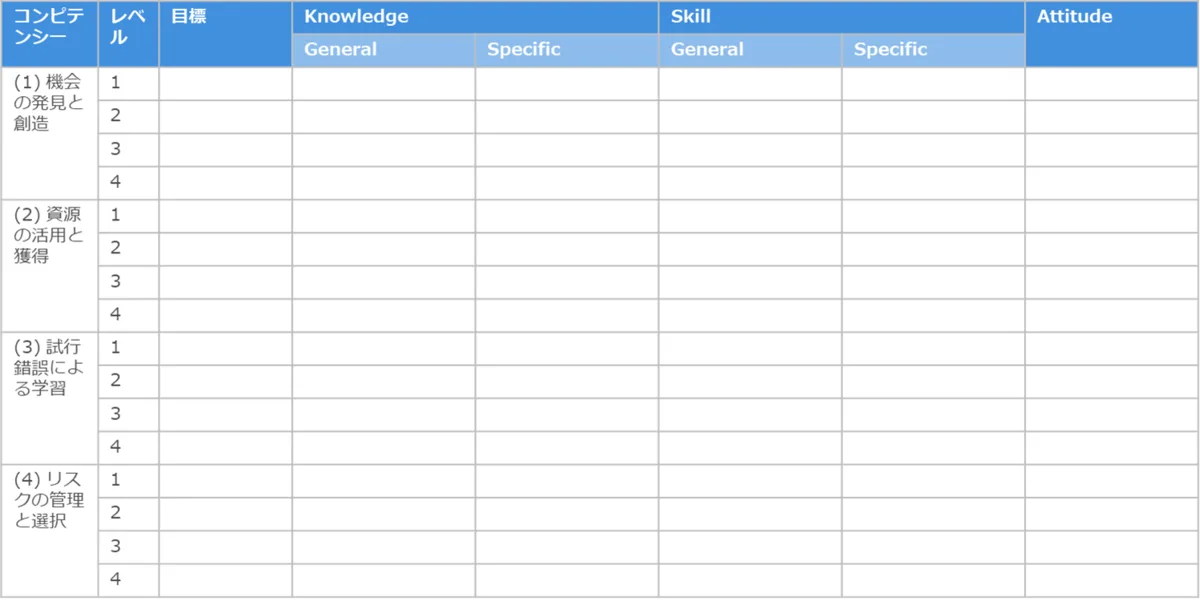
Also, because the level to be reached differs by developmental stage, I think the same education should not be given at every developmental stage. I have pointed out the importance of education matched to developmental stages in another article, so please see that as well.
Entrepreneurship education has seemed to be conducted on experience and intuition until now, but I think that by organizing concepts like this while referring to research, we can design more effective curricula. I am also concerned that if vague entrepreneurship education is promoted without this, hardly any effect can be expected.