The Shortage of Entrepreneurs: A Challenge for Japan's Startup Ecosystem in 2022
This article was machine-translated from Japanese by AI (Claude). It may contain errors. Read the original Japanese article.
As of 2022, Japan's startup ecosystem is said to have many areas for improvement. For example, the Startup Breakthrough Vision compiled by Keidanren in 2022 lists a number of challenges as of 2022.
Yet looking at the past five years, it is also true that various systems and environments have been put in place. Several startup-friendly systems and organizations have been established, and both the amount of VC investment and the amount of funds raised have been growing steadily.
There are of course still many areas where Japan falls short compared with other countries, but compared with ten or five years ago, I think the startup ecosystem as a whole is trending toward improvement.
Amid this, what seems to have changed little, and to be the biggest bottleneck among the many challenges, is the number of entrepreneurs. I will think about this while looking at the data.
Inferring a Decline in the Number of Entrepreneurs from the Data
Let's look at the report on 2021 funding compiled by INITIAL.
Japan Startup Finance 2021: The Definitive Report on Domestic Startup Funding Trends https://initial.inc/enterprise/resources/japanstartupfinance2021
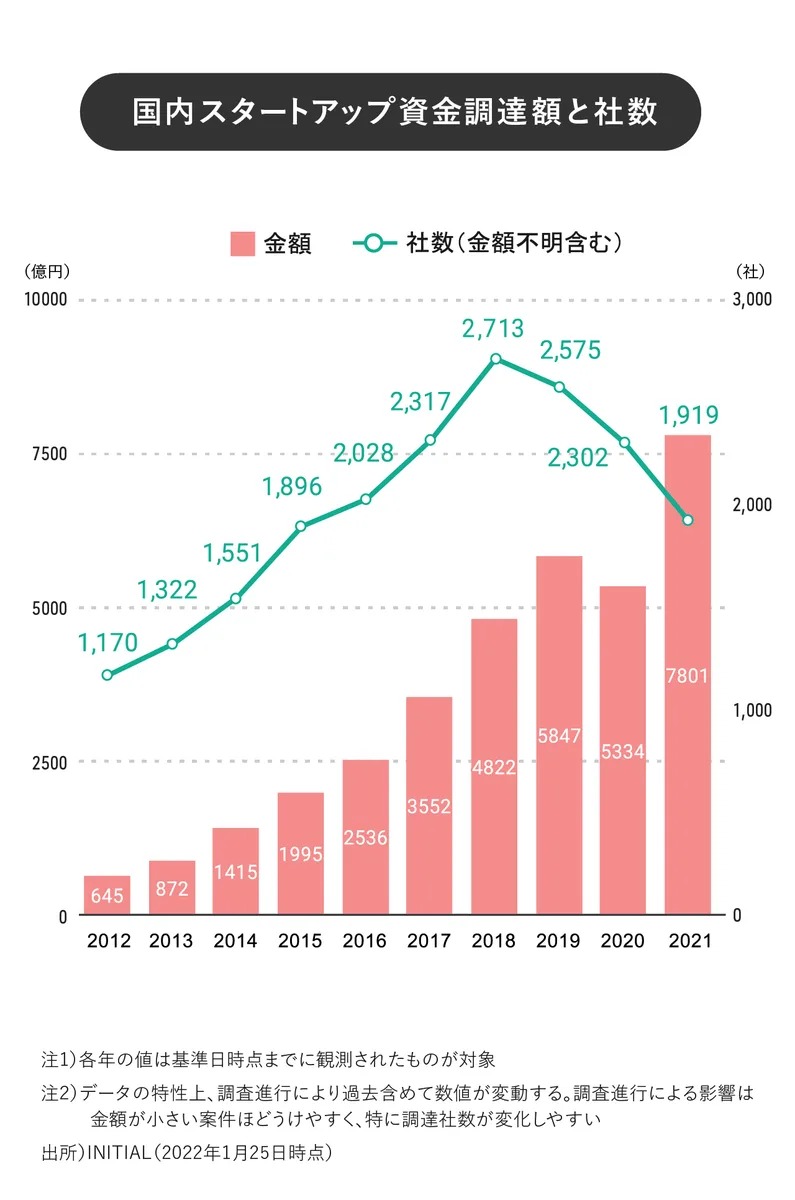
The amount invested (amount raised) has grown every year, and you can see from the red bars that risk capital has been growing steadily. Of course, it may still be a fraction or a few tenths of the amounts in other countries, but at the very least it is increasing rapidly.
On the other hand, the number of companies raising funding, shown by the green line, peaked in 2018 and fell to about 70% by 2021. Furthermore, in the "Trend in the Share of Companies Raising Funding by Years Since Founding" (p. 24), the share of companies less than one year old is declining year by year.
In other words, the data suggest that although overall investment is increasing, investment in newly founded startups is not increasing.
"The Number of Entrepreneurs" as a Cause of Flat Investment in Newly Founded Startups
Let's think about what causes these numbers.
First, one could doubt the data itself. Many small fundraisings are not made public, so there may be funding rounds that go uncaptured. But this should be roughly the same in every year, so I believe it does not greatly affect the change over time.
Other possible reasons include:
- Investors have stopped investing in early stages (the required level has risen, they have shifted their investment focus from seed to early stage, and so on)
- There are few ideas worth investing in (the areas that attract investment have changed, and so on)
- The number of entrepreneurs is small
Among these reasons, based on what I feel from working every day with people at the very beginning of starting a company, I think the decline in the number of entrepreneurs is the biggest one.
I often hear the same worry from investors. "Since there are no entrepreneurs, we'll go and create them ourselves," and a growing number of VCs are considering VC-led company-building programs and startup studios. As my personal impression, too, the number of entrepreneurs has not increased much.
Measures Other Than Increasing Investment Funds Are Needed
Considering that the amount of risk capital is growing every year while the number of fundraisings and the number of entrepreneurs are not, I think we can say that "increasing the money flowing to VCs will not by itself increase the number of entrepreneurs." Of course, it may take effect later with a delay, but at present that trend is not visible.
That being the case, to improve the startup ecosystem as a whole, it seems we need to take measures to "increase the number of entrepreneurs" other than increasing the amount of funding.
However, care is needed in choosing those measures too.
For example, it would be possible to forcibly increase the number of new businesses. Issuing an order such as "each university must produce 50 startups" would increase the number. But whether blindly increasing the number of startups is the right policy is debated, and I think the arguments against it tend to outnumber those in favor. In fact, Japan also carried out the plan for 1,000 university-originated ventures, but its evaluation has not been favorable either. I think that if efforts to forcibly increase startups just to raise the count begin, they risk creating distorted incentives and leaving a heavy cleanup burden.
So an effort that does not think ahead, such as "we have to increase the number of entrepreneurs, so we'll increase it by any means necessary," is dangerous. I think we need to consider why the number of startups is not increasing and approach that cause.
In the next article, therefore, I would like to think about why the number of entrepreneurs is small.