Traps Local Startup Promotion Tends to Fall Into
This article was machine-translated from Japanese by AI (Claude). It may contain errors. Read the original Japanese article.
As of September 2022, startup promotion and the Digital Garden City Nation Initiative have both begun to move forward as government policy.
It is easy to imagine that, as a result of simply combining the two, a movement toward
producing IT (digital) startups in each region
will grow stronger.
However, if that happens, I think there are several traps that are easy to fall into. First, I would like to introduce the three most representative ones.
Three Traps
(Trap 1) Local cities produce startups, which are eventually taken by the central hubs
The first trap, the outflow of entrepreneurs and startups, occurs at several points as a startup grows.
- Each region promotes IT startups.
- One of the few entrepreneurs in the region starts a company, but some people go to Tokyo or Silicon Valley at the very moment they decide to start one.
- Among the startups that remain, some IT startups begin to show signs of success.
(However, many startups fail and struggle to produce results.) - Investors say, "We'll invest if you come to Tokyo," but the startups somehow hold out locally.
- An IT startup receives hundreds of millions of yen in investment from a venture capital firm and accelerates hiring, but it cannot recruit talent as it had expected in that region, and its customers are far away, so some decide to relocate their headquarters to Tokyo or Osaka, closer to the talent pool and customers.
- The region is left without any notable IT startups, and the effort it spent nurturing them comes to nothing.
In fact, something similar apparently happened in the United States. IT startups born in cities like Atlanta seem to have moved to Silicon Valley, Boston, or New York as they grew.
Dan Breznitz, a professor at the University of Toronto and co-director of the university's Innovation Policy Lab, points out in his book Innovation in Real Places that Atlanta had become, so to speak, a "feedlot" for those central cities.
Of course, not every startup born in a local region relocates to a major city. Some people will want to succeed in their home region, and a business that does not require much talent has no need to move.
Still, I suspect that many startups will naturally want to move closer to talent pools and customers in order to grow quickly.
The IT industry is well suited to startups because it can be started at low cost and can grow relatively easily. On the other hand, IT companies have little equipment and relatively young employees, so relocation has little impact on their families, which makes them easy to move. For this reason, in a region with no ties to IT, it is hard to produce IT startups, and it is also hard to get them to stay.
Of course, times have changed, and even a startup in a local region can allow "fully remote work" and gather engineers from all over Japan and the world. But that means that, while it can "gather talent from around the world," it also finds itself "competing for talent with companies around the world that allow remote work," which is also a rather steep road (especially with the weak yen now).
Looking only within Japan, large Tokyo companies such as Yahoo! and Tokyo startups have recently begun to allow remote work with "work from anywhere" policies. Companies that have marketed the quality of life in local regions will from now on be compared with Tokyo-based companies that allow remote work.
So I suspect that it is probably not enough to promote startups in a uniform way in every region.
If that happens, it could become a repeat of the earlier regional revitalization efforts, in which regions across the country promoted tourism and ended up eating away at the same pie of travelers.
(Trap 2) Commissioning Tokyo consultants produces uniform action plans that exhaust everyone
But if the order to promote startups is eventually issued across Japan, many local governments will be at a loss, because they have no experience in supporting startups.
When they are in trouble, the ones who show up are "Tokyo consultants who claim to have experience in nurturing startups and building ecosystems." Some may be well-known consulting firms, and some may be individuals who advertise that they are back from Silicon Valley.
That is the second trap.
I understand why officials at local governments unfamiliar with startups would want to ask such "battle-hardened" consultants to draw up a plan. In fact, at the beginning there is also some part of it where borrowing outside help cannot be avoided.
As a result, however, it can easily happen that Tokyo consultants who are not familiar with the circumstances of each region draw up the same uniform support plan and ecosystem-building plan for every region, and that the same kind of "accelerator" is run everywhere.
And then regions end up eating away at the small pie called "Japanese startups" ... something often seen with tourism during regional revitalization could happen again in the startup field.
That would not lead each individual local city to success, and the overall conclusion might even become "startup promotion doesn't work after all." Moreover, money that was originally meant to energize local regions would flow back to Tokyo through Tokyo consultants.
(Trap 3) Subsidies and support cause the ecosystem to stagnate
After getting help from consultants, or after thinking things through on their own, local governments may in some cases support startups by providing subsidies.
But subsidies can be a poor fit for IT startups in their early stages. That is because a startup is fundamentally a company that keeps exploring in order to grow rapidly in a short period. A local government has no choice but to provide subsidies for a specific business, but the earlier the stage, the more the direction of the business can change.
It has also been pointed out that the function of an accelerator is not only to speed up growth but also to end bad ideas quickly, that is, to encourage early exit from bad ideas. Doing so provides opportunities to explore new ideas and helps raise the speed of the ecosystem as a whole.
However, if a local government that has few challengers in its region and is averse to failure runs an accelerator, there is nowhere else to provide support, so even a bad idea can survive, kept alive on subsidies and support.
The media often point out the existence of zombie companies among small and medium-sized enterprises, but I think zombie companies can easily be created in startup promotion as well.
Escaping the Traps
I have listed several negative points so far, but I am not saying that "because there are traps, we should not promote startups." I have listed several traps only in order to think about what to do so that, "because there are traps, we proceed while being careful of them."
To prevent falling into these traps, I think there is some meaning in thinking now about how startup promotion in local regions should be done.
So in this article, I will summarize below my current thinking on countermeasures and directions.
Countermeasures
These are only hypotheses limited to startups, but I think countermeasures can be taken in several directions. Here I will present three possibilities.
(1) Promote IT startups connected to regional industries
First, even for IT startups, the point is to be oriented toward producing IT startups suited to the industries of each region.
For example, if a region is strong in shipbuilding, one approach would be to promote logistics startups and have them collaborate with companies in that region.
As I introduced in a previous article, startups in German cities also show this tendency. In the United States, it is well known that in New York, which is strong in media and finance, media and finance IT startups have been emerging. In Japan as well, Quando and others are working to update regional industries while making use of Kyushu's strengths.
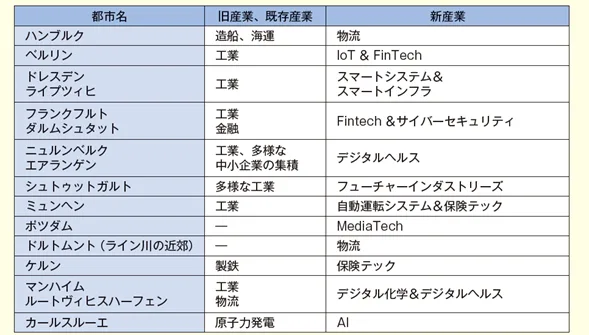
From https://www.projectdesign.jp/201812/area-future-vision/005752.php
If startups are tied to existing industries in this way, it becomes difficult for them to relocate their headquarters right away, and there is also a talent pool with domain knowledge, and customers are nearby.
What matters here is how to incorporate the new IT people into the region's networks.
For example, in Atlanta, which I mentioned earlier, there seem to have been efforts to promote IT, known as Silicon Peach. There was also an excellent university, Georgia Tech, which continued to produce IT talent. The reason startups relocated nonetheless is analyzed to have been that they were socially disconnected from the region's industries and people.
I think local governments and regional financial institutions, in particular, could play a major role in building relationships between such emerging industries and existing industries.
(2) Promote deep tech startups suited to the region
Many of the government-affiliated experts involved in startups come from IT backgrounds, and I get the impression that they speak on the premise of IT startups, but startups are not limited to IT in the first place.
My personal view is that it is precisely because they are in local regions that it would be better to promote deep tech startups that draw on the distinctive strengths of each region's universities and research institutions, so as to make use of regional characteristics.
Universities and research institutions in local regions should have the history, networks, talent, and facilities that have solved the problems of each region's industries. The region's challenges are also close at hand.
In that sense too, I believe that in promoting startups in local regions, educational institutions such as universities, and research institutions close to industry such as AIST, will be a key. Research seeds become seeds of new industries, and educational institutions continuously produce people who have learned new technologies. Also, if a startup born from them tries to relocate, it would need to rebuild its research facilities, so relocating its headquarters would not be easy.
For example, Gryllus, famous for its cricket crackers and born out of Tokushima University, is an example of long years of research at Tokushima University leading to a business.
There are also points to be careful about. Many "university-originated startups" and "university-originated ventures" have revenue of less than 100 million yen, so there may not be that many companies aiming for rapid growth like startups. If the aim is really to produce startups, it is not enough for something to be Deep Tech; support must go to companies oriented toward rapid growth.
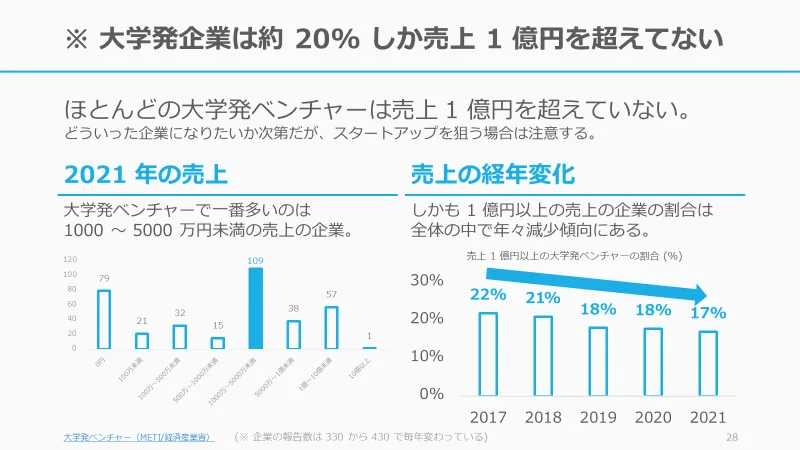
Revenue of university-originated startups. Few reach 100 million yen or more.
(3) Promote GX startups
The third is GX (Green Transformation). GX, represented by carbon neutrality, has the potential to change how many things are made and transported and to transform many industries.
When it comes to GX, attention tends to go to the crisis side, as in "if we switch to electric vehicles, factories will decrease and jobs will be lost," but that is the same for every city in the world. Unless we see it not only as a pinch but also as a chance, we will simply be swallowed up by the great current.
GX includes businesses that handle advanced technologies, known as Climate Tech, and businesses that require somewhat more labor (that is, create jobs). I think the former can make use of technologies from universities and research institutions, while the latter may hold possibilities that include companies other than startups.
The GX field in particular is one that goes well with policy. Could we not promote GX startups in combination with climate change policy, and sell the solutions created there to regions around the world that are struggling?
For example, CarbonCure, which fixes CO2 in concrete, is now in demand from concrete companies around the world and has made great strides, including investment from Mitsubishi Corporation. Its headquarters are in Halifax, Nova Scotia, Canada (population of about 430,000), and from its early days it was supported by Innovacorp, a VC established by the province of Nova Scotia.
Talent development and education in line with the direction of the startups to be created
Only after deciding the direction to some extent can we finally discuss what kind of talent to develop.
If you want to produce the IT startups in (1), it becomes an important initiative to properly carry out education that produces digital talent, as called for by the Digital Garden City Nation Initiative. In some cases, it may be necessary to create an environment such as Aizu-Wakamatsu having the University of Aizu, which is strong in IT.
If pursuing (2) or (3), I think entrepreneurship education at local "universities" should not presuppose IT startups but should include somewhat more discussion oriented toward deep tech. However, since the IT skills needed for (1) are needed in any field anyway, programs run by local governments rather than universities may do well to lean toward IT.
In any case, I think that without a clear direction, it is hard to see what kind of talent to develop.
Conclusion
What I have written so far applies only to "startups that aim for rapid growth and lead regional industries." Whether startups are needed, and what position startups should have in a region, will differ depending on that region's industrial policy1.
I believe there are forms of entrepreneurship other than startups, and in fact those are the great majority. Entrepreneurship other than startups is possible to some extent in any region, whereas industries and regions suited to startups seem relatively few.
I also think it is good for the number of excellent small and medium-sized businesses rooted in the locality to grow for the metabolism of regional industries, and since companies that promote DX in each region are needed too, increasing that kind of entrepreneurship is important separately from startup promotion.
Still, I also think that to build something that can be called an industry in a region, it is better to have companies that grow rapidly in the way startups do.
In an idealistic sense, startup promotion is an opportunity to think about promoting regional industry. It may become a project of 10 or 20 years, but the regions that have built up in that way should ultimately have a competitive advantage.
For example, I hear that a promising bio startup founded in Kyoto moved its company to Kobe. The background is probably that Kobe has been putting effort into promoting biotech for a long time. Startups relocate to places where the environment and facilities are in place.
And to think about regional industry, we need to think about what kind of city we want to be in the first place. I think that is closely tied to smart cities and to the projects of the Digital Garden City Nation Initiative.
In considering regional industrial policy, it will also be necessary to refer to the research on cluster policy that has been accumulated so far2, but first, I have summarized what I am thinking now from the broad perspective of startups.
Addendum: Tokyo is not immune either
Large cities such as Tokyo, Osaka, and Nagoya are not safe either.
Looking at the world, there is no need to start a company in Tokyo. In fact, I have heard of an entrepreneur who was wavering about starting a company in Tokyo but, considering environmental factors such as facilities and talent, started it in Boston instead.
From the world's point of view, even Tokyo is just one region and only one option.
In some cases, Tokyo could even become a feedlot for Silicon Valley and Boston. Companies that have grown may say they will compete in Silicon Valley or Boston and move their headquarters to Delaware and the like.
Also, it is occasionally discussed online that talented young people who join Japanese companies as new graduates are, after four or five years, once they have acquired skills, poached with high salaries by foreign companies such as Google, but this is a global version of the structure in which "the periphery trains, and the center takes the benefit after they have grown." At present we may have no choice but to see it as "unavoidable, since few Japanese companies can pay young people high salaries," but over the medium to long term, I think it would be better to see it as some mechanism not working well and to improve it.
Also, just as Tokyo consultants throw their weight around in local regions, consultants from Silicon Valley and Boston may well throw their weight around in Tokyo. We should learn what can be learned from other ecosystems, but if the preconditions differ, it cannot necessarily be applied as it is. We need to think carefully about what can and cannot be used.
We should start by examining the policies of countries and cities around the world and improving the clearly bad parts, but I think Tokyo, as the city representing Japan, must also think independently while looking at the world about what startup strategy to draw up and how to differentiate itself from cities in other countries.
Footnotes
-
For regions without industry, such as bedroom communities or regions with fewer than 100,000 people, I do not have a hypothesis either about how to produce startups. I do think it might be better to promote local businesses that win customers from outside the region and keep the local economy running, rather than startups, but... ↩
-
For example, in 2022 RIETI published a good report titled "Industrial Agglomeration Policy Suggested by Recent Economics". ↩