Misconceptions About Deep Tech Startups
This article was machine-translated from Japanese by AI (Claude). It may contain errors. Read the original Japanese article.
As the government's focus shifts gradually from support for startups as a whole to support for startups in specific fields, I feel that attention to "deep tech startups" is growing. And indeed, announcements have been made that national support for so-called deep tech startups will become more generous (e.g., Government to increase support for advanced startups by 30% to 140 billion yen, FY2024 target - Nihon Keizai Shimbun (2024/06/03)).
As the fields suited to startups change with the times, I personally think it is a very welcome development that investment is increasing in fields likely to grow.
At the same time, I also think that unless we settle to some degree on what "deep tech startup" refers to, appropriate support will not be provided.
In fact, even within my own range of view, the meaning of the term "deep tech startup" seems to differ from person to person. If various support measures are implemented in this state, I worry that no matter how much the budget grows, it will not be allocated appropriately, and as a result the expected outcomes will not materialize.
So in this article, while sorting out the definitions of terms, I will list the misconceptions about deep tech startups that I see, and then write about what kind of understanding we should proceed with.
- Misconceptions About Entrepreneurship and Startups
- Some Misconceptions About Deep Tech Startups
- Misconception 1: Deep tech startups need an innovative technology seed
- Misconception 2: A deep tech startup is a company that commercializes advanced technology
- Misconception 3: Deep tech startups tackle meaningful problems
- Misconception 4: Investors do not take investment risk in deep tech startups
- Misconception 5: Deep tech startups cannot know whether a market exists
- Misconception 6: It is enough to beat other competing technologies on performance and cost
- Deep Tech Startup = High-Growth Entrepreneurship That Takes Technology Risk
- Toward Thinking About Future Support for Deep Tech Startups
- (1) Distinguish between concepts and names
- (2) Align the evaluation method for subsidies with the next investment phase
- (3) Let more companies exit
- (4) Gather technology by working backward from the business, and fund R&D
- (5) Refine the methodology for supporting "commercialization that grows big"
- (6) Rethink resource allocation
- Summary
Misconceptions About Entrepreneurship and Startups
First, as a basic premise, I think most challenges are admirable and worth supporting. At the same time, when thinking about "challenges supported by the state," we need to consider "what we are supporting (favoring), and for what purpose," that is, the purpose and the target.
And when we think about state support for startups, the purpose seems in most cases to be the country's economic growth.
If so, the purpose of promoting deep tech startups is to promote the founding of companies that lead to large enterprises that will carry the economy and employment of the next generation. It is the promotion of "startups" as companies that grow rapidly in a short period, so-called high-growth startups.
This is different from promoting entrepreneurship in general.
Of course, promoting entrepreneurship itself as a preliminary step toward producing startups, as companies that grow rapidly in a short period, may be one of the options as a means. But the premise of this argument is that the purpose is, after all, to produce startups that grow rapidly.
Please regard the discussion from here on as being about promoting deep tech startups with such economic growth in view.
Some Misconceptions About Deep Tech Startups
Starting from this premise, I feel there are several misconceptions about what is meant by deep tech startups. Let me sort out some representative ones.
Misconception 1: Deep tech startups need an innovative technology seed
Deep tech startups are often introduced as "commercialization of R&D results" or "commercialization of innovative technology." In this case, "research results come first" and "university spinouts" are taken as the premise.
However, deep tech startups are emerging even without such technology seeds.
For example, Astroscale, which went public in June 2024 and recorded an opening price valuing it at over 150 billion yen, is a company often classified as a deep tech startup. Yet I understand that the first technology Astroscale used was not based on a university research seed.
H2 Green Steel, a Swedish company that makes green steel, also looks like a deep tech startup. But its technology is based on Kobe Steel's MIDREX, not something they developed themselves.
Tesla, arguably the most successful deep tech startup, also did not use university technology or cutting-edge technology.
In other words, deep tech startups do not necessarily start from university or research institute technology.
Why, then, do these companies look like deep tech startups? I think it is because they appear to deal with difficult technology, and because, even if the technology is somewhat mature, there are risks such as whether it can be combined, whether additional R&D and technology development can be done, and whether mass production is feasible. There will also be cases where a company has no technological strength at first, but technology becomes its strength as the business proceeds, and it becomes a deep tech startup.
Of course, there are also many cases where a cutting-edge research seed exists before commercialization and the company becomes a deep tech startup by commercializing it, and that is undoubtedly lower in risk and preferable. There are also fields, such as drug discovery, where science directly translates into competitive advantage.
Although there are many cases where "cutting-edge technology is also valued by the market," that is by no means "all" that a deep tech startup is.
However, current support in Japan looks heavily skewed toward support premised on the former, "there is a cutting-edge research seed," and I am concerned that startups like the three examples above would be excluded.
Misconception 2: A deep tech startup is a company that commercializes advanced technology
On the other hand, commercializing advanced technology born from research does not make a company a startup.
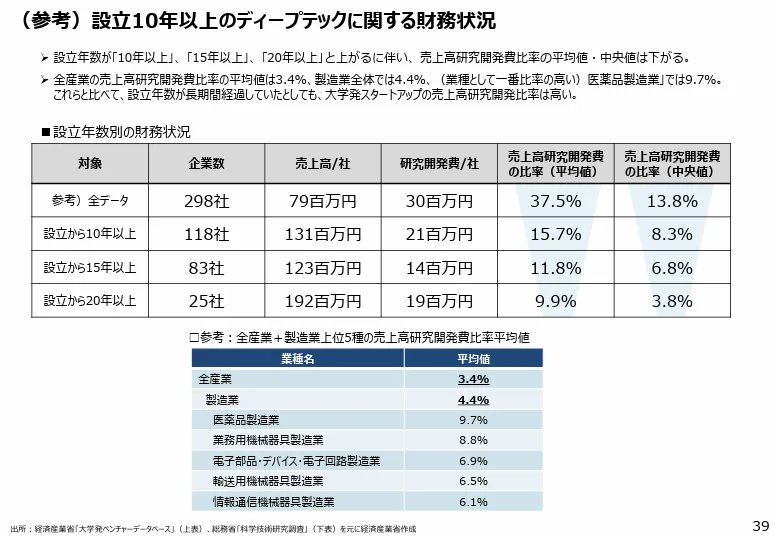
For example, there is currently a statistic that 85% of university spinout ventures have annual sales of less than 100 million yen. This is sales, not profit.
One might think it takes time for sales to rise because it is deep tech, but as the figure below shows, many remain below 100 million yen in sales even after several decades, and even if the technology has been commercialized, they have not become large companies1.
https://www.meti.go.jp/shingikai/sankoshin/sangyo_gijutsu/kenkyu_innovation/pdf/028_06_00.pdf
In other words, many university spinout ventures may be "deep tech" companies trying to commercialize advanced technology, but they are not "startups" that grow rapidly in a short period.
That is in a sense natural, because what determines a startup's sales is "which customer problem it solves," not whether it uses advanced technology in the solution. If the technology can solve a big problem, sales will be large; if not, sales will end up small.
For drug discovery aimed at socially important diseases, a large market awaits beyond the research, so one can simply do excellent research without thinking about the market. But there is not necessarily a large market beyond research.
Let me add that this does not mean that much research has no value. The yardstick of value used in research (mainly novelty) differs from the yardstick of value used in the market (mainly the degree of problem solving and cost), and it is natural that the same technology has different value when measured by a different yardstick.
Also, because there is a large gap between the original research technology and the technology a business requires, it is natural that additional development is needed.
Much of the technology born from research is cutting-edge. Among technologies pursuing such novelty, there are outstanding ones with potential commercial value, such as the research that became the basis of PeptiDream. But most research is produced with a strong awareness of "novelty" as a value, for the purpose of researchers writing papers. In that context it is cutting-edge and valuable, but that does not mean it is commercially valuable.
Therefore, if the goal is startups, it is not enough to simply promote "R&D of advanced technology." Yet I think current promotion of deep tech startups has somewhat of that tendency.
Such promotion may certainly increase the number of companies that meet the condition of "deep tech," but whether they meet the condition of "startup" is a separate matter. And I think there will be more companies that become small businesses not meeting the condition of "startup," and are therefore turned down by many investors.
Misconception 3: Deep tech startups tackle meaningful problems
There is also a view in some quarters that the "deep" in deep tech startup means "a deep problem" or "solving social problems."
But, for example, if one spends cutting-edge robotics R&D costs for the purpose of delivering meals, I think that may be a superficial problem, but it is still deep tech. Of course, one can link meal delivery to social issues such as labor shortages, but that is also something one can embellish in many ways.
On the other hand, if we judge whether something is deep tech by how meaningful the problem is, then businesses that try to take on deep social problems such as poverty and inequality with mature software technology would also be deep tech startups, and most conventional startups would be included. Then the point of going out of our way to use the term deep tech startup to make a distinction is diluted.
So I think the discussion is less likely to become confused if we do not get caught up in the nature of the problem, focus only on the nature of the solution, and use the word "deep tech" when the solution involves high technology risk, while moving those tackling deep problems toward the word "impact," as in impact startups.
Misconception 4: Investors do not take investment risk in deep tech startups
First, let me sort out risk a little. When trying to grasp the risk of a business, in a considerably simplified way, we consider two kinds: technology risk and market risk.
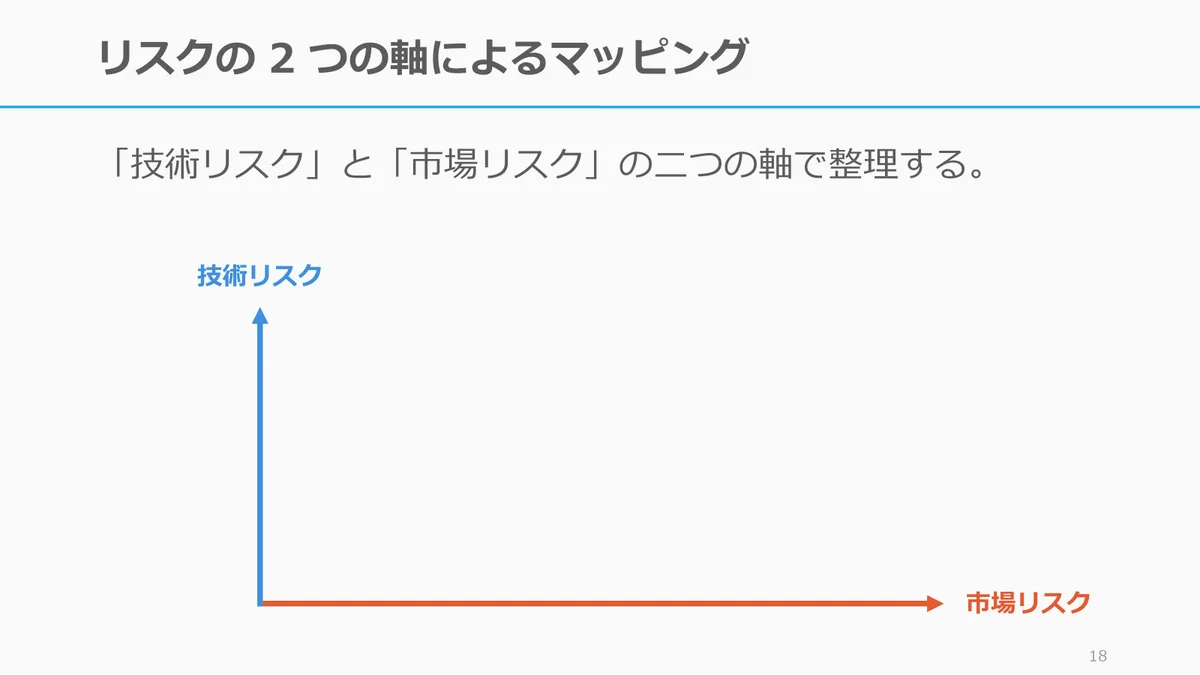
The reason investment gathers abroad in fields such as drug discovery is that these are fields where "if you can make it, it will sell." That is, technology risk is high (it is unclear whether it can be made), but it is known that if it can be made, it will sell (market risk is low).
If one takes the technology risk of "not knowing whether it can be made," it is an investor's nature to want market risk to be low, and in fact I think there are not many players even abroad who actively invest in fields where both market risk and technology risk are high. If one does invest in fields where both risks are high, one can only invest in things that would yield considerable upside if successful. Nuclear fusion, for example, may be one such case, because solving the energy problem entirely would create enormous wealth.
There is of course an aspect in which investors and citizens across Japan do not take risks, but I think a better way to put it is that "risk has not been lowered sufficiently."
What needs to be done is not only to take bigger risks, but also to learn how to lower both technology and market risk, to create an environment where that is possible, and to promote mutual understanding between the technology side and the market side. These too become possible countermeasures.
In fact, it does not look to me as though people on the technology side are doing enough to lower market risk. And rather than saying "investors don't take risks," I think it would be a more scathing criticism to say that "investors lack the ability to build a business (the market side) or to lower risk" and "lack the ability to imagine upside that would justify investing even at high risk."
Misconception 5: Deep tech startups cannot know whether a market exists
It is sometimes said that "with new technology, we don't even know whether it can be made, and we won't know whether there is a market until we make it." For example, in some fields such as the robotics I mentioned earlier, it is often still unclear both whether it is technically feasible and whether a market exists.
However, as I sorted out in the discussion of risk above, it is only natural to want to lower at least one of technology risk or market risk. And if a deep tech startup is a business that mainly takes technology risk, I think it is better to at least secure that a market exists. In fact, "going to build technology where a market clearly exists, or where a market is likely to grow rapidly" looks to me like the key to startup-like growth.
There are deep tech startups that began with both risks high, such as Tesla in its early days, so of course there are cases where it is unclear whether a market exists. But I think it is healthier for the nation's portfolio as a whole if deep tech startups in fields with an existing market, or fields where a market is likely to grow rapidly, make up a larger share than such businesses.
Misconception 6: It is enough to beat other competing technologies on performance and cost
Even if you beat other competing technologies on performance and cost, if there is no large market there, it ends as a small business.
"Can we win the competition" is of course important, but from a commercial viewpoint, "are we competing in the right place (market)" is also important. When starting out with a technology bias, I think people tend to concentrate on the short-term question of "can we win the competition."
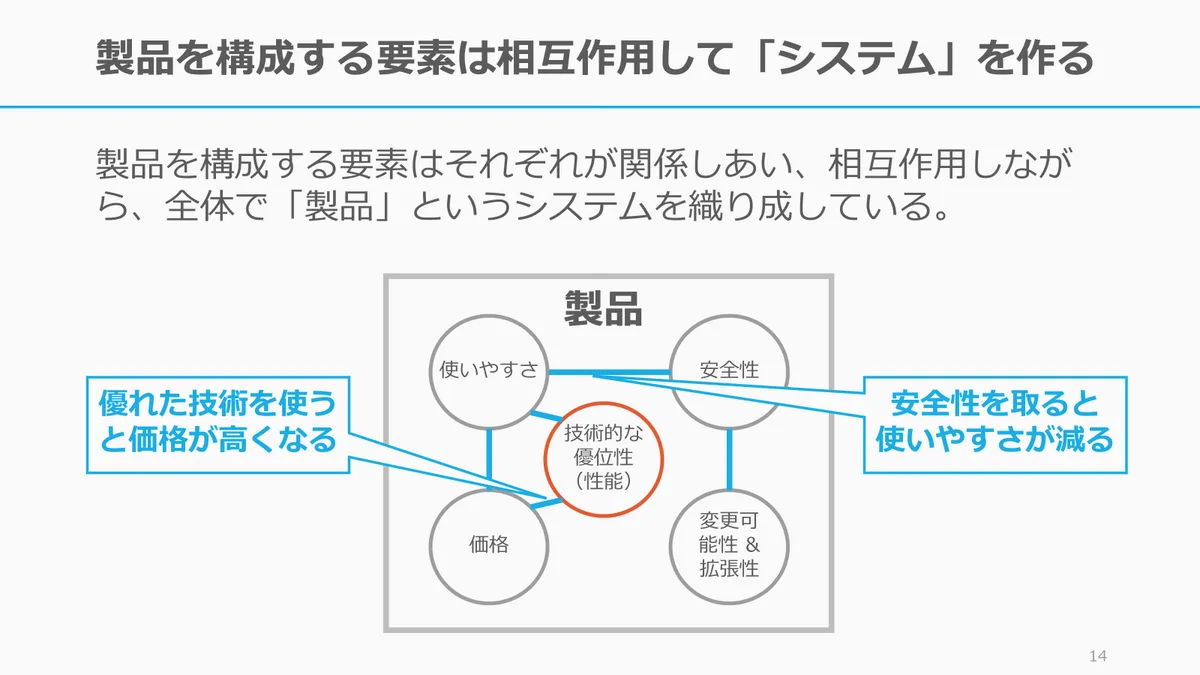
Also, technology is only a small part of a product. Technology is a large element among those that form the system of a product, but the product is built through its interrelations with the other elements. So unless the whole is designed well, no matter how strong the single element of technology is, you may lose as a whole. We also need to think about what technology is good while thinking about that whole.
https://speakerdeck.com/tumada/ji-shu-toshi-ye-wo-sisutemu-to-reiyagou-zao-deli-jie-suru
Deep Tech Startup = High-Growth Entrepreneurship That Takes Technology Risk
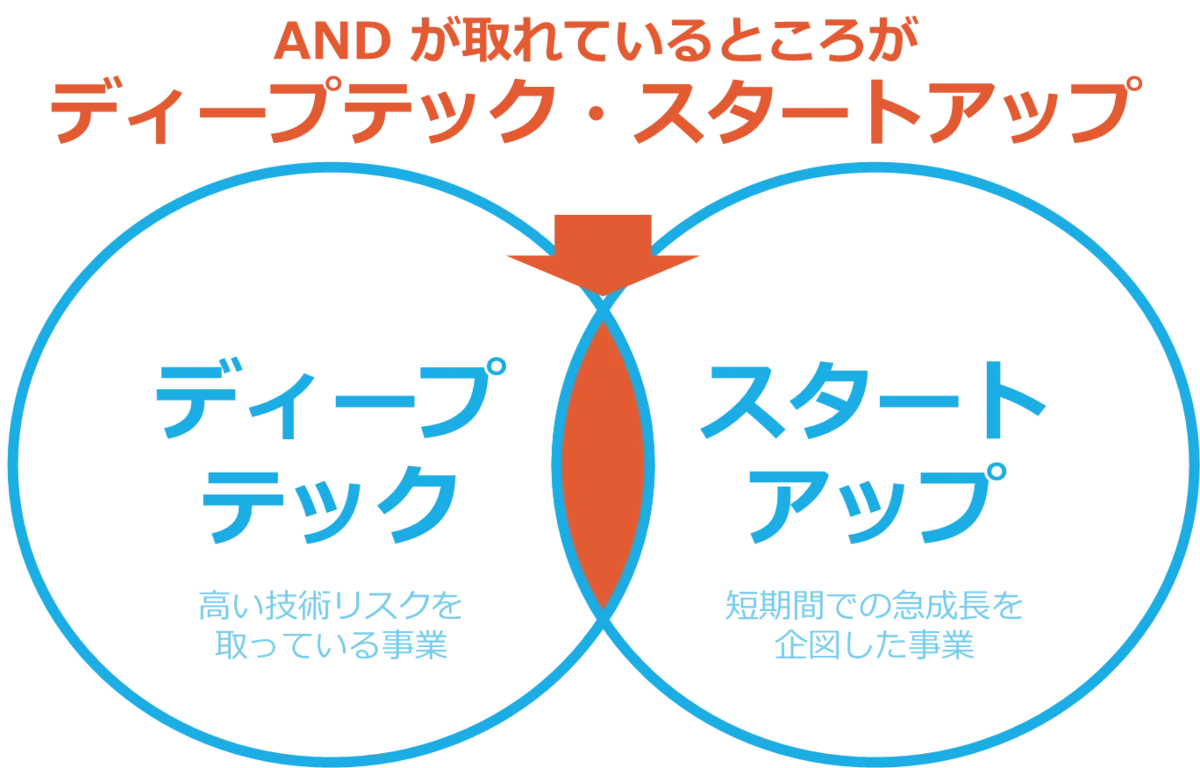
To sum up the discussion so far, I personally think it is easiest to understand a "deep tech startup" as
- Deep tech: running a business that takes on high technology risk
- Startup: intending to grow rapidly in a short period
a new company, or a style of entrepreneurship, that meets these two conditions.
The hard part is "rapid growth in a short period"
When you think about these two conditions, the stricter constraint is actually whether you meet the condition of "growing rapidly in a short period." It was a condition that was hard to meet even for IT in the 2010s, when the market was growing rapidly, so that is only natural.
To meet that condition, I think what is strongly needed is the idea of taking technology risk after working backward from the market: first choosing a market that is already large or is likely to grow sharply, and then taking technology risk. It is by no means something to think about starting only from a technology seed.
Even if one does start from a technology seed, it seems necessary to have people who know the business side well (executives and investors) and people who can flexibly develop that technology seed further to fit the business.
A rebuttal to the objection that "there are far too few such companies"
When I write this, some respond that "realistically, there are far too few such companies" or "that is too idealistic."
But if, for that reason, we promote entrepreneurship that drops one of the conditions, or try to get by for now by promoting a different kind of entrepreneurship, we lose sight of what purpose we were promoting deep tech startups for in the first place. Worse, resources such as people, money, and time would be dispersed, and this might even obstruct achieving the original purpose.
Whatever the reality, and however difficult the road ahead, thinking about the means to reach a meaningful destination should be the place where creativity is exercised. Of course it is a hard road to travel, but I think it is important to keep the purpose steady, start from the goal, and work out the best path.
Toward Thinking About Future Support for Deep Tech Startups
(1) Distinguish between concepts and names
In Japan there are two terms: "venture companies", used since the 2000s to mean entrepreneurship in general, and "startups," newly used since the 2010s for growth-oriented companies. They are sometimes distinguished sharply and sometimes lumped together.
So, although this relies heavily on the Japanese context and usage, I think we should call entrepreneurship aimed at commercializing technology as a small business or indie business "deep tech ventures," using the conventional term "venture company," and call companies that can leap big "deep tech startups," separating them and discussing them as different terms and concepts.
Each form of entrepreneurship has its own distinct value, because the social value created by entrepreneurship goes beyond economic value. Implementing research cultivated at universities in society, and university spinouts contributing to regional industries, have value that cannot be measured by the market capitalization of the resulting companies alone.
Still, from the viewpoint of the country's economic growth and creating many jobs, I think we should mainly support deep tech startups that grow rapidly in a short period.
So I believe that giving different names such as "deep tech ventures" and "deep tech startups" and carefully separating the concepts will lead to more appropriate resource allocation.
(2) Align the evaluation method for subsidies with the next investment phase
Many deep tech startups need money at the very earliest stage and inevitably rely on subsidies.
However, in conventional subsidies that support the commercialization of R&D, it seems that "whether it will fail," that is, the hit rate, is weighted heavily. I think this is because using taxpayers' money creates an incentive to avoid failure, and because reviewers were mainly researchers from universities and large companies.
But in the world of startup investors, it is said that the size of the home run matters more than the hit rate. And because subsidies actually provide money at an earlier stage than investors, unless they are selected by prioritizing "the size of the home run over the hit rate" even more than startup investors do, they cannot be connected to the next startup investors. In other words, there is currently a large gap between "the stage before seed investment, which prioritizes success rate (subsidies)" and "the seed investment stage, which prioritizes home runs."
As a result, a subsidy program may count as "a success because there were few failures," yet from the investors' side it frequently happens that "they are all just small grains, so we can't invest." This is a tragedy caused by differing evaluation methods, and I think it needs to be corrected.
(3) Let more companies exit
I think the emphasis on not failing also leads to a high survival rate of companies. In the following survey, the five-year survival rate of university spinout ventures after founding is 5.5% in the US and 108.7% in Japan.
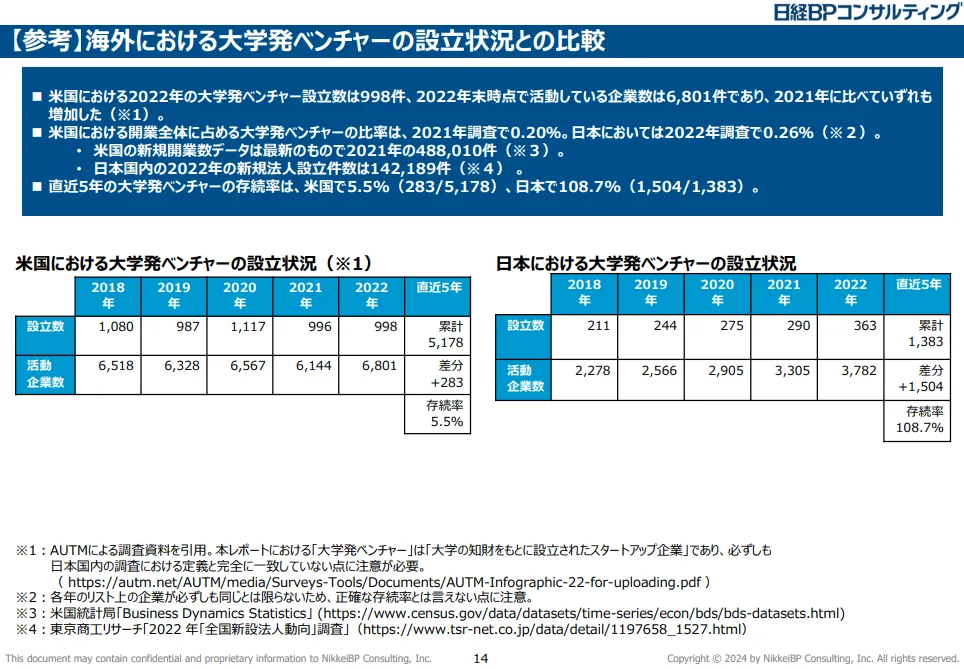
A high survival rate is not necessarily a good thing.
This is because if a company survives for a long time, technologies and patents that could be used for other commercialization are monopolized by a particular company for a long time. Intellectual property loses its effect after 20 years. If one company holds a piece of intellectual property for 10 years, its remaining life becomes 10 years, and startups using that IP would no longer be founded.
IP born at public universities also has an aspect of being a public good, although it also belongs to the inventors. I do not think it is good for a particular company to keep holding a public good that would have been reused had it failed and closed.
This too seems, like the above, to be a problem of evaluation. Unless we think carefully about how to evaluate, I think deep tech startups will find it hard to emerge.
(4) Gather technology by working backward from the business, and fund R&D
The gap funds spreading at Japanese universities and NEDO's NEP Exploration Course are, after all, technology-originated. "Thinking about the business starting from the technology" is of course important, but "thinking about the technology starting from the business" is also important, and there is currently almost no support for such efforts.
In the US, however, research institutions such as ARPA-E and DARPA promote this kind of backward-working R&D, and Breakthrough Energy also appears to provide grants for R&D in designated business areas through mechanisms such as Fellows. Such efforts may be needed in Japan too.
In other words, it might be good to create a mechanism such as a "reverse gap fund," which "fills the gap starting from the market," the opposite direction from the conventional one, and funds research by working backward (in reverse) from the market.
However, unlike an ordinary gap fund, which provides money for the long-established concrete deliverable of "research results," this reverse gap fund would need to treat things like market selection and a business plan as its concrete deliverables first. For that, people who can do business development are needed, and this remains a challenge.
Also, since it is difficult for a single university to do this alone, it may be necessary to involve other universities through joint research and the like.
(5) Refine the methodology for supporting "commercialization that grows big"
Rather than simply commercializing research results, I think we need to provide support that makes them grow big. Unless that is designed very intentionally from the early stage, it is hard for a business to become big. Rather than wishing "I hope it grows big" and waiting for heaven's will, it is important to design at least a little from the beginning so that "if it goes well, it will grow big."
Of course, in markets such as medicine and drug discovery, the markets are often large, so the contest is then whether the product can reach the specifications the market demands (and whether it has an edge over competitors). For such fields, I think the "commercialization of R&D results" approach, with research results as the starting point, is fine.
In other fields, however, I think some ingenuity is needed.
One example is methods such as company creation and venture creation. I think there is the option of building businesses likely to grow big through a method in which people on the side that knows the business and the market create companies themselves, rather than just investing.
Also, before indiscriminately providing R&D funding, it may be effective to build a flow in which we support drawing up a business plan that will grow big, support deciding the specifications to be developed, and provide "de-risking of market risk" support, such as covering the cost of techno-economic analysis and LCA, to bring the project early to the stage of "if you can make it, it will sell," and then provide R&D funding at that stage.
As for gap funds as well, researchers tend to see them as "research funds." So efforts may be needed to give them names such as "high-growth gap fund" to make clear that they are a different mechanism from "money that is an extension of research."
(6) Rethink resource allocation
Until now, I think the method of aiming for probabilistic hits, as in Silicon Valley, with the thought of "aim for hits, and hopefully one of them will land," has been imitated, and in doing so, resources were allocated more to things with a high hit rate and low upside. I think this has to change.
The barbell strategy is one example. Startup investment is already, at that stage, the high-risk "1" side of a barbell strategy's 9:1 split, but within that 1, we might allocate 0.8 to "fields that are high-risk but where a big hit can be aimed for if done properly," and invest the remaining 0.2 in "ultra-high-return things that might hit by chance." I think we need to consider the method of resource allocation and the method of evaluation in this way.
It is true that over the past 20 years, the depth of executives and know-how in Japan's startup ecosystem has increased, but if we want to create companies that leap even higher than now, we need to rethink "resource allocation," one of the major elements of strategy.
Summary
What I have written so far is mainly a way of thinking about producing deep tech startups in the short to medium term. Let me add at the end that, in the long term, funding science research and advancing that research properly will also lead to future deep tech startups.
Also, this article is my personal opinion, the "misconceptions" and proposed improvements as seen from my current viewpoint. My views will probably change as I go on with various activities.
Still, now that support is about to increase, I put this into writing in the hope that, at least regarding its direction, what I have learned from being involved in this field for several years can be put to use.
I hope it is of some help.
Footnotes
-
The "university spinout ventures" as defined by METI are not all deep tech companies, but on the other hand they include many deep tech companies. ↩