The Branching and Evolution of How Deep Tech Startups Are Launched
This article was machine-translated from Japanese by AI (Claude). It may contain errors. Read the original Japanese article.
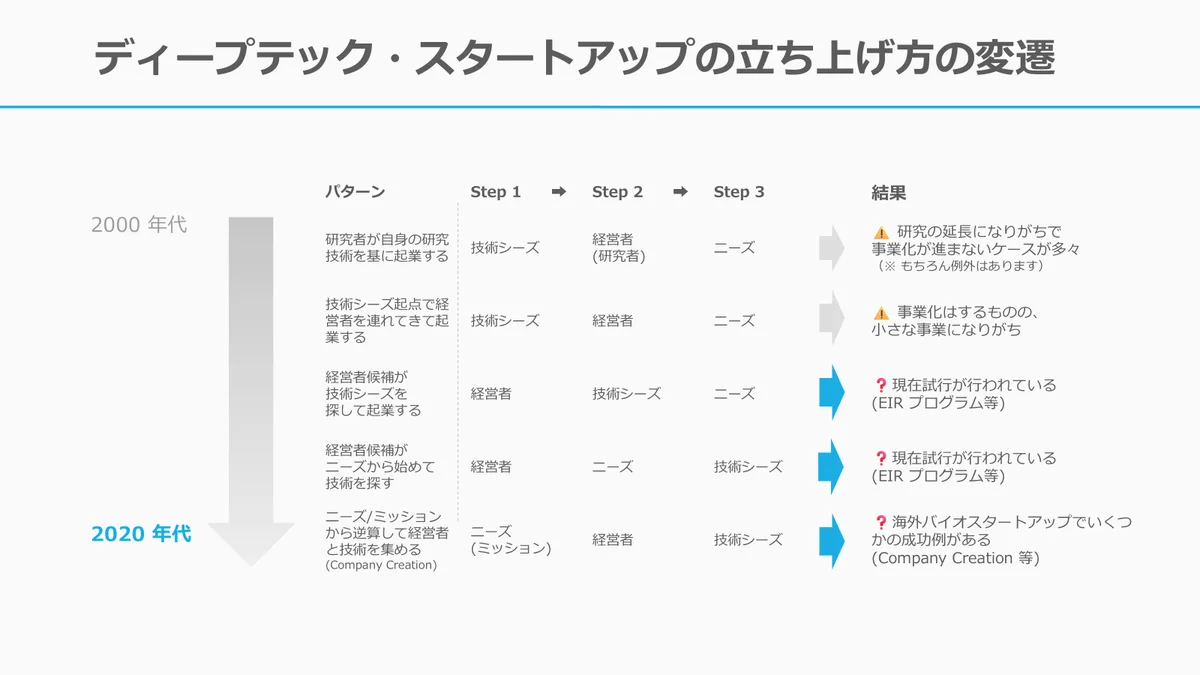
Expectations for university spinouts and deep tech startups are rising. However, I feel there is a gap between how people on the outside imagine deep tech startups are launched and how they are actually being launched today.
This is just my personal opinion, but over the past 25 years the methodology of deep tech startups seems to have gradually evolved and branched out. Let me summarize that process of change.
Note that in this article, "startup" means a rapidly growing, high-growth startup.
- Three elements deep tech startups need to line up early on
- (Model 1) Technology seed ➡ Researcher ➡ Needs (early 2000s)
- (Model 2) Technology seed ➡ Executive ➡ Needs
- (Model 3) Executive ➡ Technology seed ➡ Needs
- (Model 4) Executive ➡ Needs ➡ Technology seed
- (Model 5) Needs (mission) ➡ Executive ➡ Technology seed
- Summary
Three elements deep tech startups need to line up early on
Broadly speaking, the elements a deep tech startup needs to line up early on are these three:
- Technology seed
- Executive
- Needs
It would be ideal to line them all up at once, but in practice you have to start from one of them.
These three elements themselves have not changed over time, but the order in which people think these 3 elements should be lined up seems to have shifted gradually from era to era.
(Model 1) Technology seed ➡ Researcher ➡ Needs (early 2000s)
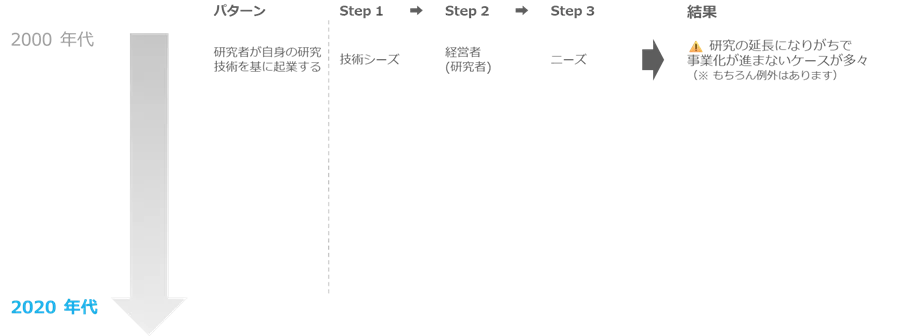
The first model that was envisioned was startups that begin from a technology seed.
The assumption was that there is first a technology seed in the form of research, that it sits at the center of everything, and that the researcher becomes the executive and commercializes it. I think there was a premise behind this: "if you have a technology seed, the business will work out somehow."
I think the Plan for 1,000 University-Originated Ventures, which began around 2001, embodied exactly this thinking. The model is that there is a technology seed in the form of research, the researcher who developed it starts a company and acts as its executive, then identifies needs and commercializes, and thereby succeeds.
The problem with this model, though, was that even after founding a company, researchers kept doing research, and commercialization often did not progress at all. For example, I sometimes heard stories that some researchers at the time had treated startup support funding as an extension of their research grants.
(Model 2) Technology seed ➡ Executive ➡ Needs
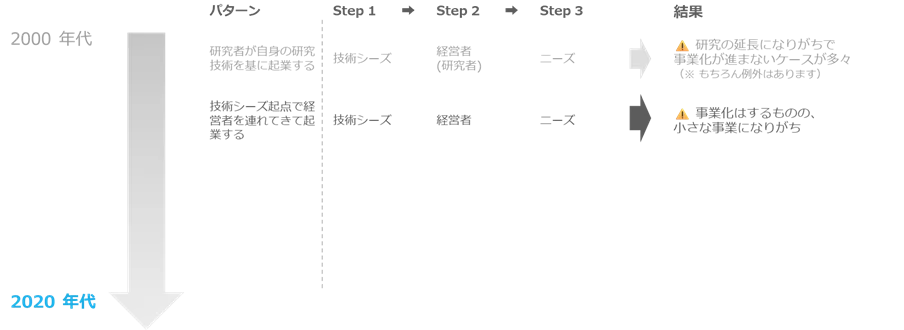
The next model to become mainstream still started from a technology seed, but brought in an executive rather than a researcher. There may have been a sense of reflection that "having researchers commercialize things doesn't seem to work."
This is a model resembling American VCs, in which a VC selects a technology and brings in an executive. In some cases, a VC may identify the technology and the needs first and then bring in the executive (that is, the flow of technology seed ➡ needs ➡ executive).
Commercialization progressed this way. But the problem that eventually emerged was that when a company is bound to its technology seed, in some fields it inevitably tends to end up as a small business. In fact, even ten years after founding, many deep tech companies have revenue of only around 100 million yen.
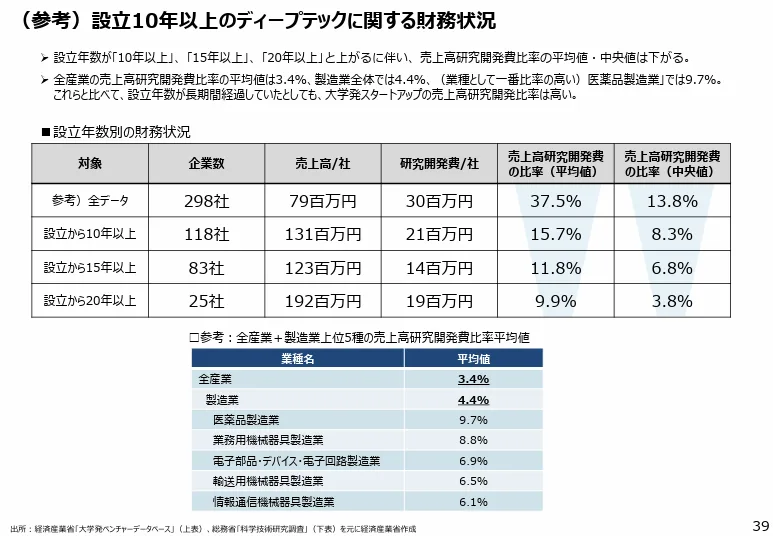
https://www.meti.go.jp/shingikai/sankoshin/sangyo_gijutsu/kenkyu_innovation/pdf/028_06_00.pdf
Also, given the historical background before it, running companies with a strong technology orientation meant that they did not think of growing rapidly like a startup, and tended to aim instead at "technology commercialization" on the scale of several hundred million yen.
Note that both (Model 1) and (Model 2) are effective in some fields, such as certain areas of drug discovery. But this comes with the premise that they are effective only when several conditions are met: "the strength of the technology translates directly into the strength of the business," "if you can make it, it will sell," and "the market is large." Because such fields are in fact limited, people gradually realized that starting from technology alone is not enough, and other methodologies began to be tried.
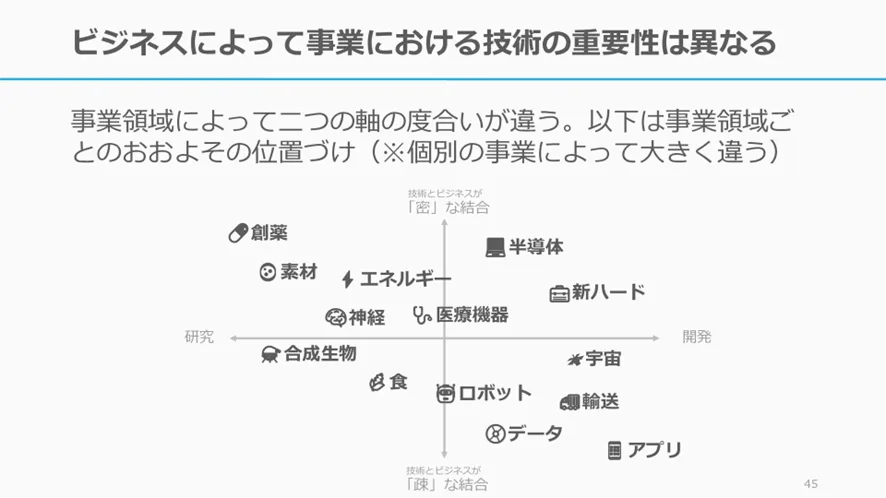
(Model 3) Executive ➡ Technology seed ➡ Needs
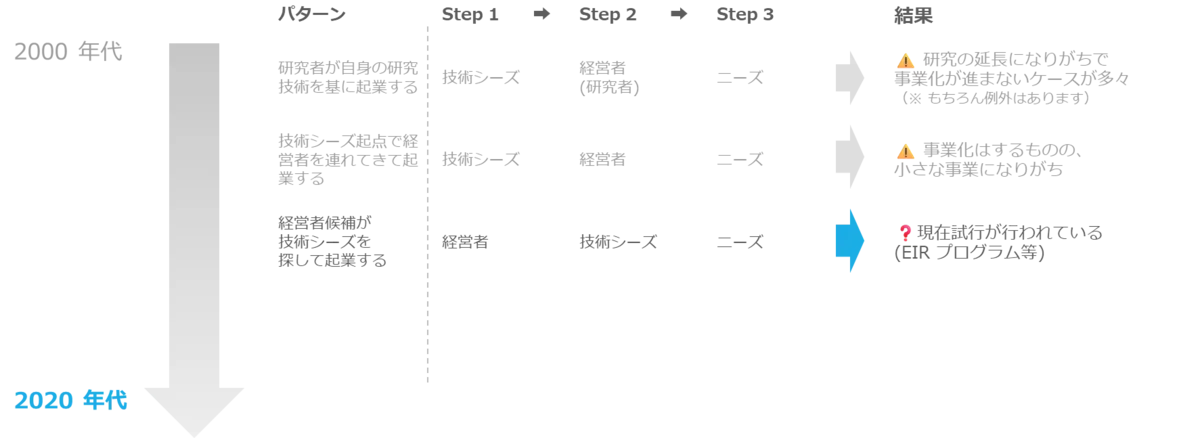
It became clear that starting from a technology seed may make it hard to build a very large startup. What is being tried now is startups that begin from the executive.
The flow is that someone who could become an executive explores technologies, and if they find a promising one, they go looking for the needs to which that technology can be applied. VCs and universities hiring people with business experience through schemes such as Entrepreneur in Residence (EIR) is exactly this mechanism.
This also seems to be one valid approach. However, because the structure in which the business's potential is constrained by the technology remains largely unchanged, it can happen that "the business doesn't grow as large as expected." It also becomes a challenge whether the executive can build a business in which "the strength of the technology = the strength of the business."
In addition, if you come to lean on a particular professor's technology, there is the disadvantage that when a bigger opportunity is found, you can no longer let go of that professor's technology. (That said, I think that risk should be taken within a reasonable range.)
(Model 4) Executive ➡ Needs ➡ Technology seed
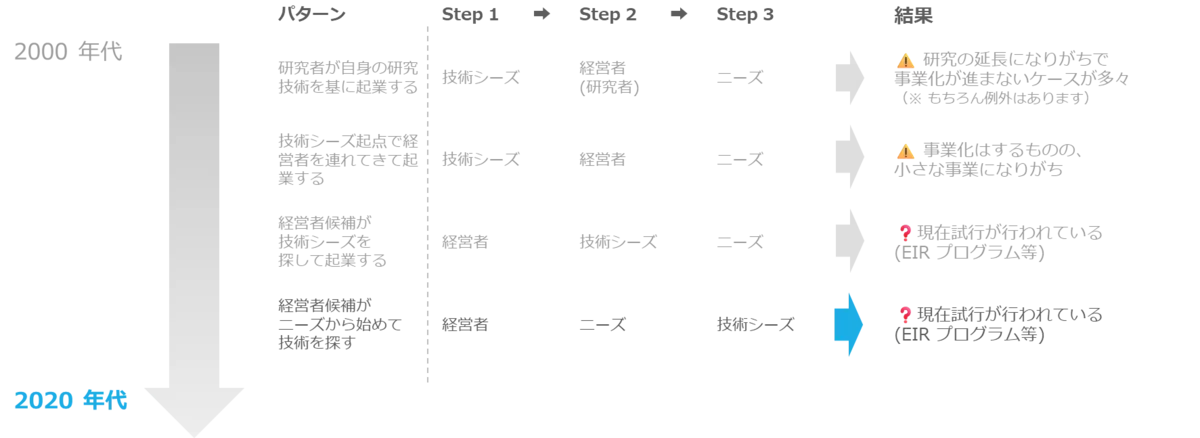
Model 4 resembles Model 3, but I picture it as a model in which the executive identifies the needs and gathers multiple necessary technologies. It starts from the executive, but the difference is that next it starts from the needs and goes looking for technology seeds. Those technology seeds are often university research (deep tech).
If you try to put this into practice, you would end up with the same mechanism as the EIR in Model 3, but because the needs are identified first and the technology is made interchangeable, the risk that "the business doesn't grow as large as expected" can be avoided to some extent. As a new challenge, however, you take on the risk that "you don't know whether the necessary technology exists."
For this model, a university EIR is somewhat awkward because it is bound to the university's technologies, and a VC's EIR can be said to be the easier form.
In reality, (3) and (4) are a gradient, and I suspect that in many cases the executive finds the right combination through repetition: finding a technology and looking for needs, then, once needs are found, looking for technology again, and so on. Even so, I think whether you emphasize the technology seed (whether commercializing the technology will lead to great success) or emphasize the needs (whether in some cases you may discard the technology) are very different approaches.
(Model 5) Needs (mission) ➡ Executive ➡ Technology seed
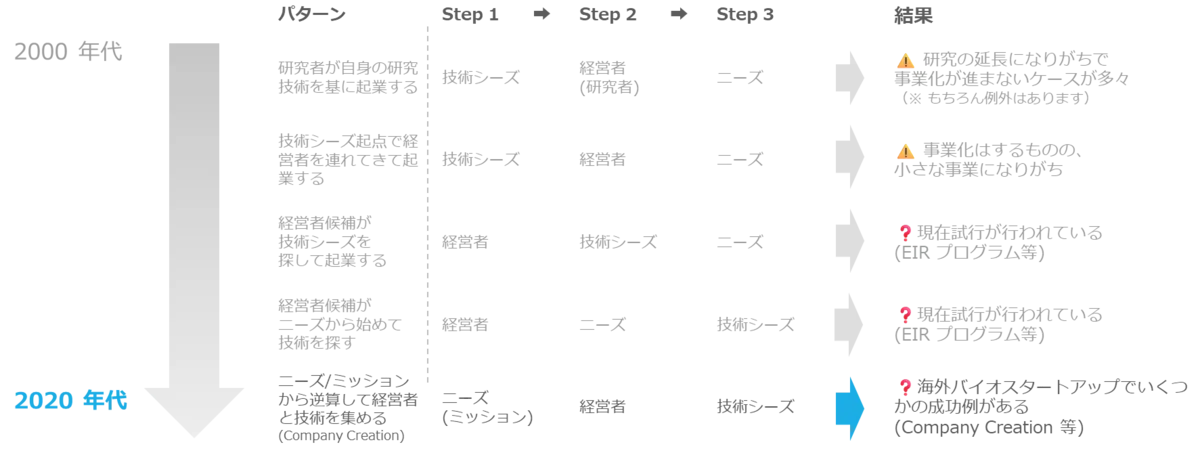
I think the company creation now being tried can be described as a model in which VCs and others identify the needs first, bring in a suitable executive, and combine technology seeds. In some cases, the order may be needs ➡ technology seed ➡ executive.
A similar model is the Building Backwards that ARCH Venture Partners talks about. It is precisely a model of "building while working backward."
I write "needs (mission)" because there are also patterns in which companies are built in cooperation with the government, based on a large mission such as decarbonization.
This way, you rarely miss the needs. However, risks remain, such as whether you can find an executive and whether you can find the right technology. Also, Northvolt, which was built with this model, is currently in trouble, so in that sense it does not always succeed (unmet needs in medicine and the like probably do not change that often, but future needs in other fields change easily).
Summary
This does not mean that today's deep tech startups are all the company creation model of Model 5, nor that any one of them is the most correct.
I think it is better to see the present as these 5 patterns coexisting, each chosen according to the business, the field, and the risks that can be taken.
Yet many people seem to tend to think of Models 1 and 2 as "deep tech startups." There are also patterns like Model 3, but even then they become technology-heavy, "startups for commercializing a technology" (equivalent to what have traditionally been called venture companies).
In that case, unless the technology and the market satisfy certain conditions, they cannot achieve high growth. For some technologies there are fields where such thinking can succeed, but there are also many fields where it cannot.
Over these 25 years, I think there has been trial and error in how to launch, and accumulated knowledge has built up. So I think we need to think more deeply about how to use "deep tech" to create "deep tech startups," while considering which business fields we are trying to take on and which model is suitable in those fields.