The Rise of Startup Studios and the Venture Creation Model, and Why Japan Needs Them
This article was machine-translated from Japanese by AI (Claude). It may contain errors. Read the original Japanese article.
- 1 About Startup Studios
- 2 About the Venture Creation Model
- 3 The Future of These Models in Japan
- 4 Summary
Looking at startup investment in North America, late-stage is cooling, but seed-stage valuations are still holding at high levels.1
Looking at accelerators, which were important players in the pre-seed and seed ecosystem, accelerators other than Y Combinator are becoming sluggish, and arguments that accelerators themselves need to change have also begun to appear.
Meanwhile, VCs are becoming more active too. Sequoia has started an accelerator called Arc, and Andreessen Horowitz has also launched a new accelerator called START, as they begin trying to reach into the pre-seed and seed stages, which come earlier than they have traditionally operated.
At the same time, many Japanese VCs have also started running accelerators and have begun supporting startups at an "earlier stage."
Part of this may be that funds have grown larger and have more financial room. But it also looks like the opposite of the usual dynamic, in which a larger fund size forces larger ticket sizes and VCs pull out of early-stage support, so I think we should take it as meaning something.
One reason, I think, is this. Because the fund sizes of Japanese VCs are growing steadily,2 they are reaching the point where they cannot pay off unless they invest in ideas and teams that "aim for at least a unicorn," and the number of entrepreneurs taking on large-scale problems is relatively short compared with the investment capital available. Of course such entrepreneurs exist, but more money is gathering than they can absorb, so the situation looks like one where we would want many more of them.
And so, if VCs move to earlier stages, programs that have traditionally played the accelerator role are forced to move to a stage even earlier.
As this chain of "moving earlier and earlier" continues, I think many supporters may move closer to the Startup Studio or the Venture Creation Model going forward.
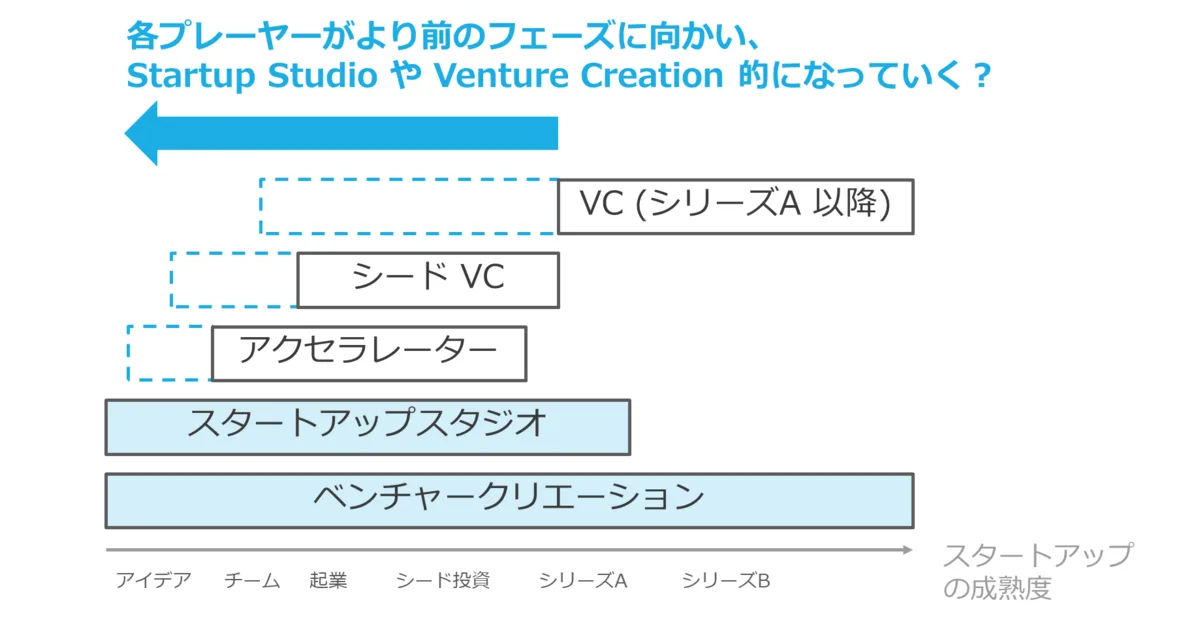
If things do go in that direction, the number of people acting like EIRs inside Startup Studios and Venture Creation will surely grow. That is part of why I published an article about EIRs, and at the same time I was also looking into the potential of the Startup Studio and the Venture Creation Model. I have put together what I found as personal notes.
1 About Startup Studios
1.1 Overview of Startup Studios
A model that has been steadily increasing over the past few years is the one called the Startup Studio. You can confirm that their number is growing year by year in the list of Startup Studios around the world compiled by volunteers.
You can also sense their growing presence from the fact that the organization behind the Global Accelerator Network (GAN), which had been compiling startup accelerators, launched the new Global Startup Studio Network (GSSN) in 2019.
At the end of 2022, Steve Blank, famous for customer development, also contributed an article to the Harvard Business Review (the original can also be read here). In that article, he summarizes the Startup Studio process as follows.
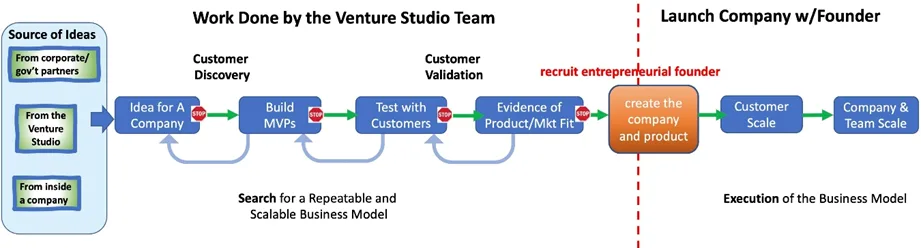
In terms of this diagram, a Startup Studio has the function of "handling everything up to PMF in-house, then bringing in an entrepreneur/executive and spinning the company out." For this reason, a Studio usually keeps engineers and other talent in-house so that it can build up to a product prototype internally.
In practice, however, some call themselves a Studio when they only help with company registration, and some cover only the very earliest idea stage, so how far a studio goes varies from studio to studio. (Entrepreneurs who deal with Studios, please be careful.)
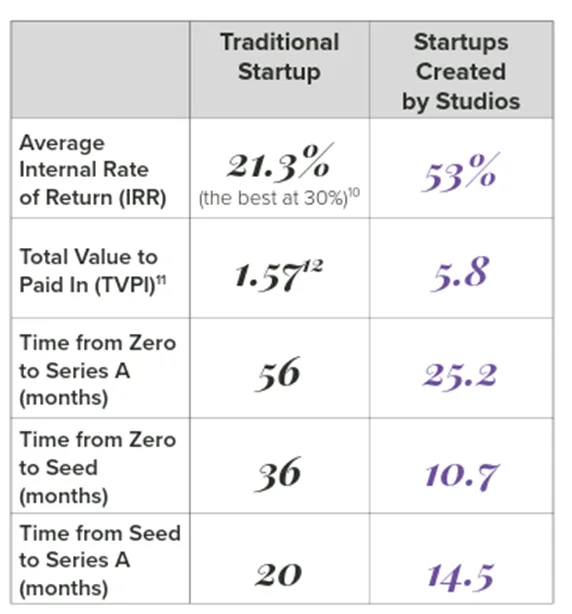
This Startup Studio model is said to have a high success rate. The IRR of an ordinary startup (probably meaning a VC) is 21.3%, versus 53% for a Studio, and seed fundraising takes 36 months for an ordinary startup versus 10.7 months for a Studio (I do wonder whether that is really true...).
On the other hand, another feature of the Startup Studio is that it takes a large amount of equity. Studios apparently take anywhere from 20 to 90% equity (30 to 80% according to the HBR article).
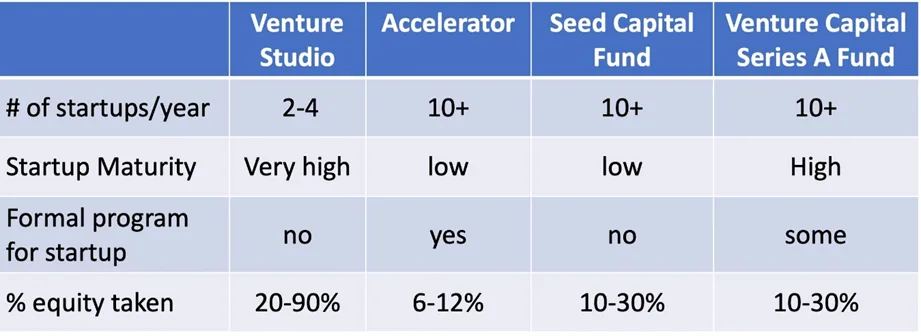
The figure of 90% is startling. The company will surely struggle in the next round, so I doubt that taking 90% makes anyone happy... but I do hear of unscrupulous businesses and individuals who take a great deal of equity under labels such as "Startup Studio," "co-founding," or "founder support," so it may well be possible. (I will say it again: please do not get caught by such people or businesses. Tohoku University has also issued a warning about this.)
That said, the Studio model costs a great deal, so I can understand why they want more equity than in ordinary investment. For estimates of these costs, "Everyone's Startup Studio" and similar sources go into detail.
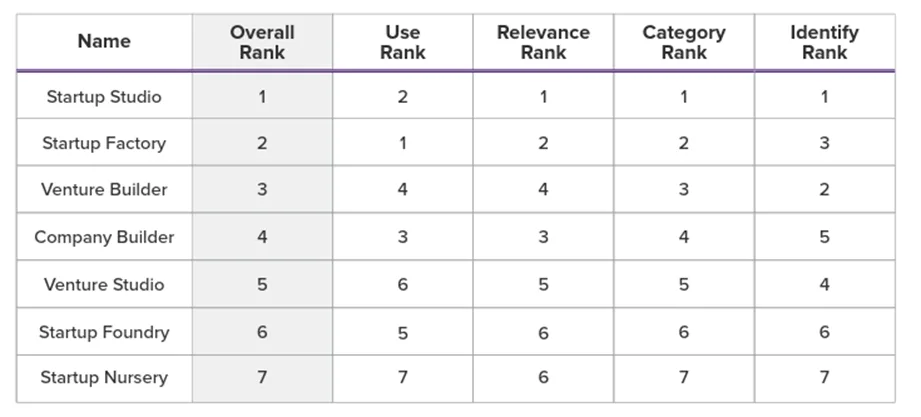
Related concepts similar to the Startup Studio include "Venture Studio" and "Startup Factory." They may differ if you look closely, but Startup Studio seems to be the most commonly used, so I will use the name Startup Studio in this article.
https://www.gan.co/wp-content/uploads/2020/03/The-Rise-of-Startup-Studios-White-Paper.pdf
1.2 Examples of Startup Studios
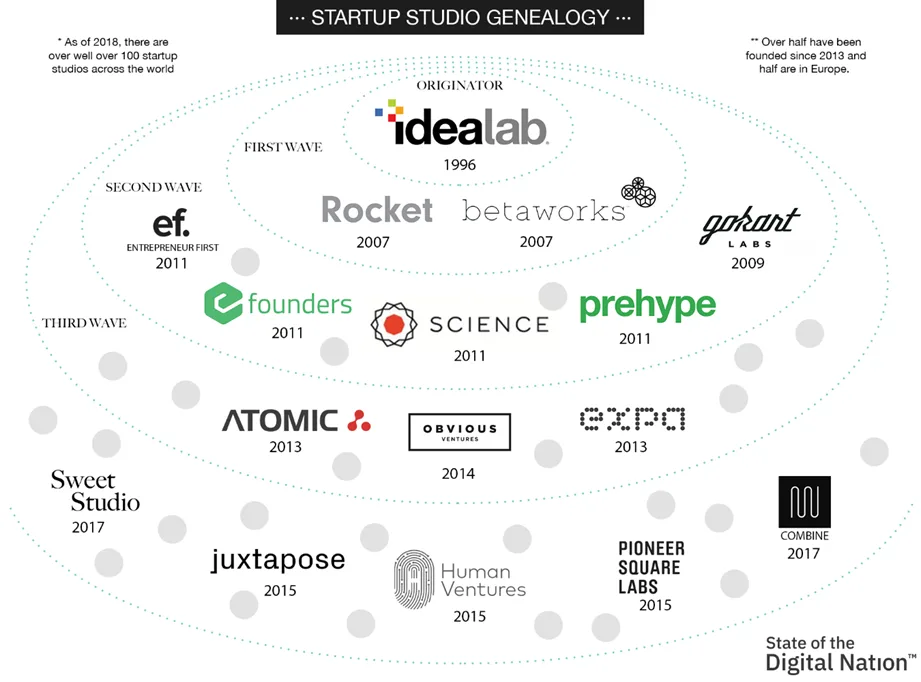
My impression is that the Startup Studio model has come in waves several times, receding each time. Starting with Idealab, which created Overture and others, efforts overseas are summarized in the following diagram.
https://medium.com/collider/state-of-the-digital-nation-2020-venture-road-22de4377836
A wave also came in 2011 to 2013, and was covered in places such as an article in TechCrunch.
Studio initiatives have been carried out in Japan too. There were BEENOS Startup Studio and Mistletoe, among others. Even today, the group of companies that participate in the Startup Studio Association are making attempts.
Incidentally, Idealab's Bill Gross is well known for this TED talk and others, and he was actually born in Japan.
1.3 Background
I think the background to the rise of the Studio model includes reasons specific to IT and the driving role of serial entrepreneurs.
First, starting a company in the IT field has features such as:
- Relatively low initial costs
- Relatively low costs of trial and error
- Relatively easy to repurpose the technology that engineers hold
which made it possible to try out ideas through trial and error at relatively low cost.
The fact that so many serial entrepreneurs have emerged in this field is probably also significant. Someone who has started a company once sees and hears about a wider range of problems, and as a result seems more likely to become a serial entrepreneur, or to become someone who comes up with such ideas.
For example, Twitter co-founders Ev Williams and Biz Stone created Obvious Corp, a Startup Studio (in their words, a Product Lab), and Medium apparently came out of it. However, Obvious has since turned into a pure VC.
The PayPal Mafia is also involved here. Max Levchin, famous for PayPal, also started a studio called HVF Labs, and Affirm, where he himself serves as CEO, apparently came out of it. Peter Thiel came up with Palantir, and Keith Rabois came up with the concept for Opendoor. Although they handed the management over to other executives, the initial ideas came from these PayPal-related people.
1.4 Types
There are also several types of Startup Studios. There are several ways to classify them, but let me roughly organize them into the following types.
- Independent Startup Studios – I think this is the most common type.
- Corporate Startup Studios – These spin out of large corporations or create new businesses.
- VC-backed Startup Studios – They basically operate as VCs, but you could also call them "the extreme end of hands-on."
- Consulting-based Startup Studios – For example, BCG X (BCG Digital Ventures). Recently (July 2023), Bain also acquired the APAC division of Rainmaking. I also hear of Studios in the context of regional revitalization.
The well-known independent Startup Studio is Idealab, which seems to be the typical studio. Many of the studios whose logos appear in the earlier diagram follow a model similar to Idealab's.
Even among independent ones, though, some take a different form from Idealab. Examples are Entrepreneurs First and Antler, which mainly handle the period around co-founder matchmaking. They do not appear to have a function for building products in-house, so they differ from the Studios responsible for everything up to PMF, but they also differ from Accelerators, so they are programs that are sometimes introduced in the context of Startup Studios.
In Japan, my impression is that corporate Startup Studios are common. For some reason, Wikipedia also says that accelerator programs in Japan are "run by large corporations," which may be a feature of Japan.
An example of a VC-backed Startup Studio is Sutter Hill Ventures, which produced Snowflake, whose 2020 IPO was called the largest in software history. However, while an ordinary Studio creates several companies a year, Sutter Hill creates about one a year, so it seems closer to the Venture Creation Model described below than to a Studio.
Sutter Hill's Mike Speiser, even though he is a VC, served as Snowflake's CEO through the Series A, and then, in the scaling phase, brought in an outside CEO3 and left management to him. Sutter Hill still held about 20% of the shares at the time of the IPO, and is said to have earned from Snowflake a larger return than Accel earned from Facebook (about 1,600 times, apparently). The methodology is covered in detail in this article and this article, among others.
I will not touch on the consulting-based type in this article for now.
In addition, the business models differ in various ways, but I will leave the discussion of Studios there for now. For details, please see "Everyone's Startup Studio."
2 About the Venture Creation Model
2.1 Overview
Startup Studio is a term often used in the IT context, whereas in the biotech field one often hears the term "Venture Creation Model."
As the name suggests, this is a model in which a VC "creates venture companies" itself, and the most famous example is Flagship Pioneering, which produced Moderna. Third Rock Ventures, Atlas Venture, and others take similar approaches.
What differs from the Startup Studio is, I think, that the field is mainly drug discovery, and that the firm leads follow-on investment all the way through to the IPO. For example, at Moderna's IPO in 2018, Flagship Pioneering is said to have held a 19.5% share.
2.2 Process
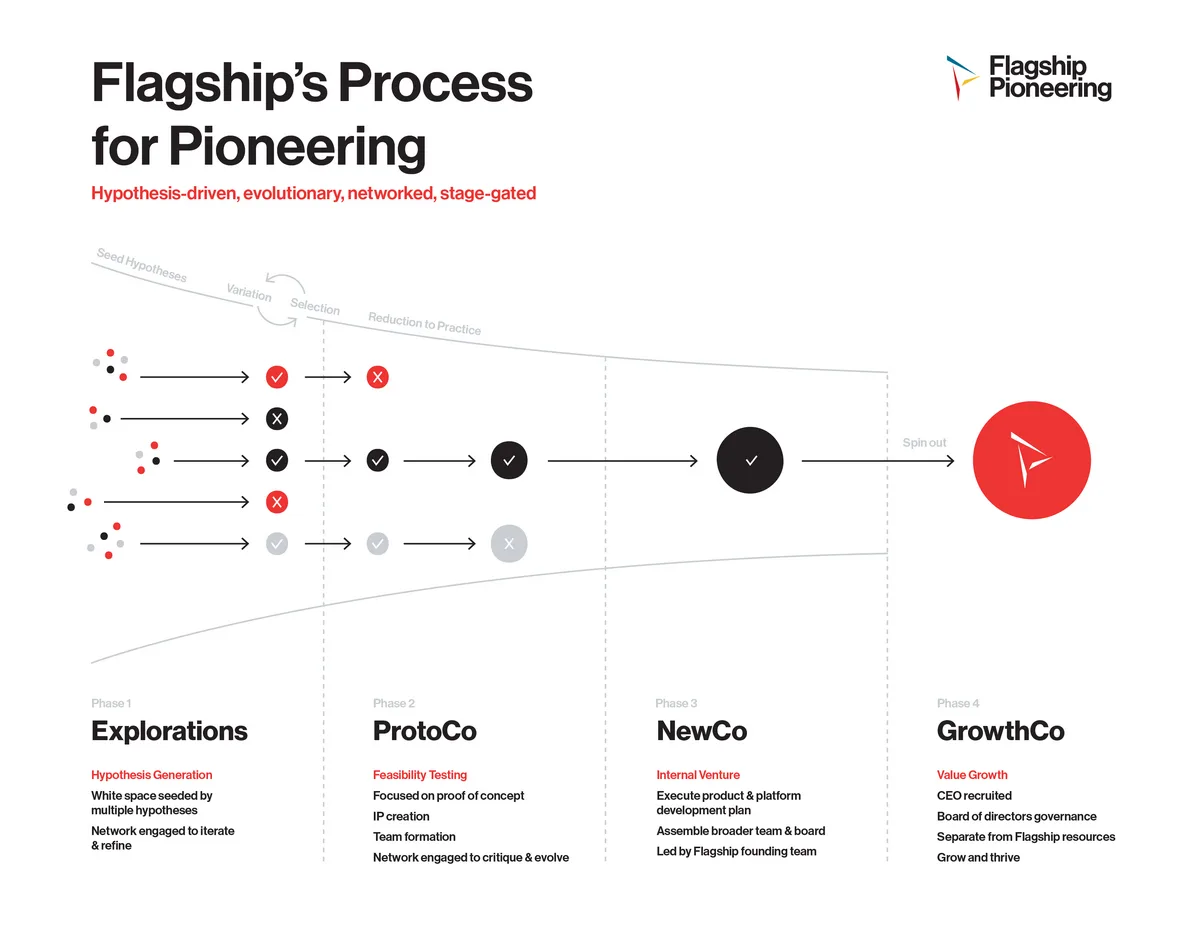
Flagship, Third Rock, and Atlas all divide the process into four phases.
Flagship | Third Rock | Atlas | |
Phase 1 | Explorations | Discover | Discover |
Phase 2 | ProtoCos | Launch | Derisk |
Phase 3 | NewCos | Build | Shape |
Phase 4 | GrowthCos | Transform | Strengthen |
Quoted from https://www.flagshippioneering.com/process
In Japanese, Professor Koyanagi's blog article gives a good summary of Flagship Pioneering's approach.
As for Flagship Pioneering's internal process, I suspect the most detailed source is the Harvard Business Publishing case "Institutionalized Entrepreneurship: Flagship Pioneering." Atlas Venture also shares information through a blog called Life Sci VC, and reading it tells you a lot about their thinking.
The latest on Flagship Pioneering is covered in detail in this article, and at the time it was written the firm apparently had about 300 (!) scientists and business-side employees, which you could say means it commits that many people to creating new businesses.
2.3 Types
As for this Venture Creation Model, I have rarely seen it outside drug discovery. It may just be that my research is insufficient...
Some use the name Venture Creation, while others use the name Company Creation. The words are just different, though, and my impression is that the substance is not very different.
If there is a major difference, it would be around "how far the firm leads the ideas itself" and "whether or not it has an in-house research and development function"... I am not well versed in this area, so I would like to ask the experts.
3 The Future of These Models in Japan
Naturally, entrepreneurs know the problems on the ground better than investors do, and in the overwhelming majority of fields entrepreneurs will know more.
On the other hand, I feel that if we leave things to entrepreneurs' natural idea generation, there is a gravity pulling toward smaller ideas (especially for first-time entrepreneurs). That is where serial entrepreneurs are looked to, but in Japan, where there is little M&A, serial entrepreneurs are hard to produce, so under that constraint, I think the early-stage navigation of how to get even first-time entrepreneurs to aim big has become very important.
Also, in response to the shortage of entrepreneurs explained at the beginning, I think the number of VCs and support organizations taking on these Startup Studio and Venture Creation Model approaches will grow in the future.
It is, so to speak, a style of "not waiting for entrepreneurs, but going out to create businesses ourselves." Rather, I think we are approaching a situation where, unless they do so, they cannot make investments that match their fund size.
That said, I think that whether the same approach as overseas can work in Japan is a somewhat different question, and I think we also need to consider developments like the following.
3.1 Expanding Into New Fields
Drug discovery and IT are ahead, and I expect Startup Studio-like efforts will continue in these two fields. However, the low-hanging fruit has already been picked to some extent, so I think this model may spread to other fields as well.
If there is a problem, though, it is that drug discovery and IT are in a sense "special enough for this model to work."
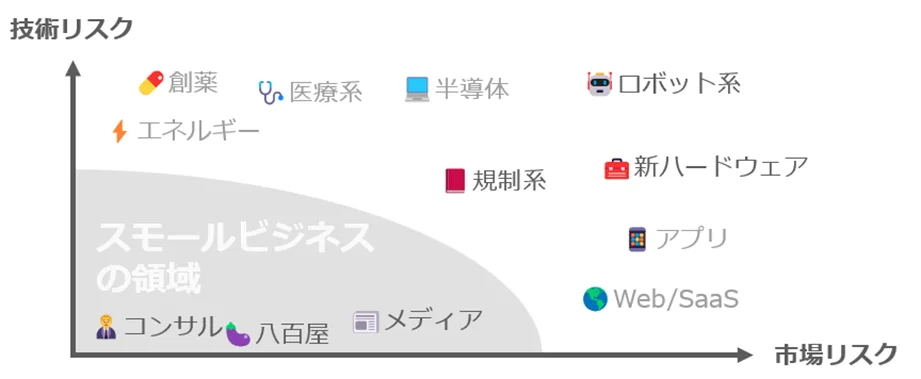
For example, if we divide a business's risk into "technology risk" and "market risk,"
- Drug discovery has high technology risk but low market risk (= if you can make it, it will sell)
- IT has low technology risk but high market risk (= if you only know what will sell, you can make it)
they take on risk in these ways, but other fields vary widely, and there is no guarantee that returns will match the risk.
https://speakerdeck.com/tumada/deep-tech-sutatoatuputohahe-ka?slide=55
In drug discovery, it is also distinctive that the subsequent process is highly predictable.
The probability and timeline for small-molecule drug discovery are said to look like the following (the data is old, so the amounts and other figures may need updating).
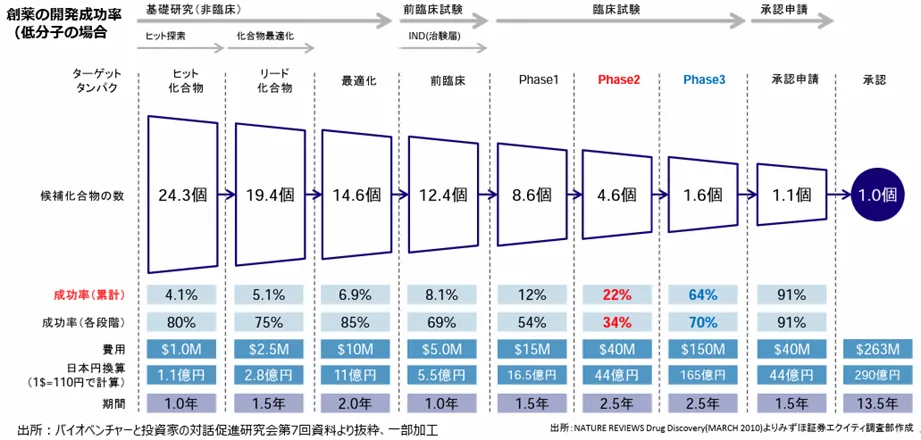
https://www.kantei.go.jp/jp/singi/kenkouiryou/iyakuhin/dai5/siryou1-3-6.pdf
In IT, technology is easy to repurpose and the cost of trial and error is low, so it is easy to make many attempts within a Studio. In other fields, though, I think the model would be closer to biotech, where producing a few companies a year is doing well.
In that case, this model pays off only in fields where a small number of attempts can yield a "sufficient success rate" and "sufficient returns." Such fields are probably few (though they will likely change over time).
There is also the difficulty that the field has to be fixed to some extent, because the equipment needed differs from field to field. If equipment had to be bought anew for each company, costs would rise further.
So what fields are possible? One is Climate Tech.
Efforts have started, with BXVentuers, Marble, and 1.5° Ventures launching initiatives close to the studio model that specialize in Climate Tech. What is interesting is that all of them originated in the EU.
Idealab is also putting effort into Clean Tech: EnergyVault, which went public through a SPAC, and CarbonCapture, which is trying to build DAC, both came out of Idealab. This is a field I am personally involved in as well, so I think it is worth exploring.
3.2 The Role of Nonprofit Organizations
The weakness of the Startup Studio and the Venture Creation Model is that they cost a lot.
Flagship has just under 300 staff, and hiring that many people is a considerable cost. So unless it takes a large amount of equity, it does not pay off. Alternatively, it charges startups for the services (billing back). Either way, though, it becomes quite a burden.
In terms of time, too, it takes longer than ordinary investment. Sutter Hill and Polymath Ventures, among others, have formed evergreen funds with no fixed term and can take a long-term approach, but raising such funds would require a track record. There are also options such as making the studio and the fund separate entities (a dual entity structure), but that in turn makes fundraising from LPs difficult.
So ideally this should become a business that stands on its own as a for-profit venture, but for a while, until the cycle starts turning, I think it would be good if universities and other nonprofit organizations could do it. That is because they should not need to take much equity.
Harvard's Wyss Institute may be a similar effort. Wyss has recently partnered with VCs such as Collaborative Fund and Northpond Ventures, aiming at research and spinning out startups. As someone connected with a university, I admit this is somewhat of a self-serving position...
3.3 Combining With EIRs
EIRs, which are gradually beginning in Japan too, do not seem likely to work well if left to laissez-faire and also lack reproducibility, so I think they will gradually converge on the Studio model, which gathers EIRs in one place and turns them into a program.
4 Summary
- Waiting for a good pitch does not work (good ones are few)
- The good pitches that do come are fought over
- Then why not just make good pitches ourselves?
This is a simple way of thinking, if you will,
but then the first question that comes up is probably "can it be done?"
I would like to say "I can do it!", but the actual reaction is normally likely to be "What, Venture Creation?!" I also think it is quite difficult.
Still, it is true that just waiting gets us nowhere, and I can hardly imagine a future in which the number of entrepreneurs surges in a year or two. Considering that the ecosystem as a whole has to get over this wall, I think the current direction is to somehow find a way to make it possible.
In particular, I think it is better for everyone to grow the pie than to fight over the domestic market and number of entrepreneurs, which will shrink from here on...
That is what I have been thinking, so if anyone is interested in this kind of initiative, I would be delighted to do something together.
Footnotes
-
However, the number of deals is decreasing, and the picture looks different from the optimistic seed-stage conditions of 2022. ↩
-
However, I have also heard that it is becoming harder to launch a first-time fund. ↩
-
Incidentally, the CEO who was brought in was Bob Muglia, formerly of Microsoft, who was a distant former boss of mine. ↩