How Much Did Japan Really Need Accelerator Programs? And What We Need Next May Be "Inception"
This article was machine-translated from Japanese by AI (Claude). It may contain errors. Read the original Japanese article.

Summary slides by NotebookLM
"Acceleration programs," or "accelerator programs," are said to be programs that "accelerate" startups, beginning with Y Combinator in 2005. This model was imported from the United States to Japan, and many accelerator programs have been run across the country.
Looking back over the past decade, however, I think there is room to reconsider how far accelerator programs in Japan actually functioned in the form that was "needed."
To put the conclusion first, my hypothesis is that in Japan, what was needed more than "acceleration" was a program that supports the "initial design of the business" in the first place, and that not enough resources were allocated there. I think this mismatch was significant.
By "accelerator" here, I mean programs that generally provide intensive support over several weeks to a few months (whether or not they involve investment) and move forward progress in areas such as fundraising, customer acquisition, and product validation. Also, I am writing mainly about "ventures that aim for rapid growth and have external funding or rapid expansion in view" (startups in the so-called narrow sense), not about entrepreneurship as a whole.
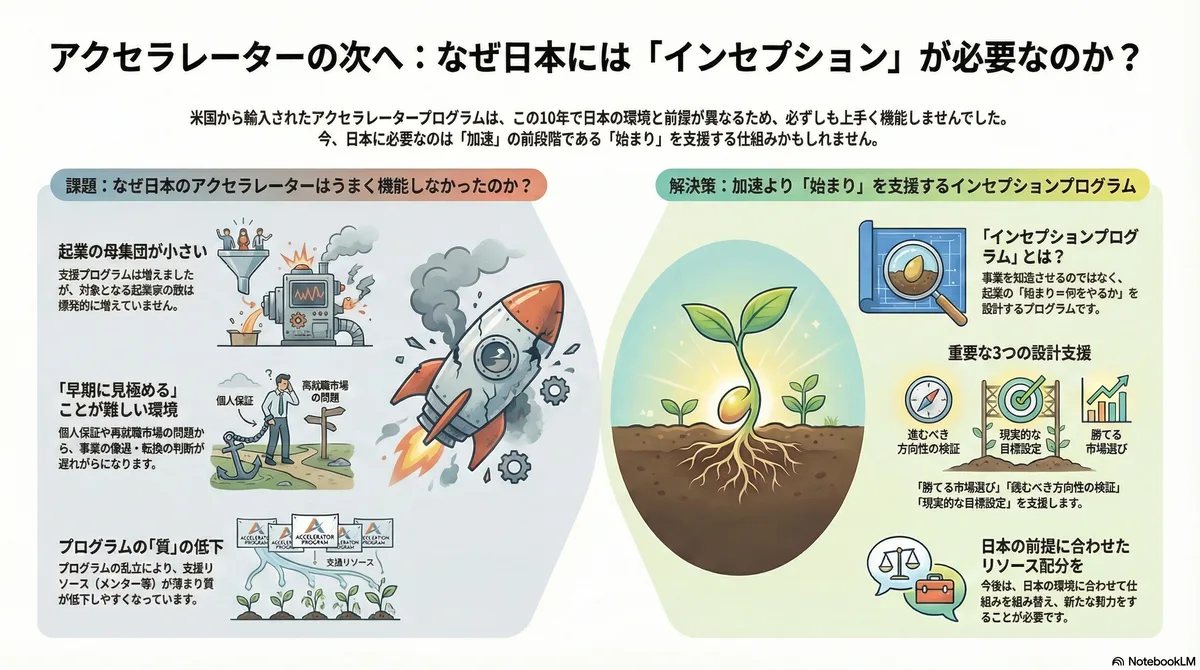
Why Have Accelerators Had a Hard Time Working in Japan?
(1) The "Population of Startups" That Can Be Targeted Is Not Large
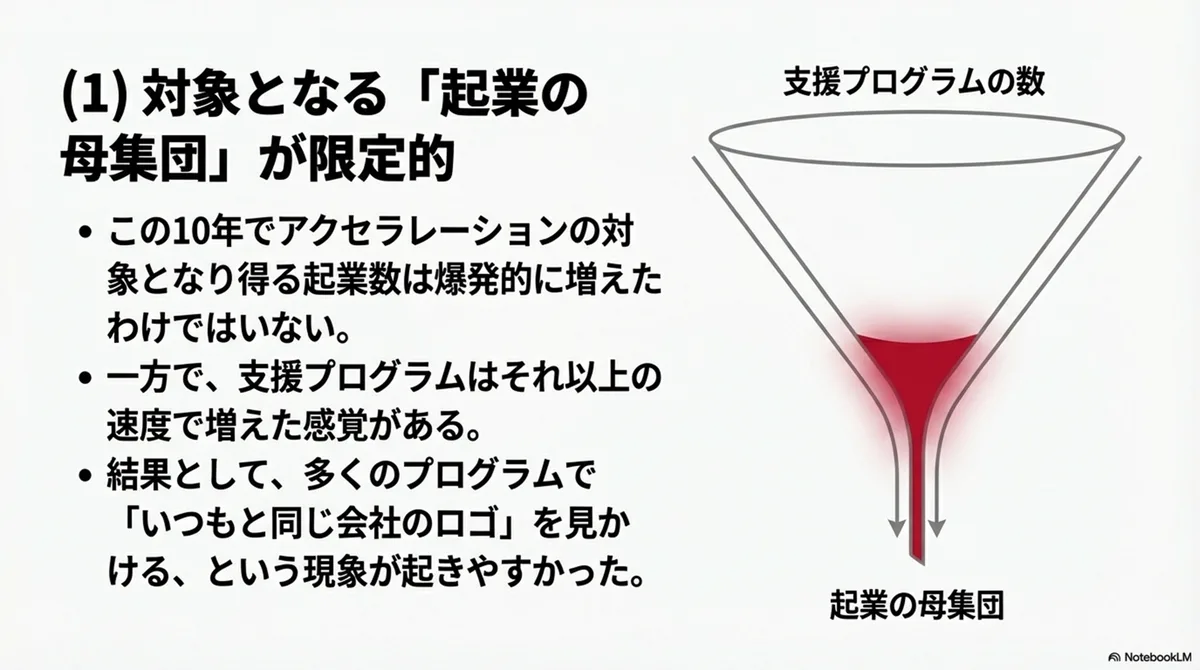
From what I observe, the number of ventures that could be subject to acceleration has not exploded over the past decade, but my sense is that support programs have increased at a faster pace than that.
As a result, it seems that accelerators and startup support programs have tended to produce the phenomenon of seeing "the same company logos as always."
(2) Once Started, They Tend to Last a Long Time
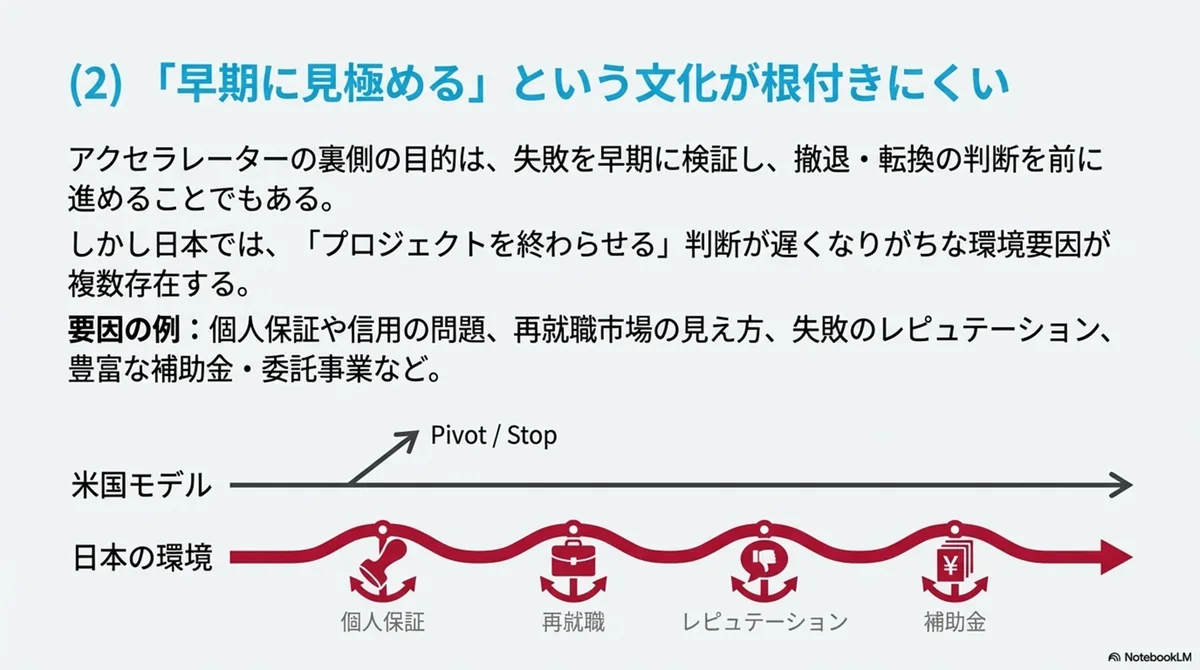
The purpose of acceleration is to speed up a business, but behind it lies the aspect of "identifying early." This includes not only supporting success but also validating failure early and moving forward decisions to withdraw, pivot, or continue. If failure becomes clear quickly, it becomes possible to try the next idea.
In Japan, however, I think there are several environmental factors that tend to delay the decision to close a company itself or to "end a project." Examples include personal guarantees and credit issues, how the job market for re-employment looks, the reputational cost of failure, the abundance of subsidies and commissioned projects, and the timeline until large-enterprise customers adopt a product. Factors that delay decisions to withdraw from or pivot a business, and an environment in which it is easy to keep a business going, are both in place.
Furthermore, the fact that the number of new ventures in Japan is not that large and that many acceleration programs involve no investment also seems to make such withdrawal decisions harder. The absence of investment is not bad in itself, but incentives regarding success and failure tend to be weak for both those who select and those who support, and when the number of ventures is small and candidates for support are few, programs tend to accept even ideas of somewhat lower quality.
As a result, I also feel that the supported companies, rather than "accelerating their decisions," went "from one source of support to the next," which left them unable to decide to withdraw from their businesses and made "life support" more likely.
(I am not saying that "life support = bad." I am writing from the viewpoint that, at least for startups, if a company is not going to grow rapidly, it is better for the decision to give up to come early.)
(3) The Problem of Program "Quality": Insufficient Effort and Supply Constraints
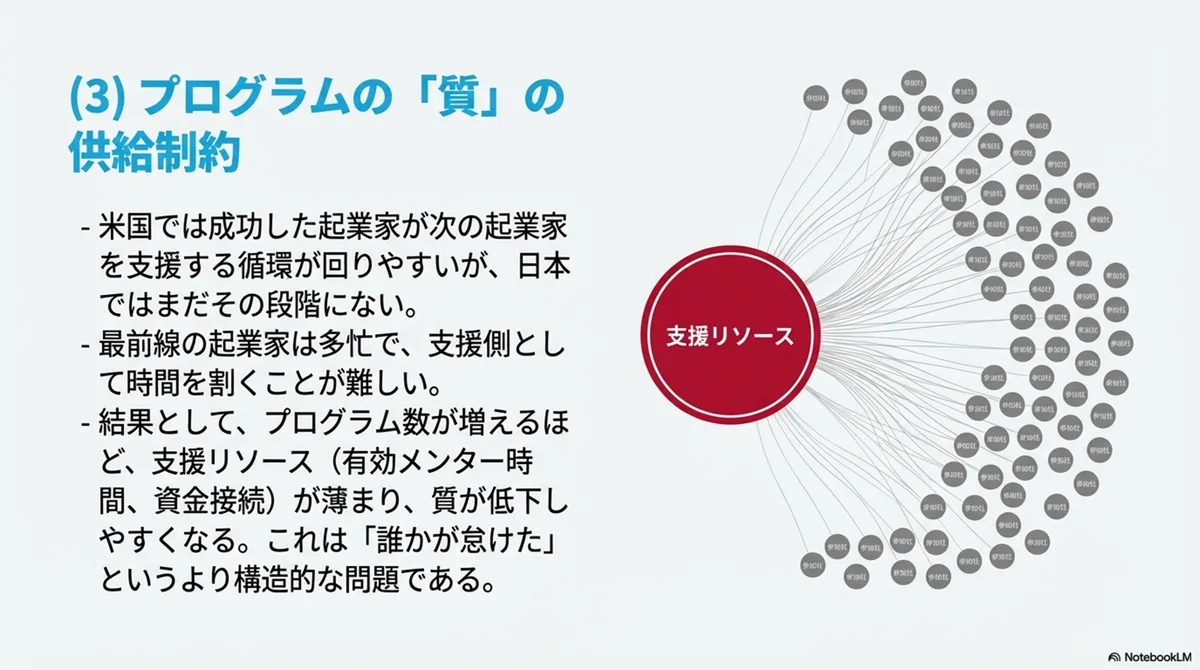
There is also a structure that makes it difficult to ensure the quality of programs.
In an environment like the United States, where many hugely successful startups have emerged, experience forged in real battles is supplied, and a cycle in which entrepreneurs themselves support the next generation of entrepreneurs is likely to turn. In Japan, by contrast, we are not yet at a stage with that many big successes. Entrepreneurs on the front lines are also busy, and tend to find it hard to make time to be involved on the supporting side. I also often hear that, especially in regional programs, there are relatively few people who can make startup-style decisions or give concrete advice.
And as the number of programs grows, the scarce resources on the support side (mentors, connections to customers, connections to funding) get spread thin, and quality tends to decline. This is less a matter of "someone slacking off" and closer to a problem in which "effective mentor hours ÷ number of participating companies" structurally gets divided down.
Even So, Accelerators Are Not Unnecessary
The accelerator programs that Japan imported from the United States may work if conditions like those in the United States are met: an environment where "large numbers of entrepreneurs emerge spontaneously," where people "wind down as if killing the project rather than the company," and where "the people involved in the programs are of high quality." But because Japan's preconditions differ, my sense is that on the whole they did not work very well, and that is what the past decade of trials amounted to.
Having written this far, you might read it as "so accelerators are unnecessary?" but that is not what I am saying. In Japan too, there are still situations where acceleration and incubation are needed, and there are programs that are truly meaningful.
That said, I also feel that, like startups, accelerators are an area that tends to follow a power law. Even in the United States, successful accelerator programs are limited, and there is a view that, in terms of consistently producing unicorns, only Y Combinator has succeeded.
Still, if we take this difference as a premise, I feel that Japan should have allocated resources to a somewhat different layer before importing "acceleration."
And going forward, I think a mechanism that supports this stage "before acceleration" is becoming necessary after all.
A Proposal for an Inception Program: Supporting the "Beginning," Not Acceleration
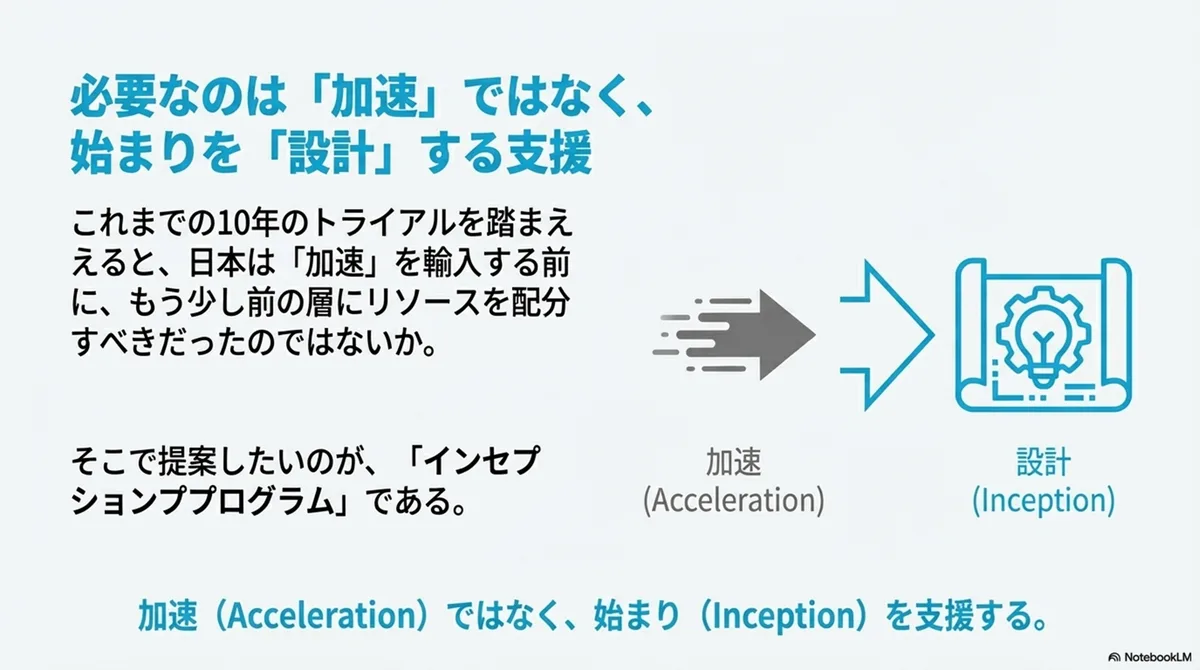
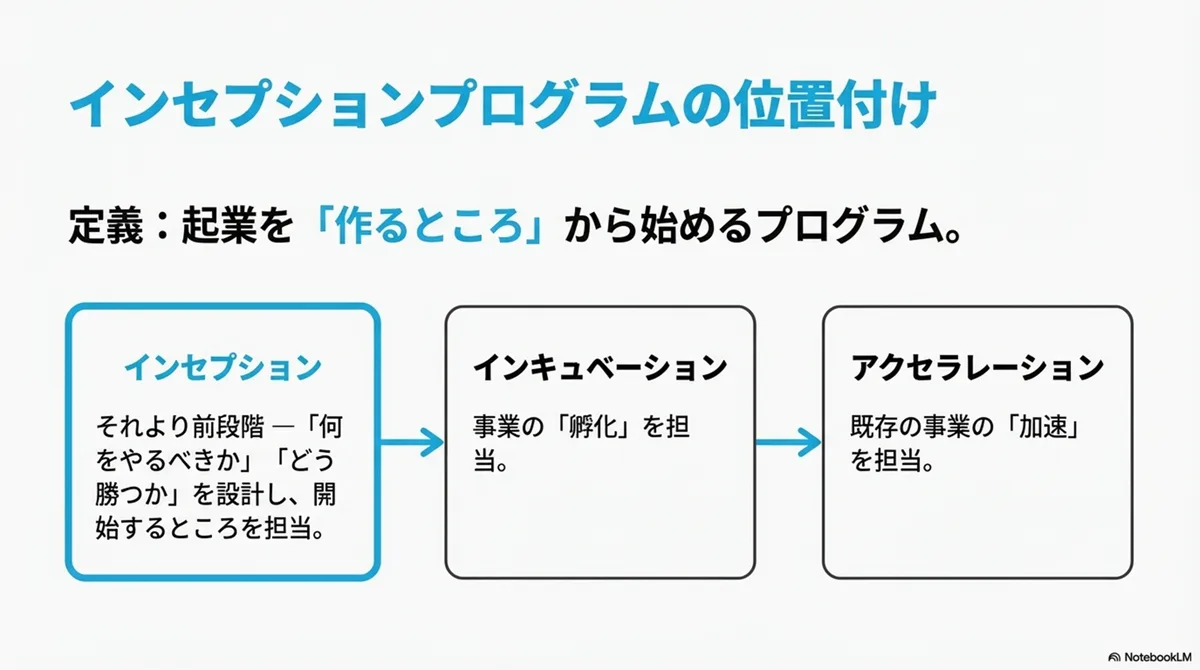
What I would like to propose, then, is an inception program. It is positioned as a program that starts from creating the venture.
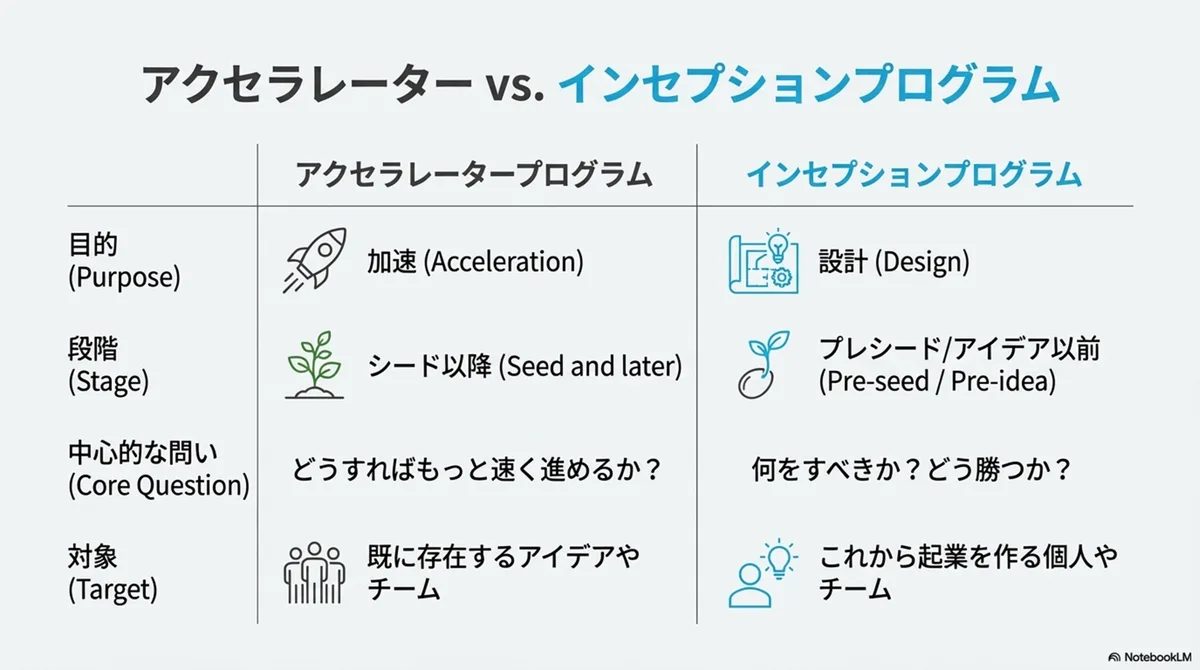
Acceleration handles speeding up and incubation handles hatching, but both are concepts that assume starting from a state where some kind of "seed" (an existing idea or team) already exists. Inception is the division that covers the stage before that: designing "what should we do" and "how will we win," and getting started. You could call it company creation or a venture studio. What matters is "which phase is being supported."
Especially for startups today, how to design the business in the early stage has become more important. For example:
- How to choose a market (not just a large market, but including "attainability")
- What direction to pursue (whose budget, and how it will be bought)
- How to set goals that are both ambitious and realistic (learning speed and capital efficiency)
Rather than accelerating an idea that already exists, I think Japan needs more programs that build this kind of design together with entrepreneurs.
However, this is by no means entrepreneur-friendly. It would no longer be a program that unconditionally supports "what the entrepreneur wants to do." It is a move toward optimizing the ecosystem as a whole, and I think it would be a program that stands apart from general startup support programs.
In Closing: Readjusting Resource Allocation to "Japan's Preconditions"
Summary by NotebookLM
To repeat, I am not saying that accelerators are unnecessary. There are situations where they are needed, and there are probably situations where they are working well.
However, looking back at the past decade of trials, there is a regret that, even though Japan's preconditions differ from those of the United States, we multiplied the same form in large numbers. As a result, I think the resources did not go to the support that Japan's ecosystem truly needed.
With a boom, it is somewhat unavoidable that something ends up in oversupply. The problem is how we learn from it and apply it next time.
In that sense, I believe that going forward, more effort is needed to reorganize the resource allocation of conventional support programs to suit Japan's environment and the latest circumstances, and that a new framework like the inception program is needed for that purpose. That is what this post was about.
I did propose that name back in 2019, but I am proposing it again here.