"Industry Creation" Between Startups and Regions
This article was machine-translated from Japanese by AI (Claude). It may contain errors. Read the original Japanese article.
Summary by NotebookLM
In thinking about startups, I am once again feeling the importance of considering "the industry as a whole."
There are two main reasons:
- If you try to build a large startup, you have to think about what kinds of companies are needed around it
- The question "By 2050, in which industries will Japan be earning its living?" is becoming more important even when thinking about startups
That is what I believe.
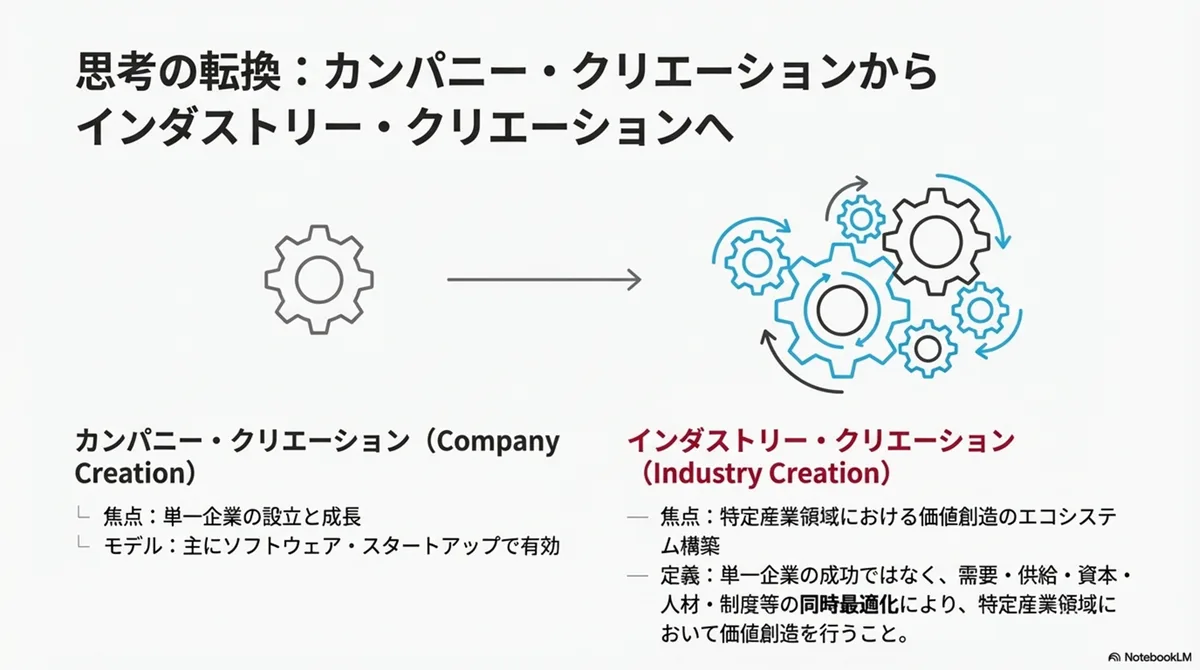
If we borrow the term "company creation" from the startup world, expanding the unit of thought "from companies to industries" can also be described as a need for "industry creation" thinking and efforts.
(Here, industry creation refers to creating value in a specific industry domain not through the success of a single company, but through the simultaneous optimization of demand, supply, capital, talent, institutions, and so on.)
Why the Industry as a Whole Matters
Let me lay out this background using an example.
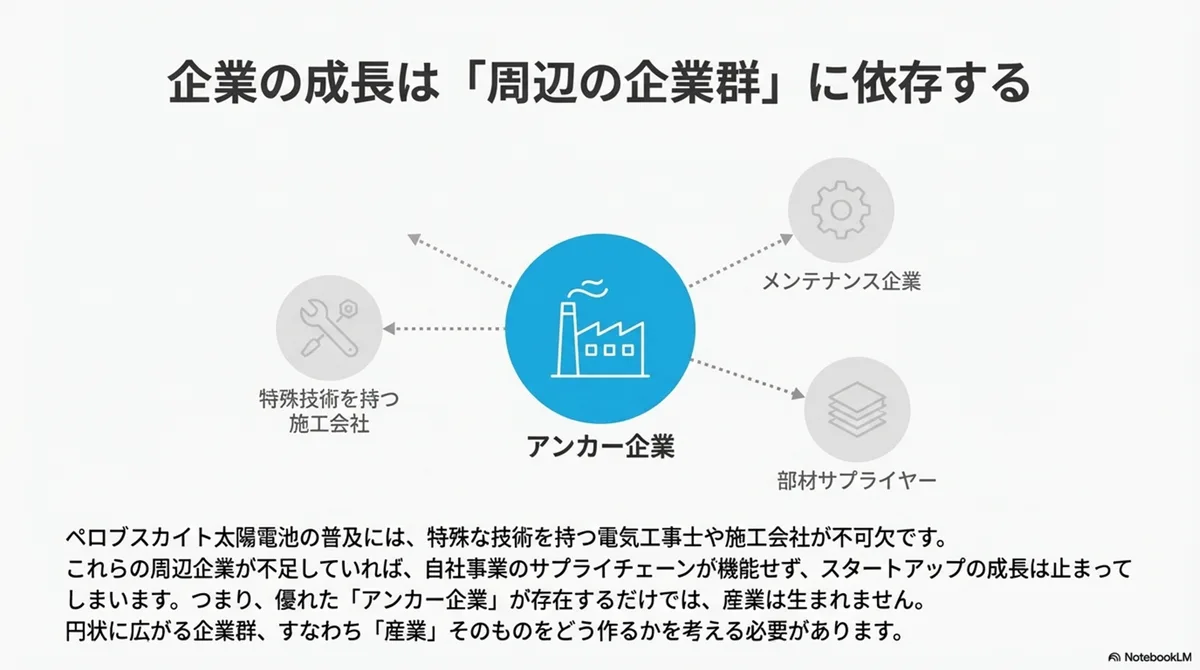
As of 2025, perovskite solar cells are attracting attention in Japan. Suppose a high-growth startup emerges to carry out their research, development, and mass production.
But if there is a shortage of electricians and installation contractors, the cells cannot be installed, and the company's growth in Japan would probably stall.
In other words, even if you manage to create a candidate for a high-growth startup, the companies around it become the rate-limiting factor, and the startup's growth stalls as well. If you truly want a startup to grow rapidly, you need to think about how to build the industry, including the supply chain surrounding its own business.
Put in a diagram, anchor companies and high-growth startups sit at the center, with many companies arranged in a circle around them. The question is how to create that situation, or, so to speak, how to create an industry.
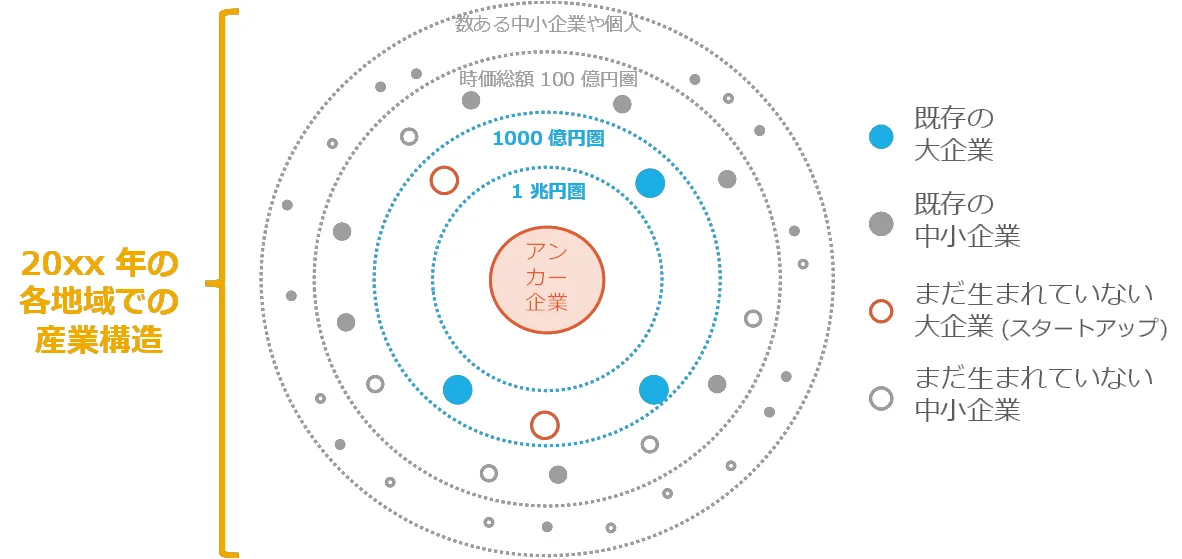
The automobile industry of the past was likewise built this way: companies such as Toyota at the center generated large demand, and around them Tier 1 and Tier 2 companies emerged, thereby creating an industry.
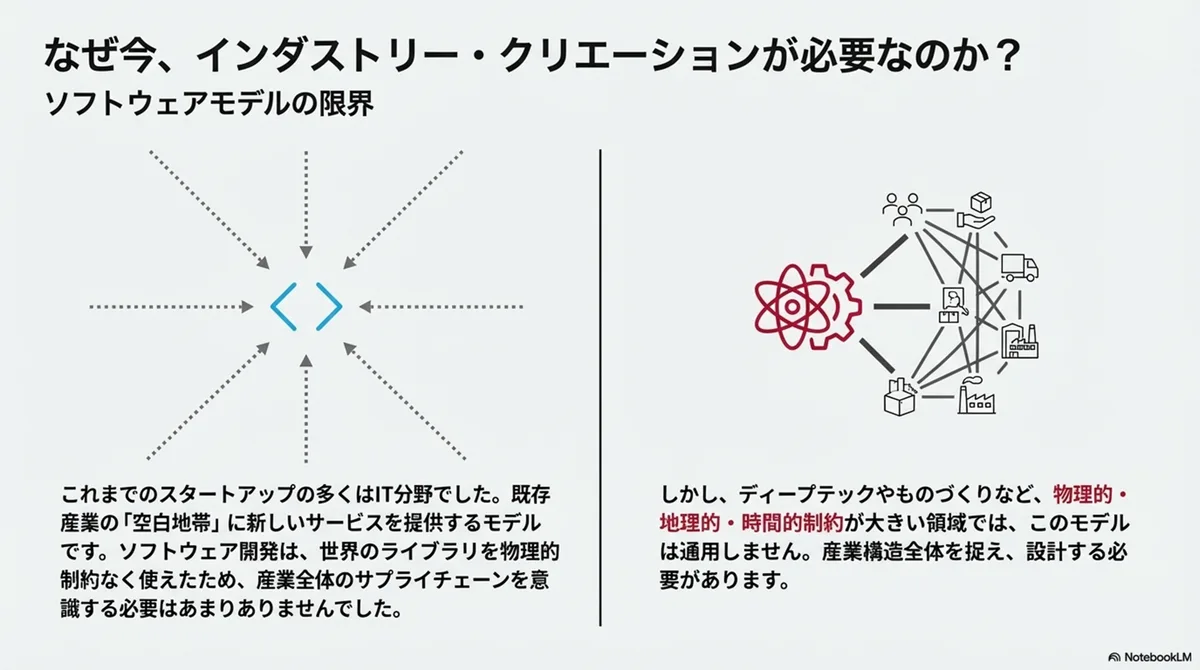
By contrast, over the past 20 years or so, the "industry" of Japanese startups has been almost entirely "IT." Creating and offering new IT services in the previously empty markets of the Web and smartphones, or creating IT services in the software market, which is an extension area for existing industries, has been regarded as creating "the IT industry."
For businesses that are completed within software, there was not much need for this way of thinking about how to build an industry as a whole. There was little need to be conscious of the supply chain upstream and downstream, and development could use libraries from all over the world without physical constraints.
Today, however, efforts are underway to create startups in industry domains other than IT. There, existing industrial structures exist, and geographic, physical, and temporal constraints also arise, so the need to proceed while considering the whole picture increases.
The Difficulty of Building Companies That Are Not Startups
Returning to the solar example, a company that employs the people who do such installation work would have a labor-intensive business model and would be dispersed across regions, so it would probably end up as a company whose individual market capitalization does not rise very high. One option is for a startup to foresee all this and go full-stack, doing the installation and so on itself, but there are domains where such vertical integration is feasible and domains where it is not.
Funding and support are also issues. VCs with large funds can invest only in the startups at the center. Startup support is, after all, support for high-growth startups, and the general entrepreneurship support provided by government also targets individual startups. I don't think there has been much effort to support entrepreneurship in a way that specializes in a particular industry and optimizes that industry as a whole.
My concern is this: software startups could uniquely focus on optimizing for building a single company, but in other domains, don't we have to design with the whole industry in mind?
This may not be the role of the startup ecosystem. But considering that we cannot build large companies unless we think about these things as well, I believe that startups themselves also need to think about and propose this overall picture of an industry.
The Region as the "Vessel of an Industry"
From the perspective of building such industries, I think regions are important.
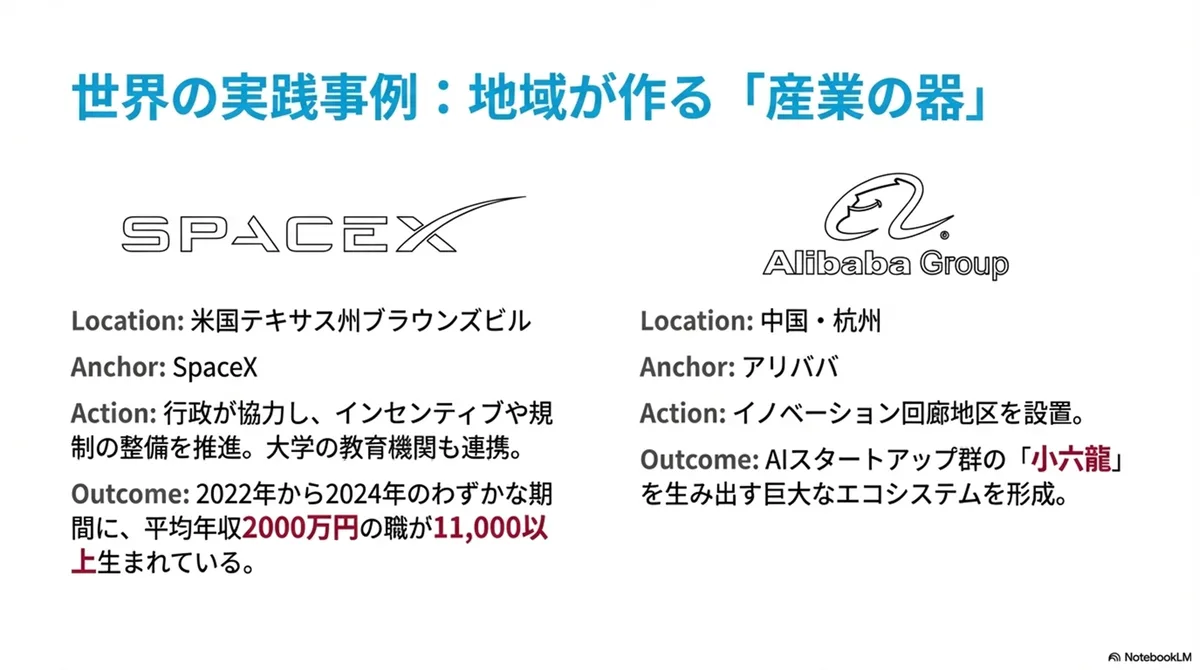
For example, SpaceX, an anchor company, is located in Hawthorne. It not only carries out research, development, and manufacturing; its suppliers also sit alongside it, government works with it to put incentives and regulations in place, and educational institutions such as universities cooperate. As a result, it is said that in just the short span from 2022 to 2024, more than 11,000 jobs with an average annual income of 20 million yen were created.
In Hangzhou, China, a district called the Innovation Corridor was built around Alibaba, and it has now also produced the group of AI startups known as the "Six Little Dragons."
Japan also needs to build such vessels. Each region has its own history and industries, as well as its own geographic features. If a port is nearby, exporting and importing is easier, and the talent you can hire differs depending on what educational institutions exist.
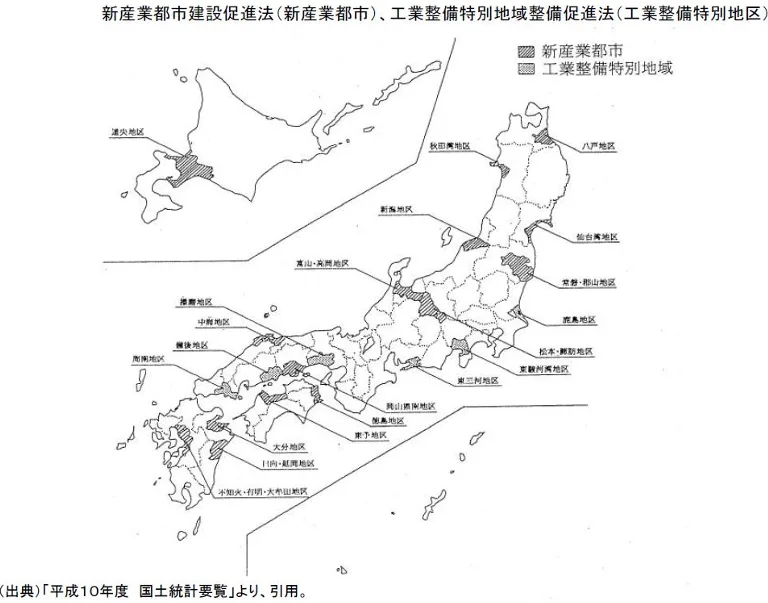
Reference example of past efforts: https://www.cas.go.jp/jp/seisaku/gx_jikkou_kaigi/senmonka_wg/dai8/siryou2.pdf
I think we need the perspective of how to carry out this kind of design in each region.
In fact, one thing I hear a lot from the people around me lately is the "redesign of the Pacific Belt." The industrial complexes (kombinato) of the Pacific Belt, built after the war, are gradually seeing their utilization rates fall amid global competition, and with a view to GX we have to think about how to redesign the existing facilities and assets in terms of industry and employment. This is exactly the time when region-by-region industrial policy of this kind is needed.
Building Minimum Viable Clusters and Competition
This is, so to speak, a discussion of industrial clusters. Still, I think there is an aspect in which building such clusters top-down has become harder than it used to be. In the postwar period, the economy was a catch-up economy, and demand for things like chemical products was reasonably visible. That is why it could be foreseen that if investment were concentrated and supply provided cheaply, one could capture a certain amount of domestic and overseas demand.
Today, by contrast, we don't know which industry will hit, and some exploration is necessary. Moreover, unlike in the past, we are not in a position to nurture industries gradually; I think we need the mindset of how to build such industries with speed.
That makes an approach of building new industrial clusters quickly and experimentally necessary. If we call the smallest unit of this, after industrial clusters, a Minimum Viable Cluster (MVC), I think we need to experiment with designs like the following in various places.
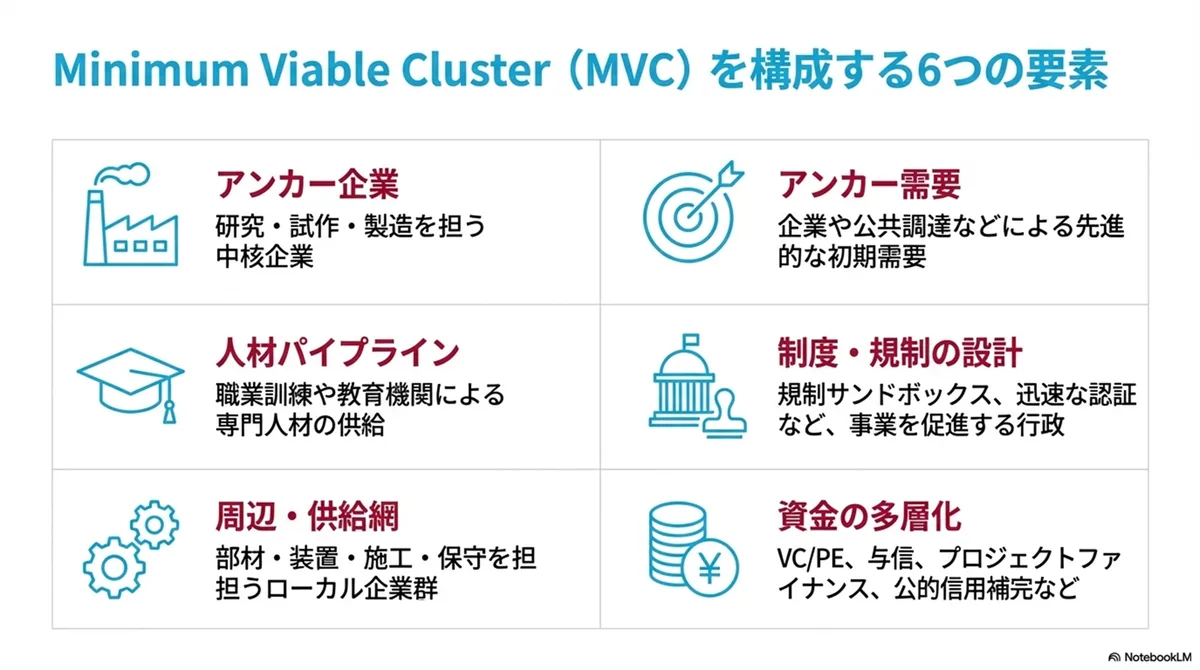
- Anchor company (a company with research, prototyping, and manufacturing)
- Anchor demand (advanced demand from companies, public procurement, and so on)
- Peripheral supply network (companies providing components, equipment, installation, and maintenance)
- Talent pipeline (educational institutions offering vocational training, micro-credentials, and so on)
- Design of institutions and regulations (government providing regulatory sandboxes and rapid certification and pre-approval)
- Multilayered financing (financial institutions providing VC/PE, credit and project finance, public credit enhancement, and so on)
In China, local governments engage in this kind of effort while competing fiercely with one another, and it appears that emerging industries have arisen from that.
In Japan as well, I think we need to create multiple such MVCs in each region, compete within Japan, and have the companies that grow there venture out overseas.
Startups can be, and must become, the central parts in that process, and at that point, coordination with regional industrial policy becomes all the more important.
In fact, the value of regions is gradually beginning to change. In the past, IT meant concentration in Tokyo, but if Japan continues to partner with the EU, for example, there is ample possibility that manufacturing will gradually shift its bases to Kyushu and Hokkaido, where green electricity may be available cheaply.
In Which Industries Do We Go for the "Center"?
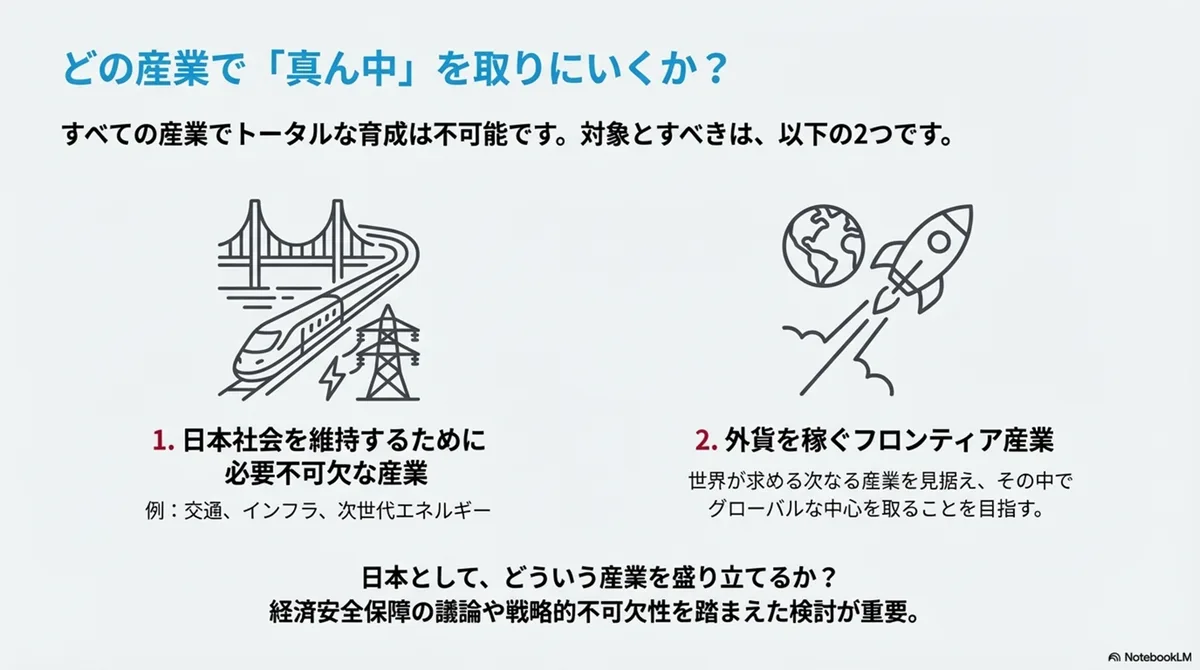
That said, we cannot do this kind of comprehensive development in every industry. The target industries will probably be:
- Industries needed to sustain Japanese society (for example, transportation)
- Frontier industries that earn foreign currency
What we then need to think about is which industries Japan as a country should build up.
In IT, the United States has become almost the sole winner. In AI too, US startups such as OpenAI and Anthropic have emerged as anchor companies right at the center of the circle diagram I mentioned earlier, while Japan ends up building businesses mainly at the periphery, such as applications that use AI. But the closer a company is to the center, the higher its ultimate profit, and the further toward the periphery, the more it takes the position of a digital sharecropper, and the digital deficit widens. That is the structure.
In that case, the mindset of picking the next industry the world wants and going for the center within the world becomes more important.
I also feel that, for startups from Japan to grow rapidly, there is an increasing need to think about growth potential at the industry level and to place bets accordingly.
We will need to look broadly at global markets and, while considering things such as strategic indispensability in discussions of economic security, think about which industries to build.
Implementation: How to Advance Industry Creation
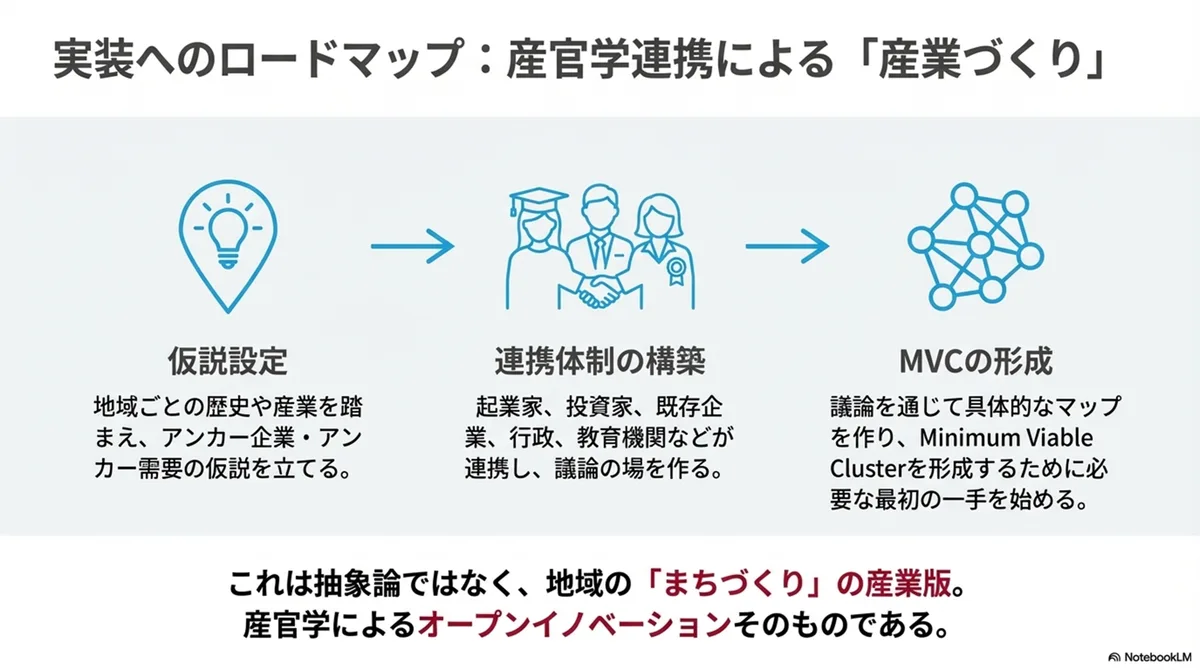
From here on is about how to do it. Each region will probably need to consider quite concrete businesses, not abstractions, based on its own history and industries. My own proposal is to set hypotheses for the anchor company and anchor demand, think about the value chain around them, and build the group of necessary, high-value-added businesses.
For that, I think collaborative work will be needed: entrepreneurs and investors devise businesses, existing companies and government generate early demand, educational institutions develop talent, and government enables regulation and certification to be handled quickly. While drawing up the final map, we should start taking the steps needed to form a Minimum Viable Cluster, and start building a forum for such discussions with a small group of members. This is probably what is needed in each region. In a sense, it is an industrial version of town planning (machizukuri): building teams for "industry building" across industry, government, and academia.
In a sense, it could also be called open innovation among industry, government, and academia.
And I think the indicators should also be replaced, not with the amount of funds raised, but with things that measure the muscle of an industry, such as the domestic value-added ratio, the export ratio, and the number of high-value-added jobs created.
Conclusion
If we define Japan's winning condition in 2050 as "a country where many people can live with a reasonable level of prosperity," I feel we have now reached the stage of squarely considering how to implement such mission-oriented industry creation. There are various constraints, such as demographics, geopolitics, and technology, as well as variables such as international relations, but within them we must find a path to winning.
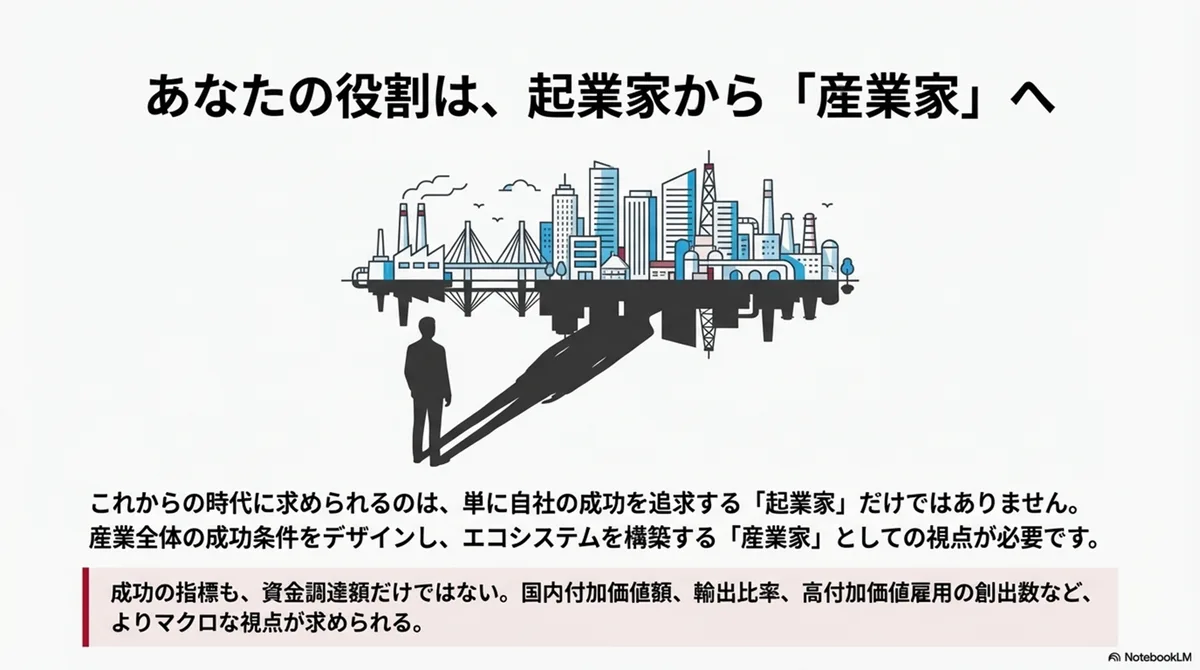
For that reason as well, I feel that what is needed are people and places that go beyond a company's own conditions for success and design the conditions for an industry's success.
In that sense too, I believe this is an era in which we think about "creating industries" (industry creation), and I hope that we can start with what we can do, so that it does not end as an ideal but moves toward implementation.
(I previously wrote an article titled "From Entrepreneurs to Industrialists," and this article is an extension of it.)