The Full-Stack Deep Tech Startup Strategy
This article was machine-translated from Japanese by AI (Claude). It may contain errors. Read the original Japanese article.

I have long translated and written articles about the concept of the "full-stack startup," which Chris Dixon proposed in 2014.
Combining this full-stack startup with deep tech gives you the "Full-Stack Deep Tech Startup." It has been proposed by Ian Rountree of Cantos Ventures, an American VC.
The defining feature of a full-stack deep tech startup is that it
provides the "end product" rather than selling a "breakthrough technology"
.
In the space sector, a full-stack deep tech startup does not run a business selling "advanced rocket engines." It sells rockets (or rocket services).
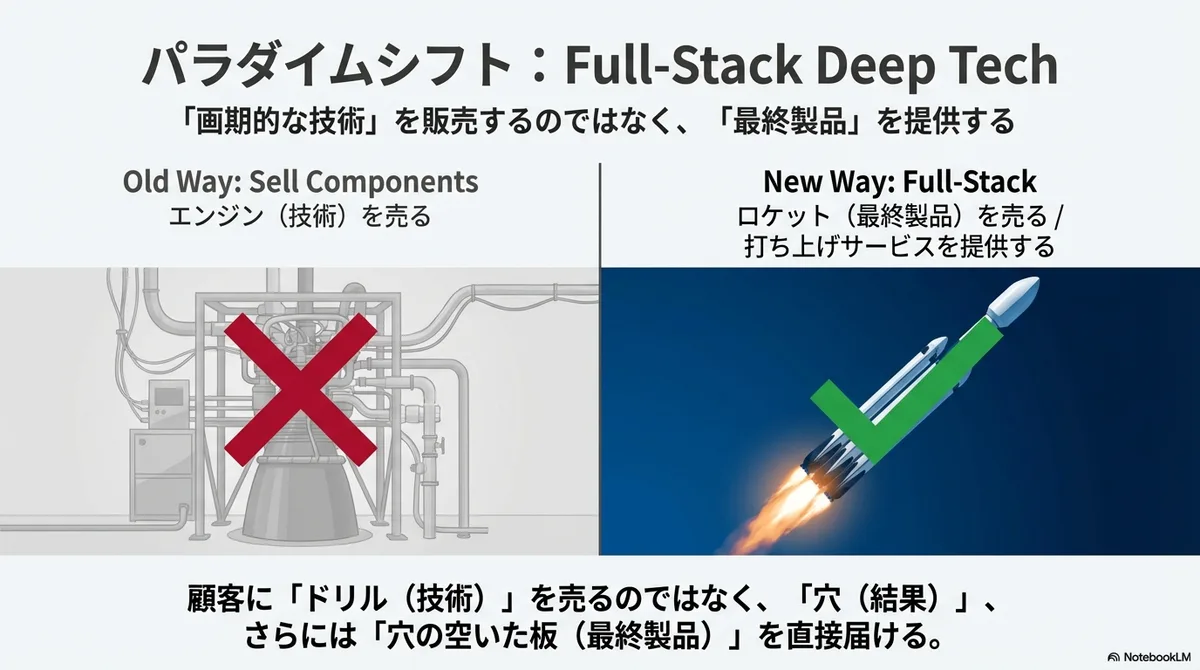
I myself often feel that precisely because they are deep tech startups, a full-stack orientation may suit them better.
So why is full-stack better suited to deep tech? After listening to the Energy Impact Partners podcast from the start of this year on which Ian appeared, I once again felt that this way of thinking should be widely known in Japan too, so I am putting it together in an article.
A Brief Summary
- Going full-stack is a strategy in which a startup absorbs the various kinds of friction (integration, operations, sales, liability) in-house, increasing its speed of learning and implementation. As a result, it also leads to a larger TAM and entry barriers.
- However, because the scope of the business widens, the startup takes on CAPEX, regulatory, and operational risks. Judging whether it suits you, and the business vision, therefore become very important.
The Problem: Why Do Deep Tech Startups Stall at Series A?
A deep tech startup is regarded as a form of entrepreneurship that aims for rapid business growth by commercializing technologies that have "a low Technology Readiness Level but great potential," mainly from university research and the like.
Its scope spans a variety of fields, such as space, materials, drug discovery, and electronics.
What they have in common is that the technology itself is the core competency of the business.
For that reason, the conventional approach of deep tech startups has been to "sell a breakthrough technology to incumbent companies."
Technology Is Just a "Gear"
However, as I explained in the slides on the "layer structure," technology is only one part of the system that is a product.
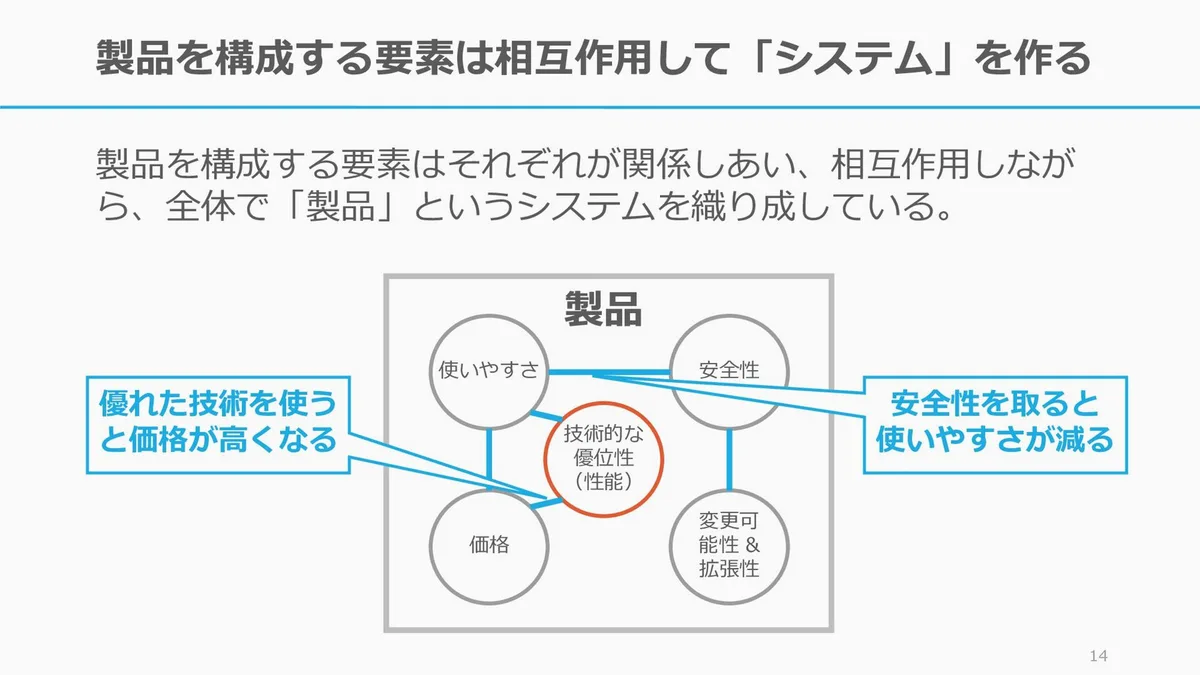
To put it another way, technology is one of the "gears" that make a product work well.
And the product is one gear in activities such as production at a factory, and the product can in turn be called one gear in the company's profit-generating activities.
Would You Replace Everything for the Sake of One "Gear"?
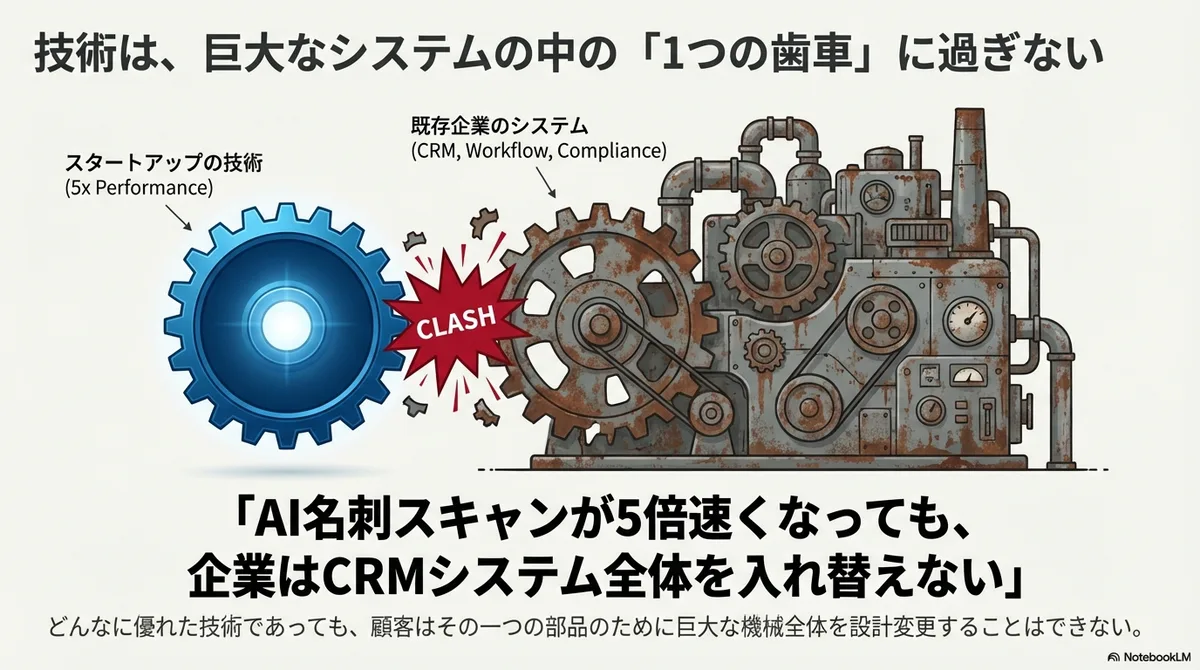
A gear fully performs its function when it meshes well with other gears. But when the meshing is poor, it does not run smoothly.
Raising the performance of the whole business means that these gears must mesh continuously, that is, that the so-called workflow must flow. So no matter how excellent a single gear is, it is unlikely that anyone will decide to change everything else in order to adopt it.
As a result, the following kind of decision is likely to be made:
"No matter how excellent a single gear is, it is hard to decide to replace all the other gears in order to adopt it."
Example: Fast business card scanning
A familiar, concrete example makes this easier to understand.
For instance, in our everyday workflow, even if someone told us "AI will make business card scanning five times faster," we would hardly consider replacing our business card management CRM. That is because scanning business cards is only a small part of the overall workflow.
Problems and Risks That Tend to Arise from "Selling Technology"
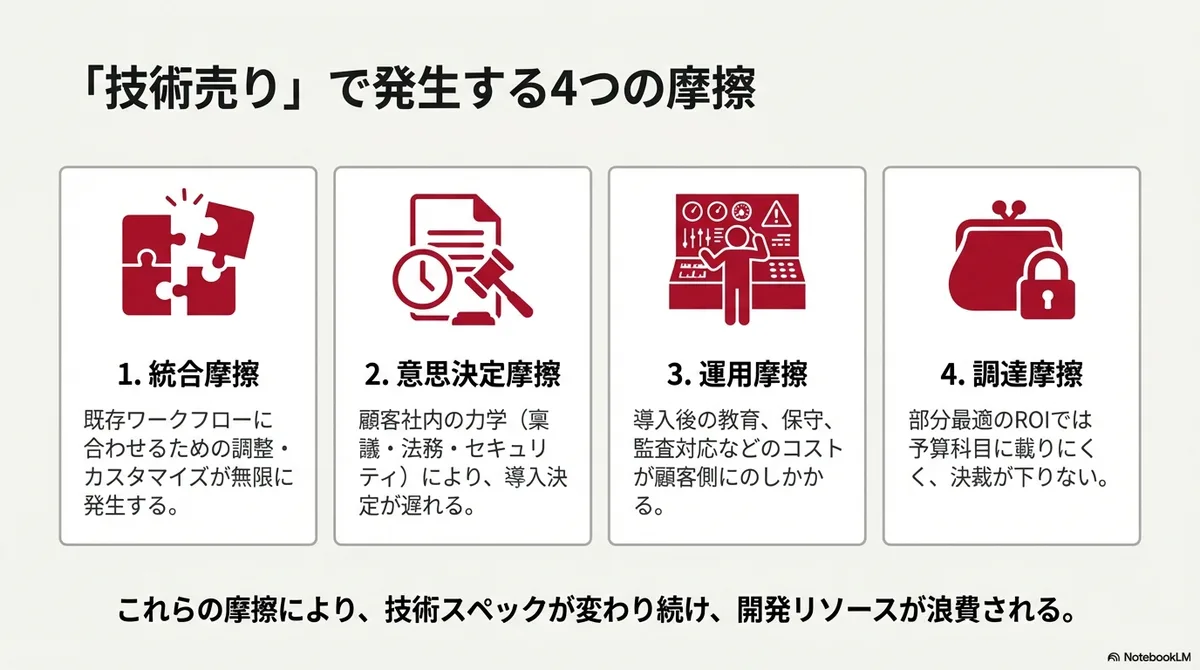
In the conventional model of "selling technology as a component," the following kinds of friction tend to occur.
- Integration friction: The adjustments and customization needed to fit the existing workflow keep growing
- Decision-making friction: Because of the internal dynamics of the customer's organization (approval procedures, procurement, IT, the front line, legal, audit), reaching a conclusion is slow
- Operational friction: The operational burden after deployment (training, maintenance, monitoring, audit response) tends to increase
- Procurement friction: When the ROI is a local optimization, it is hard to fit into a budget line item, or people say "the current setup is good enough"
- The gap from demonstration to commercial use: The PoC passes, but the project stalls on the requirements of production operation (quality, supply, safety, regulation)
What makes things even harder is that, because this friction becomes apparent only after the fact, the specs and requirements demanded of the technology keep changing, and the direction of the technology development itself may change as well.
No matter how many resources have been poured into technology development, when the specs change, the development done up to then is often wasted.
"Progress in Technology Development" Is "False Progress"
I think that in deep tech this difficulty comes to light at Series A and afterward.
In the very early stage of a business, progress in developing the technology itself is "valued." You will probably be able to raise early funding from some investors. As a result, the team comes to think "this direction is right" and keeps pushing technology development forward.
But once the technology has reached a certain level of performance and you try to apply it at the customer's site, the kinds of friction described above arise. The direction of technology development then keeps changing, and you end up doing additional technology development with the remaining funds.
And as you approach Series A, investors' evaluation criteria shift from "technical progress" to "revenue" and "potential scale." But a team that is not ready for this often finds it difficult, with the funds that remain, to show enough business progress (not technical progress) to match investors' expectations, and it can easily happen that the team has no choice but to continue technology development somehow with subsidies.
Because the team fails to foresee this qualitative change in what counts as valued progress, and because of the high praise from recent investors based on "technical progress alone," it becomes easy for the team to be unable to allocate resources to the activities that are actually needed.
Solving the Problem with a Full-Stack Deep Tech Startup
This is where the Full-stack Deep Tech Startup (FDTS) comes in.
A full-stack deep tech startup absorbs, in-house, the friction that tends to arise in this kind of "technology selling," and extends its value chain, changing from
- Conventional: selling components
- FDTS: selling products
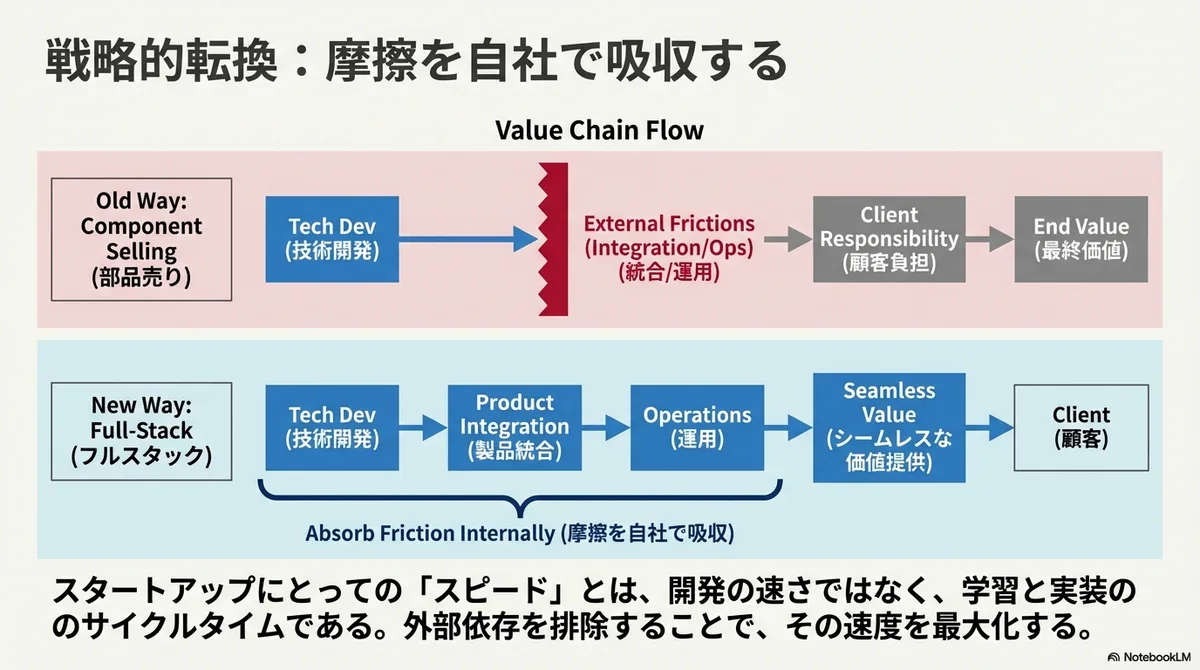
To put it a bit more abstractly, friction arises everywhere, but I think the idea is to bring the parts that used to involve intense friction with outside parties inside the company, and to extend the value chain to a point where there is little friction with outside parties, thereby reducing friction in relative terms.
If that point is a commodity, the startup provides that commodity product, so it sells products rather than components.
In some cases, however, it may provide modules, or it may provide services that go beyond the product.
The Benefits of a Full-Stack Deep Tech Startup
Taking the full-stack deep tech startup approach has the following benefits.
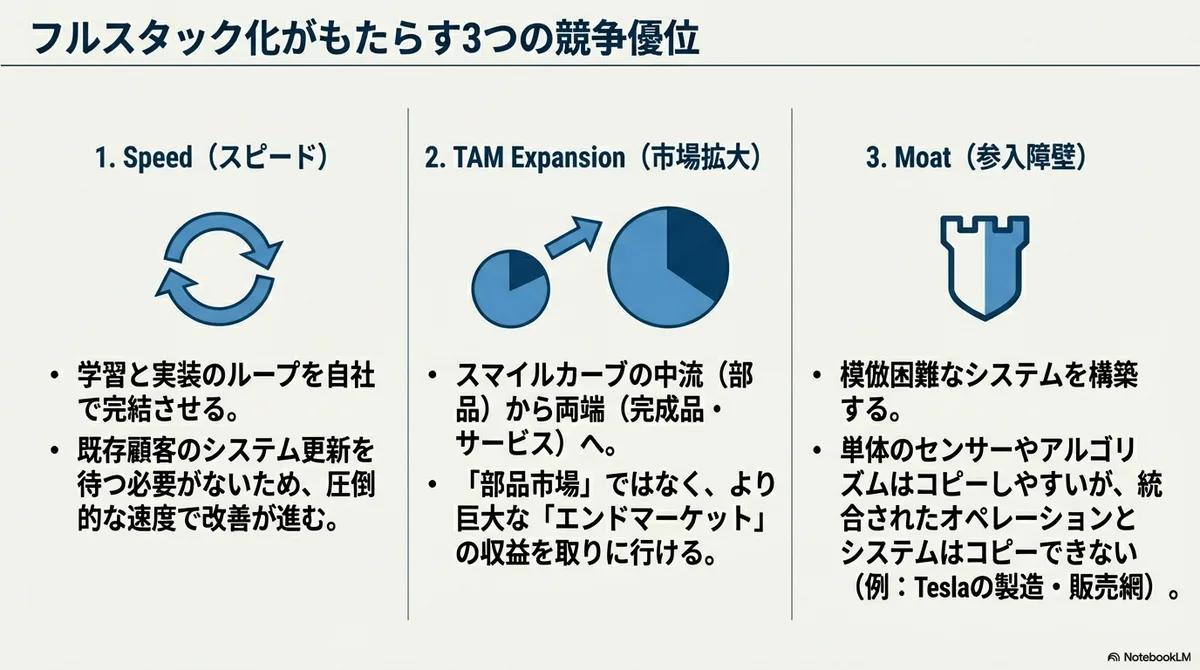
(1) The scope you can control in-house grows, so learning and implementation get faster
First, the scope you can control in-house grows. The scope that is rate-limited by outside parties (the circumstances of incumbent companies) shrinks, and the loop of trial and error turns. For a startup, "speed" should be not merely development speed but learning speed.
It is said that speed is everything for a startup. In articles such as "The Limits of the Lean Startup" and "The Demand-Side First Penguin," I wrote that "customers shape the direction of the business." When you think about how to keep your own speed from being constrained by outside parties, going full-stack is one method.
Of course, if you can clear those constraints through top-level sales and the like, that is a different matter.
(2) You can go after a larger market (TAM)
Selling technology as a component generally falls in the middle of the smile curve, unless that technology has a considerable degree of exclusivity.
By extending the value chain, on the other hand, you can also cover the highly profitable parts and approach a larger TAM. And if you ultimately refine the technology and operations, your profit margin also grows. By capturing customers, further product development becomes possible as well.
SpaceX did not sell rocket engines. It built rockets and sold launch services for satellites as infrastructure. That is precisely why the space industry was born and why it was able to create new services of its own, such as Starlink.
(3) You can build barriers to entry
Full-stack also has major downsides (CAPEX and organizational complexity), but conversely, if you can climb that high mountain, you become hard for other companies to imitate.
For example, it is quite difficult to imitate a company like Tesla. So once you have fully won, the likelihood that your profit margin rises is also high.
Why Full-Stack Deep Tech Startups Now?
As with startups themselves, a concept like this needs a hypothesis about "why now."
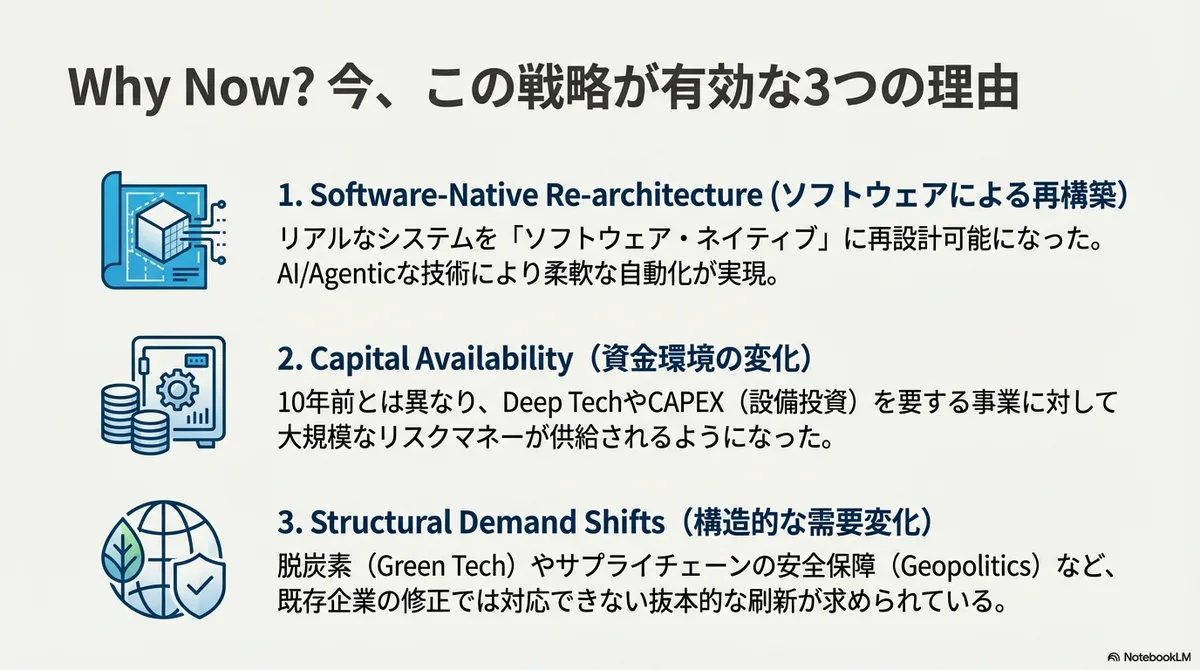
(1) The opportunity to rebuild with software
Software is increasingly being used in forms other than those of incumbent companies, and connectivity is rising. When factories shifted from steam power to electric power, what was required was not the technological change in the power source itself. As with the way electric motors changed the production layout, the point lies in changing the design philosophy of the factory (the production architecture).
Conversely, it has also been pointed out that traditional factories were slow to switch to the new technology of electricity because they already had existing equipment and had already invested in it. (A recent example is Damron (2025) of Duke.)
You could also say that by skillfully combining the certainty of conventional deterministic software with the flexibility that has developed in recent probabilistic software (AI), the range in which machines can act agentically, and their applicability, are expanding.
In a sense, the fact that today we can build a "Software-native" "Full-stack Deep Tech startup" is one of the reasons for "Why now."
(2) Easier access to funding
Compared with ten years ago, the environment in which startups can raise large amounts of capital has expanded. Full-stack requires capital early on, so this structural change is important.
(Ten years ago, it would probably have been an idea that no one gave a second look.)
(3) Changes in demand (decarbonization, geopolitics, and so on)
Demand that differs from conventional demand is emerging, such as demand for green products and demand for supply chain restructuring due to political risk.
This wave is not temporary, and because it can connect to the rebuilding of industrial structures, there are more and more situations in which full-stack players who "make and supply" can capture value easily.
Examples of Full-Stack Deep Tech Startups
Let us look back and see whether such startups actually exist.
Among the older ones, I think the following startups fall into this category.
Company | Typical | Full-stack |
SpaceX | Sell rocket engines | Provide space services |
Tesla | Sell batteries to GM | Sell EVs |
Among recent ones, there are startups like the following.
Company | Typical | Full-stack |
Anduril | Sell SaaS to the defense industry | Sell defense products |
Solugen | Sell biomanufacturing technology | Sell chemical products |
Hadrian | Sell SaaS for manufacturing | Sell aluminum parts |
They are not deep tech, but the same is true in the software domain.
Company | Typical | Full-stack |
Flexport | Sell software to logistics providers | Sell transportation services |
Uber | Sell SaaS to taxi companies | Sell taxi services |
The Downsides
Full-stack is not a cure-all. The main downsides are as follows.
- Large capital is needed early on (CAPEX)
- In addition to technical risk, it takes on operational, quality, supply, and regulatory risks
- The more it leans toward services, the more scalability may fall (for example, people getting involved in the last mile)
Even so, the benefit of full-stack is that it lets you gain speed that outweighs those downsides.
Businesses Where Full-Stack Does Not Fit
That said, it is probably not the case that every deep tech startup suits full-stack. For example, the following kinds of businesses may not need to be full-stack deep tech startups.
- Drug discovery today is a different case: because large businesses can easily be built on technology alone, there is probably no need to take on the risk of full-stack, including channels and the like.
- Technologies that cause no integration friction and that land well on their own as standalone technologies also need not aim for full-stack.
- If the TRL/MRL/ARL is extremely low, scientific validation of the technology becomes the rate-limiting factor, so there is a chance that nothing can be done even if you put in funding.
- If it is a very important component or material within the end product, and its performance is about 10 times better than existing ones, there will be people who want it even as a component or material, so selling components or materials may work.
- Products whose end product carries a high degree of emotional value, such as brand value, may likewise be difficult. However, as with Tesla, if you can build a brand for the end product, there is also the benefit of earning excess profits.
Businesses Where Full-Stack Fits
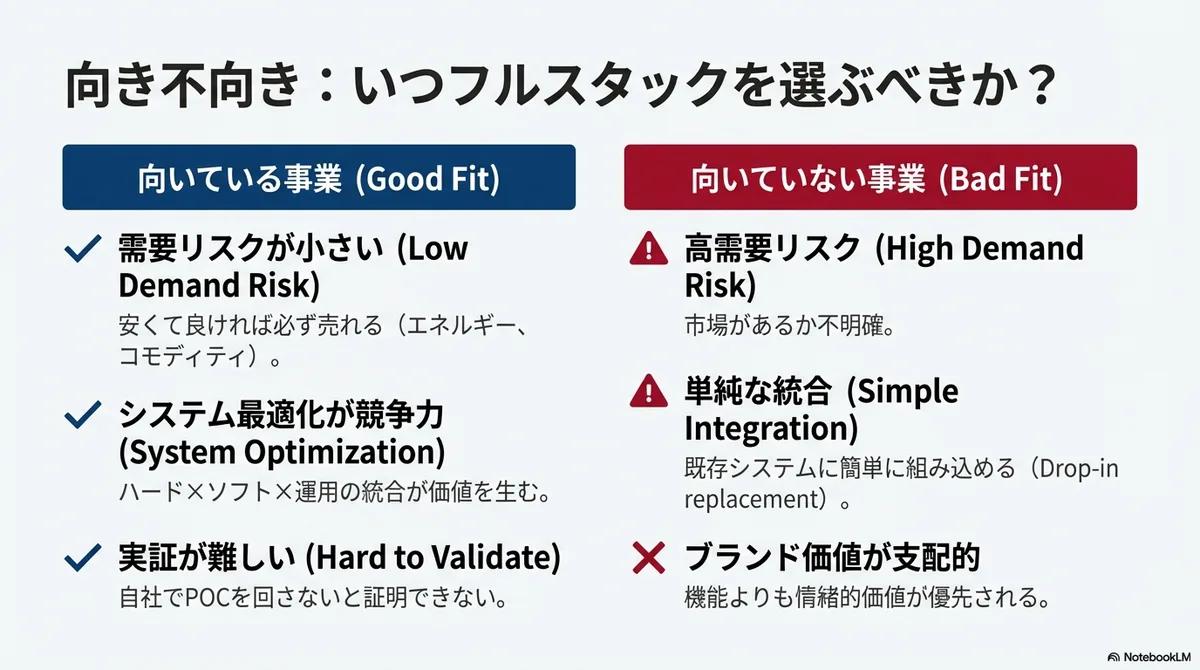
On the other hand, I think there are also businesses where full-stack fits.
(1) Products with low demand risk
The first is products with low demand risk.
If customers will buy the product once you can make it, and a large market is waiting, then demand risk is small. (See also my article on demand risk and supply risk.)
After that, it is enough to achieve cost reductions while lowering supply risk through technology development and operations.
For example, with commodities such as energy and chemical products, the function of the end product is the same no matter how it is made. If it is cheap, it gets bought.
Because going full-stack means taking on supply-side risk, a product group with low demand risk makes it easier to balance risks.
(2) System optimization and learning curves become competitive strengths
Businesses in which hardware, software, and operations are tightly coupled, with strong coupling between layers, that is, businesses where a standalone technology alone does not create value, can also be said to suit full-stack.
There are probably also many domains where learning curves apply: improving the product through feedback such as operational data, or reducing costs through manufacturing volume.
(3) Businesses where demonstration is difficult
The good thing about aiming for full-stack is that, as long as you have the capital (and the permits and licenses), you can shorten the time to demonstration dramatically.
If it is a not-so-important component or material, or even an important one that offers only an improvement of a few tens of percent, customers will probably not decide to rebuild everything for it, and persuading them would take several years.
So there is an approach in which you first build it full-stack, even if the scale is small, and then shorten the part of the value chain you handle as you scale up.
In fact, some startups have taken this approach. They first demonstrate full-stack in-house, then narrow the value chain to only their own high-profit areas, and transfer the other value-adding activities to partners.
(4) Businesses that can release multiple products
Once full-stack is achieved, a company tends to move toward multiple products. Because it has many touchpoints with customers and large capital, it is easy to go multi-product, and doing so raises sales.
Because so much is done in-house, as long as the organizational design works well, the company can ensure speed and flexibility and secure competitiveness.
As for business domains, an a16z article says that the following areas may hold promise.
- Construction
- Education
- Freight transportation
- Semiconductor manufacturing
- Public utilities
There are probably many others, but I list these for reference.
Beyond Outputs, Toward Outcomes
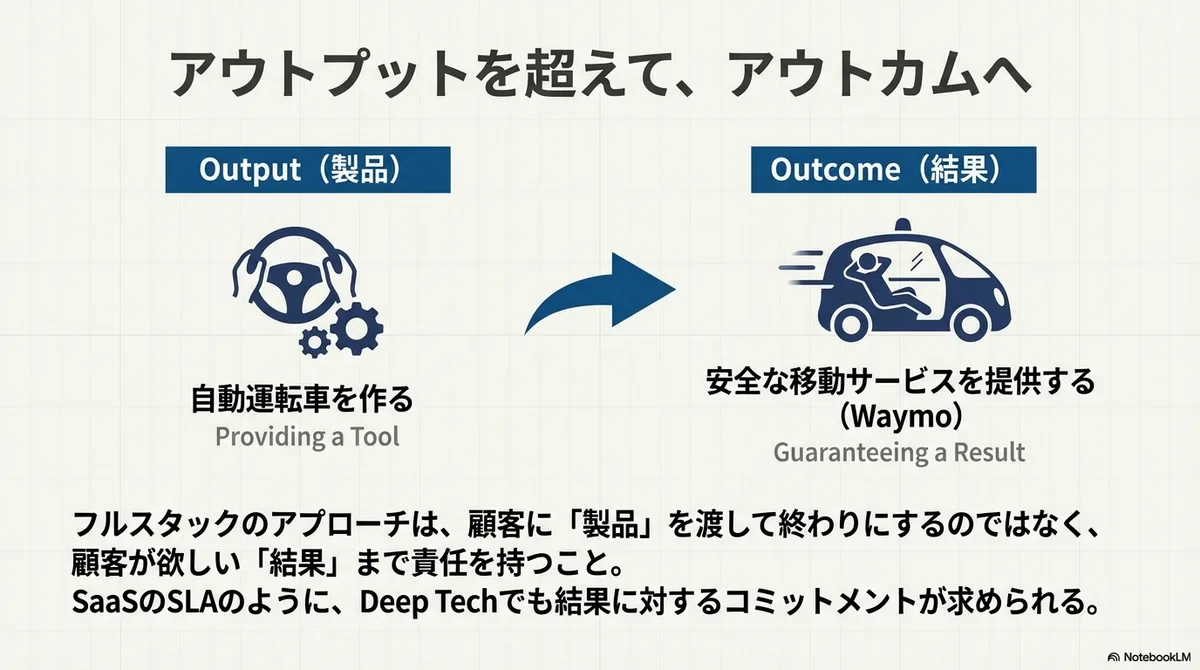
The full-stack deep tech startup that Cantos advocates has the "end product" as its output. But the closer you get to the outcome beyond that, the easier it becomes to earn more revenue.
For example, Waymo's current valuation is probably what it is because it offers a passenger transportation service, rather than self-driving software or a product called a "self-driving car."
In fact, SaaS, Robot as a Service (RaaS), and driving guarantee services are starting to be offered not as products but as services with SLAs. This is because, by providing services beyond the product, a company can obtain data and customer touchpoints there and connect them to further improvement.
On the other hand, there are services that lose scalability as they get closer to the outcome. For example, RIZAP provides outcomes such as "losing weight" and "building muscle," but precisely because of this, people must be involved, and the structure makes it hard to achieve scalability in the last mile. Uber resolves the part where people must ultimately be involved through matching, but even that has limits.
Also, the closer you get to a service, the more operations and risks increase. How to mitigate those risks with software and the like is, I think, where you get to show your skill.
The "How" of the Full-Stack Deep Tech Startup
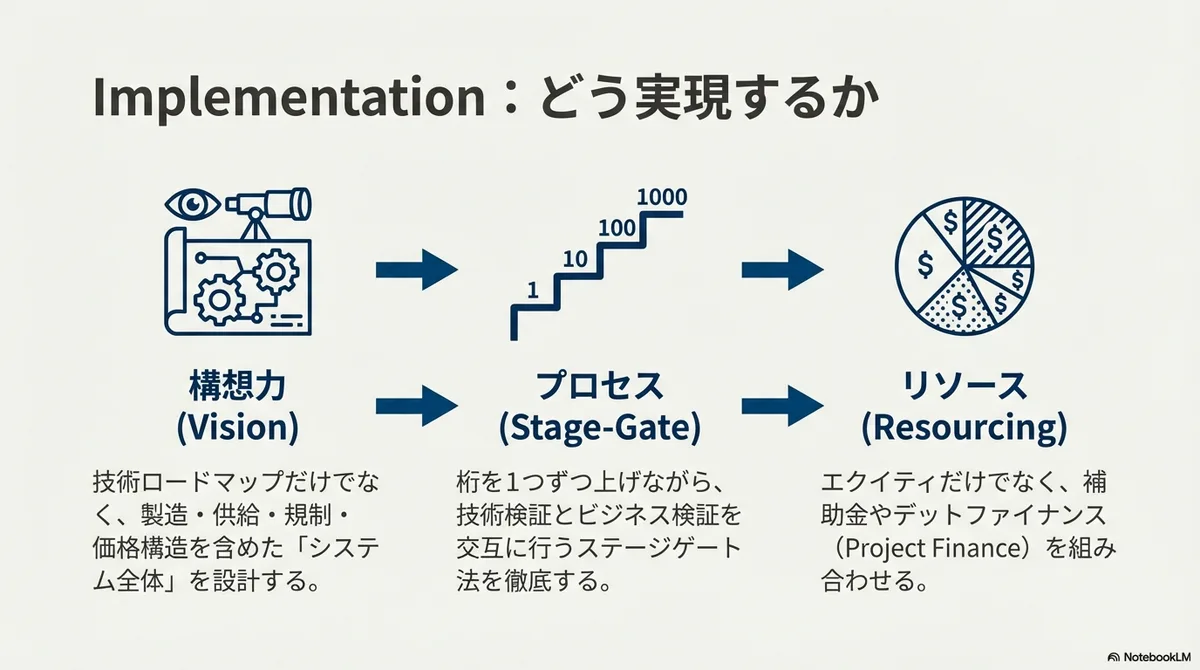
From here on, the element of working hypothesis becomes quite strong, but I will talk about the "How" as I currently think of it.
(1) Vision
This full-stack business is about optimizing the entire system for supply.
Just as Edison considered the whole system, including not only the light bulb but also power generation, transmission, and the cost of copper, what is required is "vision" that takes a very high vantage point while running very fine-grained experiments.
What matters here is that it is a whole-picture vision that includes not only the technology roadmap but also
- Manufacturing, supply, and maintenance
- Procurement, contracts, and the division of liability
- Regulation and certification
- Pricing and the profit structure
Please do not forget this.
(2) Processes such as stage gates
As you raise the order of magnitude one step at a time, from 1 to 10 to 100 to 1,000, you will probably need to set up stage gates. Diversifying from the start, as Lilium did, is hard, and trying to build something big all at once, as Northvolt did, increases the chance of failure.
That said, depending on the competitive environment of the business, you may sometimes take the risk of skipping some orders of magnitude and jumping up two. And depending on the technology, different technical validation may be needed at a scale one order of magnitude up and at a scale two orders up, in which case it can be more rational to go up two orders at once rather than inserting a step that goes up only one.
(3) Securing speed
Between each stage gate, the whole system needs to be aligned all at once.
Also, learning is everything in the early stage, but once you go after sales, quality, delivery, and operations become dominant. Running these two on the same line easily leads to breakdown, so how to run the organization becomes important as well.
(4) Securing resources
What is required is the skill to gather large amounts of resources such as money and people, and to use those resources effectively. As for money, you need to know diverse ways of raising it, not only equity but also subsidies, debt, and project finance. Also, since there is a lot of investment from operating companies in Japan, you will need to explore this kind of model while making good use of them.
As for people, you need to assemble a wide range, from researchers to product development, operations staff, and regulatory staff, and integrate them as a business.
A Conversation Between Entrepreneurs and Investors
I have written many times that deep tech startups are not the commercialization of technology. I think the concept of the full-stack deep tech startup is also useful in such discussions.
However, it must be kept in mind that this full-stack approach increases risk on the investor side. This is because capital risk rises and risks other than technology increase as well.
On the other hand, half-hearted funding of deep tech startups can leave them only able to build a business structure that creates friction with customers, which prevents them from gaining speed, and may kill not only the potential of that startup but also the potential of the technology it came from.
When it comes to how to get past the initial friction, investing a fairly large amount of money from the start and considering vertical integration of the non-technology parts can also be a path that mitigates risk for both investors and entrepreneurs.
Even if it is not full-stack, I think there is a chance that extending the value chain will reduce friction.
I hope that this article will be an opportunity for entrepreneurs and investors to discuss
- "How far should we extend the value chain at the start?"
- "What should we refine to mitigate the risks we are concerned about?"
- "Can we draw a vision big enough to accept those risks?"
Conclusion
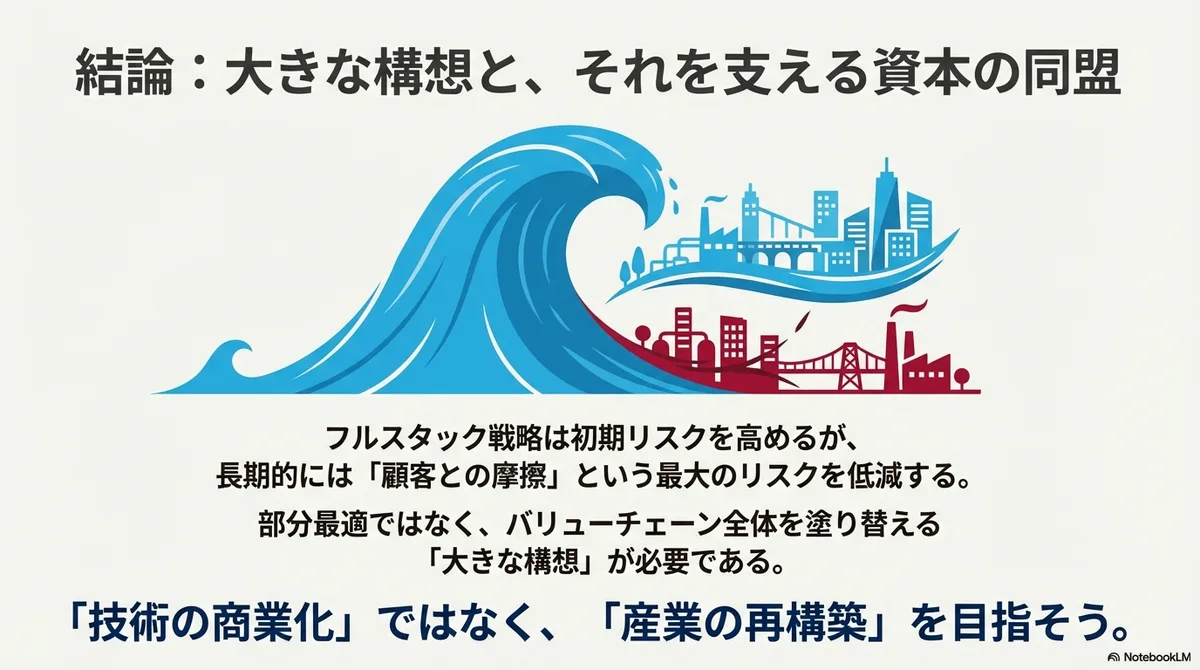
To produce full-stack deep tech startups from Japan, it is necessary to put larger sums of money behind startups with good visions and to encourage them to draw larger and more refined visions.
In particular, because large sums of money are needed from the start, unless some investors and subsidy administrators recognize that such a strategy exists and we create a situation in which they endorse it, the judgment will probably be that it is "too risky," and there will be no startups able to take this strategy.
Conversely, as the number of investors with this kind of thinking and strategy grows, the number of startups able to take this strategy will grow.
This manuscript is my hypothesis, a kind of discourse. But I think it is the kind of discourse that, when many people come across it and some investors come to hold beliefs close to it, brings money together and makes it possible for entrepreneurs to actually take on such challenges.
I think sharing this strategy has meaning as a way of looking for such allies, so I am writing it down.