Blueprinting the Future
This article was machine-translated from Japanese by AI (Claude). It may contain errors. Read the original Japanese article.
I feel that over the past few years, the importance of "blueprinting the future" has been growing.
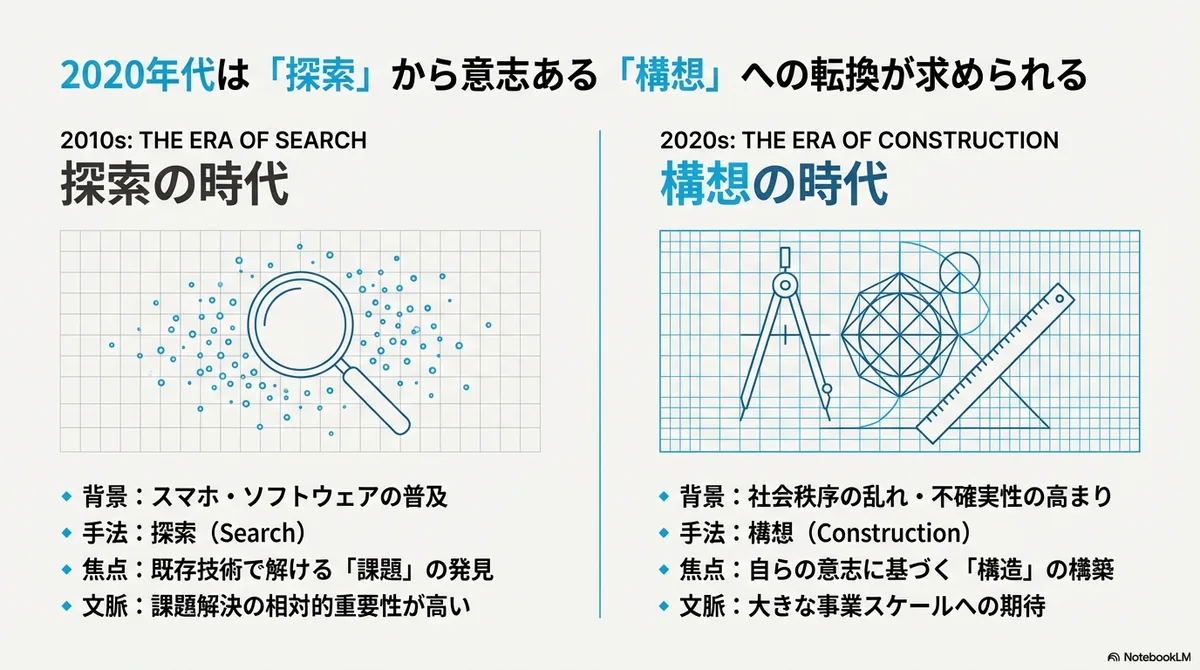
The 2010s seem to have been a period in which "groping our way through the future" to find the right problems that could be solved by "the solution of software and smartphones," and the importance of problem solving, were relatively high.
In the 2020s, however, expectations for building larger businesses have risen. On top of that, as the order of society has been seriously disrupted, we now live in an environment with a different kind of uncertainty from that of the 2010s.
When trying to create new businesses in such an environment, it seems that "blueprinting the future" based on our own will has become all the more important.
So how can we get good at drawing a blueprint?
In Implementing the Future, which I wrote in 2021, I said "I looked into it, but couldn't find out how to draw the future," and went no further than introducing Roberto Verganti's methodology.
But I think that now I may be able to go a little further. I have written books such as Raising Your Resolution and Hypothesis-Driven Action, and recently I have also been getting more involved in workshops on blueprinting the future.
This article is an attempt to summarize a little of what I have learned there. It is still at a soft stage and seems to remain at the level of generalities, so I would like to refine it further.
Please note that I have written this article with "blueprints for new businesses" and "futures more than 10 years away" in mind, so it may not apply to other domains.
Concepts organized in this article
First, let me explain the key points of this article.
- What a blueprint is - A hypothesis of a "picture" of one point in the future, and of the "steps" leading up to it
- What makes a blueprint good or bad - It is good if both impact and confidence are high, and bad if they are low
- The components of a blueprint - It can be organized along four axes: size / granularity / consistency / sequence (time)
- How to create a blueprint - The core is to repeat divergence and convergence (= hypothesis and verification) in stages and at high speed
I also use concepts from the following three books.

- Why a blueprint is needed (Why)
- What a blueprint is (What)
- The "resolution" of a blueprint
- A blueprint is a "group of hypotheses"
- Evaluating a blueprint: impact × confidence
- How to create a blueprint: the overall flow
- Summary
Why a blueprint is needed (Why)
Why is a blueprint needed? First, creating a blueprint of the future has several benefits.
(1) What to do becomes clear
It also gives us a clearer view of what we should do now.
Creating a blueprint of the future makes the gap between the future and the present clear. This makes it possible to frame the problem as "how do we close the gap between the future and the present?"
In other words, without an ideal future we cannot find problems, and without problems we cannot determine what we should do now.
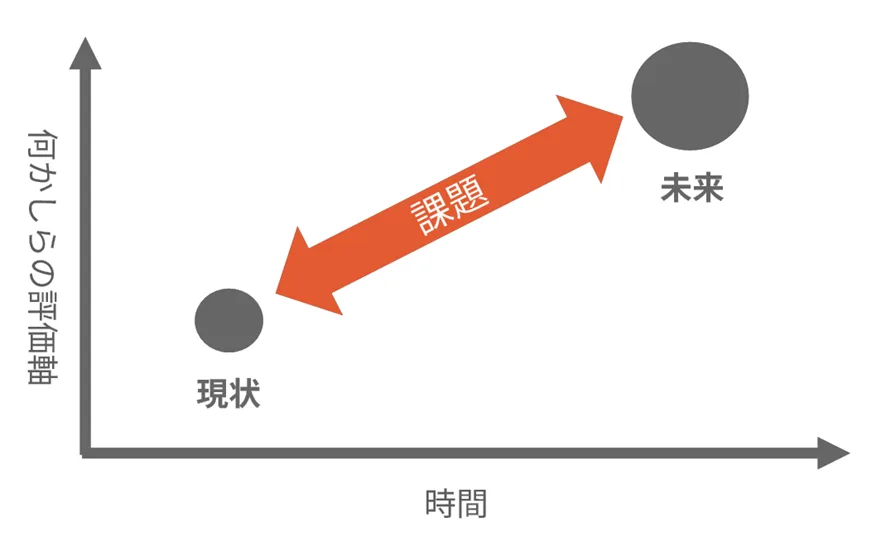
If the future we want to reach changes, the problems change, the solutions change, and what we should do now changes. Conversely, if we can settle on a good blueprint, we can narrow, to some extent, the range of this back-and-forth between problems and solutions.
(2) It becomes easier to find allies
Having a blueprint also makes it clearer what we are doing, which makes it easier for allies to gather.
By publishing a so-called logic model or Theory of Change, it becomes easier to achieve collective impact.
What a blueprint is (What)
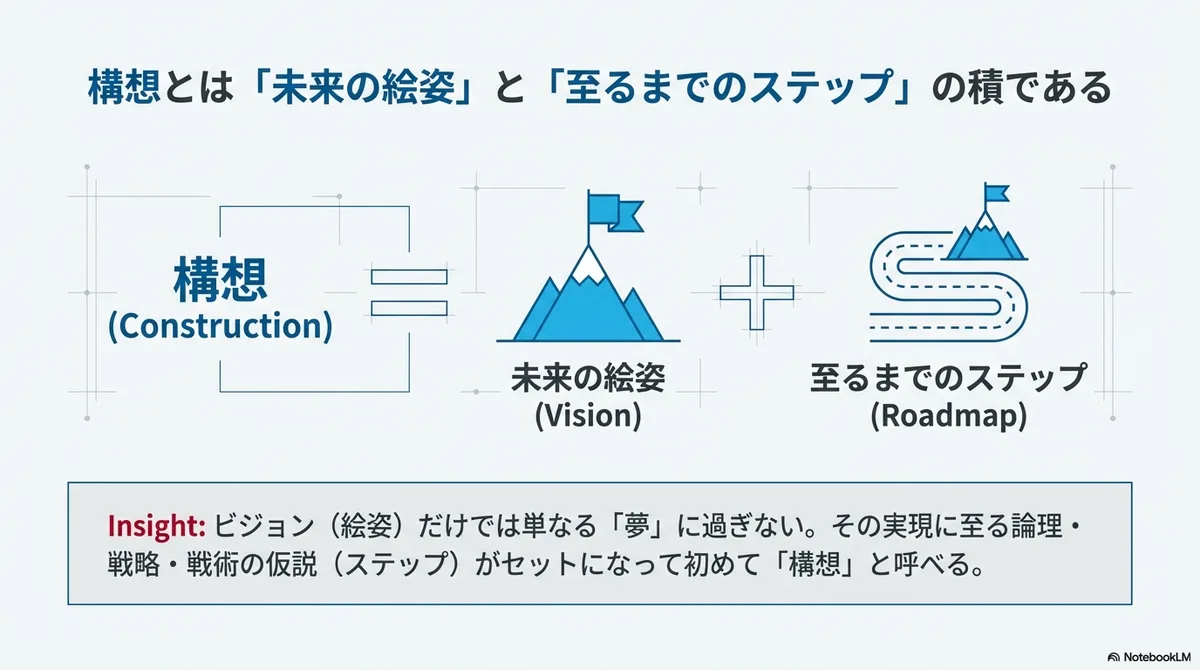
I regard a "blueprint" as "a hypothesis of a picture of one point in the future and of the steps leading to it."
In other words, a blueprint contains two hypotheses.
- A hypothesis of a picture of one point in the future
- A hypothesis of the steps leading to it
The picture is the goal, and the steps are tactics, moves, a roadmap, and the like.
What is called a "vision" alone cannot be called a blueprint; only when it is accompanied by hypotheses of the moves leading to the vision, so to speak hypotheses of strategy and tactics, can it be called a blueprint.
In terms of mountain climbing, a blueprint can also be described as a set made up of the mountain to be climbed and the plan for how to climb it.
The "resolution" of a blueprint
Let's express a "blueprint" with a jigsaw puzzle.
The state in which we can say "we have a blueprint" can be said to satisfy the following three conditions in a jigsaw puzzle.
- We know the finished picture as a whole
- We know the pieces
- We know the order in which to place the pieces
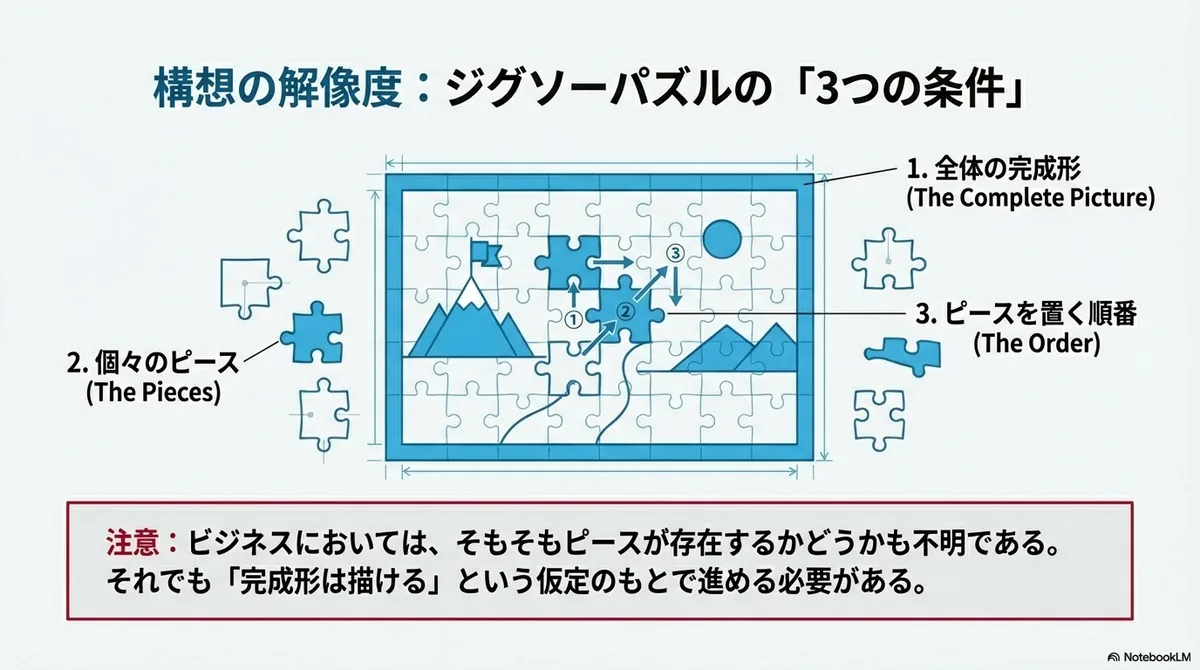
However, in reality we do not even know whether the pieces exist, so please note that we do not know whether we will complete the whole picture either.
With this jigsaw puzzle as a metaphor, I think the quality of a blueprint can be organized along the following four axes.
- Size (the size of the picture: the size of the finished puzzle)
- Granularity (the fineness of the pieces: how far the elements have been broken down)
- Consistency (whether the pieces are free of contradictions and firmly connected to one another)
- Sequence (the timeline of the order in which the pieces are fitted in)
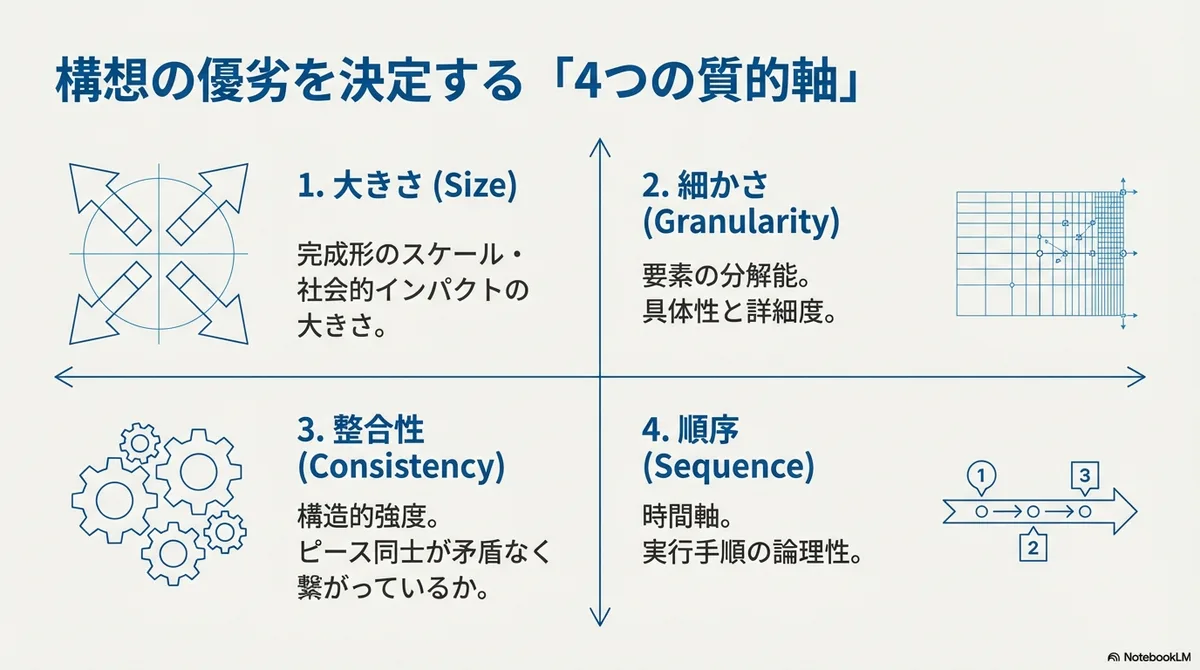
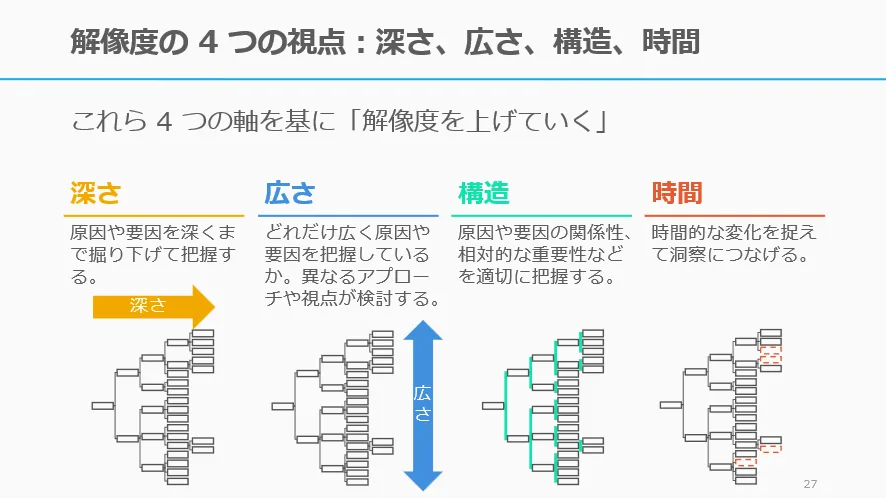
In terms of the perspectives taken up in Raising Your Resolution, the correspondences are as follows.
- Size: breadth
- Granularity: depth
- Consistency: structure
- Sequence: time
Dependencies among the four elements
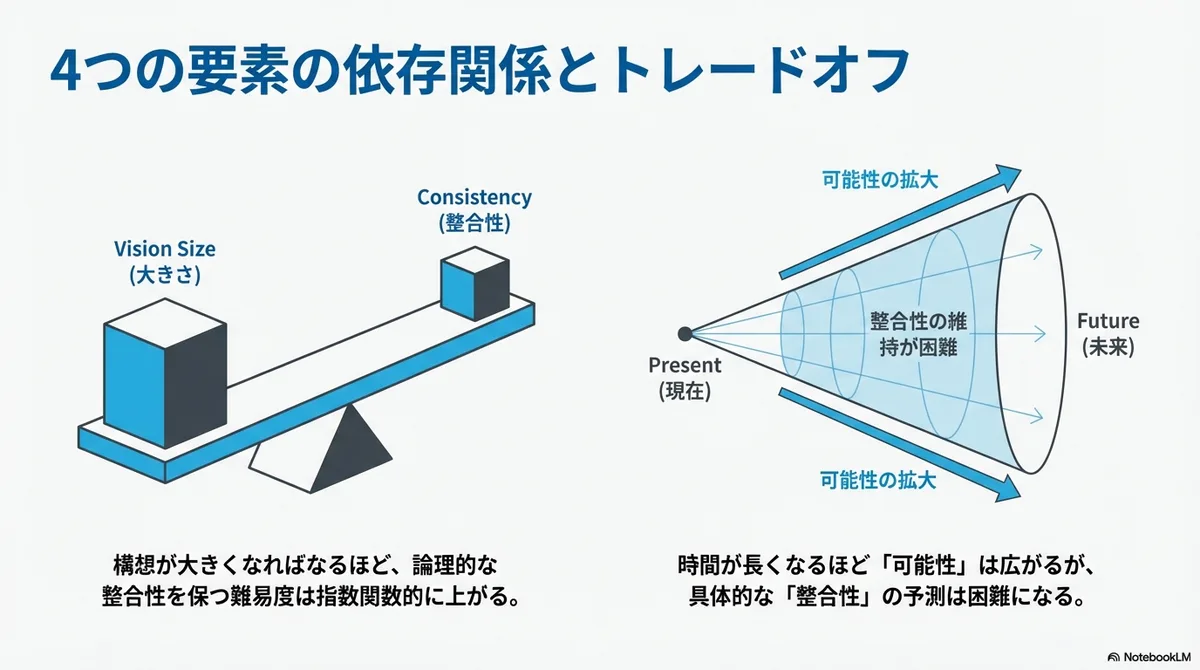
These four elements of "size," "granularity," "consistency," and "sequence" have dependencies among them.
- The larger the blueprint, the harder it is to maintain consistency. It is similar to writing: it is easy to write a consistent text within 140 characters, somewhat harder with a 1,000-character manuscript, fairly hard with 10,000 characters, and harder still with 100,000 characters.
- On the other hand, if we are strongly set on the consistency and feasibility of a blueprint, it becomes hard to draw a large one. Unless we consciously keep aiming for both to be high, our thinking is pulled back by the gravity of reality and feasibility.
- The larger the blueprint, the harder it is to pay attention to fine details. Even if there are a few large, highly abstract pieces, preparing and bringing those pieces is hard work. Conversely, if we pay too much attention to fine details, we can no longer draw a large blueprint.
- As the time span grows longer, the possible futures widen, as in the "cone of the future" (the inverse of the cone of uncertainty), and it becomes harder to maintain consistency. On the other hand, with a longer time span our ideas tend to expand, and there is more that we can do. For example, if the target is five years out, we must achieve it with technology available today, but at 15 years out we can do some technological research and development as well.
Besides the consistency of the final picture, consistency in timing matters as well: for example, if we aim for 2040, it should come together in exactly 2040.
A blueprint is a "group of hypotheses"
I said that a blueprint is a hypothesis. A hypothesis is a tentative answer.
And a blueprint is not a single hypothesis but a group of hypotheses, intertwined in complex, systemic ways; in the language of Hypothesis-Driven Action, it can also be called a hypothesis map.
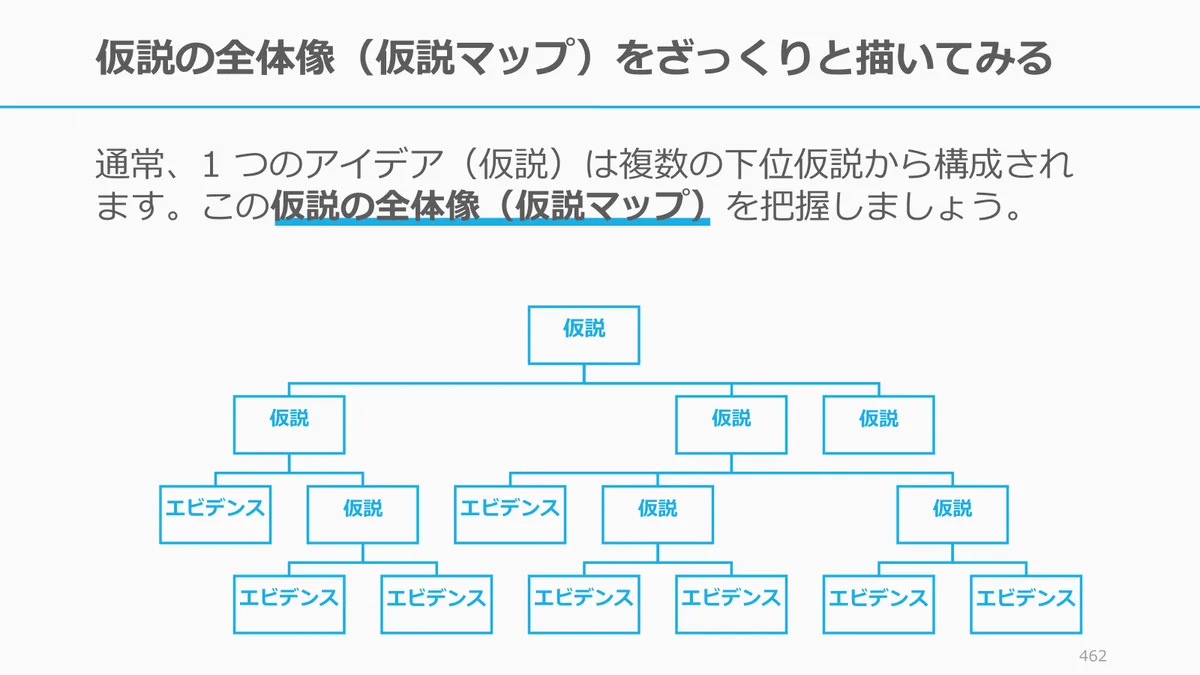
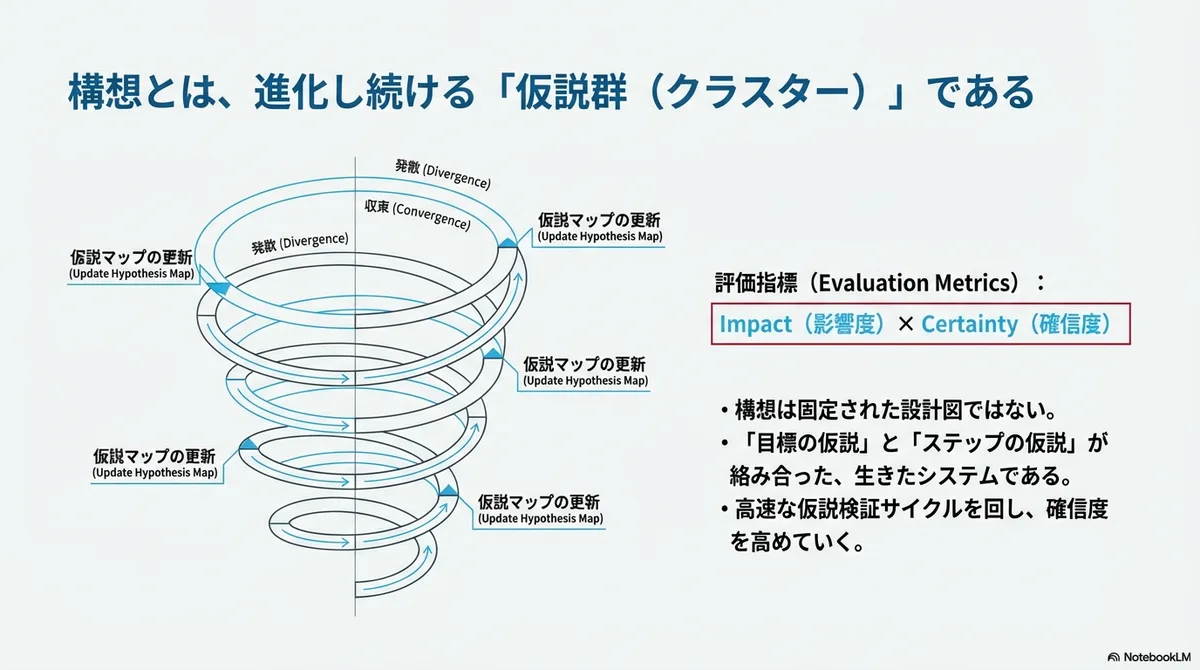
And let me emphasize that, precisely because a blueprint is a hypothesis, it is not a fixed blueprint so much as a "living thing" that we keep updating, and something we update as a result of action and verification.
Evaluating a blueprint: impact × confidence
The strength of each hypothesis or group of hypotheses can be organized mainly along two axes.
- Impact
- Confidence (feasibility)
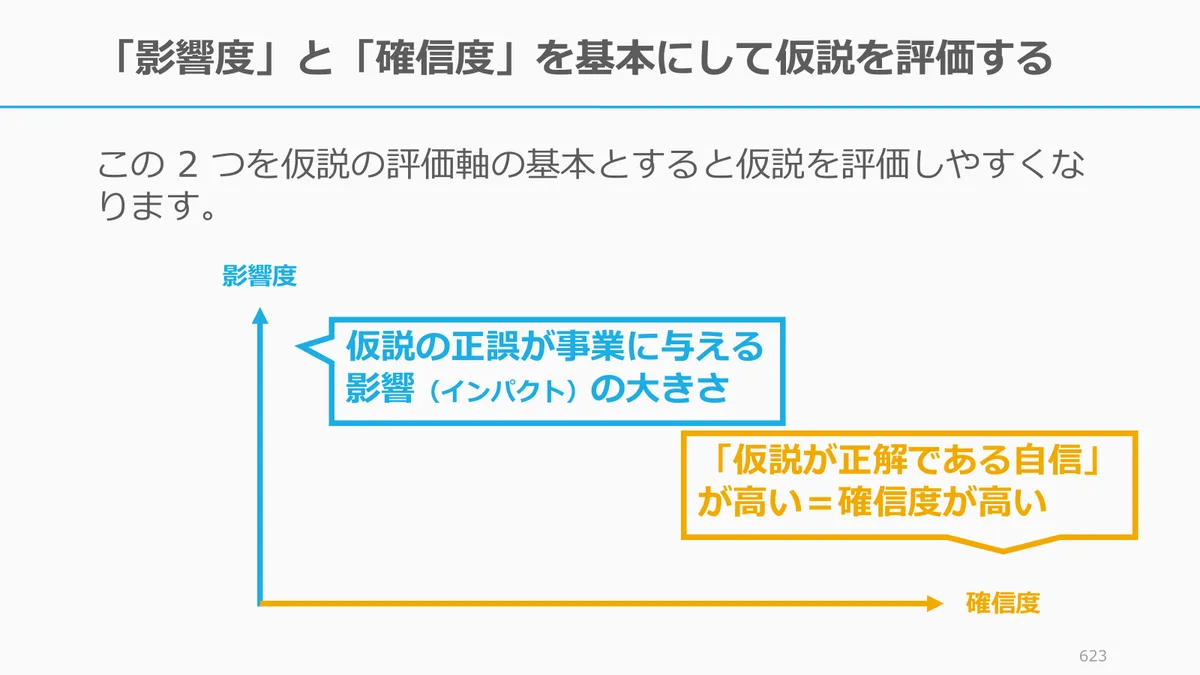
I think that blueprinting means building a "blueprint" as a group of hypotheses in which both impact and confidence are extremely high, going back and forth between the goal and the steps while raising both impact and confidence.
How to create a blueprint: the overall flow
So far we have organized "what a blueprint is." From here, I will explain the How in more detail.
Basically, the How of blueprinting the future is "repeating divergence and convergence at high speed." Put differently, it can also be described as "repeating, at high speed, the creation and verification of working hypotheses."
I have summarized the basic way of creating working hypotheses in Hypothesis-Driven Action and its related slides, so please refer to those.
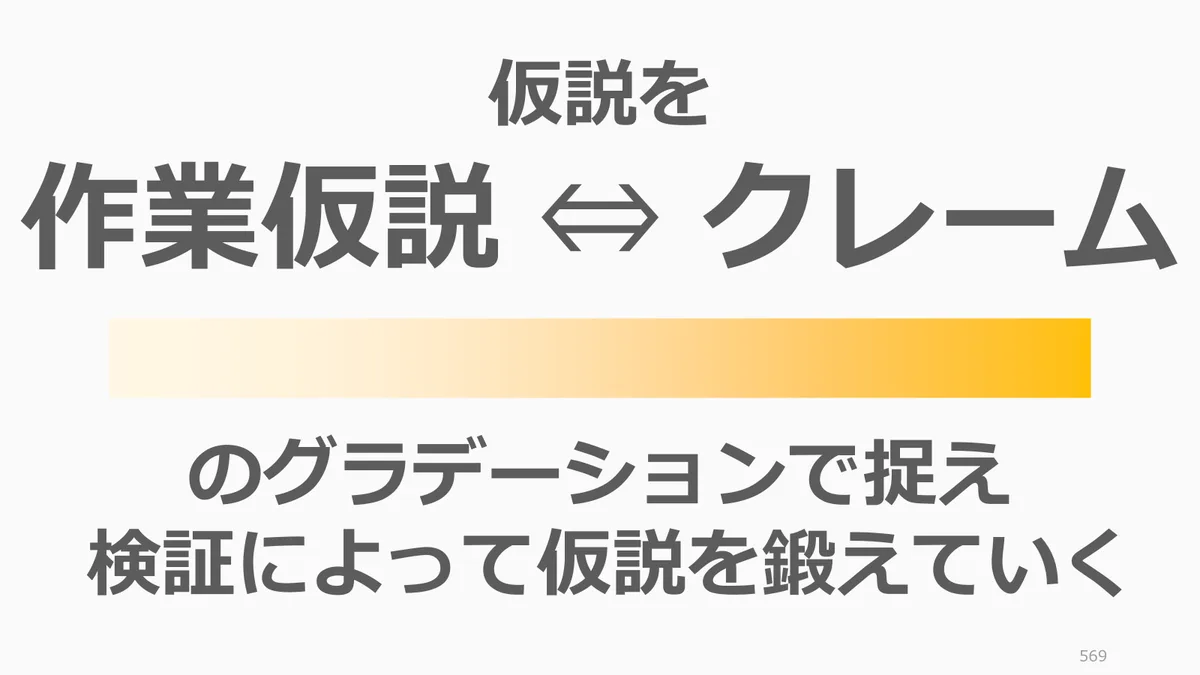
Here I will explain methods of divergence and convergence, hypothesis and verification, limited to the domain of thinking about a blueprint of the future.
(1) Diverge and converge in stages
When thinking about the future, I feel it is better to repeat divergence and convergence in stages than to diverge all at once.
For example:
- Divergence and convergence on a rough picture of our company 20 years from now
- Divergence and convergence on the path to realizing it
- (If necessary) Divergence and convergence on the verification plan for the first one to two years
and so on. Especially when thinking with multiple people, proceeding in stages to some extent makes it easier to align understanding.
However, it should not be one-way: if, as you move forward, you decide that it is not working after all, I recommend going back to an earlier stage and diverging and converging again.
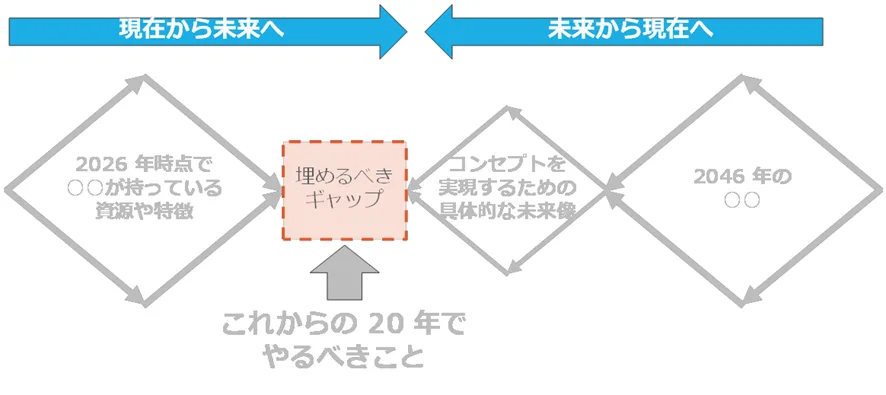
(2) Squeeze from both the present and the future
We diverge and converge while going back and forth between "thinking from the future" and "thinking from the present."
If you have seen the film TENET, you will understand: the image is of a pincer movement from the present and from the future. It can also be called a combination of so-called backcasting and forecasting.
This makes it possible to verify the feasibility of the future and so on, and to grasp a more refined direction.
However, because the gravity of reality is too strong, I recommend holding discussions that put as much weight as possible on the possibilities of the future.
Combining this with "diverging and converging in stages" gives a diagram like the one below. The image is of divergence and convergence from the future toward the present, and divergence and convergence from the present toward the future.
(3) Squeeze from both the concrete and the abstract
This is said in many places, but going back and forth between the concrete and the abstract makes the blueprint more refined. Many people are good at one and weak at the other, so it is a good idea to be more conscious of the one you are weaker at.
(4) Start from fantasy and find the "path that can be taken"
We tend to think from what we can do, but we need to encourage letting our ideas fly a little first, starting from fantasy, so to speak. Working backward from there and finding the narrow path that leads to it is blueprinting.
The trick to not staying at mere fantasy is to verify at high speed. As long as we have the ability to verify, we can quickly discard poor ideas.
(5) Know the current system
Organizing the current state in a systems-thinking way is important for both divergence and convergence.
Knowing how a change in one element affects other elements also makes leverage points easier to see.
Divergence
The hardest thing when diverging is drawing a big blueprint. Many people are not used to drawing big blueprints, and in some cases they feel fear. The reality is that I have not yet found a good way to get past this. But without being able to draw a big blueprint, you will not produce impact.
In Hypothesis-Driven Action I also explained how to draw big hypotheses, and here I summarize several concrete methods for thinking about a blueprint of the future.
(1) Think about the future two levels higher
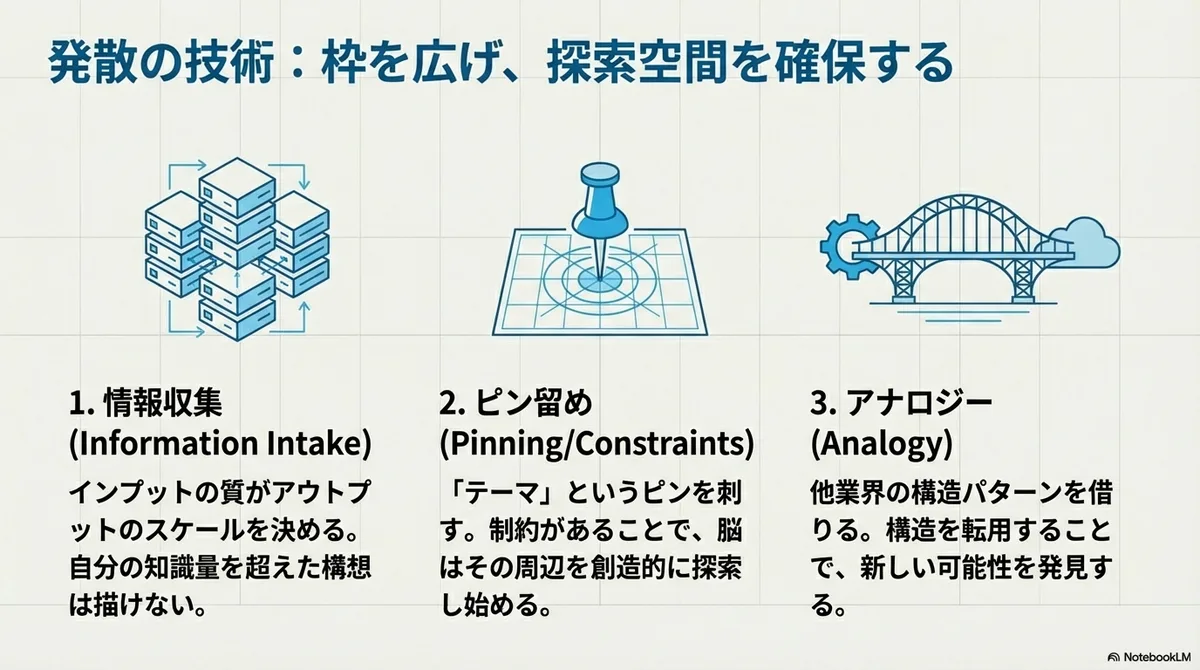
In the case of a company, I think one method is to think about the future at the level of the "industry," one level above the company, and then the "nation," one level above that, and, given how that future turns out, to consider the position of the "industry" and "our company" in the nation of that future.
If you try to "think about the future of our own business," you can only think along an extension of our own business.
(2) Gather information
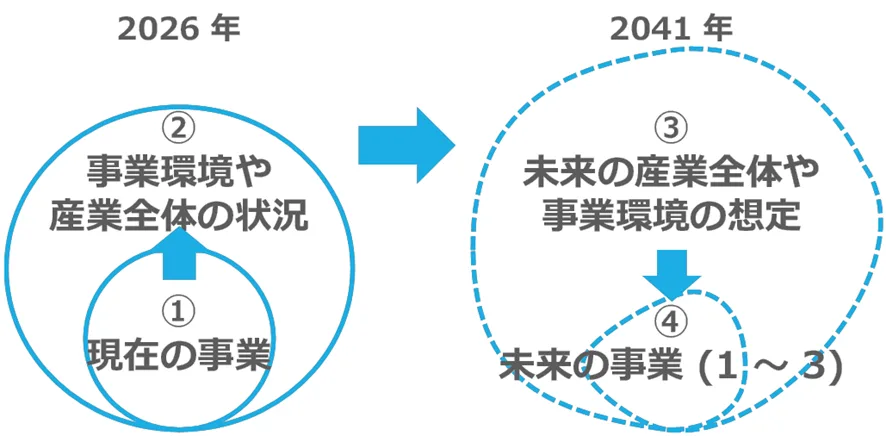
I have a hypothesis that thinking big requires information.
Along with drawing analogies, I think that basically many people do not have the appropriate information, and so cannot set a frame for thinking big.
(Simply gathering inputs in advance changes the quality of divergence.)
(3) Set appropriate constraints and pins
It seems to me that when ideas have some constraints, the search space is gently closed, which in turn makes it easier to encourage ideas that lie outside the frame. In other words, it means having a theme or the like.
When using generative AI, too, an abstract prompt returns only generic answers, but pinning down a good spot (using an appropriate word as the pin) and asking for ideas around it seems to make it easier to get unique ideas.
How this pin is placed determines, to some extent, how promising the blueprint is.
(4) Loosely keep appropriate frameworks at hand
By forcibly applying the frames of other domains, we sometimes notice a new way of seeing a phenomenon. This is what is called analogy.
To draw analogies properly, you need a structural understanding of things and a stock of patterns of structure itself.
Convergence
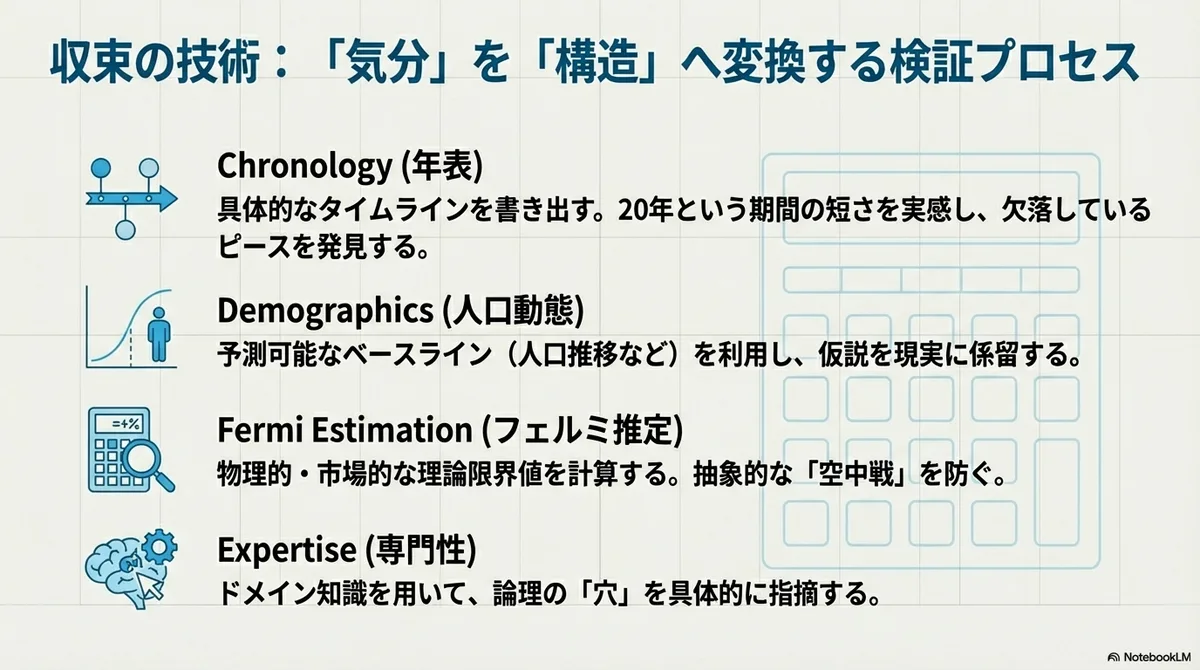
Much of convergence is "verification." In terms of blueprinting, it takes the form of checking granularity and consistency. In terms of Hypothesis-Driven Action, it corresponds to "verifying the hypothesis map."
The following are means of convergence that can be used when thinking about a blueprint of the future.
(1) Create a timeline
Especially when thinking about a larger future, I recommend writing a "timeline" and doing a sanity check on timing. Writing a timeline helps turn a blueprint of the future from a "mood" into a "structure." You find that 20 years, for example, is surprisingly short, and you can also discover other elements to consider and verify consistency.
(2) Verify against a future that does not change much
For example, even 20 years out, population forecasts probably do not change greatly in relative terms (of course, there is a range).
Societal changes may result from it, but verifying against elements that are relatively easy to use as a "baseline" prevents the discussion from becoming too much of an aerial battle.
(3) Estimate and verify (Fermi estimation, etc.)
Making use of Fermi estimation and the like is also a form of verification.
In technology especially, theoretical maximums do not change, so I recommend doing this kind of calculation (since the laws of physics will not change in the future either).
https://blog.takaumada.com/entry/calculating-the-impact
(4) Develop expertise
Expertise in each domain is effective for looking at the puzzle pieces in finer detail.
It is especially effective for quickly finding holes (gaps) in consistency and constraints (regulation, supply constraints, technical limits).
(5) Turn the verification perspectives into a minimal checklist
If the perspectives of convergence are shallow, a story that only looks consistent can come together. At a minimum, I recommend verifying from the following perspectives.
- Consistency
- Feasibility
- Economics
- Competition
- Refutation
There are also various other verification methods, such as devil's advocate, pre-mortem, and pre-parade, so it is good to use those.
Tools
(1) Use ChatGPT
When diverging on ideas, we have become able to prompt generative AI services such as ChatGPT effectively.
LLMs in particular are good at divergence. In a sense, the divergence of ideas is also hallucination.
However, the fact that hallucination occurs also means that they are prone to mistakes in verification. In that sense they are not good at convergence. Convergence also requires will, so that is still a part that is hard to leave to AI.
(2) Use NotebookLM
By roughly feeding in information, creating a draft of a blueprint of the future based on that information, and turning it into slides, it becomes easier to create a starting point for discussion.
Using image-generation tools such as Nano Banana Pro or Mixboard is also one option.
(3) Use a hypothesis map canvas
I think organizing with something like the hypothesis map canvas is also an option.
Summary
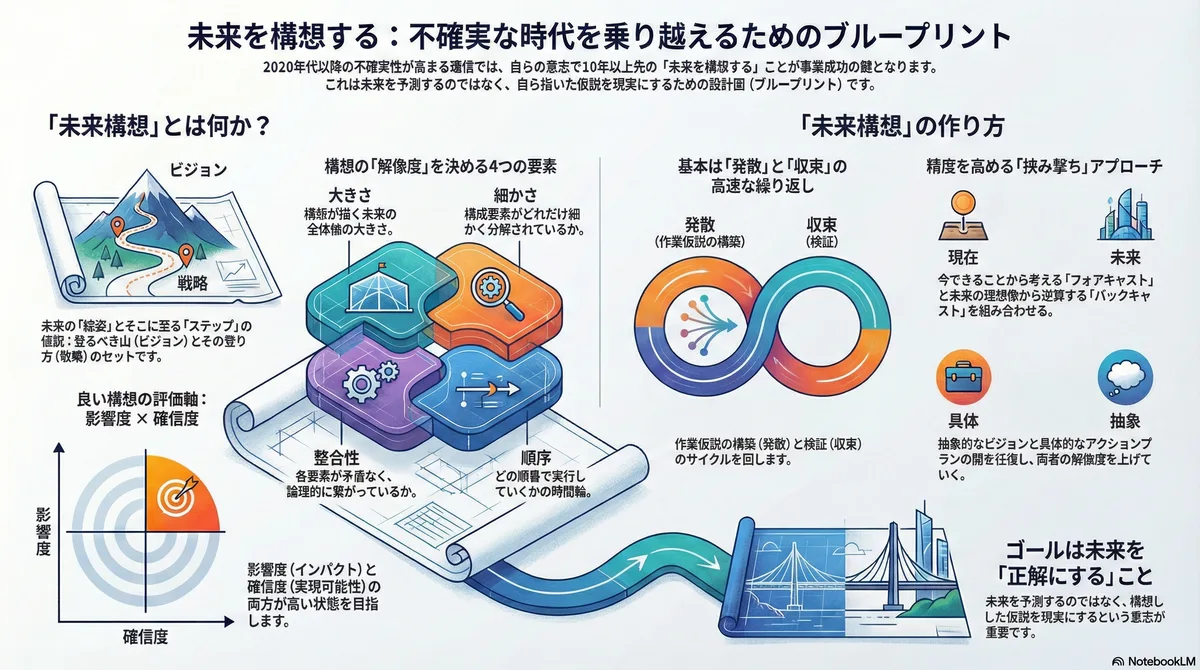
In this article, I have summarized several ways of thinking that may be useful for blueprinting the future. I have not written down everything we are trying yet, but for the time being they should be usable as a set of tools.
In the case of a workshop, activities are chosen to fit the time constraints, and they are modified to suit the participants and purpose or supported by information prepared in advance, so I think there are many different ways of doing it.
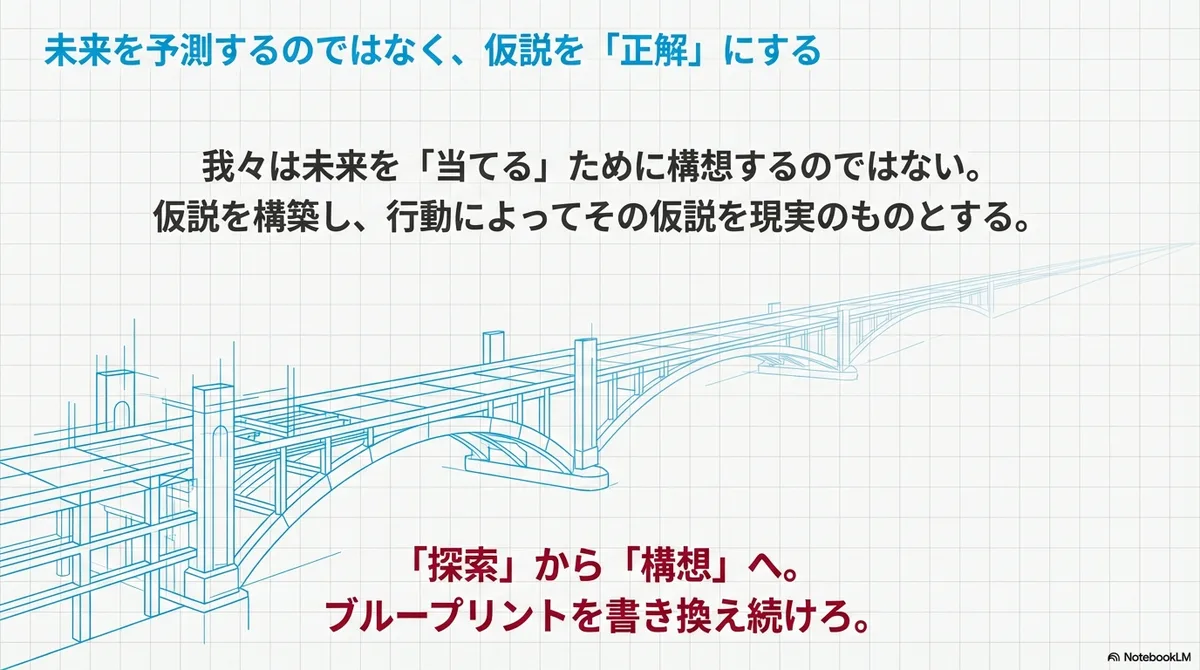
And above all, it is not about "predicting the future" or "getting the future right"; I think it is important to approach it with the feeling that we blueprint the future and actually work on it, thereby "making our hypotheses about the future correct" and "making hypotheses reality." Let me emphasize that last of all.
If possible, after the resource book I am currently writing, I would like to write a book called Blueprinting the Future (tentative title), and while writing it, deepen my own methods for blueprinting the future a little more.
(That said, I would like to write a book that is not a How book soon and deepen some other thinking...)
Summary by NotebookLM