How to Explore Ideas in the Age of Generative AI (2026 Edition)
This article was machine-translated from Japanese by AI (Claude). It may contain errors. Read the original Japanese article.

The advent of generative AI has greatly changed how we do intellectual work, starting with programming.
In 2025 in particular, I feel that generative AI became much more practical for research and idea-generation tasks. The arrival of ChatGPT Pro 5.2, steady progress in NotebookLM, and Gemini 3 plus Nano Banana were major advances in terms of research and structuring information.
On how to come up with ideas, I wrote an article back in 2023 called "How to Start a Climate Tech Startup." This time, I would like to summarize the "method for exploring ideas" that I recommend as of February 2026, in the era after generative AI.
🎯 Goal of This Article
In this article, I break down the steps for creating an idea (hypothesis) in detail and talk about how to use generative AI along the way.
The target output is "a hypothesis good enough that, if you take it and go meet people, you will get good feedback." I think it is difficult, at this point, to create a perfect hypothesis through interaction with generative AI alone.
Note: To create a truly good hypothesis, you need information that generative AI does not have. You also need to repeat experiments and hypothesis testing that involve taking action. The situation may change if AI becomes able to run even that improvement loop, but to obtain the latest information that generative AI does not have and cannot infer, I think human involvement will remain necessary for some time.
This article mainly deals with "startup ideas," but I think parts of it can also be used in other areas (research, for example). Please adapt it as appropriate.
💡 Premise: When Using Generative AI to Explore Ideas, "Steps" Matter
Even though generative AI has advanced, if you throw a prompt at it like "Come up with new ideas in the field of XX," you will not immediately get a promising hypothesis back.
So, to create good ideas and hypotheses, you go through the following process:
- Divide the process of shaping an idea or hypothesis into stages
- Use generative AI at each stage, and have a human review the output
- Then give additional instructions to refine the idea
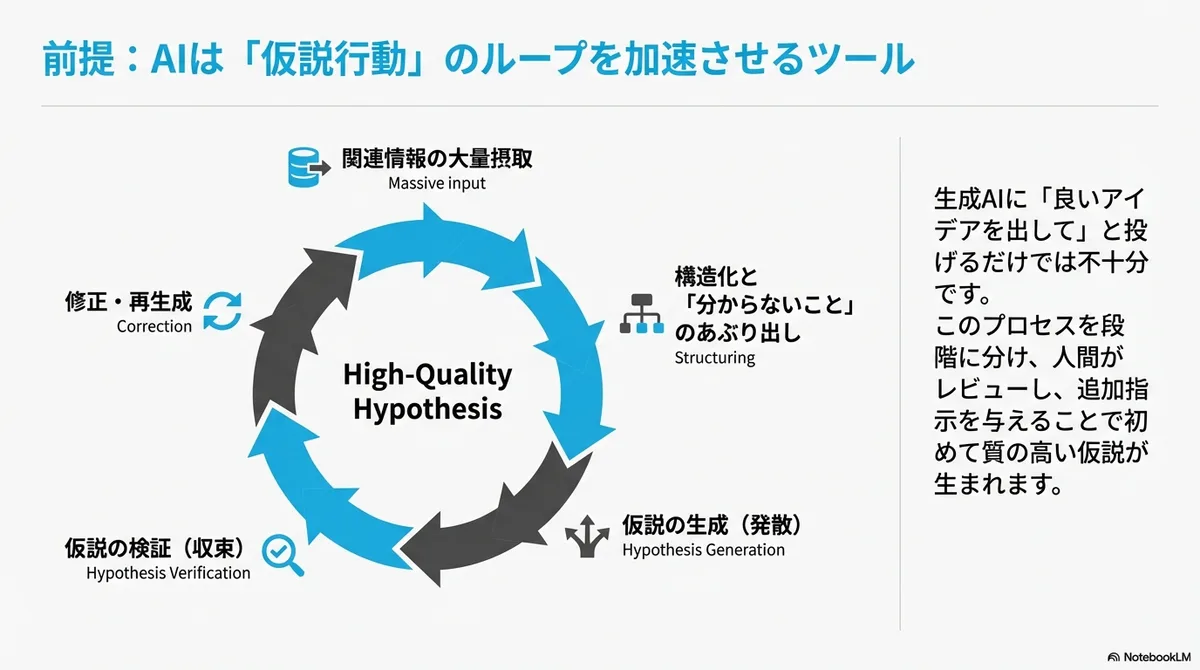
What becomes important here is "what steps to follow so that exploring and shaping an idea goes well."
I have organized these steps in detail in the book "Hypothesis-Driven Action," so please take a look if you are interested. In short, I believe the effective activity in the early exploration and shaping of an idea is to repeat (loop through) the following steps appropriately.
- Take in a large amount of related information
- Structure the related information, and use that to bring out "what we don't know"
- Generate hypotheses about "what we don't know" (divergence)
- Test the generated hypotheses (convergence)
- Revise and regenerate hypotheses based on test results and new information
And today, generative AI services can make some of the work in these steps considerably more efficient.
So in this article, I will briefly explain how to use generative AI along the way, following the steps described in Hypothesis-Driven Action.
🚨 Tools and Constraints
As of this writing, the generative AI I recommend for research is the latest version of ChatGPT Pro.
Among the free options, as of February 1, 2026, when I am writing this, I recommend things like Kimi K2.5 Thinking, but this will probably keep changing, so please choose whatever is appropriate. Please also be careful not to enter sensitive information into the free versions.
I also recommend using Google's NotebookLM and the AI functions in Google Sheets as appropriate.
When typing prompts into these generative AI tools, I recommend using voice input as much as possible and opening multiple windows to run two or three investigations in parallel, which saves time. ChatGPT Pro is slow, so typing is fine, but Kimi and Gemini are fast, so you can run two or three in parallel. For voice input, my impression is that Aqua Voice and Typless have high accuracy at present.
Note that even generative AI services are still weak at testing hypotheses, so please read this on the assumption that humans will do a fair amount of the testing.
🐾 Steps for Shaping an Idea
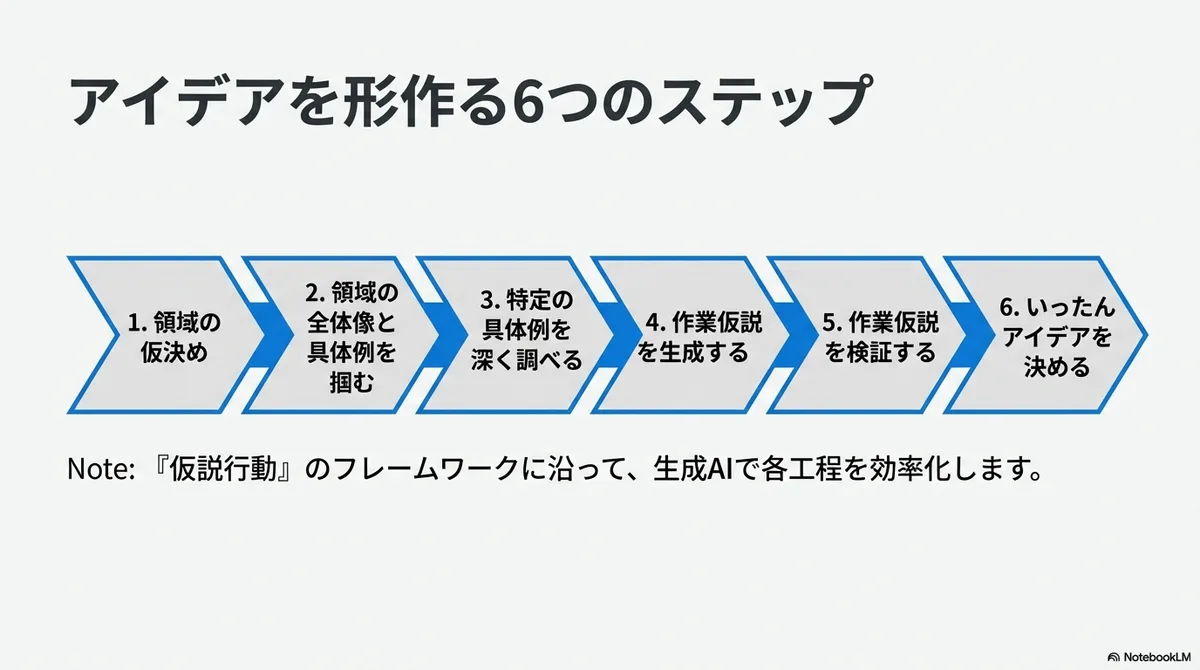
This article proceeds through the following steps.
- Tentatively decide on a field
- Grasp the big picture of the field and concrete examples
- Investigate a specific example in depth
- Generate a working hypothesis
- Test the working hypothesis
- Tentatively decide on an idea
From here, I will talk about each step.
(1) Broadly Explore Candidate Fields and Decide Tentatively
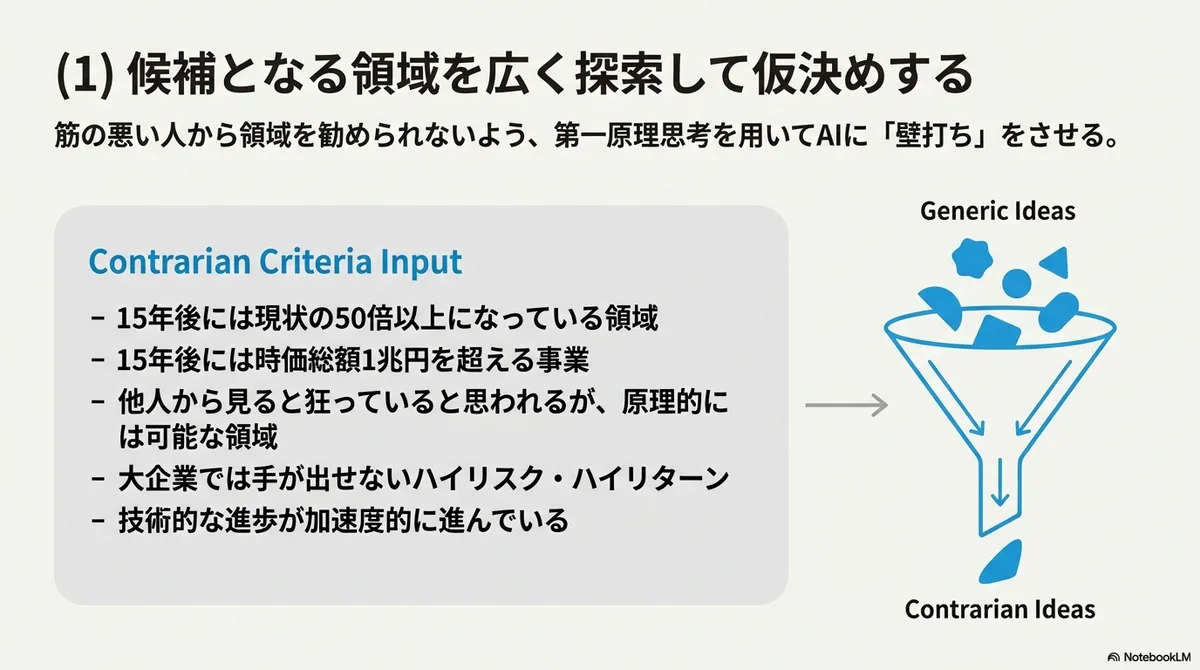
Before thinking of ideas, you first need to decide, to some extent, on the frame of the field in which you will think of ideas. This is because exploring without a frame is far too inefficient.
For choosing a field like this, ordinarily, rather than using generative AI, asking someone with good instincts for ideas "What fields are getting attention now?" tends to get you a better answer. However, not everyone has such people around them, and you cannot always ask them. Also, if someone with poor instincts recommends a field, it will lead to a big detour, so I think asking generative AI for the time being is not a bad compromise.
For example, try giving a prompt like the following, roughly written is fine, to ChatGPT, Kimi, or similar tools.
I want to start a company from now on and build a fast-growing startup.
Please think deeply, using first-principles thinking, and propose fields that match my interests and the conditions below. Then, please name specific startups as references. If you have additional questions, ask them before you start researching.
## My fields of interest
«Enter your interests here»
## Conditions
- A field that matches my interests is preferable (but this is low priority)
- A field whose market is still relatively small now, but will be more than 50 times its current size in 15 years
- A field where, starting from zero now, I could build a business worth over 1 trillion yen in market capitalization in 15 years (use the P/E ratios and other figures needed for the market cap calculation from the relevant industry)
- A field that others think is crazy, but is possible in principle (a field many people would dismiss)
- A high-risk, high-return field that large companies cannot touch and only startups can take on
- A field where technological progress has been accelerating over the last few years
- A field that is rarely mentioned in general newspapers and news sites in Japan or abroad (a field that is only touched on briefly in specialist publications)
- A field that a fairly small number of enthusiasts and experts in Japan or abroad are passionately advocating
- Regardless of my own expertise, prioritize being able to build a large business (I can learn the expertise later and catch up)
## Note
- Please propose business fields that would be very large if realized, but are currently seen as quite heretical
The above is only an example. Please improve the prompt with your own ingenuity. Here are my recommendations for improving it.
- I recommend having generative AI improve a roughly made prompt like the one above. For example, something like: "Please improve the following prompt using current best practices for prompt improvement. At the end, state in what respects you improved it. (Insert the prompt above here)" The prompt above is written quite roughly to make it easier to read.
- For exploratory work like this, I also recommend entering the same prompt several times. The answers change probabilistically, so treat it like a gacha and try two or three times. (If you can set the temperature, you could make it higher, for example.)
- When exploring, it is conversely very important to impose conditions and constraints. Without constraints, you only get vague, average answers. By limiting the range of exploration, generative AI tries to find a solution within those constraints, and it often returns answers that did not exist before. That is why the prompt above has so many conditions.
Dig deeper into keywords that catch your interest
If you find a "keyword that catches your interest" during this research, investigate various things centered on that keyword. Once you have a keyword, you tend to get much further using it as a clue.
The keyword might be the name of a specific startup, or it might be about a technology. Use such a keyword as a wedge and dig into its surroundings.
Ask questions and dig deeper
If there is anything you don't understand in the answers, put your questions to the generative AI.
However, in a field you are seeing for the first time, it is hard to have questions, so including that, try having an LLM or similar tool automatically generate questions and prompts, with something like
Please give some examples of questions and prompts for exploring these fields more deeply
and I think that will give you a reference for the questions to enter next.
Have generative AI answer multiple questions at once
It is also convenient to list the questions you consider good, whether your own or ones the generative AI made, in a Google Sheet and have the Google Sheets AI function answer them all at once (in a chat interface, you spend time waiting for answers, and having it answer everything in one prompt lowers accuracy).
For example, enter a formula like the following in a cell and apply it to the cells below.
=AI("Please answer the following question: "&A2)
The performance of the Gemini used by the AI function is still lacking, but for a rough understanding it is fine even if performance drops somewhat, and it serves as a reference. Also, keeping a record of the questions and answers can be useful later.
(Note, however, that to use the AI function you need a Google AI or Workspace subscription.)
Decide on a field loosely
After roughly investigating several fields, decide on a field tentatively, on the assumption that you may change it later. The image is to loosely set the frame of the field you will explore for now.
It is also fine to set a limit such as 30 minutes or an hour, investigate several fields, and then decide. You will come back to selecting a field eventually, so it is fine to decide quickly.
(2) Broadly Investigate the Big Picture of the Field and Multiple Examples
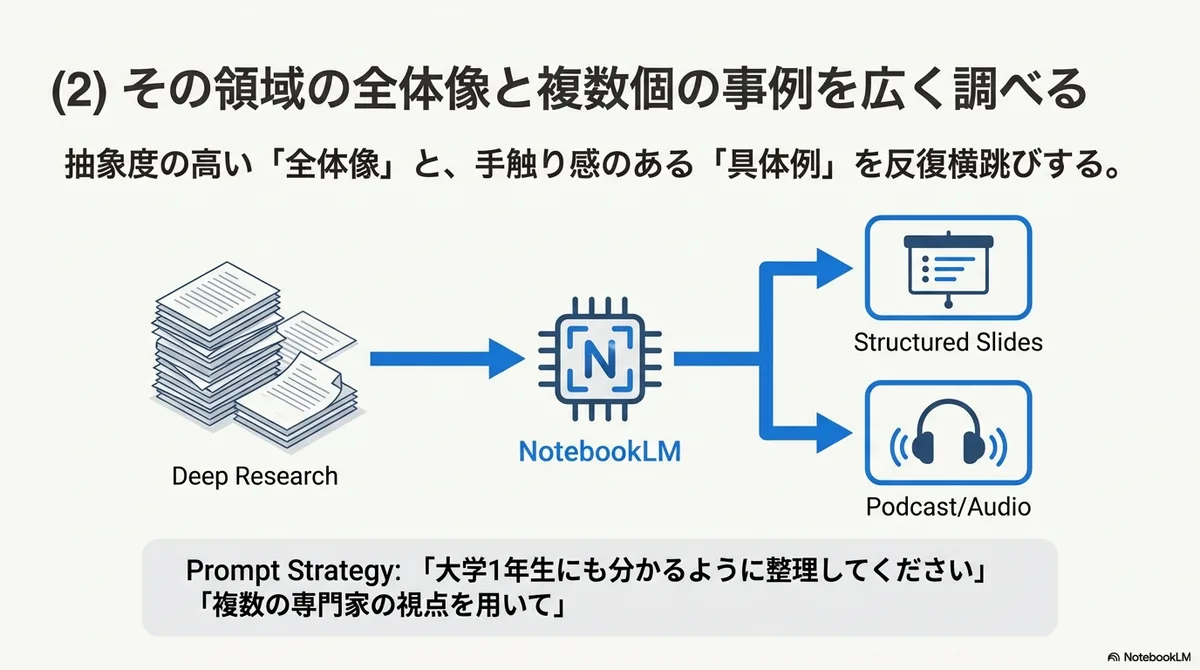
Once you have decided on one field, investigate the big picture of that field and examples. I recommend doing these in parallel.
The big picture gives you a highly abstract framework, while examples give you highly concrete information with a tangible feel. Basically, you set your focus while quickly hopping back and forth between the two.
Understand the big picture
Understand the theme. However, "knowing the big picture perfectly" is something you can never finish no matter how much time you have, so do not aim for that.
For example, if the topic is space-based solar power, enter into the prompt
Please organize the latest status of space-based solar power businesses, technologies, and startups, using the perspectives of multiple experts, in a way that even a first-year university student can understand
and have it investigate. (Here too, I think it is better to have generative AI improve the prompt beforehand if possible.)
If there is something you don't understand, try digging into it.
However, in a field you are seeing for the first time, it is hard to have questions, so I think it is also a good option to have it generate questions with something like
I want to understand the big picture of these fields more deeply and broadly. Please give some examples of additional questions and prompts for that
and then have them answered all at once in a Google Sheet or similar, as described above.
Using NotebookLM here is also recommended. After running Deep Research on the field once, you can generate slides, or output a podcast or video, which lets you advance your understanding in a way that differs from reading text.
Investigate cutting-edge concrete examples
For example, investigate concrete ideas as follows. I recommend investigating examples that are as cutting-edge as possible, because basically you will be creating ideas close to them.
For startups, try asking generative AI with a prompt like the following.
Please investigate concrete examples of space-based solar power startups and organize their characteristics and progress from the perspectives of multiple experts. To get the latest information, be sure to run a search before organizing.
Investigating from startups lets you learn about the cutting-edge challenges. For research, it may also be good to focus on non-peer-reviewed papers such as those on arXiv.
If it doesn't feel right, change the field
If, as you investigate, you find no cutting-edge idea that captures your interest, go back to selecting a field and investigate a different one.
(3) Investigate a Specific Example in Depth
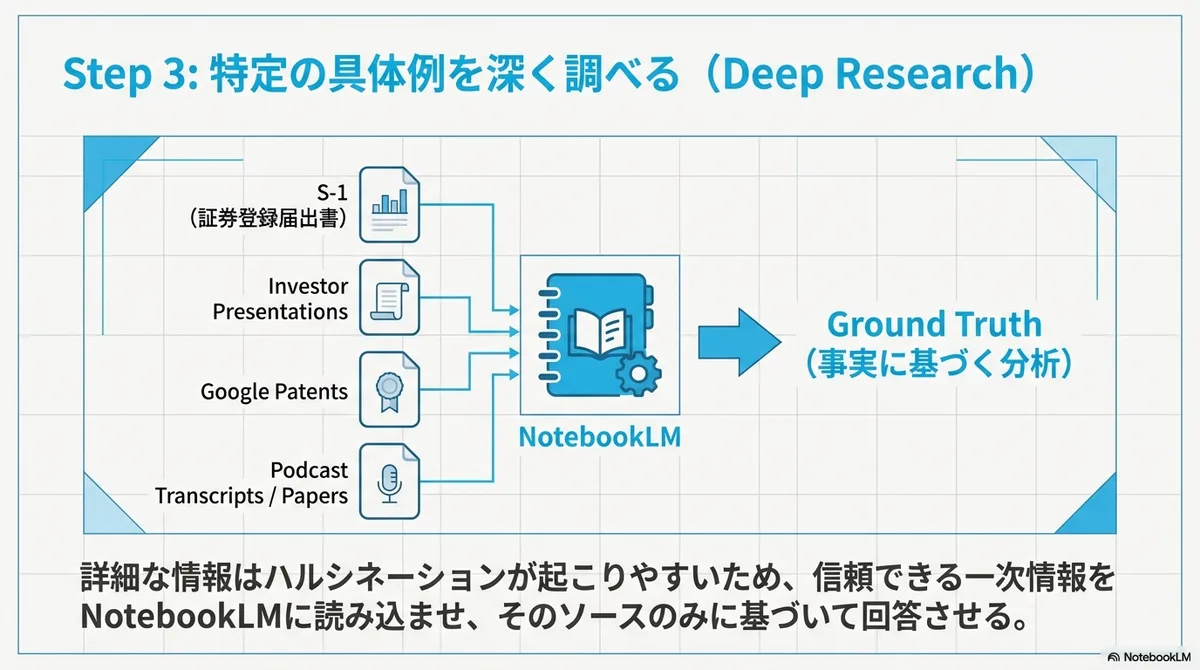
Once you have built up a map of the field's big picture and its various players to some extent, dig deeply into individual ideas (here, startup companies) and prepare to create an idea (hypothesis) that is uniquely yours.
Because ordinary generative AI services are prone to hallucination when it comes to detailed information, I recommend compiling accurate sources in NotebookLM rather than throwing prompts at a generative AI service.
Here are some tips for doing so.
- Using NotebookLM's Deep Research can mix in strange information, so I do not recommend it. It takes extra effort, but I recommend running Fast Search and then manually selecting only appropriate sources.
- Especially if you are researching a company's early days, I recommend actively adding YouTube videos, podcasts, and the like. Audio tends to contain more sensitive information.
- Technical details are sometimes not public, so also add the company's Google Patents entries and the key people's papers.
Here too, by turning the information gathered in NotebookLM into slides or a podcast, you can build understanding quickly.
For example, I run a podcast introducing the latest startup information researched with these methods, on YouTube and Spotify. If you are interested, I would be glad if you subscribed and used it as an opportunity to learn about a wide range of concrete examples.
Also, rather than doing this for just one idea (company), do it for multiple ideas (companies), and get to know the characteristics of each idea in detail.
In the case of business ideas, I also recommend investigating publicly listed companies. They should serve as a reference for the eventual stock price at listing. In that case, search for things like "company name S-1" or "company name investor presentation" and register the results as sources in NotebookLM. If possible, it is better to look at PDFs with images yourself as well (because they are informative).
Ask NotebookLM, or use something like ChatGPT Pro, to ask about the problems of that company's business in question.
Ask questions
You will surely come up with many questions as you investigate. In particular, if the field is outside your specialty, you may not even understand the terms. Having questions is a good thing, so I think you should keep asking them to generative AI.
For this too, I think it is good to use Google Sheets if you want to have them answered all at once, and chat if you want to dig deeper.
Find the gaps in the big picture
As you learn more deeply about multiple concrete efforts, your resolution of the industry or field rises, and you gradually come to see what can be done now, what cannot, and why.
Ideas that look new often have a past like the following:
- They could not be realized until now for some reason
- They were tried in the past and failed
By grasping this as well, you can sort out things like "is it impossible in principle?" and "why is it possible now?"
In this way, as you fill in "what is actually already known, but I don't know" and look for "what no one knows and I don't know either," truly good new ideas come into view.
If you find out why something that is possible in principle has not been realized, or what the challenges are, your scope narrows to finding a way to solve them.
(4) Create a Working Hypothesis
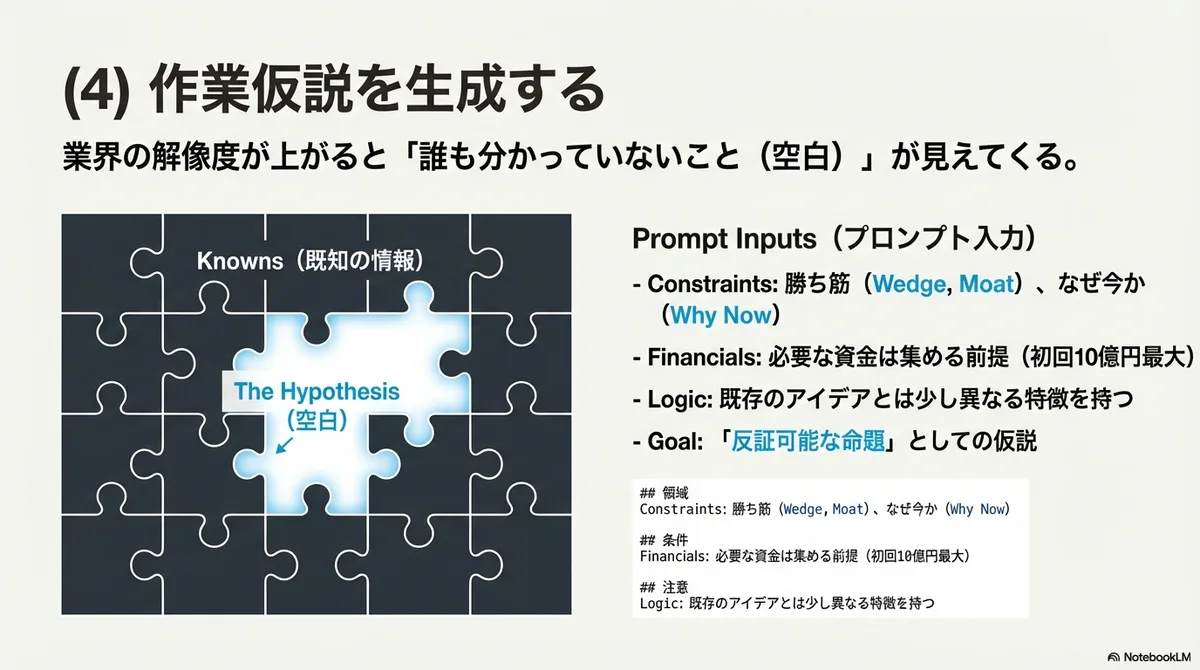
If an idea (hypothesis) has emerged from your research so far, it is fine to use it as is. If there is an idea that can serve as a reference (base), you can also create an idea by modifying it a little.
If you have not yet come up with anything that qualifies as an idea, it is also an option to have generative AI create a base for this working hypothesis. For example, like this.
I want to start a company from now on and build a fast-growing startup.
Please think deeply, using first-principles thinking, and propose multiple ideas (working hypotheses) that fit the field and conditions below. Please also explain the characteristics of each proposal while comparing them.
If you have additional questions, ask them before you start researching.## Field
«Enter what you have researched, the field, and so on in various ways»
## Conditions
- Starting from zero now, I could build a business worth over 1 trillion yen in market capitalization in 15 years (use the P/E ratios and other figures needed for the market cap calculation from the relevant industry)
- Others think it is crazy, but it is possible in principle
- A high-risk, high-return venture that large companies cannot touch and only startups can take on
- Can explain "why now" (regulatory changes, technological progress that has been accelerating over the last few years, and so on)
- A path to winning (wedge, moat, differentiating factors) can be found
- Has characteristics somewhat different from existing ideas
- It is assumed that the necessary funds will be raised, but the maximum amount that can be raised initially is 1 billion yen
## Note
- Please propose business fields that would be very large if realized, but are currently seen as having quite low odds
- Make them falsifiable propositions (hypotheses)
- If you cannot generate any matching ideas, report that there were no matching ideas
It is preferable to write the "idea field" you input into the generative AI in detail if possible. That information becomes a "pin 📌" marking the center of exploration for the generative AI, and it will explore the surroundings of that pin. Where you place the pin 📌 greatly changes the generative AI's response.
The more general the prompt you give generative AI, the more general the answer, while the more specific the specifications you give, the more appropriate the proposals tend to be.
Draw the big picture of the idea
To refine this idea further, I recommend first drawing the big picture (a map) of the hypothesis. This means sorting out what must hold true for this hypothesis to hold.
Gradually polish it by repeatedly bouncing ideas off generative AI.
In the end, it is also good to ask something like
Please draft a business plan following the FoundX pitch template (https://review.foundx.jp/entry/2025-slide-template)
and have it produce a complete version.
Refine some of the hypotheses
To refine this idea further, gradually polish the especially important hypotheses among them while repeatedly bouncing ideas off generative AI.
It is good to ask several questions such as "Can technological progress in other fields be applied to this field?", "What approaches are possible in principle but have not been tried at all?", and "What unasked questions could cause a breakthrough in this field?"
Flesh it out and turn it into slides
Understanding the working hypothesis generated by AI takes some effort.
So if you have NotebookLM gather information related to this idea and output slides or a report centered on the idea, your understanding deepens, and slides also make it easier to explain to others.
When outputting slides in NotebookLM, I recommend specifying the page structure in YAML. The current maximum is 15 pages, so keep it within 15 pages.
(5) Test the Working Hypothesis
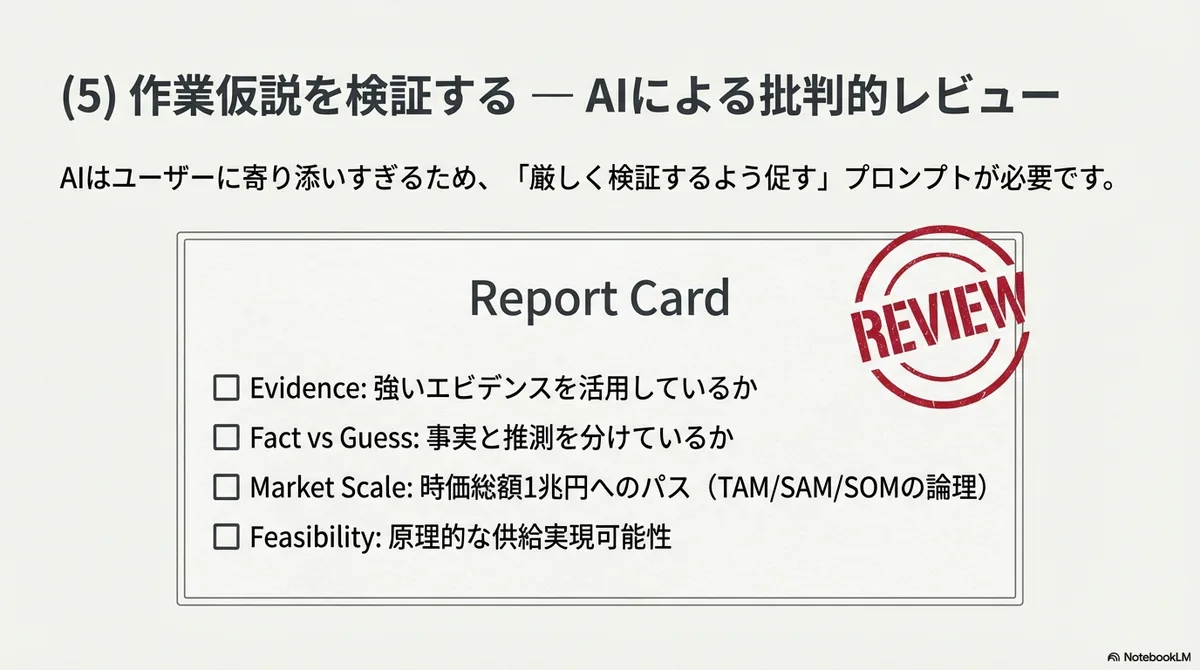
Once a good hypothesis has emerged, you enter the phase of testing it with generative AI. However, please note that generative AI at present is not very good at hypothesis testing. It is safer to treat the results as a reference only, but even so, there are many ways it is useful.
For example, test an idea with a prompt like the following.
I want to start a company from now on and build a fast-growing startup.
Please test the following idea (working hypothesis). In doing so, gather a lot of related information, think deeply using first-principles thinking, criticize and test it from the perspectives of multiple experts, and state points for improvement. If you have additional questions, ask them before you start researching.
## Idea
«Enter your idea»
## Output
- Test results
- Proposals for improving the idea
- Assumptions and unknowns
- What could not be tested
- Recommended actions for further testing
## Points to test
- Starting from zero now, I could build a business worth over 1 trillion yen in market capitalization in 15 years (use the P/E ratios and other figures needed for the market cap calculation from the relevant industry)
- Supply is feasible in principle (technology and business model)
- There is at least a slight chance that demand becomes large enough
## Testing method
- Test using strong evidence
- List the facts used in the testing
- Separate facts from speculation
## Note
- Please propose business fields that would be very large if realized, but are currently seen as quite heretical
- If you cannot generate any matching ideas, report that there were no matching ideas
Prompt it to test rigorously
Generative AI tends to side with the user (avoid saying unpleasant things), so I recommend prompting it to criticize harshly. Give the generative AI a clear role, such as a red team or a critical expert, and have it criticize.
Especially for the idea as a whole, I think it is good to give it the conditions to be tested properly. For example, a cutoff for applying conditions to the hypothesis (market capitalization, in the case of business).
Try explaining it yourself
Whether you can talk about the generated hypothesis to some extent yourself is a convenient way to gauge your own understanding, and also to test it. It is also important to test the hypothesis yourself from multiple angles, such as testing whether you can explain it, whether you can give examples, and what happens if you change some of the hypotheses.
Take action to test
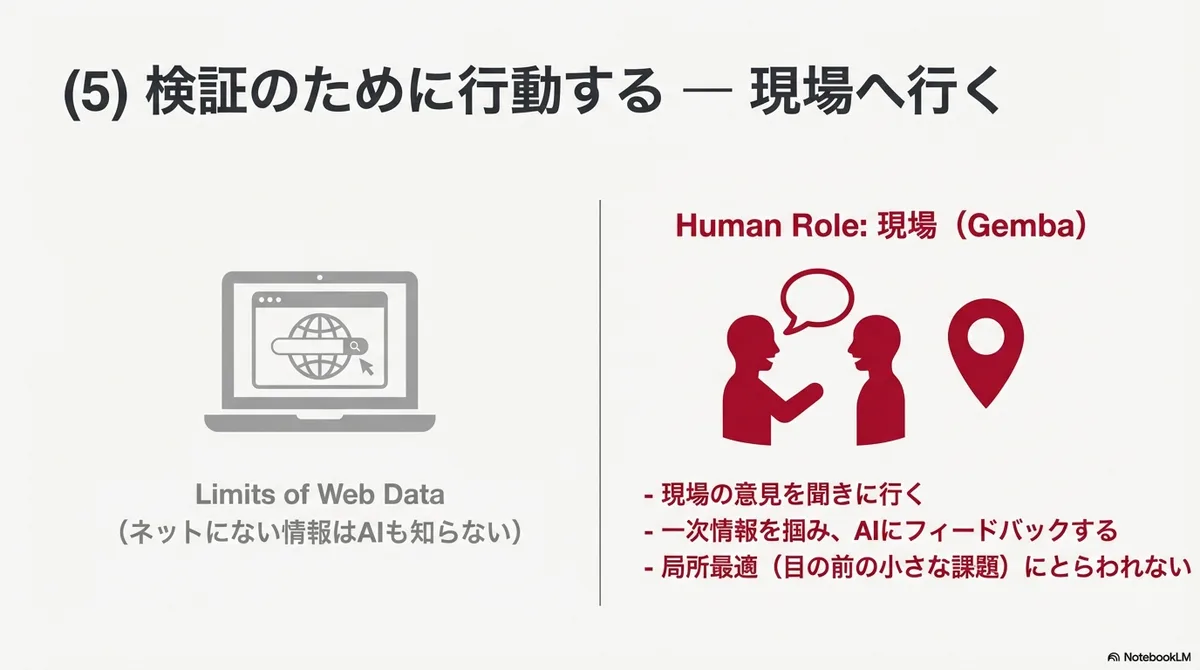
The testing above is mainly done within the range achievable by information gathering alone, but testing is not completed with generative AI. It is an everyday occurrence that an approach (hypothesis) that seems to work well overseas does not work in Japan, so you need to go and properly hear opinions from the field.
In a sense, the work left for humans is to go and collect information that is not posted on the web to test hypotheses, and to generate new data and give it to generative AI so that it can create even better hypotheses.
In particular, generative AI will get things wrong about information that is not online or in data form, and no matter how much you tell it to come up with outlandish ideas, it tends to drift toward ordinary ones. To grasp information that is uniquely yours, take action and test, obtain new information, and create new hypotheses.
Do not go for "the problem in front of you" during testing
When you talk with people, your eyes tend to go to the problem they are struggling with right in front of them. But if you aim to build a startup, what matters greatly is whether that problem is big enough, or whether it can be a first step toward a big problem.
As you repeat testing, people tend to locally optimize toward small hypotheses, so I recommend proceeding while always keeping the testing conditions in mind.
(6) Tentatively Decide on an Idea
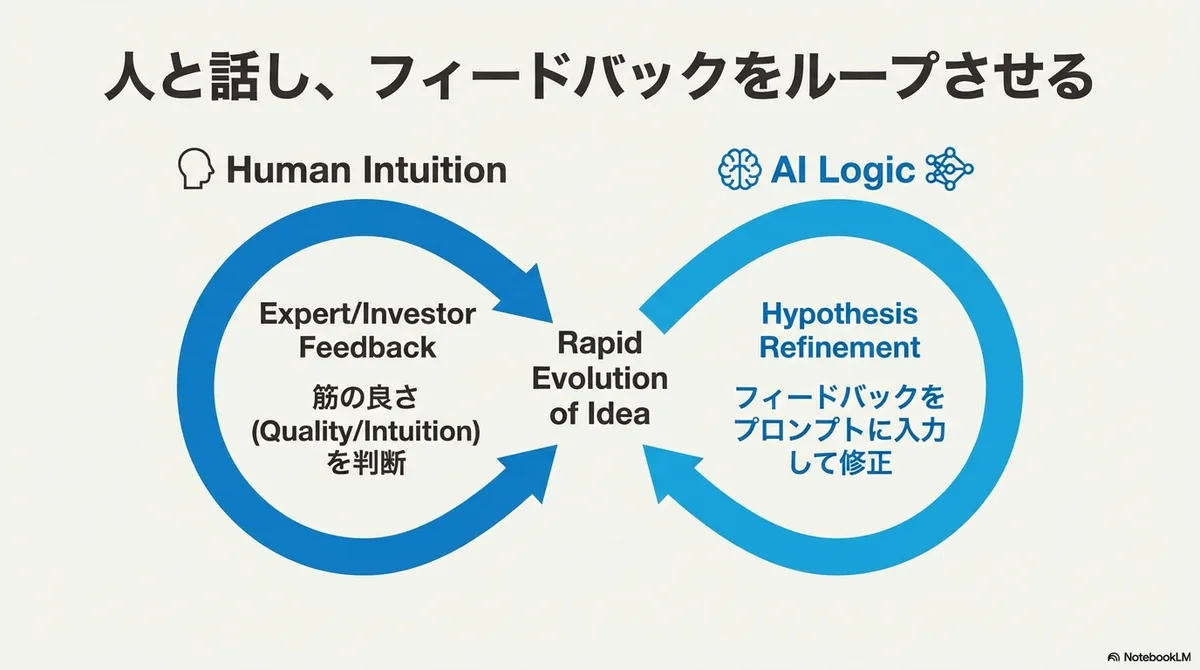
At about this point, tentatively decide on a rough idea and start creating a detailed business plan. While creating the business plan, things you don't understand will come up again, and you will sometimes test them more deeply, but you cannot start moving unless you decide that you will go in this direction for now, so decide.
Decide while talking with people
As an activity before deciding, I also recommend setting up opportunities to talk with people who can evaluate ideas (investors, professors, and so on) and trying out a few of the hypotheses you currently think are the most promising. There are some things that generative AI alone simply cannot judge. And in some cases, they may introduce you to potential customers for testing.
Also, to get good feedback from others in such settings, you need to bring a reasonably promising hypothesis. Once you can create such hypotheses and start getting feedback, the feedback loop begins to turn and the hypotheses keep getting better, so work hard until you can create working hypotheses of that level.
Tips: To Do This More Efficiently
You don't need to set up a workflow from the start, but once you get used to it, I think it is good to create and manage MyGPTs or Skills, basically oriented around building hypotheses. For example, I have created several MyGPTs and use them as a flow.
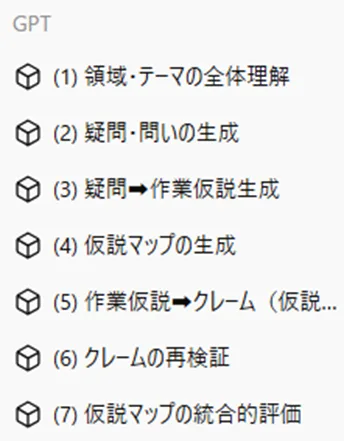
For now ChatGPT Pro performs better, so I use MyGPT, but if Skills eventually come to ChatGPT as well, I think it would be good to consolidate them there.
Also, from the perspective of setting fields, overseas think tanks and similar organizations often research and compile fairly broad agendas (though they can be somewhat short-sighted). I also distribute a podcast/YouTube series that summarizes such information, so I am sharing that as a reference as well.
📝 Summary
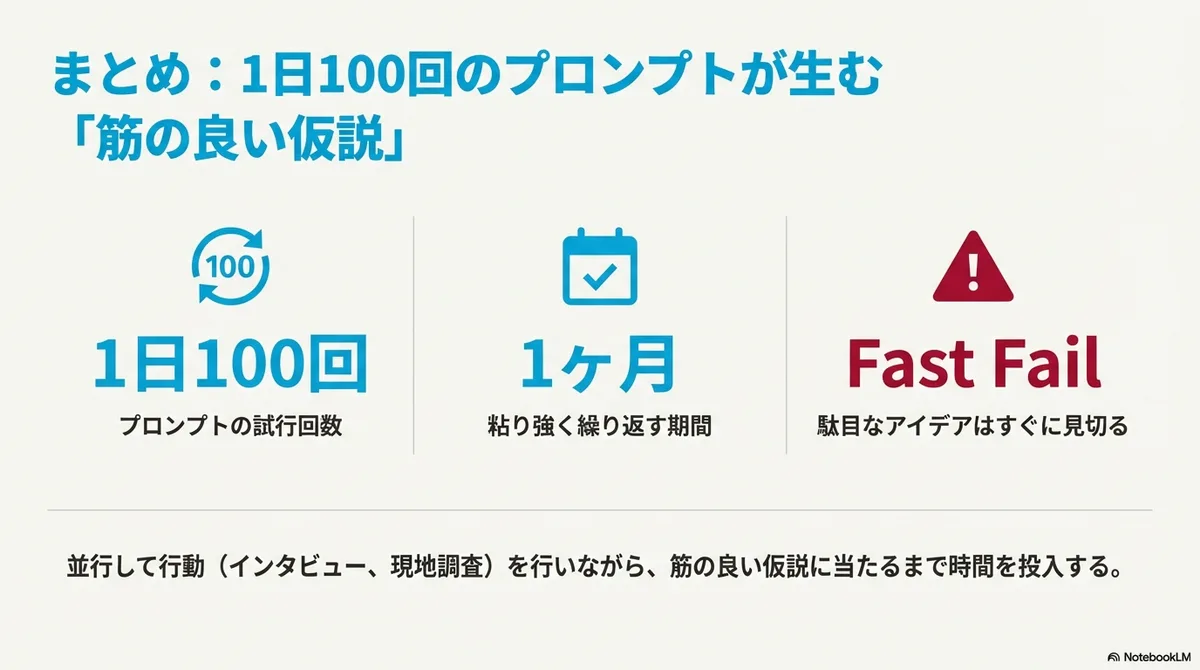
I have organized the whole flow from roughly deciding on a field to testing an idea, and summarized how to use generative AI services within it.
If you work hard at it, repeating about 100 prompt exchanges a day, testing with action, and occasionally consulting others, for about a month, you should be able to land on a reasonably promising hypothesis.
The key is to spend the time properly, and to give up quickly on ideas that don't look good and move on to the next.
While being careful about hallucination, once you reach the point of creating a roughly promising hypothesis, all that remains is to take action, and you enter a virtuous cycle in which you obtain more detailed information. As a result, you gradually realize that even ideas that look promising are about 80% wrong, but at that level, you start to obtain information that you can't get on the web, and refining the idea becomes easier, so please work toward that first.
Eventually AI may carry out this kind of work autonomously, but for now I have summarized it as a methodology using current technology.
Reference Articles
For more detail, please also see the following slides.