How Will Entrepreneurship Education Change in the Face of Generative AI? (2025 Edition)
This article was machine-translated from Japanese by AI (Claude). It may contain errors. Read the original Japanese article.
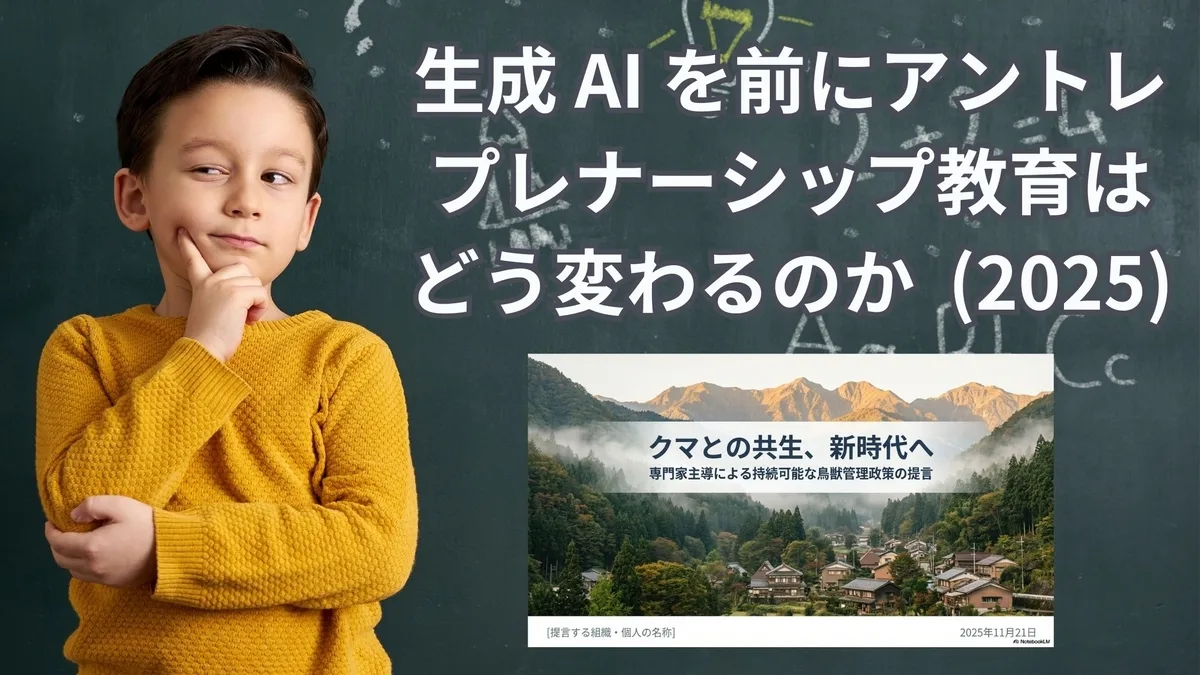
As a form of entrepreneurship education, I ran a "policy entrepreneurship" workshop using public policy.
The theme was "countermeasures against bears 🐻."
Bears have now entered hibernation season, so the issue has quieted down for the moment, but this year they became a social problem that shook all of Japan. I have also heard that, as a secondary effect of bear sightings, some policies and municipal work that should have been moving forward were partly halted because of the bears.
In this workshop, students analyzed this social issue of "bear damage" and solved it by drafting a policy in response.
Please take a look at the pitch deck they produced.
If you were told this was "a deck submitted by a student" and glanced at it, I suspect many people would rate it highly.
Yet it takes a student about 30 minutes to produce (output) this deck.
Just by following this workbook (public version), you can produce something of roughly this level in under 30 minutes.
(Note that this is not a deck made by a student who actually took part; I created it as a sample.)
The Difficulty of Assessing Learning
So if this deck were submitted as a student's work, how should we assess the student's learning?
The quality of the output will probably vary with how skillfully the tools are used. But entrepreneurship education should not be a class about using tools well.
And what can we say the student learned through this series of tasks? Does it lead to having acquired entrepreneurship?
Of course, time is set aside within the session for thinking about the social issue, and I imagine students do evaluate the AI's output and judge whether it is good or bad. Still, in terms of the intensity of "thinking" and "learning," one could say they are using their minds differently from before, and what exactly they learned about entrepreneurship, and how to assess it, become quite difficult questions.
This also means that generative AI unbundles a student's effort from the quality of the student's output.
Already Being Used
In fact, in entrepreneurship education classes in the second half of this year, I saw several cases of students using generative AI to create slides and apps and submit them. I think the students who earned the highest ratings from the audience were also those who made full use of such generative AI tools.
Outside of education, that may be fine. But if education is the main purpose, I think we should ask whether that evaluation is legitimate.
If we simply accept that producing results in business is also what is educationally excellent, then we could assess education by whether the output made with generative AI is good, and education that produces people like solopreneurs may have become easier. But whether that is entrepreneurship education is, I think, surely a different matter (it might be fine for a class on commerce, though...).
The Difficulty of Assessment = The Difficulty of Design = The Difficulty of Deciding What to Teach in the First Place
I hear that even in ordinary classes, it has become difficult to assess students through reports. In entrepreneurship education, which is closer to society, assessing learning by the quality of the output will become even more difficult.
Yet if we keep running entrepreneurship education with the same content as before generative AI, the gap between the real world and education will widen. I think that, too, is something to avoid.
Going forward, it may be that, depending on the case, we will assess students not by the quality of their output (deliverables) but by process, such as the amount of activity, or there may be other methods altogether.
My own class this academic year also included content in which students built apps using generative AI, but at that point slide generation was not yet possible. Moreover, back then I did not see much of a tendency for ideas to get better with generative AI (if anything, I had the impression that generative AI was reducing trial and error), so I thought we were still fine. But with progress in surrounding tools such as NotebookLM, I have come to think that, as in the bear countermeasures workshop above, depending on how a class is designed, it may become possible to ensure the quality of ideas... In that case, the structure of the class would have to change significantly.
In any case, it was a year in which I felt we have to ask anew how entrepreneurship education should be designed, and, going further, what entrepreneurship actually is.
(I expect the situation surrounding generative AI will have changed a year from now, but I think this question will not change much by then. For now, I have put this together as the 2025 edition.)
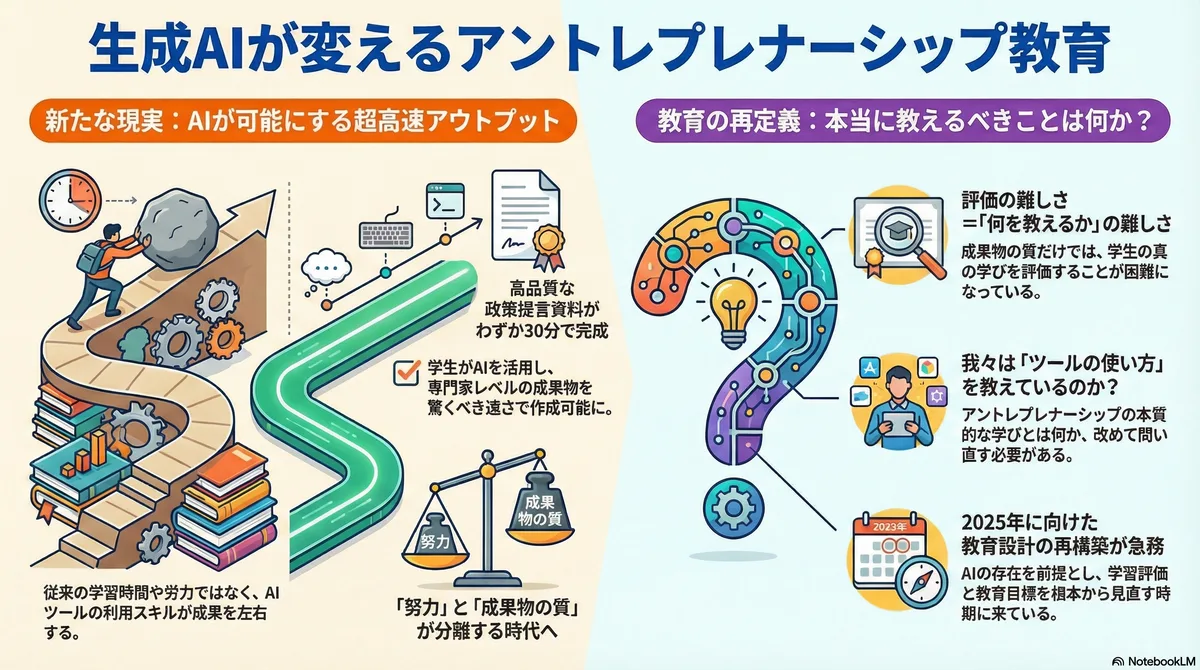
Summary by NotebookLM
This article's slides by NotebookLM