Organizing Startups by "Demand Risk vs. Supply Risk" and "Bottom-Up vs. Top-Down"
This article was machine-translated from Japanese by AI (Claude). It may contain errors. Read the original Japanese article.
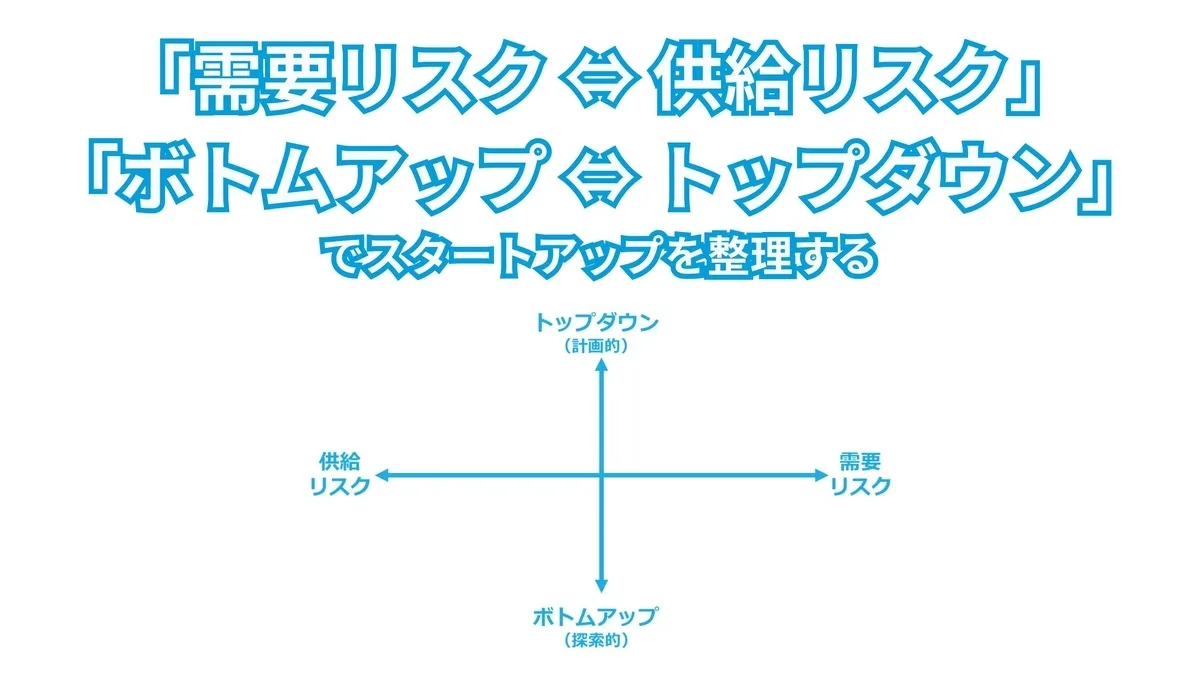
This isn't limited to high-growth startups, but new businesses in general differ somewhat in both their risks and their approaches. This article is a quick attempt to classify those types.
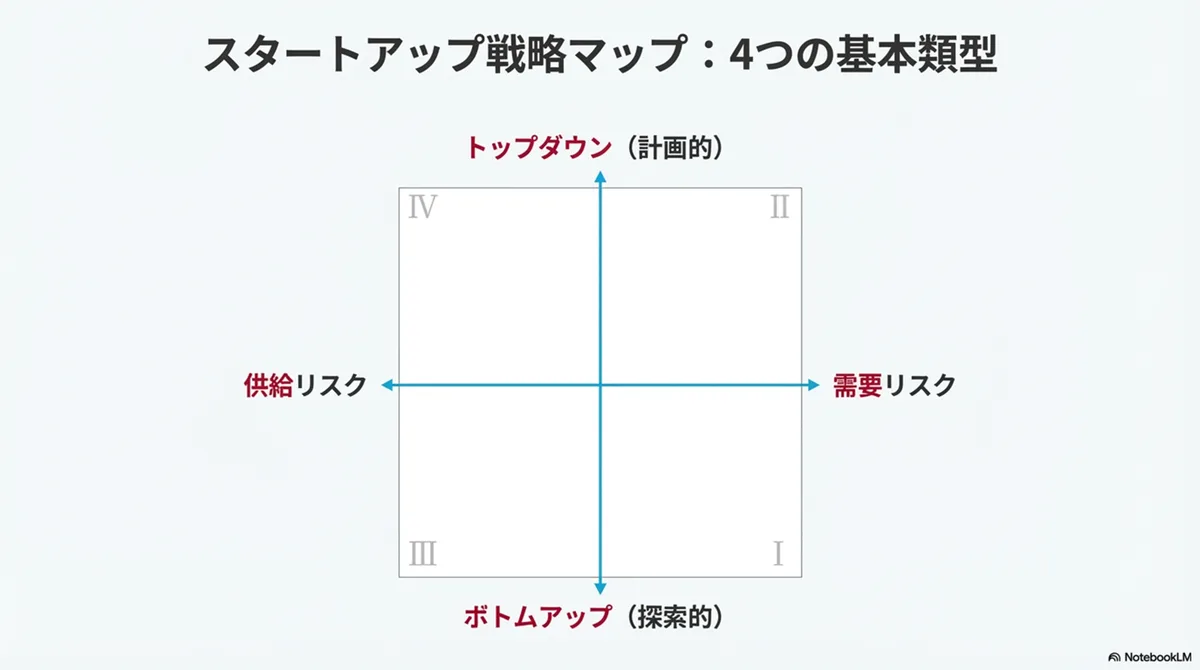
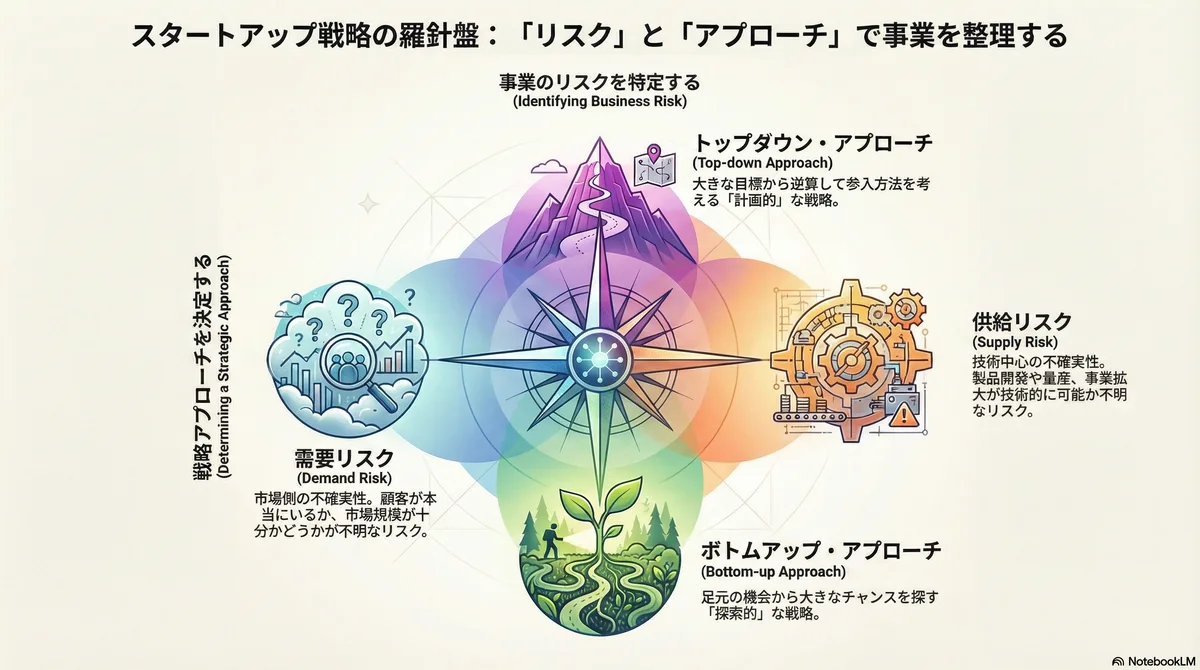
The conclusion is that, with the two axes
- Approach: Top-down ⇔ Bottom-up
- Risk: Demand ⇔ Supply
we can make four quadrants and roughly work out where our own business sits. (The slides above were produced by NotebookLM.)
① Demand Risk or Supply Risk?
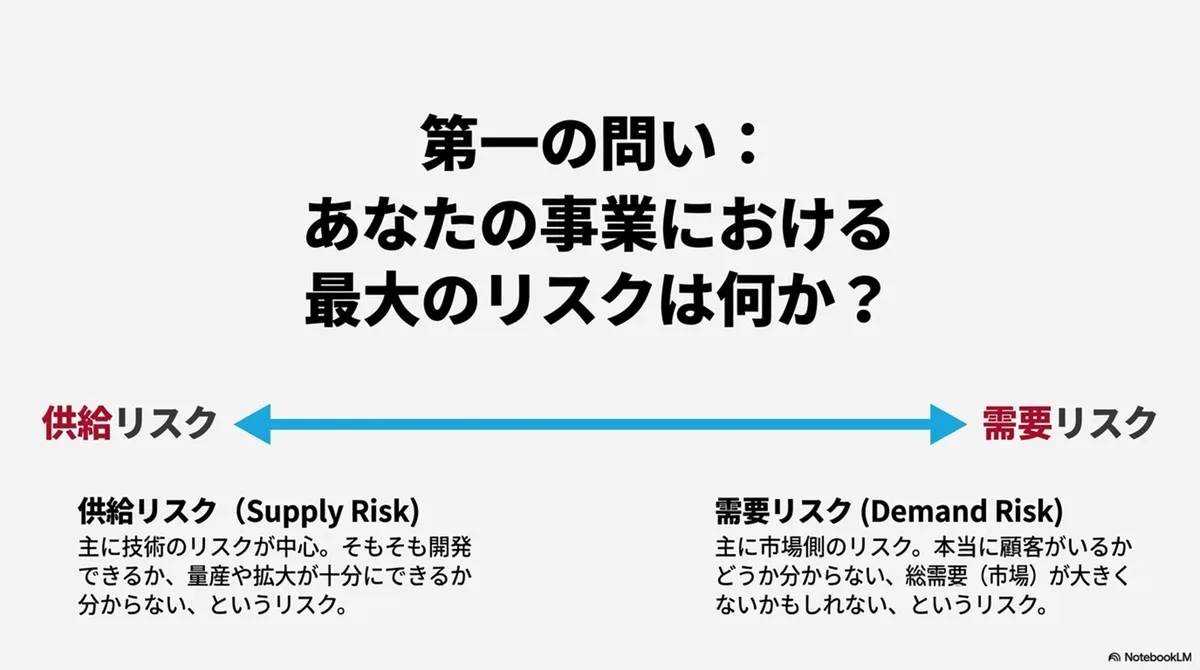
First, risk. Which risks to take differs from business to business.
In many cases, a startup is a company that takes a risk other companies can hardly take, on either demand risk or supply risk, or both.
- Demand risk is mainly a market-side risk: not knowing whether customers really exist, or whether total demand (the market) will grow large.
- Supply risk centers mainly on technology risk: not knowing whether the product can be developed, or whether it can be mass-produced and scaled up sufficiently.
Most startups take a "reckless" risk on one or the other. If that recklessness pays off, they can grow big.
② Bottom-Up or Top-Down?
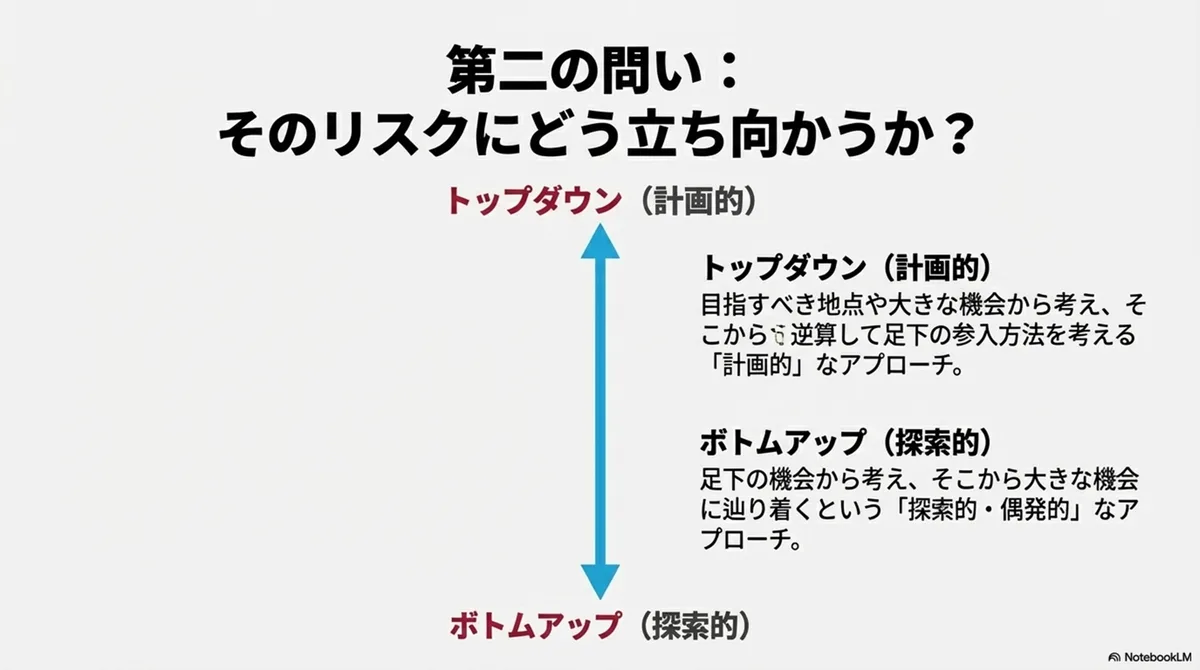
Next, approach. There are two approaches: "bottom-up" and "top-down."
The bottom-up approach starts from the opportunities at your feet and reaches a large opportunity from there. It is an "exploratory, serendipitous" approach.
The top-down approach starts from the destination you should aim for or from a large opportunity, then works backward to figure out how to enter at your feet. It is a "planned" approach.
The two are not sharply divided, and you will shift the weight between them along the way. Still, in terms of the overall business strategy, it differs which one is stronger.
There are also affinities, I think: B2C tends to suit bottom-up and B2B tends to suit top-down, and young entrepreneurs seem to suit bottom-up while older ones suit top-down.
Characteristics of bottom-up
The bottom-up approach is effective when there is great uncertainty at your feet. On the other hand, your company's growth is left to that uncertainty.
Because it is an exploratory approach, the number of trial-and-error attempts decides success or failure. It pairs well with approaches such as the lean startup, but rapid growth happens only when there is a premise or condition that "if you keep optimizing for what's in front of you, you will reach a large opportunity."
There is also technological bottom-up. For example, "commercializing an interesting technology from a lab" is a bottom-up approach.
Characteristics of top-down
This is a style in which you set a target point and work backward from it. You plan to some extent in advance where to enter first and which area to go after next.
Compound startups, for example, look more top-down (though some may have started bottom-up and then switched to top-down).
Even when using a lab's technology, if it is a case of "using the lab's technology to build a specific business," that would be a top-down approach.
Because it is planned, the top-down approach tends to become a resource game, which incumbents are good at, and you need to think deeply about your path to winning. Making positive use of uncertainty, as a startup should, will also be important at times.
For example, in the case of the technological top-down approach, one method is to calculate the theoretical limit of a technology that has not yet been realized, and then, if you succeed in developing it, win big.
Summary
To sum up, businesses in each quadrant differ in what they need to think about and in their optimal financial plan, so I think the way of thinking should change depending on which approach and which risk you are trying to take.
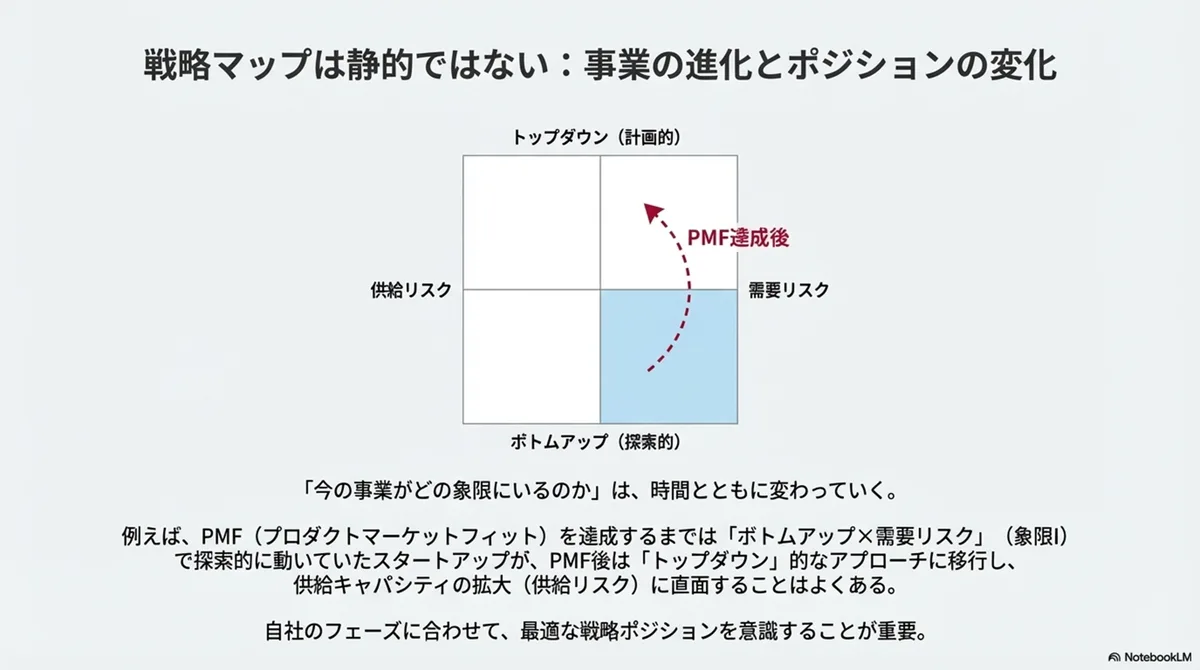
Also, even for a single business, I think "which quadrant the business is in now" changes over time. Before PMF, bottom-up and demand risk may be large, while after PMF, top-down and supply risk may become large.
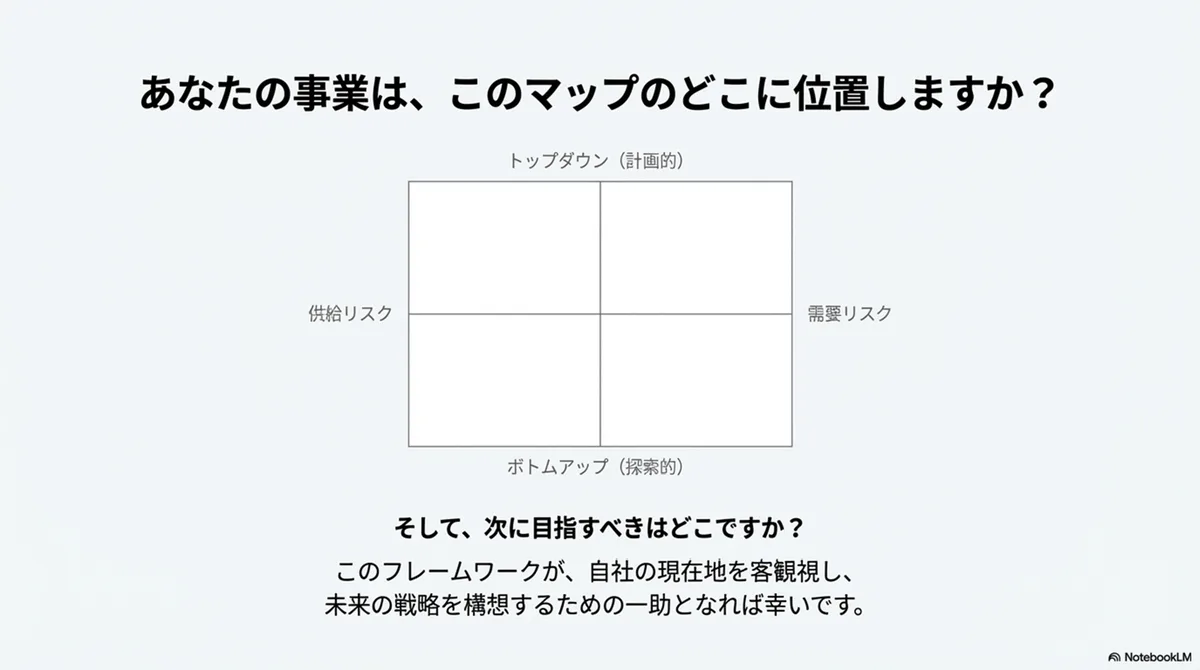
If you have time, I think it would be good to consider, once, where in which quadrant your business currently sits.
Incidentally, I think many IT startups so far have taken an approach centered on "bottom-up" and "demand risk," against the backdrop of major platform shifts.
That certainly worked in some areas in the 2010s, but now that the platform shifts have settled down, I feel it has become difficult to achieve "rapid growth" with that approach. Moreover, it has also become fairly clear that taking a bottom-up approach in Japan has a limited upside, unlike in the United States, which has a large market.
Against that background, I believe that the high-growth startup ecosystem as a whole also needs to rethink the approaches and ways of taking risk that suit current businesses and the current environment.