Startups Read "Time"
This article was machine-translated from Japanese by AI (Claude). It may contain errors. Read the original Japanese article.

Slides by NotebookLM
I feel that what makes startups distinctive is how they relate to "time" differently from ordinary companies.
By raising risk money from VCs and the like, startups can temporarily lift the constraints of short-term indicators that matter for running a business, such as cash flow and profit.
In a sense, this means that fundraising gives them freedom in choosing their time horizon, and as a result they become able to choose a race on a different time axis from ordinary companies.
Using track and field as an example, where many companies choose sprints or middle-distance races, startups use the funds they have raised to deliberately choose ultra-short sprints or ultra-long-distance races, and win.
I get the impression that this way of relating to time gets little attention, and I feel there are several patterns of "races on different time axes," so I'll introduce a few of the time-based approaches I have seen.
(1) Ultra-short sprint: Win decisively in a short time
(2) Ultra-long-distance run: Win by taking a long time
(3) Exploration run: Start running without knowing the time limit or the goal
(4) Timing run: Take a specific position at a specific moment
(5) Bonus: Claim the bottleneck in the flow
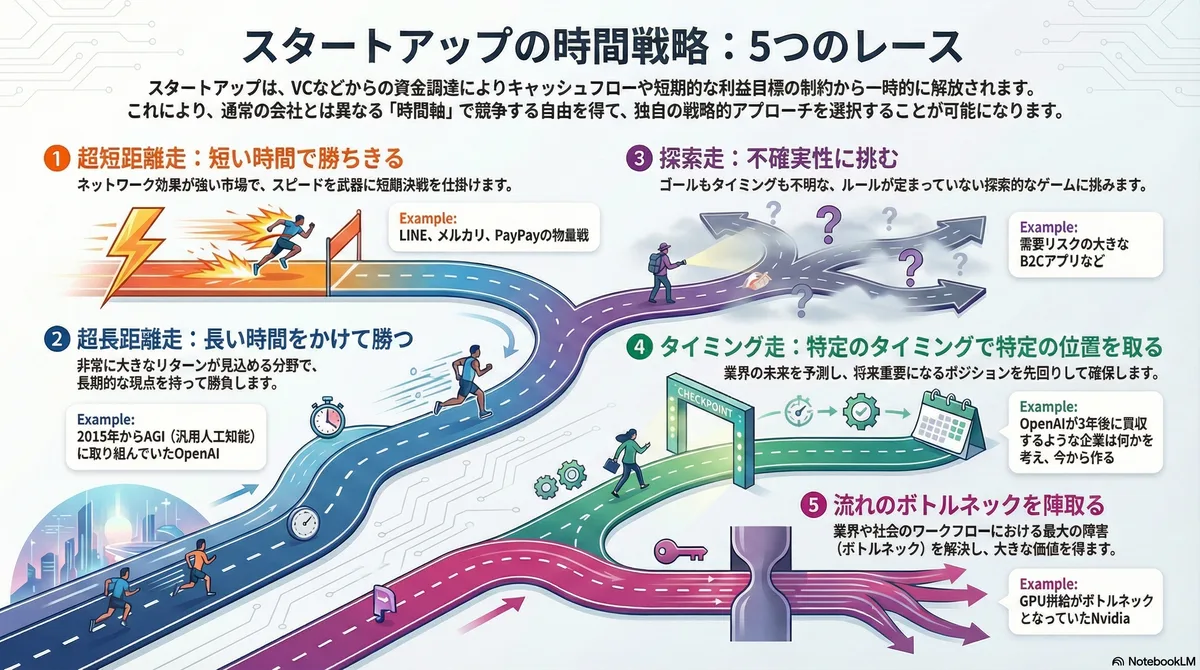
Approach (race) | Overview | Example |
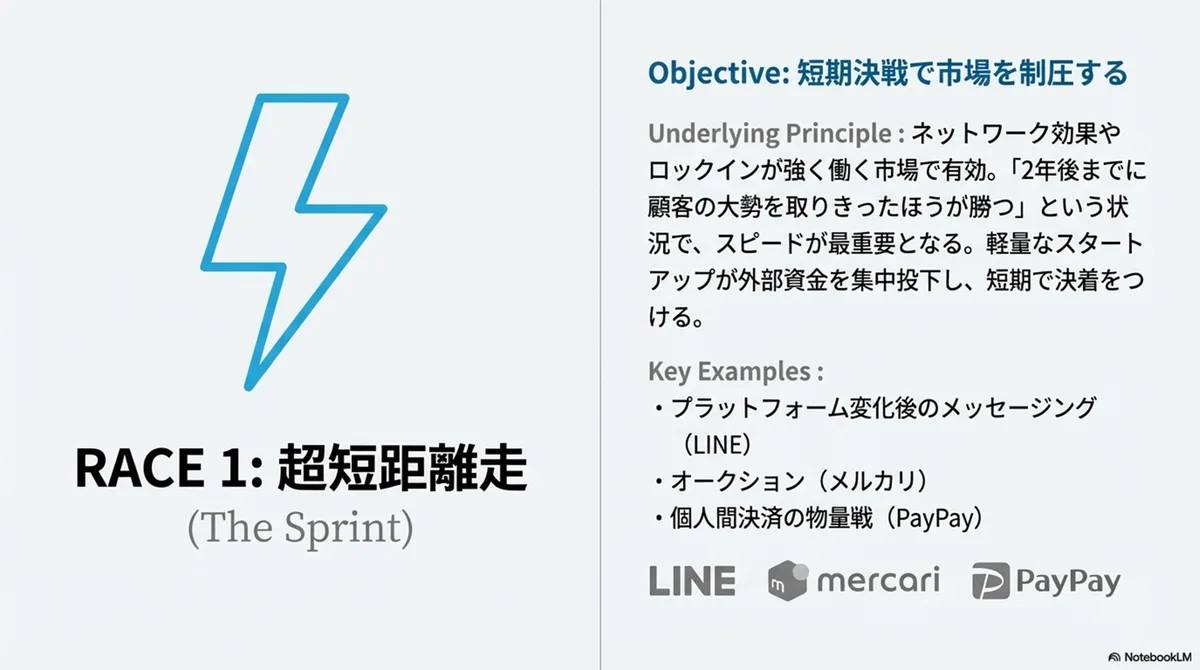
(1) Ultra-short sprint: Win decisively in a short time | In markets with strong network effects or lock-in, capture all the customers in a short period and settle the contest | Messaging after a platform shift (LINE) / auctions (Mercari) / the contest over peer-to-peer payments (PayPay's war of sheer volume) |
(2) Ultra-long-distance run: Win by taking a long time | If the return is large enough, risk money from VCs and the like makes it possible to compete on a long time horizon | OpenAI, which has been working on AGI since 2015 |
(3) Exploration run: Take on temporal uncertainty | Take on an exploratory game where neither the goal nor the timing is known, but winning might pay off big | B2C apps with large demand risk, for example |
(4) Timing run: Take a specific position at a specific moment | Anticipate industry trends and take an important position in the future. While everyone looks at the short term (Horizon 1), lay the groundwork for the mid term (Horizon 2) first | Asking what kind of company OpenAI will want to buy three years from now |
(5) Claim the bottleneck in the flow | Within a "flow" such as a workflow, secure the biggest friction, the bottleneck, and capture large value by solving it | Nvidia (GPU supply is the bottleneck) / "the bottleneck after the next" |
Note that having funds does not make a company unlimitedly free from the indicators. It is only temporarily released from the shackles of short-term indicators, and it still has to balance the books in the medium to long term. For that reason, investors are expected to receive large returns, and the company pays a corresponding cost through equity dilution and the like.
(1) Ultra-short sprint: Win decisively in a short time
This is probably the easiest approach to understand.
In businesses where network effects work well or lock-in is strong, it can happen that "whoever captures most of the customers within two years wins." Services such as messaging after the platform changed (LINE) or auctions (Mercari) fall into this category.
In such situations speed matters, and nimble startups are relatively good at this kind of fight. On top of that, by obtaining outside funding and concentrating capital, they can settle the game in a short time; this is the type of approach I mean.
It is also important to finish the job before large companies notice. For example, in the contest over peer-to-peer payment services, there probably was no Japanese startup that could have beaten PayPay's war of sheer volume (given that the funding supply to domestic startups is limited).
(2) Ultra-long-distance run: Win by taking a long time
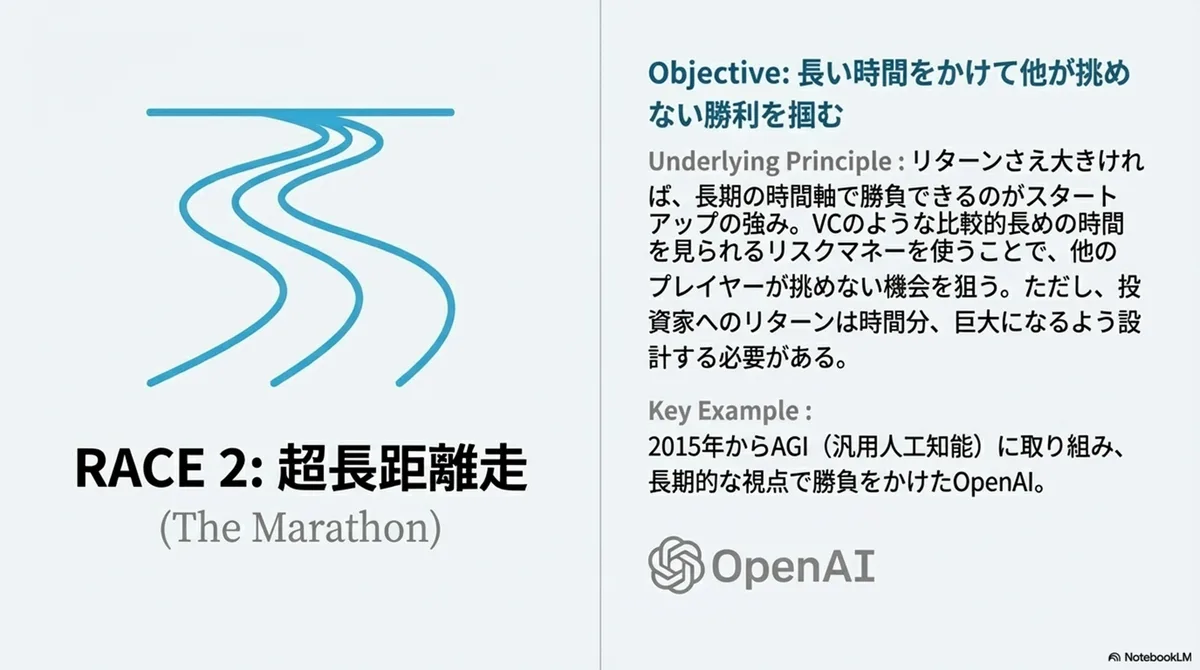
One of the good things about startups is that, as long as the return is large, they can look at a long time horizon. By using VC, a form of risk money that is relatively willing to wait a long time, they can compete over the medium to long term.
Most people compete only on short time horizons. Just being able to compete on a long time horizon lets you take on contests that others cannot. That becomes an opportunity.
However, because it takes so long, the business has to be designed so that investors' returns are quite large. It is worth noting that only a small fraction of businesses fit that frame.
Also, VCs cannot wait that long either, so in some cases it may be possible to compete over an even longer horizon by bringing on board funding sources such as direct investment from the parent of a large company or from foundations. OpenAI, which has been working on AGI since 2015, seems to have been a kind of example of this.
(3) Exploration and learning run: Take on uncertainty
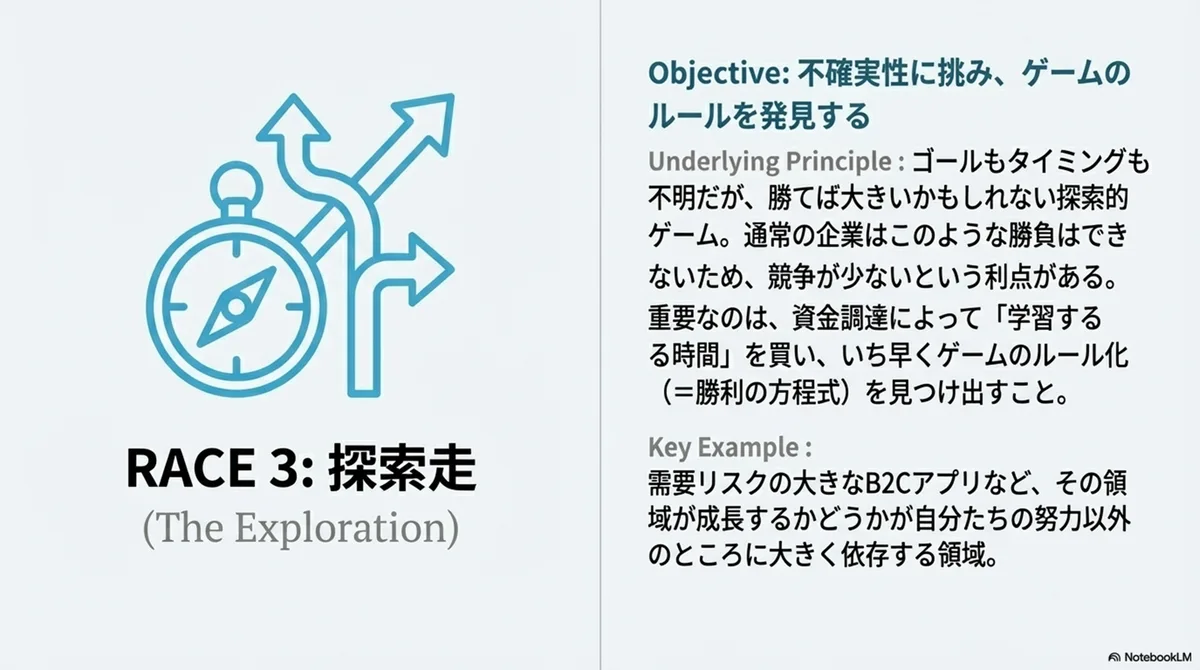
One characteristic of startups is that they can take on exploratory games where neither the goal nor the timing is known, but winning the game might bring a big reward. Ordinary companies cannot compete in such games, so there is the advantage of little competition.
Also, in a race with high uncertainty, the rules of the game are not yet understood, and in such cases the companies that can learn quickly tend to win. Even when learning is needed, you could say that they raise funds and buy time in order to learn.
However, in games like this, even if you win, it is sometimes unclear whether there will be a large reward. For example, whether the field grows often depends largely on factors beyond your own efforts, so in a sense it is luck. Still, since many people and companies cannot bet on that luck, there is a chance of winning precisely because of that, and I think that risk is something to accept willingly.
Note that there are also areas where it is known to some extent from the start that uncertainty is high but the return is not so large, and it is important to avoid choosing such areas.
(4) Timing run: Take a specific position at a specific moment
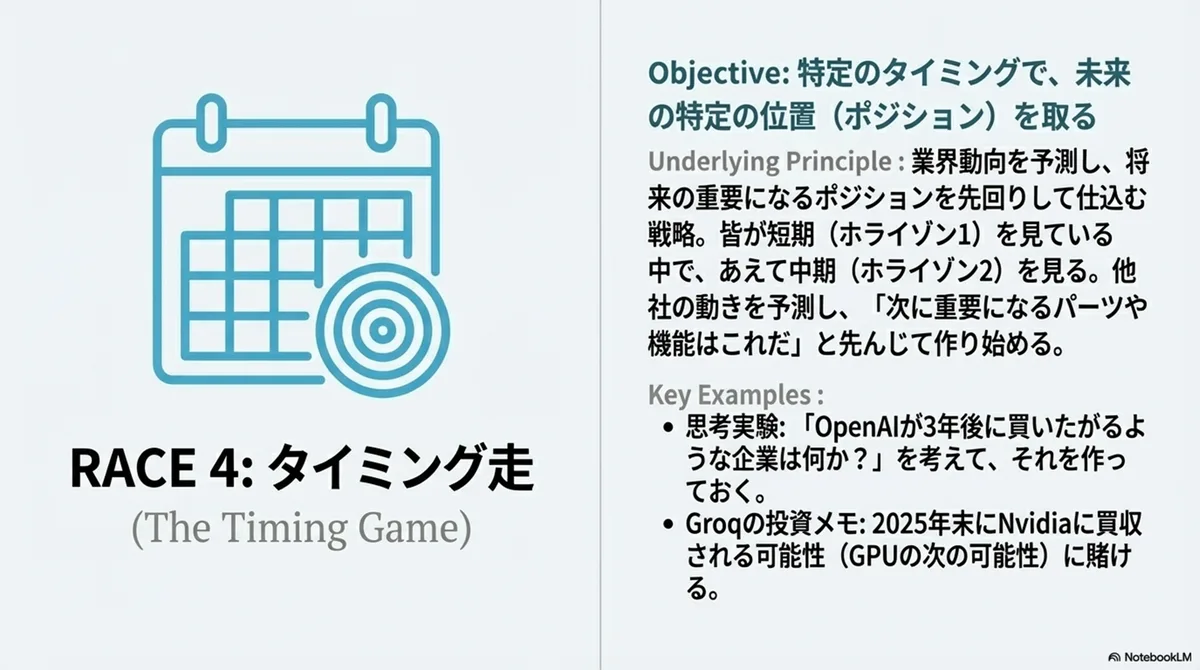
Anticipating industry trends and taking an important position in that future is also one of the frequently used time-based approaches.
There is a similar concept expressed in terms like Horizon 1, 2, and 3. While everyone is looking only at Horizon 1 (short term), you deliberately look at Horizon 2 (mid term) from now and prepare for it.
More specifically, if you are starting from zero now, one thing you can do is think about "the one after next."
This means watching what other companies do, making a prediction such as "they will probably come at it this way, and the key parts and functions there will be these," and starting to build ahead of time. For example, the investment memo on Groq, which was effectively acquired by Nvidia at the end of 2025 (strictly speaking it was not an acquisition), describes a bet on the possibility of "what comes after the GPU."
For example, today you might ask "what kind of company will OpenAI want to buy three years from now?" and build that. For a longer horizon, an example might be "a lot of EV batteries will come out in 2040, so prepare for that."
If you think this way, you can secure a good position a few years from now.
(5) Claim the bottleneck in the flow
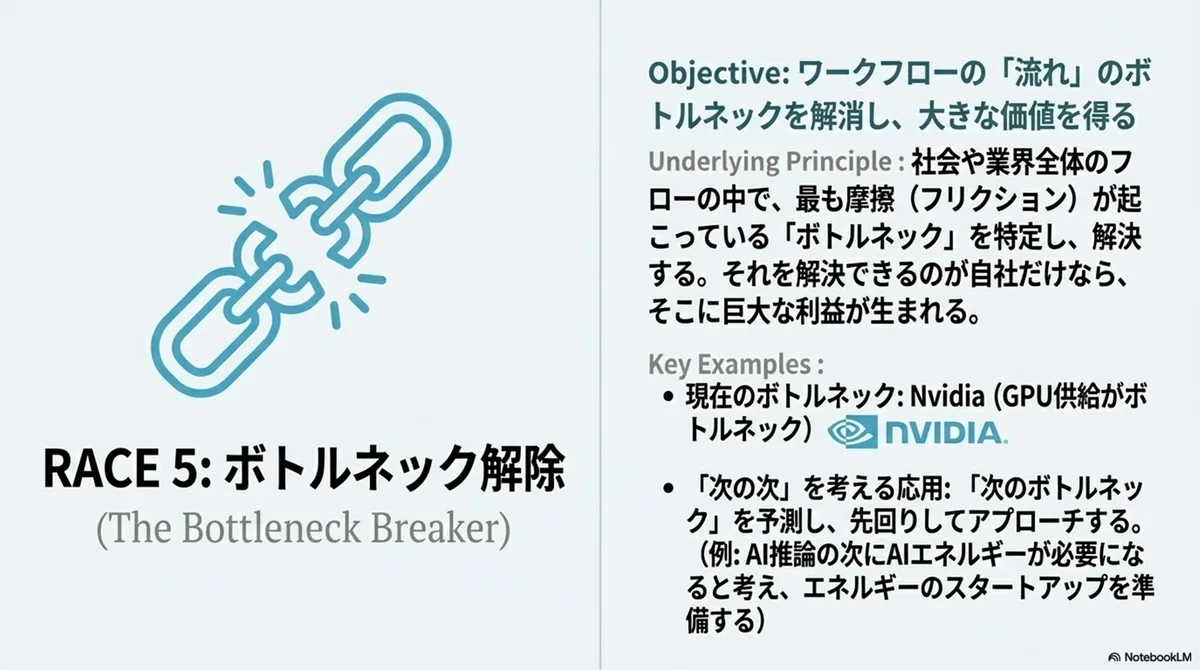
The last one is somewhat different in character, but it is a perspective that, even within the time axis, you need to be aware of the "flow," such as a workflow.
In the world there are various frictions, such as hassle and slowness, and products are offered to solve them. The place where money gathers especially is where the most friction occurs in the flow of society or an entire industry, that is, the bottleneck. If only one company can solve it, large profits arise there. Nvidia is a good example. Precisely because GPU supply is the bottleneck, many people pay high prices, and the company makes money.
The difficulty of this approach is that developing the technology needed to solve that bottleneck is technically hard (in development, mass production, and so on). Conversely, even if you can develop the technology, if it is effective only at points that do not create bottlenecks or friction, that technology will not command much market value.
Furthermore, you can combine this with thinking about "the one after next" by considering "the bottleneck after the next" and approaching it in advance. For example, a few years ago, rather than just thinking AI means inference is needed, you would think AI means energy is needed, and prepare an energy startup.
In some cases, as the real bottleneck shifts there, the balance of value created between the main and the subordinate may reverse, and one might even take a move such as acquiring a business that originally had momentum.
Summary
Summary by NotebookLM
In this article I organized the ideas from the perspective of how to make use of time.
I did so because I thought that being conscious of what kind of race you are taking on, and what kind of time you are buying with your funds, might make one aspect of your own business easier to see.
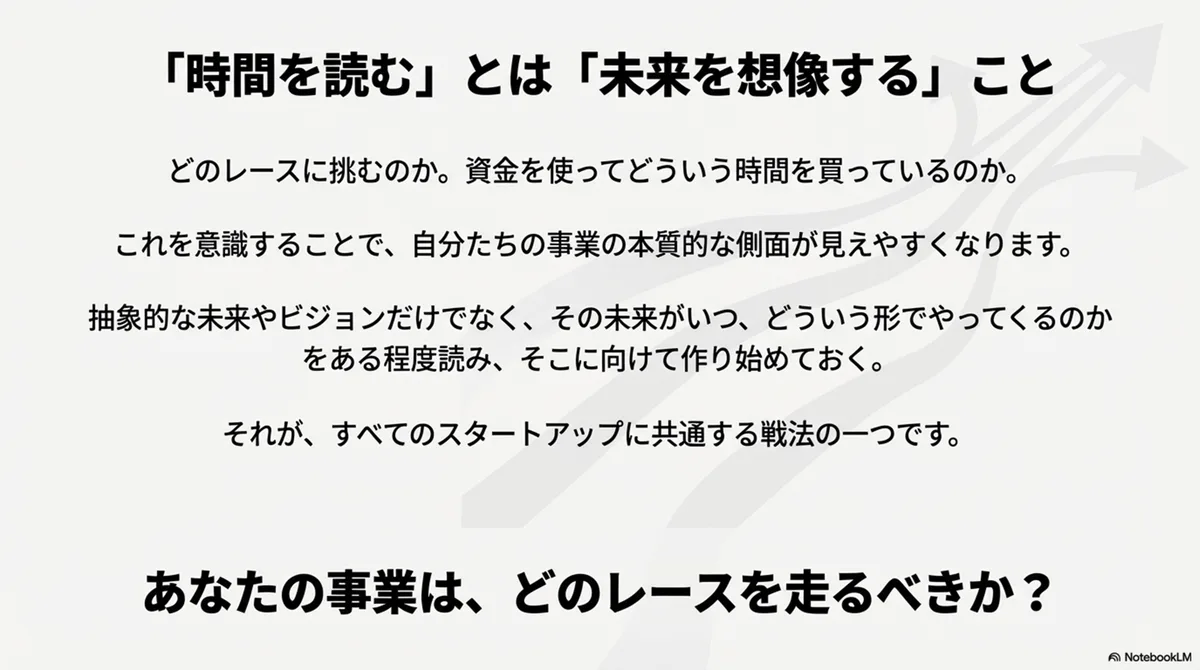
Reading time is, in a sense, "imagining the future." Not an abstract future or vision, but reading to some extent when and in what form that future will arrive, and starting to build toward it. I think that, although it is not the whole story, this is one of the tactics of a startup.