Get Past the Trough of Disillusionment for Startups
This article was machine-translated from Japanese by AI (Claude). It may contain errors. Read the original Japanese article.

Reactions to a tweet I posted recently made me feel the "antipathy toward startups" all over again. (See the quote tweets here.)
This was a year in which I heard more and more people say that "startups have become harder." Starting one has become easy, but choosing a market and growing rapidly have become harder, and the scale of growth and the level of strategy required have both increased, so I think it has become harder overall…
— Takaaki Umada 🐴 (@tumada) December 26, 2025
Do startups tend to attract antipathy?
Certainly, over the past decade or so, startups have drawn a great deal of attention and expectation. In response, I think there were parts that, to outside observers, looked like getting carried away.
In fact, startups and the entrepreneurial scene regularly see several kinds of problems come to the surface. For example, the following:
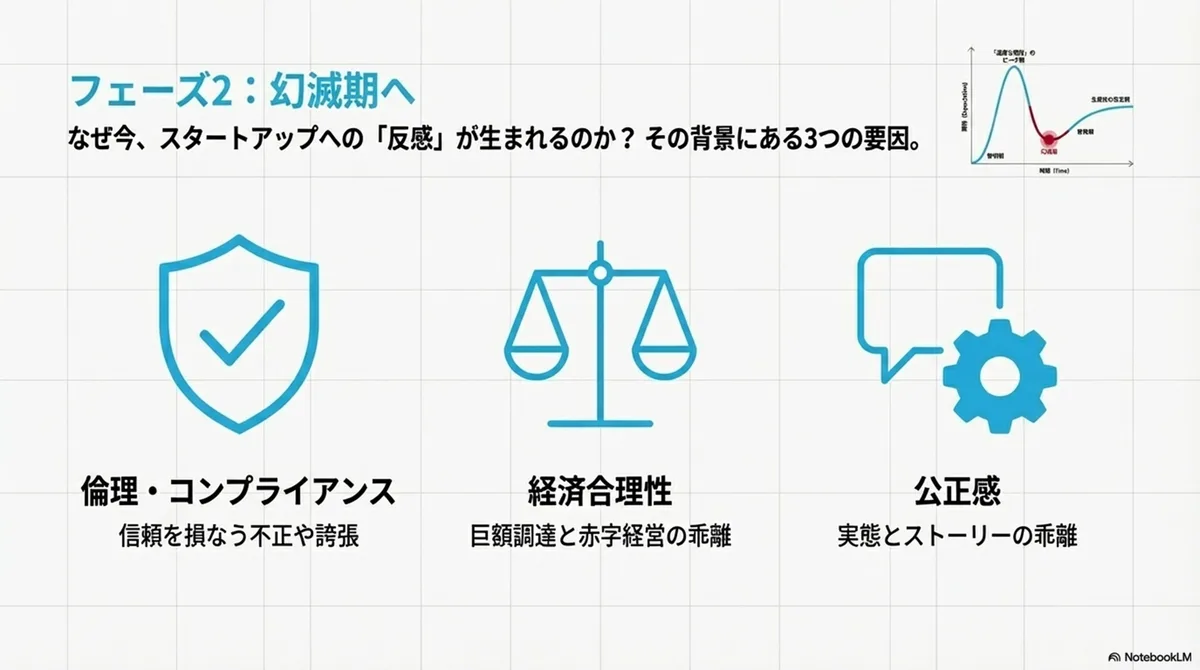
1) Antipathy toward ethics and compliance violations (fraud, exaggeration, and shadiness)
Unfortunately, in the startup world a certain number of incidents occur that damage trust, such as exaggerated advertising, falsified accounts, and the improper use of subsidies and grants. The more earnestly a business operator is doing the right thing, the stronger their anger at such incidents is likely to be.
2) Antipathy toward economic rationality (what looks like glorifying losses and disregarding profitability)
From the perspective of operators who earn profits steadily, it is natural to feel uneasy about companies that keep bleeding red ink and still obtain funding and exposure. Rather than understanding and respect for "taking on a challenge with excessive risk," the feeling that "the value of working hard to turn a profit is being belittled" tends to creep in.
3) Antipathy toward a sense of fairness (the gap between substance and surface)
When the amount raised and a flashy story come first, and the substance, such as customer value and recurring revenue, is hard to see, it looks as if "presentation is being rewarded over substance," and it is easily regarded as unfair.
While some of this antipathy rests on misunderstandings of the criteria by which startups are evaluated (time horizon and risk), I think we should recognize that the industry also has a structure that makes it "easy to attract antipathy."
The returns of the industry as a whole are not good either
There are also points that cannot be dismissed as mere misunderstanding.
For example, in recent years, backed by high expectations, startup investment has grown large, reaching an annual scale of just under 1 trillion yen.
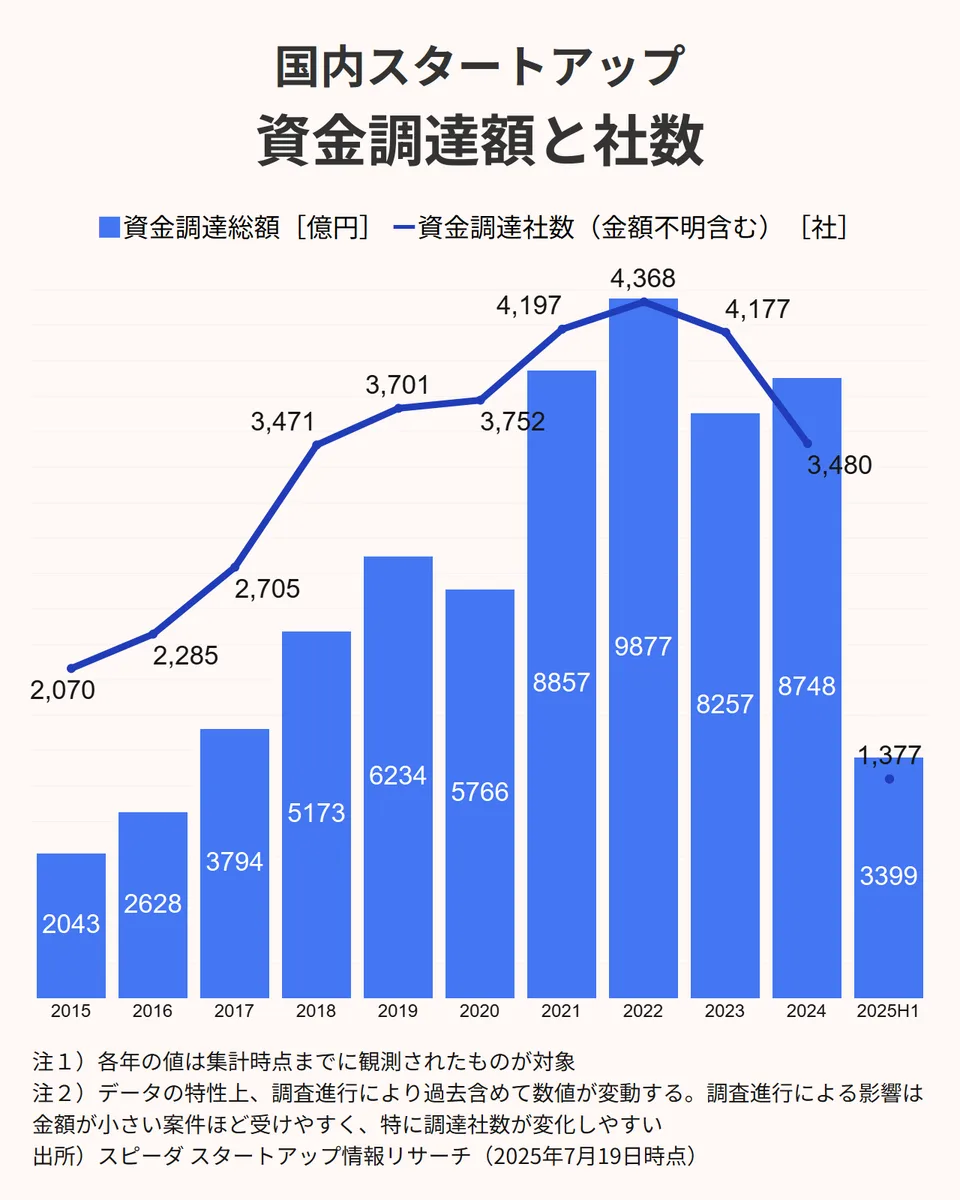
But I think many people share the sense of crisis that returns (exits) large enough to match that amount of investment have not been produced.
Of course, there are quite a few individual funds that perform well, but from 2015 onward it looks likely to be a difficult picture overall. (Note: this is not limited to Japan, and I suspect that the VC asset class in any country cannot be said to be doing all that well.)
I also think this situation has been brought about by a miscalculation: although these were startups aiming for high growth, the ceiling on rapid growth using conventional methods turned out to be lower than expected.
Perhaps against that background, I hear that it continues to get harder to raise new funds in Japan. Considering further that the antipathy described above is surfacing, that large companies' expectations for open innovation with startups have cooled, that there is a return to small businesses led mainly by younger people, and that policy attention also seems to be starting to fall somewhat, I feel that, to borrow the language of Gartner's Hype Cycle, the peak of inflated expectations has ended and we have finally entered the "trough of disillusionment for high-growth startups."
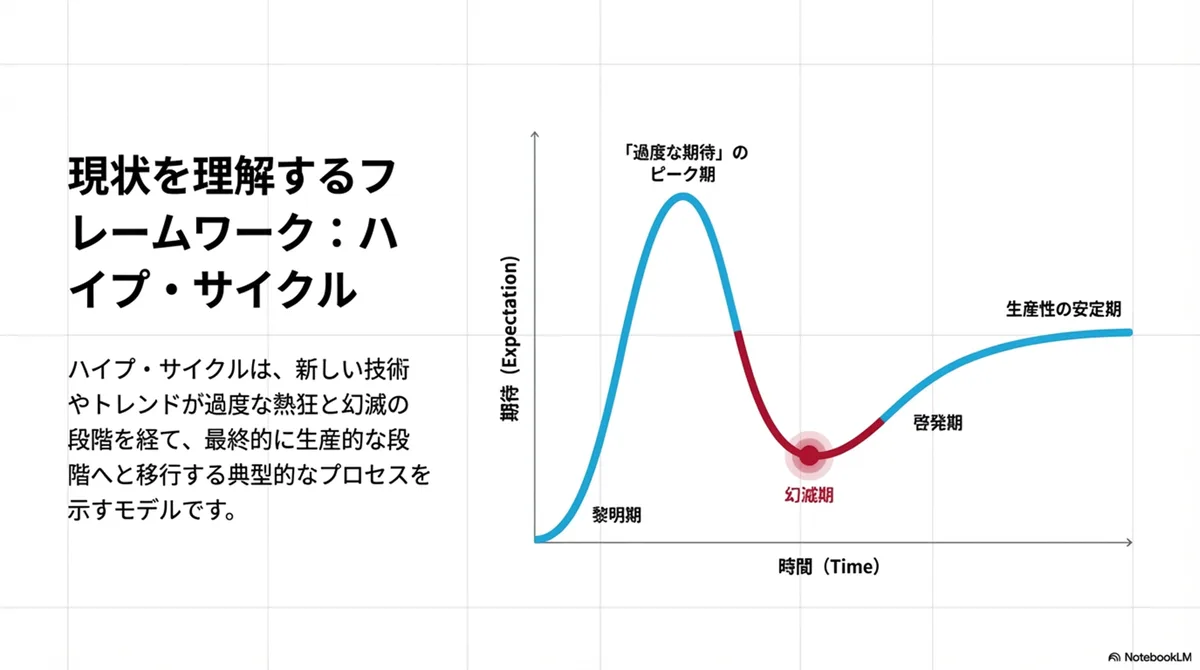
I wrote about the same thing about two years ago in the article "Stopping the 'Beginning of the End' of Japan's Startup Boom," and my impression is that it has finally arrived.

When the tide goes out like this, I think the pre-existing structure that attracts antipathy, combined with the reversal of earlier expectations, makes a backlash more likely.
However, the trough of disillusionment is also a period of restructuring, and an opportunity to push forward a redesign toward maturity.
It is a time to think about where to place expectations (what we are betting on), how to show results (what counts as success), how to secure trust (how to reduce fraud and exaggeration), and how to design exits (whether to include M&A and secondaries, not just IPOs), in other words, to think again about "what exactly a startup that Japan can expect should be," and to take action.
This article is about thinking through what we can do toward that end.
Looking back at history
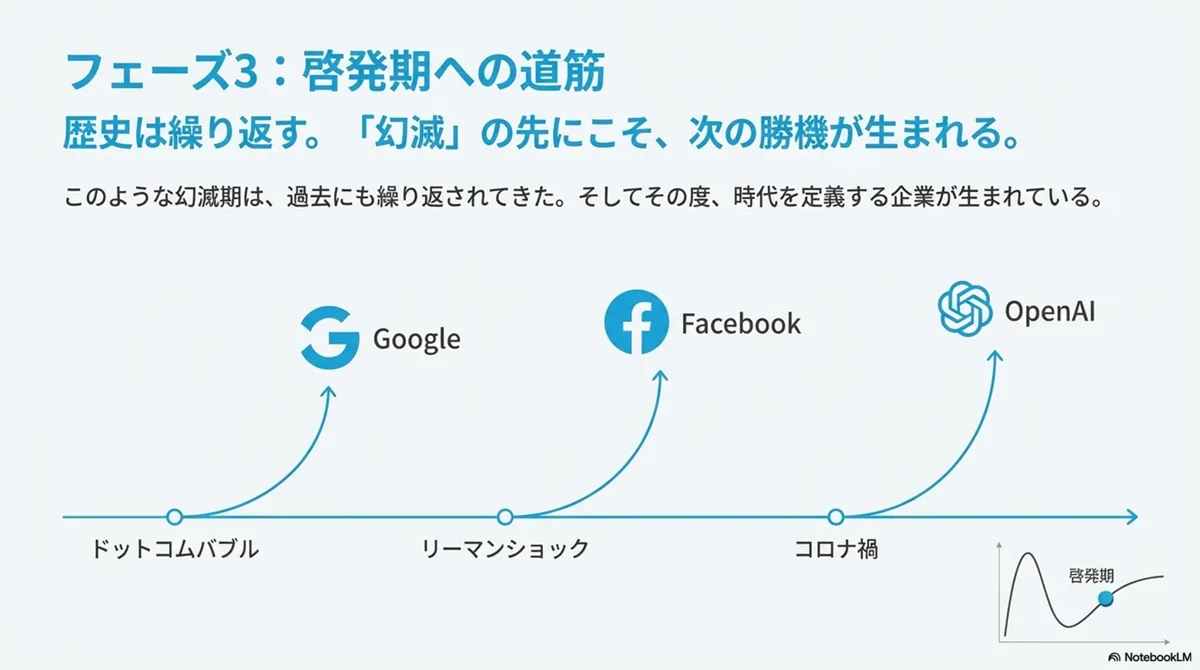
They say history repeats itself, and there were probably several such troughs of disillusionment with startups and ventures in the past as well.
I don't know the atmosphere of those times well, but I speculate that there were similar troughs of disillusionment during the dot-com bubble, during the "1,000 Ventures Plan," and around the time of the Livedoor incident in Japan.
The United States also had the dot-com bubble and others, and I hear it stagnated after the Lehman shock.
In the United States, however, after each bubble deflated, a huge home run emerged. After the dot-com bubble, Google emerged. After the Lehman shock, Facebook emerged, and after COVID, OpenAI has emerged.
It is said of VC funds that "one home run deal generates the returns of an entire fund," but these examples can also be described as cases where "one home run deal generates the returns for the VC ecosystem."
In reality, the exits of Google and Facebook may not have been large enough, in dollar terms, to cover the entire ecosystem. But in the sense that the appearance of such symbolic deals amplified expectations, they did generate returns for the ecosystem. I think that effect spread from the US to Japan and other countries.
I believe such "symbolic victories" are important for getting past the trough of disillusionment.
Getting past the trough of disillusionment
Looking back over the past decade, we stayed at the level of "creating new businesses" of small to medium scale. To get past this trough of disillusionment, building exit markets such as secondaries and M&A and strengthening governance to prevent fraud are of course important and should be done, but I think that unless we take on big challenges and produce astonishing success stories, the industry itself will not be justified.
The groundwork for that is needed precisely now.
The startups that are already large should take on the challenge of becoming even larger, and the startups that begin from now should take on even bigger challenges. I think that is the move needed to get past this trough of disillusionment.
Conversely, if we come to see ourselves as "unlike the US, Japan's startup ecosystem is one that creates new businesses of moderate size," things may become easier for a while, but money will become harder to raise and we will shrink into a contracting equilibrium. That would eventually amount to strangling ourselves.
If we want to hold firmly to the position of building large industries and new businesses, then, to earn the trust of society, shouldn't we show an attitude of creating industries that earn foreign currency for Japan and of trying to solve major social problems, or at least sketch out such visions, and thereby show the world, even in this harsh phase, an "attitude of taking on large and meaningful challenges"?
Then it should become easier to say with our heads held high that we are taking on the challenge of startups.
For that reason, and for the sake of success, how to draw a grand vision will be demanded all the more.
More concretely,
- The global type, which solves the world's problems
- The national-issue type, which solves Japan's problems
- The technology type, which redraws the industry map
and so on: creating an environment in which many more challenges in several such areas emerge precisely now. I think that is the valuable lesson we have gained from the many startups that have taken on challenges in Japan over the past several decades.
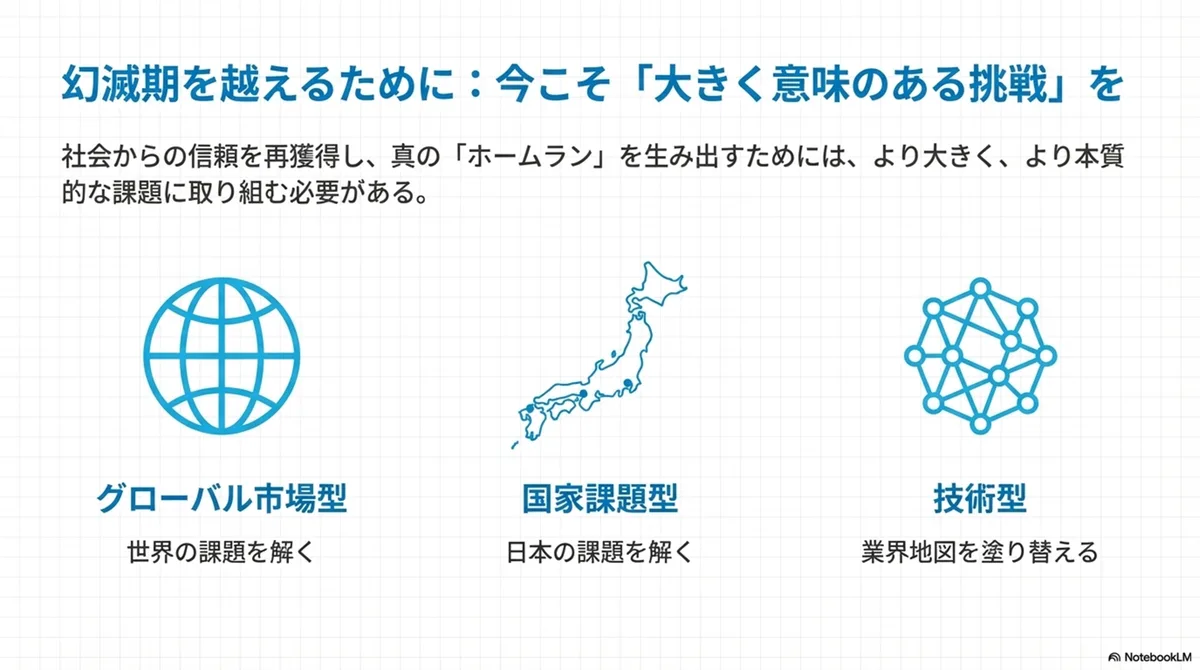
Not every startup or venture investment needs to be like this. But if we are going to take the position of building large businesses in Japan, I think a certain share of overall resources (say, 20 to 30 percent) needs to be devoted to such big challenges, and that the way startups are supported also needs to allocate more resources to drawing up such grand visions and realizing them.
Get past the disillusionment with Silicon Valley, too
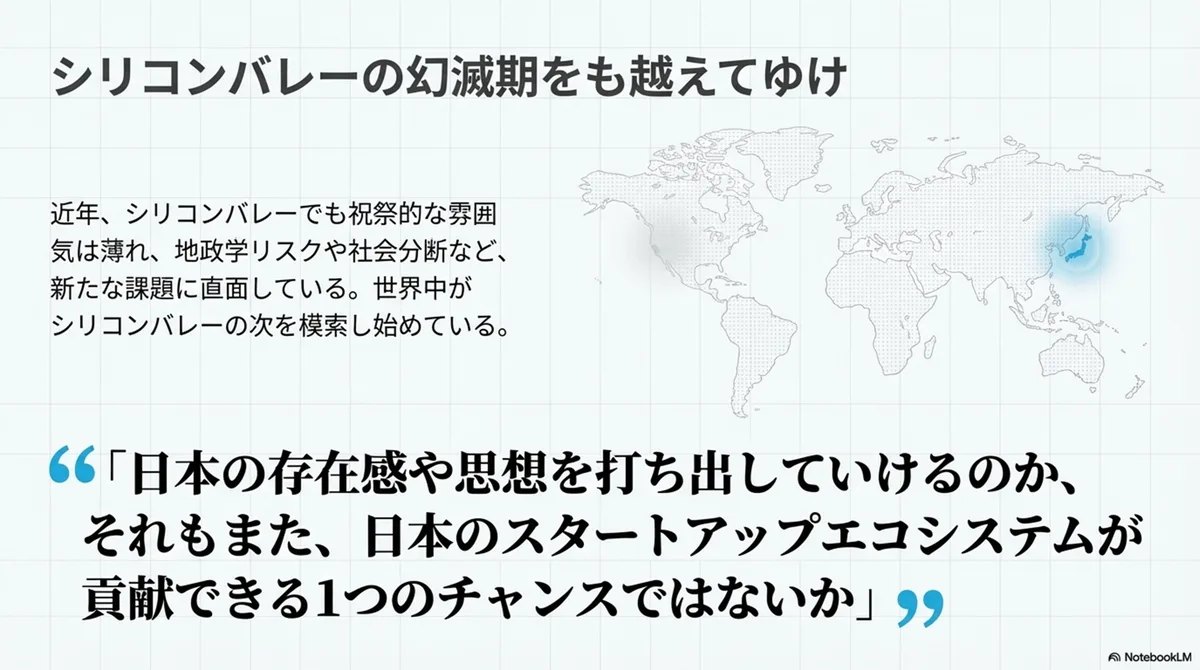
In parallel, over the past few years, the admiration for Silicon Valley has also been gradually fading, and I think that, ideologically, a trough of disillusionment with Silicon Valley may be emerging too.
In a sense, Silicon Valley was a place that symbolized the future and hope. It seemed to carry the anticipation that many new things would be born there and show us a new world.
From a situation in which positive expectations about software and the internet were the majority, we have come to see many of the negative sides of technology as well. The money-worshipping side that had been hidden has become easier to see, political division has sharpened, and I think the reconnection with religion has also come into the spotlight.
Looking at Silicon Valley startups, too, the festive atmosphere seems to be fading, and a grim atmosphere of war and security seems to be taking over.
In response to these changes in the US, the way the world looks at Silicon Valley has begun to change, and I feel that the admiration for it is changing as well.
Likewise, in Japan, the expectations for Silicon Valley that began with books such as "The Evolution of the Web" will probably remain on the economic side, but I think the ideological side is gradually changing shape.
In a sense, this is a phase of asking how to create "the next story of future and hope after Silicon Valley," and it seems to me that the competition to do so has begun.
How Japan can put forward its presence and its ideas there is, I think, another chance to which Japan's startup ecosystem can contribute.
That cannot be accomplished by a handful of challengers. We need to turn many eyes in that direction, and what matters is probably to generate such momentum as a whole.
Summary
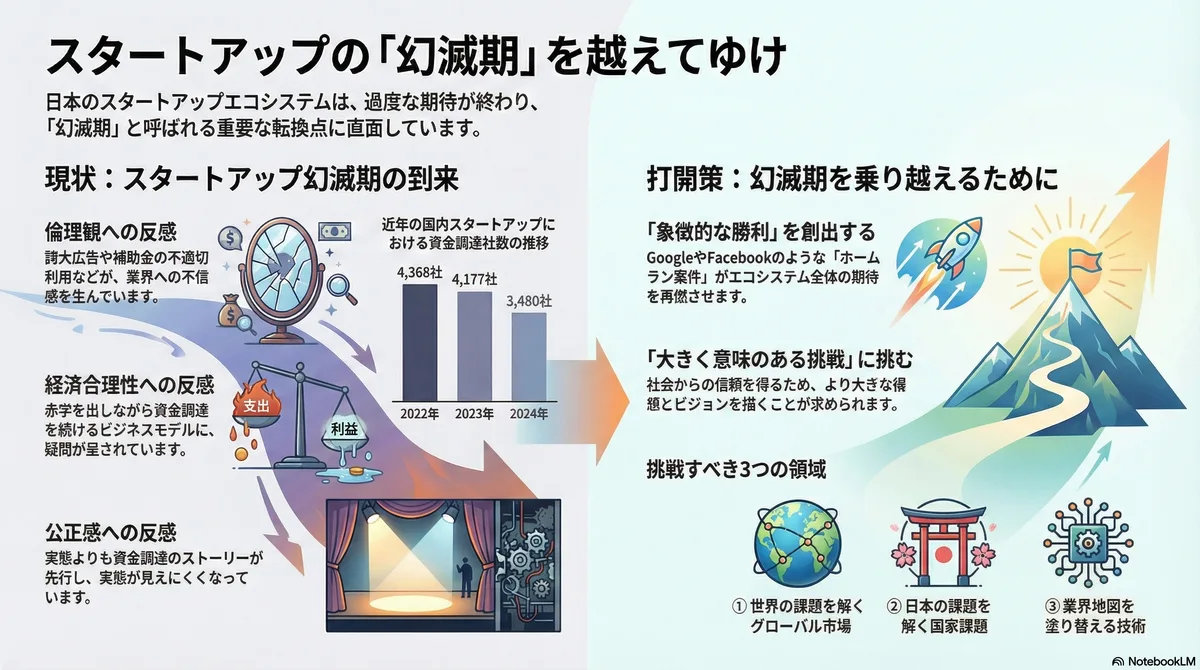
Summary by NotebookLM
Rather than lamenting this harsh phase as a "startup winter," I think it is more productive to see it as a time to build up trust and ambition at the same time. And rather than spending much time sharing laments, I believe that fostering an atmosphere in which we grasp the issues and discuss how to break through them will determine the future a few years from now.
And I think we need more activity that conveys this to those around us, communicating properly "what we are aiming for and what we exist for."
(The style of the title and the lettering in the images is taken from "Go Beyond My Corpse.")
Slides by NotebookLM