Stopping the "Beginning of the End" of Japan's Startup Boom
This article was machine-translated from Japanese by AI (Claude). It may contain errors. Read the original Japanese article.

I believe the "beginning of the end" of the startup boom is when VC fund sizes start to shrink, because that is what sets off a vicious cycle.
Here is the reasoning.
When fund sizes shrink, the capital startups can raise shrinks too. Startups then can no longer take on big challenges, and big businesses and big results become harder to come by. Funds and investment shrink further, the scale of what startups can attempt gets smaller, and they can only aim for small businesses.
Once this vicious cycle begins, the ecosystem will head toward a contracting equilibrium.
I think Japan's startup ecosystem is right now on the brink of entering that vicious cycle.
I am writing this article to share that sense of crisis.
- The prospect of returning the capital is getting dimmer
- Contracting toward an expectation of a "10 billion yen market cap"
- What we should really be doing
- Some misaligned measures
- Summary
Support for startups from both the public and private sectors has been growing. Startups appear in the news more often. The amount of funding raised is increasing, and it sometimes makes the news that the number of university-originated ventures is rising sharply.
Perhaps because of this, when I talk with politicians who are not very familiar with startups, or with people at organizations that have only recently started working on them, a fair number seem to think that "Japanese startups are doing well."
However, from what I hear from the people around me, the current startup ecosystem built on Japanese VC investment, especially the ecosystem surrounding high-growth startups, feels like it is entering a vicious cycle.
One major reason is that the prospect of delivering financial returns has been getting dimmer.
The prospect of returning the capital is getting dimmer
Over the past few years, riding the startup booms in other countries, great expectations have been placed on Japan's startup ecosystem, and the amount of money poured into it has grown. For example, VC funds established in Japan since 2019 total about 600 billion yen (according to Initial).
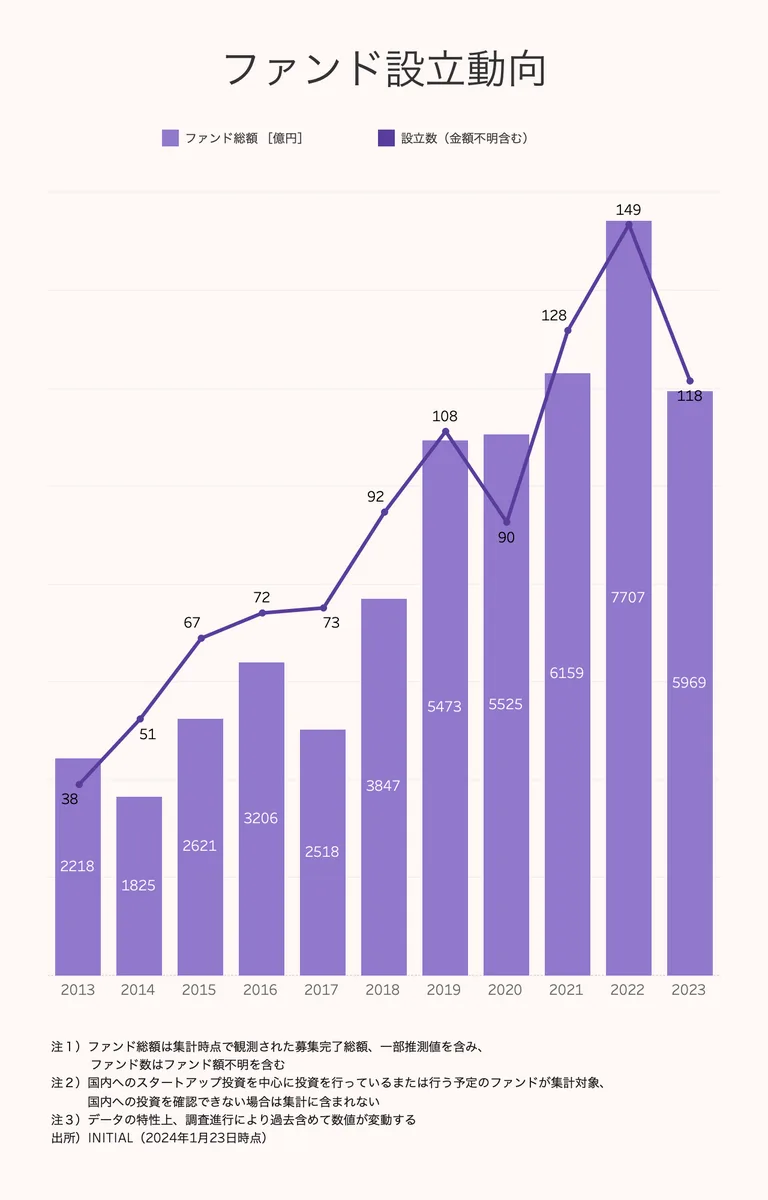
VC is a financial business. VCs are expected to grow their investors' money and return it.
1.8 trillion yen in returns needed every year
How much growth is expected? It is said to be roughly 3 to 5 times over 10 years. Assuming 3 times, and assuming VC funds totaling 600 billion yen a year are run across the whole ecosystem, the expected return after 10 years is three times that, or 1.8 trillion yen. This is a considerably simplified calculation, but it means that from around 2029, the ecosystem as a whole is expected to produce returns of 1.8 trillion yen "every year."
This 1.8 trillion yen is the expected amount of returns flowing to VCs, and on a market-capitalization basis the figure is even higher. If VCs hold 50% at the time of listing, exits totaling 3.6 trillion yen in market capitalization would be needed "every year."
So what does the exit situation look like? The exits that generate returns are IPOs and M&A, but M&A deals are few and, even when they happen, the amounts are not that large, so I will set them aside for now and consider only IPOs.
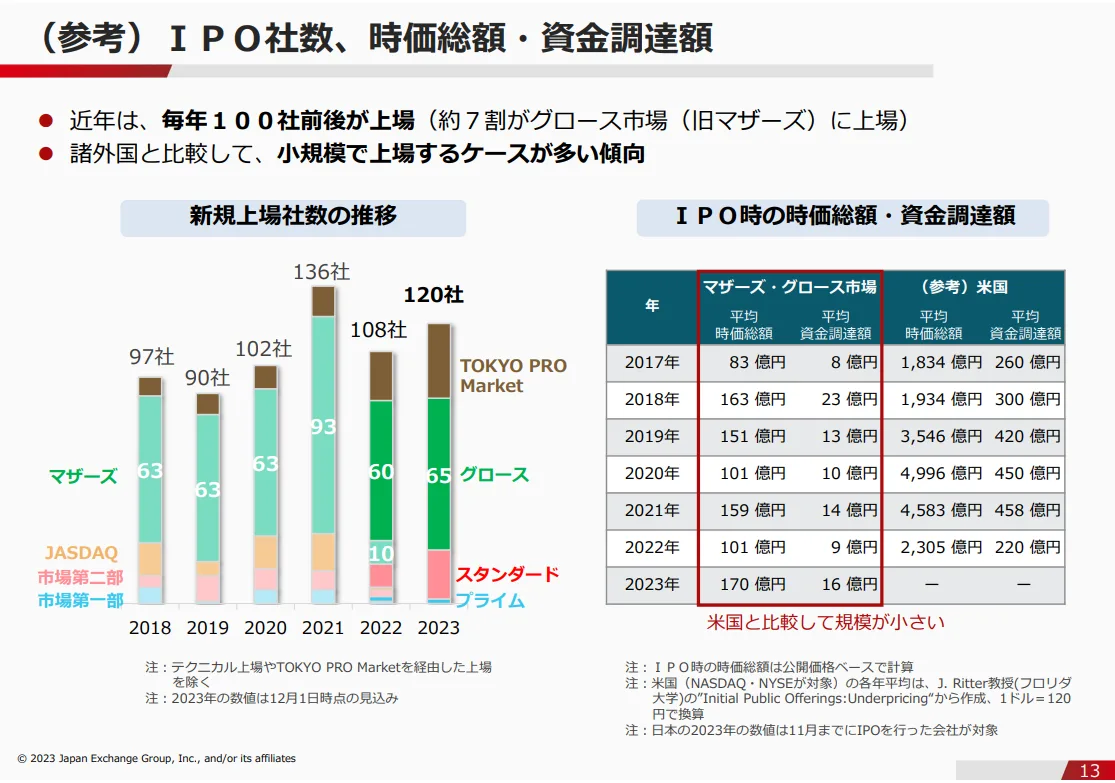
The market capitalization at listing in Japan in 2023 is said to be 7.2 billion yen at the median and 17 billion yen on average (the figures are based on data through November 2023). These values fluctuate, but they have not changed much over the past few years. The number of startups listing at over 100 billion yen also remains at around one to four per year.
https://www.jpx.co.jp/equities/follow-up/nlsgeu000006gevo-att/bkk2ed0000004ddh.pdf
Meanwhile, according to Initial, the number of companies that listed over the past few years is around 100 to 130 per year, of which about half are said to be startups.
Let me do a simple calculation based on these numbers.
Total returns are probably not even reaching 1 trillion yen at present
Suppose 120 companies list every year, and half of them, 60, are startups.
Assuming their market capitalization at listing is somewhat higher than other companies, and they list at an average of 20 billion yen, the total market capitalization comes to about 1.2 trillion yen. If VCs hold 50% of that, the return is about 600 billion yen.
Even if I fiddle with the percentages, it probably will not reach 1 trillion yen.
Fund formation in 2013 was about 200 billion yen, so the promise made ten years ago of "tripling 200 billion yen" has been fulfilled. But against the 1.8 trillion yen expected since 2019, when the amount invested jumped sharply, we are well behind if things continue as they are.
If this trend continues, expectations will not be met
If this trend continues, the expected returns cannot be delivered.
Of course, looking at individual funds, some will produce returns, but the overall situation is extremely tough. If it continues, launching new funds or enlarging existing ones will become difficult for many, and the amount of startup funding will gradually decline.
The low market capitalization at listing is not only a problem of the startups' businesses; it also involves issues such as how shares are priced at listing, so it cannot be said to be solely a problem of the startup ecosystem. Even so, given this situation, it looks unavoidable that independent VCs in particular will shrink their fund sizes and wait and see.
Contracting toward an expectation of a "10 billion yen market cap"
Once an expectation forms that a median of 7.2 billion yen is the realistic exit, what happens is that unlisted shares get valued on the assumption of an exit at about 10 billion yen, and cap tables are built to aim for a 10 billion yen exit.
In that case, the maximum market capitalization before listing becomes about 5 billion yen, and the total funding a single startup can raise comes to around 1 to 2 billion yen. The amounts raised in US seed and Series A rounds become the maximum in Japan.
In other words, assuming a 10 billion yen exit, the ecosystem heads toward a contracting equilibrium.
In fact, the fact that the market capitalization of life science startups at listing ends up "uniformly 10 billion yen" is self-deprecatingly likened to the 100-yen shops, with the "100 uniform" label (everything priced at 10 billion yen). Under such expectations, they have no choice but to design their capital policy on the assumption of a 10 billion yen exit.
Then it becomes hard for startups to draw up big strategies and hard to produce big results. Or, as I will describe later, they are forced to found companies on the premise of going overseas rather than aiming for a domestic listing.
I think people involved in life science startups have started sharing this sense of crisis ahead of others, but I believe there is ample risk that this problem will spread to the whole startup ecosystem regardless of field, and I am beginning to feel a movement toward smaller fund sizes.
And because Japan is, in a sense, a country good at optimization, I fear that once the vicious cycle starts, it will contract all at once toward a contracting equilibrium.
What we should really be doing
Given this situation, it may be unavoidable that fund sizes temporarily shrink.
But that can be kept to a temporary contraction.
That is because there is still money available for big challenges. If we take on big challenges now and produce big results, and can again increase the money and expectations flowing into this ecosystem, we can return to a growth trend.
I believe whether we can do that is the task of the generation currently active in the startup ecosystem, and that now is the turning point.
We need "challenges an order of magnitude bigger"
Against that background, I think the goal we should aim for now, and should emphasize, is to create businesses and track records big enough that even investors in the public markets are convinced at a glance.
What is needed for that is big challenges, and supporting those challenges. We must encourage and support big challenges and build new industries.
The amount of startup funding reached nearly 1 trillion yen in 2023, about 10 times the 2013 level. If it has changed by an order of magnitude, we have earned the right to take on challenges an order of magnitude bigger, and with it the duty to do so.
Looking at the state of domestic industry as well, I think big challenges are needed.
Those who will tackle the "crisis of Japanese industry"
The number of Japanese industries that can earn foreign currency is declining. In March 2024, the Ministry of Finance also launched a council titled "Challenges and Prescriptions for the Japanese Economy from the Perspective of the Balance of Payments," where this point is being discussed.
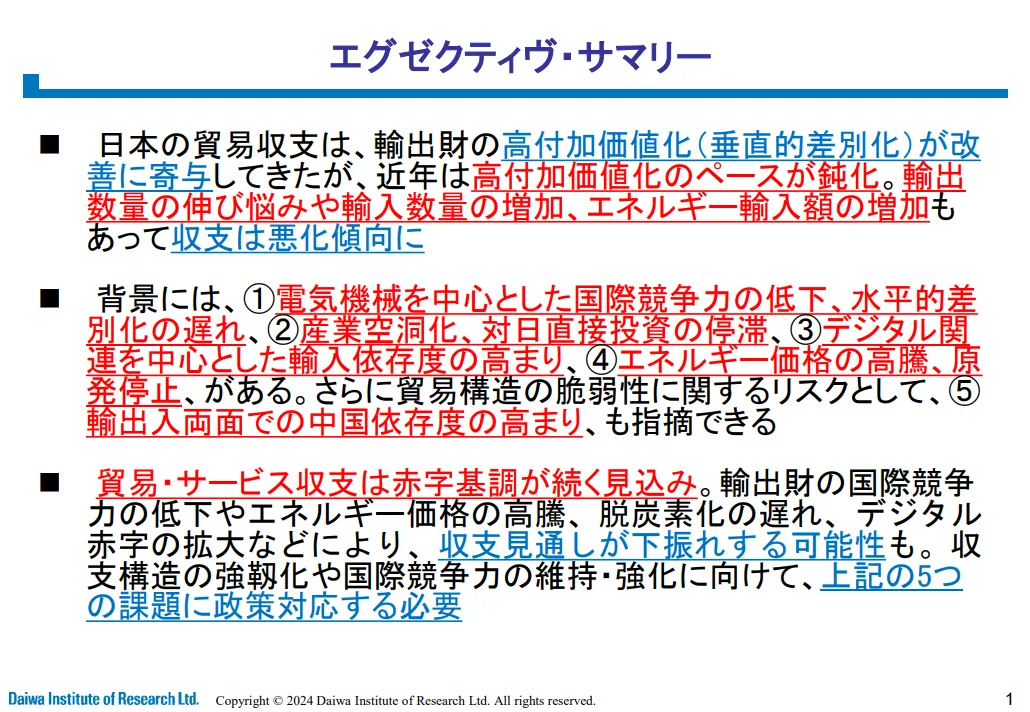
I think the awareness of the problem behind convening it is summarized in the summary of Committee Member Kumagai's materials.
The concern is the worsening trend in the trade balance, behind which are declining international competitiveness, industrial hollowing-out, growing import dependence centered on digital-related goods, and soaring energy prices. These are expected to continue for some time, and the possibility of them getting even worse has also been pointed out.
https://www.mof.go.jp/policy/international_policy/councils/bop/outline/20240424_1.pdf
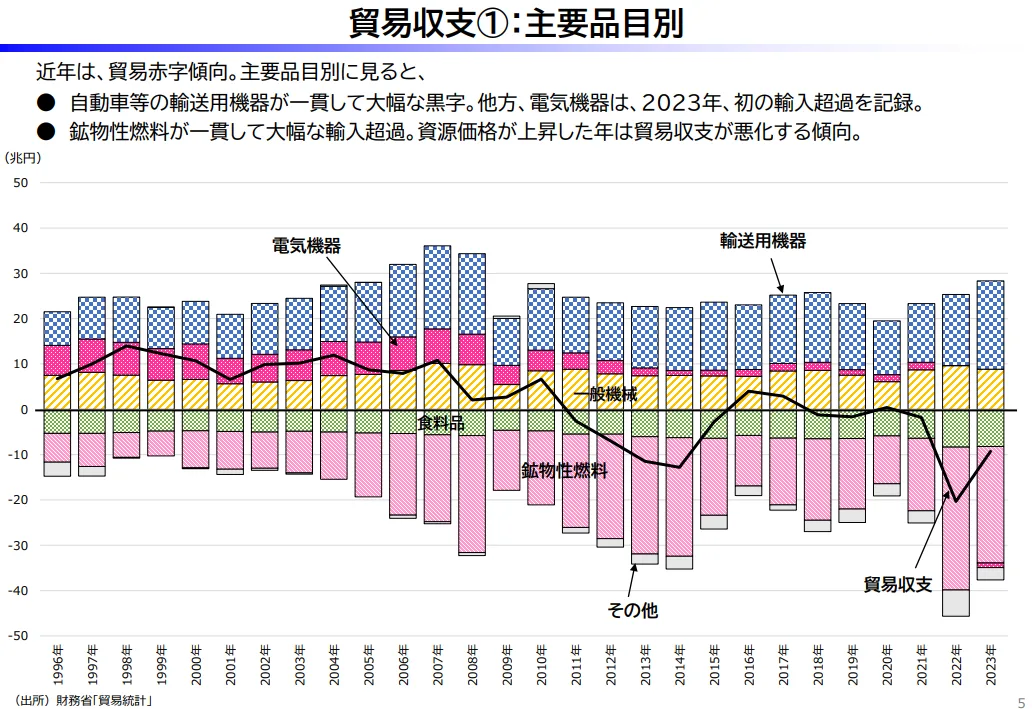
More specifically, in 2023 the trade balance turned into a deficit even for electrical equipment, a category in which Japan is thought to be strong.
https://www.mof.go.jp/policy/international_policy/councils/bop/outline/20240326_1.pdf
https://www.mof.go.jp/policy/international_policy/councils/bop/outline/20240326_1.pdf
(Note that, as Professor Saito points out at the same council, a trade surplus is not necessarily positive for the domestic economy. Likewise, a deficit is not necessarily negative. If the economy is growing, or if exports have higher added value than the imports, a deficit can be called an investment.)
In the services balance, Japan earns from tourism, but it continues to run a large deficit in digital.
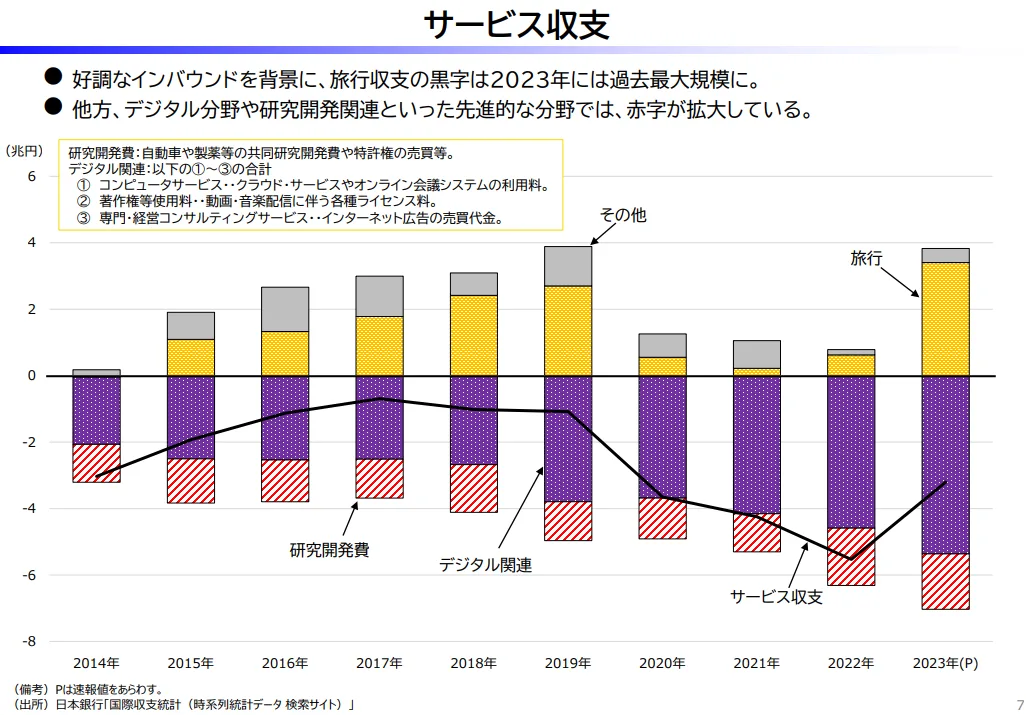
https://www.mof.go.jp/policy/international_policy/councils/bop/outline/20240326_1.pdf
Japan is also a country that relies heavily on imports in many areas, such as energy (mineral fuels), food, and digital infrastructure, and with the weak yen adding to the pressure, the trade deficit has been widening over the past few years. To import these things, we need industries that earn foreign currency. But even the automobile industry, which currently supports the trade surplus, will probably be fine for the next few years, but as EV adoption and other shifts progress, it is unclear whether it can keep its position as Japan's top earner.
Looking at the situation right now, labor supply has been short for the past few years, so workers' pay will rise and wage hikes will occur. Inflation is picking up overall, and the economy may feel strong.
However, the state of the "industries that can earn," which support such workers' pay, looks extremely severe.
Tackle macro problems without optimizing at the micro level
Such macro problems are far removed from individual happiness.
For example, working for a foreign-affiliated consulting firm or software company and earning a high salary, or starting a small business and earning money, are, from a micro perspective, good ways to maximize that individual's happiness.
But the source of that wealth is wealth earned by other Japanese companies. If the industries that can earn in Japan decline, foreign-affiliated companies will eventually stop locating in Japan, and the number of people who can pay small businesses will also fall. Considering these macro movements, we should not recklessly recommend joining foreign-affiliated companies or starting small businesses; we must build industries that can earn.
I think the startup ecosystem is expected to create such new, earning industries, and that is why large amounts of money have flowed in over the past few years.
By obtaining funds, we have gained the right to take on big challenges, and at the same time taken on a big responsibility. That also means thinking about how to respond to these macro trends.
Yet the mainstream of today's startups is still what it was ten years ago: mostly software-based businesses for the domestic market. That has value in itself, of course, but if we stay in that situation, I think it means we cannot fulfill that responsibility at the macro level.
Think about what to define as "success" and what we should aim for
How will people act in the face of such changes?
If one optimizes for the current startup ecosystem, the "success model" for Japanese VCs would probably be to build funds of about 10 to 20 billion yen, aim not for grand slams but for the occasional unicorn-level home run, while basically aiming for moderately sized hits, raising the hit rate considerably, and recovering about 1x on the rest. If you promote startups using software for the domestic market, such a strategy may produce returns for a while.
That is one philosophy, and it is "success" as a financial professional entrusted with other people's money.
But if the startup industry proclaims that it "creates industries," it cannot be said to be fulfilling its original role, and it cannot be called "success."
If you optimize for the status quo, aiming for a moderate fund size is correct. However, "the way things are now" and "the way things should be" are different. And what is right at the micro level and what is right at the macro level are also different.
If we make the choice that is right at the micro level and can only grow startups for the domestic market, that market will shrink along with Japan's population decline. The managers and VCs of the working generation may (depending on the person) earn enough, but the domestic VC industry will shrink. If that happens, the next generation of VCs will struggle, the next generation of startups will find it harder to take on big challenges, and it will become even harder to produce industries that earn foreign currency out of startups.
Over the past 25 years, the startup ecosystem has expanded and, I think, has itself grown into an industry. That talented young people now aim for startups and VC is proof of this. I believe this achievement exists thanks to the efforts of everyone who has been involved so far.
Thanks to those efforts, we, who as an ecosystem are entrusted with nearly 10 times the money compared with 2013, carry nearly 10 times the expectations. That is exactly why I think we need to reconsider what is expected of us and what we are aiming for, and then change.
To do that, instead of repeating a certain kind of "formula for success" created in the past, we are required to find and refine new ways to reach the next stage. That is the responsibility of the current generation, and I think that, rather than only looking at past best practices, we should look to the future and discuss "how can we aim for a goal an order of magnitude higher?"
Some misaligned measures
Right now, however, I feel that other issues are being emphasized, and I think I should sound an alarm about political resources being poured heavily into them. Here are some examples.
Counting on globalization
There is an effort to support globalization. In fact, there are now examples of startups that competed in the global arena from the start going public. I think this is wonderful.
However, judging by the market's evaluation, I also get the impression that even if companies in fields like advertising or influencer marketing go global, it is hard for them to reach a market capitalization of 100 billion yen. What matters more than whether you are fighting globally is probably whether the business domain is large and how much share you can capture.
For example, the sake business might expand worldwide and be global. But unless the business is designed with considerable thought, its growth will plateau. It is not enough to simply be "global"; we must promote globalization with an eye on what lies beyond.
Globalization is essential. But globalization is not the goal; it is only a means. We need to think about supporting globalization for "businesses that will truly become big."
Promoting founding companies overseas
If it turns out that fundraising is nearly impossible in Japan, the only option is to found companies overseas. In fact, in drug discovery, I sense that moves to establish companies in the US from the start, or to convert Japanese companies into US ones, are becoming active. That is optimal as an individual company's strategy, and if one tries to maximize individual returns, one has little choice but to recommend it. This may also be a kind of globalization.
But if, for example, people use intellectual property created by Japanese public institutions or with taxpayer money (universities and the like) to found companies overseas, some managers and investors may profit, but the ripple effects in Japan are limited, for example high-value-added jobs become harder to create in Japan.
This does not apply to people who found companies overseas without using many domestic assets, such as in software, but when using intellectual property from public institutions and the like, this perspective is necessary, and in that case I think we should indeed think about improving the domestic environment.
Counting on M&A
Promoting domestic M&A is, I think, an effective measure in the short term. And for the funds currently operating, it would be welcome that such a change is occurring in the near term and that exit options are increasing.
Moreover, if startups whose capital policy assumes a 10 billion yen exit at listing increase, they become cheaper and easier to acquire, so M&A can be expected to grow.
But even if small M&A deals increase, they cannot fill the gap toward 1.8 trillion yen. In fact, startups are currently acquired fewer than 200 times a year, the average age of companies at acquisition is about 7 years, and deals exceeding 10 billion yen number only a few per year (according to Initial). Considering that acquisitions exceeding 3 billion yen are also in the single digits, even if the scale and number of M&A deals grew 10 times, it would be hard to fill the gap in expectations.
Besides, if we expect people to take on big challenges after M&A increases, then guiding them toward big challenges is what we should be focusing on.
Counting on foreign investors
Investment from foreign investors is possible, and I think startups should accept it if the terms are good.
However, I hear that some foreign investors expect "competing in Japan's reasonably large market and producing reasonable returns." Many of them apparently do not actually want Japanese startups to make high-risk bets such as expanding overseas.
Startups and policymakers both hope that "foreign VCs will make big investments," but between the policy perspective and the perspective of foreign investors, the winning conditions and time horizons differ. For the country and the ecosystem as a whole, the winning condition is to "use startups to create the next industries" and earn large returns on a 20 to 30 year horizon, whereas for foreign investors who invest at the middle and later stages, the winning condition is to earn 2 to 10 times returns over 3 to 5 years. That is just how it is and cannot be helped, but large foreign funds will not always align their viewpoint with Japan's. If the Japanese market loses its appeal, they will eventually leave.
Of course, I think it is an important tactic to have foreign funds come in temporarily and build networks with them. But to keep them involved, Japan must produce big exits domestically and get them to decide at some point that they "should keep investing in Japan." For that purpose too, I think we should pay more attention to building big businesses.
Promoting "small businesses" in the name of "big businesses"
I feel that the scale of bigness that is required often is not getting through to first-time founders and supporters.
The "size" of the challenge required now is not the size that many people imagine. To build a company worth 1 trillion yen, assuming a P/E ratio of 20, you need 50 billion yen in profit. Building such a business is extremely hard, and the fields are quite limited.
This is, so to speak, a scale at which the question is whether we can create industries that can be left to the next generation, an effort to create companies like Sony and Honda once again. Simply "starting a company" is not the big challenge that is required now.
Small challenges matter too, but with limited resources, I think it is more important now to skew support toward big challenges.
Counting on an increase in the number of startups
Increasing the number of founders and, in software and similar fields, aiming to "take many shots and hit by probability" is one approach, but I think the "growing" markets where such a strategy works are becoming fewer. The possibility of making a single app and getting lucky is now quite small.
As for size, even BeReal, which took the world by storm, was acquired in June 2024 for about 85 billion yen, falling short of 100 billion yen.
For that reason, rather than increasing the numbers recklessly, I think it would be better to keep a clear eye on the goal of "increasing big challenges."
Summary
Japan's startup ecosystem may shrink temporarily, but there is still ample money. We need to achieve big results before that money starts the vicious cycle and reaches a contracting equilibrium.
What is lacking for that, and what is required, is
- Strengthening support for big challenges
- Guiding efforts so that they become big challenges
I think we need to concentrate resources on these efforts.
The field might be a software business that truly wins globally, or it might be healthcare. It might be climate change countermeasures. And the method might be, rather than leaving things to spontaneous startup creation, company creation by investors and serial entrepreneurs, or compound startups that require sophisticated strategy.
In any case, we are required to invent new methods that develop the existing ones, in fields that break with the way things have been done, and to aim at truly big businesses.
If we keep imitating American startup methodology, as before and from now on, we might be able to produce startups one-tenth the size of those in the US market even in Japan, but if we aim for a goal an order of magnitude higher and try to compete globally, I think we have entered a phase where, if we start in Japan, we have no choice but to take a different strategy from the US.
For that, we need to encourage such challenges, increase support for them, and accumulate know-how. We need to think really hard and aim for big things.
I do not know whether this challenge will succeed. Of course, even if it fails, the startup ecosystem will remain, on a smaller scale. But if we do not succeed, we will be called "the generation that shrank the startup industry", and if we do not even try here, I fear we will be called "the generation that had the money to take on challenges, yet did not even try."
Startups are only one means of creating industries. But with domestic industry in a difficult situation, startups are now expected to possibly create new industries that can earn, and have been given the right and resources to do so. I hope that, together with those who want to meet that expectation and build big businesses, and those who want to support them, we can get through this critical moment.
I hope more and more people will support those taking on big challenges. With that wish, I have written down my own thoughts on sharing this sense of crisis and the direction of countermeasures.