Toward a Startup Five-Year Plan Looking Ahead to 2040 - What Is the Real Issue Japan's Ecosystem Must Confront?
This article was machine-translated from Japanese by AI (Claude). It may contain errors. Read the original Japanese article.

The Startup Development Five-Year Plan, formulated in 2022, is now entering its revision period.
Looking back over the past few years, Japan's startup ecosystem has drawn significant attention from both politics and the business community, and it has moved forward while tackling a range of challenges. While individual startups and funds have achieved success, I think the candid assessment both inside and outside Japan is that, viewed as an ecosystem as a whole, it has not yet delivered sufficient results or returns to match the attention and expectations placed on it.
In fact, against the Five-Year Plan's target of reaching roughly ¥10 trillion in investment by FY2027, total domestic startup funding in 2025 (excluding debt) stood at ¥761.3 billion, leaving a wide gap. Furthermore, as of mid-2025, roughly 70% of the more than 600 companies listed on the Tokyo Stock Exchange Growth Market remained below ¥10 billion in market capitalization, and the Prime Market has outperformed the Growth Market as a whole in share price gains—showing that even as the number of companies has grown, large companies have not emerged, and the market continues to fall short of its "growth" role.
If the Startup Five-Year Plan is to be revised, I believe this is also a good moment to reconsider why things turned out this way, and whether targets like "¥10 trillion in investment" were aligned with the problems that truly needed to be solved in the first place. Looking ahead to 2040, when Japan's working-age population will have declined even further, I think we should step back and ask ourselves again whether we have truly been working on the core issue of Japan's startup ecosystem—that is, the problem that genuinely needs to be solved.
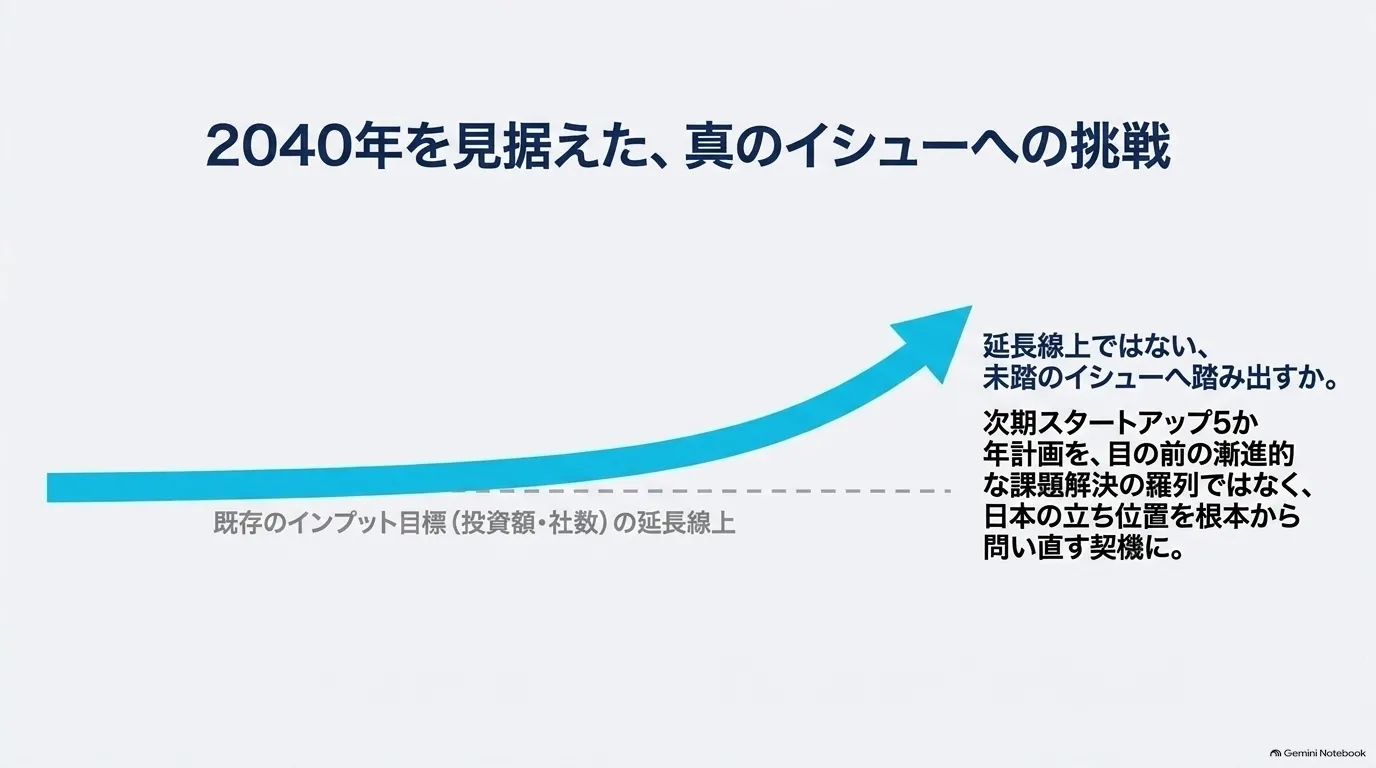
That is because unless we make "how to position Japan's startup ecosystem, how to diagnose its challenges, and which challenges to focus on going forward" a major point of debate as we consider the next plan, we risk simply continuing down the path of making improvements along the extension of our current trajectory.
We might ultimately arrive at that same conclusion anyway, but before doing so, I think the right approach is to ask whether that is truly enough, or whether we should tackle challenges that lie off our current trajectory, identify what the real issue is, and decide our direction on that basis.
To think this through, I would like to begin by reflecting on the past five years.
Reflecting on the past five years and the issues with our approach
(Approach 1) We have pursued incremental improvements
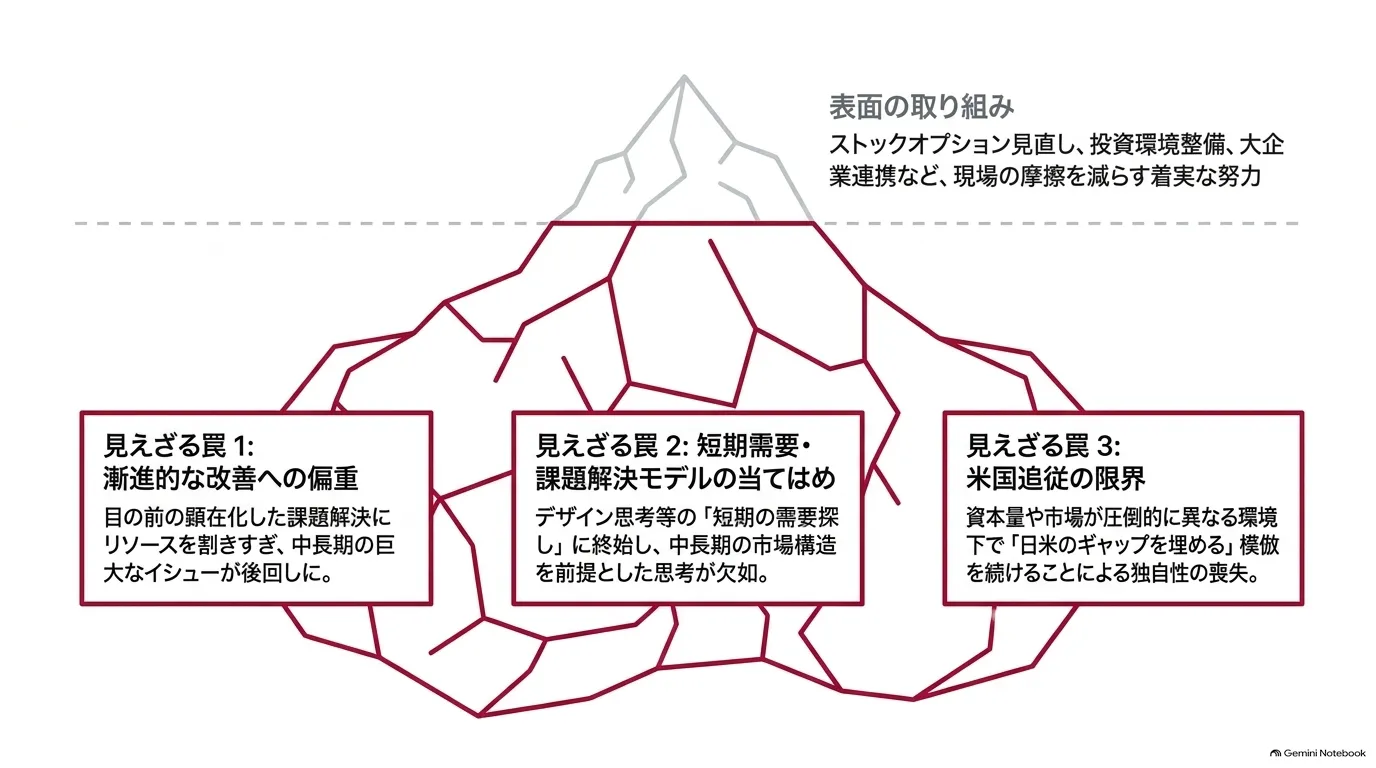
Over the past five years, a variety of improvements have been made to the startup ecosystem. From revising stock option and tax rules, improving the investment environment, and promoting collaboration with large corporations, to debates over M&A and IPO opening prices and valuations, there is no doubt that friction raised from the field has been reduced one item at a time; even though challenges still remain, I think the efforts on the policymaking side have been substantial.
Looking back, however, I also feel that we may have simply continued pursuing incremental improvements—listing the problems right in front of us and solving them one by one. In other words, we have been preoccupied with solving the immediate, visible problems raised by startups and VCs on the ground, and as a result, we may have failed to tackle the major medium- to long-term issues.
Of course, solving immediate problems is important, and it is also vital that policymakers and politicians listen carefully to the concerns of startups and VCs, grasp those problems, and work to address them.
Yet just as a startup distorts its product features and design if it listens too closely to customer requests, politics and policy end up centered on short-term, incremental improvements if they listen too heavily to voices from the field. At the same time, when limited resources are consumed by immediate problems, fewer resources remain for medium- to long-term challenges—much like constantly tackling urgent tasks at the expense of important ones (especially those with no clear answer).
As a result, there is a sense in which we were unable to confront the bigger problems—that is my reflection on the past several years.
(Approach 2) We have tried to close the gap with the United States
If there is another defining characteristic of our efforts over this period, it is that we have tried to imitate the US approach and close the gap with the United States. Much of our activity consisted of importing US know-how and educating people in it. Behind this lay the assumption that "if we close the gap between Japan and the United States, we will end up with the same ecosystem as the United States."
Yet when we reconsider the differences in capital pools and market size, as well as Japan's own strengths, one could argue that rather than trying to close the gap with the United States, it would have been better to pursue a distinct direction backed by a strategy of our own. In fact, without that distinctiveness, when investors compare deals in the United States, Europe, and Japan on a flat playing field, there are not many reasons to invest in Japan with its relatively small market.
There is certainly a great deal to learn from the United States, including practical know-how. Still, when thinking about Japan's startup ecosystem as a whole, I think we could have debated much more seriously whether a US-following approach is really the right one.
Challenges
Looking back at these efforts—including my own—I believe there have been several underlying challenges.
(Challenge 1) Did we allocate too many resources to visible, already-surfaced problems?
What solving problems raised from the field and trying to close the US-Japan gap have in common is that both focus on visible, already-surfaced problems.
Discussions surrounding M&A and late-stage capital are part of this as well. Indeed, points such as "there are too few M&A exits" and "there is too little late-stage funding" have been raised repeatedly as Japan's challenges, leading to initiatives aimed at promoting acquisitions and bringing in capital from overseas. These are certainly valid interpretations of current problems, and I am not denying that they are problems.
However, rather than root causes, aren't these really surface symptoms produced by deeper causes? There are investors around the world eagerly hunting for acquisition targets and investment opportunities; if Japanese startups are not on their radar, I think the bigger reason is not a superficial one like a lack of visibility or information, but rather that they are not large enough startups in the first place—or that we are not even trying to build startups of that scale.
If Japan had produced a startup like Cursor—even if not quite an Anthropic—back in 2022, the landscape would look different today, and I think it is worth asking anew why such companies did not emerge here.
Otherwise, we risk endlessly applying short-term fixes to short-term problems.
(Challenge 2) Did we overapply the "find and solve short-term demand" model?
This seems to apply not only to policy, but also to the methodology of Japanese startups themselves. Problem-solving paradigms such as design thinking and lean startup are approaches for capturing visible, immediate problems and short-term demand and solving them quickly. Starting from demand is itself important, but while this methodology is effective for short-term problem discovery and incremental improvement, it is not a way of thinking designed for systemic issues or medium- to long-term market structures.
The United States is a country where continuing that kind of short-term optimization works because it has a massive domestic market that can also scale globally—and, moreover, it has capital markets suited to that kind of sprint.
For Japan, which is not in that position, if it aims for a qualitative structural shift—expanding investment and creating large-scale companies—it needed to change the structure of the ecosystem as a whole rather than merely setting an input target like "investment volume." In a sense, we have failed to put solutions in place for that structural transformation.
(Challenge 3) Did we fail to fully articulate our ideal state?
When a problem is defined as "the gap between the ideal state and the current state," setting the US startup ecosystem as the ideal makes problems easy to see as gaps. Many countries define their challenges by taking the United States—and Silicon Valley in particular—as their ideal, but I think it is worth questioning whether that was really the right framing.
In reality, even within the United States, no city outside Silicon Valley has succeeded in replicating a Silicon Valley-style ecosystem. Even in Europe, while some individual success stories have emerged, almost no region has succeeded in imitating it as a whole. And even among those that do succeed, nearly 30% of startups relocate to the United States.
If the US Silicon Valley style is not our ideal, then the challenges we need to tackle should change accordingly.
Looking at the whole picture and setting priorities
Given that political and financial resources are finite, if we keep responding to short-term issues raised from the field and pursuing incremental improvements, we will be unable to allocate resources to medium- and long-term priorities. Strategy, by its nature, is supposed to be the act of looking toward the medium and long term and deciding where to allocate limited resources. What I am suggesting is that we are now at a phase where we need to rethink that strategy from the ground up.
Looking back at how things unfolded, misdiagnosing the fundamental problem and pouring too many resources into issues of the wrong priority may well be the biggest lesson from the past five years.
The shifting landscape of startups around the world
With those reflections in mind, let us turn our attention to the external environment we currently face.
(Shift 1) The expected order of magnitude has jumped
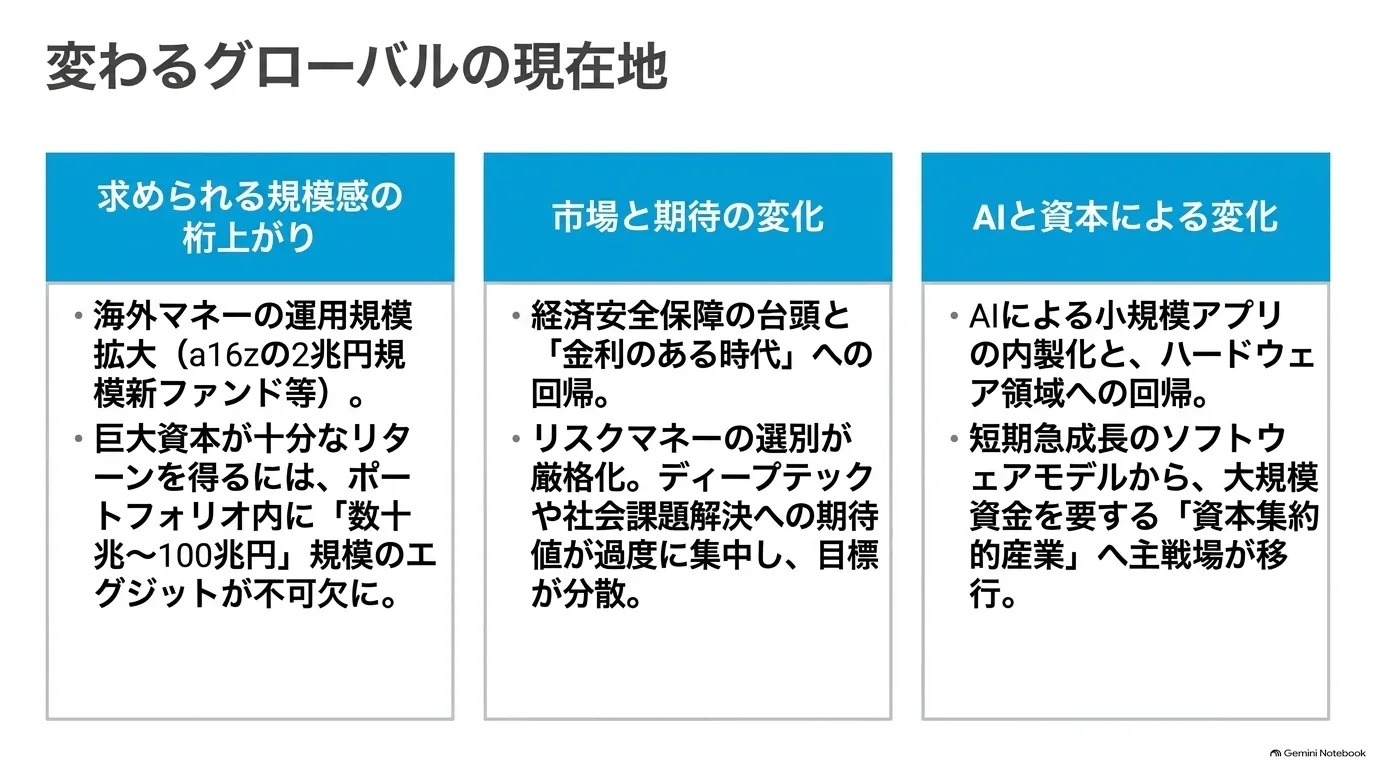
Consider, for example, the scale at which overseas investors operate. In January 2026, Andreessen Horowitz (a16z), one of the top US VC firms, announced that it had raised over $15 billion (roughly ¥2 trillion) in new funds across multiple strategies.
What Japan hopes for is that this abundant capital will flow into Japanese startups. However, even when split across multiple funds, for top VCs managing massive pools of capital in the hundreds of billions to trillions of yen to deliver adequate returns to their investors (for example, several times invested capital over ten years), the math simply does not work unless their portfolios produce mega-exits with market capitalizations in the trillions, tens of trillions, or even approaching ¥100 trillion. If a fund aims to generate trillions of yen in return from a single company, given ownership stakes on the order of a few percent to 10%, creating companies worth tens of trillions to ¥100 trillion becomes the baseline expectation behind their investments.
In other words, if Japan wants to attract major global capital, it too must set its sights on building startups starting at ¥1 trillion and reaching tens of trillions to ¥100 trillion. Yet at present, it appears that Japan's startup ecosystem has not yet had a thorough, explicit discussion about whether it intends to step onto the playing field of a game at that scale.
If that is the case, then we need to rethink what scale we are aiming for and with what strategy we intend to compete globally. For instance, there is certainly a strategy of creating many ¥10 billion startups, and there is also a positioning that defines Japanese-style startups as digitally transforming the domestic market. However, in that case, entirely different challenges would emerge—such as designing a different kind of financing system that breaks away from the US VC model.
(Shift 2) Global markets and expectations for startups are also changing
Today, as terms like economic security have entered everyday discourse, globalization has not ended, but it is at the very least undergoing a major transformation. As a result, we are moving into a world where you can no longer idyllically take products into every market the way you once could. The global market itself is changing.
Moreover, amid a global inflationary trend, Japan has also returned to an era with positive interest rates. Conditions are becoming tougher for risk capital like VC, and PE firms that have acquired startups also continue to face a difficult exit environment.
At the same time, people hearing the stories of Western startups thriving overseas are placing high hopes on startups—expecting them to use new technologies to solve a wide array of problems.
As the word "startup" has come into wider use and begun to mean different things to different people, their goals also seem to be diverging—some aiming for regional revitalization, others for economic security.
Demanding both local contribution and global market expansion creates an extremely difficult challenge to execute simultaneously. Similarly, demanding economic security while also expecting university spinouts from universities with large numbers of international students is a very difficult set of requirements, and meeting both comes at a substantial cost.
Unless we sort out this situation, "startup" will simply come to mean entrepreneurship in general, and resources will end up spread thinly across every activity.
(Shift 3) Changes driven by AI and capital
On top of these shifts, AI has also transformed the competitive landscape. While there are many predictions about what changes AI will bring, I believe several shifts are already underway right now:
- Small applications can now be built in-house
- Small and mid-sized services are facing serious security vulnerabilities
- AI has led to a rise in small-scale operators, reducing the need for VC-style risk capital among small software companies
- AI has expanded what is possible, leading to a rise in hardware startups and similar ventures
The combination of these changes appears to be shifting attention toward more capital-intensive industries. Under such conditions, large corporations with ample capital tend to have the upper hand, and even among startups, US startups capable of raising huge sums hold a strong advantage.
This means that the business domains suited to startups that raise capital to achieve rapid growth over a short period—and the roles expected of them—are gradually changing.
Points of caution
(Caution 1) Competing by shifting the playing field is important, but how you shift matters
Against this backdrop, countries outside the United States—including Europe and Japan—appear to be turning their gaze toward deep tech.
Here, however, there are several points where we should pause and think carefully.
First, even in the United States, the deep tech sector has not yet achieved massive-scale success. Part of this may be because existing financing systems cannot bear that kind of risk, and part may be because securing a one-of-a-kind position in a global niche does not necessarily lead to a large market.
We tend to gravitate toward deep tech out of a desire to "win" or "be unique," but it is entirely possible to win on technology and lose on business, or to win on business only within a small market. And even if you win individual battles, looking at the macro picture across the entire theater, you can still lose in the areas and major markets that matter most—and lose overall.
There are usually good reasons why no one else has entered a given field. That means unless we think more strategically, the risk and return will simply not add up.
(Caution 2) Conditions will change over the next five years
Furthermore, conditions will change again. Five years ago, few people imagined that generative AI would reshape the landscape to this extent—after all, late 2022, when the Startup Five-Year Plan was released, was being called the "VC winter."
With that in mind, our underlying assumptions could shift dramatically once again. That is why, rather than chasing trends that turn over every five years and locking ourselves into a rigid short-term plan, we need to extend our time horizon to irreversible structural challenges and foundational technologies that will remain relevant 15 years out (to 2040), while designing the Five-Year Plan itself flexibly so that portfolios and exit or shutdown decisions can be revisited as conditions evolve.
A new strategy for a new Five-Year Plan
Considering these challenges and shifts, I believe we need to think through a new strategy—and the Five-Year Plan revision feels like the right moment to do so.
In doing so, confronting those challenges squarely no matter how difficult they are, and stepping into uncharted territory where answers do not yet exist rather than simply importing US answers as-is, may be the way for Japan's startup ecosystem to secure a meaningful position in global competition.
In the first place, looking at the United States and imitating the US way of doing things is surely not what globalization means. Nor is globalization simply looking at the differences between the United States and Japan and filling in whatever is missing. We should certainly learn what is worth learning from the US approach, but we cannot win by playing the exact same way. Adopting a different approach from the United States and establishing a distinct presence on the world stage to compete as an equal—that, I believe, is the stance Japan should have taken in globalization all along.
And "taking on areas with no clear answers and finding the answers" is precisely what many startups in Japan and abroad have done themselves; now, I think we are once again being called on to do that as an ecosystem as a whole.
Three guiding lines for shaping strategy
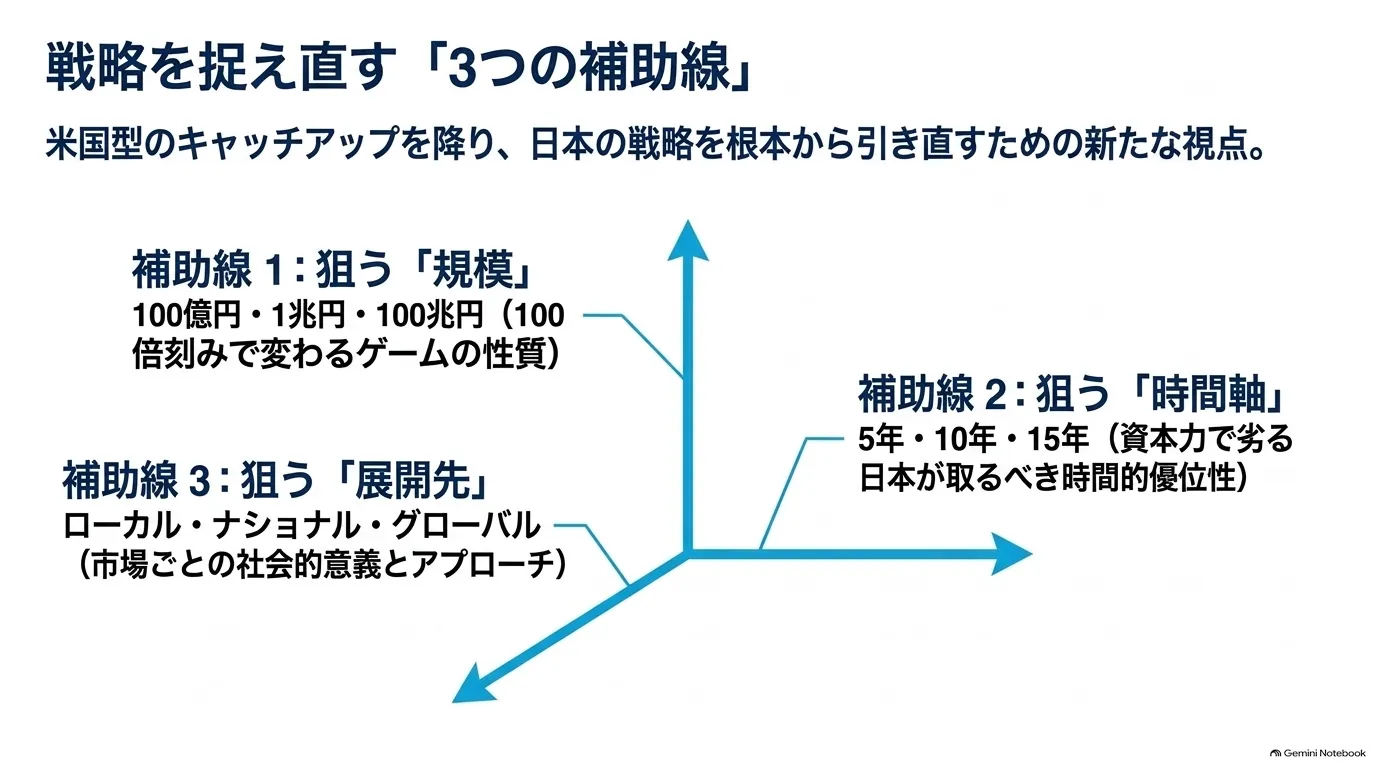
To step off the US catch-up track, avoid merely putting out immediate fires, and identify the real issues before rethinking Japan's startup strategy and industrial strategy, I would like to draw three guiding lines.
(1) Target scale
The first guiding line is scale. Let us organize target market capitalization into orders of magnitude separated by factors of 100—¥10 billion, ¥1 trillion, and ¥100 trillion (I have grouped them in 100x increments here so there are not too many options).
It takes 100 companies worth ¥10 billion each to reach a combined ¥1 trillion, and 1,000 of them to reach ¥10 trillion. Choosing whether to aim for ¥1 trillion by creating ten ¥10 billion companies a year for ten years, or by creating one ¥1 trillion startup in ten years, or to aim for a ¥100 trillion startup is not merely a matter of picking a larger or smaller target number—it changes the very game you are choosing to play.
| Scale Tier | Nature of Business and Market | Impact on the Japanese Economy and Challenges |
|---|---|---|
| ¥10 billion scale | Strong regional businesses, global niches, and national challenges such as defense tech and basic infrastructure | Even if 100 such companies grow modestly to a combined ¥1 trillion to ¥2 trillion, doubts remain about their impact on the macroeconomy as a whole. I think they require a different support framework from the standard startup track. |
| ¥1 trillion scale | Platforms solving major domestic structural challenges, or growth businesses expanding from national challenges into global markets | Producing even one such company in ten years equals one hundred ¥10 billion companies and serves as a catalyst for renewing industry structures. |
| ¥100 trillion scale | Foundational technologies and platforms that fundamentally rewrite global industry rules and cost structures | Benefits the economy broadly, generating chains of next-generation startups by alumni and expanding the base of surrounding industries. |
What we must keep in mind here is that for ¥10 billion companies, unless you produce a very large number of them, the economic impact on Japan as a whole is not all that large (even though their impact on regional economies is significant).
On the other hand, aiming for a ¥100 trillion company is close to a gamble. Yet that does not mean ¥1 trillion is not a gamble either. Considering the reality that roughly 70% of companies listed on the Tokyo Stock Exchange Growth Market remain below ¥10 billion in market capitalization, and that while VCs make thousands of investments per year, only a few dozen VC-backed companies list each year with a market cap exceeding ¥10 billion, one could argue that even ¥10 billion is already quite a gamble.
Even so, the game—and the risk-return profile—differs depending on the scale you target. We need to choose deliberately which scale we are betting on.
(2) Target time horizon
The second guiding line is time horizon. Competing on a 5-year span, a 10-year span, or a 15-year span likewise represents different games.
| Time Horizon | Nature of Competition | Competitive Conditions vs. the US and Reality for Japan |
|---|---|---|
| 5-year span | A sprint that rides a trend wave, raises capital rapidly, and settles the outcome quickly | An arena where the United States excels across capital, trends, and market size. If Japan competes on this field, a mechanism to concentrate capital just as rapidly is indispensable. |
| 10-year span | Reading "the wave after next" beyond current trends, laying the groundwork early, and waiting for the market | In domains where solving structural issues, conducting physical demonstrations, and navigating regulation take time, Japan can more easily compete using domestic challenges and testbeds as strengths. |
| 15-year span | Betting on supply-side breakthroughs no one else can touch yet and on game-changing technologies | A time horizon that conventional 10-year VC funds cannot withstand. Conversely, if Japan builds mechanisms to make patient, committed bets here, it opens a winning path uniquely suited to a middle power. |
If we try to produce results only within a short 5-year window, we inevitably get pulled into the sprint that is America's home turf.
One option is to bet on a single horizon, or to distinguish whether a given business is a 5-year, 10-year, or 15-year play. While deciding which time horizon should sit at the center, it is also possible to craft separate strategies for how to compete within each time span.
(3) Target market
The third guiding line is target market—which market or set of challenges a business addresses. While this overlaps considerably with scale in (1), it can be organized into three tiers: local, national, and global.
| Market Tier | Challenges Addressed and Primary Significance | Strategic Considerations and Separation |
|---|---|---|
| Local | Solving regional challenges and creating local employment | Because these businesses are rooted in local contexts, approaches that raise the batting average are a good fit. A local-to-global path is possible, though climbing that ladder is not automatic. |
| National | Solving national challenges such as transportation, maritime, nursing care, construction, energy, and defense | Identifying specific domains and solving them carries major social significance in itself. While high-margin models can be pursued as startups, low-margin areas like defense and basic infrastructure are likely better handled under a separate framework. |
| Global | Meeting expanding needs in global markets, or driving global game-changers | Requires designing for the global market from day one. Even when starting from a national challenge and breaking out globally, the path overseas must be built in from the outset. |
Narrowing the focus of startup policy
Simply multiplying the three axes of scale, time horizon, and target market yields 3 × 3 × 3 = 27 possible combinations.
This framing brings several benefits.
(Effect 1) Clarifying the challenges
For example, "¥10 billion × Global × Short-term" represents a strategy of producing many global niche companies that sell existing local products and technologies overseas. In that case, the bottlenecks would likely be overseas channel development, cross-border sales talent, and roll-up capital. By contrast, for "¥1 trillion × National × 10-year," the primary bottlenecks become long-term capital, regulation, and demonstration environments. Depending on which strategy you adopt, the problems you need to solve change as well.
(Effect 2) Allocating resources
Clarifying the target of policy is a crucial lever for resource allocation. Politically, taking a broader stance may make it easier to gather support, but when the target blurs, so does where resources are deployed.
If people, materials, and money were all abundant, placing bets across every domain might be fine. Yet it is also an undeniable fact that Japan is not in that position today.
(Effect 3) Clarifying societal significance
Furthermore, what society expects from the effort changes dramatically depending on which target is chosen.
Creating ten ¥10 billion companies a year—100 in total—may well be an achievable target. On the other hand, simply adding those up without factoring in much additional growth amounts to ¥1 trillion in market capitalization over ten years.
While this would bring substantial benefits to local regions, it would not leave a major impact on Japanese industry as a whole. In that case, the funding used should probably come from regional revitalization budgets rather than industrial policy budgets.
Understanding the constraints
When formulating strategy, however, we must understand a realistic degree of feasibility and the limits of our resources. In doing so, I believe the resource in shortest supply will be talent—because money is the most mobile resource and can be brought in from outside.
In the first place, in a Japan where the working-age population is shrinking and entrepreneurial talent is not abundant enough to explore endlessly through sheer volume of shots on goal, the deeper question is how to create an environment in which scarce entrepreneurial talent does not become overly dispersed across small arenas. That is precisely why, without hindering early-stage exploration itself, we need mechanisms that make it natural for talent and capital to flow toward major challenges and large markets.
A proposed strategy
Having laid out the challenges so far, my view is that the primary battlegrounds where policy should aim to increase reproducibility are best concentrated in the following categories:
- [1] National × ¥1 trillion × 10-year
- [2] Global × ¥1 trillion × 10-year
- [3] Global × ¥100 trillion × 15-year (upside allocation)
Of course, this does not mean that local businesses—or companies tackling national challenges with small markets, such as defense tech—are unnecessary. Rather, the idea is to position businesses that are indispensable to Japan under separate frameworks outside the standard startup category, supporting them through dedicated policy-based finance, government procurement, roll-up PE, or regional revitalization funds, while covering local businesses through employment policy where the goal is jobs and regional revitalization policy where the goal is regional development.
That said, the way of competing differs between ¥1 trillion and ¥100 trillion.
- [1] The core focus is squarely capturing and solving urgent national challenges. In Japan's structural national challenges—such as transportation, maritime, nursing care, construction, logistics, and energy—there is urgent, large-scale demand. Identifying these domains to some degree and solving them brings not only economic scale, but also tremendous social value in sustaining Japanese society. Moreover, by designing businesses to extend into overseas markets facing shared challenges, aiming for ¥1 trillion scale becomes realistic. However, over-optimizing for domestic business customs and regulations can lock companies out of overseas markets, so even when starting from national challenges, a path to global expansion must be considered from the earliest stages.
- [2] The core focus is squarely capturing and solving massive global challenges. I believe this scale can be targeted by reading "the bottleneck after next" on a 10-year horizon and solving global challenges from a demand-driven standpoint, or by tackling global issues such as climate change. That said, this is likely harder for Japan than for the United States and requires very careful strategic thinking (for example, competing in a US-style sprint would require a strategy built for it). When technology is involved, teams will also need to be conscious from the research and exploration stage of whether it has the potential to change cost structures by an order of magnitude, and rigorously evaluate as they progress whether it connects to a massive market and passes TEA (techno-economic analysis).
- [3] The tens-of-trillions to ¥100 trillion tier is an upside play aimed at major discoveries and implementations that fundamentally overturn industry assumptions. Companies of this scale do not emerge as a linear extension of ¥10 billion businesses. The ¥100 trillion tier is not something you can reliably manufacture on demand, nor is it possible to predict in advance which technology will fundamentally rewrite industry assumptions the way AI has. Precisely for that reason, rather than going all-in on a single technology, we need a portfolio design that continuously places broad options over a 10- to 15-year horizon across multiple supply-side bets (such as science and technology) capable in principle of shifting cost structures or industry premises by an order of magnitude—capturing the upside when a breakthrough takes off. We also need to build an end-to-end system that bridges time before VC money enters through vehicles such as FROs (Focused Research Organizations), xLabs, government grants, or EIR programs, and then deploys capital on par with other leading countries once signs of commercialization emerge and massive VC funding is called for.
Why aim for ¥1 trillion and ¥100 trillion instead of mass-producing ¥10 billion companies?
At this point, one might wonder: "If all of these are gambles anyway, wouldn't it be more realistic to steadily mass-produce ¥10 billion companies where the batting average looks higher?" Yet viewed as a medium- to long-term industrial strategy, I believe Japan cannot afford to walk away from the game of creating ¥1 trillion and ¥100 trillion companies.
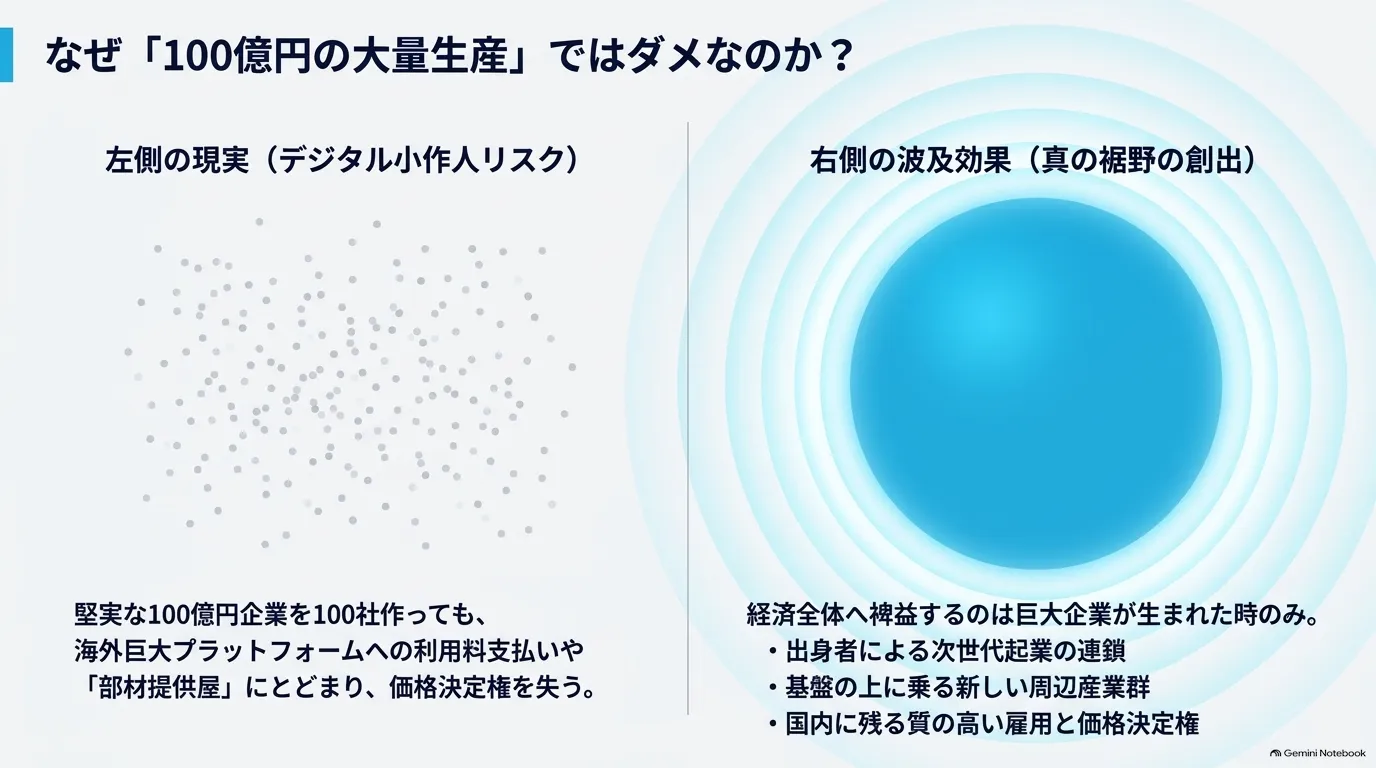
As touched on earlier, even if some degree of economic bloc formation progresses, the global economy will remain interconnected even as it changes shape. In an environment like AI and cloud computing where profits concentrate in the hands of winners, if Japan fails to produce ¥1 trillion or ¥100 trillion companies, it will lose pricing power vis-à-vis foreign mega-platforms. As a result, domestic businesses—local and national alike—could end up paying ongoing usage fees to foreign platforms, or being reduced to digital sharecroppers and component suppliers whose margins are constantly squeezed.
Broad benefits flow across the entire economy when truly large companies—worth ¥1 trillion or ¥100 trillion—emerge. Only by creating companies of that magnitude does the base of an industry widen and give rise to a broad cluster of surrounding enterprises.
The industrial base I am referring to here is not merely the physical subcontracting pyramid of 20th-century manufacturing; in the modern era, it consists of the chain of talent and know-how as alumni of giant companies go on to start new ventures and deepen the ecosystem, the new peripheral industries built atop their platforms and infrastructure, and the high-quality jobs and pricing power that remain inside the country rather than being siphoned overseas.
Can winners be screened from the earliest stages?
Here, another question may arise: "Can you really spot future winners or their eventual scale at the earliest stages of founding?" Of course, the government cannot predict and pick future winners—nor should it try to. What is needed is not for the government to pick winners, but to design a two-stage mechanism:
- Conducting "negative screening" (a baseline cutoff) to move small and mid-sized businesses whose addressable market or business model clearly caps out in a domestic niche (¥1 billion to ¥10 billion) out of startup support and into separate tracks (SME and regional revitalization programs).
- Allowing broad exploration at the earliest stages, while introducing "stage gates" (phased filtering) at Series A and beyond, or at the point of large-scale public support, that rigorously test for ¥1 trillion-scale market structure and unit economics. Rather than leaving that judgment to bureaucrats alone, mechanisms could delegate evaluation to co-investment requirements with private lead investors operating at global standards, or to independent DARPA-style Program Managers (PMs) with deep expertise and discretion.
Moreover, what is even scarcer than money is the total pool of top-tier entrepreneurs and engineers capable of turning ambitious visions into reality. Continuing policies that mass-produce sub-¥10 billion companies locks scarce talent inside a multitude of small organizations. Startups are originally meant to be corporate vehicles for taking on major risks to create new industries. I think we should hand off the ¥10 billion tier—where raising the batting average makes sense—to separate financial and industrial policies, and clearly shift startup policy to an evaluation axis aimed at hitting ¥1 trillion and ¥100 trillion home runs.
Of course, mechanisms that improve individual fund returns are also important, delivering returns for one's own fund is how investors demonstrate professionalism, and it is entirely rational for each fund to seek to maximize its own returns. At the same time, however, individual optimization can easily give rise to a fallacy of composition, leaving the ecosystem as a whole settling into a smaller scale.
Precisely because markets function efficiently, the role of overall system design and policy is to decide what kind of society we want to realize through the market as a social function, and to orient market players in that direction. By contrast, simply solving immediate problems raised from the field likely does nothing more than make the market more efficient along its current trajectory. In that sense, one could say that the ¥10 billion continued listing criterion was itself a mechanism aimed at breaking out of that local optimization.
Three solutions for aiming at ¥1 trillion and ¥100 trillion
So far, we have examined strategy and targets. Without deciding where to aim, we cannot identify the real challenges, nor can we design solutions. If Japan's startup policy seriously aims to make ¥1 trillion its main battleground and pursue ¥100 trillion upside, I believe we need to rebuild our systems along the following three directions. The financing and M&A discussed here are not the "filling gaps in conventional late-stage funding" or "M&A as small exits" critiqued in the first half of this piece, but proposals to re-architect their very roles toward 10- to 15-year long-term campaigns and the concentration of talent.
(Proposed Solution 1) Shift the time horizon and invent new financing methods
Today, in 5-year sprints fueled by massive capital, the United States and China remain dominant. The United States is overwhelmingly strong in capital and market size, while China exerts its strength in production capacity, including mass manufacturing.
If Japan chooses to compete in 5-year sprints, it will likewise need a mechanism to mobilize capital rapidly; however, to compete on equal footing globally with those players, one promising path to explore is instead shifting our way of competing and our time horizon out to 10 or 15 years, and inventing new financing methods that go beyond the conventional bridge model. Put differently, when drafting the next Five-Year Plan, we probably need to write it with ten years from now—and 2040—firmly in mind.
Until now, startup investing has been premised on a bridge model connecting short-term milestones every one to two years to the next investor, and on early IPOs driven by 10-year VC fund lifecycles. Yet trying to compete on the model where the United States excels puts other countries at a significant handicap. Conversely, viable options include supporting the long early exploration phase with non-dilutive capital such as FROs and shared research infrastructure, bridging from there into long-term capital, and connecting to VC funding beyond that.
Furthermore, in fields where it is difficult for the private sector alone to assemble massive capital and technological infrastructure all at once the way the United States can, we should also consider company-creation-style financing approaches in which government, industry, and academia join forces—pooling initial capital, intellectual property, and facilities—to launch large-scale companies with global markets in sight.
To avoid repeating the failures of past national projects where consensus-driven committees slowed decision-making to a crawl, however, a prerequisite is designing these ventures so that management control and decision-making are delegated completely to independent private-sector leadership. Rather than falling into central planning where the government tries to predict individual winners, I believe we should remove distorted KPIs such as company-count targets, establish selection criteria leveraging independent private investors and specialized PMs, and build a division of roles in which public capital shoulders only the early, long-term risks that the private sector cannot bear—on the explicit premise that failure is tolerated.
(Proposed Solution 2) Promote M&A that concentrates forces on winning candidates and reallocates talent
The second proposed solution is to explicitly redefine the role of M&A and use policy to promote M&A optimized for concentrating forces around winning candidates and reallocating talent.
While M&A involving Japanese companies reached a high level of 5,115 deals in 2025, roughly half of total deal value consisted of outbound acquisitions of overseas companies by Japanese firms. For large Japanese corporations, M&A has historically been used primarily to open overseas markets, so trying to discuss domestic startup acquisitions in the exact same context as the United States is unrealistic.
That is precisely why I think M&A for domestic startups should place stronger emphasis on being positioned not as "an exit to lock in success," but as "the proper reallocation of entrepreneurs and top talent."
How to allocate scarce, limited entrepreneurial talent into truly promising domains is a crucial perspective. We sometimes make mistakes in choosing domains, and M&A is likely the mechanism that allows us to respond when we get that choice wrong.
Moreover, when thinking about the stage at which companies make a push into global markets, consolidation through mergers and acquisitions—concentrating talent and capital into specific companies at some point—becomes unavoidable. While having many startups dispersed across different bets makes sense during the early exploration phase, when it comes time to compete globally, Japan's shrinking workforce and declining population—especially among the working-age generation—mean that fighting in a dispersed manner leaves us without enough firepower.
What I have in mind here is not rescue mergers between struggling firms. It is consolidation in which a "core company (a winning candidate)" that has broken through the exploration phase to compete globally absorbs and integrates strong engineers and teams from adjacent domains early on.
Making this happen requires not only building strong ecosystem-wide recognition of M&A as talent reallocation, but also clearing bottlenecks on both the sell side and the buy side. On the sell side, this calls for carve-out, tax, and preferred stock designs that reward founders financially upon acquisition so they can move on to their next challenge, as well as addressing structural issues on the VC fund side where consolidation often stalls due to markdowns in valuation or fund lifecycles. At the same time, on the buy side, I believe policy support will be needed—such as expanding the share delivery tax system so unlisted winning-candidate startups can acquire surrounding companies using their own shares rather than cash alone, and establishing dedicated financing earmarked for acquisitions and PMI (post-merger integration).
(Proposed Solution 3) Provide outcome-based regulation and testbeds for real-world demonstration
The third solution is designing outcome-based regulation and providing testbeds for real-world demonstration.
Individual regulatory reforms have been pursued in the past, but responding piecemeal to isolated requests will not move major industries. What is needed is identifying the regulations with genuine leverage, shifting from "rules that prescribe methods in fine detail" to "rules that specify the outcomes to be achieved, such as safety and performance," and adopting the mindset of using regulation itself to create initial demand for new markets. Alongside this, we must decide strategically which demonstration environments to build in fields such as transportation, maritime, next-generation energy, autonomous driving, and robotics. The true bottleneck today is not necessarily just the amount of money.
In particular, if AI accelerates the pace of development across a wide range of fields going forward, the bottleneck is very likely to shift to societal frameworks and institutions—and we will need to ask how those systems themselves should be redesigned.
Above all, changing regulations and providing demonstration testbeds are "jobs that only policy can do," which cannot be solved merely by handing out money. As much as possible, policy should focus its resources on system-wide optimization and on these tasks that only policy can perform.
Conclusion
In this post, I have reviewed the past five years and the current state of the startup landscape, and on that basis laid out what we should define as the core issue and what strategies and solutions we should adopt.
This is merely one personal framework, and because I wrote it fairly quickly, my views on the proposed solutions may change later. Still, unless we have much more active debate at the strategic level—grounded in the environmental shifts discussed in the first half—I suspect the next Startup Five-Year Plan will end up settling into an extension of incremental plans aimed at solving the problems right in front of us.
Even today, there seem to be scattered initiatives that claim to be "global" while in reality merely imitating the United States—promoting ways of competing that can only end in a losing battle. If people have thought it through carefully and still believe that is the right answer, then so be it; yet precisely because the Startup Five-Year Plan is now up for revision, isn't this a good time to ask once more whether we have really thought it through?
We may still end up adopting incremental measures as a result. Even then, whether or not we have a clear view of the goal ahead changes the meaning of those steps—determining whether they are meaningful progress or merely superficial problem-solving.
Looking ahead to 2040, when the working-age population will have declined sharply and the underlying premises of society will have been rewritten, we should avoid staying on the extension of input targets like investment volume and company counts. I believe this revision can serve as an opportunity for Japan's startup ecosystem to reconsider the positioning of Japanese startups anew and debate what challenges we truly need to tackle.
Asking what the real issue is—rather than settling for the problems right in front of us—and stepping together as an ecosystem into uncharted territory where answers do not yet exist is where we must begin. I have written this piece as a catalyst to spark that discussion.