
Challenges of Student Startups and Business Entrepreneurship Education in the AI Era (2026 Edition)
This article was machine-translated from Japanese by AI (Claude). It may contain errors. Read the original Japanese article.
Narrowly defined entrepreneurship education (that is, business-focused startup education) has followed a fairly established model over the past decade or so.
In this model, students with technical backgrounds or those eager to learn technical skills are taught methodologies like lean startups, design thinking, and customer development—approaches centered on "building quickly, validating quickly" and "getting out of the building to meet customers." Workspaces are provided, programs are run, people gather, peers emerge to consult with, and, when things go well, what started as a student project grows into a rapidly scaling, high-growth startup.
Another underlying premise was that students enjoyed favorable conditions for launching startups. Even if they could not compete with working professionals in experience, capital, or networks, students had time and agility, allowing them to compete through sheer volume of action. Demand centered on consumer-facing services where students themselves were users, and all it took to get started was a single laptop and minimal cloud hosting costs. One could say an open market emerged that favored young founders, largely uncrowded by experienced adults.
Due to industry maturity and the arrival of AI, these conditions appear to be changing. Alongside these business-side shifts, traditional methodologies and educational spaces on the teaching side no longer seem to function as they once did. As a result, high-growth startup creation and student entrepreneurship education have begun to diverge, prompting us to rethink fundamentally how business startup education ought to be conducted.
In this article, I hope to outline these challenges and provide material for discussing where we should go from here.
7 Challenges
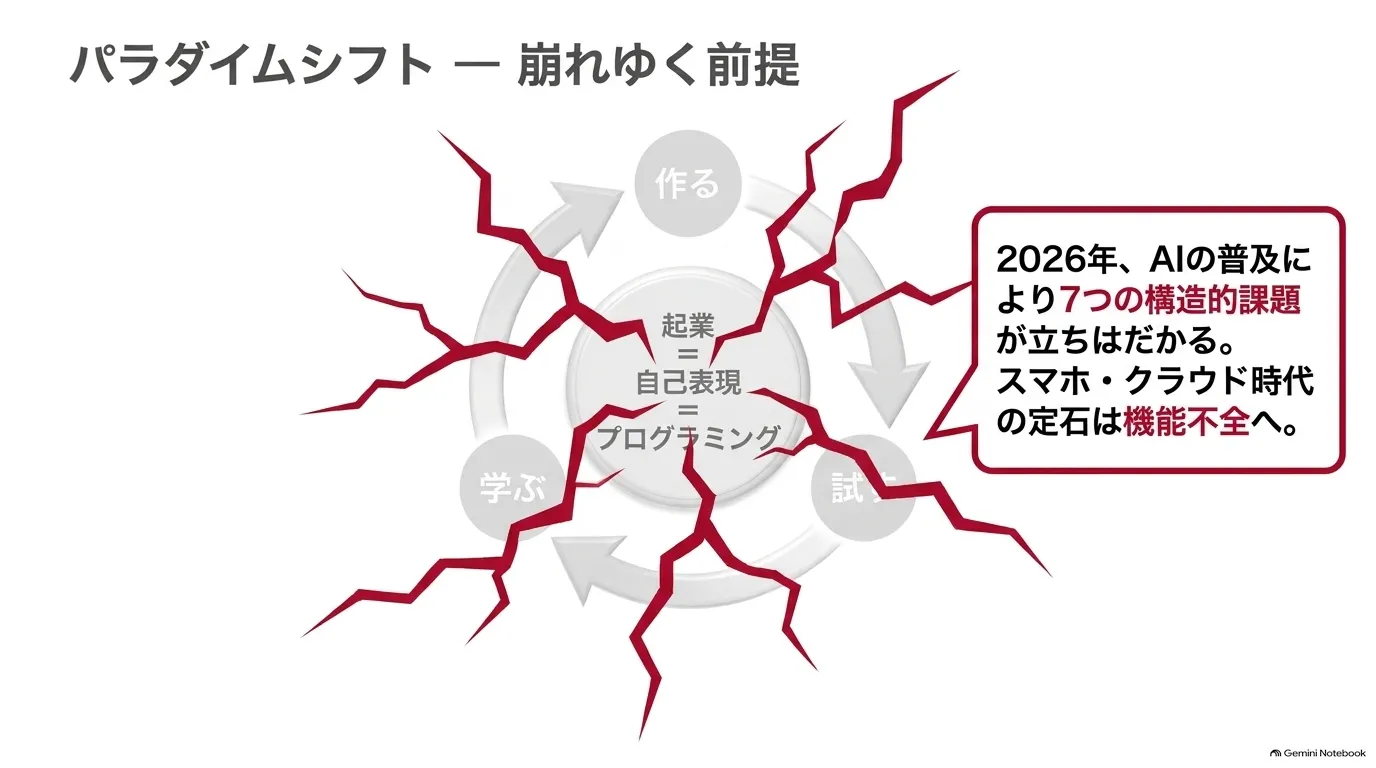
With the spread of AI and recent shifts in the startup ecosystem, the conditions surrounding student startups and the educational models long taken for granted are destabilizing across multiple fronts simultaneously. Here, I organize these unfolding changes into seven challenges. The first three pertain to the environment surrounding student startups, divided into the demand side (what kinds of businesses are needed and where) and the supply side (the means students have to build businesses). The next three are challenges on the education side, and the final one is the outcome arising from their convergence.
Shifts in Demand
- The Profile of Startups to Build Has Changed from a Decade Ago: Writing code in itself has lost its power as a differentiator, giving way to deep industry immersion, distribution channels, and proprietary data.
- Demand Has Shifted Beyond the Reach of Students' Action-Oriented Advantage: The center of demand has moved from B2C to enterprise and AI infrastructure, placing it beyond the intuitive grasp and direct reach of students.
Shifts in Supply
- The Cost of Joining the Competition Has Risen and Become Harder to Estimate: Due to flat-rate AI subscriptions, pay-as-you-go token costs, and a weaker yen, the cost to start developing software has risen and become harder to forecast in advance.
Shifts in Education
- Lean Startup and Design Thinking Are Necessary but No Longer Sufficient: In sectors that do not naturally experience rapid market growth, deciding "where to compete" (market selection) has become essential prior to hypothesis testing.
- Rapid Prototyping No Longer Proves Competence or Commitment: Because anyone can now quickly produce polished products with AI, working deliverables alone no longer demonstrate technical ability or depth of commitment.
- With No Need to Consult People, the Reason to Gather Has Faded: As AI increasingly takes over as an everyday sounding board, the necessity of gathering in workshops or incubation facilities has diminished.
The Outcome
- High-Growth Startup Creation and Entrepreneurship Education Have Begun to Diverge: As these challenges compound, the gap between what students can do and what startups demand has widened, making it difficult to achieve both education and high-growth venture creation within a single framework.
Below, we examine each of these challenges in detail.
Challenge 1: The Profile of Startups to Build Has Changed from a Decade Ago
About ten years ago, for a student aspiring to start a business in university, making money, expressing their own ideas, and working on IT or software were essentially one and the same path. By learning to code, they could give shape to their ideas as apps, which served as direct self-expression, and, if successful, could become rapid-growth startups with minimal capital. These could remain a single unified path because the widespread adoption of smartphones and the cloud coincided. University programs attracted people back then because students could satisfy any of these motivations by showing up.
Over the past few years, these three avenues have split into separate paths. Prototype-level software can now be built by anyone, and the mere act of having built it no longer sets anyone apart. Development as self-expression can be done thoroughly by a single individual using AI, but things that anyone can build rarely become viable businesses on their own. For students seeking to make money, more direct alternatives exist outside of starting a company. The status of computer science as the ultimate discipline is also shifting, with coding becoming one of the first professions heavily impacted by AI.
The profile of startups being sought after has changed as well. Steve Blank, one of the creators of the lean startup methodology, wrote an article titled "The World Outside The Classroom Changed. The Class Didn’t." In it, Blank notes that now that building has become cheap and everyone possesses the same tools, what is lacking is human attention, distribution channels, proprietary data, deep domain immersion, and evidence accepted by regulators, healthcare professionals, or payers. He observes that defensible moats have shifted from code to data, domain depth, distribution, and credibility. A decade ago, being able to write code was enough to launch a startup; today, founders are increasingly required to embed themselves deeply into specific industries and field operations.
Challenge 2: Demand Has Shifted Beyond the Reach of Students' Action-Oriented Advantage
Historically, the core advantage of student-led startups was their sheer volume of action. While unable to match working professionals in experience, capital, or connections, students leveraged their time and lightness of foot to execute relentlessly. They learned and implemented new technologies ahead of others, met countless people to discover demand, and quickly tried the next thing whenever something failed. Both discovering demand and coding could largely be compensated for through pure activity.
However, a high volume of action only serves as an advantage when demand lies within its reach. Over the past decade and a half, the location of that demand has gradually drifted away from the student domain.
Until around 2013, demand centered primarily on consumer (B2C) apps and services. Because students themselves were users, it was easy to intuitively grasp what was needed, build it, and test it immediately on friends. Over the subsequent years, the focus shifted to business-to-business (B2B), particularly small and medium-sized enterprises or startups. While somewhat further removed from student life, this domain featured fast decision-making and many stakeholders willing to meet if approached. From around 2020 onward, the center of demand moved toward enterprise. The complex operations and procurement processes of large corporations fall entirely outside the realm of intuitive student understanding.
Today, the greatest demand lies in AI. Generative AI applications and developer tools still offer real opportunities for young founders. On the other hand, demand for AI infrastructure is directed toward semiconductors and power generation—fields almost entirely out of reach for students. Such areas cannot be tackled through software alone; they require deep industry relationships, on-site operational validation, and substantial capital.
Raising that capital is no easy task either. Venture capital has changed dramatically. According to Blank in the same article, fundraising in the United States has bifurcated: founders either bootstrap until generating revenue or raise massive rounds for compute resources and distribution, with rounds raised simply to hire engineers virtually disappearing.
The student advantage of rapid action was most potent when demand could be intuitively understood and building software required specialized skill and high cost. Today, with demand moving further away and building no longer offering differentiation, the territory where that advantage works has shrunk.
Furthermore, while students used to be able to rely on intuition to identify which markets to explore, they must now be far more deliberate about which markets they enter. Even though some students and young founders will still break through via sheer hustle, opportunities to grow step-by-step through running a business will gradually diminish.
At the same time, some trends in the United States appear to suggest the opposite. According to a Fortune article, data from venture firm Antler shows that the average age of AI unicorn founders dropped from 40 in 2020 to 29 in 2024. At Y Combinator demo days, founders increasingly highlight having dropped out of college during their pitches, as reported by TechCrunch. Students and founders near student age seem, if anything, to be stepping to the forefront.
Nevertheless, this appears to be a phenomenon largely confined to Silicon Valley, where massive funding flows to a select few students positioned at the cutting edge of AI development and directly within investors' sightlines. While the entrance has not narrowed uniformly for all students, it is certainly no longer what it once was.
Challenge 3: The Cost of Joining the Competition Has Risen and Become Harder to Estimate
Conditions have tightened not only on the demand side, but also on the supply side—the means by which students build ventures.
Previously, the initial capital needed to launch a software startup was negligible. All that was required was a computer and modest cloud expenses. Most students already owned laptops, and cloud providers offered free tiers. Beyond that, one only needed to pour time into coding, and time was precisely the asset students possessed in abundance.
Today, mastering AI has become a baseline requirement for anyone aiming to launch a startup. And in AI-driven development, the meaning of action volume has fundamentally changed. What now determines action volume is how long and how intensely one can make AI work. Part of that action volume is becoming something purchased with money rather than time. For students with abundant time but little money, this is an unfavorable shift. (That said, young people are often adept at discovering clever AI workflows and cheap providers, so real opportunities remain in these areas.)
The financial burden comes in two tiers. First is the flat-rate subscription fee for AI services. In the case of ChatGPT, the Pro plan is offered in Japan at 16,800 yen per month (about $100 per month), positioned for individuals using coding agents under heavy workloads for extended periods. While the 3,000 yen Plus plan can accomplish a great deal, the gap between tiers is considerable when continuously running AI to write code over long stretches.
Second is the usage-based token cost. In addition to running AI during development, incorporating AI into one's own product incurs costs every time users interact with it. These variable costs depress profit margins for businesses. Blank also points out that inference costs have altered business unit economics, compressing margins.
In Japan, the depreciation of the yen exacerbates this situation. For someone in the United States, $100 to $200 a month might feel like skipping a couple of dinners out. In Japan, however, 16,800 yen equates to skipping more than a dozen 1,000-yen meals. Dollar-denominated token costs also become heavier in proportion to the weak yen. The burden of using the same tools to the same degree is significantly heavier for Japanese students.
Could universities simply cover these AI costs? That, too, is far from simple. In a highly simplified calculation, providing 100 students with a 16,800-yen plan for three months costs approximately 5 million yen. While leveraging OpenCode Go or local LLMs is an option, maintaining such setups requires substantial effort and cost from administrators. Factoring in additional token costs inflates the budget further, and forecasting that amount beforehand is notoriously difficult. Continuously providing full access to all students is simply unrealistic for most universities.
As discussed in Challenge 2, expanding sectors are not necessarily sectors accessible at low cost. Furthermore, even within software—a domain once accessible with minimal funds—entry costs have risen and grown difficult to predict. In short, demand has moved beyond the reach of raw activity, while on the supply side, the barrier to entering the competition has risen.
Challenge 4: Lean Startup and Design Thinking Are Necessary but No Longer Sufficient
In response to these business shifts, business entrepreneurship education predicated on high-growth startups is also changing.
Over the past decade, lean startup and design thinking have stood at the core of university entrepreneurship education. These methodologies involve observing people's needs to identify problems, building small experiments to validate assumptions, and pivoting based on learning. Teaching these frameworks to students with technical skills as a recipe for social implementation has been adopted across numerous programs.
These frameworks may still be necessary and sufficient for small businesses. For identifying an immediate customer problem, solving it, and earning compensation, following a step-by-step process of validating needs while building is generally adequate.
Historically, a similar dynamic held true for high-growth startups as well. During periods when markets naturally expanded at breakneck speed—such as the smartphone or cloud boom—identifying customer problems and iterating rapidly within a booming market allowed businesses to grow along with the tide. Founders did not have to think deeply about which market to ride; the expansion of the market lifted the business.
In mature sectors, however, the situation is completely different. The process of discovering and verifying customer pain points cannot be skipped, but that alone will not make a business large. Successfully solving a problem for a customer in a stagnant market leads only to a small business. Moreover, tackling larger enterprise problems moves beyond the pain points of front-line staff to strategic executive priorities, requiring access to division heads and corporate officers—people whom students can rarely meet.
Hypothesis testing remains essential when pursuing large-scale ventures. In that sense, lean startup and design thinking remain indispensable. Yet compared to the past, they can no longer be considered sufficient on their own.
If that is the case, identifying truly high-growth domains becomes a prerequisite. That means deciding where to compete must precede figuring out how to validate needs. Yet whether high-growth areas are low-cost domains where students can readily begin is another matter entirely. As seen in Challenge 2, demand for AI infrastructure centers on semiconductors and power, while viable AI applications require deep industry relationships and heavy funding. Discovering a growing sector and being able to start there as a student do not necessarily coincide.
Teaching methodologies alone is insufficient; yet even if educators point out high-growth sectors, students may not be positioned to launch ventures within them.
Challenge 5: Rapid Prototyping No Longer Proves Competence or Commitment
At the core of the lean startup was rapid prototyping: building fast to learn fast. Physical spaces like maker labs and workshops were positioned as facilities to lower the cost of making and accelerate this iterative cycle.
This concept worked precisely because building things required a meaningful investment of time and specialized skill. Producing a functional prototype in a short period proved two things. First was the technical competence of the team. Second was a high degree of commitment—that the team had dedicated substantial time, learned new technologies, and pursued the endeavor with genuine seriousness.
AI has overturned this premise. When it comes to software, polished products can be created in a matter of hours. Consequently, observers looking at program deliverables increasingly conclude that "anyone could do this with AI." Building something no longer earns external validation. Even more easily overlooked is that deliverables no longer communicate commitment. From the outside, it is impossible to distinguish whether an attractive product is the result of weeks of intense deliberation or something slapped together on a weekend whim.
Steve Blank reported experiencing a similar shift in his own classroom. In his spring 2026 Stanford class, teams arrived on day one with nearly finished products built using AI. Yet as the course progressed, learning stalled; students substituted AI-generated insights for genuine customer interaction, treating them as truth and seeking praise rather than disconfirmation. Blank concluded that having a product no longer demonstrates customer understanding or validated learning, and that the bottleneck had shifted from the time and cost of building to the judgment of what to build and for whom. He also reported that customers were using AI to build their own alternatives just as quickly as the students could.
Blank renamed the MVP to IUP (Initial Untested Product). However, this is largely a terminological adjustment; the underlying framework of speaking with customers to test hypotheses remains unchanged. What has shifted is not so much the substance of the methodology as the location of the primary bottleneck.
Prototypes historically served two functions: a learning tool for teams to understand customers and technology, and an external proof of competence and commitment. The former remains valid today. The latter, however, has largely vanished. Yet demo day formats showcasing finished products, maker workshops, and selection processes based on tangible deliverables were all designed largely around the assumption of the latter.
The growing preference among US investors for college dropouts, mentioned in Challenge 2, may also be related to this shift. When building something no longer proves commitment, investors look for other signals. Burning one's bridges by abandoning academic credentials provides a clear, visible signal from the outside. However, it is also a signal that forces the risk of proving seriousness onto the students. I will return to this point when discussing evaluation methods.
Challenge 6: With No Need to Consult People, the Reason to Gather Has Faded
University incubation facilities and student maker spaces were equipment depots, but they were also places to consult others. Asking the student sitting next to you when code wouldn't run, having senior entrepreneurs or mentors review a business plan, learning fabrication techniques from technical staff, and stumbling upon unexpected information from serendipitous encounters—much of the value of physical space lay in these consultations and chance interactions.
AI has stepped in to handle many of these interactions. It troubleshoots errors, debugs code, flags holes in business plans, and performs market research. Without travelling anywhere, answers are available from home, alone, even in the middle of the night. When the need to consult people declines, the need to gather declines with it, reducing the necessity of physical spaces. The ability of small teams to sustain progress on their own for longer periods further accelerates this trend.
Of course, demand for physical space has not disappeared entirely. Spaces to store equipment, access specialized machinery, or collaborate in person remain necessary. However, the traditional model combining generic maker spaces with social community no longer draws people as it once did. Similar challenges are likely emerging in academic research laboratories as well.
At the same time, relying less on human consultation carries hidden costs. AI rarely pushes back directly against a user's ideas, offering plausible-sounding validations instead. The fact that students in Blank's class accepted AI-generated insights as truth exemplifies this pitfall. Interacting with real people inherently involves the risk of confronting contradictory opinions. What is lost when people stop gathering in physical spaces may well be those uncomfortable, perspective-shifting encounters. I will return to this point later in the context of meeting people to validate hypotheses.
Challenge 7: High-Growth Startup Creation and Entrepreneurship Education Have Begun to Diverge
The cumulative result of these challenges over recent years is that producing high-growth startups and providing entrepreneurship education to students have begun to pull apart.
Historically, many university programs operated on the premise that nurturing projects under the banner of education would, with reasonable probability, produce viable startups. Providing experiential learning to students and spawning high-growth startups coexisted within the same program framework. This premise held because the distance between what students were capable of doing and what startups required was relatively short.
Today, that distance is steadily widening. What is required now—identifying growth domains, deep industry immersion, proprietary data, and significant capital—consists precisely of things students rarely possess. Entry costs have risen. Tangible deliverables no longer signal authentic commitment, weakening the criteria used to select promising teams from educational cohorts. As a result, running a program rich in educational value yields fewer high-growth startups, while deliberately producing high-growth startups increasingly demands mechanisms entirely distinct from student-focused education.
Now that the two have begun to diverge, educators must confront a fundamental question: when spawning startups is no longer the primary objective, what should university entrepreneurship education aim for, and what should it teach?
What Should We Teach?
In short, the traditional formula was: "Take students with engineering backgrounds, assume technical capability as given, and teach them methodologies for social implementation." Today, however, both pillars of this equation are shaking. Technical execution is increasingly handled by AI, while methodologies—as seen in Challenge 4—may have been sufficient in an era of natural market growth, but today represent merely one necessary condition among many.
Moreover, past entrepreneurship education focused heavily on unleashing students' action volume—advising them to build constantly and meet people relentlessly. Now that a portion of that action volume can be bought with money, and demand within direct reach has thinned, placing raw activity at the absolute center of education has become unsustainable.
Should we then simply teach contemporary startup-building techniques? That, too, leaves room for hesitation. Teaching AI-driven development workflows, current fundraising dynamics, and trending business playbooks provides students with immediate, practical takeaways. Yet whether such practical training belongs in institutions of higher education outside of MBAs or vocational schools remains questionable.
For small businesses, the conversation is simpler. As noted in Challenge 4, lean startup and design thinking remain perfectly applicable to small businesses, and lower building costs with AI make solo or small-team ventures easier than ever to start. There are diverse ways to teach how to launch and operate such businesses, and doing so holds genuine value.
Yet whether this should be the central focus of university education warrants careful consideration. With abundant learning opportunities emerging outside the university, the fundamental reasons for universities to lead such efforts must be examined, along with what society expects from university entrepreneurship education. Furthermore, the answers will inevitably depend on whether the ultimate goal of promoting entrepreneurship is self-actualization, regional revitalization, solving societal problems, or macroeconomic growth.
Next Steps
The following directions represent working hypotheses to be tested and refined through practice.
Direction 1: Define the Purpose Before Designing Programs
As seen in Challenge 7, startup creation and entrepreneurship education have begun to decouple. Despite this, university programs have long maintained both objectives in ambiguous coexistence. While that ambiguity worked when the two were closely aligned, failing to choose which objective to prioritize now causes both program design and evaluation to drift.
If prioritizing education, the objective should be delivering durable, long-term mental models and knowledge of future domains to as many students as possible. If prioritizing startup creation, it may be necessary to select a small number of teams and provide them with capital and intensive, tailored support to pursue ambitious goals.
The young US founders discussed in Challenge 2 receive substantial capital and support concentrated on a select few, primarily from investors. In Japan, this path is even narrower. The capital pool willing to make bold bets on young founders is not as deep as in the US, and under the custom of simultaneous recruitment of new graduates, the personal cost of dropping out to start a company is felt more acutely. If so, universities and supporting organizations in Japan may need to intentionally create avenues for select students to take bold swings.
Programs could also connect the two as progressive stages: an open first phase delivering broad education to many students, followed by a selective second phase where chosen teams receive capital and dedicated support. In that scenario, selection criteria must be overhauled. Since deliverables no longer indicate commitment, evaluators will need to rely on signals that require genuine time and effort—such as how many people the team met, what they validated, and what concrete commitments they secured from real counterparties. In any case, programs must begin by clarifying their primary purpose.
Direction 2: Forge Enduring Principles in the Context of Big Challenges
Hypothesis testing should be positioned not as an all-encompassing methodology at the core of education, but as one tool deployed within the context of tackling ambitious challenges. When it comes to small business ideas, AI makes building and testing so cheap that trial and error can replace formal validation procedures. Hypothesis testing becomes truly indispensable when confronting larger problems where answers cannot be found simply by building.
Ambitious challenges demand tools beyond hypothesis testing alone: choosing problems worth dedicating a decade to, forecasting technological cost curves and demand shifts, planning risk mitigation from the most lethal assumptions downward when multiple trials are impossible, deciphering decision-makers and budget holders in specific industries, and rallying peers, capital, and partners. The ability to choose where to compete, discussed in Challenge 4, is underpinned by these very tools. All of these concern strategic judgment rather than procedural execution; they predated the arrival of AI and are highly likely to remain durable for years to come.
Many of these capabilities can be learned without expensive AI subscriptions. This approach also has the advantage of largely circumventing the rising cost of competition discussed in Challenge 3 at the educational stage.
Formulating and Testing Hypotheses
Thus far, we have examined how high-growth startup creation and entrepreneurship education have begun to drift apart. While this shift had been unfolding gradually, the advent of AI has brought it into much sharper focus.
Precisely because these changes are now undeniable, it is time to rethink business entrepreneurship education in the narrow sense.
Operating at the closest frontier to society, education for startups and business must evolve alongside societal shifts. Rather than clinging to past playbooks, educators must absorb these realities, reexamine existing methods, formulate fresh hypotheses grounded in this new context, and put them to the test. We have entered a phase that demands this iterative approach anew. I offer this article as an attempt to organize the current landscape to support that ongoing discussion.