💯 Ask the Question: "How Do We Build a ¥100 Trillion Startup?"
This article was machine-translated from Japanese by AI (Claude). It may contain errors. Read the original Japanese article.
There are rumors that SpaceX will go public at a market capitalization of about ¥200 trillion, and reports that OpenAI is raising funds at a valuation of ¥125 trillion and Anthropic at ¥50 trillion.
No company in Japan has a market capitalization above ¥100 trillion. The largest company in Japan by market capitalization is Toyota, at close to ¥50 trillion today. In other words, companies valued at more than that are now emerging one after another in the United States.
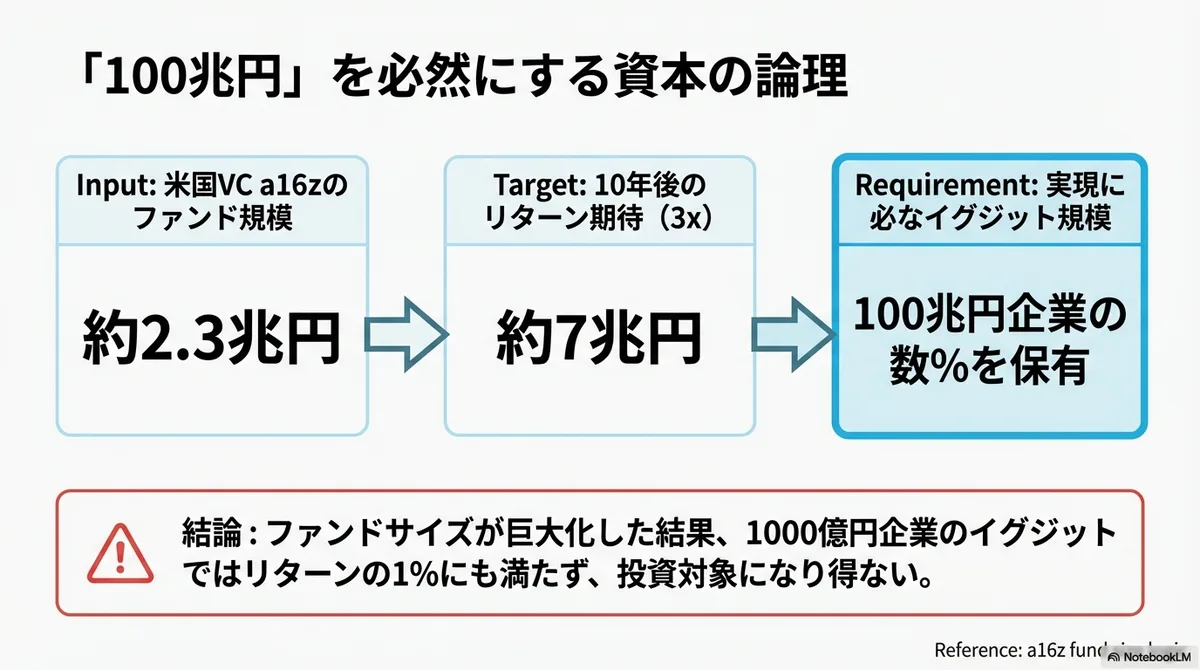
In parallel, this month the US VC firm a16z created funds totaling about ¥2.3 trillion (note: this is the total of several funds established at the same time).
A single VC firm has put together a fund equal to about three times Japan's annual VC investment, and has committed to returning several trillion yen in about ten years.
Watching these moves, it seems that the American startup ecosystem is now making "creating ¥100 trillion startups" its goal 💯.
Until not long ago, American startups were also at a scale like this:
- A ¥10 trillion-scale company about once every few years (Facebook, Stripe, Databricks, and so on)
- A few companies a year at the multi-trillion-yen scale
At that scale, my impression was that Japan might still be able to catch up a little if it worked hard (though it would be quite difficult), but the gap has now grown even larger.
And while Japan has not produced enough startups worth ¥100 billion, and is not yet continuously producing ¥1 trillion companies, in the American startup ecosystem expectations and stakes have risen to ¥10 trillion and ¥100 trillion.
With the world moving this way, Japan is also expected to respond.
Of course, the challenges facing the "Japanese startup ecosystem," and improving on them, are also important. But at the same time, I think that unless we respond in some form to this global situation, not only Japanese startups but Japanese industry itself may head toward a contracting equilibrium.
That is precisely why I have begun to think that those of us in Japan need to ask each other, more routinely, "How do we build a ¥100 trillion-class startup from Japan?" I am writing this blog post to organize my thinking on that.
Summary by NotebookLM
💸 The "Order of Magnitude" of the Bet That a16z's ¥2.3 Trillion Fund Shows
Back to the a16z fund. It is a rough calculation, but if a VC aims for a 3x return in ten years, their ¥2.3 trillion fund would need to return roughly ¥7 trillion in ten years.
To achieve this ¥7 trillion return, one of the following would be needed:
- Multiple deals in which they could capture a few percent (in the end) of the equity value of a ¥100 trillion company
- Multiple ¥10 trillion-class companies emerging, with a certain share taken in each
- Large exits comparable to those
Of course, reality is not so simple, since portfolios are diversified and dilution occurs. Still, it is a fact that the stance of the bet, "we will create ¥10 trillion and ¥100 trillion companies from here," can be seen in the size of the fund.
The a16z fund is one symbolic example. Not only that, but at a scale close to it, Lightspeed has raised a fund of about ¥1.2 trillion and Founders Fund one of about ¥900 billion. If we assume a 3x return, they are committing to ¥3.6 trillion and ¥2.7 trillion respectively, and these funds should be thinking with the same sense of scale.
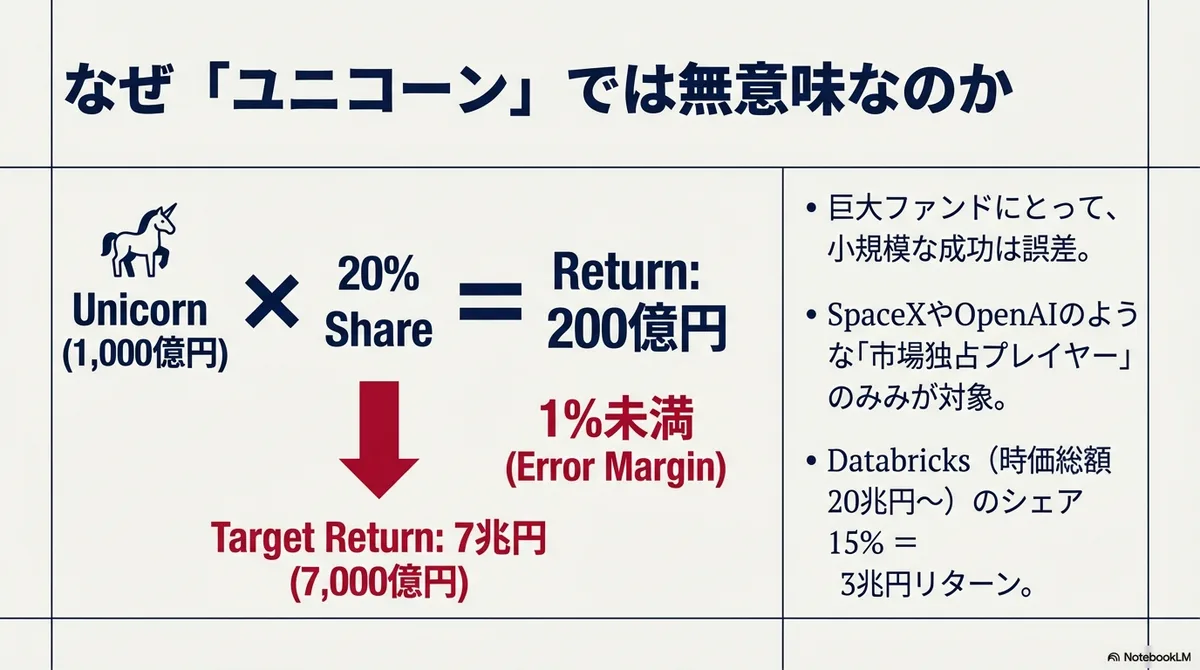
For funds of this size, it makes almost no difference how many unicorns or decacorns they produce. Even owning 20% of a ¥100 billion company is only ¥20 billion, which is less than 1% of the return the fund requires.
Adding these together, the American startup ecosystem as a whole has committed to delivering returns of more than ¥10 trillion, which means it is attempting to produce many ¥100 trillion startups.
In the United States, too, there is always the criticism that "VC fund sizes are too large." But a16z is actively investing in SpaceX, OpenAI, and Databricks. In the case of Databricks in particular, said to be valued at ¥20 trillion at present, there are even accounts from people involved that assume a16z maintains a share of around 15%, which would mean a16z may be able to deliver a return of nearly ¥3 trillion.
Moreover, because a16z's past funds have in fact generated returns, it is beginning to be persuasive that this is not impossible.
🌎 This Is Not "Another Country's Business That Doesn't Concern Us" but "a World We Are Connected To"
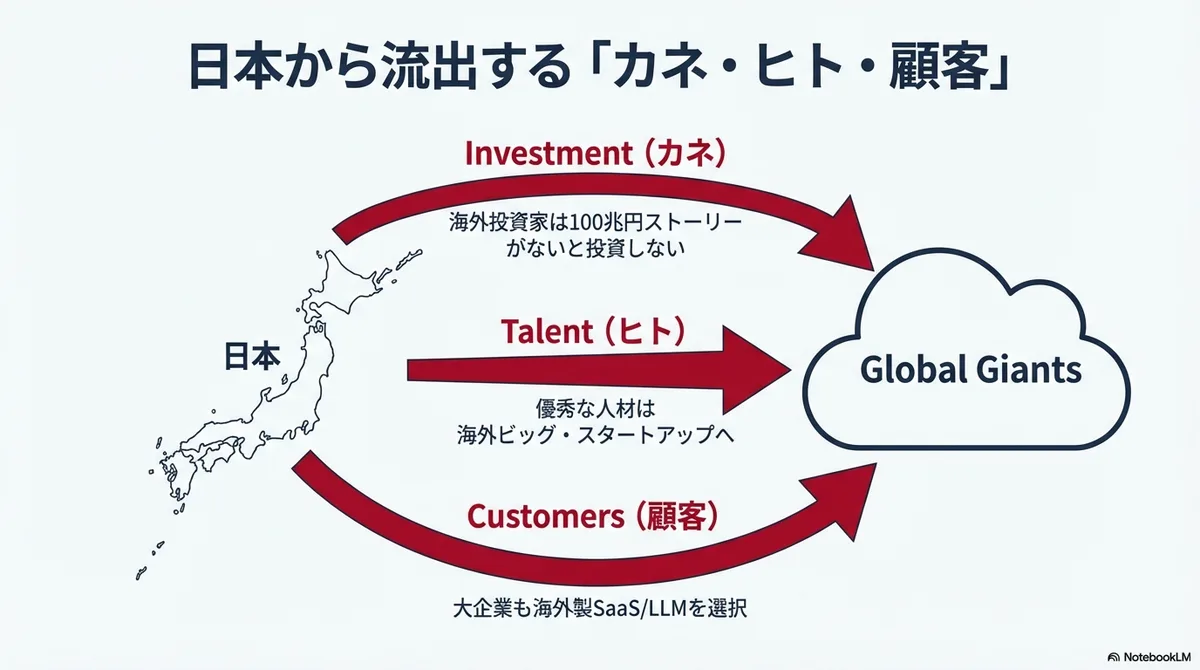
This is not "something happening across the river." I think a "hollowing out of investment" like the following could also occur in Japan.
(1) The expectations of overseas investors rise
First, in Japan's startup ecosystem, there is a constant argument that there are not enough providers of middle- and late-stage funding and that we want to draw in money from overseas investors.
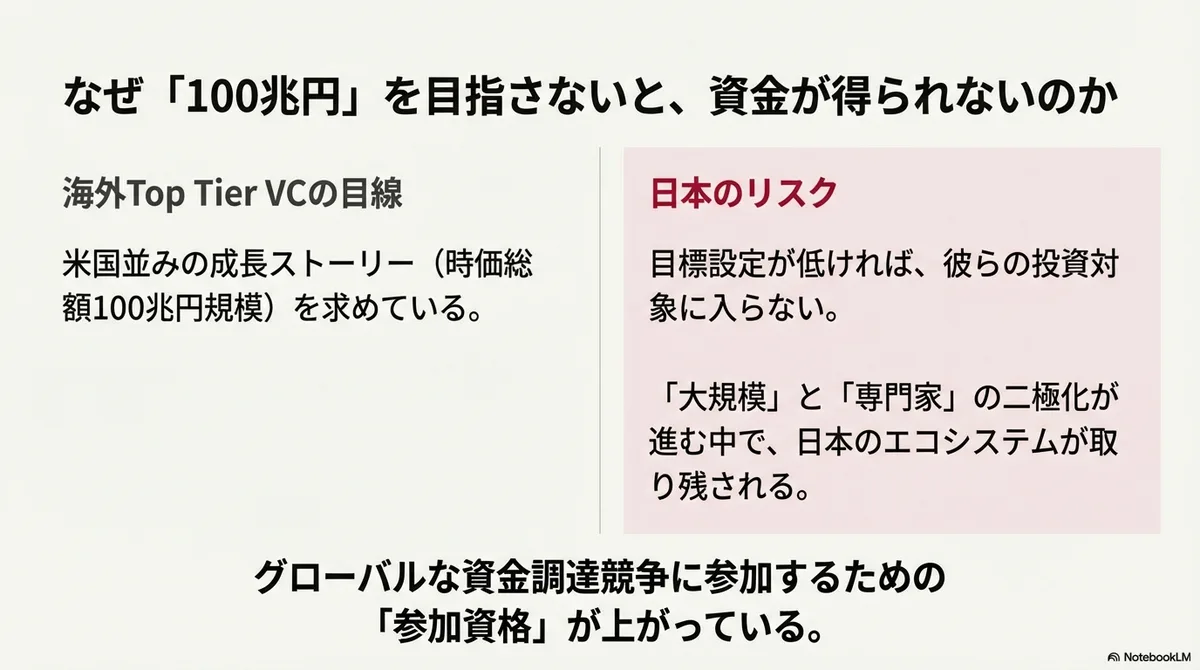
In that situation, if you try to receive investment from a top-tier overseas VC, they will demand a market capitalization on the scale of ¥100 trillion, and growth rates and a story on par with the United States, as described above. In other words, unless you set your goals with that sense of scale, you cannot receive their investment. (Of course, overseas VCs and IPOs come in various sizes, and this is not necessarily the case.)
There is also an argument that overseas VCs are increasingly polarizing into "large-scale" and "specialist" firms (though with a bit of a16z talking its own book).
Unless we keep up with such trends, I think it will become difficult for Japan's startup ecosystem to attract overseas capital.
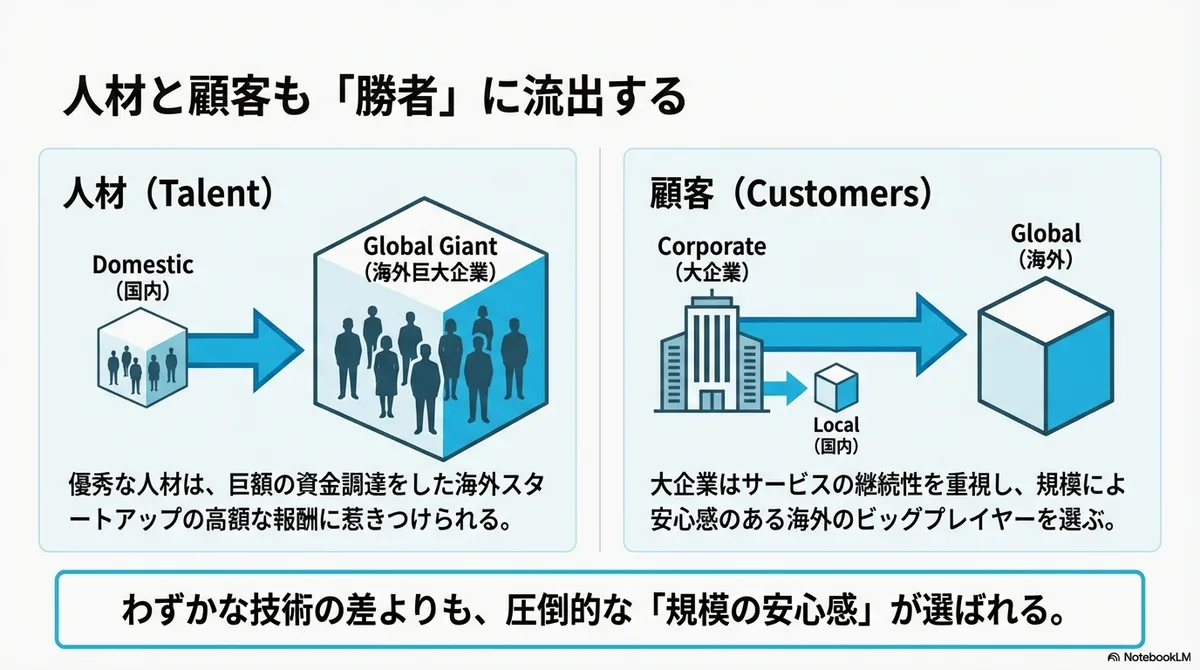
(2) Talent and customers are taken by overseas startups
Startups that raise large amounts of funding will probably keep appearing from now on. The going rate for compensation of excellent talent will also rise. Then Japan's excellent talent will flow steadily to big startups that have raised huge sums overseas.
Not only that, but the attention of large companies, which are the customers, will also turn to the global scene. This is because a startup's strength or success directly affects the continuity of the service. However excellent the technology of a small startup is, if the difference is slight, the reassurance of scale will likely be a favorable factor in a company's internal approval process.
Of course, there may be barriers such as business practices and language, but as the automatic adaptation of UIs, which is becoming possible with the development of LLMs and so on, advances, I think the barriers will become lower than before.
In fact, with LLMs, unlike SaaS, I think there are more and more cases of directly using services from overseas companies rather than using Japanese services.
(3) Investment in overseas startups by Japanese companies and Japanese funds advances
Furthermore, I think there is a possibility that an environment that makes it easier to invest in overseas startups will accelerate. For example, due to factors such as the following.
- Investment opportunities (and capital) are becoming concentrated in the US - Crunchbase reports that VC investment in US companies rose from 56% of the global total in 2024 to 64% in 2025. This is a large increase from 2019 to 2023, when the US share was around 47%.
- The overseas share of sales is rising for Japanese companies that act as LPs - At present, many large Japanese companies earn about half of their sales overseas, and as a result foreign-currency funds tend to accumulate at overseas subsidiaries, making it easier to commit to startup investments and LP investments denominated in foreign currency (though this is not necessarily always the case).
- Companies have no need to stick to Japanese startups or VCs - Particularly in deep tech, large companies often invest in non-Japanese startups. It is also said that this is because, when startups around the world are lined up on equal terms, Japanese startups are few and too small to enter the pool of investment targets.
- The difference between the performance of Japanese VCs as a whole and that of the US - In the US, too, there is an argument that "fund sizes are too large," but in areas such as AI and space, ultra-large winning paths are becoming easier to see, and as a result the VC vehicle is easier to justify (capital gathers, and then deals gather too).
These topics were also discussed in the recent Repeat Rhyme episode "Predictions for the 2026 VC and Startup Industry Trends, and a Review of the 2024 Predictions #182," and I think we have to think about how Japan will take in precisely these changes.
⏰ "Region-by-Region Industries" and "Time Machine Management" Are Becoming Difficult
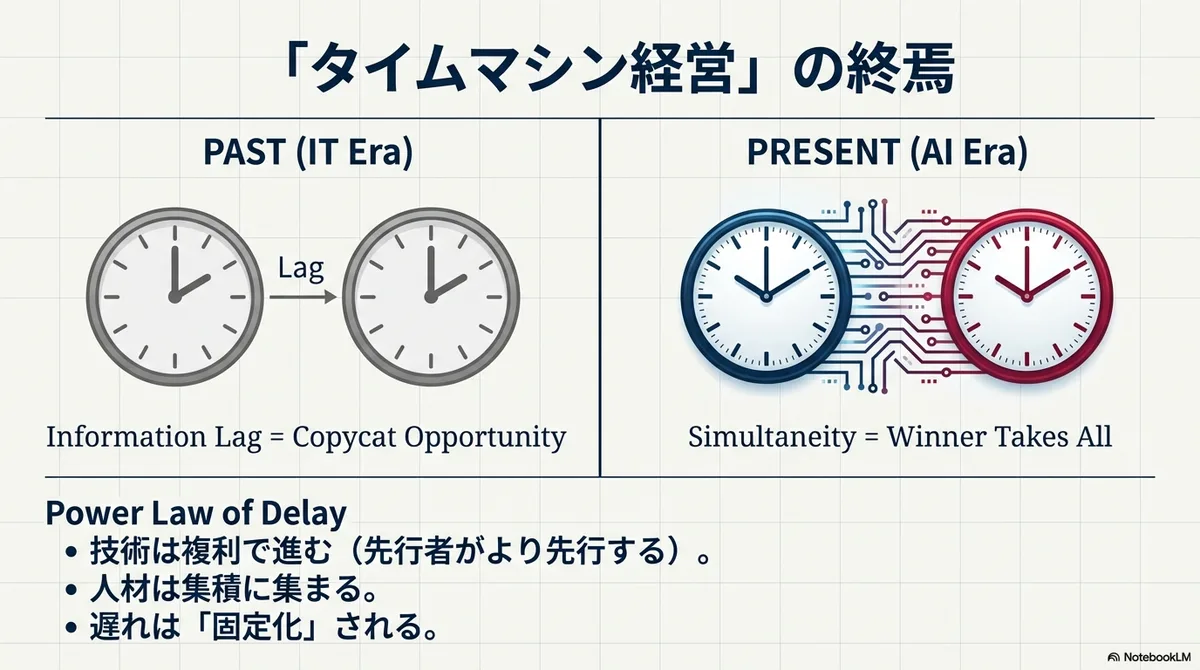
In the past, for each invention there was time for industries to emerge in each country. For example, each of the developed countries has its own representative car company.
The reason so-called time machine management was possible in the IT era was also that there were "time lags" and "barriers to entry."
But in a world where people, goods, money, and information are more tightly connected globally, an invention born in one country spreads across the world in a short time. As a result, resources tend to gather in one place, the time lag that makes time machine management possible grows shorter, and capital also consolidates in the leading country, so I think it will become harder to do.
For example, companies building AI frontier models, starting with OpenAI, come almost exclusively from the US and China (there is also France's Mistral, but in business terms it seems to have fallen somewhat behind).
As for language and regulation, which used to be barriers to entry, those barriers may also gradually come down thanks to AI and the like. (Because when development costs fall, responding to each country's regulations also becomes easier.)
This is a structural problem like the following.
- Technology and platforms advance by compounding (the leader gets further ahead)
- Talent gathers where there is a concentration (strong teams attract even stronger teams)
- Capital concentrates in the winners (capital gathers even more where the winners are)
In other words, the problem is not simply "falling behind" but "the delay becoming fixed" when viewed on a global scale, and in specific industries, a country-level power law may be more likely to operate.
Therefore, what matters is what kind of move we make before that gap becomes fixed, and how we design a path to winning before the window of opportunity closes.
🗾 Why Japan?
Wealth moves easily and tends to be unevenly distributed.
This used to be discussed mainly in terms of domestic matters, but recently it seems to be happening on a global scale as well. It is a worldwide Winner Takes All.
In the past, each country had checks such as antitrust laws, but these were mainly meant to promote healthy competition within the country.
Today, multiple frictions between nations have arisen, and a sense of crisis is emerging that excessively prohibiting monopolies by domestic companies would mean losing to competition from other countries. Given that, it seems that checks on monopolies are becoming somewhat less effective both at home and abroad, and it is even possible that if a monopoly arises domestically and its business resonates well with other countries, the nation will support it.
(That said, the rapid catch-up of China to the United States has paused for now, and the ratio of China to the US in nominal GDP peaked at about 78% in 2021, then fell from 2022 onward to about 65% in 2024, so the situation may change again...)
Until now, startups have often been asked "Why Japan," and VCs have also often been asked "Why Japan." In addition, recently, as Japanese LPs flatten their investment destinations globally, it also means that "Why Japan" is being asked anew of Japan as a whole.
(Of course, they will probably continue to allocate a portion to Japan and Asia as a risk hedge... But that is not a very positive reason.)
The Answer "Japan, Because It Has Growth Industries"
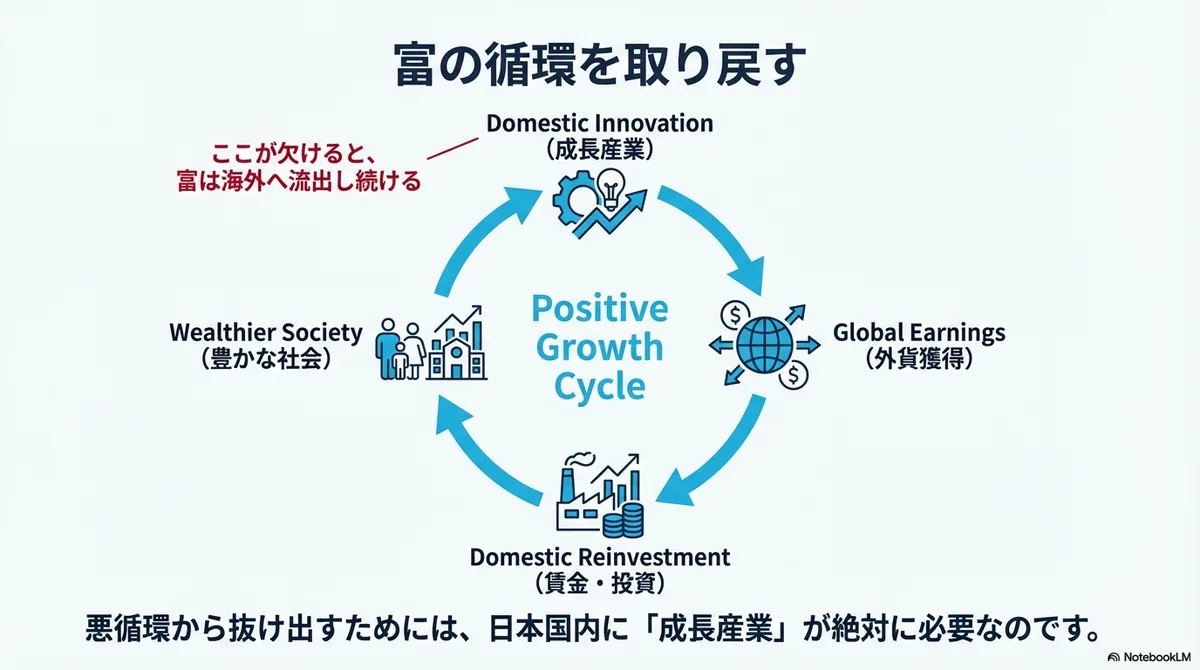
In fact, it has often been pointed out recently that many companies, including Japanese ones, regard Japan as "hard to grow in, given its population and so on," and since there are no investment targets in Japan, money earned overseas is not coming back as yen.
This, too, is happening because we have not been able to answer "Why Japan" well.
In connection with President Trump's tariffs as well, Japan has committed to ¥80 trillion in public and private investment in the United States, but even if Japanese companies profit in the United States as a result of that investment, that money will likely be used for investment circulating within the United States.
That creates pressure for a weaker yen, which puts import-dependent Japan in a difficult position and further erodes its growth potential.
To escape such a vicious cycle, Japan needs growth industries and growing companies.
I think we need to build a society in which a circulation of wealth occurs: that draws in investment from overseas, produces results through that investment, directs the results into wages to raise real wages, makes more people prosperous, stimulates consumption, and increases domestic demand and then investment.
That is why I think those of us in Japan, too, need many more people to think and envision things like "How do we build a ¥100 trillion startup?"
💯 What Kind of Scale Is ¥100 Trillion?
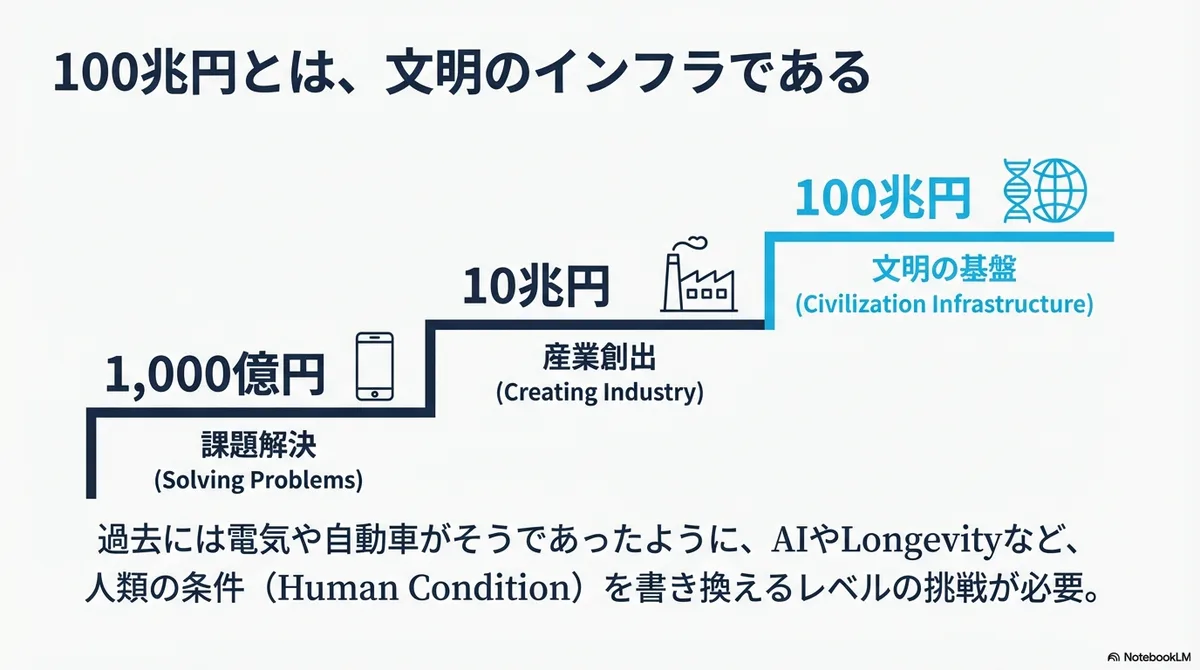
How large is a market capitalization of ¥100 trillion? As I mentioned earlier, the largest company in Japan by market capitalization is Toyota, at close to ¥50 trillion now. Excluding financials, Toyota + Sony + Hitachi comes to ¥100 trillion.
In the auto industry, Tesla alone has already exceeded ¥100 trillion, while the companies that follow, Toyota, BYD, GM, and Mercedes-Benz, only just reach ¥100 trillion when combined.
In terms of profit, a market capitalization of ¥100 trillion means a profit of ¥2 trillion at a P/E of 50, or ¥4 trillion at a P/E of 25. When you consider the number of customers, the revenue per customer, the gross margin, and so on needed for that, you can see that it is quite difficult.
"Market capitalization = social impact" is not an equation, but at the same time, the power to gather capital, create jobs, move supply chains and standards, and change industrial structures is, after all, strongly tied to market capitalization (or the market expectations equivalent to it).
My impression is that for every order of magnitude that market capitalization rises, the scale of a company is something like this:
- ¥100 billion - Solves a considerably large problem for domestic society or existing companies
- ¥1 trillion - Solves a major problem of the world
- ¥10 trillion - Builds a domestic-scale industry or infrastructure
- ¥100 trillion - Builds world-scale infrastructure of human civilization
To achieve ¥10 trillion or more, I think you need a "business where compounding works (where a power law operates)" and "something that greatly shakes the foundations of existing society."
Recently, in AI and longevity, and in the past with electricity and cars, these are probably fields that need the realization of ideas that, while having aspects that provoke debate and even threaten humanity, greatly improve the world.
In a sense, what we should aim for may be beyond the Moon, to Mars, or even Jupiter. That is, it cannot be achieved without aiming beyond the moonshot toward the Moon, at the Mars shot that SpaceX is aiming for, and the Jupiter shot beyond it.
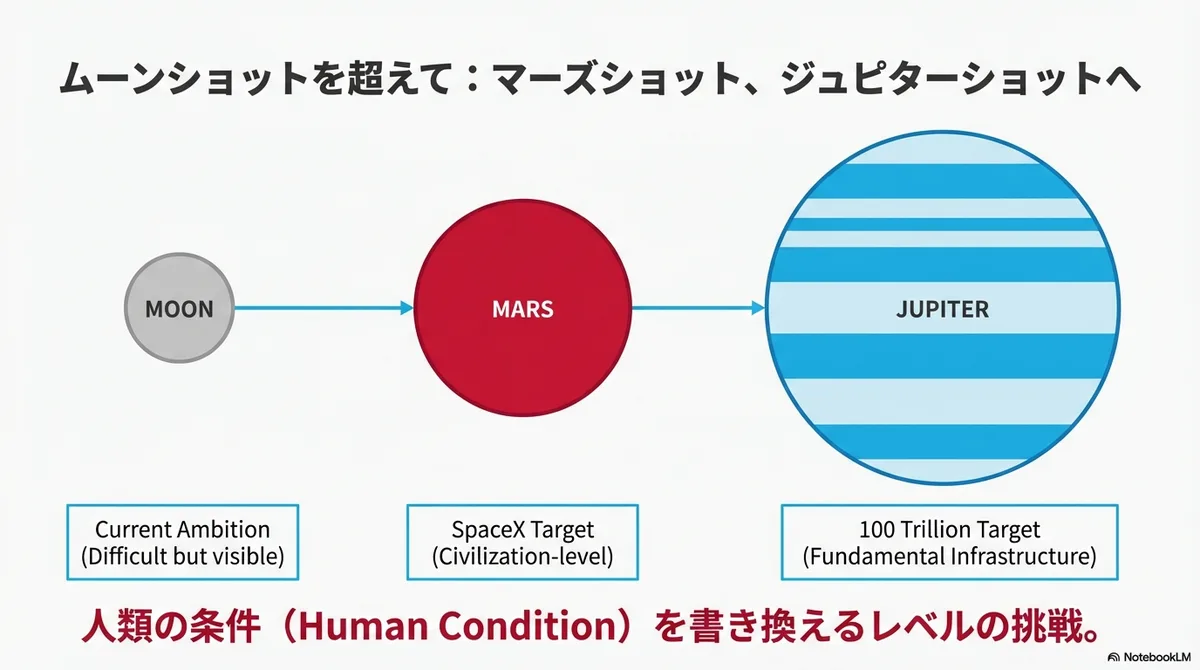
(That said, I also think that pushing this line of thought can easily lead to a bad accelerationist conclusion, and I think we need to be careful about that.)
Contributions to the Nation by ¥100 Trillion Companies
Creating companies of this scale becomes the foundation of a country's next industries.
Not only that, but as mentioned above, it can also be a trigger for drawing investment into Japan, which I think will lead to wages as well.
Investment returns themselves can be earned overseas too, but little remains in the country and the structure greatly benefits capitalists, so in order to spread the breadth of the benefits across Japanese society as a whole, we have to think about how to build these companies domestically.
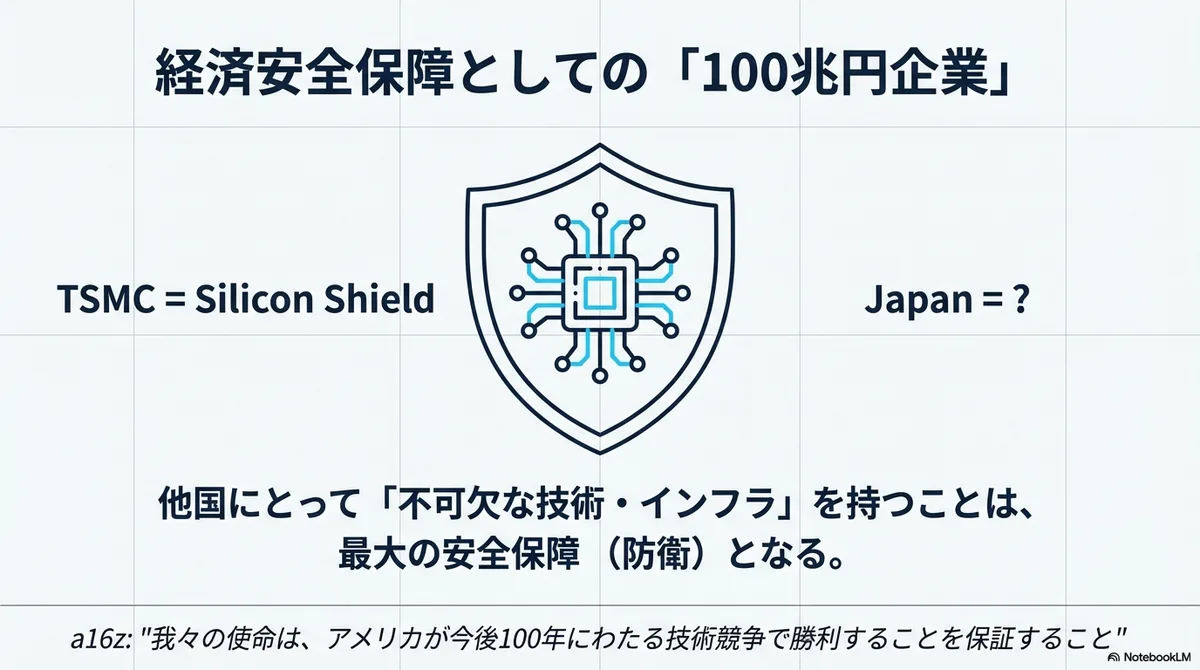
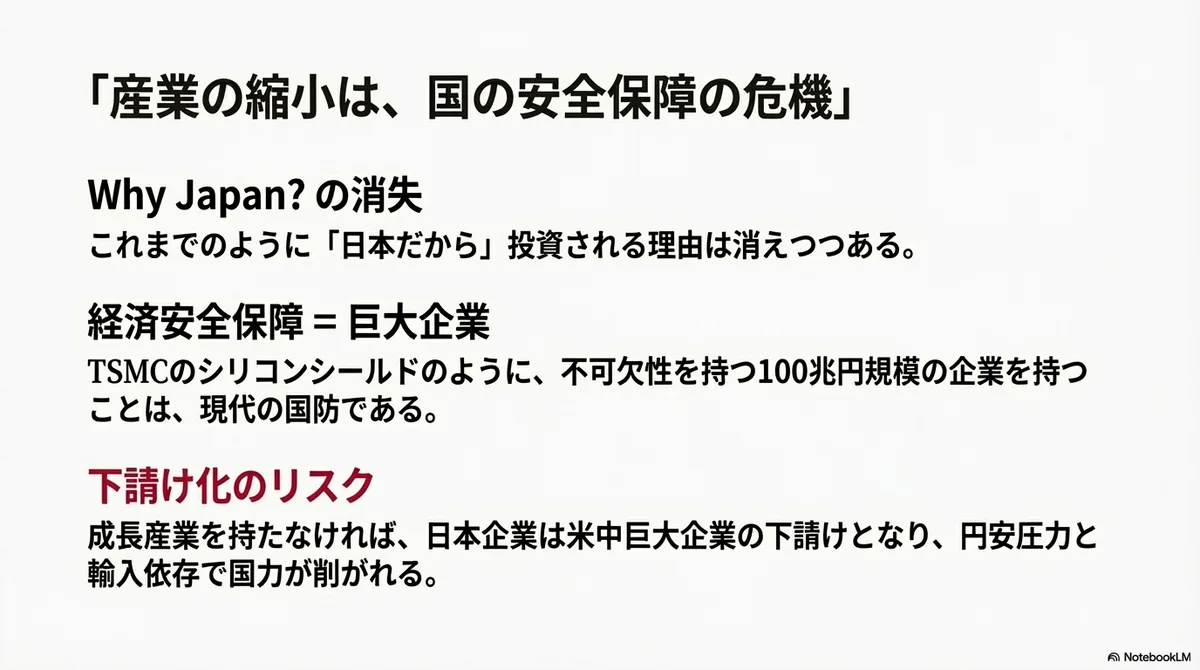
Companies and industries of this scale also contribute to a country's security.
For example, there is a theory that the deterrence of a Chinese invasion of Taiwan has a certain effect through the "silicon shield" provided by TSMC and others (TSMC's market capitalization is about ¥250 trillion), and how we can build, at large scale, companies with technological and business indispensability unique to Japan seems important from the viewpoint of economic security and traditional security (defense) as well.
EU countries are connected by land, and it seems they have an incentive to cooperate, but because Japan is an island nation, the incentive for such cooperation is not as high, which is exactly why how we can build a Japan that is needed by the United States and other countries depends greatly on economic activity.
In the article about the ¥2.3 trillion fund that a16z created, they state, "Our mission is to ensure that America wins the technology competition over the next 100 years." It is, so to speak, a declaration of intent to enter the contest for technological supremacy from the startup side and contribute to it.
If it is with that level of resolve that great expectations gather and great resources gather, then it seems we are being asked whether Japan's startup ecosystem can also have that kind of resolve.
❓ Without a Question, No Answer ❗ Will Come
Personally, my sense of crisis has grown since the time of the "Beginning of the End" article I wrote two years ago. That article stayed mainly within domestic matters, but now, with Japan's international standing wavering, we are in a situation where we have to build businesses on a new scale.
Of course, as explained in the article on supply capacity, startups that make the maintenance of Japanese society more efficient are also important. I also believe that we can produce large startups by solving world-scale problems such as climate change.
On the other hand, I think that startups that create next-generation new industries are also important for making Japanese society prosperous.
The scale at which we create those new industries probably has to aim not for ¥1 trillion but for ¥10 trillion and ¥100 trillion.
In the article "Let's Get Past the Trough of Disillusionment for Startups," I wrote about the importance of building big visions, and right now I feel a sense of crisis that unless we go beyond "how to create unicorn companies" and "how to create decacorn companies" and think about "how to create ¥100 trillion companies," Japan may not be able to secure a certain position in the global market.
Of course, it will be difficult to achieve.
But without a question, no answer will come.
This, however, should be a challenge for the United States too.
In a sense, rather than "the beginning of the end," it could even be called the starting gun of a new race. We have to decide whether to start running in response to that gun or to run a different race.
Of course, there is also the option of not participating, but as long as markets around the world remain connected, I think we should take some kind of stance.
One of those stances is to participate in the race in some form. That is why I think we should ask the question "How do we build a ¥100 trillion startup?" much more often.
Because Cases Have Appeared, We Should Be Able to Think About It
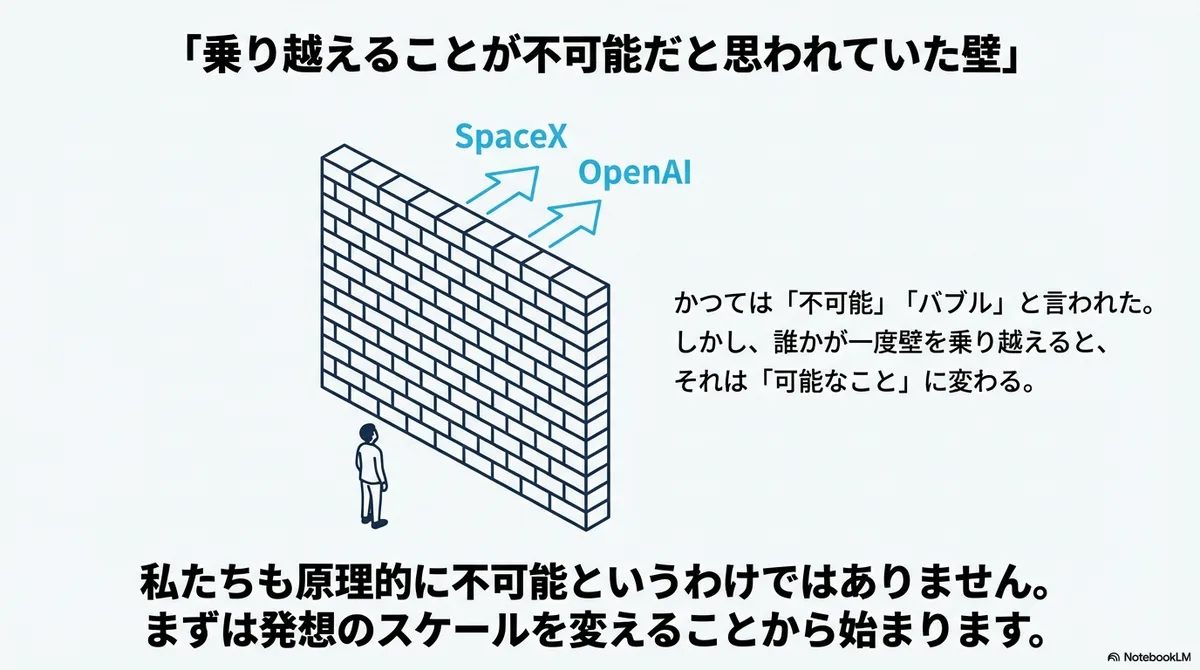
There is hope.
It is the fact that OpenAI and others achieved that scale in ten years.
Even if OpenAI's valuation itself were a product of an AI bubble, SpaceX has achieved that scale.
In sports, careers, and elsewhere, there are "walls once thought impossible to overcome," but once someone overcomes one, people follow one after another and overcome that wall.
It is not that it is impossible in principle for us either. We should be able to come up with that idea too.
That is why increasing the number of times the question "How do we build a ¥100 trillion startup?" is asked across Japan as a whole seems to be the first trial, the first step.
An Example Hypothesis: A Focused Research Organization for Humanity's Problems
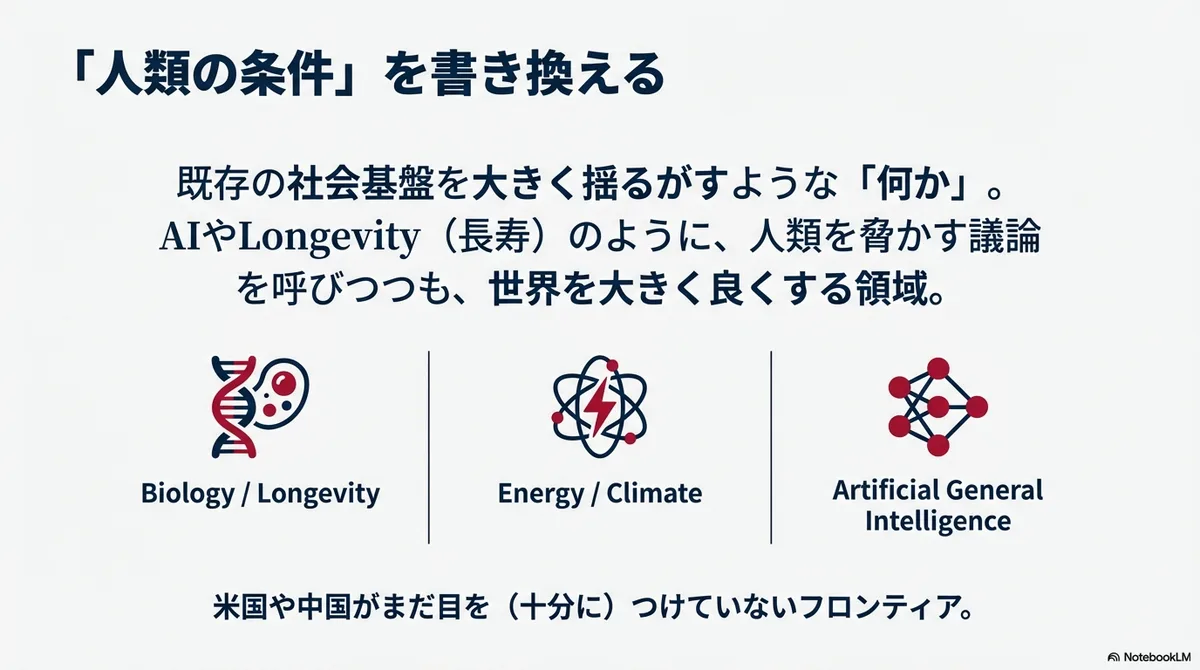
I think merely raising the problem is not enough, so I will also present one hypothesis of my own.
First, if we compete head-on, we cannot hold our own in front of large capital, so we will need to avoid fighting on the same ground as far as possible and take a strategic approach. If possible, it is desirable to be investing ahead of others in areas that the US and China have not set their eyes on.
When it comes to ¥100 trillion, something that brings quite fundamental change is needed.
What I think is needed then is to tackle research challenges that can cause fundamental change.
In fact, OpenAI, which is currently the talk of the town, was founded in 2015 as a nonprofit research institute. It has now become a company worth more than ¥100 trillion.
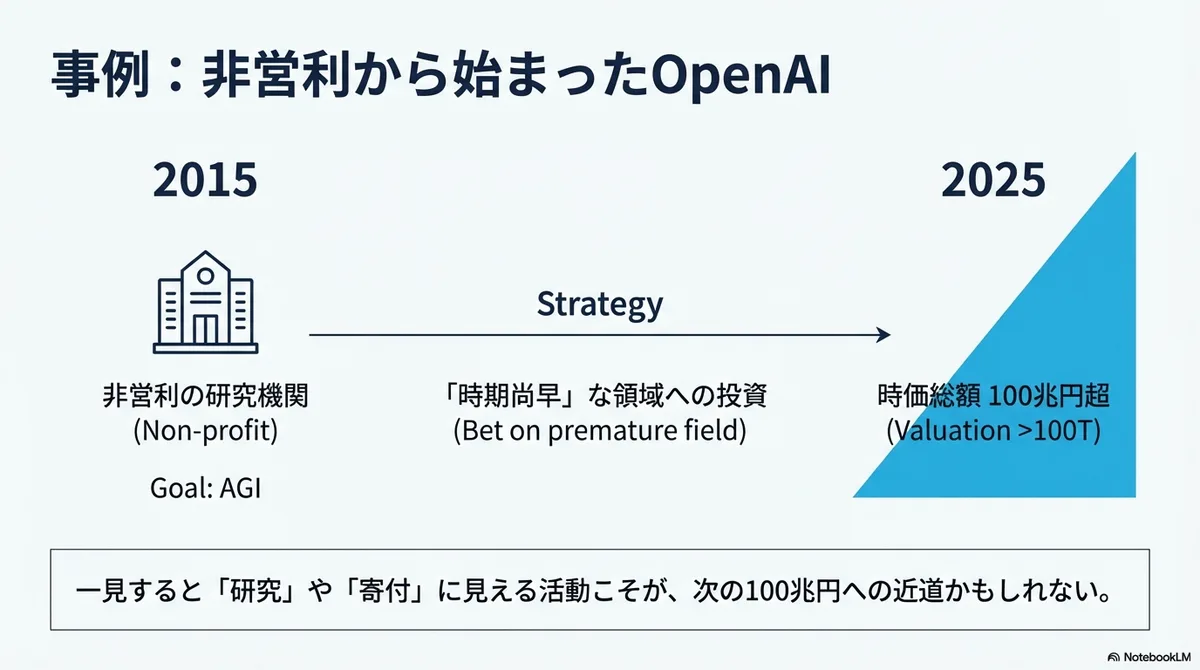
What we must be careful about is that, while it is true that the foundation "starts from research," I think it started from "a world-changing choice of theme." My hypothesis for now is that research that would turn human society upside down is what matters, like AGI for OpenAI and migration to Mars for SpaceX.
To that end, the bet is to use a mechanism like a Focused Research Organization (one closer in character to the NSF's Tech Labs Initiative), set themes that could bring about major change, create ten FROs, and hope that one in ten hits big.
Looking back, OpenAI and others also started out as something like an FRO. I think that kind of challenge is necessary.
Betting on humanoids, which are the talk of the town lately, would be too late. We need to choose an area like AGI in 2015, where signs are visible but it is thought to be too early.
For example, it might be an OS for biomanufacturing, or an artificial womb that changes society by changing how people give birth and raise children. Promoting research in areas that greatly change human life with specific goals is, I think, one possible idea.
Summary
I have taken another look at the scale at which we need to think when we talk about next-generation industries.
Of course, we also need to think about returning the returns on startup investment first, and there are people currently taking on the challenge of startups, so I do not think everyone should be this way.
But even if only a few, I think we need people who plan something at this kind of scale.
While continuing to hold my personal concerns to date, I myself would like to keep asking "How do we build a ¥100 trillion startup from Japan, from our generation?," exchange that question with many people, and build hypotheses.