Raising the Momentum of Japan's Startup Ecosystem: On Articulating Philosophy and Themes
This article was machine-translated from Japanese by AI (Claude). It may contain errors. Read the original Japanese article.

Recently I have heard, one after another, people say that "the momentum of Japan's startup ecosystem may be declining."
I feel that way myself to some extent. For example, looking at Initial's report, funding amounts have flattened, and even if there is no bad news, it is hard to say that the ecosystem as a whole is growing. The number of companies raising funds is also gradually declining.
Looking at Google Trends, "startup" is flat, while "starting a business" seems to have been gradually declining since 2023.
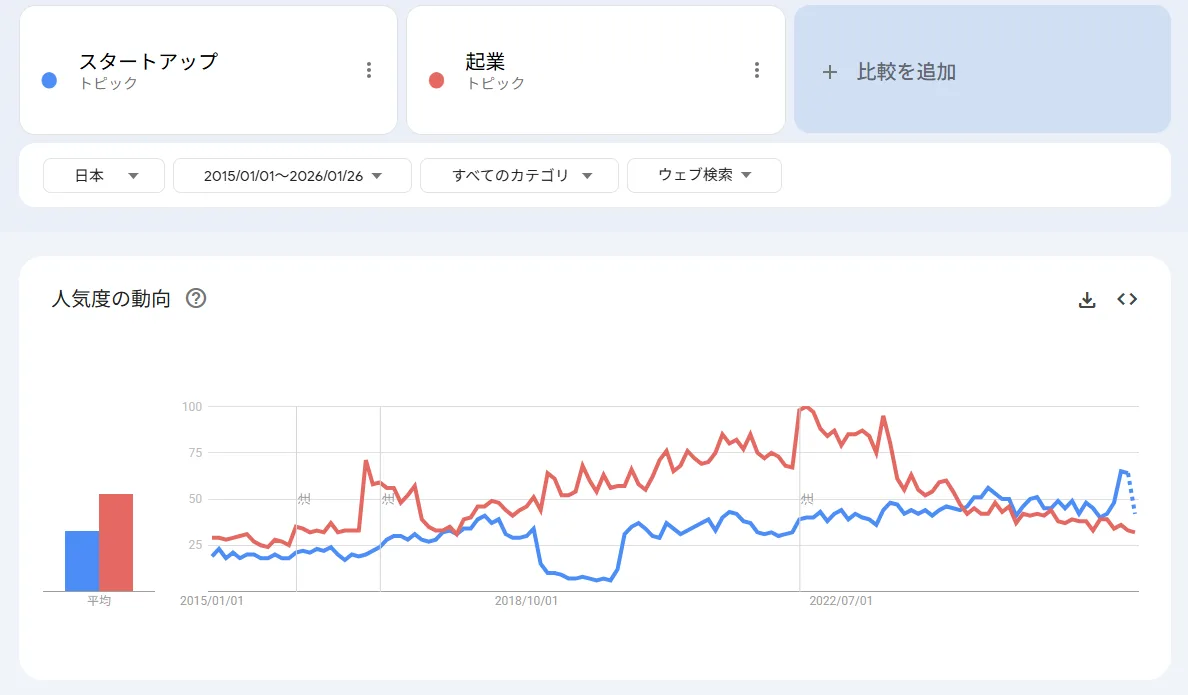
Google Trends (https://trends.google.co.jp/trends?geo=JP&hl=ja)
I think this mood and sense is shared in some quarters, and that somewhat negative remarks can be seen on social media and elsewhere.
Still, being pessimistic or cynical will not change the situation. What we should think about is how to act after taking a clear look at the current state of things.
In a sense, this may be a time when the whole ecosystem has to do what a company should do when its momentum starts to fall.
Articulating Philosophy and Themes
To raise momentum, I think the most effective things are, in the short term, for the startups now taking on challenges to succeed and create wins, and, in the medium to long term, to create big successes. For that, it will probably be necessary to make the startup ecosystem more efficient.
But I think there is one more thing that can be done in the short term.
One of them is for the people involved in the ecosystem to do more of the following:
- Communicate concretely the themes ahead and the paths to winning
- Talk about their philosophy and the future
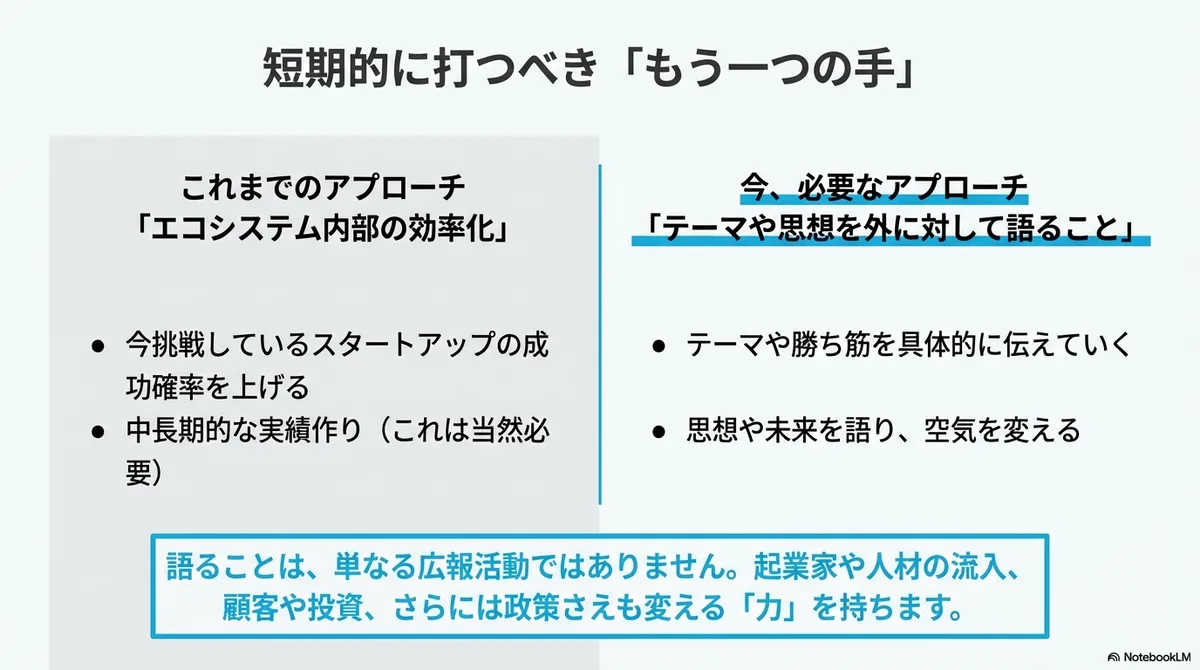
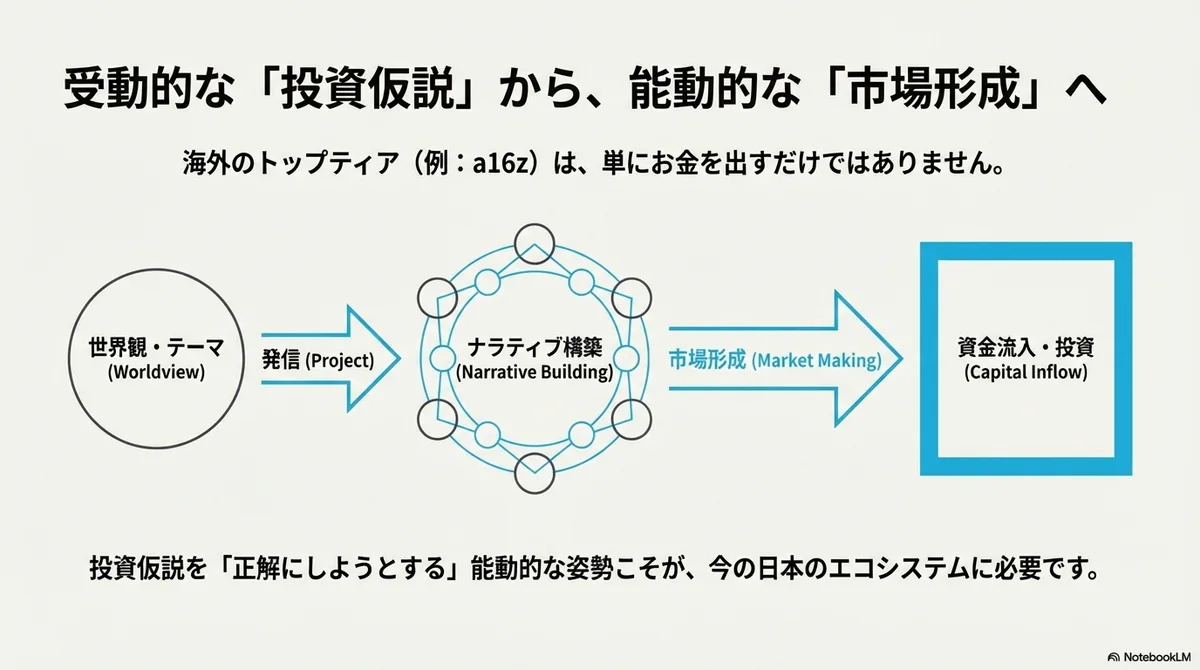
Indeed, looking abroad, firms such as a16z and Lux Capital (whatever one thinks of them) do not merely present their investment theses; they put forward their own worldview and themes, and point to where the next theme lies.
Articulating a worldview like this does more than change the atmosphere. It also influences the inflow of entrepreneurs and talent, and it has the power to change customers and policy. Moreover, if such a shared understanding can be created, it can draw in capital other than one's own, which you could even call, in a sense, "forming a market."
Not only holding an investment thesis but also working to make that thesis turn out right seems to me very instructive for Japan's ecosystem.
Creating Themes for Each Scale One Aims For
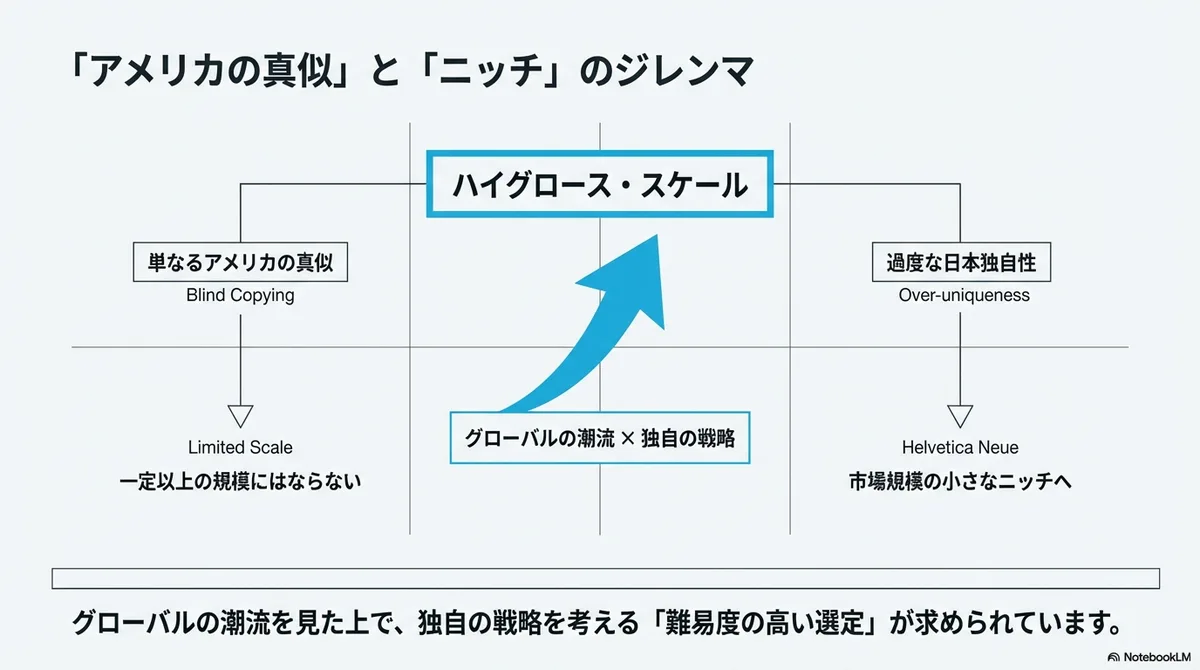
In particular, I think it is gradually becoming shared recently that "just doing time-machine management of the United States will not grow a company beyond a certain scale."
That means that, if one aims for a scale beyond a certain level, one has to think in a way that is a step harder than before, such as:
- Start in the United States from the beginning and take on the challenge as an American startup
- Start in Japan, but look not only at trends among American startups but at global movements as a whole, and then think through a strategy for Japanese startups as a whole that is uniquely Japanese
However, we need to be careful that if we simply chase "winning" or uniqueness such as "only in Japan," we easily end up in a small-market niche. A high-growth startup has to aim for a certain scale, and I think choosing a strategy and theme for that is quite a difficult path.
The other day, I wrote an article about the 100 trillion yen startup.
I certainly do not think that is the only goal. In a sense, I think it would be healthy to have several themes as a portfolio, one for each order of magnitude of market capitalization. For example, as in the table below (this is only an example).
Order of market capitalization | Theme |
100 trillion yen | The next foundation |
10 trillion yen | The next international order, the next Japanese industry |
1 trillion yen | Global, XX security, and so on |
100 billion yen | Each domestic domain |
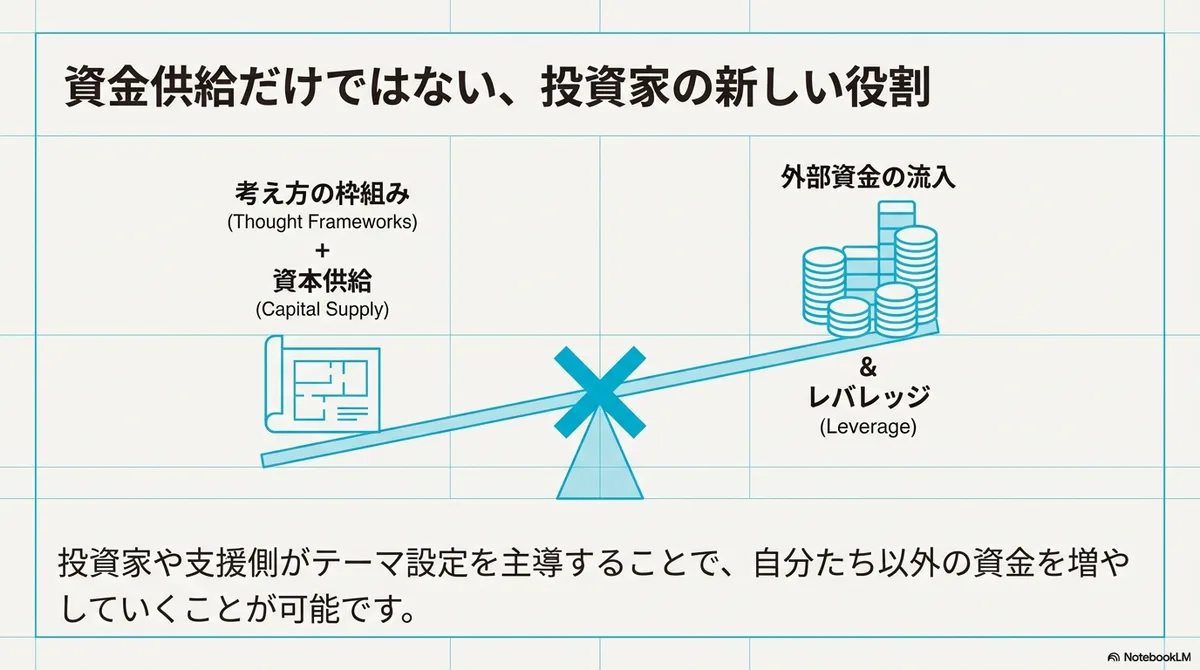
I think it will probably be investors who take the lead in putting forward such philosophies and themes, or in reframing and communicating the cutting-edge movements of startups that already exist.
Entrepreneurs on the front line probably do not have the time for this, and I think investors, who have a broad view, are better suited to it. Beyond supplying capital as investors, they will probably need more of the leverage that comes from supplying frameworks of thinking and thereby increasing funds other than their own.
Gaining Understanding from the Outside
Articulating such themes and philosophies is also, at the same time, communication to those outside the ecosystem.
Judging especially from recent developments, I think we also need to appeal anew for the position and role of startups within Japanese society.
In the past few years, startups were placed at the center of the growth strategies of the Japanese government and local governments. Even before that, large companies had been paying attention through open innovation and the like.
In that atmosphere, the ecosystem as a whole had very great momentum, so for a long time there was little need to explain why startups matter.
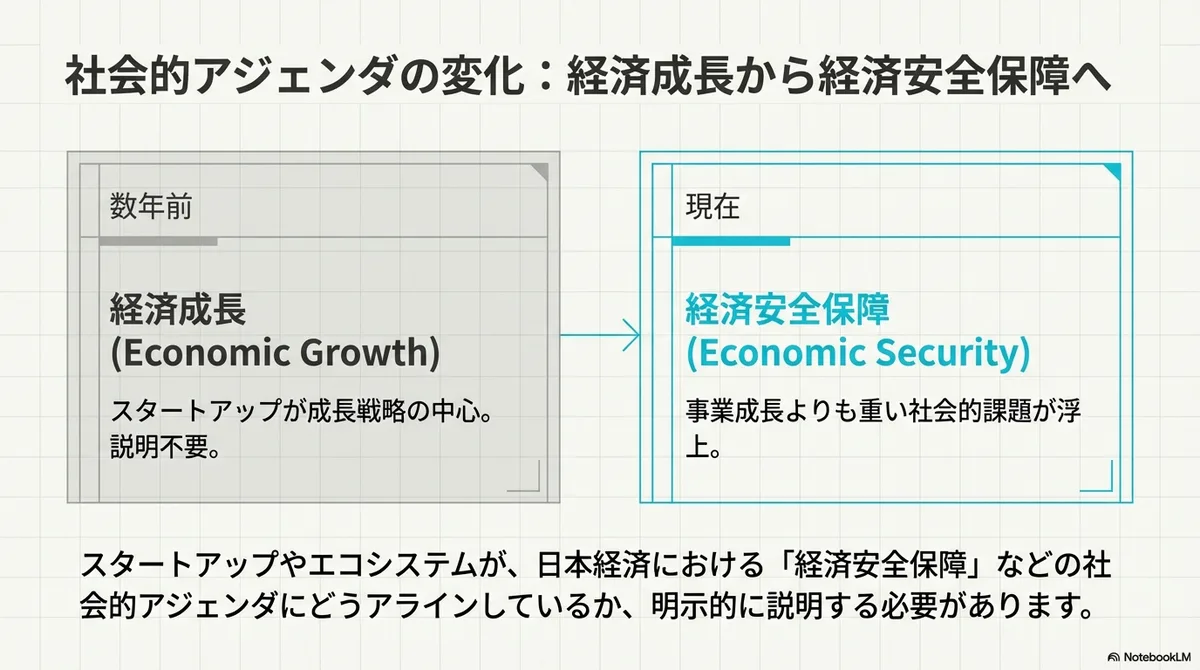
However, now that governments and companies are increasingly giving priority to issues such as "economic security" over "business growth" and "economic growth," I feel that the need has arisen anew to explain clearly what value startups and their ecosystem have in the Japanese economy, or to align explicitly with today's social agenda.
Looking also at the attitudes of people working at companies, and especially students' attitudes toward job hunting, Mynavi's survey on job-hunting attitudes shows that "stable companies" have become more favored over the past 10 years, and that the figure has risen further over the past 5 years.
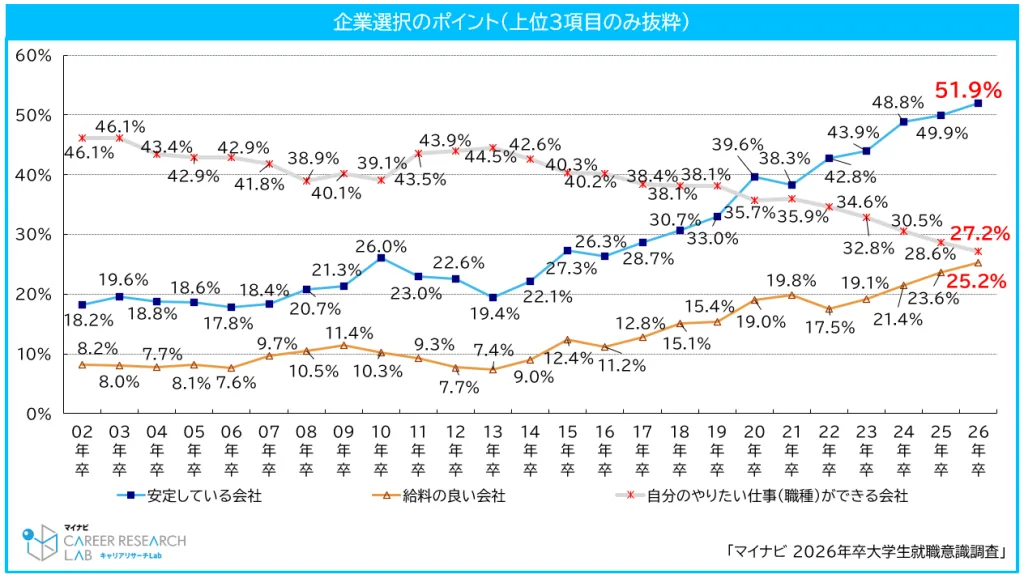
Although Recruit and Dentsu's survey show that stability is emphasized, "work I want to do" still ranks near the top, so I suspect the situation is probably that:
- "Work I want to do" is emphasized at the final stage of decision-making
- But it recedes when multiple criteria are compared
Going forward, it is quite conceivable that rising prices and the instability of real purchasing power will raise the importance of minimum hygiene factors and strengthen the tendency to prioritize pay over satisfaction. Salary levels at startups are also rising, but since they are not necessarily stable over the medium to long term, messages aimed at such employees will become more necessary.
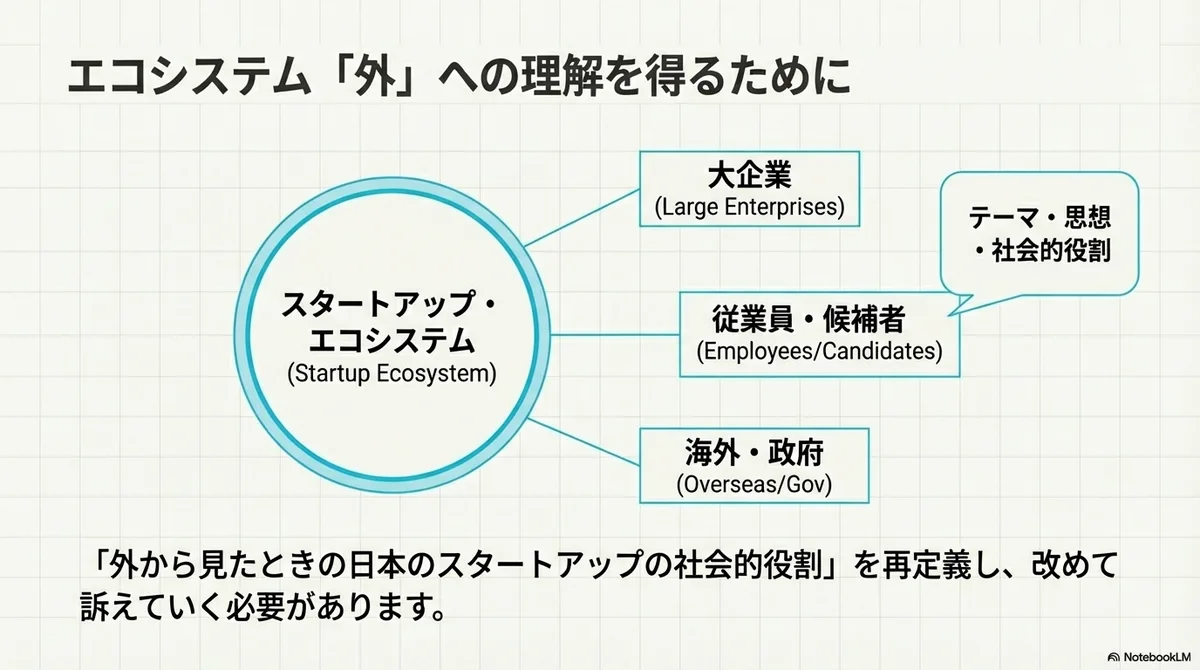
In that sense as well, I think what is called for is to redefine and communicate the value and social role of Japanese startups as seen from the outside, such as:
- The value of startups as seen by large companies
- The value of startups as seen by employees and job changers
- And further, the value of Japanese startups as seen from other countries abroad
Summary
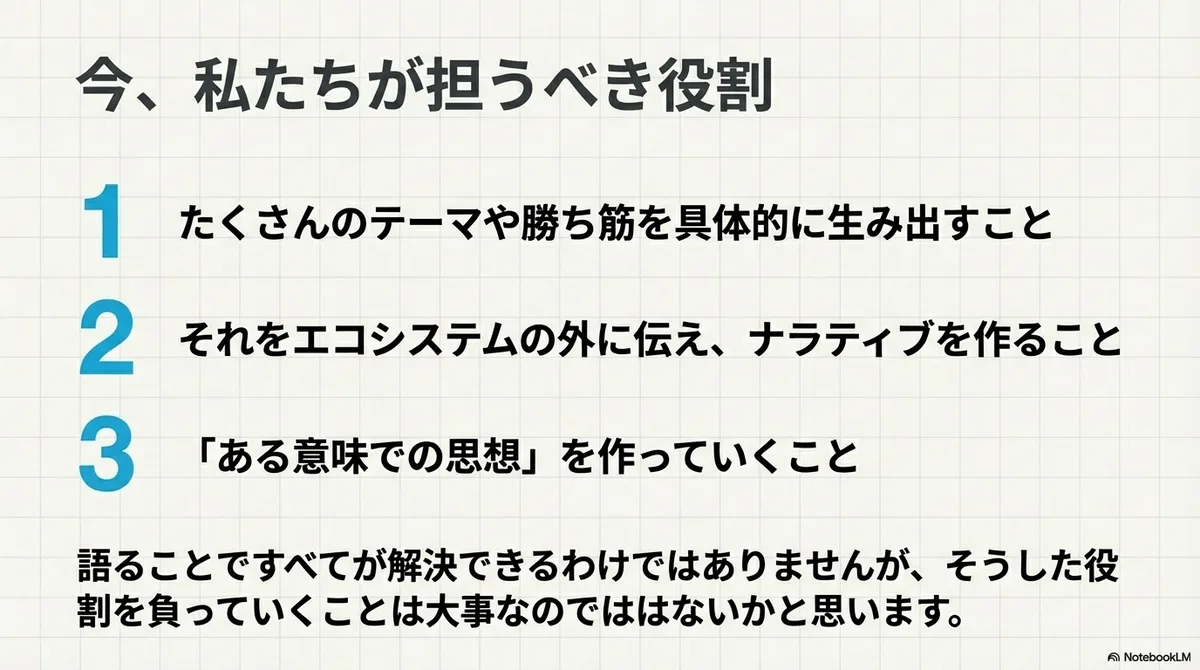
Momentum can fall in anything. Problems are bound to arise as we push something forward. Still, if there is a problem, we only need to solve it, and I hope we can properly grasp the problem and take action.
As part of that, I think there is a lot we can do: having many startup themes, ideas, and paths to winning emerge one after another, communicating them to the outside, and communicating the future. In a sense, that is also creating a philosophy.
Of course, talking cannot solve everything, and it is fine if only some people do it. Even so, I think it would be good to see a bit more of that kind of communication.
Besides, the occupations in which one can think about such a future are limited. Being involved in startups, I also think, is a good position from which one can talk about such a future and such ideals.
Of course, for investors and the supporting side, the job is to produce financial returns. Even so, if one were seeking only financial returns, it would probably be more rational to take a different finance job, and many people must have placed themselves in the startup industry precisely because they felt that was not the path.
If the meaning lies in the future and in ideals, then personally I think that right now is precisely an opportunity for that kind of communication.