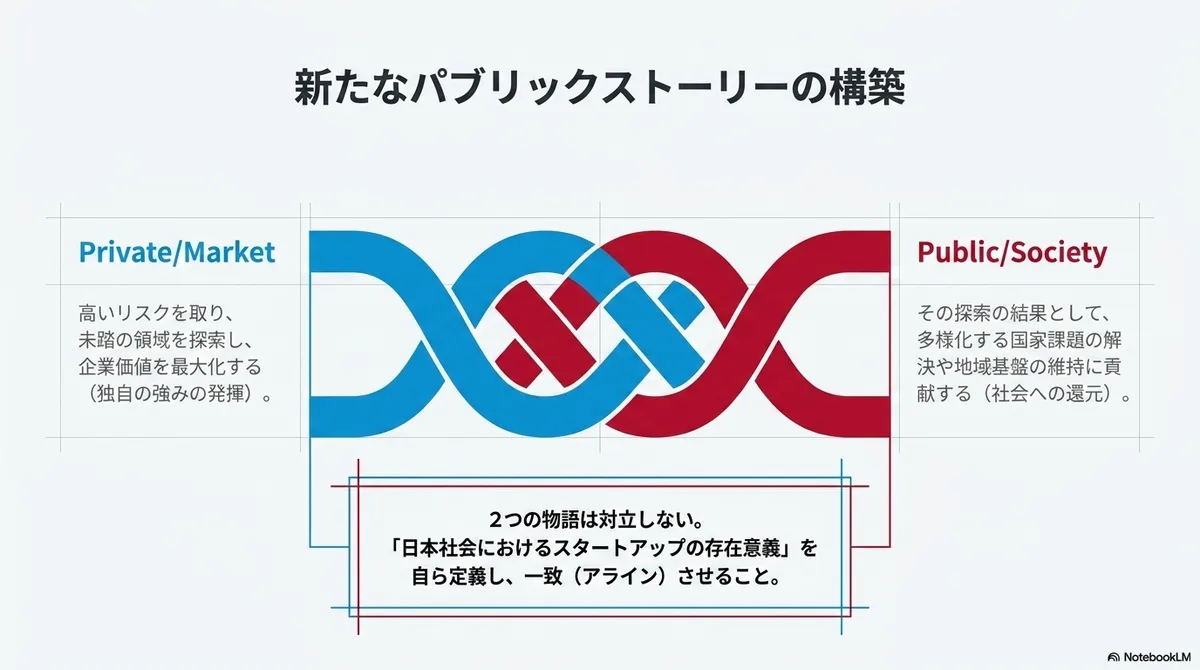
Weaving a Public Story for Startups
This article was machine-translated from Japanese by AI (Claude). It may contain errors. Read the original Japanese article.

What a startup means differs depending on your position and perspective.
For a founder, it may be a means of self-realization or financial return. For an investor, a startup is a kind of financial product. From the viewpoint of society and government, on the other hand, it is a means of increasing the public good of society as a whole.
This time, I will look in particular at how the positioning of startups is changing when seen from the perspective of society and policy.
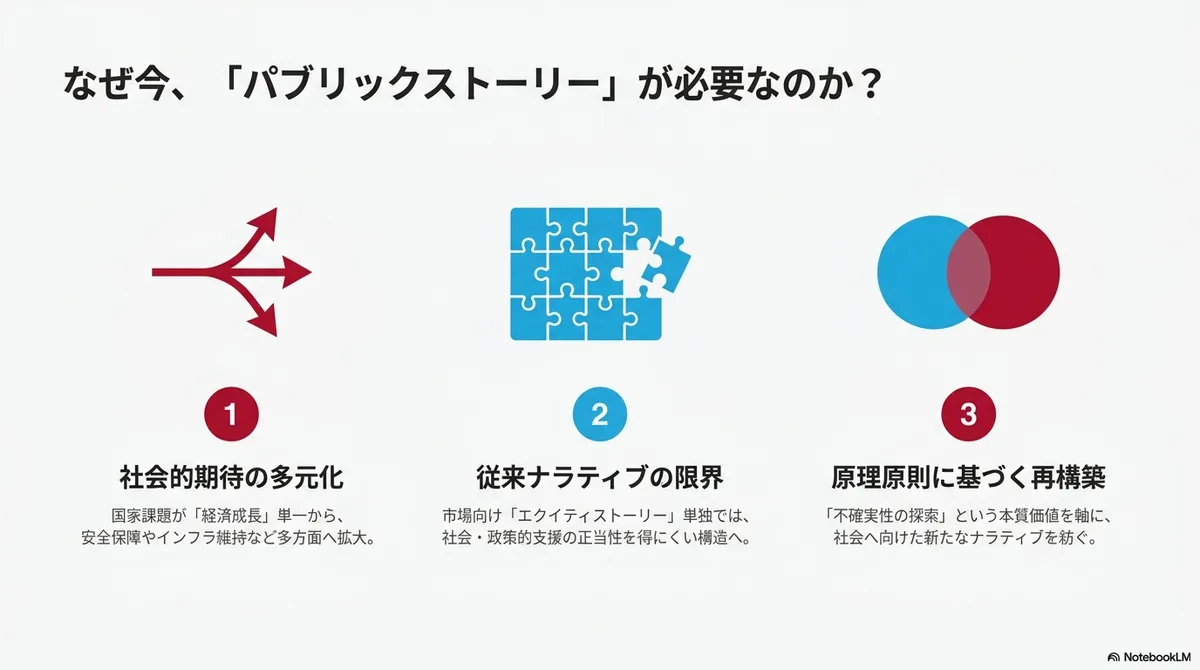
And I would like to argue, from the viewpoint of the diversification of social expectations and related angles, that startups and startup ecosystems once again need not only an equity story directed at investors and markets, but also a public story directed at society.
The Story That Startups Are the Engine of Economic Growth
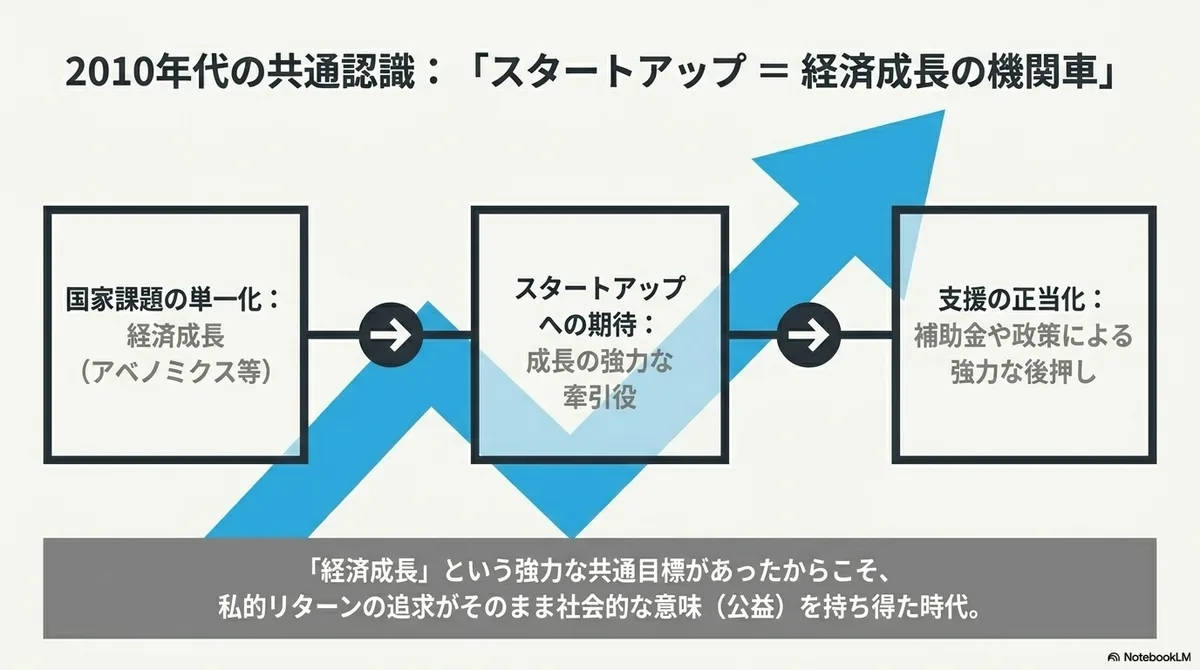
Over the past decade or so, what Japanese society and Japanese politics expected of startups, especially high-growth startups, seems to have been "economic growth."
In the 2010s, as typified by Abenomics, there was a sense in Japan that the challenge facing society as a whole was economic growth. Meanwhile, in the United States, startups such as Google and Facebook were driving economic growth, and governments around the world, seeing this, increasingly turned their attention to startups as a means of economic growth. In response, expectations for economic growth through startups rose in Japanese society as well, which I think led to policy support in Japan, including subsidies.
It was, you could say, an era in which this kind of public story or narrative about startups was implicitly shared across the world.
Because this story of "startups = economic growth" existed, and because the "national challenge = economic growth," startups were regarded as having "a social meaning that goes beyond the private returns of founders and investors," and policy support, "society's investment in startups," came to be established.
Providing public support to startups was not simply a matter of helping founders or helping investors. Policy support was justified precisely because it was expected to lead to economic growth for society as a whole.
Changes in Society's Priorities
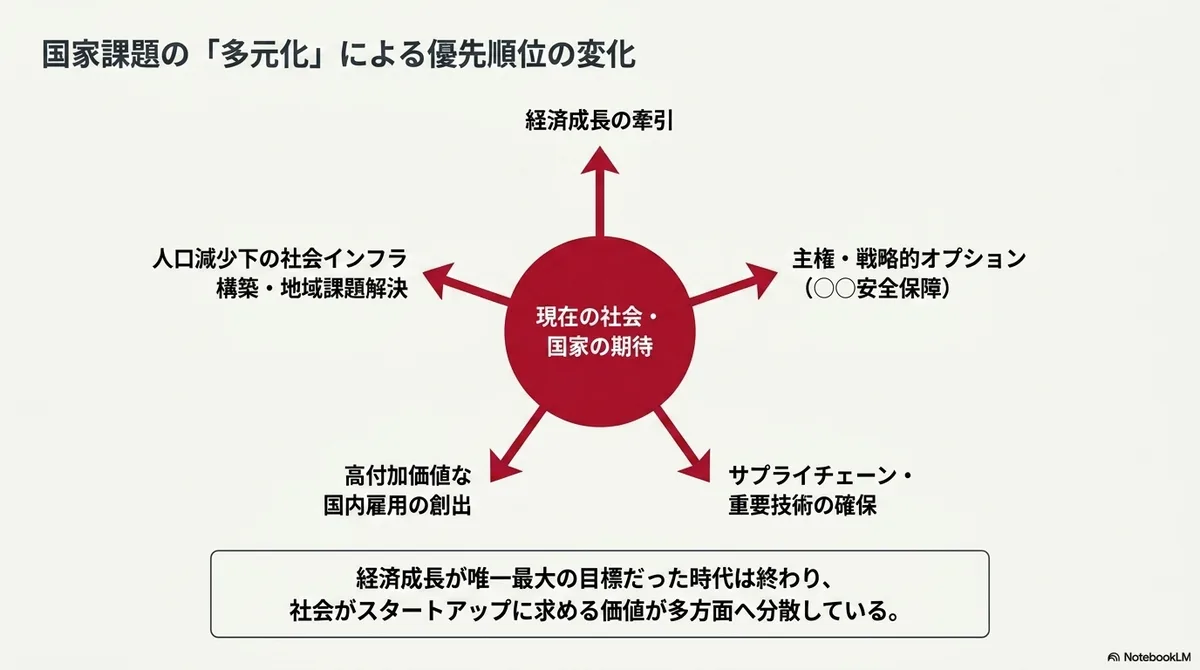
Today, however, the priorities of national challenges in Japanese society are changing.
Of course, economic growth is still important. But at the same time, other values are being recognized more strongly than before.
For example:
- Securing sovereignty and creating strategic options (XX security, and so on)
- Securing supply chains and critical technologies
- Securing high-value-added domestic employment
- Building social infrastructure that can be sustained even as the population declines
- Solving regional issues
These are issues that existed before, too, but in response to changes in the international situation, the problem of technological hegemony, population decline, and the shortage of people to sustain local communities, they have come to be seen as policy issues as important as economic growth.
In a sense, social expectations have become pluralized, and what society expects of startups is changing as well.
In the era when economic growth was the sole and greatest national challenge, it was enough to explain startups as "producers of growth," and this aligned well with financial investment, too.
But if the values society emphasizes have changed, then unless the startup side changes its explanation as well, it will not be able to earn society's trust, and it will become difficult to receive investment and support from society.
Accordingly, if the startup ecosystem wants to keep seeking support from Japanese society, and by extension policy support, I think it needs to build anew, separately from the equity story directed at the market, a public story of contributing to Japanese society.
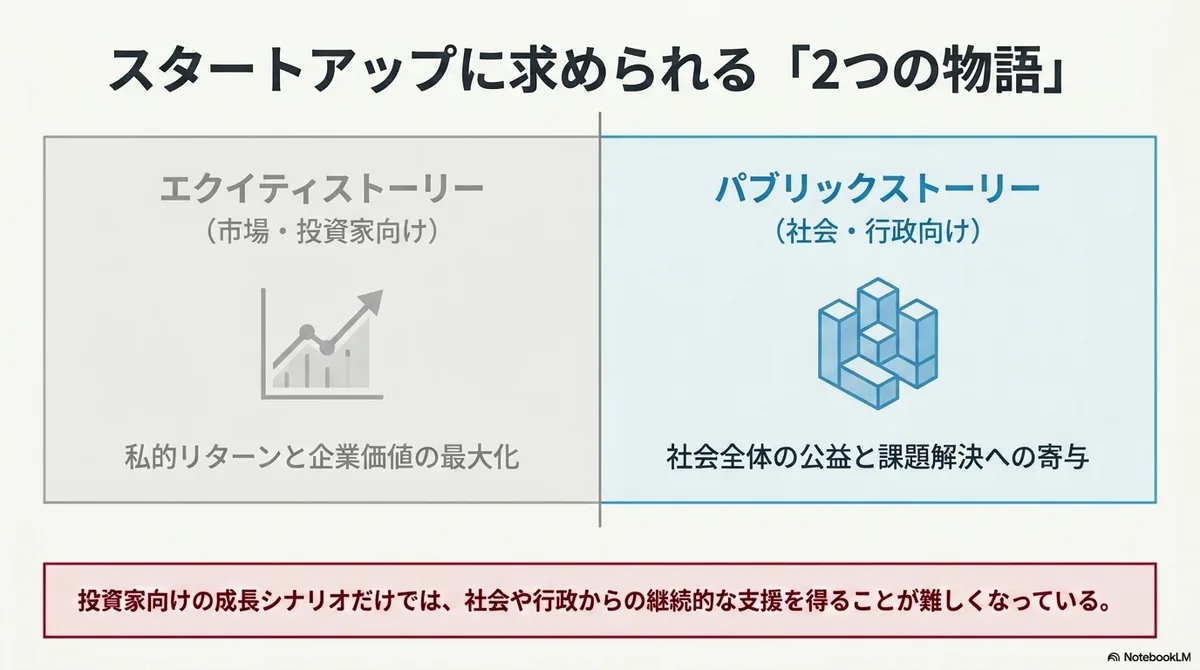
One pole of that public story is probably The Technological Republic, by the CEO of Palantir, which has been much discussed in Japan lately. Its message is that Silicon Valley should stop making consumer apps and contribute more to the nation and to security.
Of course, it is not the case that every individual startup must engage in this kind of social movement. A startup can go its own way and focus purely on its market and customers, and it can build a small but strong business. As long as markets and redistribution function properly, maximizing value in the market also leads to contributing to society.
However, viewed as an ecosystem as a whole, if we ignore what society values, we lose the legitimacy to receive support from society.
In a sense, if the value and meaning of startups in society are changing, we have to recognize that.
At the same time, I also think it has become harder than before for startups to satisfy a variety of social values, including economic growth, all at once.
The Weakening of the Explanation "Startups = Japan's Economic Growth"
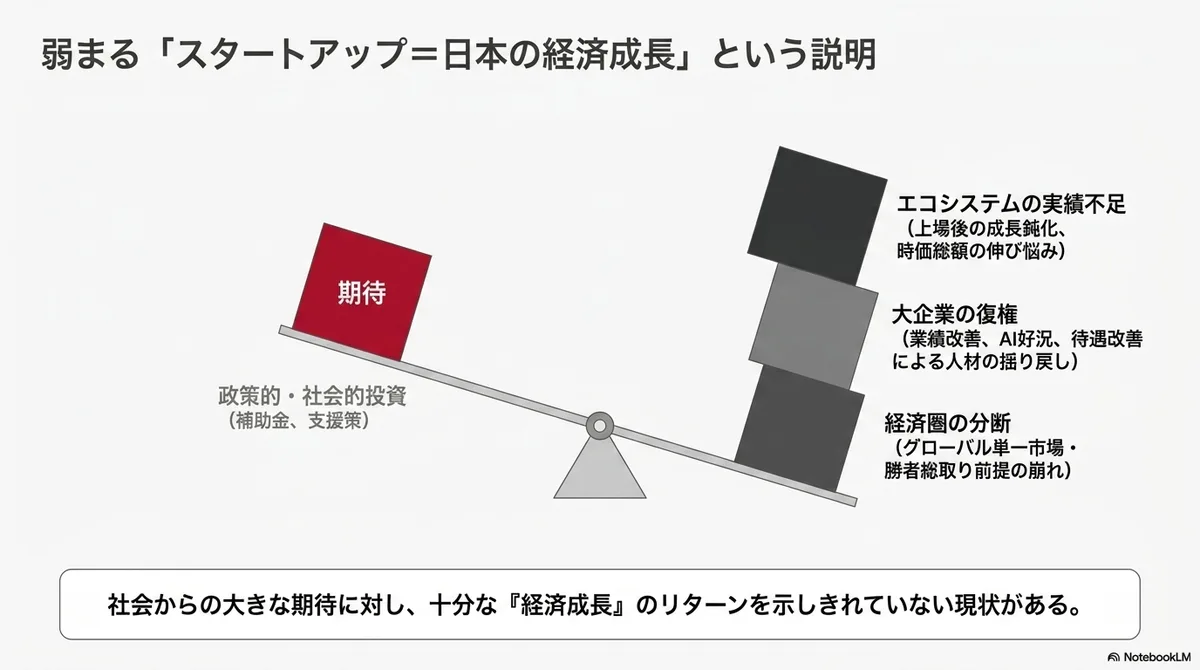
First, let us consider the story that "startups drive economic growth."
The goal of economic growth was a very good fit with for-profit companies and finance. Startups take on large risks, and a few of the companies that succeed earn enormous returns. Because the power law applies to those winners, if a single global economic sphere is functioning, growth that is close to uncapped can be expected. In that sense, the explanation of achieving economic growth through startups was very easy to understand.
In terms of results, however, if you ask whether startups over the past ten years have sufficiently met the expectation that they would drive the economic growth of Japanese society, we are not in a position to proudly say yes at this point.
Of course, there are success stories at the level of individual companies and funds, and I think those successes should not be underestimated. But when you look at the ecosystem as a whole, and ask whether it is returning sufficient returns on the policy and social investment in startups, I have to say, unfortunately, that it is not. (For example, looking at conditions in the Tokyo Stock Exchange Growth Market, the slowing of growth after listing, and the sluggish market capitalization, it is difficult to say, at least, that "startups are driving the growth of the Japanese economy to a large extent.")
Of course, Japan's startup ecosystem is still maturing, and I also think ten years or so is too early to judge results. But given that situation, if the ecosystem is going to show a movement toward optimizing for an ecosystem that does not aim for large growth, then it should step down by its own choice from the story of bearing economic growth, and choose capital, support, and ways of speaking that suit that.
The Revival and Advance of Large Companies
Meanwhile, large companies are seeing improvements in earnings and share prices, and expectations from the standpoint of economic growth are rising thanks to the boom driven by AI and other factors. Their relative role in contributing to XX security and similar areas is also growing.
In terms of talent as well, startups used to be able to offer compensation and growth opportunities that large companies could not. But as the treatment of employees and work-style reforms at large companies, along with growth opportunities from interesting new businesses, are being reassessed, I feel that students, too, are gradually turning their eyes to large companies as places to work.
In other words, the standing of startups in Japanese society is also changing.
The Fragmentation of the Global Market
Furthermore, the world is no longer believed to be a single global market as it once was. When economic spheres are divided and greater weight is placed on the economic spheres of one's own country and its allies, the ceiling of the markets startups can target changes as well.
Of course, in reality markets are connected through various detours and are not completely divided, but the premise that a company can spread globally all at once and that the winner takes the entire world market appears weaker than before.
(The story would change again if a company held a chokepoint in the world economy, but that would be a matter of a changed strategy.)
As a result, I think the explanation that "startups contribute to the economic growth of Japanese society" has become somewhat weaker than before.
Values Other Than Economic Growth and Their Fit with the VC Model
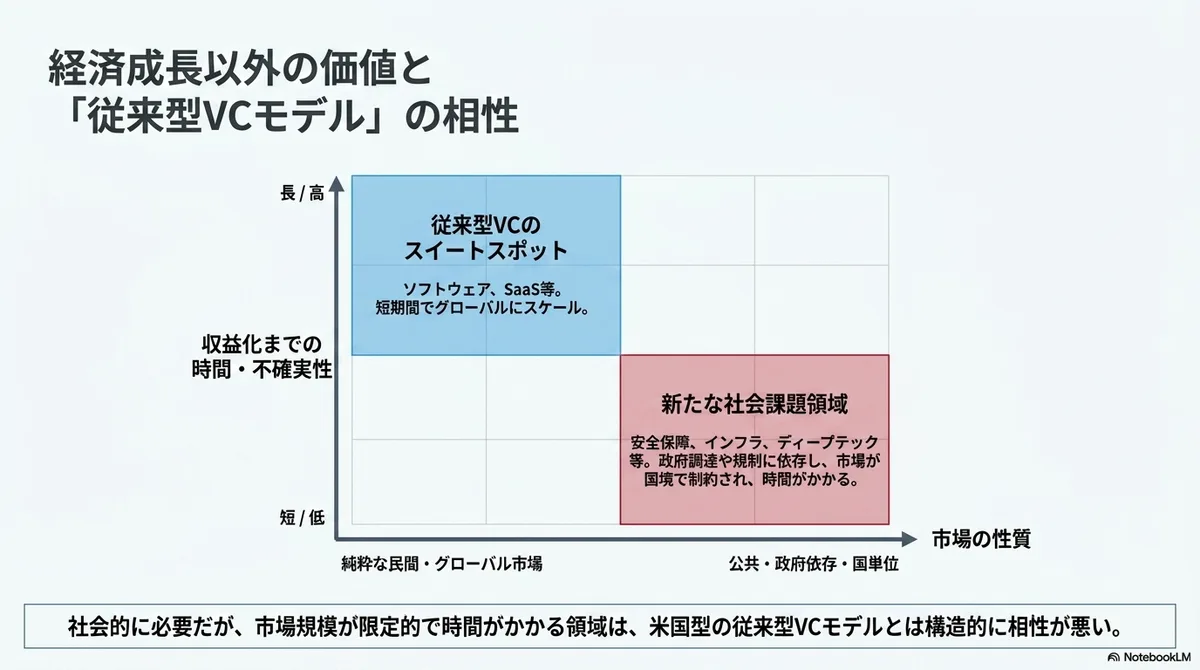
So what about values other than economic growth?
One example is securing sovereignty and creating strategic options. This is, so to speak, "XX security."
Economic security, technology security, food security, energy security: the domains in which a country's society prepares for future uncertainty are, when converted into economic value, insurance premiums for the people and society. It can also be said that these are business domains in which the economic return of a business is determined by how much the people pay, or are able to pay, in such premiums.
These domains clearly have social meaning, but the ones that produce large economic returns appear to be only a small fraction of them. This is because, fundamentally, we are talking about the national level, and the market is constrained by the size of the country.
Of course, not everything in the field of economic security is confined to the domestic market. Some things extend to the markets of allies and like-minded countries, and some technologies could hold a chokepoint in the world. Even so, unlike purely private markets, elements such as government procurement, export controls, standardization, prevention of technology leakage, and international relations come into play strongly, so there will be more areas where it is hard to fight with conventional growth strategies.
Thinking about it that way, there will be many situations in which the conventional VC model is not always optimal in Japan. VC money may be a poor fit for domains that are socially necessary but have a limited market size, take a long time to become profitable, or depend heavily on government procurement and regulation. It may be a model that works in a country like the United States, which has an enormous market within a single country, but it seems hard to say the same of Japan.
Reconsidering the Characteristics of Startups
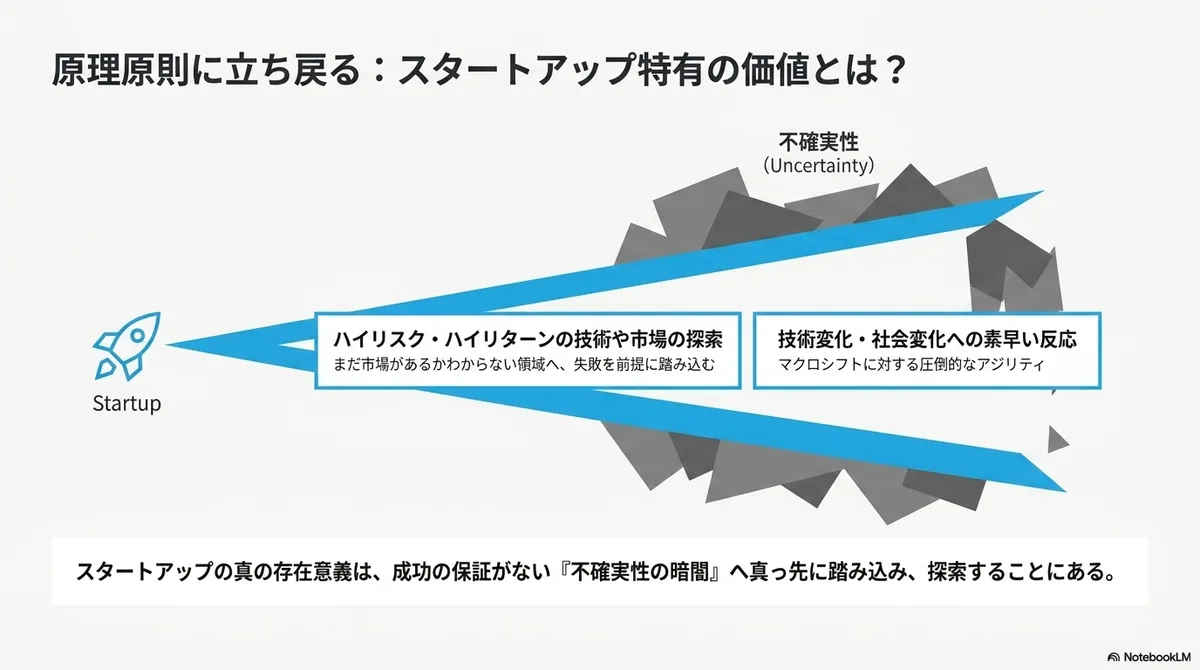
Does that mean we should give up on startups in Japan? I do not think so.
When thinking about how startups can contribute, if there are characteristics that distinguish startups from other business entities, I think they are:
- Exploration of high-risk, high-return technologies and markets
- Quick response to technological and social change
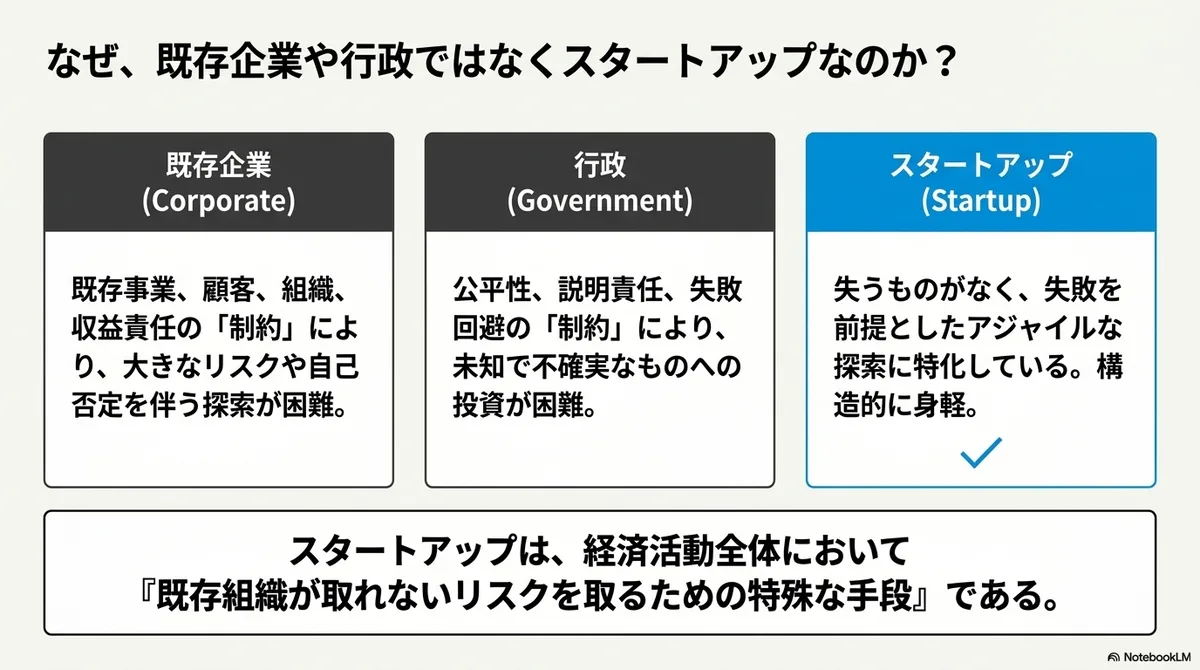
These two are areas that existing companies and government tend to find difficult. Existing companies carry existing businesses, existing customers, existing organizations, and existing responsibility for profits, while government is bound by constraints of fairness, accountability, and the avoidance of failure.
Under these circumstances, stepping into areas where it is not even clear whether a market exists, and exploring them on the premise that failure is possible, is a move that only startups can make.
I believe that is exactly where the value of startups lies. If so, then showing that they are fulfilling that role is, I think, the move startups need to make in order to receive support from society.
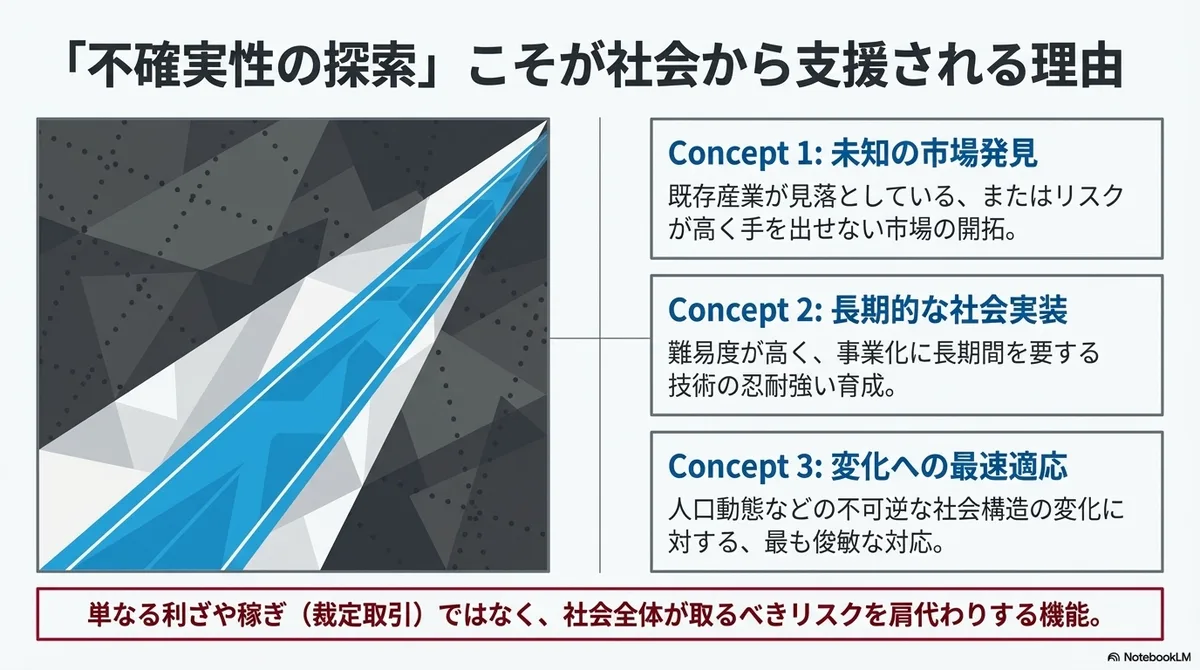
For example, in areas that are technically difficult, take a long time to commercialize, and have a low probability of success, market mechanisms alone make it hard for sufficient investment to occur. This is similar to research and development at universities and companies. Just as direct and indirect government subsidies can be important for basic research and long-term R&D, startups can respond to things that need to be prepared for over the long term.
In the current technological change brought by AI as well, the point is not merely to make existing work slightly more efficient. In Japanese society, where labor supply is constrained, it is to create new work designs premised on labor shortages, and to resolve the constraints on electric power, data centers, semiconductors, and computing resources that accompany the spread of AI. These are market opportunities, and if done properly they also carry great social meaning (since data centers and the like can also damage infrastructure such as electricity and water).
By responding nimbly to such changes in society and implementing the response in a form that is meaningful to Japanese society, I think startups can make people feel that "it is good to have startups in society." If they merely engage in arbitrage, they will lose society's trust.
Summary: Returning to First Principles and Fulfilling Our Role
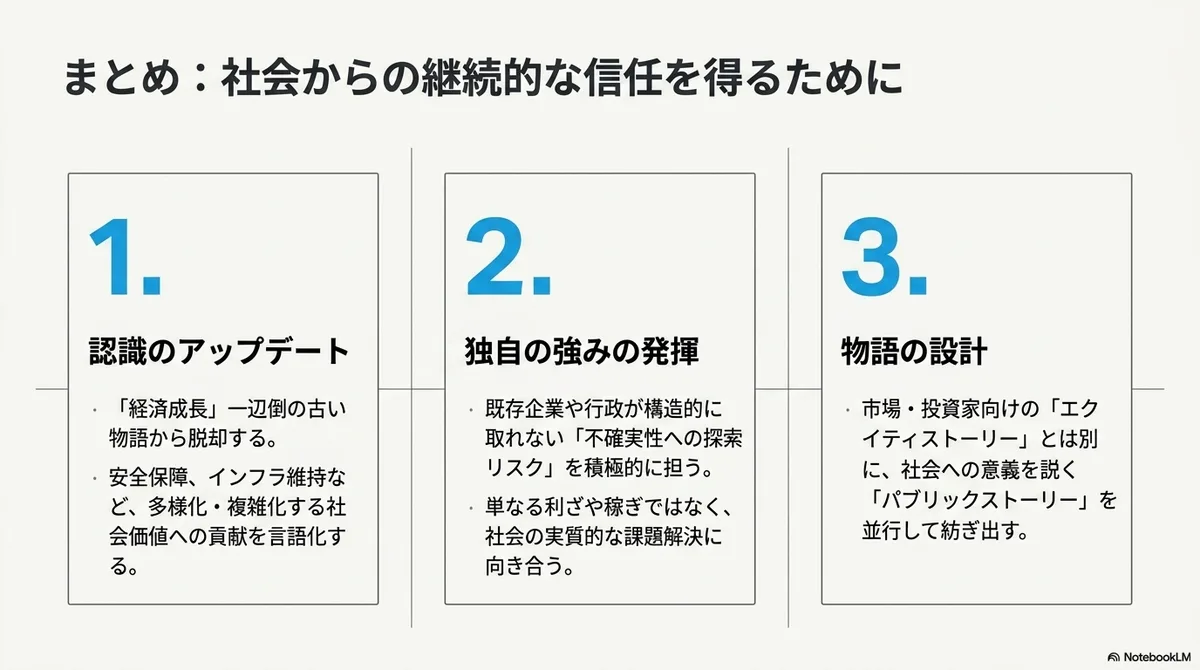
Seen against economic activity as a whole, startups are a special means. They can take risks that existing companies find hard to take and explore areas where no market is yet visible, and through this they sometimes land a big hit.
Precisely because they are such a special means, they contribute to economic growth and the public good as a result of that exploration, through taking risks that existing companies find hard to take, taking a long time to implement things in society, finding markets that existing industries have overlooked, and moving faster than existing organizations in response to social change. I believe the reason startups are supported by society lies precisely in this kind of exploration of uncertainty.
And I think we are entering an era in which, in order for startups and the startup ecosystem to receive investment and support from Japanese society, it is necessary to show anew that we are taking on such challenges and to weave a public story of "the meaning of startups in Japanese society."