Dark Supply Capacity
This article was machine-translated from Japanese by AI (Claude). It may contain errors. Read the original Japanese article.

The term "supply capacity," long used in the power and energy sector, has recently come to be used across much broader policy areas, such as labor, logistics, food, healthcare and long-term care, and science and technology.
In fact, supply risks are now rising across the board: labor shortages, logistics stagnation, rising costs of oil-related goods and construction, staff shortages in healthcare and long-term care, and supplies of food and materials. So it is natural for attention to turn to supply, and it is common for words to be borrowed and repurposed when that happens. I myself have used the term supply capacity in an article I wrote.
However, I think the term "supply capacity" can also have the effect of concealing political intent.
A useful reference for thinking about this is the debate in the United States over abundance and the tech right.
Abundance and the Tech Right
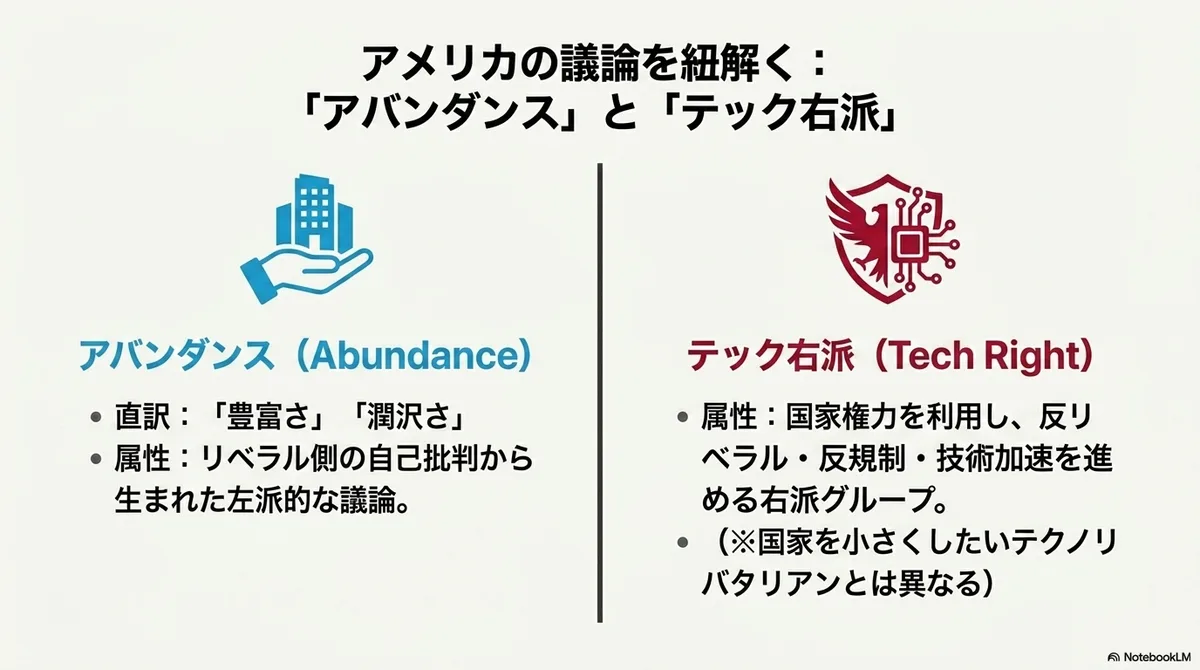
In recent years, a debate called abundance has emerged in the United States.
Abundance, translated literally, means plentifulness or richness. As a political argument, it holds that society should be able to supply more of what people need for daily life, such as housing, energy, infrastructure, public transit, healthcare, and scientific research.
For example, in response to problems such as the shortage of housing, the difficulty of building green energy facilities, and the excessive cost of public works, the basic concern of abundance is that we must become a society that can build more.
In the United States, this emerged in part as a self-critique from the liberal side, and it has a left-leaning character.
On the other hand, around Silicon Valley there is also a group known as the tech right.
Within it, there are technolibertarian positions that want a smaller state, and there are positions that seek to accelerate the development of technologies for AI, defense, space, energy, public safety, and more by using the state and government procurement. Some parts of it also move in an anti-liberal, anti-regulation, institution-dismantling direction.
As the name says, this is a right-wing argument.

At first glance, left-leaning abundance and the tech right look like entirely different things.
Abundance is an argument for increasing the housing, energy, and public goods that people need in their lives. The tech right is an argument for expanding the freedom of companies and engineers around AI, defense, crypto assets, and the like.
However, the two have something in common. Both of them
- call for increasing supply, and
- see institutions as the cause of the problem
.
(1) What Supply Should Be Increased?
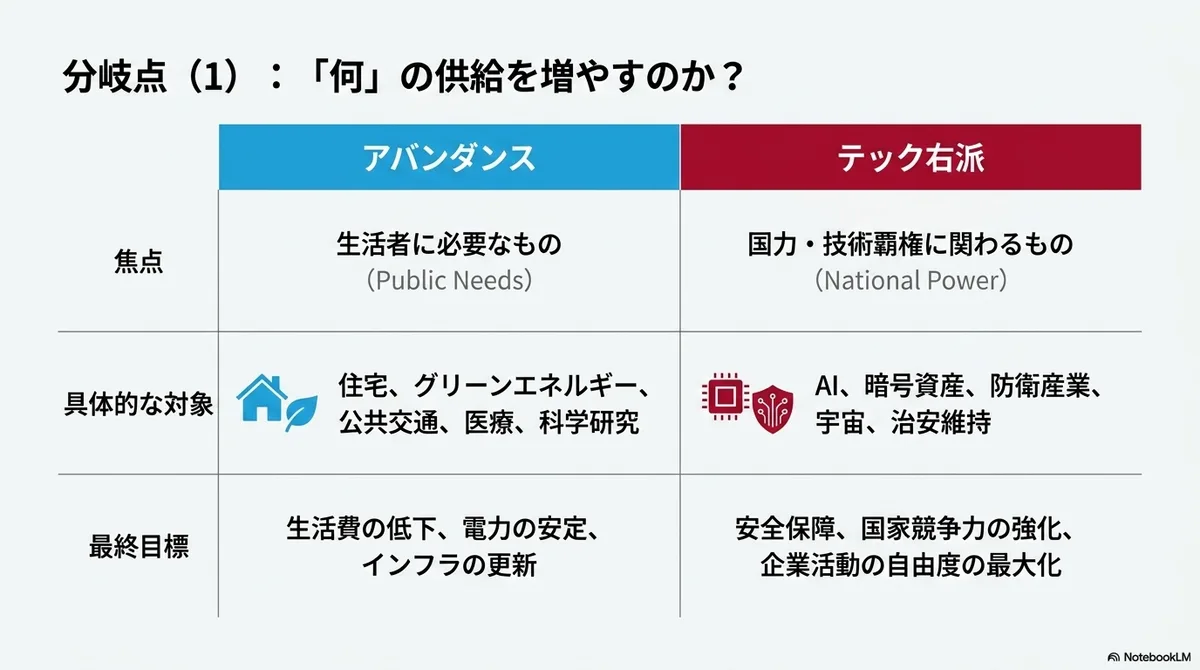
Both have a Silicon Valley-like side in the sense that they aim to increase supply by using technology.
However, what abundance mainly takes up is what people need for daily life.
That means housing, green energy, public transit, infrastructure, healthcare, scientific research, and so on. Lowering housing prices. Stabilizing electricity. Building out public transit. Renewing infrastructure. Reducing the cost of living. These are at the center of abundance.
The supply that the tech right emphasizes, on the other hand, centers on AI, crypto assets, the defense industry, space, energy, public order, border control, and technologies tied to national competitiveness. It is more easily linked to national power, technological supremacy, security, and the freedom of corporate activity than to the needs of ordinary people.
In other words, even when both say "increase supply," what supply they want to increase differs considerably.
(2) How Should Institutions Be Fixed?
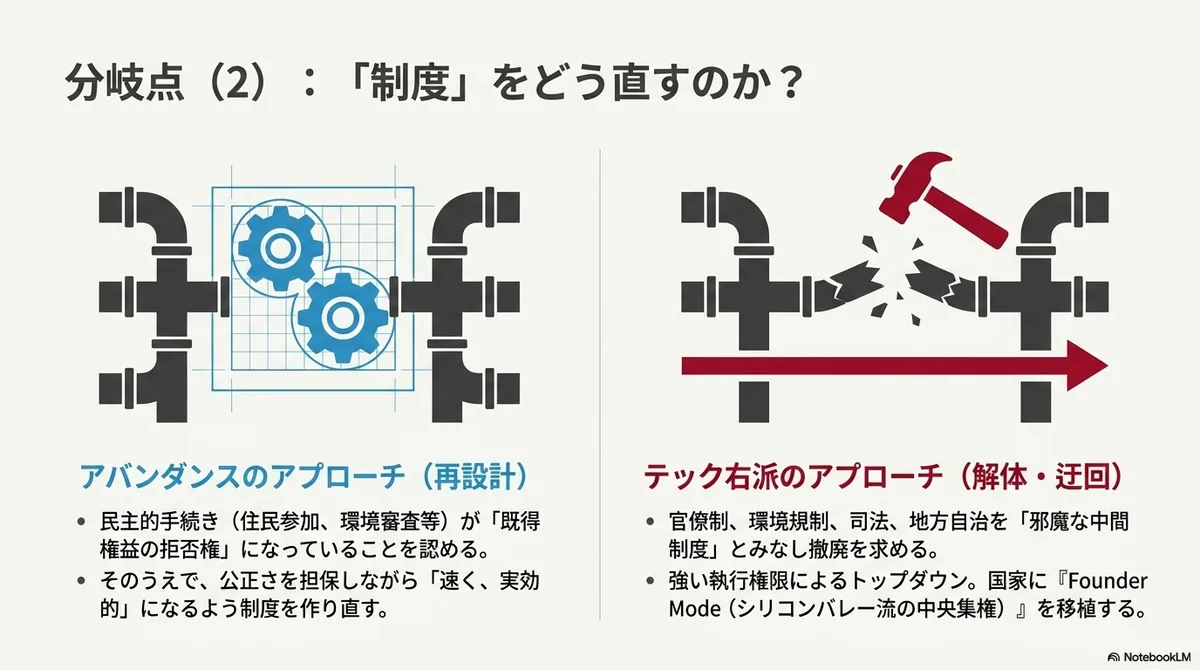
Abundance and the tech right share one thing: as a method for increasing supply, both focus on institutions. Supply cannot be produced because the current institutions are not working well, they say.
This dissatisfaction is shared, but the solutions are very different.
The tech right tends to demand not the reform of regulations but their abolition, and the abolition of institutions. It views the existing bureaucracy, universities, NPOs, expert systems, environmental regulations, judicial procedures, local self-government, and the like as intermediary institutions that obstruct supply. And to bypass or dismantle them, it tries to use strong executive power and top-down decision-making.
It is a view of governance in which strong state power is used to fix existing institutions, and the method is a centralized system like that of a Silicon Valley CEO, granting exceptional authority, building fast, and implementing fast.
It could be called an approach that uses Silicon Valley-style means: dismantling institutions to turn them into simple organizational management, demanding Move Fast and Break Things-style acceleration, and, as it were, transplanting "Founder Mode" onto the state.
Abundance, on the other hand, values democratic procedures. It acknowledges that existing institutions, such as resident participation, environmental review, litigation, and local regulation, can sometimes function as veto powers for vested interests and the status quo, and then asks how they can be improved while preserving their effectiveness to some degree.
It means discussing which procedures protect the public interest, which have become veto powers for vested interests, and which could be made faster, fairer, and more effective if redesigned, and then rebuilding institutions so that they can actually supply housing, energy, and infrastructure.
In a sense, this kind of democratic and idealistic side seems to inherit Silicon Valley-style thinking as well.
Although both derive from the same Silicon Valley thinking, they differ in which aspects they adopt, and that is where a major divergence between them lies.
Dark Abundance
So far we have looked at the similarities and differences between abundance and the tech right.
The tech right tends, relatively speaking, to hold an institutional view that it is acceptable to largely dismantle existing intermediary institutions and democratic constraints in order to increase supply.
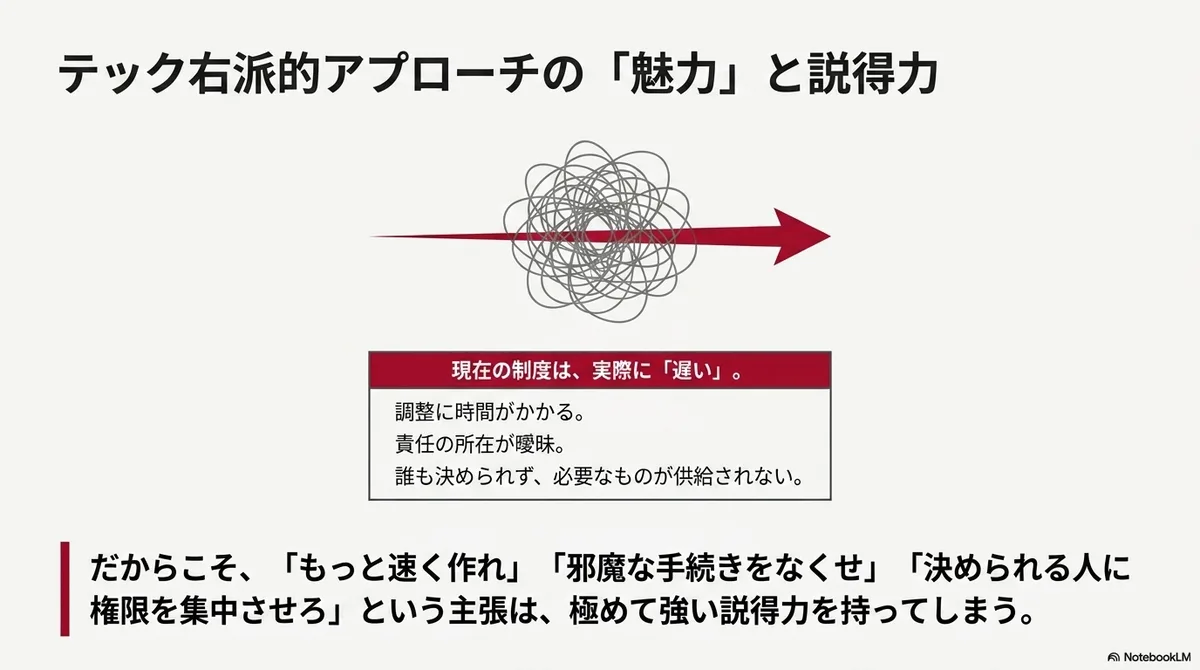
And this institutional view can look very attractive.
That is because current institutions really are slow. In many situations, coordination takes time, responsibility is unclear, no one can decide, and what is needed does not get supplied. I imagine many of you have been frustrated by the slowness of administrative procedures.
For that reason, claims such as "build faster," "get rid of the procedures in the way," and "concentrate authority in those who can decide" carry a certain persuasiveness.
But what lies beyond going down that path may be a situation in which, under the banner of abundance and increasing supply, democratic procedures, resident participation, environmental protection, worker protection, local self-government, and judicial oversight are all lumped together and treated as obstacles.
Steven Teles of the Niskanen Center calls this right-leaning, tech-oriented abundance "Dark Abundance." The term was probably taken from the Dark Enlightenment, and rendered into Japanese, it could be called "Dark Abundance."
In other words, one wrong step and the abundance debate can easily fall to the dark side.

"Supply Capacity" and "Dark Supply Capacity" in Japan

I think these arguments can also be applied to Japan.
In Japan, there is a need to raise supply capacity in many areas, including housing, energy, healthcare, long-term care, childcare, transportation, science and technology, AI, and logistics, and policies are about to be rolled out. I do not think raising supply capacity is itself wrong.
However, precisely because the phrase "raising supply capacity" is convenient, it carries the same danger as dark abundance. In terms of supply capacity, it would be a fall into "dark supply capacity."
Now that supply-side problems have surfaced and it has become easier to win agreement for countermeasures, I think we should take renewed care over what exactly we want to increase the supply of (What), how we intend to increase it (How), and in particular how we intend to change institutions.
That is because, like the Sith Lord in the film Star Wars, those in power can always exploit a crisis to expand their power legally.
So I think there is meaning in coining the term "dark supply capacity" in advance, as a check against the danger of democratic constraints and intermediary institutions being dismantled in the name of supply capacity, and I am leaving it here as an article.
Addendum
Let me add that dark does not mean armament. I also feel that arguing "do not arm" is somewhat extreme given the current international environment.
Also, this time I have talked about the supply side, but to divide things up a bit more: moving further left would lead to social-democratic supply policies such as the city-owned, privately operated public grocery stores promoted by New York City Mayor Mamdani, and going to the demand side rather than supply would place something like degrowth communism, which seeks to reduce excessive consumption by the wealthy and capitalist over-demand while securing basic living guarantees publicly. Moving somewhat further right, on the other hand, one would see the dynamism camp, such as American Dynamism (though it is not institution-dismantling like dark abundance). That is roughly how I think they could be positioned.