Thinking About Startups That Take On Japan's Six Kinds of Aging: People, Infrastructure, Industry, the Nonprofit Sector, Institutions, and Ideas
This article was machine-translated from Japanese by AI (Claude). It may contain errors. Read the original Japanese article.

How should we deal with "aging" in the broad sense? I think this challenge, which Japan is facing, could become the next frontier for high-growth startups and startup-style activity.
Specifically, these are:
- People
- Infrastructure
- Industry
- The nonprofit sector
- Institutions
- Ideas
Aging (deterioration) is occurring in each of these six important areas, and the question is whether we can contribute to solving the various problems it causes through a startup-style approach.
These six areas are not independent of one another; they are linked in a chain. Text can only show one direction, but for example:
Aging of people → labor supply shortage → difficulty renewing infrastructure → regional contraction → growing burden on the nonprofit sector → growing burden of institutional renewal → fragmentation of ideas → still greater social burden
The problems are interrelated in this way, so we have to solve them, or at least ease them, at the same time.
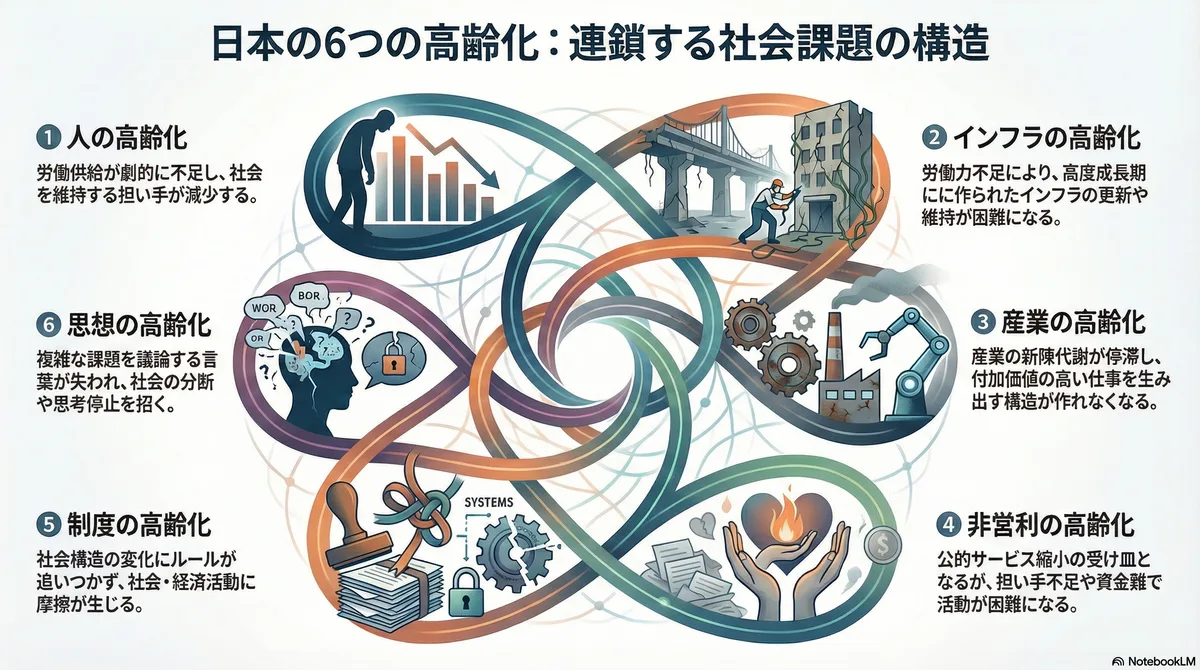
A summary of the challenges by NotebookLM
To do that, I think we need attempts to create solutions that can have a large impact in each area, which is to say startup-style solutions.
This article is one part of my own current awareness of these problems, grounded in that thinking. You could call it Requests for Startups (RFS), a Problem Statement, and a blog post for finding companions who share a similar awareness of these problems.
Note (1): These are only examples, and they are not the full extent of the problems I care about. There are also more global challenges, and I think there are problem areas that, as businesses, are based on human desires. I mention this just in case.
Note (2): I do not think it is a bad thing for people or society to grow older. Having come this far alive and well is, if anything, wonderful. But as time passes, problems inevitably arise in anything. When people age, their bodies develop ailments, and when societies age, friction arises. I accept that aging, and the problems that appear as its symptoms, are phenomena that occur. If dealing with them well lets us live more healthily, I want to solve those problems well. Let me note at the outset that I do not regard aging as bad.
Summary by NotebookLM
This is for when you want to grasp the gist quickly through slides, since the article is long.
- (1) Aging of people
- (2) Aging (deterioration) of infrastructure
- (3) Aging of industry
- (4) Aging of the nonprofit sector
- (5) Aging of institutions
- (6) Aging of ideas
- Conclusion: Preparing order and its underlying structure
(1) Aging of people
❓ What is happening
As of 2025, the median age of Japanese people is 49.8, and it has been on an upward trend, rising by about 0.4 years a year in recent years. As for the population aged 65 and over, 29.4% are already 65 or older, and it is projected to exceed 36% by 2045. It is well known that aging will advance further over the coming decades.
⏩ What will happen
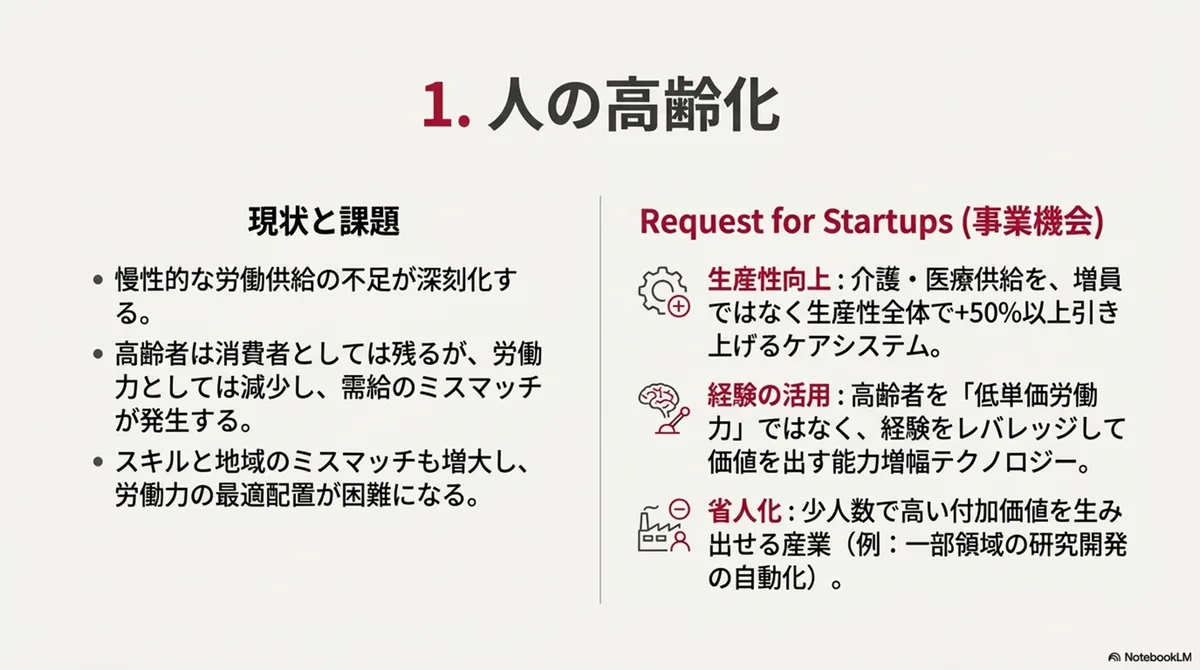
This aging causes a dramatic shortage of labor supply.
Even elderly people remain consumers, and some demand, such as for nursing care and medical care, increases, so the working population tends to shrink by a larger margin than the total population. (Furthermore, even where elderly people work, their working hours per person tend to decrease, and job mismatches become more likely.)
In addition, as the population ages, mismatches in skills and region also tend to increase, making gaps more likely between the total amount of labor input and the skills and regional distribution of the workforce.
I wrote about this in detail in the article "Solving the Challenge of Supply Capacity," so please see that.
❗ How to solve it
On this point, what is needed is:
- Inventing technologies and businesses that let a small number of people sustain society
- Inventing industries that can create high added value with a small number of people
Rather than simply solving the problem in front of us, the request to startups regarding the "aging of people" is to invent methods and mechanisms that are dramatically more efficient and effective.
The key is the word "dramatically." Rather than thinking about modest efficiency gains such as providing tools, or greater mobility through more efficient staffing placement, I think this is an area where we have to think about rethinking how value is created and reconsidering how things are done.
📢 Requests for Startups
Below I offer some ideas as samples, but I have not thought them through that deeply, so please take them only as examples.
- A care system that raises the productivity of nursing care and medical care supply as a whole by 50% or more, not by adding staff
- Capability amplification that leverages the experience of elderly people to create value, rather than treating them as a "low-wage labor force"
- Automation of research and development in some areas
Beyond these, the items I list under (2) Infrastructure and (3) Industry also belong to this category.
(2) Aging (deterioration) of infrastructure
❓ What is happening
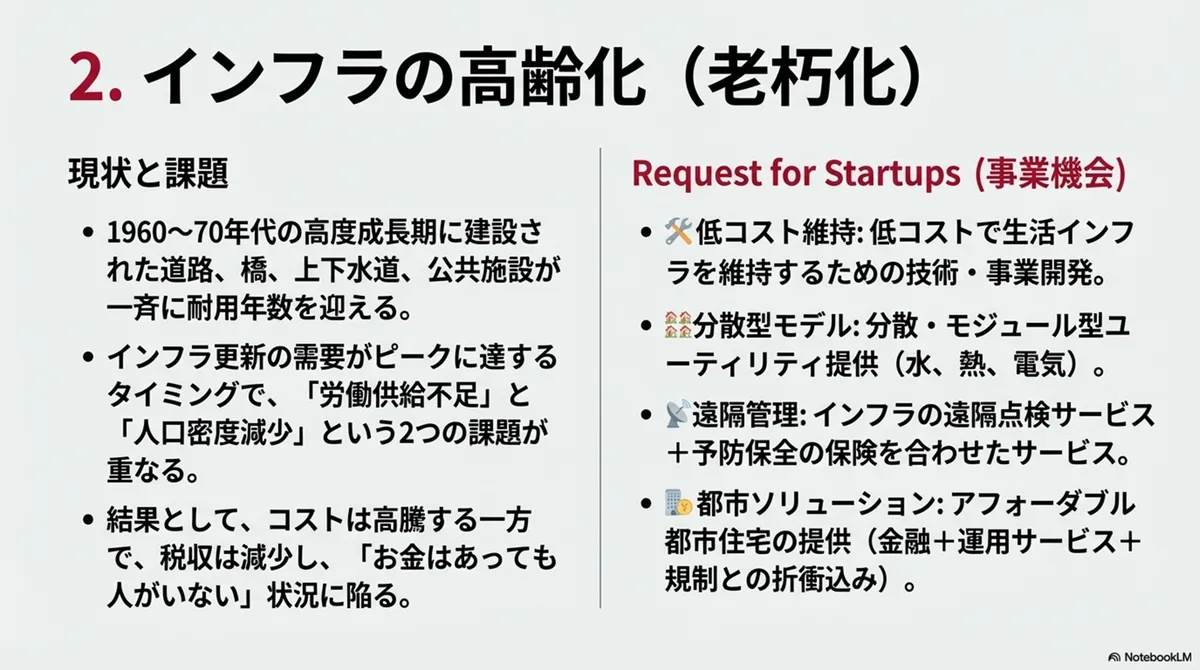
Hardware infrastructure such as roads, bridges, water supply and sewerage, and public facilities (city halls, schools, public housing, and so on) was built all at once in Japan during the high-growth period from 1960 to 1970. These are now reaching the end of their service lives at the same time. For example, the rough guidelines are 40 years for water supply, 50 years for sewerage, and about 50 years for buildings, and many have already passed or are passing them.
That said, such infrastructure is not necessarily renewed once its service life arrives. Decisions on extending its life, renewing, consolidating, or abolishing it are made in light of actual lifespan, importance, and risk. Life extension to lengthen the expected service life and leveling to spread out the peaks are also being carried out, so it is not a matter of right now. Even so, even with extension, the figure is often around 80 years, so renewal is just about to begin. In fact, stepwise increases in fees to fund renewal costs are starting to appear.
⏩ What will happen
At the same time as the infrastructure renewal period, Japan will face the following two challenges because of "population decline."
① Labor supply shortage
② Declining population density
On ①, just when infrastructure renewal increases, labor supply will fall short, including through mismatches in skills and regional distribution. Labor supply for non-desk workers is already tight, and if demand for infrastructure renewal grows further, costs will soar, and since a shortage of engineers is also expected, a situation of "we have the money but not the people" could arise. On top of that, the local governments that make decisions about infrastructure going forward are also short of staff, so even procurement will become difficult.
On ②, even if the geographic population density declines, the cost of repairing and maintaining infrastructure does not change much. Even now, the maintenance costs of regional infrastructure are barely supported by redistributing urban tax revenue (in "The Hope Called Valley of the Wind," there was even an estimate that public funds of about 2.6 million yen per person per year are being put into a certain town). It is hard to keep this up as it is, so alongside maintaining and renewing infrastructure, we need a discussion about where to contract. The fact that it is not simply a matter of renewing and expanding infrastructure makes the problem even harder.
Furthermore, declining population density in ② also means that the cost of services that could be called living infrastructure, such as transportation, medical care and nursing care, education, sanitation, and public services, becomes considerably higher. When those services disappear, jobs are lost too, more people leave, and population density falls further, a vicious cycle. In areas where density has fallen like this, the cost of maintaining safety can also rise, as with the recent bear problem.
Meanwhile, the cities that serve as receptacles for people need to create environments where many people can live affordably, and to build tax revenue that does not depend on Tokyo.
❗ How to solve it
In some regions we will have to contract and lower service levels, and I believe it will be difficult to fully maintain the current standard of living. Unless we overcome the difficulty of politics and consensus building and carry out contraction, debt will only grow.
On the other hand, if maintenance and renewal can be done at a sufficiently low cost, the scope of contraction can be made smaller, and the cost of politics and consensus building can be lowered too. This is a kind of case where politics is shaped by technology and business.
Therefore, the requests to startups are:
- Technology and business development to maintain living infrastructure at low cost
- Technology and business development to make cities cheaper and more livable
This will not be something that software alone can complete, so I think it is an area where we need to do something involving hardware. Also, if even one piece of living infrastructure is missing, people cannot live, so it needs to be assembled comprehensively (for example, even if water supply and sewerage are sorted out, people cannot live without electricity. One company does not have to do it all).
At the same time, I think the renewal of infrastructure can also be an opportunity to introduce new infrastructure. I am also wondering whether we can draw a new picture at such a moment.
Note that this should not be about simply building a business that "(vaguely) contributes to these infrastructure problems." It seems to me a problem where we must set economic and technical numerical targets and aim for a large impact.
📢 Requests for Startups
- Provision of distributed, modular utilities (water, heat, electricity, and so on)
- A service combining remote infrastructure inspection with preventive-maintenance insurance
- Transportation services built on technologies such as autonomous driving plus something extra (finance, road-surface solar power, wireless power transfer, and so on)
- Vertical integration of nursing care services (including buildings and insurance)
- Provision of affordable urban housing (including finance, operation services, and negotiation with regulations)
(3) Aging of industry
❓ What is happening
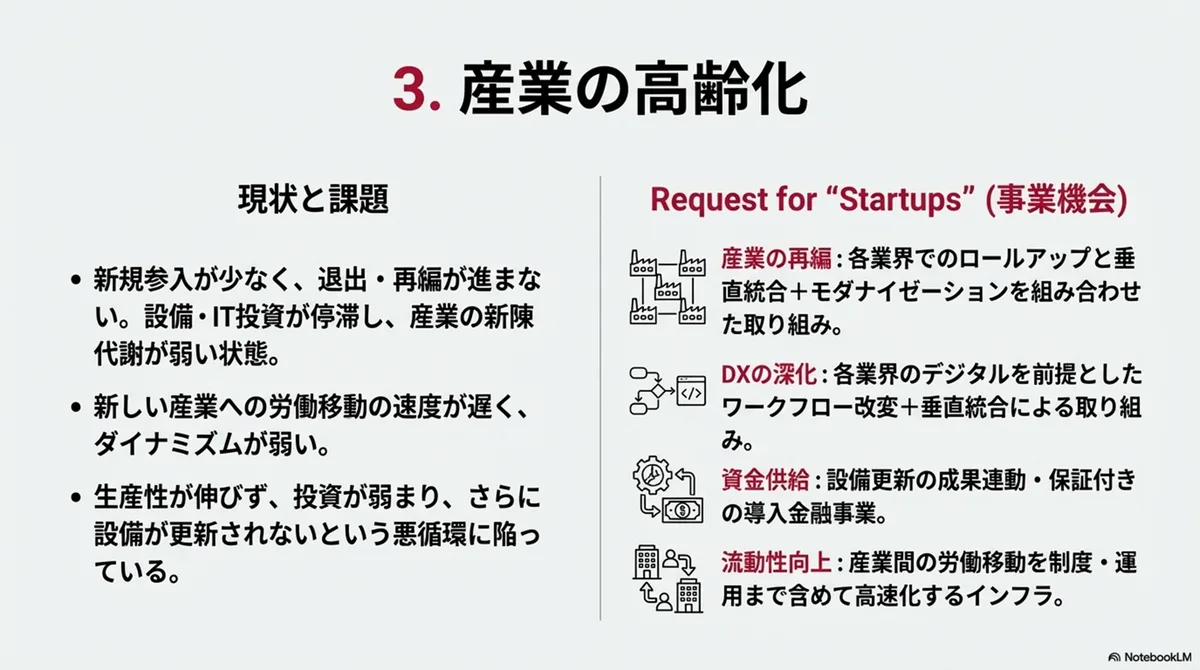
If we call a state in which there are few new entrants, exit and restructuring are slow, and investment in equipment and IT (especially renewal investment) is stagnant the "aging of industry," then it can be said that this tendency is strong in Japan.
Behind the weak metabolism and business dynamics of industry is that:
- The speed at which new industries and businesses grow
- The speed at which exit and restructuring occur
- The speed of labor movement into new industries
are all relatively slow, leaving overall dynamism weak.
Ideally, we should nurture industries that create high added value and can earn even in overseas markets, and channel those earnings back into domestic investment and wages. However, because of the outlook of sluggish domestic demand in Japan and the advance of local production accompanying globalization, a situation continues in which capital investment and wage increases within Japan are slow to progress. As a result,
- Renewal of equipment and systems is delayed
- Productivity does not grow, investment weakens, and renewal of equipment is delayed even more
A vicious cycle like this becomes likely, creating an environment in which new businesses (including startups) have difficulty being implemented in society and scaling.
Meanwhile, in service industries, a delay in nurturing high-value-added industries, weak incentives for software investment and the like owing to a low-wage structure, excessive service driven by "omotenashi" (hospitality), and a preference for custom-built contract development optimized for each client have overlapped, creating a situation where productivity improvement through standardization and software has been slow to progress.
Startups should have been expected to play the role of breaking through this stagnation and creating the next industries, but they have not responded sufficiently (or perhaps they were not aiming at such areas in the first place). I have serious regrets about this.
⏩ What will happen
As labor shortages progress, people are relatively drawn into the areas needed to sustain society, so a structure that creates more added value with the remaining workforce becomes essential.
At the same time, labor shortages encourage consolidation, joint operation, and standardization, strengthening the incentive for restructuring. Many companies are "large domestically but mid-sized globally," and in areas where investment and functions are dispersed, moves to apply economies of scale will probably advance readily.
In the phase ahead, DX and GX will come to the fore not as "things to do if we can" but as themes where "without them, we cannot sustain ourselves as an industry."
❗ How to solve it
I think what is needed is to advance (1) the rebuilding (restructuring) of each industry and (2) the creation of new industries at the same time. Especially in a phase where the labor force is shrinking, the issues become simpler, and we can concentrate on whether we can build "companies and industries that earn a great deal with a certain number of people" (the weight of the "quantity" of job creation falls relatively).
In rebuilding industries, we need actors who redesign workflows on a digital premise and see them through to implementation on the ground. Startups will also be required to play a role of redesigning things to include the value that reaches customers (final goods and services), not stopping at providing tools.
In creating new industries, it will be important to conceive of companies that, like SpaceX and OpenAI, draw in surrounding companies, talent, and capital and become a foundation with ripple effects across industries. For example, I think we need attempts to create companies and industries that grow on a scale that generates a surrounding group of companies at the level of generative AI, rather than simply "using generative AI."
📢 Requests for Startups
- Initiatives combining roll-ups and vertical integration with modernization in each industry (though they are quite likely not to be startups)
- Initiatives in each industry combining digital-premised workflow transformation with vertical integration
- Equipment-introduction financing businesses whose terms are tied to outcomes and come with guarantees
- Infrastructure that speeds up labor movement between industries, including systems and operations
- A vision for industries that will flourish around 2045
(4) Aging of the nonprofit sector
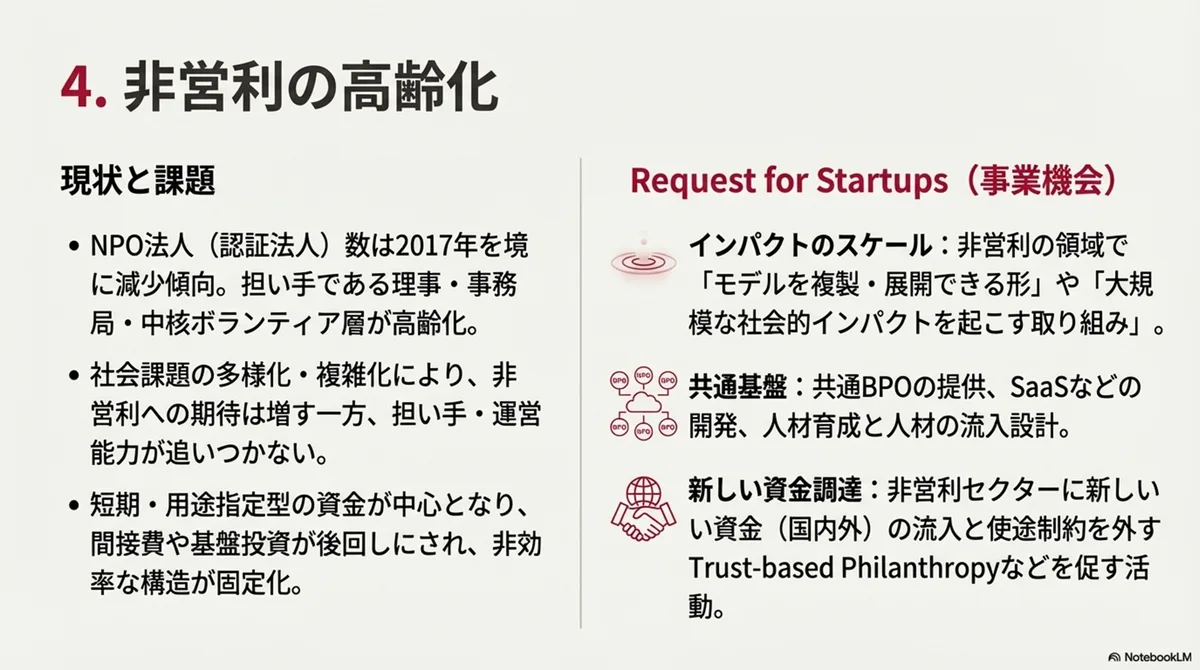
❓ What is happening
The Great Hanshin-Awaji Earthquake of 1995 is called the "first year of volunteering," and since the NPO Act was enacted and came into force in 1998, the base of the nonprofit sector has broadened.
Now, about 30 years later, the number of NPO corporations (certified corporations) has been on a downward trend since around 2017. In some cases the vehicle for activities has shifted from NPO corporations to general incorporated associations and the like, so the vitality of the nonprofit sector as a whole cannot be judged from changes in the number of corporations alone. Still, from what I hear on the ground, the aging of the "bearers" such as board members, secretariat staff, and core volunteers, and the difficulty of keeping young and mid-career people involved, seem to be becoming a bottleneck in multiple fields.
Also, the nonprofit sector has traditionally been expected to play a complementary role in filling the gaps in public services, but social problems have become more diverse and complex, and neither the public nor the private sector is responding sufficiently. The number of young foreign residents has also grown. With more people living alone and weaker local communities, spontaneously arising networks of mutual aid and cooperation are also weakening. As a result, expectations of the nonprofit sector keep growing, while the structure in which bearers and management capacity struggle to keep up is strengthening.
Meanwhile, the management base of NPOs remains fragile. One reason is a structure in which funding tends to be mainly short-term and earmarked, so not enough can be allocated to overhead and foundational investment (recruitment and training, accounting and labor administration, IT, governance development, and so on). I also hear that there is a vicious cycle in which, because frontline staff are busy handling cases, medium- and long-term foundation building is postponed, inefficiency becomes entrenched as a result, and even more time is taken up handling cases.
Furthermore, while funding is increasing in areas close to markets where beneficiaries can bear costs, thanks to impact investing and the like, the fact that the management base of the NPOs that receive it has not developed sufficiently could lead to a lost opportunity for the social impact that should have been created.
⏩ What will happen
Given the population structure and fiscal constraints, there is a possibility that public services will shrink and be restructured, with varying intensity by field (for this, please see articles such as the one from Readyfor's Impact Research Institute).
In that case, expectations of the nonprofit sector from the public sector will grow, but we must be careful because the nonprofit side faces the same labor shortage. Considering that competition for talent is already intense in industry and markets, in the nonprofit field in particular, shortages of specialists and management talent and geographic mismatches (the bearer shortage is more apparent in rural areas) are expected to occur more readily.
Moreover, looking at the environment made visible on social media and elsewhere, I feel that the nonprofit sector is being treated more harshly. There is data that Japanese people have a high level of distrust of charitable organizations, and I think there is also the fact that, because there are few NPOs, if a single organization does something improper, it causes reputational damage to the whole.
If this situation continues, there is a risk that healthy activity will be dampened and that the inflow of new participants, donations, and cooperation will thin out.
❗ How to solve it
I believe the traditional methods of the nonprofit sector (providing services and so on) have value, and I hope that as their numbers grow, more of the problems outside the market can be solved. But I think that with the current structure left as it is, things will only get harder.
Therefore we need to attempt a structural shift, and specifically I think we have to take approaches different from the past, such as:
- Having an orientation toward producing large social impact
- Developing common infrastructure (building digital infrastructure, promoting compliance, mechanisms for developing the bearers of the nonprofit sector, mechanisms for impact evaluation, and so on)
- Activities that earn the trust of the nonprofit sector as a whole, plus activities that draw in inflows
In addition, for areas that can be solved by for-profit means, we should use the power of the market (for-profit and public-private partnership), and we should also advance an overall optimal design so that the nonprofit sector can concentrate on areas that tend to fall through the cracks of the market.
📢 Requests for Startups
I am compiling this out of the thought that what is needed is not for-profit startups but startup-style activity in the nonprofit field that aims for rapid growth in social impact, such as "forms in which a model can be replicated and rolled out" and "initiatives that can create large-scale social impact."
- Activities to build common infrastructure and spread it widely all at once (providing common BPO, developing SaaS and the like, talent development and designing the inflow of talent)
- Activities that encourage new funding (domestic and overseas) to flow into the nonprofit sector and the removal of restrictions on how funds are used (Trust-based Philanthropy and the like)
- Development and proposal of new social mechanisms such as Focused Research Organizations
- Development of AI-Native think tank functions and public access to them
I also list other related articles.

(5) Aging of institutions
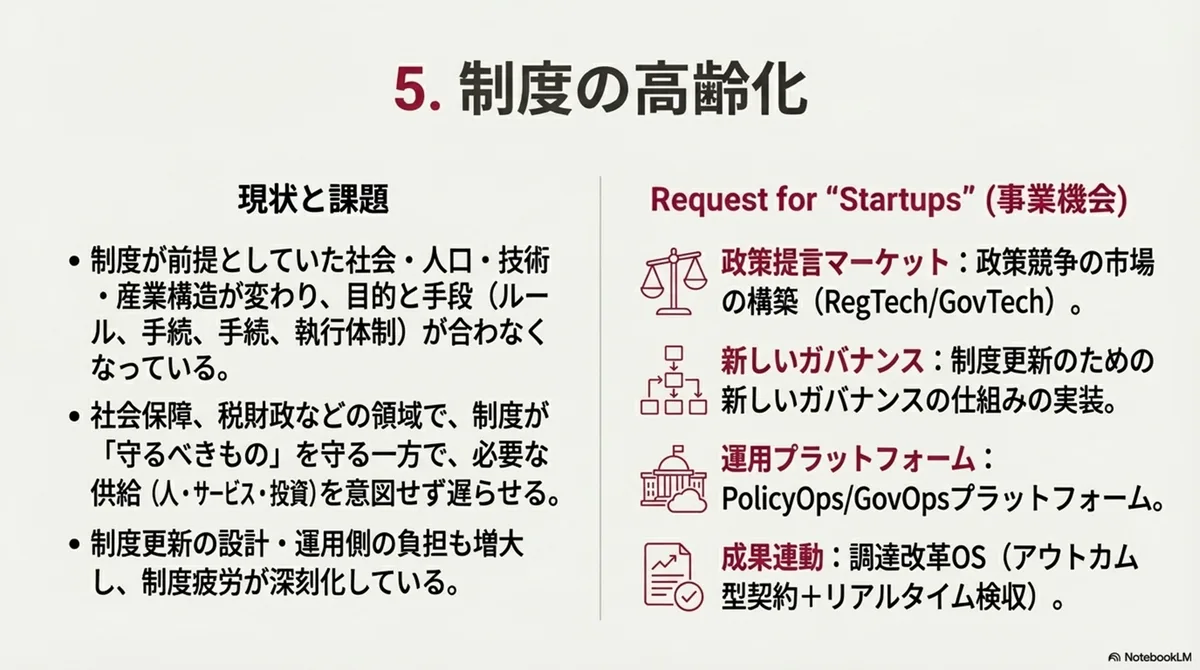
❓ What is happening
Institutions are important tools responsible for safety, fairness, and the containment of externalities. Markets are not perfect and are not suited to redistribution either, so various institutions are needed.
Institutions age. By the "aging of institutions" I mean not so much that the institutions themselves are old, but a state in which the society, population, technology, and industrial structure that the institutions presuppose have changed, so the means (rules, procedures, enforcement systems) no longer fit the purpose, and the institutions come to look old.
For example, the social security system, tax and fiscal policy, infrastructure maintenance and contraction, and the transformation of industrial structure are areas where updates to design and operation struggle to keep up with social change such as shifts in the population structure. As a result, institutions do not fit current problems, and situations in which dissatisfaction builds up become more likely.
⏩ What will happen
The faster social structures change, the more areas there will be in which institutions diverge from their premises. Moreover, even when new technologies and businesses emerge, institutions (licensing and permits, supervision, demarcation of responsibility, insurance, standards, procurement, and so on) tend to be the rate-limiting factor in their spread, and the friction of "the technology exists, but implementation in society does not advance" may grow.
In addition, it is quite conceivable that the side that designs and operates institutions (central ministries and agencies, local governments) will also find it harder to speed up renewal because of hiring difficulties, shortages of specialist talent, and a growing burden of cross-cutting coordination. In such an environment, dissatisfaction builds among workers, and a vicious cycle occurs in which still more workers leave.
As a result, occasions for using outsourcing (surveys, support for institutional design, and so on) may increase, but unless it is accompanied by a design that leaves knowledge of decision-making and implementation within the administration (in-housing, standardization, knowledge management), there is also a risk that the capacity for institutional renewal will weaken over the long term.
❗ How to solve it
Precisely because startups try new things, they are (supposed to be) quick to notice distortions in institutions. What matters when they notice such distortions is not merely to demand deregulation, but to present concrete proposals for renewal while protecting the public interest (safety and fairness). For example, the government finds it easiest to move when a "package of legislative facts" like the following is in place:
- An organization of the purpose of the current system (the value it protects) and its current means (rules and procedures)
- The concrete disadvantages arising from the divergence from premises (delays, supply shortages, costs, disadvantages to users)
- The benefits of newly formulating it (industrial promotion, improved welfare, and so on)
- Alternatives (phased introduction, limited scope, time-limited exceptions, sunset clauses, conditional on demonstration, and so on)
- Risks and guardrails (supervision, auditing, monitoring, demarcation of responsibility, penalties, third-party verification)
- Verifiable indicators (accident rate, complaints, review period, price, user benefit, and so on)
In this way, there is large scope for entrepreneurs to take on the whole process of "discovering aged regulations and institutions, and even creating and presenting a blueprint for renewal." Rather than lobbying, the aim is to maximize the public interest by thinking about how to carry out product implementation that includes regulatory strategy. But it is hard to do this with startups alone, so I think some kind of support organization is needed.
Also, the more people and organizations propose institutions, the higher the quality of alternatives, and policy competition (better proposals survive) comes into play. In Japan, independent think tanks and policy entrepreneurship are relatively thin, and proposals tend to remain isolated points. How to create the "venues and mechanisms" that continually refine and compare proposals and connect them through to implementation is also, I think, an important issue in the overall design.
📢 Requests for Startups
- Building a market for policy competition
- Implementing new governance mechanisms for institutional renewal
- PolicyOps/GovOps platforms
- A procurement reform OS (outcome-based contracts plus real-time acceptance inspection)
Here is a related article.

(6) Aging of ideas
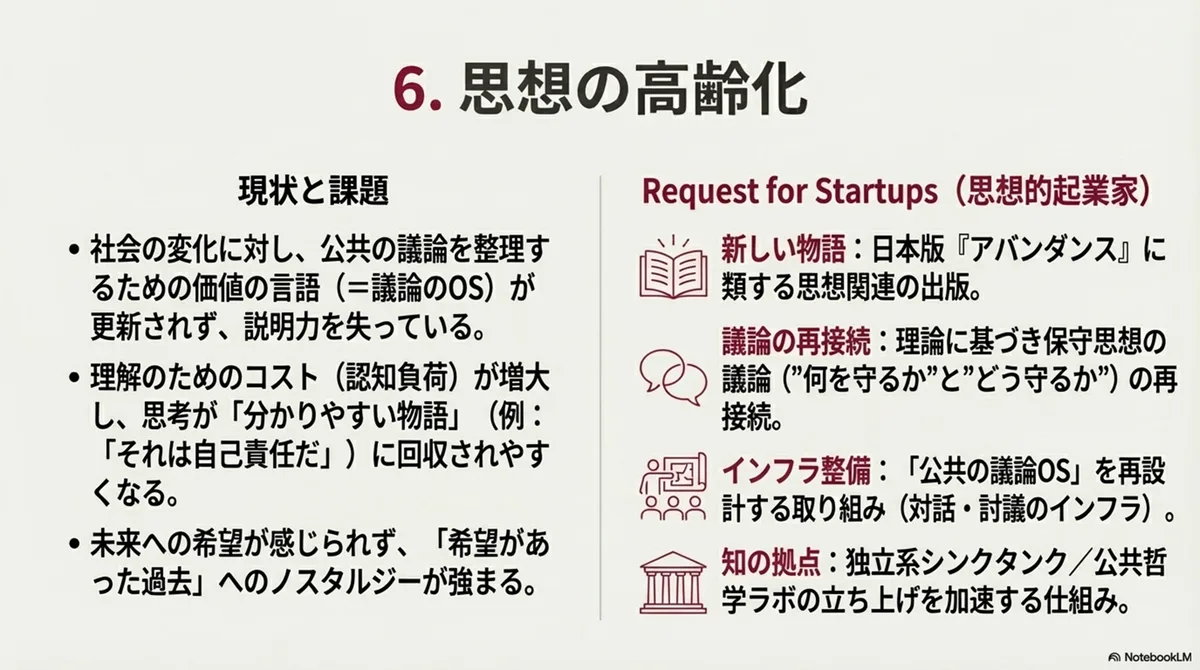
❓ What is happening
By the "aging of ideas" I mean not so much that the ideas themselves are old, but a state in which the premises of society (population, technology, the economy, the international environment, lived experience) have changed, yet the frameworks of language and values with which we organize public debate, build solidarity, and make decisions have not been updated and have lost their explanatory power.
For example, in recent years in Japan too, there have been moments when interest has grown, mainly among young and mid-career generations, in political forces and discourses different from the existing frameworks, and conversely when expectations of established parties have stagnated. I feel this may be a sign that people are beginning to seek "new ideas."
Also, claims that would once have been categorized as "extreme" have recently come to gain a certain level of support.
In the American context as well, it seems that there are more issues that are hard to grasp through the liberal/conservative axis of conflict alone. The problems on the liberal side are pointed out in works such as "Abundance," and I feel that this partly applies to Japan too. Conservatives, at home and abroad, also at times seem to be drifting, pulled along by the mood of the times without reflecting on what conservatism is (of course, this is to a considerable degree an impression based on my own observation).
The international order is also wavering. Terms such as G0 and G2, rather than G7, are flying around, and a balance of power different from the past is coming to the surface. Also, just as I was finishing this blog post, the United States used military force against Venezuela. I feel the time has come to think anew about how to deal with countries that accept changing the status quo by force, what ideas Japan will hold to, and how it will contribute to the international community.
⏩ What will happen
As society grows more complex, conflict and confusion arise more easily. Also, though this is only an impression, the more complex society becomes, the more the cost of understanding (cognitive load) increases, and the worse life gets, the less room we have, so our thinking is more easily collected into "easy-to-understand stories."
For example, we are drawn toward simple, strong explanations such as:
- "My life isn't getting better because of ○○"
- "That's your own responsibility (it's your fault)"
Conflict then intensifies, and when this is combined with the mechanisms of visibility and spread on social media, anxiety, anger, and the need to belong are amplified, making society more fragile.
I also feel that the prevalence of nostalgia for an idealized "past in which there was hope," as in Make America Great Again, is the flip side of hope for the future thinning out, and may be a sign of losing the "sense of being valued."
In such an environment, unless ideas are updated, I think the following are likely to occur:
- Intensifying division (issues cannot be organized, and people easily slide into personal attacks and attacks on attributes)
- Policy stagnation (consensus cannot be built, so nothing can be decided, or what is decided does not last)
- Erosion of trust (distrust of institutions, media, and expert knowledge chains together)
- Domestic cohesion becoming fragile in the face of uncertainty in the international environment
❗ How to solve it
We must spin a new story of hope for the future.
The "story" I mean here is not propaganda, and does not mobilize fervor by creating enemies. It is a body of ideas that lets people keep their dignity, reach agreement, and move forward in a complex reality.
Moreover, if we can shape a new framework of ideas, I think Japan could also have a large presence in the international community. That means becoming a leading actor in rule-making for a new order.
How to shape this is, I think, the startup-style activity called for now. In a sense, startups of ideas are needed, and running various prototypes may be an opportunity.
📢 Requests for Startups
The following are intended not for for-profit startups but for people who are thought leaders or entrepreneurs of ideas.
- Publishing on ideas in the vein of a Japanese version of "Abundance"
- Theory-based discussion of conservative thought (reconnecting "what to protect" and "how to protect it")
- Efforts to redesign the "operating system of public debate" (infrastructure for dialogue and deliberation)
- Mechanisms to accelerate the launch of independent think tanks and public philosophy labs
For ideas, please also refer to the following articles.


Conclusion: Preparing order and its underlying structure
As the international order and ideas that lasted for decades weaken, I feel we have entered an age of shaping new orders and new ideas.
Unless our generation builds a new order, but at the same time, what is needed when undertaking such efforts is stable living to support them, and beyond that, the hardware and economy that support it, I think.
I hope the number of people interested in even one of these efforts will grow, and if there are people trying to take on these multiple challenges within a single scope, I think we can work on something together.
In that sense, Requests for Startups may in a way be a request to find companions.
The above is, after all, only my personal thinking, but I have set down my thoughts as of now (I wrote it quickly, so it may change again soon...).