Elites, Redistribution, and Updating the Social Contract
This article was machine-translated from Japanese by AI (Claude). It may contain errors. Read the original Japanese article.
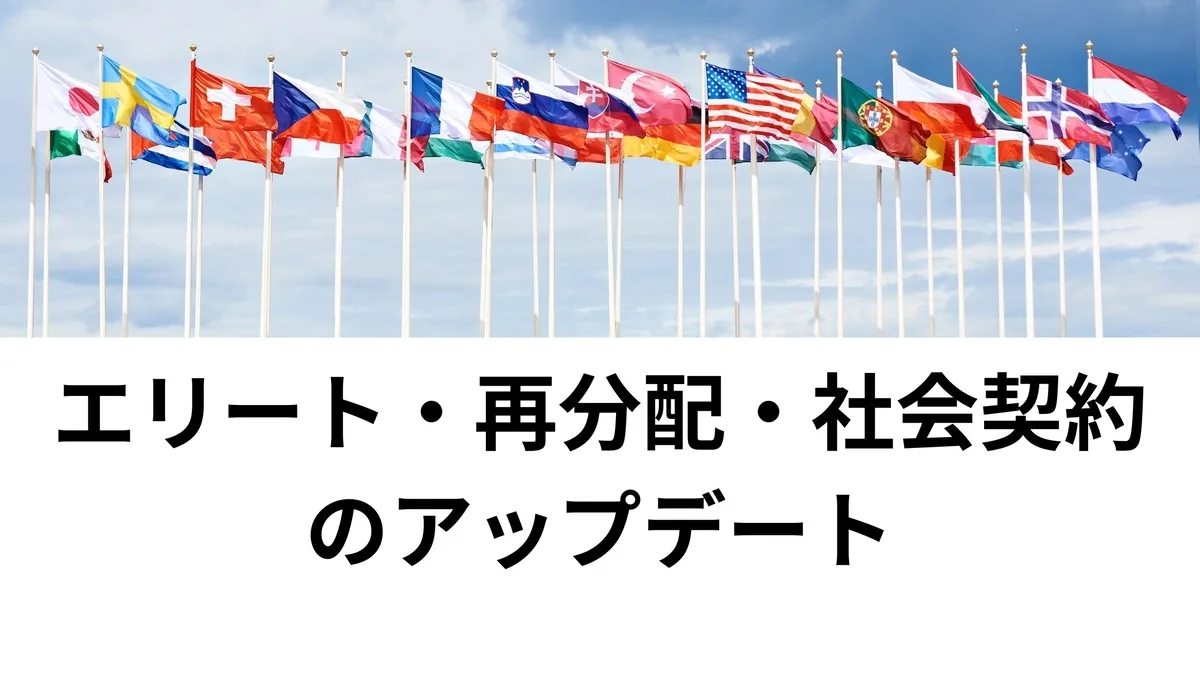
Summary by NotebookLM
One of the responsibilities I feel, as an individual working at The University of Tokyo, is, if I may say so, to contribute to the organization through everyday work such as education and services while also aiming to maximize the interests of society and the public good.
Given the socially and financially privileged position of a school that is among the country's leading top schools and that produces elites, I do my work thinking that it is not enough to simply increase the private interests (including the interests and curiosities) of the organization, its individual faculty members, and its students; we need to be conscious of "contributing to the public good" and of "benefiting many people."
In the Case of Startups
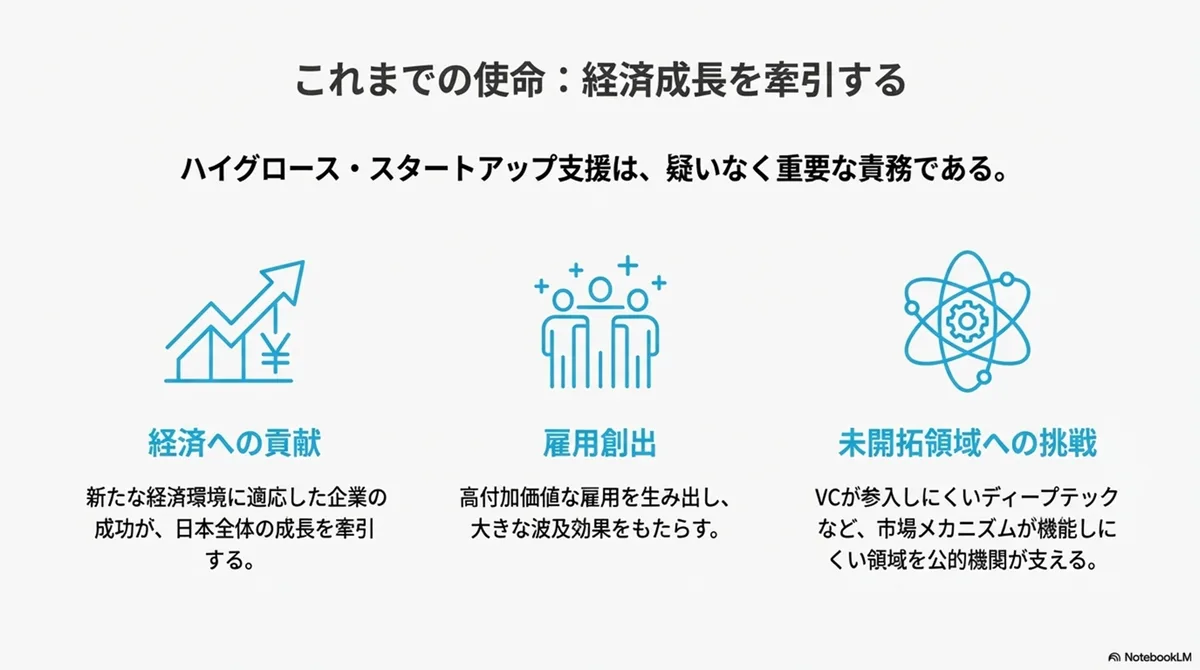
Applying this to my own duties, "supporting entrepreneurship at a university" and "entrepreneurship education," I think it means supporting the creation of large companies that will drive the next generation of economic growth (and searching for ways to do so), and nurturing better entrepreneurs and elites.
As for supporting entrepreneurship, if new companies suited to the new economic environment succeed, they can contribute to economic growth across Japan, and large ripple effects can be expected, such as the creation of high-value-added jobs. I personally believe that the significance of supporting not all startups equally, but specifically high-risk, high-growth startups and entrepreneurs tackling major problems, lies in those ripple effects and in the responsibility from a public-interest perspective.
I also believe that working at a public institution such as a university means taking on areas where market mechanisms do not function well. That is why I work with the sense that there is meaning in supporting phases (such as the stage before commercialization) and fields (such as deep tech) that ordinary VCs find difficult to enter.
In terms of the people we send out into the world, taking on startups that could become the industries of the next generation has, for the past several years, been expected to be a field where elites take up the challenge. In fact, many of them are relatively resilient against career risk, so they are originally well suited to taking on such high-risk challenges. (Of course, it also depends on the individual's disposition and wishes.)
I think that presenting the career option of founding a company in a high-risk field that can drive economic growth and has social significance is one of those responsibilities.
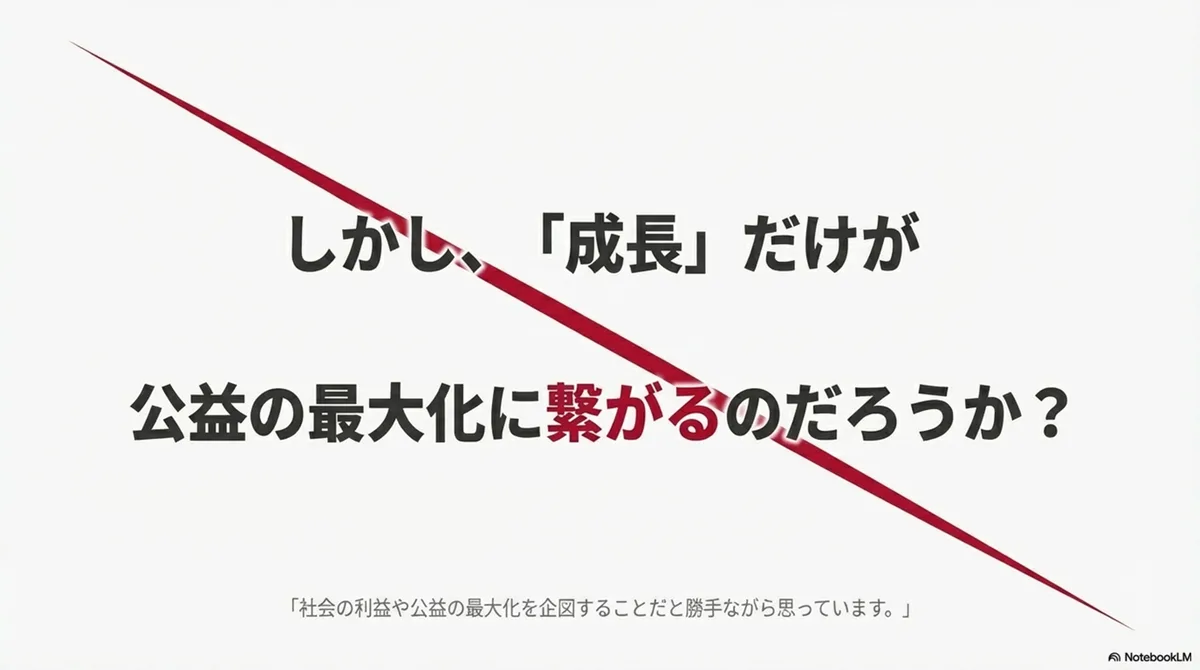
That is the story so far. While I continue to feel the importance of these efforts and will keep pursuing them, I also feel that support aimed only at the fruits of this economic growth is making it harder to maximize the public good.
Changes in the Image of the Elites We Should Produce
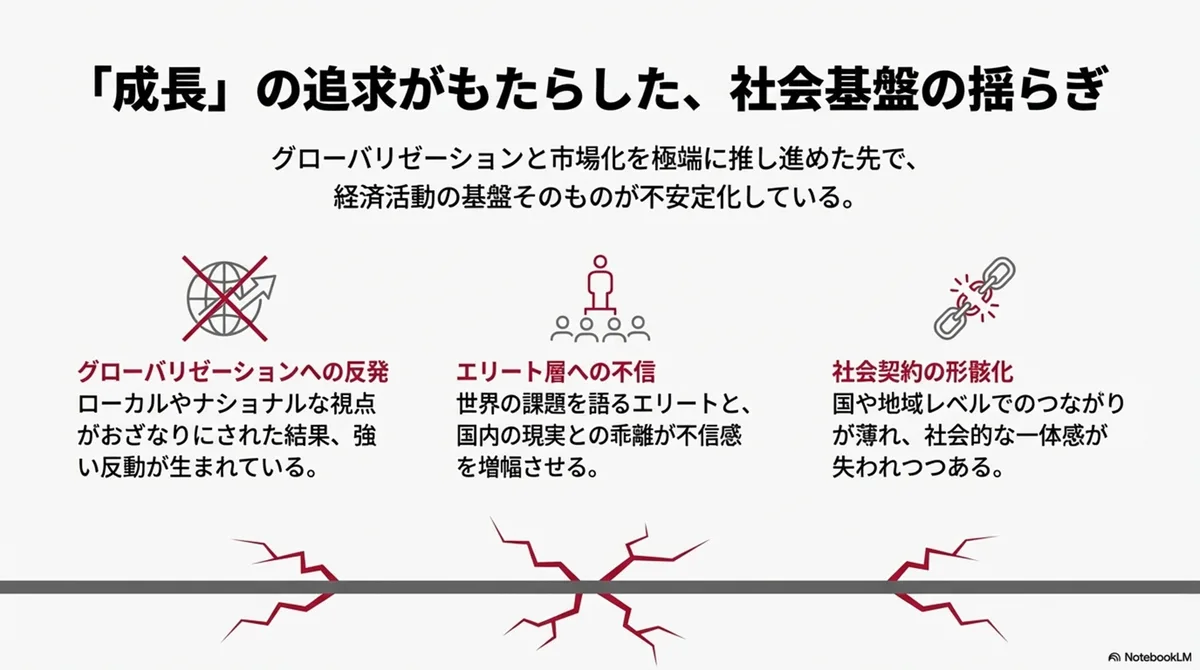
In the past, being an elite meant supporting the nation. In Japan, too, many people graduated from the University of Tokyo and went on to become government officials.
Over the past few decades, however, as globalization has advanced, the interests of society and the public good have come to extend beyond a single country, and there are increasingly more matters that must be considered at the level of the whole world rather than the nation. It could also be said that the scope of "society" has expanded to the global level.
At the same time, privatization and marketization advanced in various fields. Economic growth for the entire world was pursued, and many people entered the race. Because there were also economic incentives unique to the private sector, I think even elites naturally came to choose careers in private companies.
Japan's private-sector elites also connected with global elites and discussed the world's problems, for example at the Davos meeting.
Looking at the achievements of University of Tokyo graduates, I think we have contributed to a certain degree to producing people who can talk with such elites of the world about matters concerning the world as a whole.
On the premise that these things also have important value, in the United States, which could be called the extreme case of this, backlash against globalization and distrust of the elite class and scientists have erupted, and political polarization has advanced through the media and elsewhere, so that the society that forms the foundation of economic activity looks very unstable.
As a result, a return to the national seems to be occurring, and the foundation for talking about humanity's problems seems to be crumbling (though this too may be a view from someone close to the elite...).
While speaking about the world's problems, we must also properly address the problems of our countries and regions. If this recognition is correct, then even at Japanese universities, we will have to reconsider more carefully the image of the "global elite" that has been the mold for the past few decades, what elites should contribute to society, and the social functions expected of elites. At the University of Tokyo there was also the phrase "tough and global students," abbreviated as "Tafuguro," and I feel we are approaching a time when part of that needs to shift.
Innovation in Redistribution
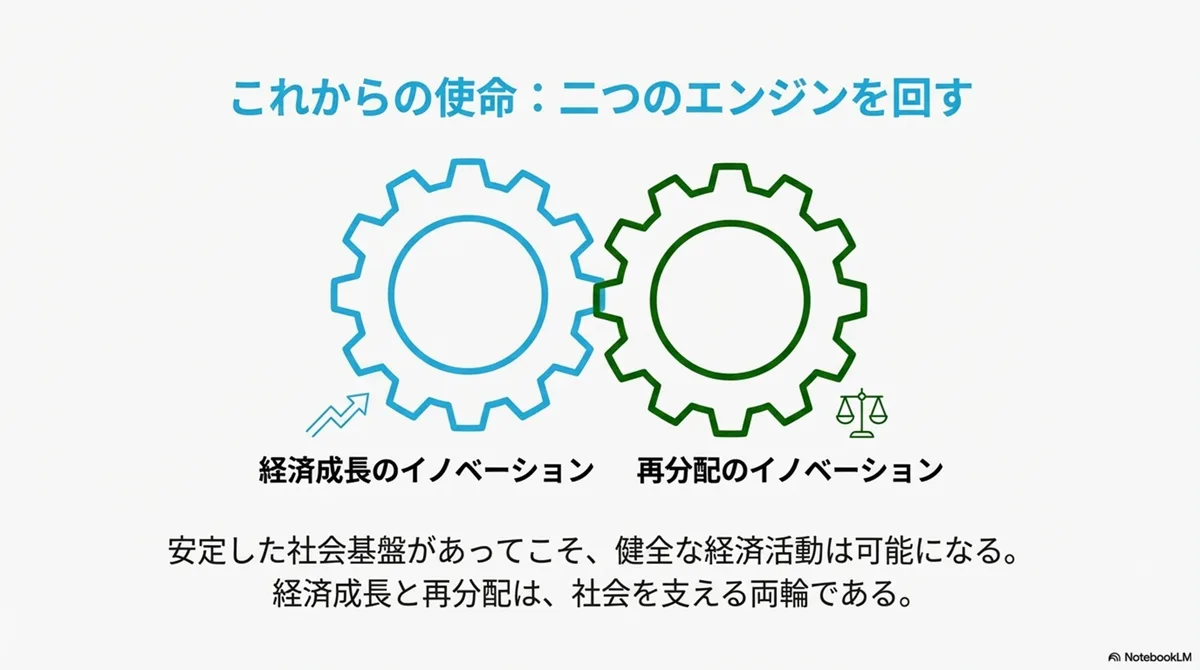
When I think about what kind of people we should be producing, I think one answer is people who do new things in the area of domestic redistribution.
When we think about the economy needed for social stability, the two great wheels are economic growth and redistribution. A society in which the economy grows and the fruits of that growth are appropriately redistributed is relatively stable.
A stable society can exist only with healthy economic growth. At the same time, healthy economic activity is possible only with a stable social foundation.
Of these, I think the latter (healthy economic activity is possible only with a stable social foundation) has tended to be overlooked until now, but looking at the movements of the world over the past few months, I feel its importance anew.
In the sense of aiming for such social stability, we must create not only "innovation for economic growth" but also "innovation in redistribution," and if people are needed for that, then as a school that produces elites we must respond. This is what I have been thinking about recently.
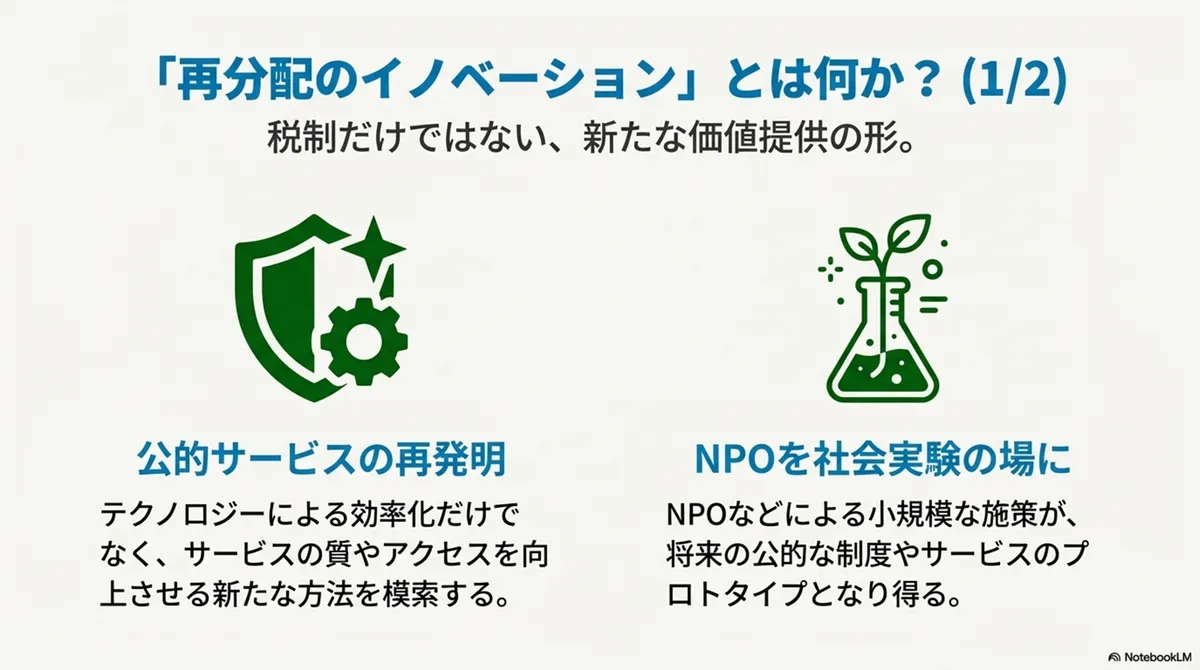
Of course, the government carries out most redistribution. Institutional redistribution is the main castle.
Still, small attempts should be possible for individuals and small organizations.
The means of redistribution are not limited to the redistribution of money. It is also provided in the form of public services. Services can be provided even through small attempts, and innovative methods may be found from there. (When we say innovation, efficiency through technology comes to mind, but I am including things that are not that.)
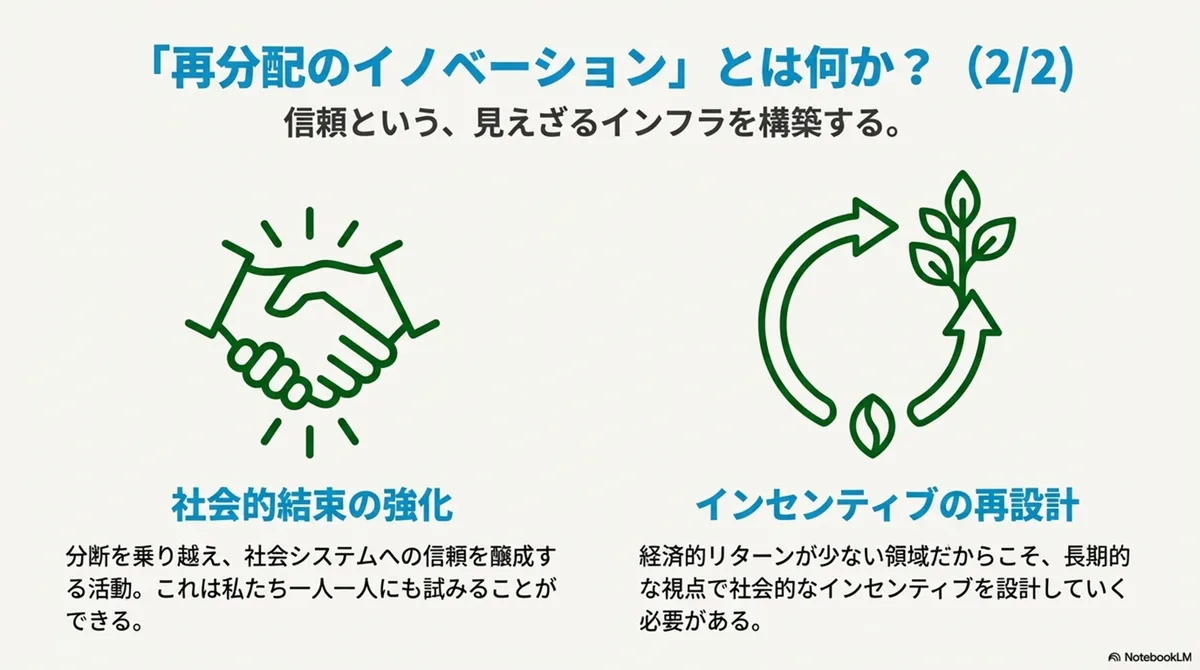
I also think that strengthening the social cohesion and trust in social systems that underpin redistribution is something each and every one of us can try.
Just as a startup may become a large company of the future, small initiatives carried out by NPOs (in the broad sense) and others can become future institutions.
I am thinking about whether there is something we can do to support such attempts.

Unfortunately, compared with economic growth, such attempts are by no means economically rewarded. I think economic incentives need to be put in place over many years, but that will not happen quickly.
That is exactly why those who can need to do what they can within their means, and we must also think about guiding more of those called elites toward this, or nurturing them.
At the University of Tokyo as well, I think President Fujii and others often mention social entrepreneurship. So-called social entrepreneurs or Public Entrepreneurs may be where this ends up.
My own recent sense is that unless we nurture such people, in the broad sense, alongside elites who aim for economic growth, it is becoming difficult to maximize the public good.
Updating the Social Contract
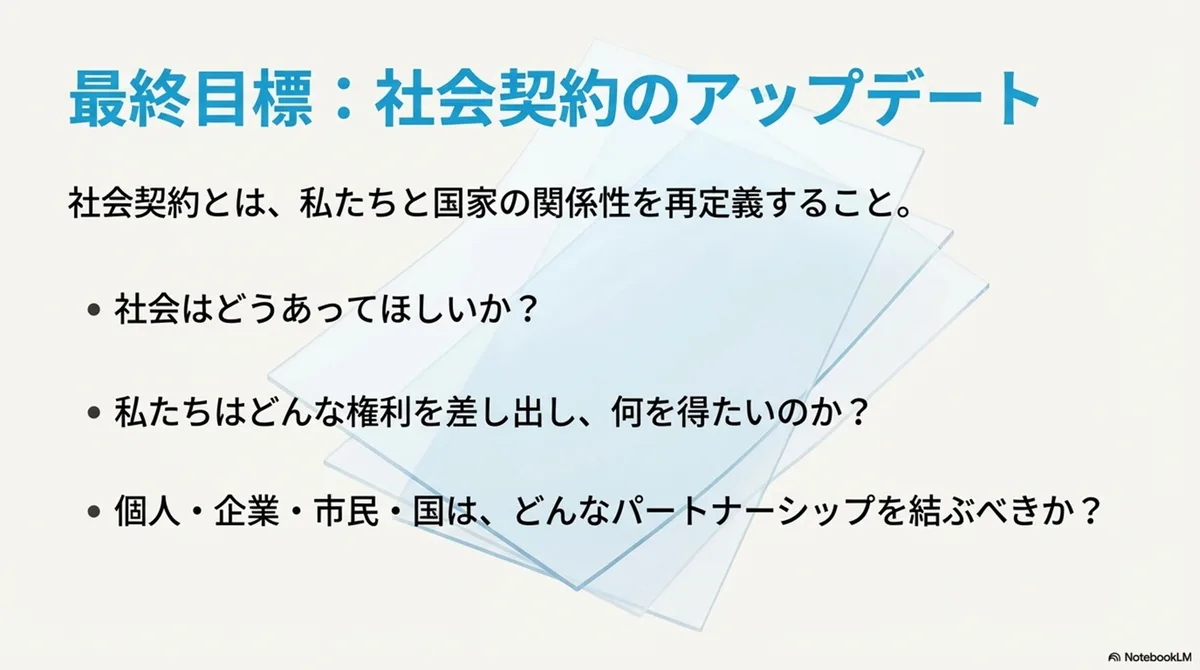
Looking around, calls for tax cuts are growing in Japan at present. This seems to stem from the current economic problem of financial hardship, and I think it is important to respond in some way to such voices in line with an economy that is experiencing inflation.
However, I think that behind these discussions of taxes and social security, there is also a strong element of an outburst of social discontent and, further, an objection to the conventional social contract.
For example, one view (my personal one) is that voters in their 20s to 40s and the middle class are beginning to show support for parties advocating tax cuts out of a feeling that taxes and social security contributions are not being used well, that they pay taxes but do not benefit, and that "us" is not on the agenda.
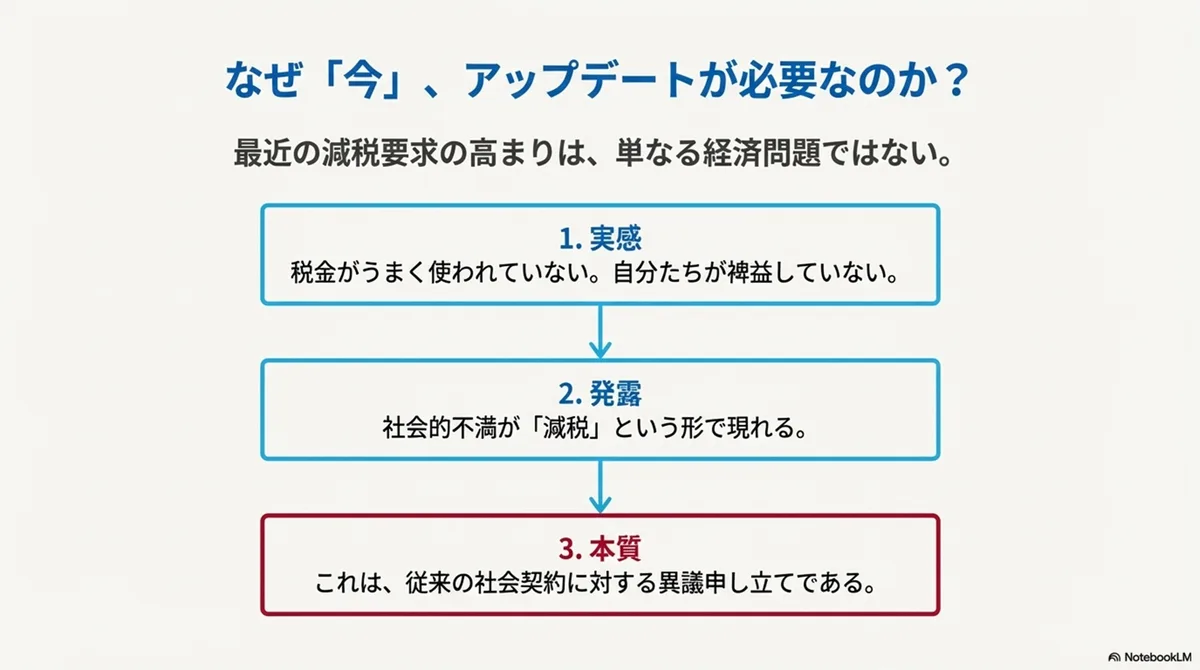
I also hold the view that, while moves by elites toward a global social contract were energized in the 2010s, in some countries the national social contract has broken down or is on the verge of doing so.
If, by making the scope of "society" global and looking only at private-sector connections in markets and at economic growth, connections at the local and national levels have grown thin, and as a result the social solidarity that underpins redistribution and the local and national social contracts have inevitably been neglected, then I think we should reflect on that, and elites need to contribute at the national and local levels while also solving humanity's problems at the global level.
The agenda and awareness of the problem that the social contract needs to be renewed can be seen in the fact that, recently, several books with "social contract" in their translated titles have been published (such as "A Social Contract for the 21st Century" and "A Social Contract for the 99 Percent"). This matter is also somewhat related to Žižek's recent remark that "we need to reinvent a progressive patriotism that embraces all of the left."
I am using the difficult term social contract, but put simply, it is about how we want society to be, and for that, what rights and freedoms we hand over to the state and what we want to receive from the state, and what kind of partnerships individuals, companies, citizens, and the state should form to increase collective benefit.
Yet if we are going to think about this, we have to go beyond the abstract level of the social contract and, based on more concrete concepts (such as what kind of society we envision), consider specifically how to update laws, institutions, social norms, rights and obligations, and so on. For that, we need a deep understanding of the current state of society and an image of an ideal society.
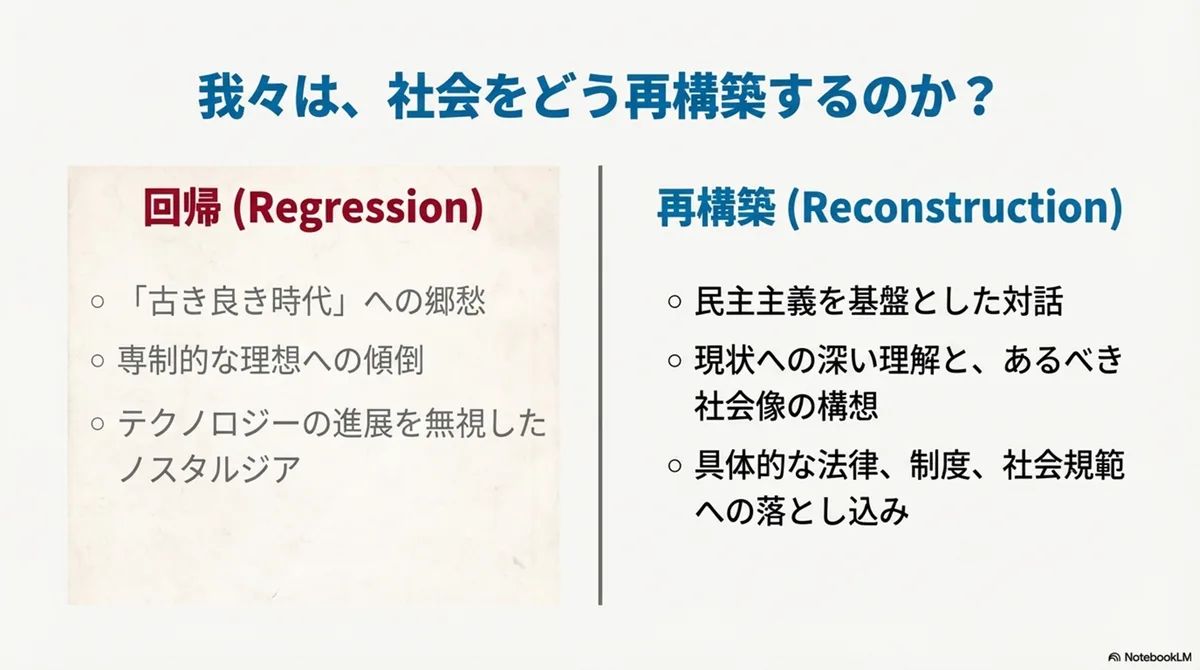
In the course of such attempts, I think there will also be people who take the "good old days" or authoritarian arrangements as the ideal for such a social contract and try to return to those times. But considering the advance of technology and other developments, such attempts will be difficult, and if we want to keep living in a democratic world, I think we must think about and act on counters to them.
Summary
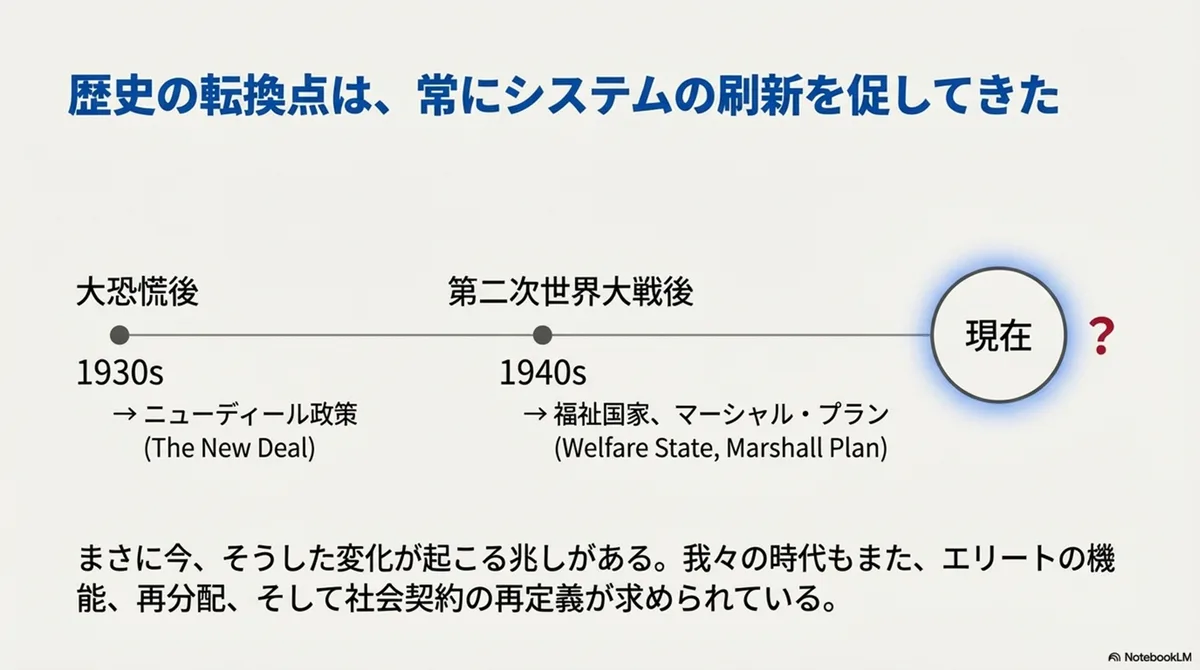
At turning points in history, the structure of the economy is sometimes renewed. After the Great Depression came the New Deal, and after World War II came the welfare state and the Marshall Plan.
Sensing signs that such a change is about to occur right now, in this piece I have tried, though without it coming together neatly, to talk about the need to redefine the function of our elites, to nurture them, to address redistribution, and to update the social contract. I hope to keep moving forward on these matters through daily trial and error.