Unbundling the University
This article was machine-translated from Japanese by AI (Claude). It may contain errors. Read the original Japanese article.
The university is an institution with a longer history than the modern state or most companies. Over that long history, the university, as a vessel for nurturing knowledge and people, has endured across centuries. That is why I think the time horizon for considering the significance of the university should not stop at a few years of reform or a ten-year plan, but should be measured in decades, or even in generations.
For example, much of the current system for science and technology research began in 1945, with the end of World War II. However, as I looked back at the prewar and postwar periods in an earlier article, about 80 years passed from the Meiji Restoration (1868) to the end of the war, and about 80 years have now passed from the end of the war to the present. It may be worth reconsidering whether maintaining the 1945 system is the right thing to do.
In fact, the international order is now on the verge of major change, and I see various moves related to science and technology in other countries.
Signs of change in the postwar science system
The greatest influence on the current shape of the university came from the Bush report of July 1945.
Vannevar Bush, director of the U.S. Office of Scientific Research and Development (OSRD), submitted the report "Science, the Endless Frontier" to President Truman. It was a plan to carry over into peacetime the wartime experience of mobilizing university researchers to develop radar and the atomic bomb.
Its content was a strongly public-investment philosophy, and a social contract: the government funds basic research at universities but does not interfere with its substance, and the results are eventually returned to society as new industries, public health, and national defense capability. This idea became an institution with the founding of the National Science Foundation (NSF) in 1950, and the postwar American research university became a model for other countries.
Change is now occurring in the United States. In May 2026, the NSF announced the creation of "NSF X-Labs." Over the next ten years, it will invest $1.5 billion to set up independent research organizations outside academic institutions, giving dedicated teams autonomy in operations and funding tied to milestones.
There is also debate that questions the very role of the university. In his 2025 essay "Unbundle the University," Ben Reinhardt argued that the university is a "bundle" that holds together education, research, credentialing, technology development, policy advocacy, sports entertainment, and even asset management, and that specialized institutions taking on parts of it should be increased outside the university.
The view of bundling and unbundling (binding together and separating) is one that tech blogger Ben Thompson and analyst Benedict Evans have used to read the structural transformation of the newspaper, television, and software industries. Drawing on Ben Reinhardt's essay, this article applies the unbundling view to the university and is an essay-style attempt to think about the future of universities in Japan along a long-term axis.
First, let us look back at what the university has bundled.
Part I: What does the university bundle?
First, I will organize what the university bundles into one.
The university is not an institution only for education and research
The university has a variety of functions and services, and sells them to students as a single set (a bundled product). But today's university also has various stakeholders other than students.
In 1958, Clark Kerr, president of the University of California, said jokingly that the three major problems of a campus are "sex for the students, athletics for the alumni, and parking for the faculty." Neither education nor research is included. Organizing the functions the university has carried gives the following.
| Function | Examples of content |
|---|---|
| Education | Lectures, seminars, liberal arts education, transmission of specialized knowledge and skills |
| Selection and certification | Admissions selection, conferral of degrees, signaling to companies |
| Research | Exploring and verifying new knowledge, training the next generation of researchers |
| Custody of knowledge | Libraries, museums, accumulation of specimens and research data |
| Transition of young people and communal living | Dormitories, clubs and circles, meeting friends and partners |
| Network formation | Alumni associations, job placement, mutual support after graduation |
| Sports | Competitions and entertainment under the university's name |
| Medicine | Advanced clinical care at affiliated hospitals |
| Asset management | Managing donations and endowments |
| Social implementation and policy support | Industry-academia collaboration, technology transfer, policy advice, regional revitalization |
Functions other than education and research are not small. In the fiscal 2023 financial results for Japan's national university corporations as a whole, about 40% of the roughly 3.4266 trillion yen in ordinary revenue is revenue from affiliated hospitals. In the United States, the endowments of 657 universities total $944.3 billion.
Even among some people in industry, one often sees them talk proudly about having "not gone to class," seeing a considerable part of a degree's value as lying outside the lectures.
Why it has been bundled, and why it is being unbundled
Why have such diverse functions been bundled into a single institution? I think there are at least four reasons: the technological constraint that people had to gather in one place to deliver knowledge; the credibility the university provides; finances that pool diverse revenue into one; and expectations from the state, companies, and others.
The technological constraint becomes easier to understand by comparison with newspapers. In "The Great Unbundling" (2017), Thompson explained that newspapers could combine news, advertising, classifieds, and weather forecasts because they controlled expensive distribution infrastructure: printing facilities and delivery networks. In the university too, the transmission of knowledge once required teachers and students to gather in the same place, and the campus and the faculty were scarce distribution channels, like a newspaper's printing plant and delivery network. Facilities with large fixed costs, such as libraries and laboratories, are also cheaper when shared across many departments. When research in the 20th century came to require enormous facilities, being a large organization able to maintain them became a strength in itself (we will see this in Part IV).
The university's brand has worked as credibility that guarantees, together, the quality of education and the abilities of graduates. This credibility is also supported by institutions. In Japan, the only bodies that can confer degrees under the law are universities and the National Institution for Academic Degrees and Quality Enhancement of Higher Education. In the United States, federal student aid can be used only when studying at an accredited institution. Because the place of study, the proof of what was learned, and even the funding of tuition are tied to the same institution, it is hard for students to choose separate providers for each function.
On the financial side, what has supported the bundle is that tuition, state grants, research funding, and donations flow into a single purse. Under this arrangement, cross-subsidization works, supporting fields that struggle to generate profit with other revenue. Indirect costs added on top of research grants also support shared foundations such as libraries and administrative organizations. Being a bundle has also served as a mechanism that protects disciplines that could hardly stand on their own.
The state and companies have also concentrated functions in the university. The state entrusted research and the training of specialized personnel to universities in order to prepare for international competition. The Imperial University set as its purpose to "meet the needs of the state", and the postwar United States poured federal research funding into universities in line with the 1945 Bush report. Today, international university rankings encourage consolidation and scale. Companies have left recruitment screening to university entrance examinations, and have also placed expectations on universities as partners for joint research. Households expect their children to find jobs, and regions expect young people to stay and talent to be trained. Each time a new issue arose, it was faster, and easier to explain in the budget, to load it onto an existing university than to create a dedicated organization, I think.
The universities, for their part, took in these expectations as opportunities for growth. They obtained research funding and expanded graduate schools and institutes, took on businesses such as affiliated hospitals, athletic teams, and asset management, and with each added function increased their scale and influence. This is the picture Clark Kerr, then president of the University of California, described in 1963 when he called the giant university with its diverse functions and stakeholders the "multiversity." On the other hand, the more funders there were, the more deeply universities came to depend on the state and companies (we will see this in Parts IV and V).
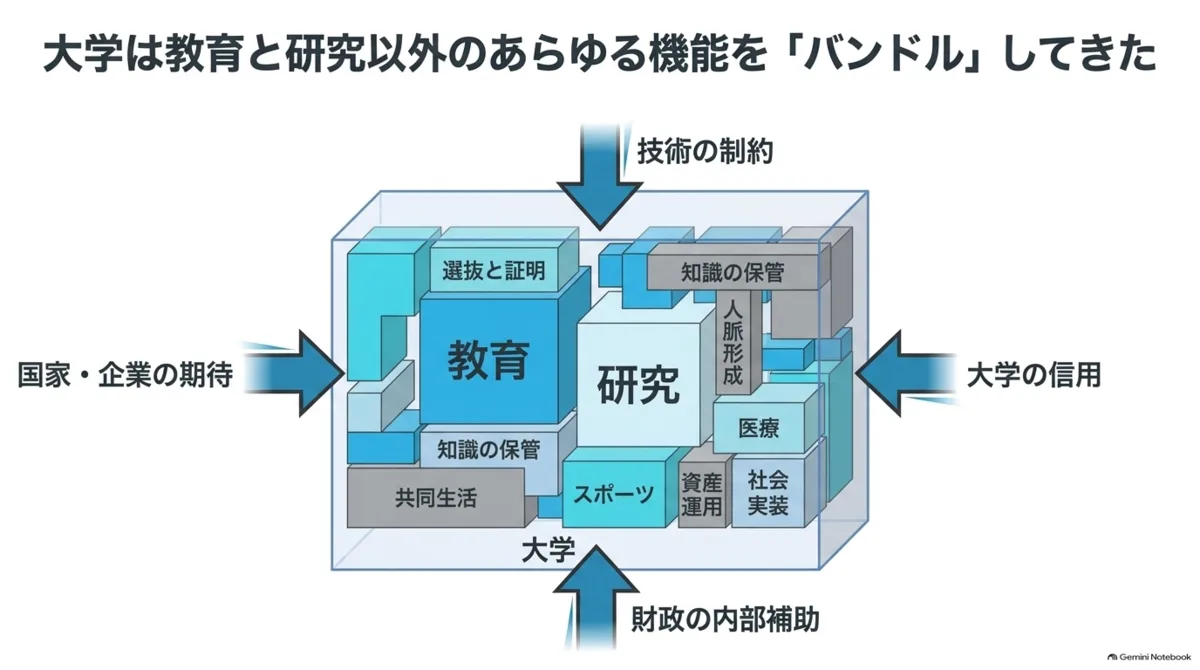
These four reasons reinforce one another. When funding from the state and companies gathers, research and facilities are enriched, which raises the brand and attracts excellent students and the next round of funding. For that reason, the bundle does not come apart immediately even if any one of them weakens.
What the internet weakened was mainly the technological constraint among the four reasons. As distribution costs fell, newspapers and cable television were taken apart by use, and Evans argued that internet services repeatedly cycle between bundling and unbundling. When MOOCs drew attention in 2012, Clay Shirky also wrote "MOOCs are our MP3, and Udacity is our Napster," and saw the same change coming to universities.
But the collapse of the university did not happen. The credibility of the degree, the flows of tuition and research funding, and corporate hiring practices remained tied to the university, and the personal connections and rites of passage that the investor Staton counted as part of a degree's value could not be replaced by online courses. I think unbundling advances when a better provider for a specific function appears outside, and the flows of funding and credibility also head toward that provider.
If so, the question to ask is not what becomes cheaper, but what reason there still is to keep things bundled. Functions for which being a bundle is a strength also persist: expensive facilities that can only be maintained jointly, the cross-subsidization that supports disciplines that struggle to generate profit, and the community of researchers who take a long time to verify knowledge together.
On the other hand, there must also be functions that remain only because the paths of funding and credibility run solely through the university, even though the reason to keep them bundled has faded. Now that AI is lowering the cost of individual tutoring and feedback on assignments, and governments and foundations have begun to fund research organizations outside universities directly, telling these two apart has become a more pressing issue than before. To move the latter outside the university, I think it is necessary first to create paths through which funding and credibility reach the outside providers.
Part II: The way science is done is beginning to change around the world
For about the past ten years, a movement has been spreading around the world to question how science is conducted and to try out new ways of doing research.
(1) Metascience, which studies and experiments on the way science is done, is spreading
Metascience is the field that tests how science is conducted, such as how research funding is allocated, the validity of peer review, and the design of research organizations, using data and experiments. In the 2010s, the "replication crisis," in which many papers could not be reproduced in follow-up studies, and the concern that breakthroughs were becoming harder to produce even as funding and researchers increased, gave it momentum. In 2019, the Research on Research Institute (RoRI) was established in the United Kingdom.
Governments are moving too. In 2024, the United Kingdom set up the Metascience Unit, a joint body of the Department for Science, Innovation and Technology and UK Research and Innovation (UKRI), and began comparative experiments on how research grants are reviewed. It reported that distributed peer review, in which applicants evaluate one another, could shorten the review period by up to 65%. A characteristic of this trend is that it does not stop at ideals but actually launches prototypes of new organizations and funding allocation mechanisms and tests them.
(I also wrote a little about metascience in another article before.)
(2) New research organizations are emerging outside universities
New forms of research organization have also begun to be explored. A representative example is the FRO (Focused Research Organization). It is a format promoted by the nonprofit Convergent Research, which develops research infrastructure tools and large-scale datasets that do not fit well with either papers or product development, using dedicated teams with deadlines and quantitative targets. Ten have already been launched in the United States, and two more started up in the United Kingdom in 2026. As Reinhardt points out, the main workforce in a university laboratory is graduate students who turn over every few years, and evaluation is biased toward highly novel papers. The FRO is an organization designed to avoid those constraints.
There are also independent institutes that guarantee long-term funding to individual researchers. The Arc Institute, established in 2021, works with Stanford University and the University of California and gives its core investigators eight-year terms (renewable) and funding with no restrictions on use. In the public sector too, DARPA-style institutions, in which program managers (PMs) with wide discretion lead high-risk research, have spread to ARPA-E, ARPA-H, Germany's SPRIND, and the UK's ARIA (launched in 2023). The NSF X-Labs introduced at the beginning is an extension of these. In 2023, Reinhardt himself also founded Speculative Technologies, a nonprofit that advances research and development in materials and manufacturing technologies that fit neither universities nor venture capital.
(3) Funding for research is beginning to come from nonprofits such as foundations
What supported the postwar research university was competitive funding from the government, such as the NSF and the National Institutes of Health (NIH). According to the Science Philanthropy Alliance's estimates (2024 data), the share of research at U.S. universities and nonprofit research institutions funded by the federal government fell from over 70% in the 1960s to 50% ($63.6 billion) in 2024. Philanthropy, which combines funding from nonprofits such as foundations and spending from endowments built on past gifts, was $27 billion, accounting for 21% of the total.
Foundations are no longer merely entities that donate to universities. HHMI opened its own research site, the Janelia Research Campus, in 2006, and the Simons Foundation opened the Flatiron Institute in 2016, while the Chan Zuckerberg Initiative established the nonprofit research organization Biohub. The Arc Institute too was established with a gift of more than $650 million from Patrick Collison and others.
Nonprofit funding has the characteristic that it can be continued for specific researchers or organizations over a longer period than government funding, which is bound by single-year budgets. On the other hand, where it goes tends to be swayed by the funders' interests, and according to the Alliance's 2023 report, 72% of nonprofit funding going to research in the sciences at universities appears to have been devoted to biology, medicine, and health sciences (fiscal 2021). Even so, it can be said that the paths for obtaining funding are steadily widening.
(4) AI is beginning to change who carries out research
In 2026, Nature published papers on AI systems aiming to proceed autonomously from forming hypotheses through experimental design to analysis, such as Google DeepMind's "Co-Scientist," FutureHouse's "Robin," and "AI Scientist" from Sakana AI and others. Companies that provide foundation models are also beginning to do things close to research, such as Anthropic creating a biology lab and OpenAI taking on unsolved problems in mathematics. (However, even in the Robin paper, for example, humans were involved in confirming candidates, drafting experimental procedures, and directing analysis, so the practical work of research has not already been replaced end to end.)
The AI systems listed above are also developed mainly not at universities but at companies and nonprofit research organizations. Developing cutting-edge AI requires computing resources and data on a scale universities find hard to hold, so AI may further increase the capital needed for research, and its center may move outside universities (we will see this in Part IV).
Autonomous laboratories, in which robots repeat synthesis and measurement around the clock, are also being implemented. If a considerable part of experiments and literature surveys is automated, the way laboratories are run, which has presupposed the labor of graduate students and postdocs, will have to change. At the same time, I think the more hypotheses and results AI produces in large quantities, the heavier becomes the role of critically verifying what is reliable and valuable. I will look at this point again in Part VI.
(5) Change is also beginning to occur in education
AI is about to change not only research but also the way education is done. For example, universities are now struggling with student reports written using this AI, and conventional teaching methods are about to be rethought.
As wages rise in occupations such as blue-collar work and conventional white-collar workers become oversupplied, it seems that going to university is no longer necessarily a worthwhile investment.
In addition, on September 22, 2026, the Horowitz Andreessen Academy (HAA), a full-time academy for high school graduates backed by the venture capital firm a16z, was announced. There are no degrees or credit recognition, and it appears to begin with a one-year program admitting about 50 students tuition-free in fall 2027, but it also appears to plan to convert later into a fee-charging university. Its pillars are co-op education involving year-round work in industry, direct instruction from practitioners, and student-led projects. A precedent is the Thiel Fellowship (2011), which gives young people aged 22 or under who leave university to take on challenges $250,000 over two years.
What these are carving out of the university does not seem to be the transmission of knowledge. Knowledge is already cheap to obtain through AI and the internet. What is being carved out is fellow travelers who share an aspiration, a professional network, field experience, and the credibility of having passed a rigorous selection. It can be said that the functions supporting selection and the transition into society, more than education itself, have begun to move outside the university first.
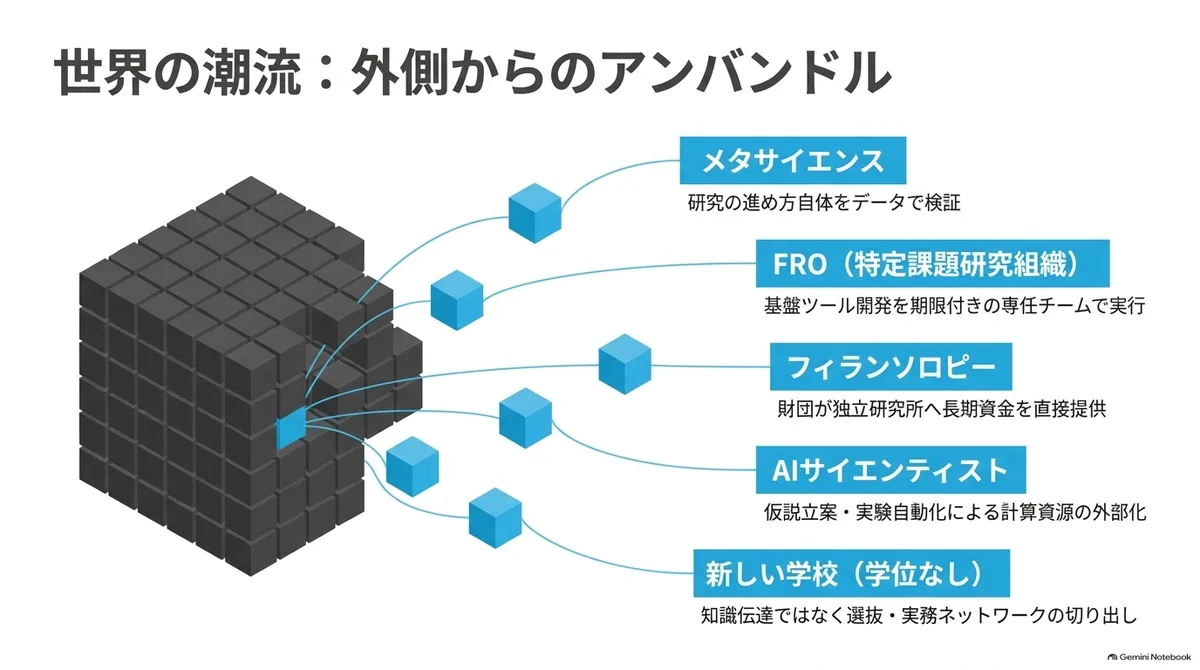
Movements around the world are unbundling the university's functions from the outside
Overlaying these on the structure of the bundle, FROs and NSF X-Labs move technology development with clear goals, and ARPA-type organizations move the discernment of challenging themes and the authority to allocate funding, outside the university or to dedicated PMs. Foundations supply funding through paths separate from the government, and metascience has made reproducibility and the grant-making system objects of verification. AI has begun to replace the practical work of laboratories, and new schools are separating selection from practical training.
It should be noted, however, that most of these are not trying to destroy the university. Many FRO researchers are people trained in graduate school, and the funding of ARPA-type institutions also flows to universities. The unbundling taking place here can be understood as increasing the options outside the university so that a suitable provider can be chosen for each function.
How to rearrange research functions is being debated around the world
In response to these movements, the focus of the debate over the past few years has been shifting from a binary of "the university or outside the university" to which research functions should be carried by which forms of funding, employment, and evaluation.
The very people who have built research organizations outside universities position their efforts as complementing, not replacing, the university. Adam Marblestone and others who run FROs stated explicitly in a 2025 retrospective that FROs are not a replacement for university research in general. Most research institutes outside universities have not built, on their own, everything from undergraduate education to doctoral training.
At the same time, a design conflict has also emerged over whether to support individual researchers or dedicated organizations. Whereas the U.S. 2026 science policy vision set out a direction of emphasizing individual researchers over the university as an organization, the League of European Research Universities (LERU) countered that even excellent individuals need universities that support long-term research, training, facilities, and academic freedom.
The shape of evaluation and infrastructure is also being reconsidered. James Wilsdon and others at RoRI raised the concern that in an era when AI writes applications and AI reviews them, the persuasiveness of the writing will no longer serve as a clue to the quality of research. How to carry work that is hard to credit in an individual's papers, such as shared data and research software, is also an issue. Even so, going outside the university does not necessarily free researchers. For example, there is a report that politically sensitive topics decreased in economics papers at U.S. universities heavily dependent on federal research funding, and if they remain reliant on government funding, free research may not be possible.
Furthermore, there are also calls for review of the Bayh-Dole Act, which underpins the technology transfer system, and of universities' management of inventions. The 1980 Bayh-Dole Act is a law that allows nonprofit organizations such as universities, and small businesses, to elect to retain rights to inventions made with federal funding, under certain conditions. In recent years, in addition to technology transfer centered on patenting and licensing, a method of disseminating technology through access to university facilities and specialized personnel has also been proposed. Reinhardt too argues that the drug discovery model of patenting discoveries and commercializing them with venture capital funding has limits when generalized as is to other fields that require long-term engineering development or the integration of multiple technologies.
In Japan, the Science Council of Japan, in its November 2025 recommendation, stated that competitive funding alone cannot support research time, stable employment, and facilities, and, along with restoring basic operating funds, is also considering employing researchers through corporate entities other than universities.
Since Japan has come up, let us now look at what situation Japan's universities are in.
Part III: Japan's universities and Japan's social challenges
While around the world it is mainly "how research is conducted" that is being redesigned, I believe Japan's universities are facing structural challenges right at their feet.
The functions and expectations Japan's universities carry
I think the function that carried the greatest weight in Japanese universities was selection and certification of ability. As we will see in Part V, Japanese companies have long used, as their hiring criterion, the difficulty level of the university a person entered rather than what they studied there.
The parties placing expectations also fall broadly into four. The state expects cutting-edge research and specialized personnel; companies expect selection signals and joint research; households expect their children to get good jobs; and regions expect young people to stay, teachers and medical personnel to be trained, and industry to be maintained. All are legitimate, but the directions they point in and what they want differ. For example, a regional national university is asked by the national government for publication metrics and external funding, and by local governments for a stable supply of teachers and nurses. These differing expectations are competing for the same limited time of the faculty.
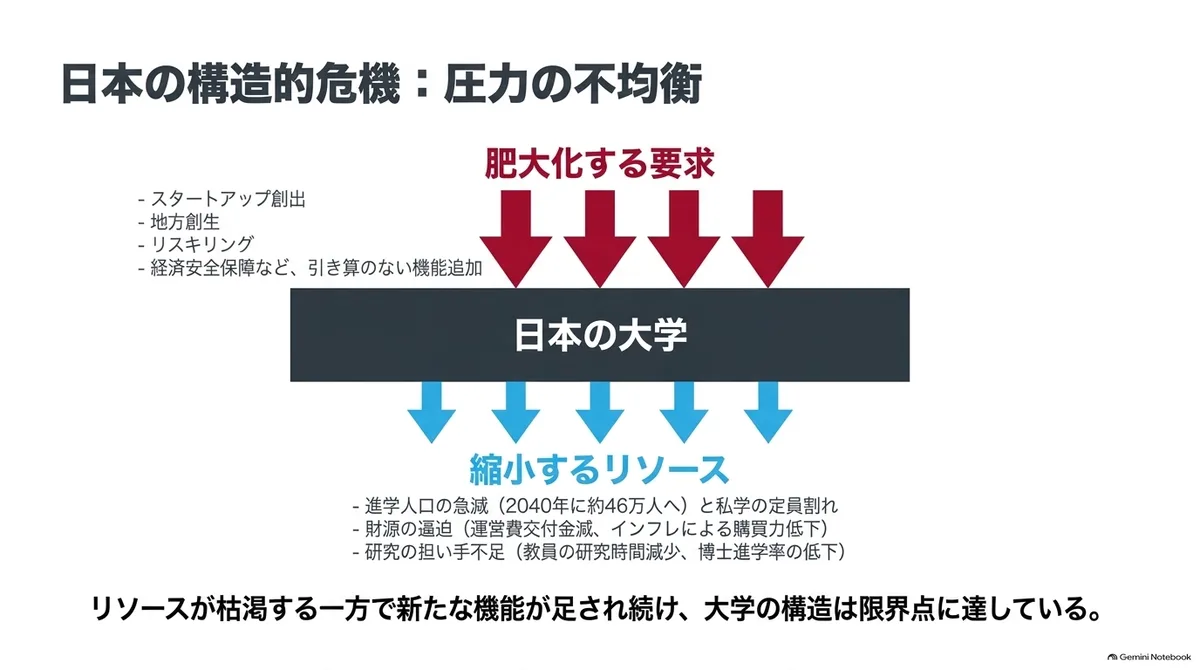
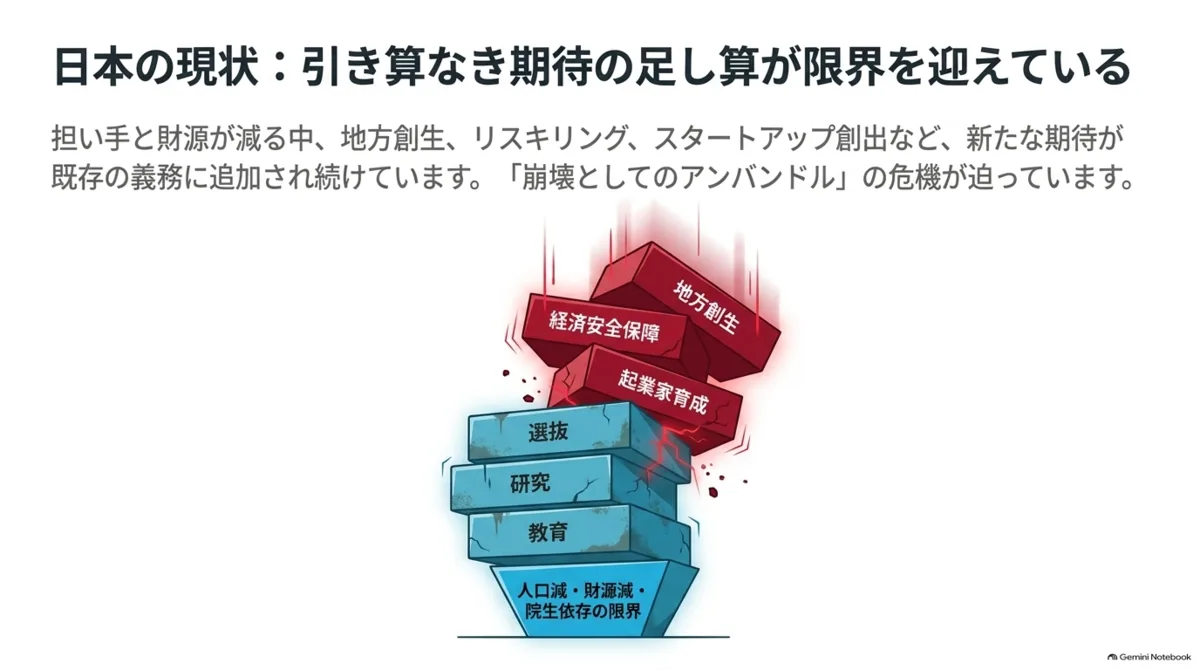
Moreover, this bundle has grown without subtraction. Even in just the past decade or so, regional revitalization, reskilling, university-originated startups, and economic security have been imposed on universities, but there have been almost no decisions to reduce existing duties in exchange.
The people who carry out research are thinning
Japanese university research is said to have relied on graduate students for much of the practical work. According to a survey by the Ministry of Education, Culture, Sports, Science and Technology, the share of working time devoted to research in fiscal 2023 was 32.2% for university faculty, against 84.6% for doctoral students. These are how each group uses its time, not shares of contribution to research as a whole, but with the share of faculty research time continuing to fall from 46.5% in fiscal 2002, the structure in which graduate students carry much of the practical work of research comes into view. I think it is closer to reality to say that, with the boundary between education and labor left ambiguous, graduate students' motivation and out-of-pocket burden have supported research.
That environment is changing. Since fiscal 2021, support that provides doctoral students with an amount equivalent to living expenses has spread through programs such as the Japan Science and Technology Agency's (JST) Support for Pioneering Research Initiated by the Next Generation (SPRING). Once the idea of regarding doctoral students as researchers who should be compensated takes hold, there will be a need to pay students who carry the practical work of the laboratory, or to hire dedicated staff. In other words, universities and laboratories will bear increased costs for what had been covered by unpaid labor.
At the same time, the number of people carrying research is also declining: doctoral program enrollment peaked at 18,232 in fiscal 2003 and was about 16,000 in fiscal 2024, and the rate of progression from master's to doctoral programs fell from around 14% to 10.4%. The weak yen has also reduced the purchasing power of research funding.
Students and funding are declining
According to the MEXT's projections, the roughly 630,000 students entering university are expected to fall to about 460,000 in 2040. The share of private universities under enrollment capacity reached 59.2% in fiscal 2024 according to a survey by the Promotion and Mutual Aid Corporation for Private Schools of Japan, and in fiscal 2026 it is still 46.2%.
For private universities that depend on tuition, a decline in students directly becomes a financial crisis. The operating grants for national universities fell from 1.2415 trillion yen in fiscal 2004 to 1.0945 trillion yen in fiscal 2015. Costs are swelling with rising prices and the weak yen, while pay raises and the like lag behind, and households have little room for large tuition increases.
Research capacity and regional roles are also wavering
In Science and Technology Indicators 2026, Japan ranks 13th in the world in the number of Top 10% adjusted papers, which indicates the number of highly cited papers. Cutting-edge science increasingly proceeds with large-scale facilities and dedicated interdisciplinary teams, and there is a growing number of problems that a chair-system laboratory of one professor and a few graduate students cannot handle.
Regional universities are being asked whether they can survive even as they send teachers and medical personnel out into their communities. The spread of job-based employment and re-learning has begun to relativize the university's greatest function, selection by deviation score, and voices questioning the university's social benefit have repeatedly arisen, such as the so-called "humanities are unnecessary" argument of 2015. There are measures such as the Program for Creating Emerging Research, which provides individual researchers with funding for up to ten years, but most of the funds flow to existing universities and national research and development agencies, and it has not been an occasion for creating new research organizations outside universities.
Japan, where the problems come first and the options outside fail to keep up
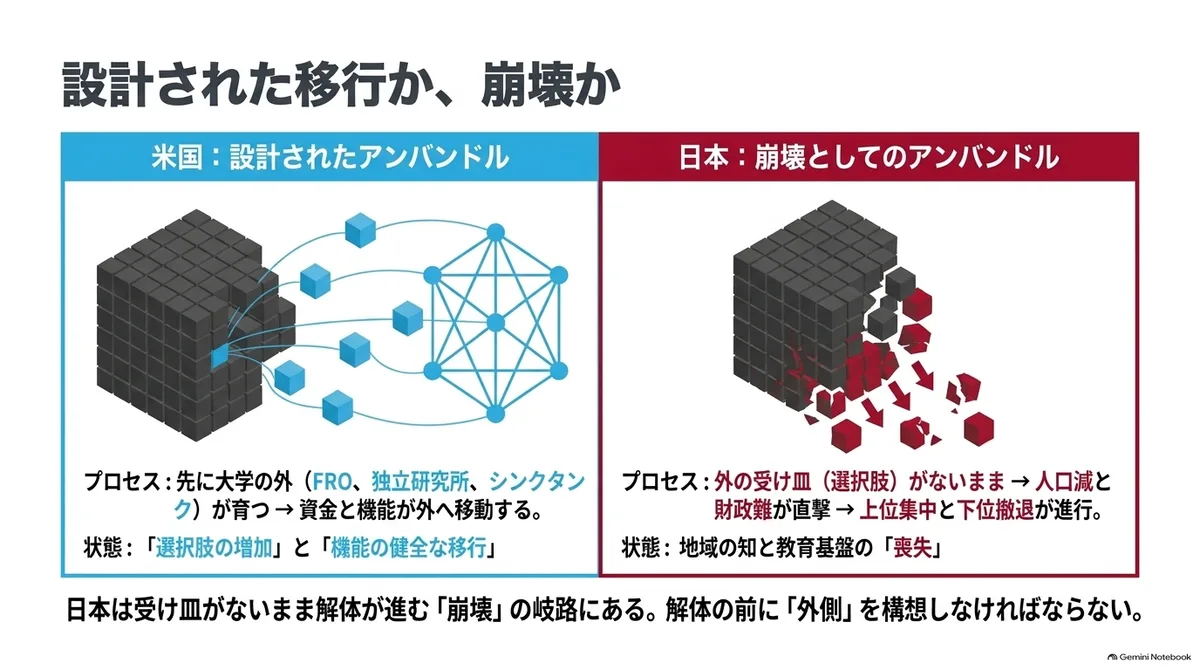
I think the greatest difference between the United States and Japan lies in the order in which unbundling proceeds. In the United States, options such as new research organizations, philanthropists' funding, practice-oriented schools, and degree-agnostic hiring have been set up outside universities first, and as a result the university's functions are beginning to be carved out.
In Japan the order is reversed: the decline in the number of people carrying research, the sharp drop in the college-age population, and fiscal strain are hitting universities first, while the receiving structures outside are limited. There are public research institutions such as RIKEN and the National Institute of Advanced Industrial Science and Technology (AIST), and inter-university research institutes, but routes for launching new research organizations, employment that lets researchers move back and forth between universities, and use of facilities regardless of affiliation remain scarce. If functions are detached without sufficient receiving structures, that would be not a transfer but a loss of the functions of scholarship and education.
Moreover, there is a risk that unbundling in Japan will proceed from both ends. At the top, concentration in a small number of research universities will advance, and at the bottom, withdrawals and mergers of regional private universities will continue. In regions from which universities have withdrawn, both the foundations for training teachers and medical personnel and the region's hubs of knowledge may be lost.
Japan's universities stand at a fork: will they head toward "designed unbundling," or be swallowed by "unbundling as collapse"? To avoid collapse, we need to envision the outside of the university before dismantling advances, and agree on which functions will move where. As a clue, I will first search the history of the world's universities.
Part IV: The world's universities have repeatedly bundled and unbundled
I will trace, through the history of each country, which functions were built into the university, when and why, and what was placed outside it.
The countries from which Japan has adopted university systems
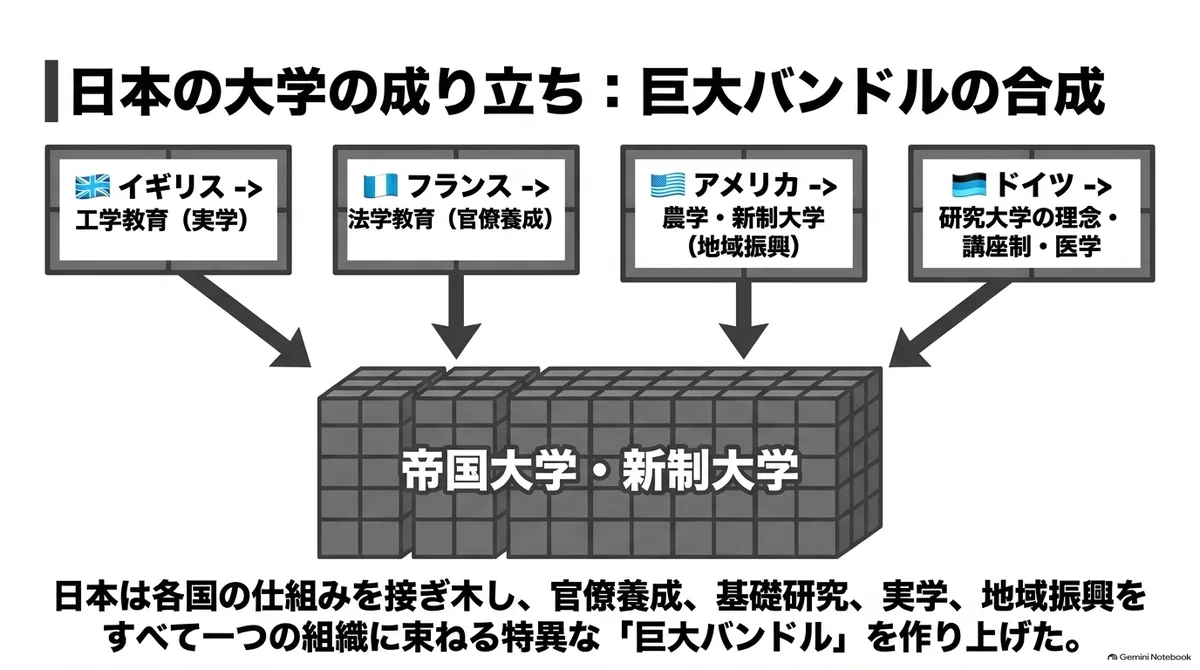
Modern Japan did not take a single country as its model. In the early Meiji period it learned engineering from Britain (especially Scotland), law and educational administration from France, agriculture from the United States, and medicine from Germany, and the Imperial University of 1886 integrated these and set the German research university ideal and the chair system at its base. After the war, the new-system universities began with the United States as the model, and from the end of the 1990s onward, American and British systems continued to be adopted one after another.
| Period | Main events in Japan | Country taken as the model |
|---|---|---|
| 1871-1877 | Establishment of the Kogakuryo and Imperial College of Engineering | Britain (Scotland) |
| 1872 | Promulgation of the Education System Order; establishment of the Ministry of Justice Law School | France |
| 1876 | Opening of Sapporo Agricultural College | United States |
| 1886-1893 | Imperial University Ordinance, Degree Ordinance, introduction of the chair system | Germany |
| 1949 | Launch of new-system universities; reorganization of the graduate school system | United States |
| 1998-1999 | TLO Act; introduction of the Japanese version of the Bayh-Dole system | United States |
| 2004 | Incorporation of national universities | Britain |
| 2004 | Creation of professional graduate schools (law schools, etc.) | United States |
| 2022- | International Top Research University system; university fund | United States |
Below, after an overview of medieval and early modern Europe, I will look at what division of labor each country built between the inside and the outside of the university.
The medieval university began as a guild responsible for training and certifying the professions
The university was born in Western Europe around the 12th century as a guild (universitas). In Bologna the students formed the guild, and in Paris the teachers did. Above the faculty of arts for liberal education, it placed the higher faculties of theology, law, and medicine, and trained clergy, lawyers, and physicians. The "license to teach," granted to those who had completed their apprenticeship and oral examinations, also served as proof of qualification, and in the 13th century residential colleges for communal living, such as the Sorbonne and Merton College, were also born. There was not yet research in the modern sense, and the medieval university can be said to have been a bundle of professional training, certification of qualifications, and character formation through communal living.
The early modern university served the state and denominations, and the new science grew outside it
Through the Reformation and the formation of sovereign states, universities split by denomination and became state institutions that trained clergy and officials. The modern science of the 17th century grew mainly outside universities, at the Royal Society of London in 1660 and the Académie royale des sciences in Paris in 1666. As Reinhardt cites, fewer than a quarter of the Royal Society's founding members are said to have held a primary appointment at a university. As an exception, Leiden University established clinical medical education in the first half of the 18th century, and that current extended to Japan's Dutch learning.
France abolished the university and created separate institutions for each function
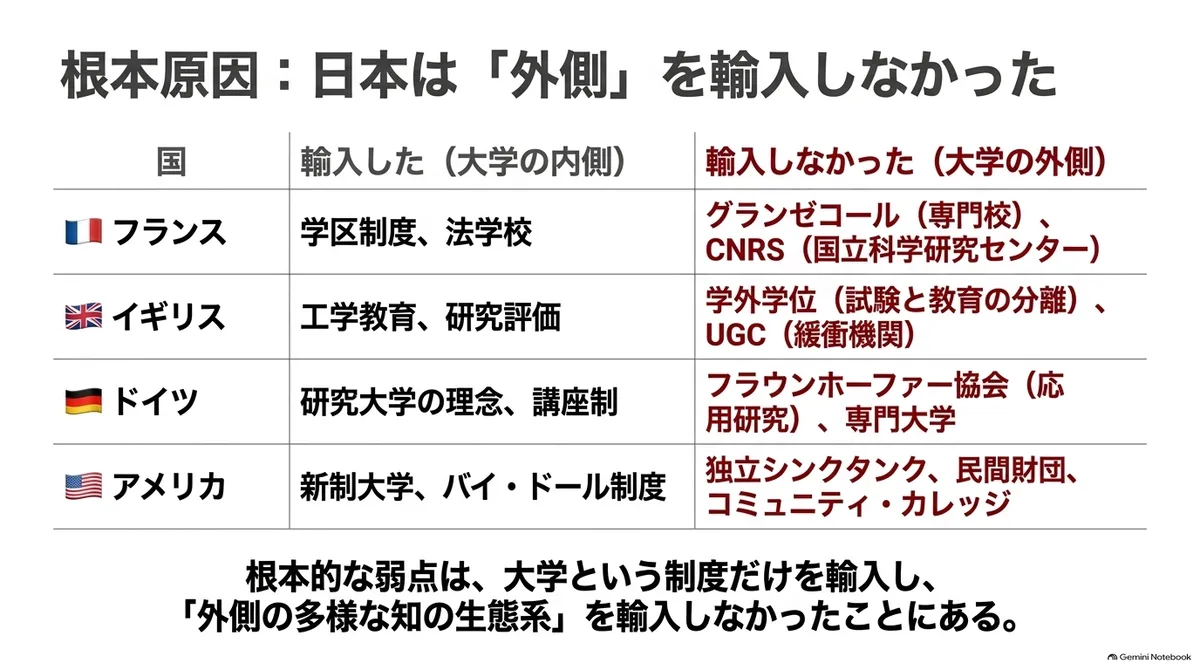
In 1793, during the French Revolution, the university was abolished as a privileged guild of the old regime. In its place, groups of specialized schools for each function the state required (the grandes écoles) were created, such as the École Polytechnique and the École normale supérieure. The legal revival of the comprehensive university came in 1896, and cutting-edge research was carried by the National Center for Scientific Research (CNRS), founded in 1939. It is a three-part system in which separate institutions handle elite training, research, and higher education for the general public.
The separated institutions were not isolated, and today "joint research units" (UMR), in which CNRS researchers and university faculty work in the same lab, are common. On the other hand, since the 2010s France has steered toward consolidation, and in 2020, aiming for presence in international rankings, Paris-Saclay University, which merged several grandes écoles and universities, was launched.
What Japan took from France was the nationally uniform school district system of the Education System Order and the French law education of the Ministry of Justice Law School. It did not adopt the three-part structure of grandes écoles, research centers, and mass universities.
Britain has lined up the colleges, practical learning, and examining bodies
Britain has lined up organizations with different origins. The college systems of Oxford and Cambridge are education through communal living and small-group tutorials. Scotland had a tradition of practical learning, and Henry Dyer, who came to Japan on the recommendation of Rankine of the University of Glasgow, designed the curriculum of the Kogakuryo, the predecessor of the Imperial College of Engineering. The "external degree" begun by the University of London in 1858 granted degrees by examination regardless of where one had studied, and was a pioneering example of separating education from certification.
In 1919, the University Grants Committee (UGC) was established, with the government providing funds and a committee of scholars deciding the allocation, and it functioned for about 70 years as a buffer body to keep the government from interfering in the substance of scholarship. Policy knowledge also grew outside universities, as in Chatham House (the Royal Institute of International Affairs), founded in 1920. After the polytechnics were unified into universities in 1992, research assessment (now the REF) and the introduction of tuition fees advanced.
What Japan took from Britain was the engineering education of the Imperial College of Engineering, research assessment modeled on the REF, and the idea of incorporation. It did not adopt the foundations of communal living in the college system or the buffer bodies.
Germany created the research university and at the same time placed research outside the university
The University of Berlin, founded in 1810, produced and spread to the world, from the ideal of the "unity of research and teaching" based on Humboldt's conception, the seminar, the laboratory, the chair system in which a full professor presides over a chair, and the modern doctorate. At the same time, Germany also built up institutions layered outside the university. The technical colleges became technical universities able to award doctorates in 1899; research was placed in the Kaiser Wilhelm Society (1911) and the Max Planck Society in its lineage, and applied research in the Fraunhofer Society (1949) and others; and around 1970, universities of applied sciences for vocational and professional education were also established.
At the Fraunhofer Society, basic funding from the federal and state governments is about one third of the budget, and the rest is contract research income. Because basic funding increases in line with the funds earned from contracts, an incentive to keep doing research useful to industry is built into the organization. It is an example of establishing, outside, an organization dedicated to industry collaboration, rather than asking the university to commercialize.
Almost all German universities are state-run, and tuition is in principle free. Their finances depend on public funds, but their autonomy has been supported by the academic freedom guaranteed by the Basic Law (the constitution) and by self-governing organizations such as the German Research Foundation (DFG), in which researchers themselves handle review and allocation. It shows that even when funding is public, autonomy can be preserved if there is a mechanism that places allocation decisions on the academic side.
What Japan took from Germany was the ideal of the research university, the chair system, German medicine, and the doctoral system. It did not adopt the groups of research institutes outside the university or the differentiation of institution types.
America grafted together British and German parts to create the multiversity
American higher education began with residential colleges modeled on British colleges, like Harvard College, founded in 1636. Their main purpose was to train clergy for the church.
In the 19th century two elements were added. One was the land-grant universities, created with proceeds from the sale of federal public lands under the Morrill Act of 1862, which rooted the idea that universities should serve regional industry and the public. The other was Johns Hopkins University, opened in 1876, which put German-style research and graduate education at the center. The American research university is a hybrid combining British-style liberal education, German-style research, and America's own regional service. Outside the university too, there grew up the Carnegie and Rockefeller foundations, corporate laboratories such as Bell Labs, two-year junior colleges (now community colleges), and independent think tanks such as the Brookings Institution and the RAND Corporation.
After World War II, the Bush report and the founding of the NSF made federal research support permanent, and the GI Bill made the university a mass institution. Indirect costs were added on top of federal funding, and as contract administration concentrated in university headquarters, the administrative organization grew huge. In 1963, Kerr named the giant university with its diverse functions and stakeholders the "multiversity," and in the same lectures called research universities that depend on federal funding "federal grant universities," also voicing concern that funders direct the substance of the university. Bush's design tried to restrain government intervention through peer review and multiple funding agencies, but the more state funding grew, the more deeply the university came to depend on the state.
The California Master Plan that Kerr led in 1960 divided research and doctoral education to the University of California, undergraduate education and practical master's degrees to the California State University, and broad open access to the community colleges. While functions were bundled in a single university, the state system separated the types of institutions. Only some private universities have a degree of financial independence through huge endowments, and most students attend state universities that rely on state budgets and tuition.
What Japan took from America was the philosophy of Sapporo Agricultural College, the new-system universities, the course-based doctorate system, TLOs and the Japanese version of the Bayh-Dole system, law schools, the university fund, and so on. What it did not adopt was the three-tier differentiation of functions, the depth of private foundations and independent think tanks, and a labor market in which researchers move among universities, companies, and institutes.
Research became a capital-intensive undertaking in the 20th century, requiring enormous facilities
What 19th-century research needed was mainly libraries and small laboratories, on a scale that universities and philanthropists could finance. The big change came in the 20th century. In the 1930s Ernest Lawrence enlarged the cyclotron at the University of California, and after the Manhattan Project of World War II, facilities that no single university could hold, such as accelerators, nuclear reactors, and research computers, became a premise of research. In 1961, the physicist Alvin Weinberg called this kind of research "Big Science." The United States created national laboratories run by consortia of universities, Europe created the internationally cooperative CERN, and Japan also built shared-use facilities such as the High Energy Accelerator Research Organization (now KEK) and SPring-8.
This change affected both the bundle of the university and its autonomy. Being able to own expensive facilities, hire the technical staff to maintain them, and handle safety management became a strength of large organizations, and worked as a force binding the university together. At the same time, dependence on the states and companies able to cover those costs also grew stronger.
AI may further increase the capital that research requires. Developing cutting-edge AI models requires computing resources on a scale universities cannot hold, and Stanford University's "AI Index" reports that most notable AI models in recent years have come from companies. The autonomous laboratories seen in Part II and the building of large-scale data also require large investments. On the other hand, AI also makes some computation and analysis cheaper, and in that respect lifts the capability of small laboratories. Which way it swings will depend on institutional design: who holds computing resources and data, and to whom they are opened.
The academies of the Soviet Union and China, which completely unbundled research
At the opposite pole is a system that institutionally separated research from the university. The Soviet Union concentrated research in the institutes of the Academy of Sciences and made universities mainly institutions of education. The Chinese Academy of Sciences (1949) followed this, and modern China has maintained the academy system while concentrating funding in top universities. In Science and Technology Indicators 2026, China ranks first in the world in total papers, Top 10% adjusted papers, and Top 1% adjusted papers alike. Japan did not take this system as a model, but it becomes a point of comparison when we consider international competitiveness in Part VI.
Four perspectives from world history
Four perspectives can be drawn from the history of universities around the world.
First, bundling and unbundling have repeated like a pendulum. It has swung from the medieval bundle, to the externalization of research in the Scientific Revolution, the French division, the German reintegration, and the American multiversity, and now reintegration is advancing in Europe and the externalization of cutting-edge functions in the United States.
Second, the greatest incentive in the modern era for pulling universities into large bundles is the international university rankings, which tend to reward institutional scale. It could be said to be one factor driving universities into an international race to expand.
Third, countries where scholarship and industry prospered all, without exception, had a thick ecosystem of knowledge outside the university. Examples are France's grandes écoles and CNRS, Britain's external degrees and UGC, Germany's research societies and universities of applied sciences, and America's foundations, corporate laboratories, think tanks, and community colleges.
Finally, the discussion of unbundling is not a passing fad but is positioned within a lineage of institutional thought that connects to the external degree of 1858 and the multiversity argument of 1963.
Part V: Japan's universities started from an unbundled state and have been bundled by policy
So far we have looked at the history of bundling and unbundling around the world. Next we look at Japan. Japanese higher education started from a state in which the carriers were dispersed, and functions have been bundled into a single institution by policy.
Edo-period learning was divided among domain schools, private academies, and Dutch learning
The education of the samurai was handled by domain schools and the Shoheizaka Gakumonjo, practical and intellectual education by private academies such as Tekijuku and Kaitokudo, and the introduction of Western knowledge by the grassroots networks of Dutch learning, symbolized by Kaitai Shinsho. I think this division of labor, in which character formation, training in specialized skills, and the exploration of new learning were entrusted to separate carriers, will be a historical reference point when we envision carriers outside the university.
Early Meiji Japan was in an unbundled state, with each ministry having its own schools
The ministries of the Meiji government created their own schools to train the personnel they needed. The Ministry of Public Works' Imperial College of Engineering took Scottish engineering education as its model, the Ministry of Justice Law School took French law, the Hokkaido Development Commission's Sapporo Agricultural College took American agricultural colleges, and the Tokyo Medical School took German medical chairs.
The picture of each ministry directly managing schools for each function is close to France's grandes écoles, and it can be said that modern Japanese higher education started from an unbundled state.
The Imperial University bundled the ministries' schools and added the German-style chair system
What bundled these together again was the Imperial University Ordinance of 1886. It merged the University of Tokyo, the Imperial College of Engineering, and others, and defined its purpose as teaching and research in the arts and sciences "to meet the needs of the state." For a time, graduates of the law and literature faculties were exempted from examinations and appointed as junior officials, and the diploma also served as a qualification for appointment to the bureaucracy. In 1893 the German-style chair system was introduced, and engineering, which in Germany had been excluded from comprehensive universities, was also taken in as a faculty. I think this point, at which the training of bureaucrats, state qualifications, basic research, and engineering education were bundled into one organization, was the starting point of the composite bundle of Japanese universities.
University autonomy was also shaped within this Imperial University. After the Sawayanagi Incident of 1913-14, the practice arose that faculty appointments required the consent of the faculty council, and this became the prototype of Japanese university autonomy. However, it was autonomy that protected personnel decisions inside a university established and funded by the state, and it differed from the autonomy of foreign "universities," which have lasted longer than states or governments and maintained a degree of financial autonomy. In the Takikawa Incident of 1933, the Ministry of Education placed a Kyoto Imperial University professor on suspension, which showed its limits.
The University Ordinance made private schools universities and made universities a source of corporate personnel
The University Ordinance of 1918 recognized public and private universities, and Keio Gijuku, Waseda, and others became universities. The practice of companies recruiting university graduates in bulk took hold, and universities also became a source of white-collar workers for companies. Even so, liberal education was carried by the old-system higher schools, teacher training by normal schools, and vocational education by technical colleges, and in 1917 the Institute of Physical and Chemical Research (RIKEN) was created outside universities. At the same time, affiliated research institutes placed inside universities also began, and the movement to place things outside and the movement to bundle them inside ran in parallel.
Wartime science mobilization demanded research results themselves from universities
In 1939, the Science Research Grant, the predecessor of today's KAKENHI, was created, and affiliated research institutes and enrollment quotas in science and engineering were expanded. The state came to demand from universities not only personnel but the results of technology development themselves.
In the student mobilization of 1943, the conscription deferment of humanities students was suspended, while students in science and engineering and teacher training were deferred. The asymmetry of expectations toward the humanities and sciences carved in at that time, and the division into science and humanities tracks, appear to connect to the present.
The new-system universities of 1949 converged the types of institutions into one
In 1949, after the war, new-system universities were launched with the United States as the model, and the old-system higher schools, normal schools, and technical colleges were all absorbed into universities. Under the principle of one national university per prefecture, functions that had been dispersed outside the university before the war, namely liberal education, teacher training, practical education, and regional development, were bundled into a single organization. While France, Germany, and the United States all continued to maintain multiple types of institutions, only Japan converged the form of higher education almost entirely on the four-year university.
On autonomy, Article 23 of the Constitution guaranteed academic freedom, and the 1949 Special Act on Educational Public Service Personnel gave the faculty council authority over faculty appointments. While the prewar practice was written into law, finances remained dependent on the national budget.
In the era of high growth, the university's real function became selection
In the era of high growth, enrollment quotas in science and engineering were expanded, and the enrollment rate reached nearly 40% by the mid-1970s, from about 10% in 1960. Companies moved from a premise of training people through on-the-job training after joining to using which deviation-score level of university someone had passed as the hiring criterion, rather than what they learned at university, and the university's real function narrowed to a signal of selection at the entrance. Applied research for industry was carried by companies' central laboratories, and universities were not much asked to drive economic growth. Among the few educational institutions created outside universities at this time were the colleges of technology (1962) and the specialized training colleges (1976).
In the 1990s, Japan began demanding of universities both long-term research and rapid commercialization
In 1991 the liberal arts divisions were dismantled in the deregulation of university standards, the graduate school emphasis advanced, and in 1995 the Science and Technology Basic Act began the rollout of science and technology policy through basic plans. Almost simultaneously, the demand to industrialize research results quickly was layered on, with the TLO Act of 1998, the Japanese version of the Bayh-Dole system in 1999, and the "1,000 university-originated ventures plan" of 2001. Japan introduced, all at once and at almost the same time as the expansion of research support under the basic plans, the framework of industry-academia collaboration that the United States had taken time to establish, and came to count the number of patent applications and university-originated ventures as university results. Behind this, I think, was the decline of companies' central laboratories after the collapse of the bubble, which shifted onto universities the burden of long-term development that companies had carried.
Since incorporation, functions have kept being added to universities
In 2004, national universities moved to national university corporations, adopting Britain's NPM (New Public Management), but operating grants were cut by roughly 1% every year, and the structure changed to one supplemented by competitive funding. After that too, functions kept being added: professional graduate schools, the explicit mention of "social contribution" in the Basic Act on Education (2006), the three-category priority support framework for national universities (2016), international top research universities and the university fund, regional revitalization, reskilling, entrepreneur training, economic security, and compliance with the requirements of the new tuition support system. Subtraction, abolishing duties that are no longer needed, has effectively not been carried out.
The form of autonomy also changed. Incorporation gave national universities legal personality, but the Minister of Education, Culture, Sports, Science and Technology sets the medium-term goals, and with the cuts to grants and the shift to competitive funding, the state's involvement grew stronger through evaluation and funding. In the 2014 amendment of the School Education Act, the faculty council was positioned as a body that gives opinions when the president decides, and the 2023 amendment of the National University Corporation Act placed a management policy council including outside members at large national universities.
Schools and institutes created outside universities have been absorbed or placed at the periphery
Most institutions born outside universities have been absorbed by universities or placed at the periphery. The Imperial College of Engineering was absorbed into the Imperial University, and the old-system higher schools and normal schools into the new-system universities. RIKEN succeeded in commercialization before the war as the "RIKEN Konzern," but lost its industrial base with the postwar dissolution of the zaibatsu. The colleges of technology, the University of the Air, and inter-university research institutes also fulfilled their roles but did not become alternatives to the four-year university.
Policy knowledge likewise did not grow much in independent research institutions outside universities. In Japan, the main route was for university faculty to serve as individual members of ministry advisory councils and expert panels. There are corporate-affiliated think tanks and the National Institute for Research Advancement (NIRA, 1974), but there is not the depth of independent nonprofit think tanks found in the United States and Britain. The distance between universities and industry has also swung between two extremes by policy, from the era of campus unrest when "opposition to the industry-academia cooperation line" was shouted, to the present, when startup creation draws attention.
Japan's university types are divided by the era in which they were born
| Type | Main historical background of formation |
|---|---|
| Research universities (former imperial universities, etc.) | Imperial University Ordinance of 1886 and the building of the imperial university network |
| Regional national universities | New-system universities of 1949 (principle of one national university per prefecture) |
| Large private universities | University Ordinance of 1918 and mass higher education in the high-growth era |
| Small and medium-sized private universities | New establishments following the deregulation of establishment standards from the 1990s onward |
| Public universities | Postwar establishment by local governments, and recent conversions of private universities to public |
The problem is that these types have been fixed not as differences in role but as a ranking along the same yardsticks of number of papers and entrance-exam deviation score. The 2005 report of the Central Council for Education organized the university's functions into seven and tried to have each university choose, and the three priority support categories of 2016 were also an attempt to have them choose roles, but differentiation did not advance. One reason is probably that, as long as types are received as a ranking, there is no incentive to choose a function that looks lower. It could also be said that a few easy-to-understand yardsticks, such as the number of papers and deviation scores, erase diversity in ways of being.
The cost of multifunctionality was divergent evaluation and a lack of options
I think the cost of having bundled every role can be summarized mainly in two. One is the divergence between expectations and evaluation. Universities are expected to do long-term basic research, yet are also evaluated on short-term results such as the number of patents and university-originated startups, and the same laboratories and faculty take on demands with different time horizons and risks under a single evaluation system. The other is the lack of options. The type of institution is skewed to the four-year university, the funder to the state, evaluation to papers and external funding, and careers to a single path toward university professorship, so once someone stumbles, there is nowhere to escape.
The loss of room for long-term research is often cited as the main cause of the decline in research capacity. But I wonder whether the shortness of time horizons is a result rather than a cause. The job security of the chair system nurtured long-term research but also produced closedness, and even in the United States, most research funding is competitive funding on a three-to-five-year cycle.
The hypothesis of this article is that the deeper factor lies in an inescapable bundle structure that forces expectations of differing natures into a single evaluation framework, with few options outside.
| Challenge faced | Structural factor that makes the blow severe in Japan |
|---|---|
| Shrinking college-age population and under-enrollment | The type of institution is unified into the university, so a university's withdrawal directly means the loss of regional higher education |
| Research system dependent on graduate students and young researchers | The chair system is the basic unit of research, making it difficult to create new research organizations with dedicated teams |
| Decline in faculty research time | Research, commercialization, management, entrance exams, and student guidance pile up on the same faculty |
| Labor market mobility and re-learning | University functions are skewed toward entrance selection, and proof of ability at graduation and for working adults is underdeveloped |
| Fiscal constraints and inflation | Funding sources are skewed toward the national treasury and households, with a thin layer of private foundations and donations |
Japan imported the university but did not import the outside of the university
Looking back on the history of Japanese universities, a force that bundles functions into a single organization, as with the Imperial University and the new-system universities, has consistently been at work. Organizations born outside universities were absorbed or pushed to the periphery, and functions kept swelling by addition without subtraction. There is also the history that each time the parties expecting things of the university changed, among the state, companies, households, and regions, demands accumulated without past expectations being settled. Furthermore, there is a tendency for the timing at which Japan adopts foreign systems to coincide with the time at which their limits become visible and reviews begin in the home country.
And as a similar weakness, there is the aspect that Japan imported the institution called the university but did not import the outside of the university. As seen at the end of each country's section in Part IV, most of what Japan did not adopt were institutions and mechanisms placed alongside the university, outside it: France's grandes écoles and CNRS, Britain's buffer bodies, Germany's groups of research institutes and universities of applied sciences, and America's foundations, think tanks, and community colleges.
Japan too has outside institutions such as RIKEN, AIST, and inter-university research institutes. But most of them remained a small number of types established by the state, and the entry of new organizations, the granting of budget and personnel discretion to leaders, the carrying over of personnel and results after a term ends, the shared use of facilities regardless of affiliation, and movement between universities and the outside remained difficult. What Japan did not import was the diversity and openness of the outside. As a result, the university has taken on even functions that should properly have been placed outside. Now that carriers and resources have begun to thin, I think the scarcity of this outside is a major reason Japanese universities cannot move.
Part VI: Toward the next 80 years, sort the university's roles and build the outside of the university
The proposals from here converge on unbundling the university, that is, sorting the work to be entrusted to the university from the work to be left to outside organizations, and creating diverse receiving structures outside the university.
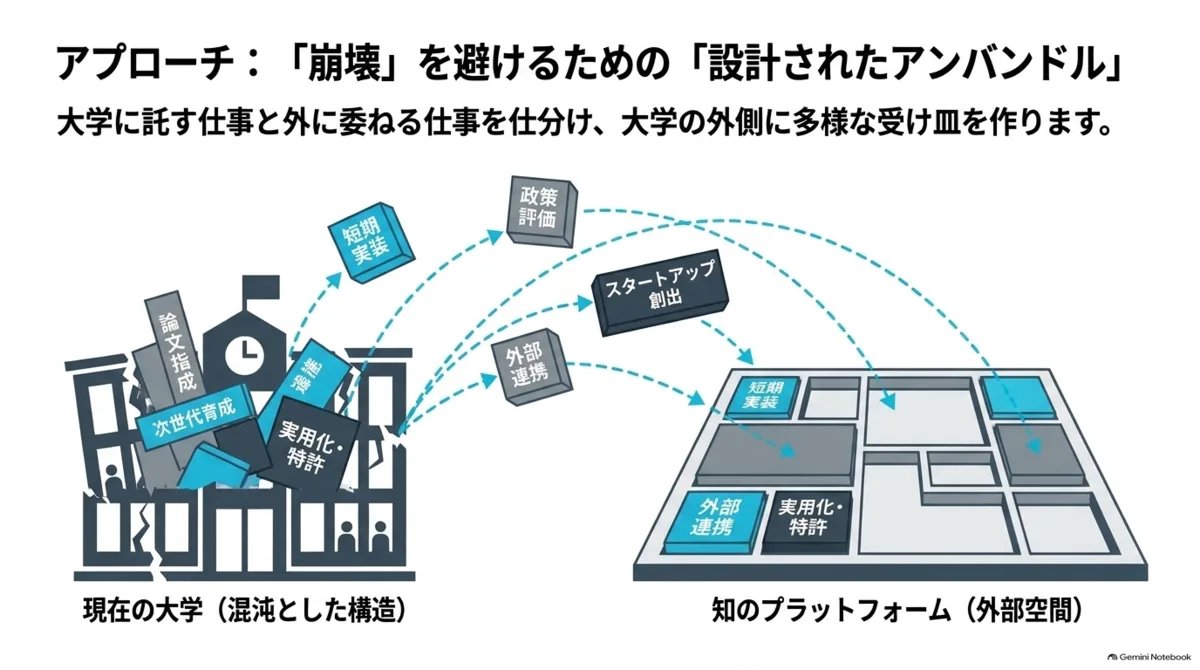
Because the final form 80 years ahead cannot be drawn, make choices that are right in any future
At the beginning of this article, I spoke of looking at spans of 80 years: the 80 years from the Meiji Restoration to the war, the 80 postwar years, and the coming 80 years.
Looking ahead 80 years, there are highly reliable forecasts for population. According to the estimates of the National Institute of Population and Social Security Research, Japan's total population will be about 87 million in 2070 and about 50 million in 2120. In 80 years, an era awaits in which research and universities must be supported by less than half of today's population.
On the other hand, how autonomously AI will come to advance research remains hard to predict. On funding too, the science and technology budget has grown to about 1.5 times its fiscal 2000 level, but international indicators of papers have not improved. Because the comparison is not one with matched conditions, we cannot say the increase was ineffective, but neither can we say flatly that increasing the amount alone will solve the problem.
Under such uncertainty, I think it is wiser, rather than drawing a finished picture for 80 years from now, to put effort into choices that do not lose value in any future, remove unnecessary regulations and affiliation requirements, and accumulate small, diverse experiments.
The four core businesses that remain with the university in any future
I think the core that remains with the university in any future consists of the following four elements: exploration, facing long-term questions without seeking immediate results; verification, in which the community of experts scrutinizes how well-founded claims and experimental results are; succession, protecting knowledge, literature, specimens, and data from dispersal and handing them to the next generation; and the development of people who pose questions, nurturing, through dialogue with predecessors and peers and through communal living, the ability to pose one's own questions in areas with no answers.
As seen in Part II, in a world where AI outputs large quantities of hypotheses and draft papers, I think the role of the community that judges and guarantees what counts as trustworthy knowledge, and especially the responsibility of verification, becomes heavier.
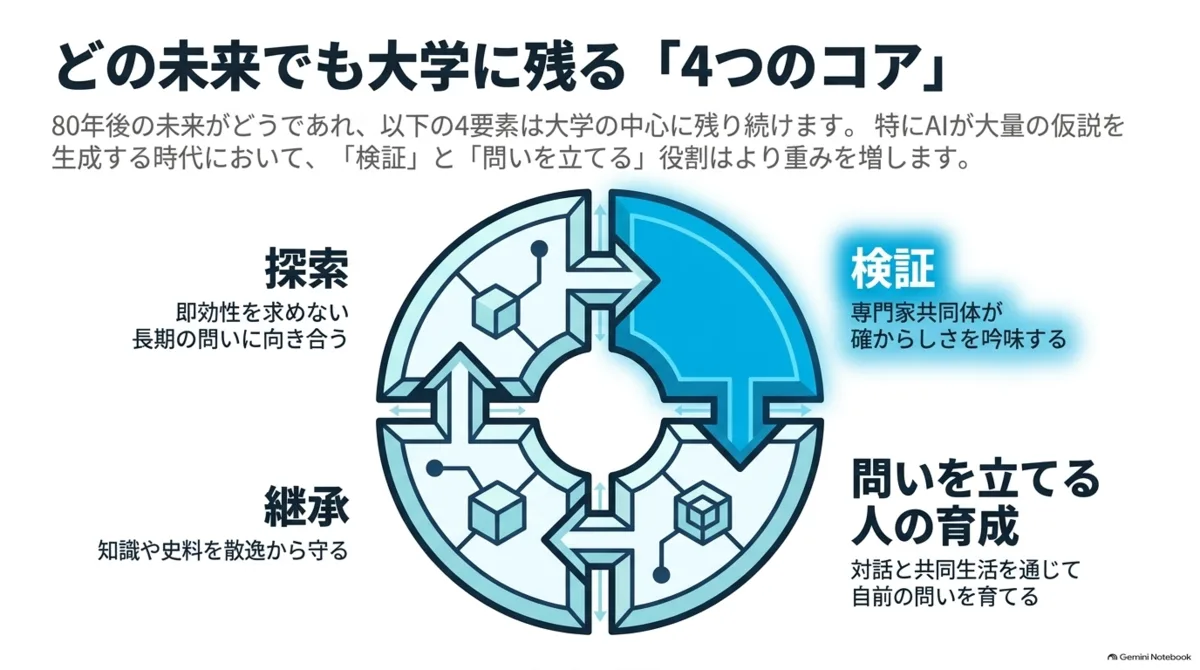
Separate the work entrusted to the university from the work entrusted to outside organizations
If we take the hypothesis presented in Part V, the root of the dysfunction lies in having carried, in one organization and under one evaluation framework, both uncertain long-term exploration and industrial implementation that demands deadlines and results. So technology development and the building of infrastructure tools that are responsible for specifications and deadlines are entrusted to outside organizations such as FROs, and evaluated on whether they delivered the agreed deliverables.
The same sorting applies beyond research. In education, this means valuing proof of ability at graduation rather than the difficulty of entrance exams; in regional contribution, it means taking on the training of teachers and medical personnel as a commissioned contract with local governments that sets the term, budget, and achievement criteria; and so on.
Sort work by its nature
One criterion for sorting is the distinction between exploration and integration. The university's strength is that individual researchers can pursue a single question for decades, and its weakness is gathering large numbers of specialists from multiple fields and steering them toward a single engineering goal. Reinhardt points out that academia, which bases its incentives on individual credit, cannot maintain a large engineering team for long.
The other is the distinction between research that generates ideas and research that delivers results, which can be told apart with the following three questions.
- Is there a need to bear strict responsibility for the specifications and deadlines of the deliverable? -- If yes, it is carried by a structure and evaluation separate from the laboratory.
- Is there a need to integrate dedicated experts from multiple fields over the long term? -- If yes, it is the work of a dedicated team outside the laboratory.
- Is there genuine educational value in graduate students taking part in the practical work of the research? -- If yes, it is the work of a university laboratory.
However, separating evaluation or structure is a different decision from making it a separate legal entity. Ways of placing something outside the laboratory include at least three: creating a department within the university with dedicated staff and separate evaluation; jointly operating it among multiple institutions, like inter-university research institutes and technology research associations; and making it a separate legal entity, like FROs and independent institutes.
For work in which the value of graduate students learning how to build it and the need for maintenance by dedicated engineers coexist and the answers to the questions conflict, such as research data infrastructure, one could consider placing it in an in-house department or a jointly operated organization, with graduate students taking part in research there. It is reasonable to separate legal entities only when the necessary discretion and employment cannot be secured within the university or a jointly operated body. It should also be noted that in a subsidiary wholly funded and controlled by the university, pay scales and personnel matters tend to follow the university's rules, and the point of separating the entity fades.
In education too, systematic lectures could be consolidated into credit transfer among universities and digital lectures, leaving on campus small-group seminars where students pose questions and read primary sources critically and discuss them. The sorting up to this point has mainly had science and engineering in mind, and I will consider the humanities and social sciences in the next three sections.
If the humanities and social sciences are to go outside, first build self-sustaining funding and governance
What can go outside in the humanities and social sciences is work for which there is outside demand from governments, local governments, companies, and citizens, such as policy analysis and evaluation, data infrastructure for social surveys, the preservation and public release of historical materials, citizens' learning, and translation and publishing. On the other hand, there is also work that would vanish if left to the market, such as theoretical research, critical research, long-term fieldwork, and the reading of classical languages and old documents. So perhaps work with demand could go outside with the foundations for self-sustainability put in place, while work that struggles to survive in the market could remain at the university and be protected by the budget as a public good. This is so that the organizations placed outside do not rely on the same cross-subsidization as the university, in which income from work with demand supports research without demand.
One could consider building the funding of outside organizations in four layers that do not depend on a single funder: a foundation of multi-year operating funds through buffer bodies and endowments; shared contributions through membership fees from university libraries, local governments, and others; business through commissioned work and publishing priced at full cost; and donations with funding sources disclosed and no donor involvement in conclusions. This is because financial independence and autonomy mean not receiving funding from nowhere, but being able to continue activities even if one loses any one funder, or goes against its wishes.
Open social science policy knowledge beyond the advisory councils and spin it out as think tanks
As seen in Part V, in Japan the main route by which social science knowledge reached policy was for faculty to serve as individual members of advisory councils. Much of the analysis was prepared by the ministry acting as secretariat, and the organizations specializing in analysis had neither stable funding nor independence.
The first piece of work to spin out is policy analysis and evaluation. In 2011 the United Kingdom created the Education Endowment Foundation (EEF) with funding from the Department for Education, and had it independently verify the effects of education policies. In Japan too, perhaps a portion of the budget for policy projects above a certain scale could be devoted to independent evaluation, with the commissioning entrusted not to the responsible ministry but to a buffer body. This is to eliminate the conflict of interest in which the ministry being evaluated chooses the evaluator, and to create stable demand for outside evaluation bodies. A division of labor is also possible in which advisory councils remain a place for coordinating interests and building consensus, while the analysis that serves as evidence is left to outside organizations.
The second is the data infrastructure for social surveys: long-term surveys that have depended on KAKENHI grants each time would become permanent infrastructure, and the provision of data would be funded by membership fees from user institutions, like the University of Michigan's ICPSR. The third is the independent think tank itself, for which, as a condition of receiving public funds, diversification of funding, disclosure of funding sources and analytical methods, and securing the right to publish without the commissioner being able to intervene in conclusions would be required.
On the other hand, theoretical research and critical sociology that do not match policy demand might be better left at the university and supported as a public good. As seen in Part II, pressure from funders can change how research topics are chosen.
Reposition the humanities at the center of the core that remains at the university, and connect them with outside carriers
The central work of the humanities, reading and interpreting texts and historical materials, confirming the meaning of words and concepts, and handing them to the next generation, is the very verification and succession among the four cores that remain at the university. Skills that take many years to acquire, such as reading old documents and classical languages, will die out unless the university guarantees positions. In an era when AI generates large amounts of text, the weight of the skill of critically examining the origin, context, and meaning of text will, if anything, increase.
However, humanities research has been in part supported by the surplus of cross-subsidization, and if the accounts were made transparent, it might be the first to be cut. The humanities inside the university need to be supported by an explicit budget, and the organization of historical materials, critical editions, translations, and works read over long periods need to be evaluated through expert peer review.
On that basis, the venues and funding for humanities activity can be extended beyond the university. As with the private academies and Dutch learning of the Edo period, libraries, archives, museums, publishers, academic societies, and independent researchers still support humanistic knowledge today. Possibilities include placing research positions in local museums and archives, making academic journals freely available through membership fees from university libraries as the UK's Open Library of Humanities does, and establishing regional humanities funds that accept bequests and the like. It should also be possible to build a fund from donations and ensure continuity with the returns on its investment.
The university remains the core that trains experts, guarantees positions, and judges quality, while outside carriers widen the venues and funding for humanities activity. I think we need to treat protecting the humanities themselves and protecting the humanities within the university as separate problems.
Sketching the ecosystem outside the university
As receiving structures for the work sorted so far, we can sketch the following division of labor.
| Carrier | Main mission |
|---|---|
| Research universities | Long-term exploration, verification, training of the next generation of researchers |
| Regional university consortia | Regional talent development; joint ownership of infrastructure and administration |
| Education-focused universities | Liberal arts education; re-learning for working adults |
| External specialized research organizations | Technology development and tool building with set goals and deadlines |
| Independent policy think tanks | Policy analysis and evaluation; data infrastructure for social surveys |
| Industry-led educational institutions | Training in practical skills and certification of ability |
| Archives of humanistic knowledge and citizens' learning | Preservation and public release of historical materials; lifelong liberal education |
| Shared research infrastructure | Providing large facilities, computing resources, and data regardless of affiliation |
| Autonomous buffer bodies | Allocation and evaluation of research funding free of political interference |
| Foundational systems for talent mobility | An employment environment in which researchers can move between universities and outside organizations |
In the short term, I think what to build is external specialized research organizations (such as FROs) that set goals and advance cutting-edge development. Still, in Japan, where a culture of philanthropy has not matured, a Japanese version of the FRO, funded by industry consortia and government money through matching funds, is realistic. However, we should avoid producing its funding by cutting the university's basic operating funds.
Different ways of unbundling for each type of university
Even so, uniform unbundling cannot be applied. For each of the types seen in Part V, I give examples of directions that can be chosen.
- Research universities move technology development with settled direction to a Japanese version of the FRO and the like, and concentrate on exploration, verification, and training young researchers.
- Regional national universities keep regional talent development while jointly owning facilities, administration, and basic lectures through a university consortium with neighboring universities.
- Large private universities move large lectures to a shared online platform and direct resources to small seminars, co-op education, and re-learning for working adults.
- Small and medium-sized private universities try partnerships and changes of field, and, if they withdraw, sketch out in advance a path to guarantee current students' learning and convert the campus.
- Public universities can choose a path of taking on the function of analyzing regional policy issues, making use of their closeness to the founding local government.
These are not prescriptions allocated from above by the state, but examples of options for each university to choose a direction from its own history and strengths.
Re-measure international competitiveness by the power to connect the world's research, not by rank
Given the large gaps in population and R&D investment, competing with the United States and China on the volume of papers is, one has to say, a war of attrition Japan has little chance of winning. So one option is to re-measure international competitiveness, shifting from rank in paper rankings to how deeply and irreplaceably a country ties together the world's knowledge network (the strength of a node). Indicators would include international co-authorship, the circulation of research talent, shared facilities such as SPring-8, and international use of long-term records. By this yardstick, the long observations, cohort tracking, and preservation of historical materials and specimens that Japan has cultivated turn into strengths that other countries find hard to imitate. However, the yardstick of competitiveness and the yardstick of public purpose, raising citizens and inheriting regional knowledge, should be treated as separate axes of evaluation.
Unbundling creates new dilemmas
Unbundling does not eliminate contradictions; it can be said to replace contradictions that were inside an organization with problems of coordination between organizations. The greatest dilemma is that if long-term exploratory research is purified into the university, it may drift away from the needs of industry and lose its base of support. There are also the following dilemmas.
| Institutional dilemma | The two values in conflict | Direction for overcoming it |
|---|---|---|
| Slack or accountability | Granting slack unconditionally leads to idleness, while overly strict accountability prevents long-term bets | Give slack to individuals, not chairs, and evaluate through ex-post peer review at milestones |
| Openness or economic security | Open research collides with demands to prevent technology leakage | Gather sensitive research in controlled institutions outside the university, and protect the university as a place that is open in principle |
| Globalization or knowledge in the mother tongue | If everything is conducted in English, Japanese-language thought and education for citizens will wither | Make graduate schools and cutting-edge research bilingual, and base undergraduate liberal education and education for working adults on Japanese |
| Structural reform or transition costs | Rushing reform creates great friction, such as vested interests, failures, and blows to regional economies | Apply new rules in stages starting with new hires, and prepare transitional measures |
How cross-subsidization is handled is also a condition of the transition. This article calls for replacing cross-subsidization with direct budgets for explicit public goods, but it does not dismantle cross-subsidization until that funding is secured. The concern that separating research from the university does not necessarily produce results is also natural. Reinhardt himself assesses that the Institute for Advanced Study at Princeton and similar bodies, apart from their early years, have not continued to produce results as expected.
Designing re-unbundling in anticipation of renewed bundling
As history shows, even if functions can be separated now, it is certain that new demands will cling to them over time and they will be bundled again. What we should aim for is not a one-time perfect unbundling but building into the institution in advance a mechanism that allows re-separation when the bundle swells again.
Ingenuity is possible: imposing sunset clauses of about 10 to 15 years on newly established institutions and deciding, when the term comes, through evaluation whether to extend, dissolve, or hand over to another organization. Other measures one could consider include placing institutions that preserve data and historical materials separately as permanent organizations, building periodic review clauses into policies that impose new functions on the university itself, and adopting as a principle "one function given up for each function added," deciding at the same time which existing obligation to abolish whenever a new role is requested.
The HAA seen in Part II, announced as a nimble school that grants no degrees, also plans to begin from 2028 a two-year program with tuition comparable to a traditional private university. If its reputation rises, it may be asked for completion certificates, dormitories, and research functions, and there is ample possibility that it will walk the path of re-bundling. Those who build the outside also need a design that allows them to re-separate themselves.
Proceed through the next 80 years in three periods
The next 80 years cannot be designed all at once, and will proceed incrementally. How to proceed then? I think there could be, for example, the following way.
Phase 1 (2026-2040): a period of organizing and experimentation
In the period when the decline of the 18-year-old population is steepest, relax regulations and affiliation requirements and experiment. Priorities are the creation of a Japanese version of the FRO, trials of a policy evaluation framework and regional humanities funds, building models for the withdrawal and conversion of small and medium-sized private universities, and developing shared computing resources and data infrastructure. Record not only results but also total costs and a comparison with the case in which the same amount was invested in reform inside the university, and use them as material for the next decision.
Phase 2 (2040-2070): a period of restructuring and establishment
Verify the experiments, make successful models permanent, and withdraw attempts that did not work. The aim is a state in which outside receiving structures, such as independent research organizations, think tanks, practice-oriented schools, and archives of humanistic knowledge, have gained depth and trust in society.
Phase 3 (2070-early 2100s): a period of steady state
The aim is a state in which, as population decline settles, the division of labor between universities and outside institutions is stable, and fixed terms and periodic reviews have become ordinary procedure.
The principles to be kept through the three periods include prioritizing connection as nodes of knowledge over the size and number of universities, preparing outside receiving structures before separating functions, giving long-term slack to people rather than organizations, and building periodic re-unbundling in from the start. However, this is a proposal as of now, and there is ample possibility that my own thinking will change in the future.
Epilogue: Through unbundling, the university becomes for the first time an institution with an autonomous purpose
Repositioning the meaning of the university
Ever since the Imperial University Ordinance of 1886 set the university's purpose as "meeting the needs of the state," the purpose of Japanese universities has continued to be given from outside: the needs of the state, corporate selection, households' upward aspirations, and the demands of regional revitalization and innovation. The value of an organization whose purpose is given from outside is determined by how well it meets the goals imposed on it, and the more evaluation indicators increase, the further the university's daily life drifts from inquiry.
If miscellaneous functions come to be shared with specialized outside institutions, room to choose its own purpose will return to the university. That purpose, though provisional, is, I think, to develop people who pose questions, to explore new knowledge, to verify that knowledge critically, and to preserve it over the long term across generations.
The university as a place of education will become a harbor of knowledge to which one can return many times in life, not a place passed through just once at 18. The university as an organization will also become a hub connecting diverse outside carriers of knowledge, collaborating with independent research organizations, think tanks, local governments, libraries and museums, and places of citizens' learning. The founding spirit of private schools that tried to build bases of scholarship apart from the demands of the state, such as Keio Gijuku's "independence and self-respect" and Waseda University's "independence of learning," may become a signpost for Japanese higher education as a whole.
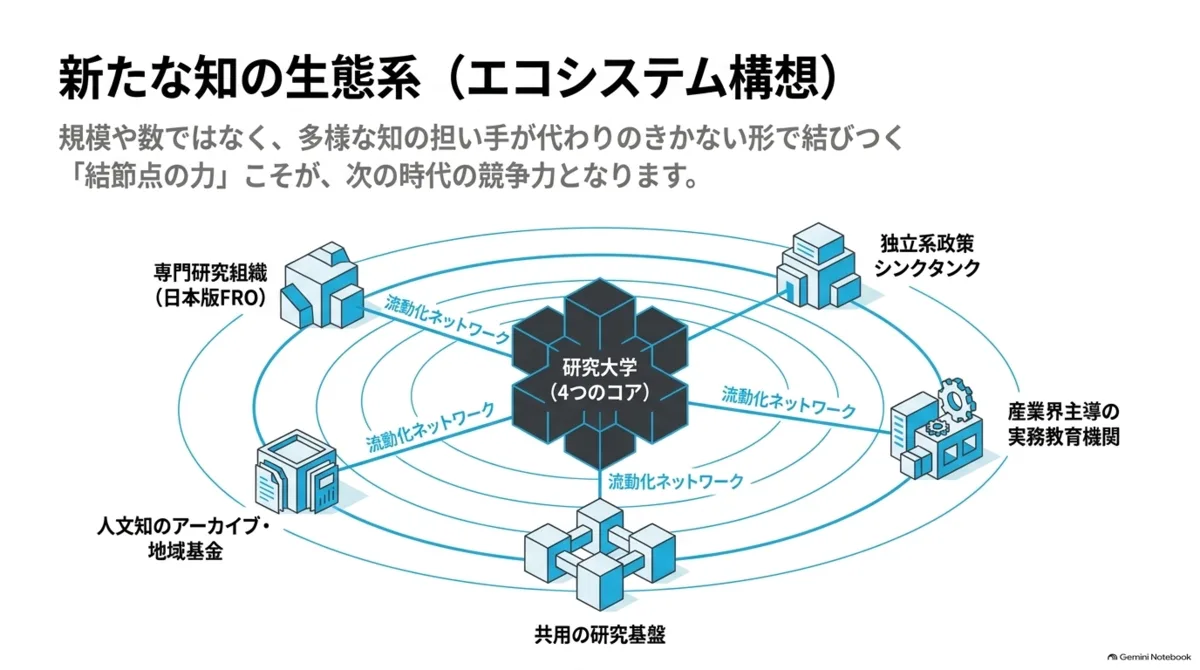
Summary
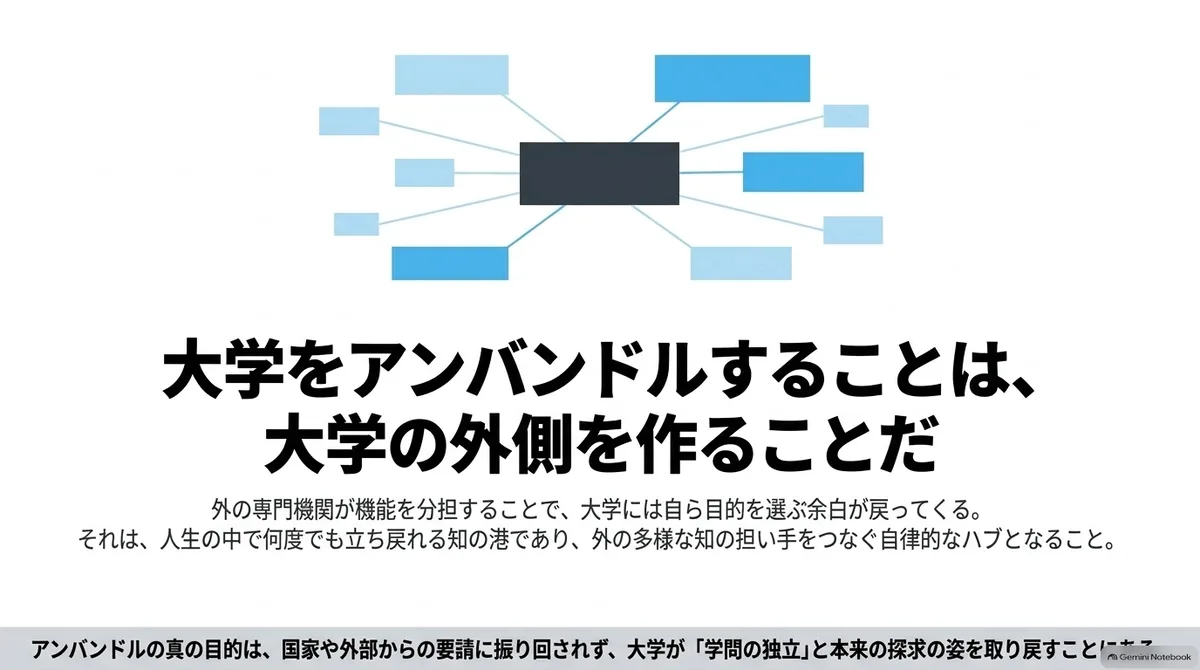
The claim of this article is that unbundling the university means building the outside of the university.
In the 80 years since the Bush report, science and technology policy has proceeded on the premise that if funds are invested in universities' basic research, the results will eventually return to society. Around the world now, options are emerging outside the university: FROs, ARPA-type organizations, foundation funding, research by AI, and new schools. Japan, meanwhile, faces a thinning of its carriers, a sharp decline in the college-age population, and fiscal strain, and its existing bundle is on the verge of collapse with few receiving structures outside. Universities in every country, in every era, have lined up an ecosystem of knowledge outside the university, but Japan imported only the institution of the university and made it take on even the expectations that should have been carried outside.
What should be done toward the next 80 years is to sort the work entrusted to the university from the work left to outside organizations, to open up the facilities, funding, status, and organizational structures that the university has monopolized and build the outside, and to build in a mechanism that allows re-separation when things swell again. University autonomy should be re-supported through diversified funding, buffer bodies, and a limited set of roles. I believe that doing so will widen the conditions under which Japan's universities can pursue their own purposes.
The next 80 years are the era in which the young generation now studying on campus and working at lecterns and in laboratories will spend most of their lives. I hope this article can be an occasion for people inside the university and challengers outside to work through, in dialogue, an institutional design that asks what role the university plays in society, which work to leave with the university, which to entrust to the outside, and what kind of outside ecosystem to build.