Organizing Company Creation into 12 Cells (Excluding Drug Discovery and Software)
This article was machine-translated from Japanese by AI (Claude). It may contain errors. Read the original Japanese article.
I have been writing articles about company creation.
In an earlier article, I divided company creation, in which a party other than the entrepreneur (such as an investor) is involved before the company is founded and launches it, into four kinds of "starting point": technology-driven, demand-driven, outcome-driven, and mission-driven. At the end of "Thinking About Company Creation Along a Timeline," which I wrote afterward, I noted that combining the classification by starting point with the timeline framework might make it somewhat clearer where a project under consideration stands and what it should compete on. More recently, I wrote an article titled "Fighting Innovation Battles and Timelines with 12 Cells."
Building up several articles in this way, I used the framework from that last article, the 12 cells, as my main tool and worked with ChatGPT and others to map examples of company creation onto it. This article summarizes the results of that exercise.
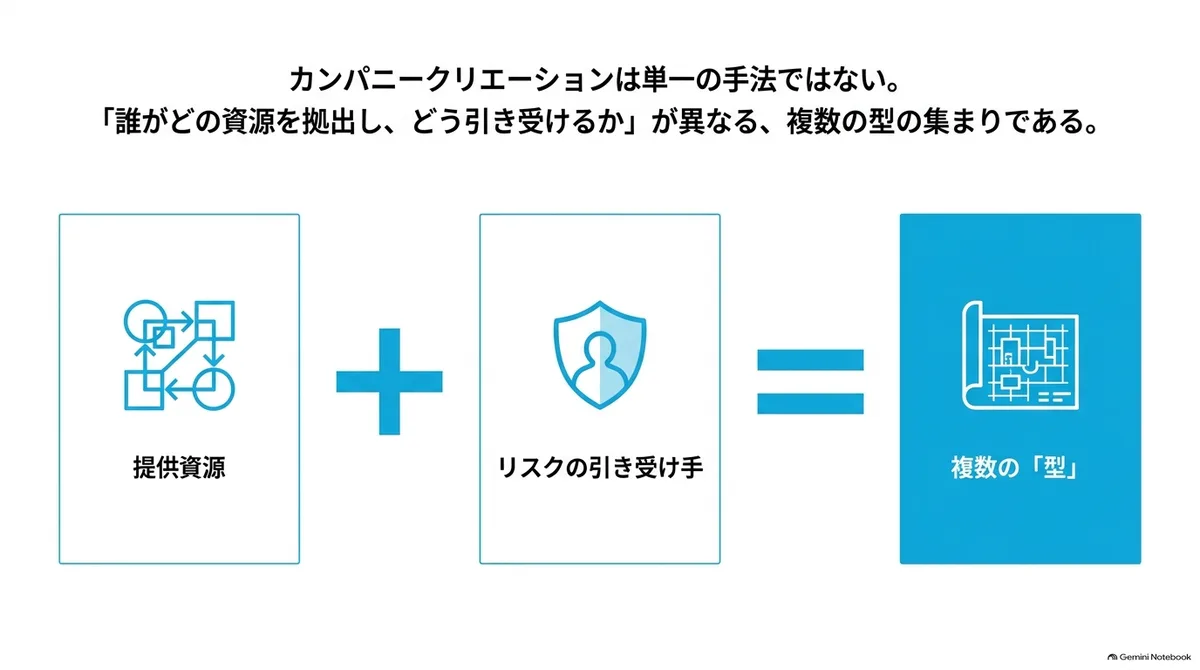
I have organized the material from the viewpoint that company creation is not a single method but a collection of multiple models that differ in "who contributes which resources, and how they take on the burden."
Operators (Investors) That Practice Company Creation
First, let me introduce representative organizations that practice company creation.
I had ChatGPT research company creation and spinoffs since 2020 in particular, and it found 20 organizations and 104 cases of creation or commercialization. I corrected obvious errors, but I have not checked every case, so please take the figures as indicating a tendency. In addition to VCs and PE firms, I included venture builders, in-house studios, and commercialization programs at universities and research institutions.
Drug discovery is probably the field with the most cases of company creation, but I excluded cases of drug discovery, pharmaceuticals, and biomedical devices from this study, because commercialization proceeds differently in those fields. I also excluded studios that handle only software, so Sutter Hill and similar firms are not included.
As a result, the cases counted below are mainly in climate, materials, defense, AI and IT infrastructure, space, and energy. I also included non-medical agricultural biotech. Rather than excluding an entire organization that also works on drug discovery, I separated cases individually.
I divided cases broadly into two groups by the style of leadership in company creation. Where the organization had its own exploration themes or internal projects and built the company by running dedicated personnel and the initial setup, I call it "organization-led." Where the organization and the founder shared the work of conception, intellectual property, team, and initial operations before the company was formed, I call it "jointly led by organization and founder." In reality there is probably a gradient, but I have divided them into two for convenience.
| Organization | Main founding function / program | Listed cases (excerpt) | Organization-led | Jointly led | Cases listed |
|---|---|---|---|---|---|
| Eclipse | Eclipse Venture Equity | Mytra, Peak Energy | 0 | 4 | 4 |
| 8VC | 8VC Build Program | Saronic | 0 | 1 | 1 |
| Lux Capital | Lux Labs (announced in 2024; earlier cases came from its predecessor founding function) | Thematic, Osmo | 0 | 2 | 2 |
| Xora Innovation | Company-creation team | Amperesand | 0 | 1 | 1 |
| Red Cell Partners | National Security Practice / Cyber Practice | DEFCON AI, Claros | 0 | 7 | 7 |
| Flagship Pioneering | Flagship Labs | Terrana Biosciences | 1 | 0 | 1 |
| Deep Science Ventures | In-house company-creation team | Mission Zero Technologies, Parallel Carbon | 19 | 0 | 19 |
| Technofounders | In-house venture building | Bliss Ecospray, ION-X | 0 | 3 | 3 |
| Cambridge Future Tech | In-house venture building | Mimicrete, Literal Labs | 0 | 10 | 10 |
| Marble | Climate-tech venture studio | Aerleum, Vema Hydrogen | 0 | 13 | 13 |
| Wavemaker Impact / 100x100 | Climate-tech venture building | WasteX, Rize | 1 | 13 | 14 |
| Vargas | In-house company-creation function | Stegra, Aira, Syre | 4 | 0 | 4 |
| Actis | Energy Infrastructure | BluPine Energy, Nozomi Energy | 4 | 0 | 4 |
| EnCap Investments | Energy Transition | Linea Energy, Bildmore | 1 | 1 | 2 |
| Prosemino | Prosemino Venture Builder / Prosemino Labs | Sention Technologies, Super6 | 0 | 2 | 2 |
| MIT | MIT Proto Ventures | Hyperion Transport Systems, Vertical Horizons | 4 | 0 | 4 |
| TandemLaunch | TandemLaunch Startup Foundry | LATYS, Waveshaper AI | 6 | 0 | 6 |
| Atomic | Co-found with Atomic | Butter Payments, Exowatt | 0 | 3 | 3 |
| TNO | TNO Ventures / Tech Transfer Programme | LionVolt, TORWASH | 0 | 3 | 3 |
| Founders Fund | Partner-led incubation | General Matter | 1 | 0 | 1 |
| Total | 20 organizations | 41 | 63 | 104 |
The result was 41 organization-led cases and 63 jointly led cases.
Among the organization-led cases, the breakdown is Deep Science Ventures with 19, TandemLaunch with 6, Vargas with 4, Actis with 4, MIT Proto Ventures with 4, and so on. In every case, the organization first hires founding candidates, executives, and venture builders on its own payroll, gives them a project, and then turns it into a company. The 63 jointly led cases are closer to a form in which outside executives and researchers share the work of execution with the organization before the company is formed.
Where Company Creation Stands on the 12 Cells
In the earlier 12-cell article, I divided the supply side into four types according to "what most strongly impedes the move to the next state," and the demand side into three levels according to "how well a tradable demand has been identified."
The table below shows this.
| Dominant supply-side risk \ Demand risk | Low | Medium | High |
|---|---|---|---|
| Deployment and operations risk | (1) Rollout race | (2) Deal-structuring implementation | (3) Paid use-case exploration |
| Scale-up risk | (4) Capacity race | (5) Staged scale-up | (6) Simultaneous exploration of mass production and applications |
| Engineering risk | (7) Target-spec development | (8) Roadmap-first development | (9) Simultaneous exploration of product and applications |
| Science risk | (10) Mission-type validation | (11) Option-forming research | (12) Frontier exploration |
I had AI classify the current position of the 102 companies, which is the 104 cases minus the 2 that ceased operations, on these 12 cells. The result was as follows.
| Dominant supply-side risk \ Demand risk | Low | Medium | High |
|---|---|---|---|
| Deployment and operations risk | (1) 1 company | (2) 26 companies | (3) 0 companies |
| Scale-up risk | (4) 3 companies | (5) 16 companies | (6) 0 companies |
| Engineering risk | (7) 4 companies | (8) 42 companies | (9) 5 companies |
| Science risk | (10) 0 companies | (11) 5 companies | (12) 0 companies |
Several things can be read from this distribution.
(1) Concentration in (8), with Medium Demand Risk
Of the 102 companies, 89 are in the medium demand-risk column (the center column). The low demand-risk column (the left column) has 8 companies, and the high demand-risk column (the right column) has 5.
Within the medium demand-risk column, (8) Roadmap-first development alone accounts for 42 companies, 40 percent of the total. These are projects where applications and prospective customers are visible, a base technology exists to some extent, and what remains is the process of turning that technology into a product that meets customer specifications. The next largest is (2) Deal-structuring implementation, with 26 companies; there the technology is existing technology, and the substance of the business is designing the combination of suppliers, customers, funding, and contracts. All 5 companies in the science row are in (11), and there are no cases in (10) or (12).
However, 84 of the 104 cases have an adoption year of 2022 to 2025, so apart from the 2 that ceased operations and the 1 restructuring, most of the companies have only just started. In other words, this distribution shows the number each organization has been able to start repeatedly, not the positions where returns have emerged. Please read the distribution as telling us not "the cells where things work" but "the cells that are easy to start in."
(2) The Low and High Demand-Risk Columns Are Carried by a Narrow Set of Players
The 8 companies in the low demand-risk column are Eclipse's 3 (Mytra, Peak Energy, Gambit), 8VC Build (Saronic), Red Cell (DEFCON AI, Claros), Vargas (Aira), and MIT Proto Ventures (American Fusion Instruments).
Except for Aira and American Fusion Instruments, the 6 companies were co-founded by US VCs using an "executive plus market hypothesis" approach, and they are in defense, power supply for AI data centers, stationary energy storage, and logistics robotics. In this approach, an executive with a track record is paired up front with an area where demand has become concrete.
The 5 companies in the high demand-risk column are all in (9): Deep Science Ventures' Dunia, Marble's AtmoCooling, and TandemLaunch's three (Waveshaper AI, Recho AI, Wisemotion). TandemLaunch selects university technologies first and then assembles a founding team, and projects that look for an application to adopt while turning the technology into a product end up in the high demand-risk column. There are no cases in (3), (6), or (12).
(3) Each Organization's Projects Cluster in One or Two Cells
All 4 of Actis's companies and both of EnCap's are in (2); 11 of Wavemaker Impact's 14 are in (2); 9 of Cambridge Future Tech's 10 are in (8); and 13 of Deep Science Ventures' 19 are in (8). TandemLaunch's 6 are split 3 and 3 between (8) and (9), and Flagship's 1 is in (11).
Vargas's 4 are spread across (1), (2), and (5), but they all share the approach of first assembling demand contracts and industrial partners and then creating the company. Marble is centered on (8) but extends to (2), (5), (9), and (11); organizations that start from people see their projects spread across cells.
Cases of Cessation and Restructuring
The survey table identified 2 cessations. Red Cell's Eyris was closed in December 2024, and Marble's Centeon is shown as inactive on its official website. The causes of both have not been disclosed, so it is impossible to determine whether it was a technology failure or a failure of demand to materialize. These two companies are excluded from the distribution above.
There is 1 major restructuring, in (5). Stegra completed an additional 1.4 billion euros of financing in June 2026 and announced a review of its construction schedule. This is not a cessation or a bankruptcy, but it corresponds to the point discussed below: even when the demand outlook is there, the cost and schedule risk of the first large-scale facility remains.
I believe that the concentration in the medium demand-risk column, and the clustering of each organization in particular cells, reflect that the work remaining before founding differs from cell to cell, and that few organizations can take on that work repeatedly.
Columns: Demand Risk Determines the Work That Remains Before Founding
The demand-risk column represents what remains as an "unresolved element" before founding. People and capital are needed in every column. On top of that, the rationale for an investor to lead a founding arises when the operator can provide resources that an entrepreneur would find hard to assemble through ordinary investment or partnerships, such as purchase commitments, facilities, intellectual property, customer access, or the ability to structure deals. The investor-led model works precisely because using such resources can greatly reduce the cost and time of the work needed before founding.
The differences among the columns can be summarized as follows.
| Column | Work remaining before founding | Conditions under which investor leadership is advantageous | Who actually moves the column | Examples from the survey table |
|---|---|---|---|---|
| Low demand-risk column (left) | Confirm that the demand conditions are real, and assemble the technology, people, facilities, and funding to supply under those conditions. Speed of launch is at a premium | When the operator can provide resources that take an entrepreneur alone a long time to secure, such as purchase commitments, management to run manufacturing, facilities, and funding to carry the development period | Buyers (participating through offtake contracts or as industrial partners) | Vargas (Syre has a seven-year offtake contract with H&M worth a total of 600 million US dollars; Aira offers existing heat-pump technology on a monthly fee with direct sales and maintenance bundled), the "executive plus market hypothesis" of Eclipse, 8VC, and Red Cell (Peak Energy, Saronic, DEFCON AI) |
| Medium demand-risk column (center) | Divide the unresolved matters into what can be learned through customer validation (required performance, adoption burden, benefits) and what requires the judgment or agreement of others (budget approval, permits, financing, purchase contracts), and structure the decision-makers and the order of agreements for the latter | When the operator has the expertise, credibility, and access to stakeholders needed to structure the deal, and can move multiple decisions at once. If customer validation is the main task, leave it to the founding team and have the operator confine itself to providing funding and access | Demand-side decision-makers and policy. If the payer, budget, period, and specifications become concrete through public procurement, contracts for difference (price-gap support), large-company offtake, and the like, the column moves toward "low" | Deep Science Ventures (13 of 19 companies in (8)), Wavemaker Impact (11 of 14 companies in (2); Rize was conceived by four parties, who appointed the CEO), Actis and EnCap (secure the executive first, then structure assets, contracts, and funding) |
| High demand-risk column (right) | Explore the combination of application, customer, and reason to pay. Design in advance the discretion to change the hypothesis and who bears the cost of exploration | When experimental facilities, intellectual property, data, customer access, and the like can be used as shared resources across multiple projects. For projects that can be handled with a small team and low-cost experiments, a structure that frequently requires investor approval becomes more of a burden | The exploration team itself (moving from (12) to (11) is the work of narrowing the demand hypothesis, and moving from (10) to (7) is the work of establishing the science; both lie with public research funding and the university side) | Flagship (the organization bears exploration costs and recovers the cost of rejected hypotheses through equity in the companies that succeed; Terrana was made public after about four years of non-public development), TandemLaunch (3 of the 5 companies in (9); it fixes the combination of technology and people first) |
Firm demand does not mean that a large capital investment is justified all at once. If performance in a real environment and mass-production yield have not been confirmed, a process of judging the next investment in stages while watching the results of that validation is indispensable. Northvolt, which I mentioned in an earlier article, ran into trouble because, despite holding huge offtake contracts, it took on the execution risk of technology development and mass production at the same time. Stegra, mentioned in the previous section, also remains in (5) despite having firm demand contracts and has been forced to rework the schedule and financing plan for its first plant.
In the low demand-risk column and in (5), the real protagonist moving the column is the buyer (the customer). At Syre, H&M takes on demand through a long-term contract; at Mission Zero Technologies, Anglo American participates as a co-founder; and at Arctial, Rio Tinto and Mitsubishi Corporation have joined as industrial partners. The fact that US VCs establish projects in this column with the "executive plus market hypothesis" model is also limited to areas where the market hypothesis is backed by institutions or firm demand, such as defense procurement and power supply for data centers.
The same applies to demand created by policy, which is what I called "mission-driven" in the earlier article. The cells in the column move only once it is decided "who will pay for that company's product, and under what conditions." Because a change of payer or the end of a budget can send the column back to the right (the high demand-risk side), the work of carefully assessing the binding force and duration of the contract remains before founding.
Among the 20 organizations surveyed this time, there was not a single case in (10) or (12). The three cells in the science row are alike in that science is the greatest constraint, and they differ in the demand-side outlook. (10), where "demand is clear but the science is not yet established," seems to be common in drug discovery, but outside that field it is territory carried by government mission-type research and the R&D of large companies. Once the science is established, it moves to (7).
(12), where both demand and science are undetermined, is the realm of basic research, and investors can handle it only after the hypotheses about applications and prospective customers have been narrowed and it arrives at (11), or after the science has been established and it arrives at (9). What investor-led creation handles in the science row is concentrated in (11), where the science is not yet established but there is a demand hypothesis and an option can be structured to test multiple hypotheses in parallel. The fact that there are no cases in (3) and only 5 in (9) is probably because, unless there are shared resources such as intellectual property and platforms that can be shared, it is hard for an investor-led rationale to hold.
Rows: Supply Risk Determines the Operator's Capabilities
While the column determines the character of the work before founding, the row determines what the operator must validate and what organizational capabilities it must be able to provide repeatedly. I have left out of the table what must be confirmed in common at the point of company formation in every cell (the rationale for proceeding as a company, rights to use resources, the team, funding for the next validation, and authority over decisions and termination), and list only the conditions specific to each row. Of the examples, Versant, Third Rock, and The Production Board focus on drug discovery and so fall outside the survey table, but I cite them as examples of creation functions.
| Starting-point row | What the operator assembles before founding | Founding conditions specific to the row | Main risks remaining at company formation | Required founding function and examples that adopt it |
|---|---|---|---|---|
| Science row | Experiments that can refute the hypothesis, confirmation of reproducibility, and study of applications and routes to commercialization | The rationale for continuing the research as a company, and the design of the next set of experiments | Scaling up effect size and reproducibility, narrowing the demand side | In-house research and experimental facilities (Versant), interim management (Third Rock), a permanent-capital holding company (The Production Board), an iterative process for hypotheses (Flagship), in-house research and validation budgets (Marble) |
| Engineering row | Candidate applications, customers' required specifications and prices, and prototypes. In parallel, selection of the business lead | Terms of use for intellectual property, the target application, and the technical and business leads | Integration and certification in real environments, aligning with customers | Selection of university technologies and assembly of founding teams (TandemLaunch), business and funding plans inside the research institution with adjustment of external executives, licenses, and equity (TNO), founding teams with divided roles (Cambridge Future Tech), provision of in-house labs (Prosemino Labs) |
| Scale-up row | The supply technology, a techno-economic analysis of cost and manufacturing method, a management and manufacturing team, and negotiation of purchase terms | Concrete commitments from customers, feasibility of supply, and an outlook on facility financing | Yield and unit cost, execution of the first plant | Structuring demand contracts and industrial consortia (Vargas), combining executives and market hypotheses (Eclipse), structuring factory financing |
| Deployment and operations row | The first deployment sites, the sales, installation, and maintenance setup, winning initial projects and bidding, and financing contracts | The customer's economic benefit, an outlook for operations in which the company itself profits, and workable financing contracts | Learning the differences between sites, repeating operations, fluctuations in volume and timing | Hiring executives with a track record and structuring deals (Actis, EnCap), deployment design combined with finance and distribution (Wavemaker Impact), integrated operation of direct sales, installation, and maintenance (Aira) |
The nature of the exploration period and cost changes from row to row. The same operator can handle multiple rows, but because a different creation function is needed for each row, I believe this is the background to why each organization's projects cluster in one or two cells.
What is easy to overlook when crossing rows is the time that lies outside the operator's own exploration period. According to NTU's account, Amperesand's research began in 2016, and after prototyping and validation it was spun out in 2023. By the time Xora became involved, the science risk had already been cleared, so as a Xora project it starts from the engineering row, but the seven years of R&D leading up to that had been carried out ahead of time on the university side. When evaluating a project in the engineering row, one needs to check who bore the time and cost of this earlier stage. (In drug discovery, the flow from science to deployment and operations is easy to see and tends to be fast. However, since the sources of demand and price are insurance premiums and social security spending, one cannot say flatly that there is no demand risk.)
Rows and columns also determine the kind of capital required. Deep Science Ventures, Cambridge Future Tech, Marble, and TandemLaunch, which handle (8), are a model in which the whole organization bears the exploration cost and turns the project into a company in a short time. As institutional guidelines, TandemLaunch takes 12 to 18 months, Marble 12 months, and Prosemino 12 to 24 months, and TNO's preparation for company formation takes 6 months. Vargas, Actis, and EnCap, which handle (2) and (5), are a model in which PE or infrastructure capital holds a majority stake and structures assets, contracts, and borrowing project by project, and both the scale of capital and the form of recovery are different. (11) differs in duration, as with Terrana's roughly four years and Amperesand's seven years of earlier stage. What an ordinary VC fund with a ten-year term can do comfortably among these is the (8) model. In other words, it is the capital constraint, not the nature of the project, that determines the territory one can work in. Removing that constraint may require cooperation with government-affiliated bodies and the like.
Treat the Entry Point of Exploration Separately from the Cells
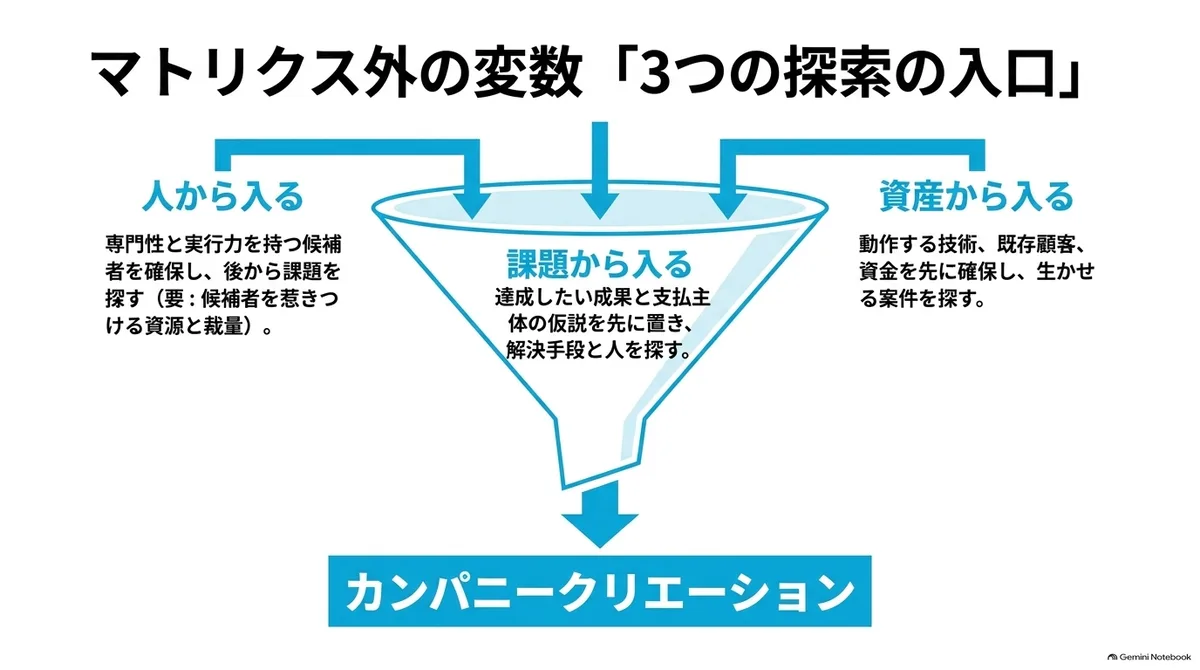
When we consider the "entry point of exploration" separately from a project's cell, there are broadly three kinds of entry point.
- Starting from people: First secure candidates who have expertise in a particular field and the ability to execute, and then look for problems and customers that suit them. Marble's recruitment does not require a team, intellectual property, or a concrete idea, and emphasizes expertise and the potential to lead a company. An EIR (entrepreneur in residence) scheme could be said to be a similar mechanism.
- Starting from problems: First set out the outcome to be achieved and a hypothesis about who will pay, and then look for the means of solving it and for people. Deep Science Ventures and MIT Proto Ventures are examples.
- Starting from assets: First secure resources such as science and technology that already work, existing customers, installation and operations capabilities, or funding, and then look for projects that can make use of them. TandemLaunch, TNO, and Vargas use this entry point.
According to a World Nuclear News report (April 2025), General Matter is a project that a Founders Fund partner founded himself after looking for a US uranium enrichment company to invest in and not finding one. It was incubated inside Founders Fund for about a year. The entry point was people, but in the survey table I placed it in (8) as a stage where development of enrichment technology and facilities remains, and it would move to the low demand-risk column once the terms of the government contract are confirmed. This form is not a mechanism the organization repeats, but an individual case that arose from a partner's personal judgment.
The entry point of starting from people can be used only by an organization that has a channel for continuously securing candidates and has the resources and discretion to offer them. An organization with a weak channel starts from problems or assets, and welcomes people only after making concrete the business conditions it can present to founding candidates (the position of the cell and the work completed before founding). Because the operating side takes on the validation and coordination for that, the entry point should be chosen with the capabilities and costs of the shared team in mind.
From the Entrepreneur's Side
The same framework gives an entrepreneur material for deciding whether to take part in an investor-led project. For example, it would be good to ask about items such as the following.
- The resources the operator provides (customer commitments, intellectual property, facilities, funding, management talent)
- The work I will be responsible for (the validation shown by the row, and the demand-side work shown by the column)
- The equity at founding
- Which side holds the authority to change the hypothesis, hire, add budget, and terminate
The organization of columns and rows tells you "the work I will be responsible for." In the low demand-risk column, the main work is executing supply; in the medium column, it is customer validation and structuring agreements; in the high column, it is exploring applications and customers. The row shows the kind of risk you take on: for the science row, experimental results; for the engineering row, integration and certification; for the scale-up row, yield and cost; and for the deployment and operations row, repetition at the site. Whether your own experience fits that work is the first condition for deciding whether to join.
As for equity and discretion, there is a tension: the greater the investor's contribution before founding, the larger its equity at founding, and this weakens the pull on outstanding entrepreneurs. The range runs from structures in which the investor holds a majority, as at Flagship, to structures in which it remains only the first investor, as at Marble, so it would be good to look at how much work is completed before founding and how much is handed to the entrepreneur at founding. However, the size of equity and day-to-day discretion are separate matters, so I recommend judging only after confirming how authority is allocated.
From the Side of Those Starting in Japan
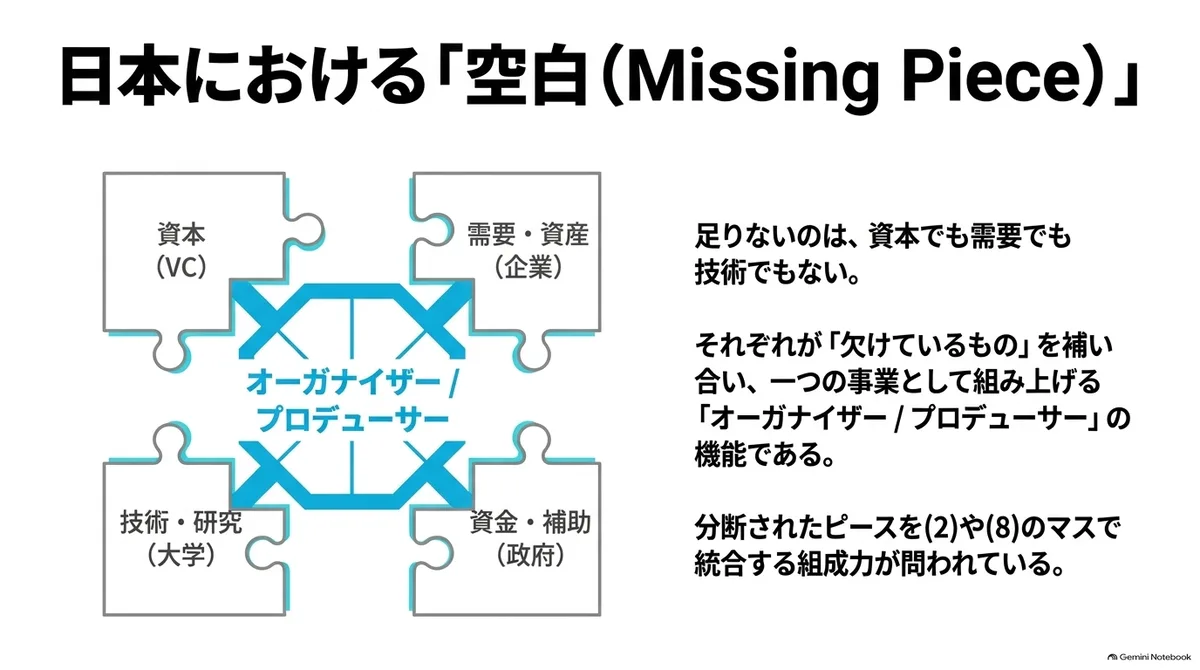
When the same framework is applied to those who are about to start company creation, namely VCs, companies, universities and research institutions, and government-affiliated bodies, it becomes clear that what each has and what each lacks differ. In table form, it looks like the following. The examples are limited to organizations covered in the survey table and the main text.
| Actor | What they have | What they lack | Suited cells | Suited entry point | Corresponding precedents |
|---|---|---|---|---|---|
| VC | Capital, a network of management talent, discipline in decisions and termination | Experimental facilities, earlier-stage research funding, access to the demand side, pre-founding personnel costs | (4) (7) (8) | People (executive plus market hypothesis) | Eclipse, 8VC, Red Cell |
| Company | Demand (its own purchasing), facilities, employment, credibility for structuring deals | A mechanism for handing authority over hypothesis changes and termination to the front line, a practice of releasing equity to outsiders | (1) (2) (5) | Assets, problems | H&M (Syre), Anglo American (Mission Zero), Rio Tinto and Mitsubishi Corporation (Arctial) |
| University or research institution | Technology, earlier-stage research funding and time, experimental facilities | A business lead, selection of applications, a mechanism to settle intellectual property terms early | (8) (11) | Assets (technology) | TandemLaunch, TNO, MIT Proto Ventures, Cambridge Future Tech |
| Government-affiliated body | Earlier-stage research funding, procurement, loans and guarantees for first-plant facilities, capital of government-affiliated investment companies | Selecting projects and judging termination, management talent | Movement from (10) to (7), from (12) to (11) or (9), column movement, first-plant facilities in (5) | No entry point | Tesi (Arctial), Temasek and GenZero (Rize), DOE contract (General Matter), tax-credit finance (Bildmore) |
For VCs, it is as described in the previous section: what an ordinary fund can repeat is the (8) model. To do (2) or (5), it needs to team up with trading companies or infrastructure capital, and to do (11), it needs to team up with a party that holds earlier-stage research funding. What a VC can bring on its own is capital, a network of management talent, and discipline in decisions and termination.
The role in which companies can be most effective is that of the first buyer. I said earlier that it is the demand-side parties that move the columns, and in this framework, issuing an offtake, lending a demonstration facility for the first project, or making the company's own purchasing the first deployment site has more power to move a project's cell than taking part as an investor.
On the other hand, a company's weakness is authority. If an in-house studio, despite having demand, facilities, and people, fails to reach the joint leadership discussed in this article and remains an internal new business, it is because the company has not been able to hand decisions on changing hypotheses, adding budget, and termination to the front line. If a company uses its demand and facilities for company creation, one possible division of labor is to entrust only the design of authority and equity to outside parties.
What universities and research institutions have is technology, and earlier-stage research funding and time. NTU bore Amperesand's seven years, and TNO builds business and funding plans in internal projects before forming a company. What they lack are business leads and selection of applications, and TandemLaunch and Cambridge Future Tech take that on as organizations. Because investor-led company creation in the science row starts only from (11), what universities should prepare is probably the earlier stage that carries research that far, a mechanism for settling intellectual property terms early, and the readiness to accept business leads who come from outside.
What government-affiliated bodies have is earlier-stage research funding, demand, funding for first plants, and the capital of government-affiliated investment companies. The work of raising the TRL of research in (10) and (12) and moving it to a higher row is not part of investor-led company creation and would fall to public research funding. Public procurement and price-gap support are policies for moving the column (demand), but they can be counted as real resources only after the binding force and duration of the contract have been confirmed, and General Matter's government contract is an example. Loans and guarantees from government-affiliated banks come into play in (5), after demand contracts and technical validation are in place.
Conversely, what government-affiliated bodies lack is the judgment to select and terminate projects, and management talent. Note also that subsidies look like demand, which makes it easy to misjudge a subsidized project as being in the medium demand-risk column.
And what each lacks is held by someone else. If so, a hypothesis suggests itself: what Japan lacks is not capital, demand, or technology, but the organizer, producer, or arranger who assembles them into a single project. Vargas assembling power, hydrogen, customers, capital, and management into a single business, and Wavemaker Impact turning farmers, finance, and buyers into a single business, is exactly this kind of structuring work, and it may be fair to say that the question is how to carry out such efforts.
Company Creation and Industry Creation
So far I have written in units of how a single operator turns a single project into a company.
On the other hand, there is an implicit premise that the conditions for repeating company creation include having in place things that lie outside the company: earlier-stage research funding, shared resources, and counterparties in the value chain. I also think that if one envisions company creation in Japan, then unless one designs who will take on this outside layer at the same time as designing the operator, it will in the end not get off the ground.
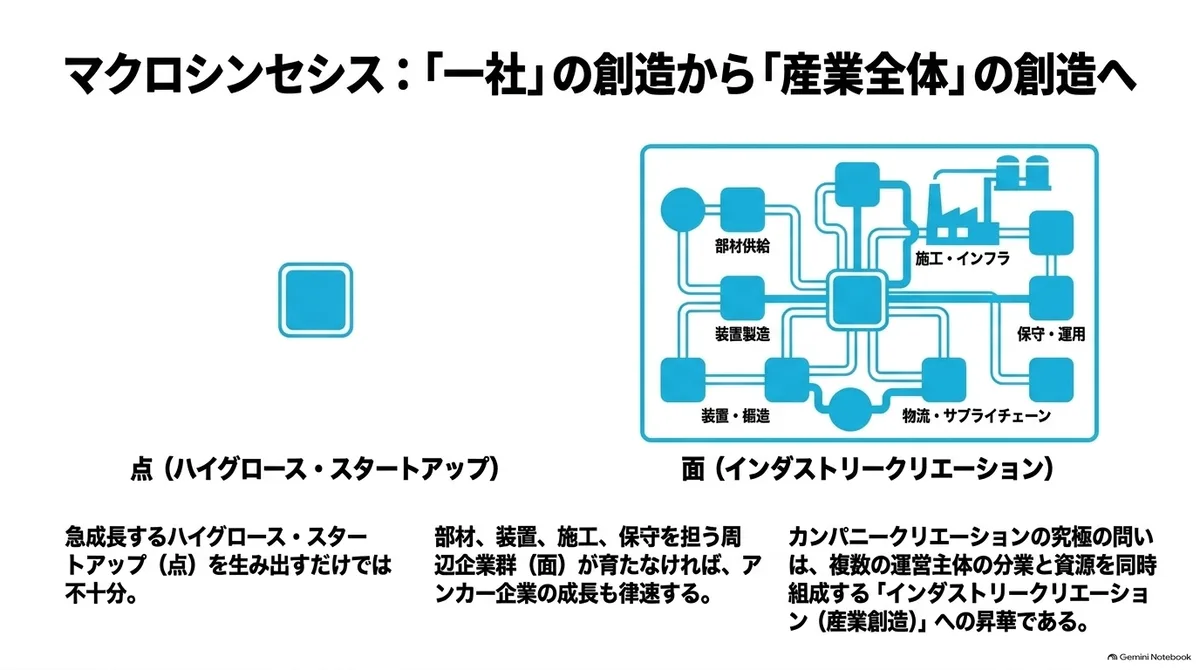
For example, as I wrote in "Startups and 'Industry Creation' with Regions," even if one manages to produce a candidate for a high-growth solar panel startup, its growth will also stop if the surrounding group of companies that handle its components, equipment, installation, and maintenance becomes the rate-limiting factor. Unless those companies are created as well, large companies like high-growth startups will be hard to produce.
In this sense, I think there are two models of what is called company creation. One is the model of creating fast-growing startups that go after large demand and large risk. The other is the peripheral companies that are missing when one looks at the industry as a whole. Peripheral companies do not presuppose rapid growth, but they are necessary as a condition for anchor companies to grow.
Once the scope is widened this far, company creation comes to be a question closer to the creation of an industry (industry creation), which includes the division of labor among multiple operators, how shared resources are held, and the simultaneous structuring of suppliers, customers, and funding, rather than an activity of building companies one at a time.
Seen in the distribution on the 12 cells, these two models are in charge of different cells. Organizations that repeat (8) and (11) with VC-type capital can be read as doing activity closer to the former, and organizations that structure (2) and (5) project by project with PE or infrastructure capital as doing activity closer to the latter.
And unlike the US and China, Japan does not have so many startups that are born by responding nimbly to new demand, so it may be necessary to consider whether to create such peripheral businesses at the same time, or whether startups themselves should extend their value chains considerably and make them their own business. On the other hand, compared with the EU and others, manufacturing remains, so there is also a chance that cooperation among large companies and small and medium-sized enterprises could manage it.
I would like to address the organization of and thinking about these matters from the industry side in a separate article.
Summary
I have organized company creation as an activity that expresses the state of a project through 12 cells formed by the types of supply risk and the stages of demand risk, and selects the leadership model according to who can take on the work remaining before founding. I think the columns in the table lay out the character of the work remaining on the demand side, and the rows lay out the validation and creation functions the operator must provide repeatedly, so that together they tell us what functions are needed. People and capital are needed in every cell, and whether to start from people, from problems, or from assets is a choice separate from these 12 cells.