Thinking About Company Creation Along the Time Axis
This article was machine-translated from Japanese by AI (Claude). It may contain errors. Read the original Japanese article.
In my previous article, I organized company creation by differences in its "starting point": starting from technology, starting from demand, starting from outcomes, and starting from mission as a new possibility. After that, I published an article titled Thinking About Startups in Terms of Supply Risk and Demand Risk.
In discussions with several people based on this framework, I came to feel that adding one more axis would be useful in practice. That axis is the "time horizon of the opportunity." I believe that what company creation aims for changes greatly depending on whether the opportunity it targets is short-term or long-term.
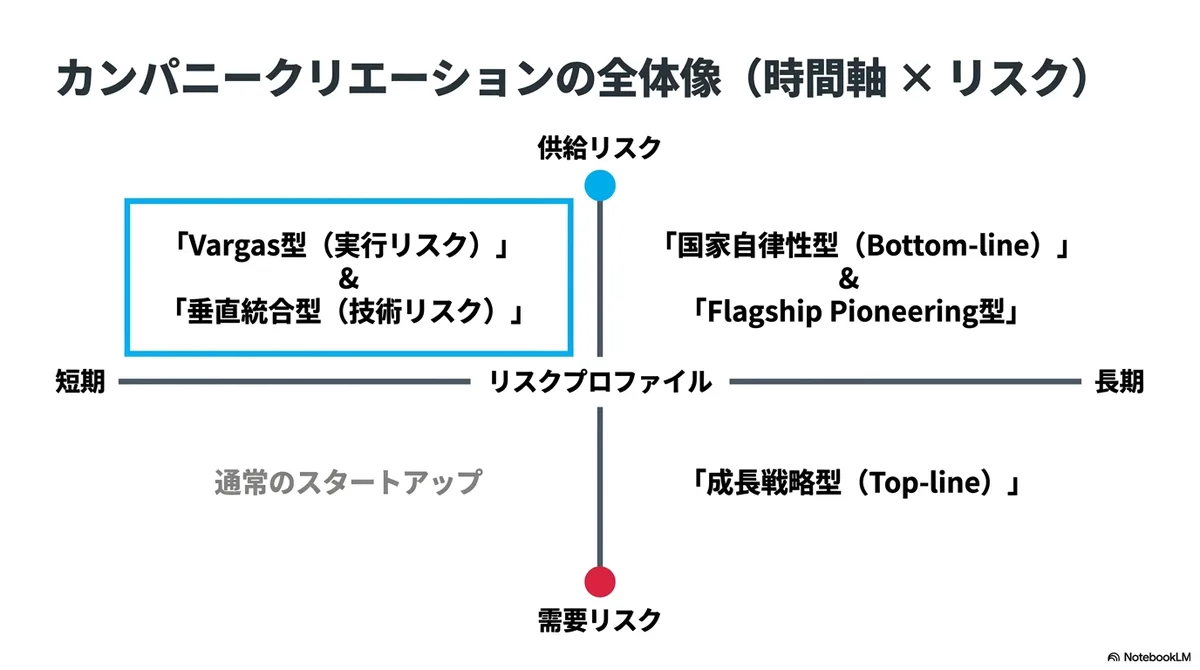
Short-term company creation tends to take almost no demand risk and to take on a large amount of supply-side risk, that is, execution risk and capital risk. Long-term company creation, too, has approaches that take almost no demand risk and take supply risk (the risk that a disruptive technology can be realized), such as Flagship Pioneering.
Apart from these, though, I feel there are several other models of creation.
In the short term, there is the vertical integration type. This is also a model that takes supply risk.
In the long term, one is a vision of growth, aimed at raising the top line of the economy, and the other is a vision of autonomy, which sets a nation's bottom line and fills the gap between it and the current situation.
Organized a little, it looks like this.
- Short term
- Supply risk (note: not limited to the following)
- Vargas type
- Vertical integration type
- Demand risk
- (Ordinary startups)
- Supply risk (note: not limited to the following)
- Long term
- Supply risk
- Flagship Pioneering type
- National autonomy type
- Demand risk (note: not limited to the following)
- Growth strategy type
- Supply risk
I will go through these in order.
Short-Term Opportunities: Short-Term Company Creation Tends Not to Take Demand Risk
The risks a startup takes can be broadly divided into demand-side risk and supply-side risk. And much of what we know as "startup methodology" has been built on the premise of opportunities with large demand risk and small supply risk.
For example, what high-growth IT startups of the 2010s were aiming at was an opportunity where "if it hits, demand may expand rapidly in a short time, but we don't know whether that demand really exists." On the other hand, supply-side risk was small. The technological foundation had already been established by the cloud and smartphones, software could be built by a small team, and the marginal cost of replication was almost zero. In other words, since almost all of the uncertainty was concentrated on the demand side, "making something people want" was what mattered. Methodologies such as the lean startup and the MVP developed precisely to fit this structure, as answers to the question of how to verify uncertain demand cheaply and quickly.
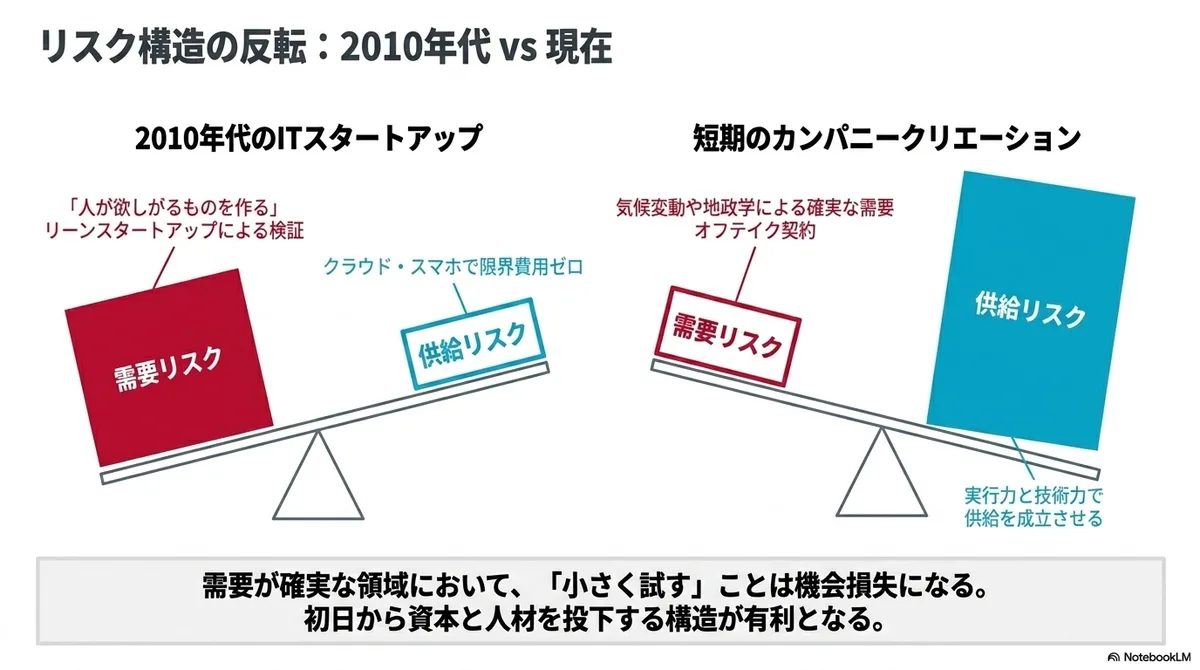
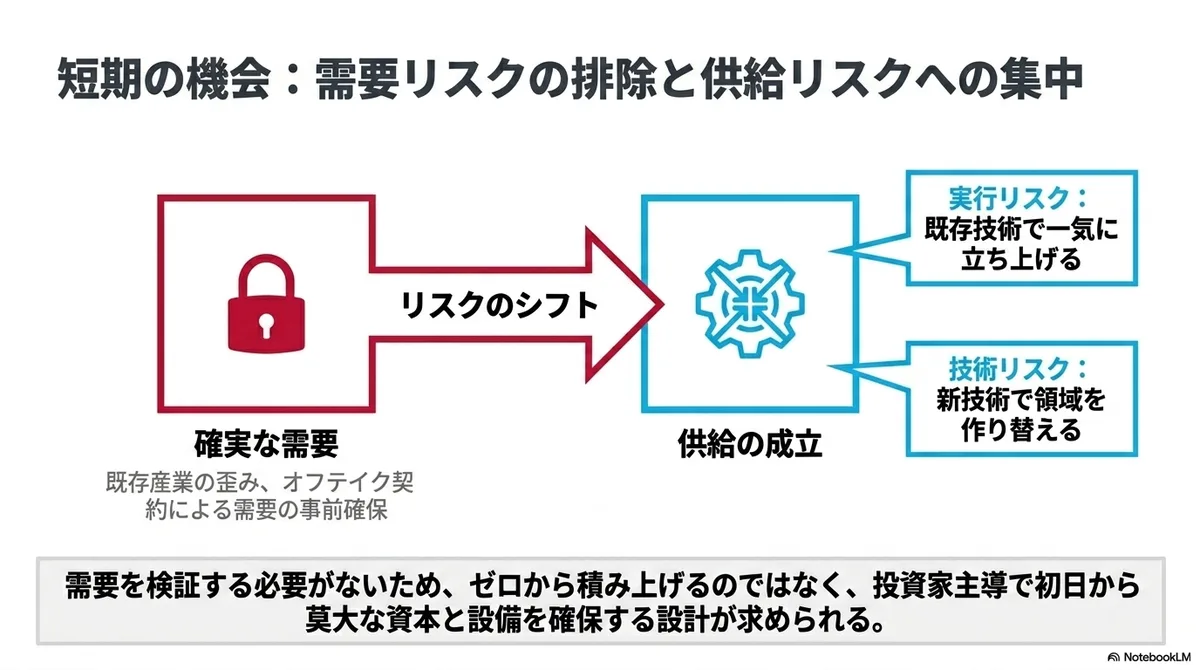
Short-term company creation inverts this risk structure. When climate action and sharp geopolitical shifts are underway, distortions arise throughout industry where "demand is almost certain, but supply cannot keep up." Short-term company creation selects such places, secures offtake contracts first to reduce demand-side risk in advance, and adopts a design that concentrates on the supply-side risk of whether supply can be brought into being to meet the demand that has become certain.
If there is no need to verify demand, there is also no reason to proceed by testing a little at a time. That is exactly why this is a domain that structurally tends to favor company creation, in which investors and supporters gather capital, assemble people, and secure facilities from day one, over ordinary entrepreneurship, in which an entrepreneur builds up management resources from zero.
Just to be clear, this is not to say that the lean startup has become outdated. For opportunities where demand is uncertain, it is still rational to start by verifying demand. Rather, the point is that when the risk structure of an opportunity differs, the appropriate methodology and the appropriate way of building a company also differ. We can perhaps put it this way: in the 2010s there were a great many opportunities of the kind "supply is easy but demand is uncertain," so demand-verification methodologies became mainstream; now, opportunities such as "demand is certain but supply is hard" and "demand exists because there are incumbent companies, but a mechanism that can overturn them is hard to build" have become relatively more numerous, so company creation and vertical integration in existing industries are attracting attention.
And there are two kinds of supply-side risk: execution risk, when supply capacity is brought up all at once on the premise of existing technology, and technology risk, when new technology changes the way of supplying itself. Depending on which one is mainly taken, short-term company creation splits into two types.
(1) Bringing Supply Up All at Once Against a Bottleneck with Certain Demand
The first is the type that mainly takes execution risk. A typical example is found around data centers.
According to a report by the IEA, data center electricity consumption is expected to reach about 945 TWh in 2030, more than double the current level and more than the electricity consumption of Japan as a whole. Moreover, a considerable part of this demand is tied to projects in which investment has already been committed. That said, demand risk is of course not zero. If investment in AI stalls, this outlook will be revised downward. Even so, compared with other new industries, the certainty of demand is strikingly high.
Supply, on the other hand, has not kept up. In the United States, for example, lead times for power transformers have reached four years, and prices have risen by about 80% over the past five years. The data center itself can be built in about two years, yet the equipment that delivers the electricity has a four-year wait, a reversal of the usual order.
In other words, what is being asked here is not how to find demand, but how fast supply can be brought up toward demand that is already visible: a problem of execution. When demand changes greatly in a short time, existing suppliers are bound by long-term contracts and relationships with existing customers, and cannot reorganize their structure right away. As the entity that guarantees this "speed," there is meaning in building a new company from scratch. It gathers capital all at once, assembles people and manufacturing capacity in a short time, and brings supply into being at many times the usual speed. The standard approach of proceeding while verifying bit by bit is, here, rather an opportunity loss. Vargas, too, can be seen as building companies in response to demand for green products that arose in the short term.
And a tailwind for new companies is the tendency for new technologies and new suppliers to be adopted more readily when demand changes greatly. In normal times, buyers do not go out of their way to procure from suppliers with no track record. But when the wait is four years, more buyers look for alternatives, turning a blind eye to some weaknesses. In other words, a sudden shift in demand opens a window for new entrants.
However, there are also conditions on the new technology that is required. That demand has already taken off means, conversely, that there is no time to settle in for research and development. So what can be used here is mainly technology that can meet requirements with modest development, or the repurposing of technology that has already been brought to a reasonable level of completion in another field. Nor does this mean that deep tech that takes years to develop can easily get in (indeed, I think deep tech that takes a long time to develop should be considered on the long-term time horizon of the visions described later).
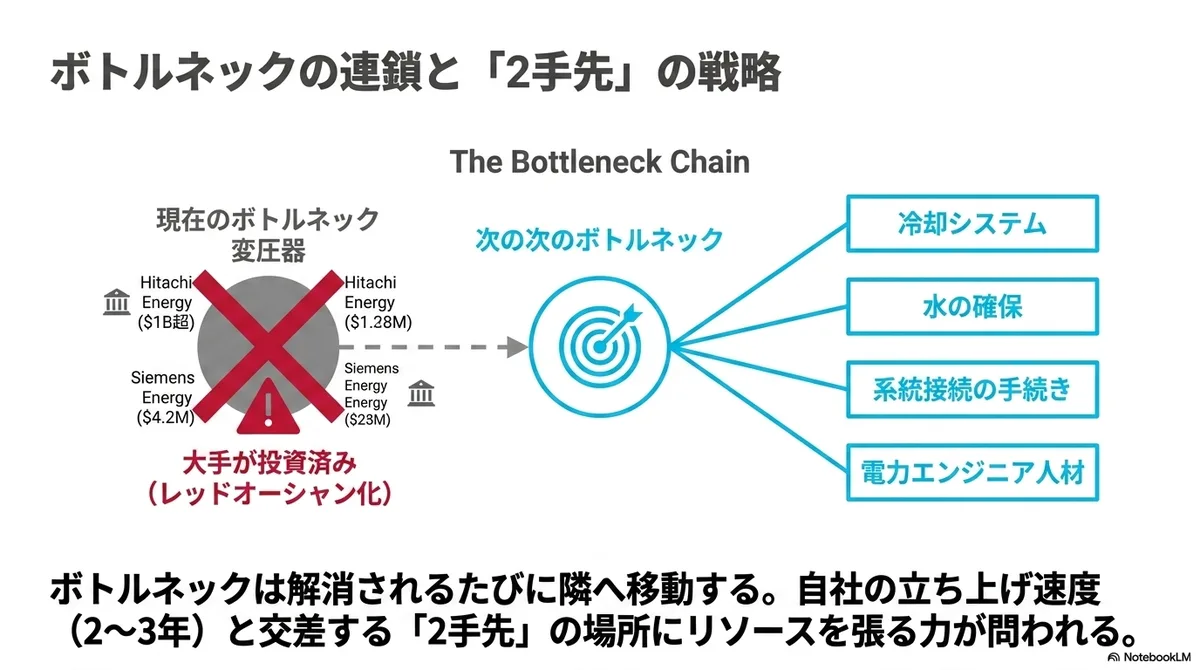
There is one more point to note. Everyone rushes to the bottlenecks that are visible now. In fact, for transformers, not only have several startups already emerged, but Hitachi Energy has already announced investments of over $1 billion, and Siemens Energy $420 million, to increase production in the United States. If it takes two to three years to set up a company and begin supplying, you may find yourself colliding with the expanded production of established major players by the time you enter. Even if there is "preferential treatment for domestic companies" from the standpoint of economic security, Japan has strong large corporations, so that logic may not be available.
That being the case, there are several patterns that startups should aim for.
If, as in the United States, large resources can be gathered in a short time, a startup-style approach of responding immediately once you have caught "today's bottleneck" may be applicable. For example, if you could raise 20 billion yen right now, it might still be in time to create a transformer startup from now.
But in a country like Japan (or rather, in countries other than the United States), such a contest is hard to wage unless conditions such as technology are in place. So the reasonable course would be to aim around the "bottleneck after next," which not many people have yet touched. For example, if you think about what will get clogged after transformers, it may be cooling and securing water, or the procedures for grid connection and the supply of power engineers. Each time one bottleneck is resolved, the bottleneck moves next door, so you are required to read that chain two moves ahead and place your bet where it intersects with your own speed of setup. What is tested in this type is execution ability and the ability to read the chain of bottlenecks.
Using New Technology to Remake a Domain Whose Importance Is Already Visible
The second is the type that mainly takes technology risk. When an entirely new supply-side technology such as AI appears, this is a way of competing by making good use of that technology to remake, in an entirely new way, a domain whose importance is already visible.
Here, too, demand risk is not taken. The targets of remaking are domains such as healthcare and accounting, where the existence of demand is self-evident and it is rather supply that falls short because of labor shortages. The risk being taken is on the supply side: whether new technology can resupply that domain better.
For example, General Catalyst advances a strategy called "Creation," which involves not only investing but creating companies themselves, and in 2023 it co-founded Hippocratic AI together with entrepreneur Munjal Shah and others. It is a company that supplies AI agents that handle tasks such as follow-up calls to patients, in response to the clear demand created by the shortage of medical personnel, including nurses, and it was reported to have recently raised $126 million at a valuation of $3.5 billion. General Catalyst has further formed a company called HATCo, which completed the acquisition of Summa Health, a health system in Ohio, in 2025, and is seeking to remake hospital operations themselves on the premise of AI and then roll out the mechanisms validated there to more than 20 partner health systems.
The same pattern is spreading beyond healthcare. Thrive Capital is reported to have formed a holding company called Thrive Holdings and to be committing around $1 billion to a strategy of acquiring accounting firms and other businesses and remaking them with AI. The fact that OpenAI has taken a stake and that a further raise on the order of $2 billion is reportedly under negotiation also shows how high expectations are for this pattern.
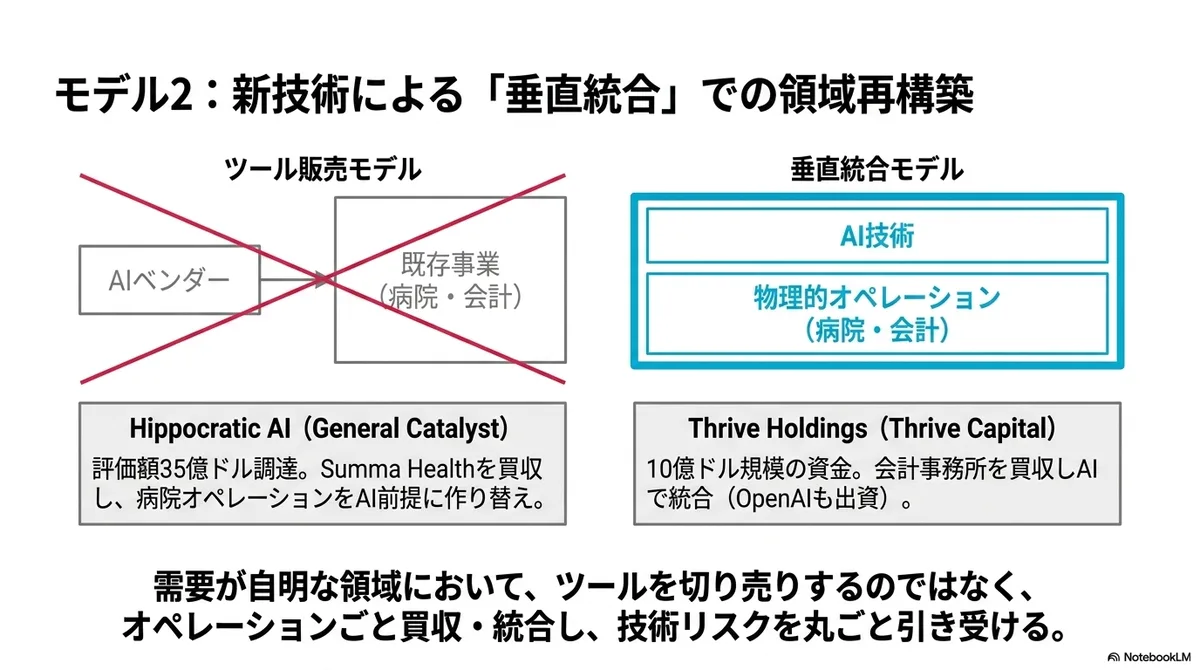
What these have in common is that they do not sell AI as a tool to existing players, but take on the operations of the target domain themselves and remake them. While the technology is still not well understood, selling it piecemeal as a tool will not get it used well by existing organizations. If so, the reasoning goes, it is better to build the technology's performance improvement curve into the business plan and own and run the operations of hospitals and accounting firms yourself, which keeps the technology risk under your own control and lets you capture the full value. In other words, this type can be said to be a design that does not take demand risk, and in exchange takes on, through vertical integration, the entire supply risk (technology risk) of whether a domain can be remade with new technology.
And it is clear that this pattern is a good match for investor-led company creation. In addition to large capital, it requires the means of acquisition and the assembly of management talent versed in both the target industry and AI, so the hurdle is high for an individual entrepreneur starting from zero.
That said, this does not mean that any supply-side risk is fine to take. The collapse of Northvolt, which I mentioned in the previous article, can be read as a case that got stuck because it took large technology risk and mass-production execution risk at the same time, even though it had secured its demand with offtake contracts. I would like to stress that removing demand risk does not guarantee success; it merely shifts the object of risk to the supply side.
Long-Term Opportunities Are Visions for National Autonomy and Industry
When the time horizon is extended to 10 or 15 years, the nature of the opportunity changes.
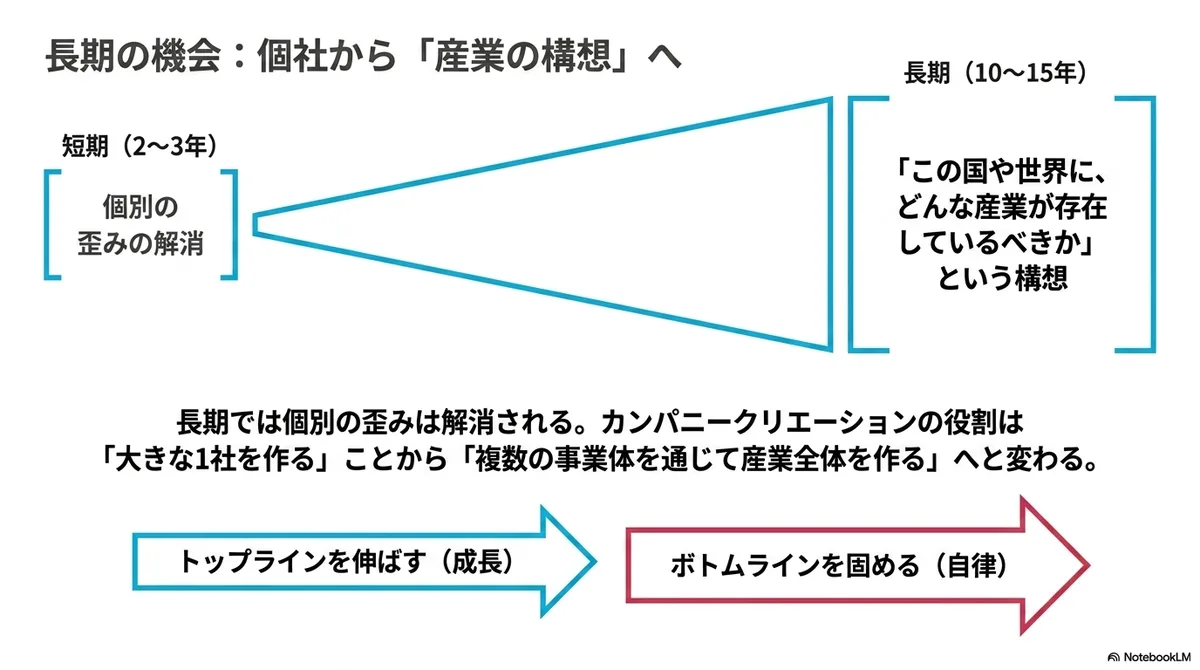
Because individual distortions are resolved within the short term, what is assumed as demand over the long term is mainly a vision of "what industries should exist in this country and in the world." I think company creation can be positioned as a means of turning that vision into a concrete group of companies.
And I believe there are two types of long-term industrial vision, differing in direction.
They are:
- A vision of growth, aimed at raising the top line of the economy
- A vision of autonomy, which sets a nation's bottom line and fills the gap between it and the current situation
That is, a difference in direction: raise the ceiling, or support the floor. The two look similar, but their conditions for success are quite different.
(1) A Vision of Growth Takes the Risk of Creating Industries to Raise the Top Line
A vision of growth means "creating ahead of time the industries that should be large markets ten years from now." In terms of a national economy, it is a vision for raising the top line, that is, the ceiling of growth itself.
The biggest difference from the short term is that here one bets head-on on things that are not yet certain. If you wait until demand becomes certain, you are no longer ahead of the curve, so in a long-term growth vision someone has to take on the demand risk and supply risk that the short term avoided. The central question then becomes what kinds of industries to envision.
In a sense, Japan is a country that succeeded at this kind of industrial development after the war. But the difference from that time is that it could refer to the economies of Europe and the United States as "demand that was already ahead." That meant it did not have to take much demand risk, since it could concentrate on how to supply that demand. Now that it has joined the ranks of the advanced countries, however, creating the next industries requires the work of aiming at industries to which no one has the answer.
This also seems to be a domain that calls less for company creation, in the sense of building one large company, than for industry creation, in the sense of how to build multiple business entities.
(2) A Vision of Autonomy Fills the Gap with the 2040 Bottom Line
The other long-term type is the vision of autonomy. If a vision of growth is a bet aimed at upside on the top line, this one is meant to secure the nation's bottom line, that is, the floor of "what we must at the very least be able to provide autonomously."
Consider Japan in 2040. How will it secure its energy? How much food would it need to last several months? How far will it make foundational components such as semiconductors producible domestically or among trusted countries? How much of its defense and pharmaceutical supply will it hold itself? Drawing the nation's bottom line on questions like these, taking stock of the gap between it and the present situation, and working backward to build the industries that fill that gap: that is company creation as a vision of autonomy.
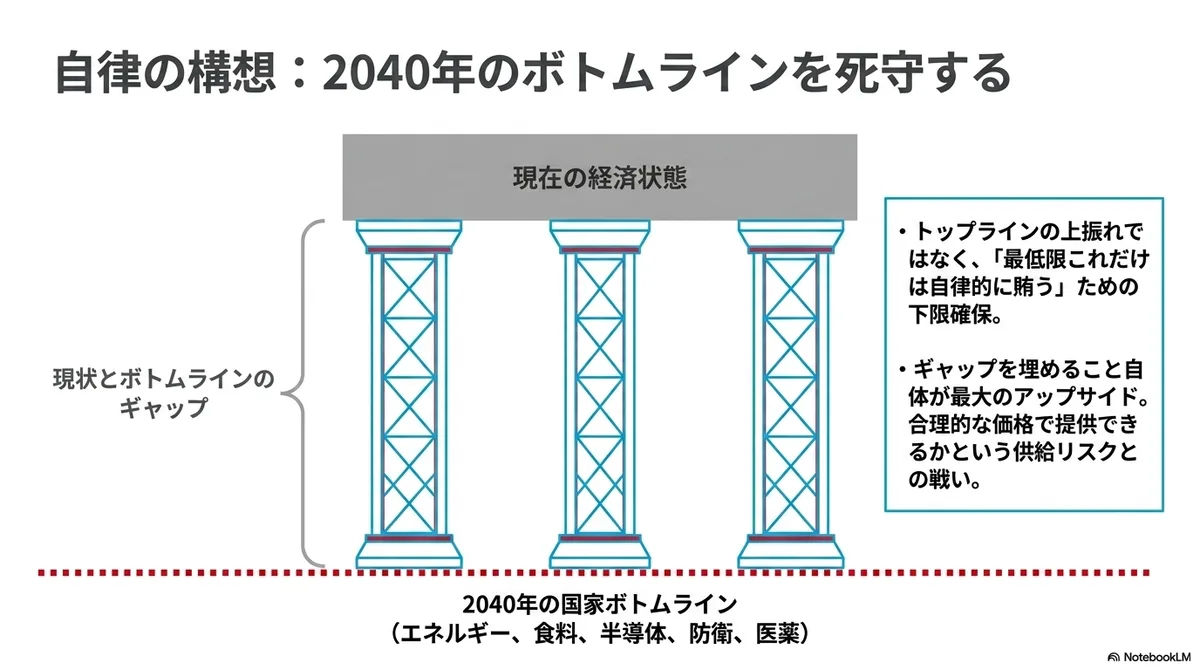
The difference from a vision of growth is that demand can be foreseen to some extent, but there is supply-side risk in whether it can be provided at a reasonable price, and the upside may not be that large. In a vision that fills the gap with the bottom line, the gap itself is the greatest upside. Also, political judgment enters into deciding the bottom line that raises the predictability of demand. (And if it is set too high, it becomes economically inefficient. Such bottom lines are a matter of discussions of security of one kind or another, and these are like insurance premiums.)
Industries of this kind tend to be hard to get off the ground on market principles alone, and the time before returns appear is often too long. Since it is unclear how far VC-style investment would follow, I think the only realistic means may be a mechanism that shares risk by layering government public procurement and price-gap support, offtake contracts and investment from large corporations, and investors' ability to form companies, like the "mission-starting type" I described in the previous article.
This domain may seem unsuited to startup-style competition, and one might think that large companies would come in if demand were certain. But listed companies tend to find it hard to take on such long-term demand, and considering that if companies with competitiveness in this area of autonomy can be produced, they could be exported to other countries too, I also think it is a domain in which trying startup-style company creation is worthwhile.
Incidentally, 2040 may seem like the distant future, but it is actually not that far. If launching a company through company creation takes seven to ten years, the number of cycles that can be run between now and 2040 is one and a half, or at most two. Fifteen years may look like a long-term vision, but considering that it is actually a fairly short timeline, I think there are places where startups can deliver value.
Summary
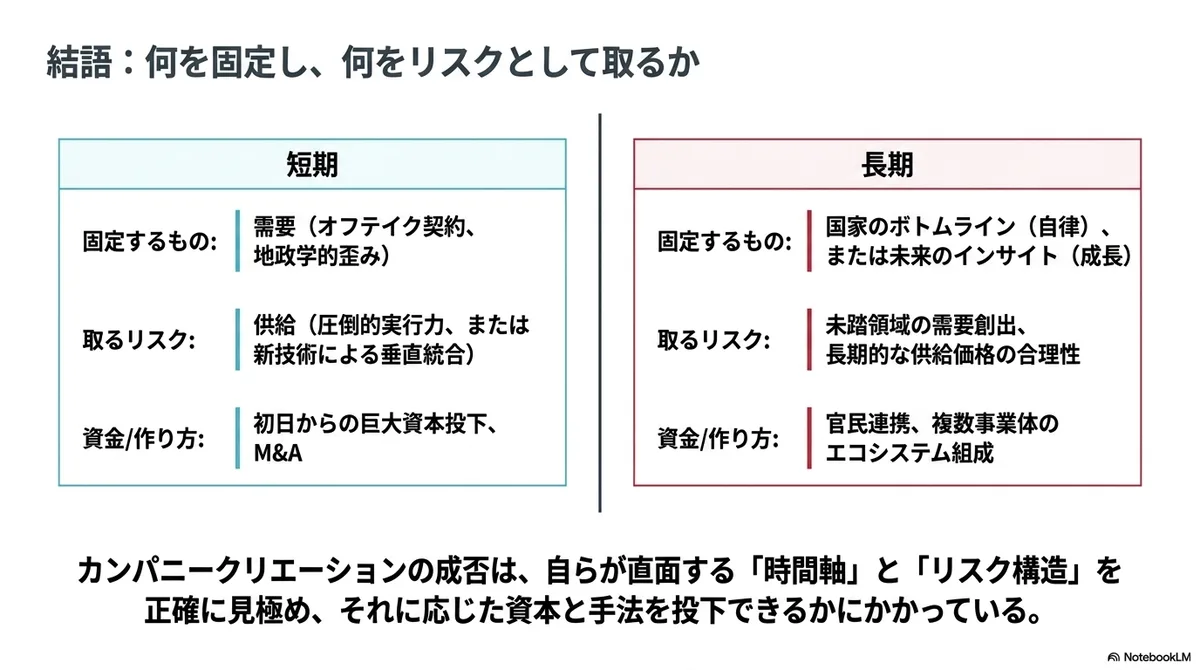
In this article, I have set out the following framework: short-term company creation takes almost no demand risk and takes large supply-side risk in the form of execution risk and technology risk, while long-term company creation divides into a vision of growth that raises the top line and a vision of autonomy that fills the gap with the nation's bottom line.
By combining the earlier classification by "starting point" with this one, I think it becomes somewhat clearer where the company creation we are currently considering is positioned, and what we should compete on.
The point is what to hold fixed and what to take on as risk, and that the providers of funds and the way of building change according to that risk.
This framework is still being tested, so if you are actually working on company creation, or are thinking about such mechanisms on the policy side, I would very much like to discuss it with you.