Choosing a Big Mountain and Learning How to Climb It with AI: A Look Back at the 2026 Entrepreneur Dojo
This article was machine-translated from Japanese by AI (Claude). It may contain errors. Read the original Japanese article.
The 2026 course of the Entrepreneur Dojo, an entrepreneurship education program at The University of Tokyo, has come to an end.
The first half, S1 (April to June), consisted of 7 sessions centered on lectures and guest talks, and the second half, S2 (June to July), consisted of 7 sessions of team-based practice. This year, we changed the design of the course significantly in both. This article is a record of those changes and a reflection on them.
Background and Context
First, for context: at the end of last year I wrote an article titled "How Will Generative AI Change Entrepreneurship Education?" With generative AI, students can produce a reasonably polished pitch deck in 30 minutes. This means that the effort and ability of students and the quality of what they deliver can easily diverge widely. Moreover, the quality of the output also varies greatly depending on the generative AI plan a student has access to. As a result, differences in how much students pay for AI and in their AI literacy now have a large effect on their deliverables. Yet if we keep restricting the use of AI in class, the gap between the classroom and the real situations where entrepreneurship is demanded will only widen.
I have also explained that entrepreneurship education has a broad and a narrow sense. This course is designed to lean toward the narrower sense of entrepreneurship while also aiming to cultivate entrepreneurship in the broader sense. Its purpose is not to convey business knowledge and skills, but to cultivate qualities and abilities that encompass them and can be used in other fields too, such as hypothesis testing and acquiring resources, though it does lean relatively toward the narrower sense. And even when dealing with entrepreneurship in the narrow sense, we talk not about starting businesses in general but about high-growth startups.
In this environment, what should entrepreneurship education teach, and what should it assess? The article at the end of last year closed with that question, and I am sharing this as a record of our own attempt, as of 2026, to answer it. I should say in advance, however, that it is not something that can be applied to every region or every educational purpose.
This Year's Major Changes: Vision and AI
There are three major changes.
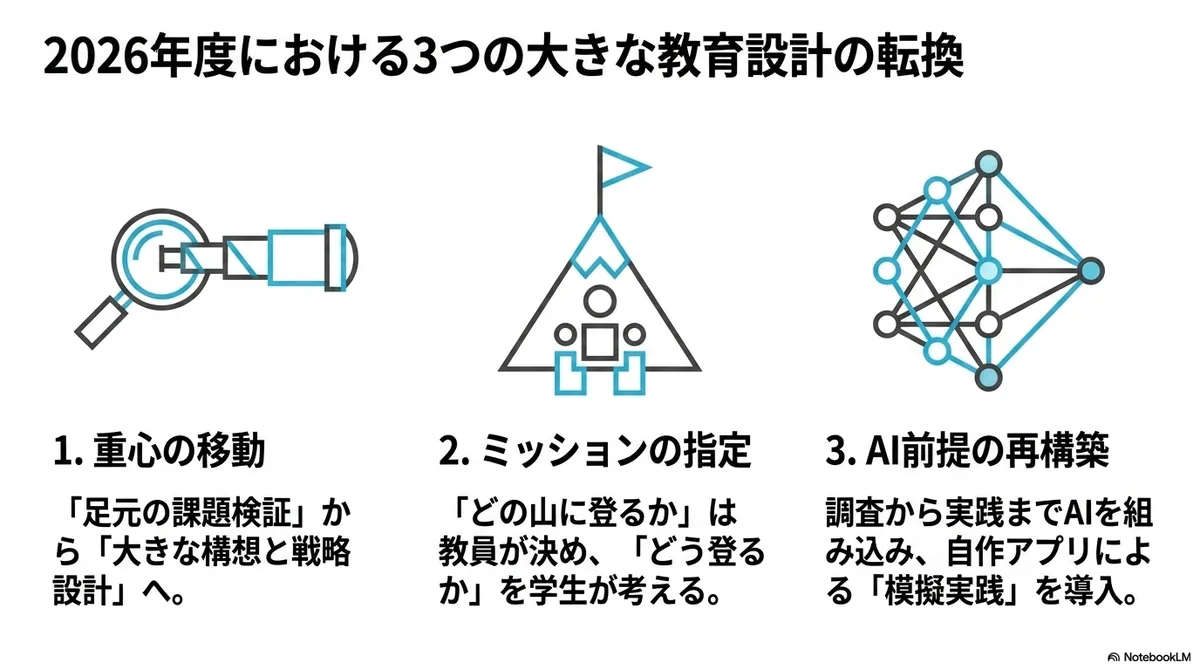
First, we shifted the center of gravity of what we teach from "finding an immediate problem and testing hypotheses" to "drawing a big vision and designing the strategy to reach it."
As I have said before, I think conventional methodologies such as Lean Startup and design thinking have limits when it comes to producing high-growth startups in Japan. This is because they tend to start from familiar ideas, and because, in the course of testing, they tend to converge on small businesses.
Of course, the approach of searching for hidden problems, thinking up solutions, and testing them is still effective for starting a small business, and even if you draw a big vision, what happens at your feet remains a succession of hypothesis tests. As a teacher, I am also glad that the methodology of hypothesis testing is easy to teach.
Even so, considering the environment in which Japan's startup ecosystem finds itself, the development of AI that I describe below, and the fact that "easy to teach" is being equated with "good," my current view is that deciding "which mountain to climb" first is becoming more important (see Fit Journey v2).
The above is about entrepreneurship in the narrow sense, but I think the broader sense faces a similar situation. In Japan's industrial visions, regional visions, and national strategies today, various big visions are beginning to be demanded: how to draw a new picture and implement it as the population shrinks, and what position to build for ourselves as the international order wavers.
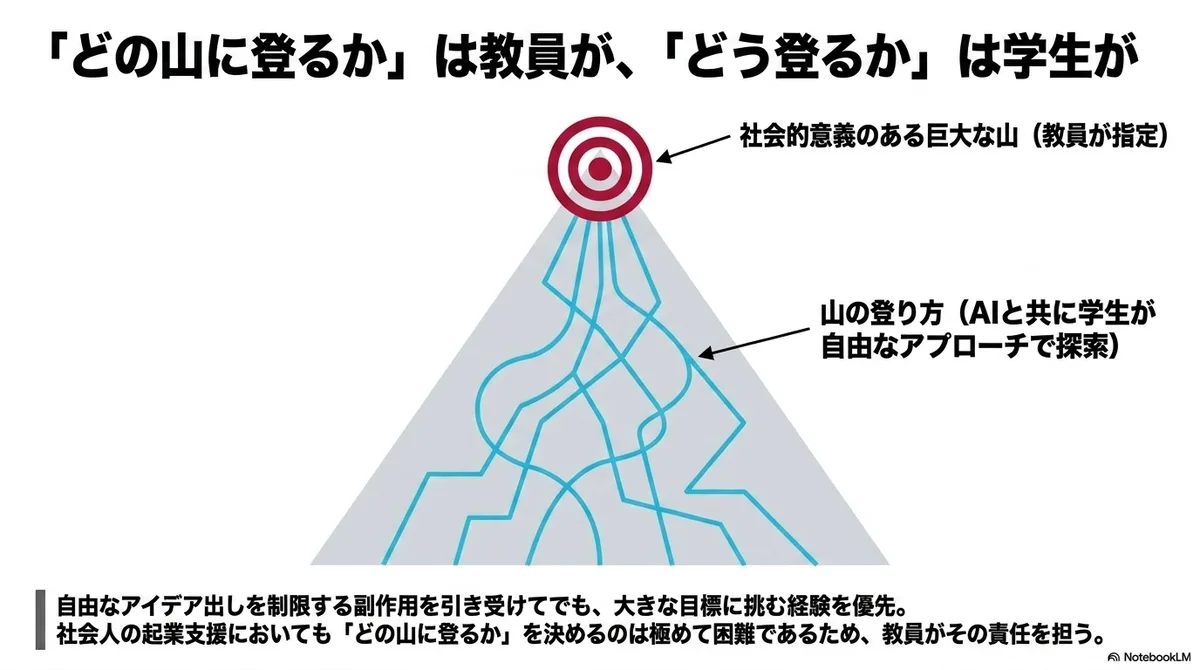
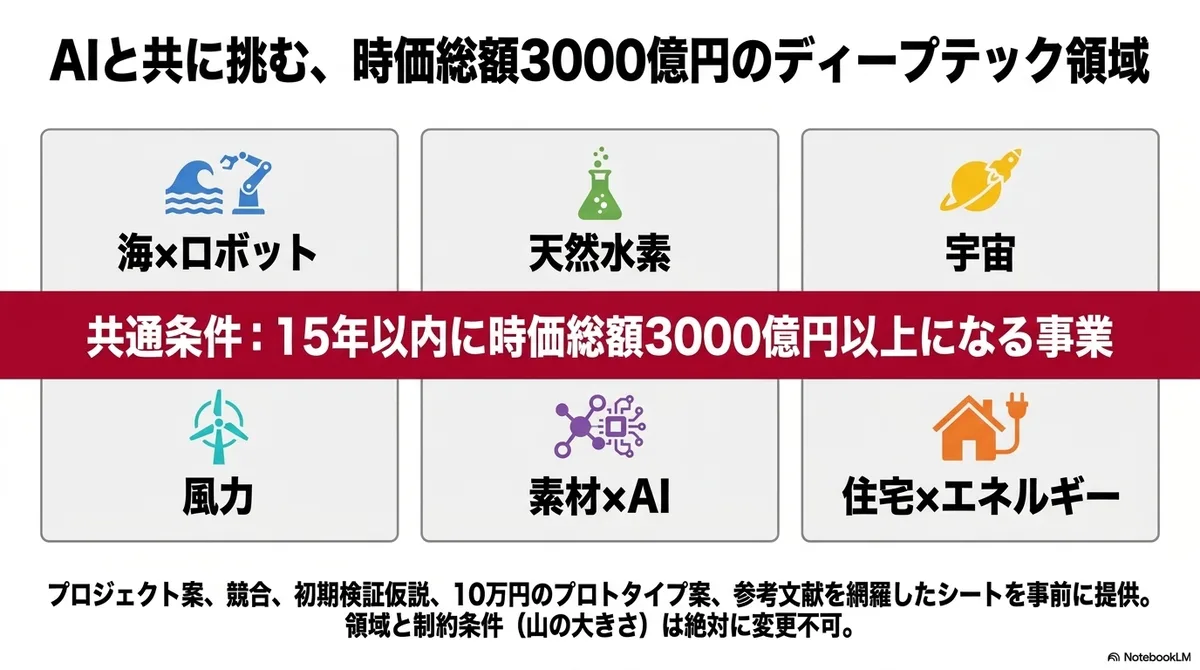
Second, in S2 the teaching staff began specifying a "mission." We prepared in advance a big goal with constraints, such as "build a business in the field of underwater robotics that reaches a market capitalization of at least 300 billion yen within 15 years," and had students choose from among them and take on the challenge. The size of the mountain cannot be changed, but how to climb it is up to you.
Actually, for several years already, the S2 workshop had stopped starting from completely free-form student ideas. The reason is that free-form ideas tend to be ones that are hard to test through interviews and other hypothesis testing. Because we wanted students to test hypotheses through interviews, we had restricted the choice of free-form ideas (that said, students were allowed to modify an idea as long as it stayed in the same field).
The side effects of such constraints are that some students lose motivation because the idea is not their own, and that it becomes harder for them to experience team building led by a leader. Even with those disadvantages, however, we had prioritized the experience of hypothesis testing. This year, we lowered the priority of the experience of testing hypotheses through interviews and raised the priority of the experience of taking on a big goal.
We might also have had students set such big goals themselves, but even when I support working adults in starting companies, deciding "which mountain to climb" is an extremely difficult task. That is precisely why, in this course, the teaching staff took on the selection of the mountain, and we had students concentrate on training in "how to climb a big mountain."
Besides, opportunities to try one's own ideas are increasing, both in extracurricular activities on campus and in programs outside the university. If so, we thought it might be better for a university course to be a place that presents mountains of great social significance that are hard for individuals to choose on their own. Learning how to climb a big mountain in a short period has traditionally been difficult, but we also expected that AI could accelerate it.
Third, we rebuilt the entire course on the premise of using AI. We incorporated AI into everything from research, simulated interviews, and strategy planning to fundraising plans and the creation of pitch materials, and we built about five web apps for the course ourselves, inserting a "simulated practice" stage between classroom learning and practice.
These three are not independent changes. Because generative AI has lowered the cost of research and trial prototyping, the ability to decide where to head has become relatively scarce, and we moved the center of gravity of education there as well. And thanks to the same generative AI, the teaching staff themselves became able to build the materials and apps that support that shift. This year's course was the implementation of the policy "use AI to speed up exploration and prototyping, and in return ask humans for the choice of mountain, strategy, and judgment," divided between S1 and S2.
S1: Emphasizing Drawing a Big Vision
We define S1 as the term for foundational knowledge and unlearning. To add a note on the latter: many students do not "lack knowledge" about startup-style business but rather "hold mistaken knowledge," so it first needs to be loosened up. This positioning is unchanged. We also kept the framework of 7 lectures and guest talks, and replaced two major parts of the content.
(1) Market and Strategy
The first is an emphasis on market and strategic thinking. The old version of the "Startup Fit Journey" that we have used at FoundX was a path that started with the customer and built up through problem, solution, product, and market. This year we used a new version that adds two stages before that: "selecting the market (Market)" and "building the strategy (Market/Strategy Fit)." This is because macro-level settings are difficult to change later. If you get the market wrong, no matter how hard you work on micro-level testing afterward, the possibility of high growth is extremely low.
In class, I repeatedly talked about the choice between "scoring 95 on a test out of 100, or scoring 9.5 billion on a test out of 1 trillion." The yardstick for startups is not the probability of success but the size of success. For University of Tokyo students, who have trained to avoid dropping points within a fixed maximum score, this is probably the part that most needs unlearning.
Some end-of-term reflections included statements such as, "Until now I emphasized how good a result I could produce on a given task, but I hardly had the perspective of which task to work on in the first place." That this came back not as acquired knowledge but as an awareness of which yardstick they themselves had been using was a response close to the aim of a course targeting unlearning.
(2) Simulated Practice with AI
The second is simulated practice with AI. This year I built web apps myself and incorporated them into class and homework. They include, for example, the following.
- A lecture app that transcribes the lecture in real time and has AI suggest improvements to the questions students post
- An interview app where students experience sales and investment decisions with AI as the counterpart
- An app that simulates the flow of starting a business in 6 steps (the Fit Journey experience app)
- A collection of prompts for market selection and strategy planning
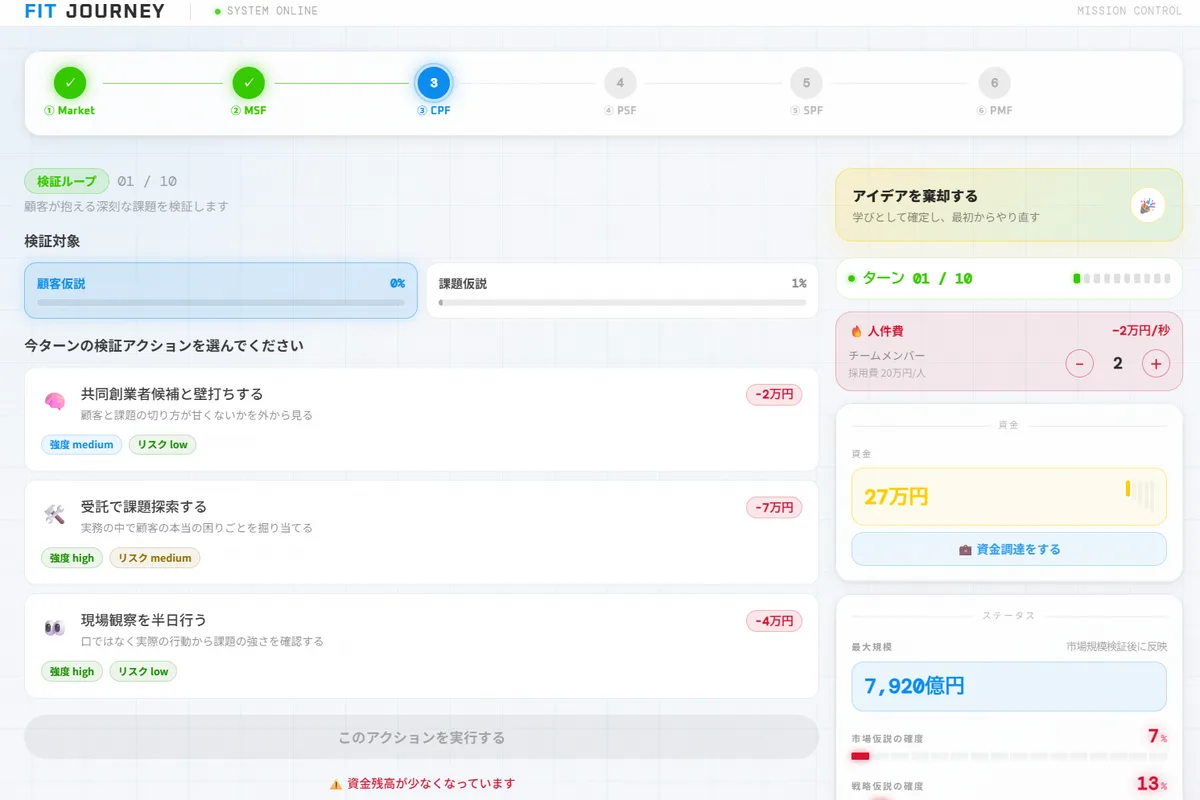
Fit Journey simulation
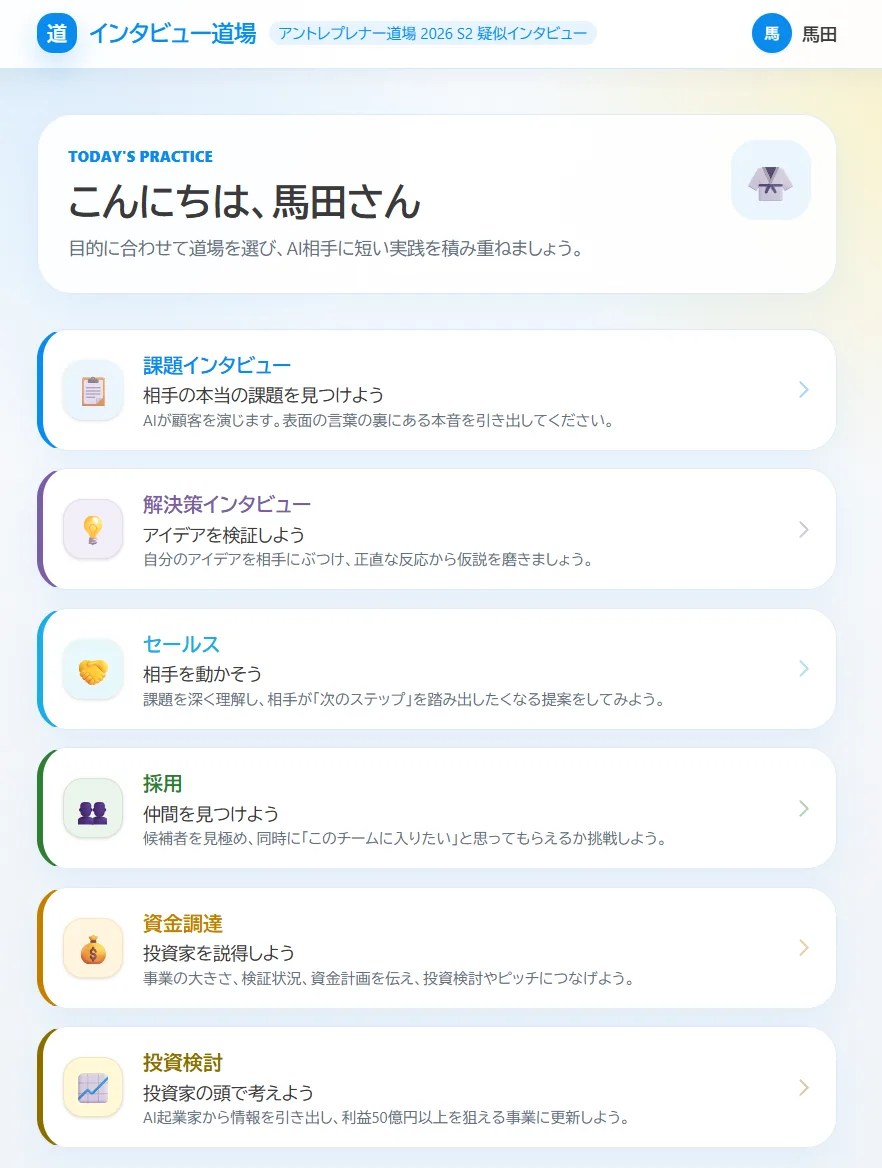
Interview Dojo
I think there are several advantages to using AI apps.
Traditionally, the next step after learning in the classroom was straight into real practice (though students did do mock training with one another in class). We have now inserted between the two a practice ground where the cost of failure is almost zero.
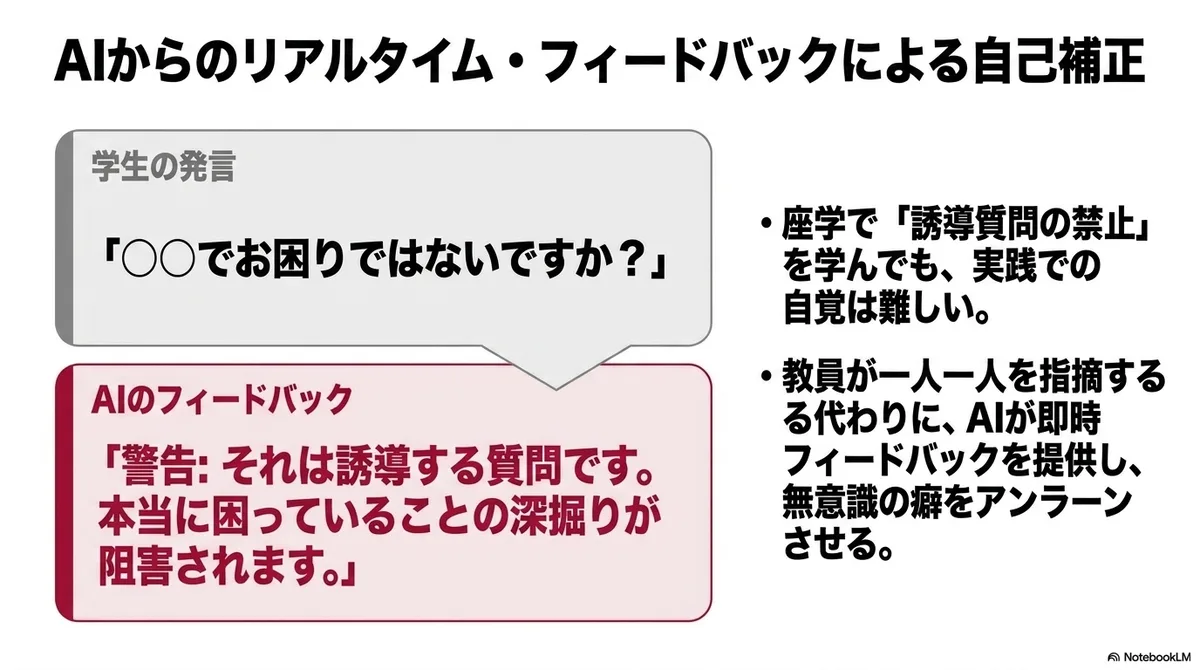
The advantage of simulated practice with AI is that the AI gives advice at any time. For example, the interview app immediately returns suggestions for improving a question and the reasons why "that question won't work." A typical remark in students' reflections was: "Even when I thought it was a good question, I ended up leading the other person, or I couldn't dig deep enough into what was really troubling them." In a lecture, one can explain, "Do not ask leading questions," but you cannot notice that you yourself are leading until someone points it out. Yet it is difficult for a teacher to point that out for every student one by one, so my judgment was that using AI and similar tools could serve as a supplement.
We also took care to design a mechanism that does not collect personal data and a setup in which the operators do not see what students enter (for example, when students clear a homework assignment, a clear code is issued and they report it through Google Forms). As for app development, I had built one more strategy-related app, but I couldn't make it work well and gave up. My impression was that it is still difficult to have AI serve as a partner for highly abstract thinking.
What left an impression was the awareness of AI's limits. For a homework assignment of using AI to select a market under the hypothetical condition of a 300 billion yen market capitalization, one student wrote, based on having run it many times themselves, "When you rely on AI, you tend to drift toward average ideas in large, safe markets." It is a little paradoxical that the outcome of a course dealing with the use of AI was a felt sense of AI's limits, but I think it is also a reasonable result.
As a minor tip, it was helpful to be able to think about the questions for the reflection sheet together with AI. How much students learn from a reflection varies considerably depending on which questions are posed. Designing reflection questions used to be done within the team, and being able to do it with an AI that I can consult at any time and that responds with pedagogical knowledge was helpful.
S2: Specify the Mountain and Climb It with AI
S2 is 7 sessions in workshop format. Students split into teams and proceed from initial research to building a business hypothesis, strategy and prototype planning, and fundraising plans and the creation of pitch materials. For the final 2 sessions, we invited 5 active entrepreneurs and 5 investors as judges, and using the jigsaw method, every student gave a pitch individually. The purpose was for students to experience putting their hypotheses before real-world evaluators, entrepreneurs and investors, which is what pedagogy calls authentic assessment.
On top of that, we made the following changes this year.
(1) Designing the Missions
The missions we prepared were centered on deep-tech-leaning fields such as ocean × robotics, natural hydrogen, space, wind power, materials × AI, and housing × energy. For for-profit missions, we imposed a common constraint of "a market capitalization of at least 300 billion yen within 15 years" (for social-enterprise-type missions, we set a different form of big goal). Each mission comes with a sheet listing example project proposals, competitors, hypotheses to test early on, prototype ideas that can be built for about 100,000 yen, and references. The project proposal could be changed, but the field and the constraints could not.
(2) Incorporating AI into Each Step
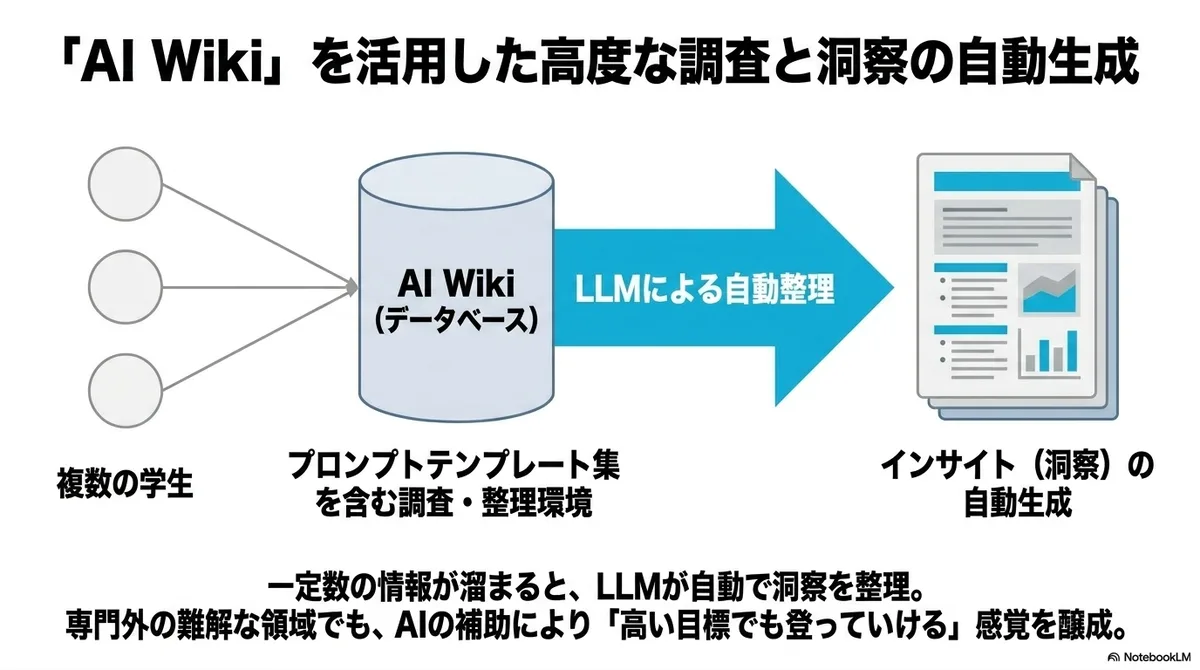
We incorporated AI into each step. For research, we use NotebookLM and the "AI Wiki" we prepared for the course. This is a research and organization environment that includes a collection of prompt templates: whenever a student asks the AI something, all the exchanges are saved to the Wiki, and once a certain number of Wiki pages have accumulated, an LLM automatically organizes the insights. It is, so to speak, a group version of an LLM Wiki. For the AI, we select, via OpenRouter, whichever model is good in terms of speed, performance, and cost at the time.
Results
As a trend, my impression was that time was shorter than before. It seems that it is still very difficult to catch up on something outside one's specialty even with AI. On the other hand, I think that in a time without AI, we would not have been able to do research this thorough.
I think what students learned also changed a little. Rather than the conventional lesson of "I realized the importance of hypothesis testing," there were comments suggesting that they had gained a sense that "even with a high goal, if you research properly and keep climbing, you can get to a certain point." I think this is also as the course was designed.
The reactions of the judges also changed. Through last year, they said "it's hard to comment," perhaps because the gap was too large between students' "apps for problems around them" and the ideas investors usually encounter. This year, we received the feedback that "it was easier to comment, but because they were on the same footing, the rough edges stood out." That is exactly why there were also comments asking students to do more interviews and go to the field to raise their resolution. This might be possible with a little more time. Even so, I take the fact that students came to be evaluated on the same footing as ordinary entrepreneurs as a step forward in itself.
What We Cut, and What Was Difficult
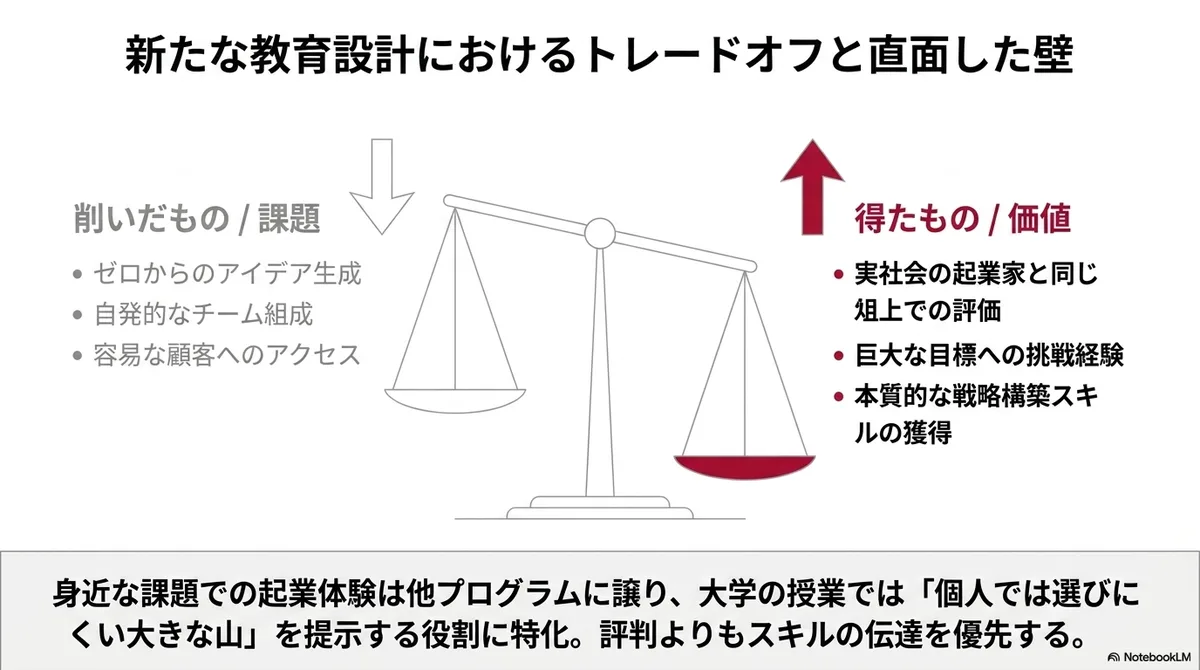
On the other hand, there are things we cut because of this design.
First, students cannot practice creating ideas from scratch, because the teaching staff specify the missions. In addition, because the operators also formed the teams, students have no experience of gathering their own companions and forming a team (although teamwork within the team is of course necessary).
This is because there are relatively many opportunities to try one's own ideas and find companions in extracurricular activities on campus and in programs outside the university, but I think there is certainly an aspect in which we could cut these things precisely because this is Tokyo, which is blessed with such opportunities. In fact, although we explained that "those who want to try their own ideas should do so in other courses or extracurricular activities," it is also true that there were complaints about this change and students who withdrew. Even so, if the skills that are needed are changing, I have judged that we should convey the needed skills rather than worry about reputation.
The most difficult part was interviews. Through last year, students themselves specified ideas for which they could be the customer, so it was easy to test hypotheses through customer interviews, but this year, with mission-oriented deep-tech fields at the center, reaching someone to interview became difficult in itself. This year too, one company kindly cooperated and some teams were able to actually conduct interviews, but my impression was that it was somewhat difficult. Next year, we may be able to ease this somewhat with measures such as narrowing the missions to those related to technologies from the University of Tokyo, or reducing the number of mission types and asking prospective customers for their cooperation in advance.
Generative AI and Entrepreneurship Education
Finally, let me summarize what I thought about based on this year's experience.
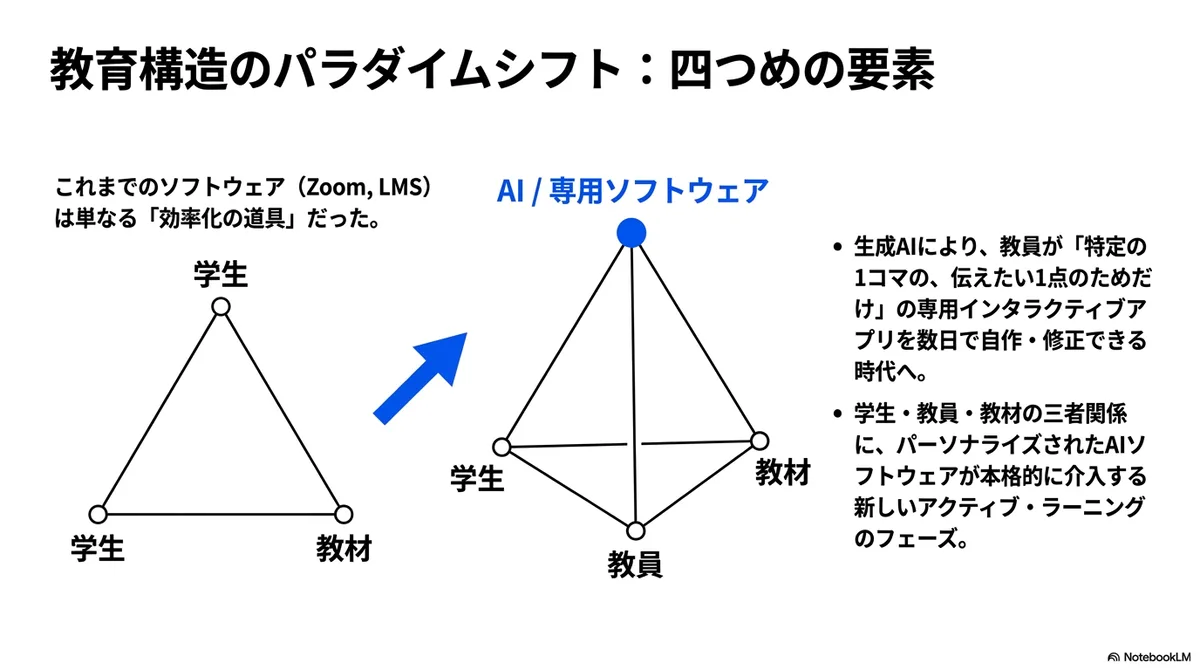
First, I think it is significant that teaching staff can now create interactive teaching materials themselves. Until now, educational software has been a tool for efficiency, like Zoom or an LMS. It processes fixed procedures quickly and accurately, but it did not change the content of the class much. Generative AI is different. An app that a few years ago would have cost several million yen and taken several months to outsource can now be built by an individual instructor and fixed every week. Moreover, some personalization by AI is also possible. Software has become viable as a tool made solely for a single point you want to convey, in your own course, in your own session. I think this is a change that is not limited to entrepreneurship education.
Second, in return, designing a course has become harder. This is because software has come in in earnest as a fourth element, where there used to be the three parties of students, teachers, and materials. Now that we can quickly build not only general-purpose tools but also dedicated software tailored to each individual lecture, I think a period of groping will continue for a while over how to position software and generative AI within active learning.
Third, even so, there is no doubt that the gap between reality and education will widen if we do not use AI. As I touched on in the previous article, precisely because entrepreneurship education is close to the real world, I feel we need to keep thinking anew about how to reach an accommodation with the real world and how to maximize students' learning in a short period.
Similar Efforts Around the World
Educational settings overseas also seem to be struggling with how to live with generative AI.
For example, in the spring 2026 Stanford Lean LaunchPad, 8 teams conducted 978 interviews in about 10 weeks, and every team used generative AI. What was reported there was the problem that the speed of building products with AI overtakes the speed of learning from customers. Students could build a polished MVP in a few hours, but sometimes could not explain which hypothesis it was meant to test. This is almost the same understanding as my concern about the unbundling of effort and deliverables.
The format of specifying missions has been pioneered by Hacking for Defense, which originated at Stanford. It is a course in which student teams take on real problems brought by government agencies and others, and it has been rolled out to about 70 universities. The difference is that Hacking for Defense deals with "problems people are facing now," whereas the Dojo has the teaching staff set "fields that should become big in the future." In addition, Wharton's Generative AI Labs has built pitch-practice simulations in which AI plays the role of mentor or investor, and even envisions an environment where instructors can create simulations dedicated to their own courses.
In other words, our course this year can be positioned as an experiment that integrated elements being tried separately around the world, namely mission-specified courses, AI simulations, hypothesis testing, and working backward from a long-term vision, into one metaphor and curriculum: "climbing a big mountain with AI." To be fair, however, many overseas cases are also still at the stage of practice reports, and rigorous verification that AI use improved long-term learning outcomes is yet to come. I would ask that the claims of this article be read not as a method whose effectiveness has been proven, but at the level that experiments in the same direction have begun simultaneously around the world.
Conclusion
AI has sped up the hypothesis-testing cycle for problems close at hand. In such a world, if the work remaining for humans is "deciding which mountain to climb, designing how to climb it, and continuing to exercise judgment," then the center of gravity of education also needs to shift there. This year's Dojo was one attempt at that.
In class I asked students, "Would you score 95 on a test out of 100, or 9.5 billion on a test out of 1 trillion?", but I think the same question is also directed at us on the teaching side: whether to build a slightly better course within the existing framework, or to rebuild it starting from what should be taught.
And I think that those of us involved in entrepreneurship education must constantly ask ourselves, "Are we exercising entrepreneurship?" and "Aren't we taking on a challenge in education every year, too?" This year's effort is our answer to that.
Our hypothesis may be wrong, and we may not be teaching the same course next year (we will probably have changed it), but I am putting this in an article as a sharing of information about what we are doing at this point.
There is no plan to release the apps we used this time, but the collection of prompts is published on the FoundX site. If there are educators or policymakers going through the same trial and error, I hope it will be of some use.