Embedded Entrepreneurship Education
This article was machine-translated from Japanese by AI (Claude). It may contain errors. Read the original Japanese article.
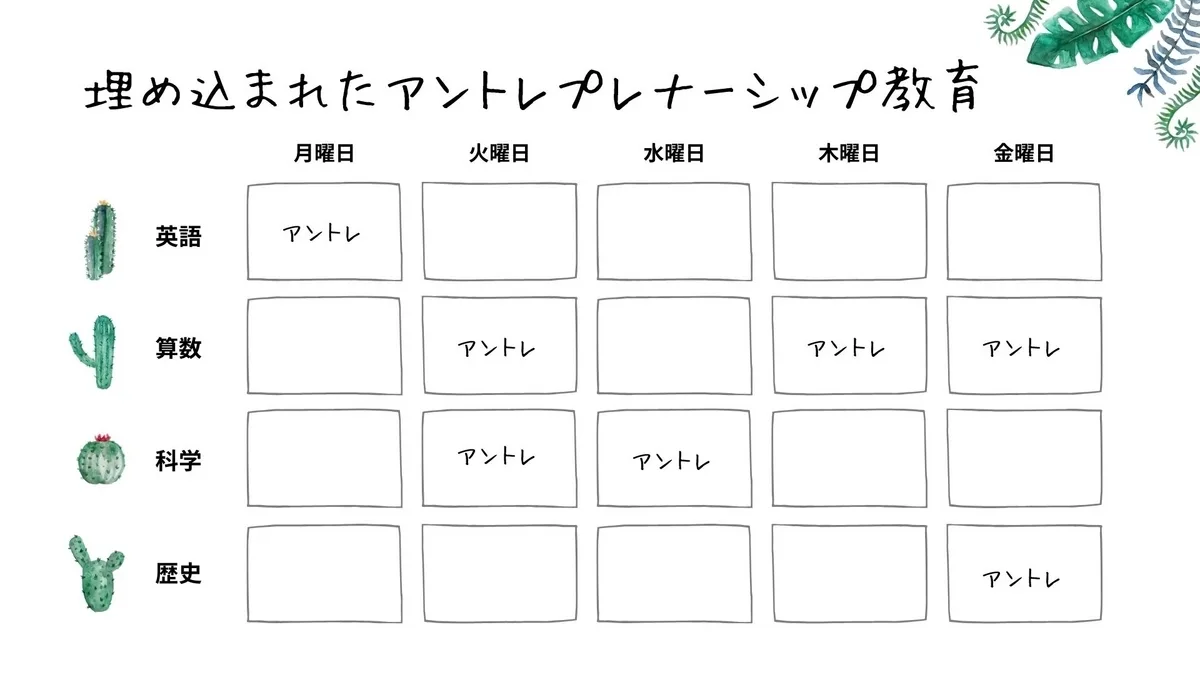
Previous plans for rolling out entrepreneurship education in primary and secondary schools have faced several challenges. For example, the following.
- They assume a "separate" class period from the existing subjects, which burdens schools and teachers (especially when the burden is already growing because of foreign language and information education)
- Teachers with a naive understanding (a misunderstanding) that "entrepreneurship education = business education" push back
- There are few people, especially in rural areas, who can deliver appropriate entrepreneurship education, which makes it difficult to expand widely
I think one way to solve these problems is "Embedded Entrepreneurship Education (EEE)".
Rather than setting aside a separate slot for entrepreneurship classes, this is education that aims to develop entrepreneurial abilities within existing subjects.
For example, in Japanese elementary schools, it could take the following form.
Subject | Specific activity | Entrepreneurial qualities and abilities cultivated |
Science | Propose something not in the textbook and try an experiment | Hypothesis testing |
Social studies | Learn about social issues in the local community and solve them | Solving social issues, hypothesis testing, acquiring resources |
Japanese language | Write a message that moves someone to act | Acquiring resources |
Arithmetic | Do calculations with money | Finance, accounting |
Trying to realize embedded entrepreneurship education involves the major task of changing the content of existing subjects bit by bit. However, the benefits that outweigh this, I think, include the following:
- No additional entrepreneurship classes are needed (which reduces the burden on teachers)
- The knowledge of existing teachers can be put to use (although they may need to learn active learning methods)
- It may produce a greater effect than teaching entrepreneurship classes separately
- Entrepreneurship, which is closely tied to active learning and to the Ministry of Education's "Zest for Living," can be cultivated while making use of the existing curriculum
These are the things I believe we can gain.
The EU, the United Kingdom, and other places have been trying this out ahead of us, and I think we can proceed while referring to these cases.
Incidentally, a systematic review of this Embedded Entrepreneurship Education was written in 2023.
Related article: