"Narrow" and "Broad" Entrepreneurship Education
This article was machine-translated from Japanese by AI (Claude). It may contain errors. Read the original Japanese article.
Entrepreneurship education comes in two kinds: "narrow" and "broad."
Put simply, narrow entrepreneurship education is education for starting a business, while broad entrepreneurship education is education for cultivating entrepreneurial qualities and abilities, including those used outside of starting a business.
The OECD's report on entrepreneurship education also discusses entrepreneurship education by dividing it into broad and narrow. In it, the two are positioned as follows:
- Narrow entrepreneurship education - education for starting a business
- Broad entrepreneurship education - creativity, opportunity orientation, proactiveness, and the like
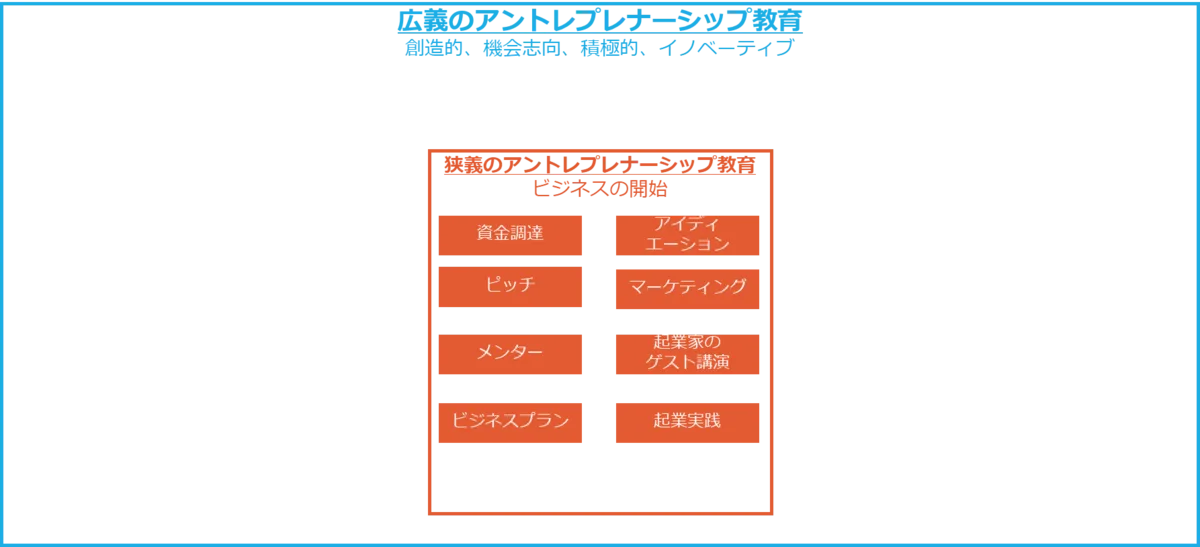
Narrow and broad entrepreneurship education
In Japan, many people seem to believe that teaching narrow entrepreneurship education is what entrepreneurship education or entrepreneur education means. However, looking at the global trend in entrepreneurship education, I think it is moving toward placing more weight on broad education.
Of course, I think it is possible to cultivate broad entrepreneurship through business education, and I think it is one effective means. In fact, in our own classes, too, we talk about business as the subject matter.
However, what differs from narrow entrepreneurship education is that, even while working through the subject matter covered in the narrow kind, the course is designed with a strong awareness of how to help students acquire broad entrepreneurship.
For example, the diagram below shows what we keep in mind when designing our classes. What we convey and have students experience in class are the business activities shown in red. But we design the class so that students can acquire the qualities, abilities, and other resources shown in orange, which correspond to the intermediate sense, with a very strong awareness of this, and so that they ultimately arrive at broad entrepreneurship.
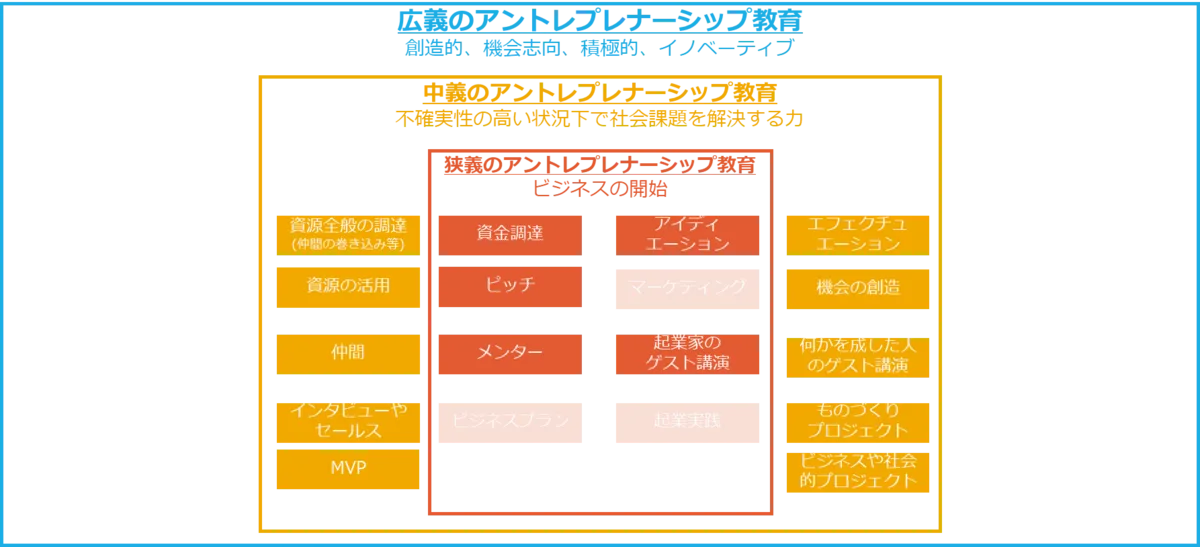
If we carry out only narrow education without considering this classification into narrow and broad, it becomes merely training for entrepreneurs, and I don't think there is much point in spreading that training even to people who do not wish to start a business.
Moving Away from Narrow Education
If Japan is to expand entrepreneurship education further, it will need to shift from narrow to broad entrepreneurship education.
Otherwise, we cannot nurture entrepreneurs of all kinds ("XX entrepreneurs") beyond business entrepreneurs. Nor will it be easy to gain society's approval for spreading entrepreneurship education more widely among young people, because only a small fraction of people will start a business.
The reason I use the term "entrepreneurship education" and avoid the term "entrepreneur education" as much as possible is also out of awareness of this distinction between narrow and broad. "Entrepreneur education" inevitably calls to mind education for business entrepreneurs, that is, the narrow kind.
At a time when many kinds of "XX entrepreneurs" are needed, I believe we should aim for education that produces more entrepreneurs in fields other than commerce and cultivates the general-purpose entrepreneurial abilities for that, and so I actively use the term entrepreneurship education.
From Training to Education
Furthermore, when thinking about narrow and broad, I think it is better to consider training and education separately. I have written about this before in another article.
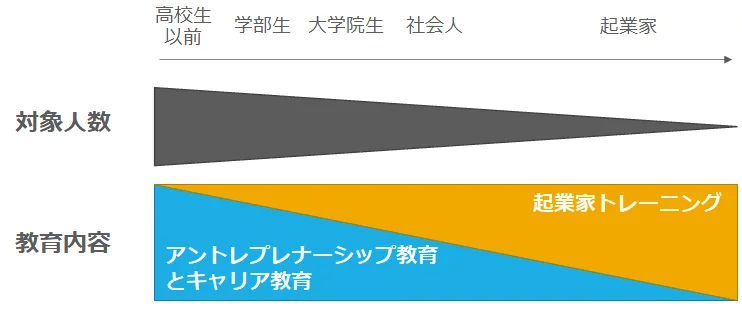
Among the activities I am involved in, FoundX at The University of Tokyo is aimed at entrepreneurs and aspiring entrepreneurs, so it is narrow entrepreneurship education and close to training. By contrast, what I do in university classes is broader entrepreneurship education, and I carry it out with education in mind.
Much of the "entrepreneur education" currently offered at universities seems to be a "startup version of business education," with content that teaches finance, organizational design, business models, and so on, and much of it is close to "training for entrepreneurs."
Even if it is effective for those who have decided to become entrepreneurs, it is not very useful for those who have not (the great majority). Nor do I think it is the kind of thing to be given to university students or to junior high and high school students.
I think "narrow entrepreneur education" is fine for professional graduate schools of business, MBA programs, and the like, because the people there already have a strong intention to start a business. But I believe that what should be taught in school classes, which have a broader range of participants, is broad entrepreneurship education.
Personally, I am opposed to actively rolling out narrow entrepreneurship education within school education other than MBA programs. (It would be more acceptable if participation were optional.)
I think it would have a better effect on Japanese society as a whole to position entrepreneurship education as education for producing various kinds of "XX entrepreneurs," and for cultivating the general-purpose qualities and abilities needed for that purpose.