Entrepreneurship Education as Career Education
This article was machine-translated from Japanese by AI (Claude). It may contain errors. Read the original Japanese article.
Various studies have pointed out that one major factor influencing whether someone chooses an entrepreneurial career is whether their parents are entrepreneurs. Having an entrepreneur as a parent is said to raise the probability that a child becomes an entrepreneur by 1.3 to 3.0 times (see the opening of the study below).
One interesting study examined adoptees in Sweden.
When it investigated which has a greater influence on the careers adoptees follow, their adoptive parents or their biological parents, the result was that for becoming an entrepreneur, the influence of the adoptive parents was about twice as large as that of the biological parents. It seems that for an entrepreneurial career, the environment in which one is raised matters more than genetics (although influence from biological parents was also confirmed).
If an entrepreneurial role model is close at hand from a young age, perhaps one naturally recognizes that "such a career exists too." It is not only entrepreneurs: the large number of second-generation politicians may be due not just to having a base of supporters, but also to the fact that their parents were politicians, so they learned about that career early and watched it up close. Isn't that a major factor as well?
And I think this result also suggests that entrepreneurs can be nurtured. If we can create such an environment, we may be able to increase the number of people who become entrepreneurs.
Entrepreneurship Education as Career Education for Young People
Career education is often provided to young people, such as in elementary, junior high, and high school. This is probably because education at an early stage is considered effective for careers. Indeed, at the level of higher education such as university, it is quite likely that it has become harder to influence a person's career.
If we want to increase the number of entrepreneurs, it would probably be more effective to have people receive career-education-style entrepreneurship education at an early stage of development.
However, there are several points of caution.
(1) Receiving entrepreneurship education does not mean everyone should become an entrepreneur
First of all, it is not the case that it would be better for everyone to become an entrepreneur. Individual aptitude also matters. Maintaining existing systems is also important, and people engaged in existing industries are needed too.
So when spreading entrepreneurship education, I think it is not good to send the message "let's all become entrepreneurs" (similar points are often discussed). It would be better to keep it to the level of getting people to recognize that the path of an entrepreneur exists as one career option.
Even if such a career is presented, I think it is better to offer it purely as a way for people to find out for themselves whether they are suited to it. Those who are suited can pursue it further, and those who feel they are not can stop. I think we should provide opportunities to assess aptitude while showing such options.
To begin with, the people who can become entrepreneurs are those who can take a certain amount of risk. And not everyone can take such risks. I think we should present the option of an entrepreneur as a career while keeping this in mind.
(2) Present careers that include not only commercial entrepreneurs but also XX entrepreneurs
I also think it is important for people to be aware of various entrepreneurial options beyond commercial entrepreneurs, such as social entrepreneurs, policy entrepreneurs, and civic entrepreneurs.
This is because in today's society, "entrepreneurial talent" is needed in various fields.
When we talk about entrepreneur education, the conversation tends to turn to business. But I think that entrepreneurship education going forward would give a wider range of people a reason to take it if it were positioned not only as a way to increase business entrepreneurs but also as a way to nurture entrepreneurial talent in a broader sense.
(3) Increasing the number of programs is not necessarily the answer
Nor is it the case that we should simply increase the number of career education programs related to XX entrepreneurship.
According to a career survey by Applied Social Psychology Research Institute Inc., it is suggested that even as the number of career education programs taken increases, views on work do not change.
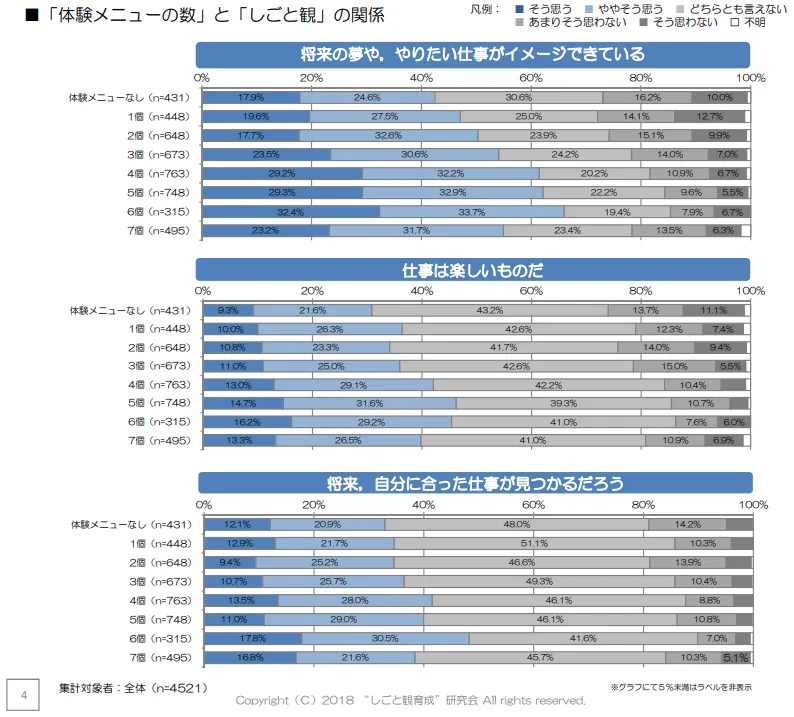
Survey on the State of Career Education as Seen by High School Students (2018) https://value-senmon.com/archives/news/1456
These results cannot be applied as they are, but I do get the sense that increasing career education on entrepreneurship would probably have little effect.
Providing highly authentic experiences with tasks matched to developmental stages
So what should we do?
First, as a starting point, I think it is important to let people know that an entrepreneurial career is an option. Guest lectures and the like may be fine for creating that starting point, but considering that even mentoring and the like did not have much effect, I don't think we can expect results from that alone. So the key is whether we can design the educational opportunities that follow the starting point as a continuous sequence.
As for which kinds of career education are effective, I am still investigating this myself, and I would very much like to hear from you. As one hint, though, the "Survey on the State of Career Education as Seen by High School Students" cited above also points out that when students approach career education with an active attitude and the experiences they gain are excellent, their views on work change.
In fact, I suspect many people feel that entrepreneurship education is more effective when done through practice rather than lectures.
So my working hypothesis for now is that, after providing a starting point, it would be good to offer opportunities where we provide entrepreneurial experiences in a highly authentic form, cultivate self-efficacy and abilities through those experiences, and at the same time let students learn whether they are suited to it.
However, when we try to provide business entrepreneurship experiences to deliver those experiences, we run into the wall that, for students in primary and secondary education, creating value through business is extremely difficult. Moreover, an entrepreneurial experience is not simply a matter of buying and selling; it means starting a new business. Even adults often fail at new ventures, so it is extremely hard for children of that age to succeed in a new venture.
On the other hand, if we think only in terms of what they can do, it ends up being just mock stalls and business plans, which makes for an experience with low authenticity. I am a little doubtful whether that can be called an excellent experience.
If so, how about making it possible to choose areas of entrepreneurship other than business, according to the developmental stage?
For example, in elementary school, students might work on problems at their school and resolve them through rule-making, such as changing school rules, which could build self-efficacy while presenting the career of a policy entrepreneur. In junior high school, they might solve problems in their community, using IT and other skills that students are good at.
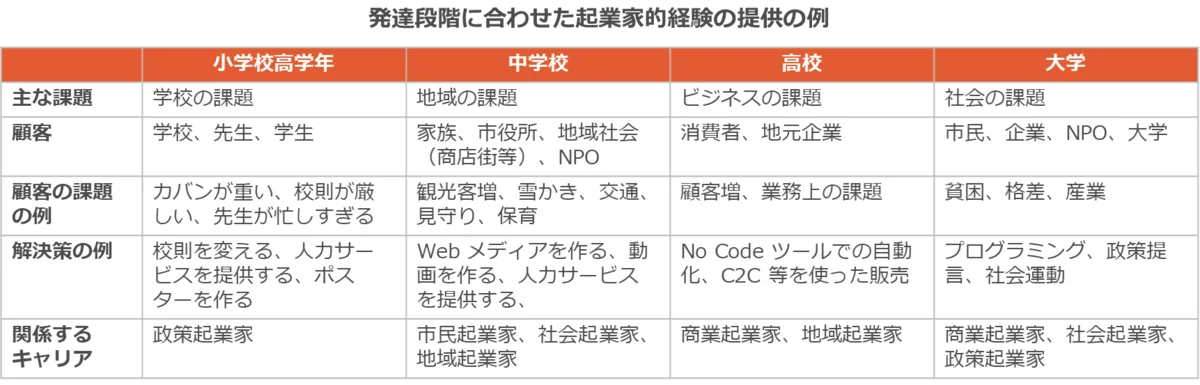
In this way, when implementing entrepreneurship education in primary and secondary education, I think encouraging efforts that solve social issues of the school and the community, rather than efforts that solve problems through business, would make for a more highly authentic experience.
I believe that thinking about such highly authentic (not simulated) entrepreneurial experiences suited to each developmental stage, not limited to business, and providing opportunities for them, is both a way of showing entrepreneurial careers and the entrepreneurship education needed to cultivate the qualities and abilities.
Providing such problem-solving experiences also leads to opportunities to meet people who can become role models. It could also create a chance to work together under such a person.
Or it could create a chance to meet friends who are XX entrepreneurs solving similar problems.
What can be done within education and classes is limited, but precisely because it is a class, we can show students a new world and create opportunities to build connections. Personally, I think that providing opportunities to connect with role models and peers through real experiences is the part of entrepreneurship education that can be called career education.