On Entrepreneurship Education
This article was machine-translated from Japanese by AI (Claude). It may contain errors. Read the original Japanese article.
A book by the president of Northeastern University was recently translated into Japanese, arguing that to avoid losing our jobs to machines, we need to be not waterproof but "Robot-Proof." Among the four skills that make a person robot-proof, it lists "entrepreneurship."
Over the past several years I have been involved in entrepreneurship education, and I think we have achieved a fair amount of educational results (by one measure, the numbers also showed a strong educational effect). Since I am now being asked for my opinions on entrepreneurship education, I would like to put my thoughts in order. That said, they are not very well organized yet...
- Purpose
- Necessary changes
- From entrepreneur "education" to entrepreneur "learning"
- From developing entrepreneurs to developing the entrepreneurial spirit
- From knowledge to attitude
- From business to career
- From plans to practice and products
- Practice, not real businesses
- From quality to quantity
- Build networks, not just individuals
- Not only business education, but also specialist education
- Not only education for makers, but also effects on adopters
- From industry to social impact
- From management to governance
- Doing both education and research
- Concrete methods
- Conclusion
Purpose
The impact entrepreneurship education should aim for
Where to place the ultimate purpose of entrepreneurship education needs further discussion, but when targeting a broader range of people, I think something like "enabling everyone to live by producing results in a highly uncertain environment" would be good. This is almost the same as "Entrepreneurship Education That Fosters the Zest for Living," published around 2017 by the Ministry of Economy, Trade and Industry and the Ministry of Education, Culture, Sports, Science and Technology (the link is dead, so there is no link).
Let me explain the background. One thing that should be aimed for in entrepreneurship education is to create large companies, as startups do, and contribute to society. On the other hand, I think the perspective that starting a business (being able to start a business) can be the greatest economic safety net should also be built into entrepreneurship education.
For example, even if the economy worsens and the company you work for tells you that you are being laid off, if you can find an opportunity and start a business on your own, you can make a living economically. Also, if you always have the confidence that "I can earn on my own" (that is, a situation in which you have a safety net), then even while working for a company you become able to take on various challenges inside it. Even if you fail, you can simply start a business.
Of course, if the education is meant to produce more and more startups and nonprofits that solve social problems, the wording would differ from the purpose above, and I am not denying such activities. But in the context of having more people learn entrepreneurship, there is no need to insist on startups, so I think it would be better to emphasize the safety-net significance more strongly.
In our classes, we define entrepreneurship as "pursuing opportunities beyond the limits of the resources one can control, creating new value by solving social problems, and continuing to provide it in a sustainable form." The mission of the FoundX team is "to enable and spread innovation, thereby creating slack and building a more open society." These lean somewhat toward startups.
Necessary changes
I think entrepreneurship education should change. Here I note down, as an individual, several perspectives on that.
From entrepreneur "education" to entrepreneur "learning"
The word "education" inevitably leads to an educator-centered way of thinking. But in truth the learner is the protagonist, and those of us involved in education are only supporters of the learners.
When we use the word education, we inevitably start thinking in terms of what kind of lecturers to invite and what kind of educational programs are needed. And education tends to mean teaching something from above. This is especially so when the person is an eminent businessperson invited from outside.
On the other hand, if we direct our support toward "learning," we gain a much wider range of options: how to get students to learn proactively, how to design classes, how to design the learning environment, how to run quasi-curricular activities, and so on. Moreover, by focusing on learning, we can use existing learning theories and should be able to deliver evidence-based education. And in the case of regional universities, even if they cannot offer entrepreneurship education that brings in entrepreneurs, they may still be able to have students engage in learning for entrepreneurs.
Of course, the idea of education is still necessary. But just as Professor Mizokami clearly distinguishes active learning from active-learning-style classes, I think we should think of entrepreneur education and learning separately, and focus on proactive learning by learners.
And to think this way, I believe it would be better not to use the term entrepreneur "education" so much.
From developing entrepreneurs to developing the entrepreneurial spirit
I am not against developing entrepreneurs, but I do not think universities and other higher education institutions should push starting a business as a career path indiscriminately. I think they should present it as one option among career paths, but it is not desirable for an educational institution to strongly push only the career of entrepreneur.
What we should aim for is cultivating the entrepreneurial spirit (entrepreneurship). Keeping that entrepreneurial spirit as the main focus while showing the career of entrepreneur as one of its applications seems the appropriate line.
Entrepreneurship is translated as the entrepreneurial spirit. There are various definitions depending on the author, but as I said at the start, we define it as "pursuing opportunities beyond the limits of the resources one can control, creating new value by solving social problems, and continuing to provide it in a sustainable form."
More generally, though, entrepreneurship can be thought of as the skills and attitudes that enable one to cope with uncertainty. Seen that way, the entrepreneurial spirit is not unique to entrepreneurs; it is an attitude and mindset that is also useful for social entrepreneurs, researchers, and others to have. For example, researchers are people who step into unknown territory and make new discoveries, and they also need to know how to obtain funding from outside. That could be called the same skill as an entrepreneur's. In fact, once you start running a lab, management skills will be required as well.
On the other hand, if we make developing entrepreneurs the goal of entrepreneurship education, the number of startups inevitably becomes the goal, leading to the shortsighted idea that "we just need to get people to start businesses." I think this results in putting the cart before the horse, such as officially launching a student entrepreneur club on campus and having students start businesses. If it does not cost much (and if we do not fall into the trap of The Tyranny of Metrics), perhaps we should pursue the number of startups, but it is, after all, a lagging indicator.
From knowledge to attitude
When we talk about learning the entrepreneurial spirit, I think we first need to hold the view that it is not knowledge but attitude.
In the field of pedagogy, there are frameworks called KSA and KSAVE.
- K: Knowledge
- S: Skill
- A: Attitude
- V: Value
- E: Ethics
In the field of health behavior it is called KAB, where the B stands for Behavior.
In terms of entrepreneurship education, I think it is basically not aimed at acquiring knowledge or skills, but is an educational method for changing attitudes. Or, going beyond that, its purpose is to bring about the behavior change that makes entrepreneurial behavior more likely.
For that reason, I believe entrepreneurship education has a high affinity with active-learning-style lectures.
Of course knowledge is necessary. But the outcome of education should not be the retention of knowledge; it should be measured by changes in attitudes and behavior. So I believe we should continuously investigate whether behavior has changed.
From business to career
In entrepreneurship classes, some people tend to think that "business knowledge" equals entrepreneurship. They seem to be satisfied, for example, with teaching frameworks or design thinking methods. But by the distinction above, that leans too far toward education and too far toward knowledge. There is probably no scaffolding either.
Education centered on business knowledge is effective for people who have already decided to become entrepreneurs, but for those who have not, unless they understand why they are learning it, it will probably be almost ineffective. It also requires caution when given to young learners with no business experience or knowledge. Most students have no business experience, cannot connect the knowledge gained in class with their own experience and other knowledge, and in many cases end up receiving the education without understanding the significance of learning knowledge and skills meant for entrepreneurs.
From plans to practice and products
In the past, creating a business plan seems to have been one deliverable, but merely creating a plan does not change people's attitudes much, and its effects are often invisible.
So I think that, to build entrepreneurship, it is necessary to consider that entrepreneurship is nurtured through practice, and to deliberately shift toward making products rather than plans. It may look like a detour, but I believe it will ultimately connect more effectively to cultivating entrepreneurship.
Fortunately, digital products can be started with just a little study. Products are now easy to make, and if programming education and the like are implemented well, I think more people will be able to learn by making products.
Also, perhaps because the idea of design thinking came into Japan in a somewhat distorted form, I have seen situations where a workshop ends with generating ideas, and that is treated as entrepreneurship. In reality, however, learning begins only after you make a tangible product, show it to customers, and get feedback. We carry out this kind of practice through Hongo Tech Garage and other programs, and we would like to compile in papers the effects we are beginning to see.
Practice, not real businesses
That said, I am against having students start full-fledged businesses as practice. They would be targeted by bad investors, and their studies would suffer. Some people become stronger by being thrown into the valley and climbing back out, but it would also produce many dropouts. That cannot be called planned education. What matters should be to have them work within a reasonably safe range and raise the educational effect while providing scaffolding.
Also, even if we try to have students actually run businesses, with the product development ability of students, except for a few, they cannot quickly build anything very good. As a result, businesses emerge such as making a curation media site and earning from ads, which are startups but hard to call entrepreneurial. I think that is the harm of emphasizing business. Rather, what matters is how far the educators can draw lines, such as having students do a project of about three months as practice, or start a social venture on the premise that it will be dissolved after about a year.
From quality to quantity
I think there are broadly two directions in entrepreneurship education. One is to have people who already have a strong intention to start a business learn how to become entrepreneurs. The other is to offer entrepreneurship education also to the middle group in terms of entrepreneurial intention.
If we emphasize the entrepreneurial spirit, I think we should aim for the latter, reaching more people. Learning to become an entrepreneur can, I think, be supported through extracurricular activities.
Build networks, not just individuals
Developing individual abilities is important, but I think what kind of network is cultivated around them is an important perspective for entrepreneurs' learning.
For example, I summarized the importance of entrepreneur networks in my previous book, and the following report has also been published.
In Japan, interesting characteristics are seen in the relationships among players and factors. Compared with other countries, if we limit the group to people who have business opportunities and technology and knowledge, the probability of starting a business is high (Takahashi et al., 2013; Honjo, 2015). Also, compared with other countries, the probability that people with an entrepreneur network make angel investments is high (Honjo, 2015; Honjo and Nakamura, 2019). Furthermore, in Japan, the probability that a person with entrepreneurial experience makes angel investments is about five times that of a person without such experience, and this ratio is higher than in the United States and many other Western countries (Honjo and Nakamura, 2019). In other words, in Japan, while the rates of starting businesses and angel investing are low on average, if we limit ourselves to specific people who have business opportunities, technology and knowledge, entrepreneurial experience, and entrepreneur networks, starting businesses and angel investing can be said to be thriving. RIETI - It's a small world! - Thinking about entrepreneurship in Japan
Not only business education, but also specialist education
What can be said from the quotation above is, I think, that business education alone is not enough, and education that develops expertise must be provided at the same time.
I think entrepreneurship in general may be taught as a standalone class, but rather we should also teach entrepreneurship for each individual field within specialized courses, and explain and convince students more closely of the relationship between their field of expertise and starting a business. For example, a medical device startup and an IT startup have many things in common, but also many differences in how they think.
Not only education for makers, but also effects on adopters
At the same time, I believe the effects of entrepreneurship should not be measured by whether new things are created. I think adopting or starting to use a new technology is also a worthy form of entrepreneurship, because it requires managing uncertainty. I believe the effects of entrepreneurship education should be seen not only in how many entrepreneurs were produced, but also in changes in attitudes on the adopting side, that is, willingly starting to use new things, through such education.
I also think that building such attitudes on the adopting side increases the number of people who receive new innovations, and as a result makes it easier to start businesses.
From industry to social impact
I think that from now on, social problems will emerge one after another, starting with regions with weak fiscal foundations. Now that administrative functions keep being cut by the currents of neoliberalism and New Public Management, it is the people living in the region who will solve the problems at that time. And I believe entrepreneurship is important for solving those problems.
I think it is essential to prepare an educational system in which the venues for practicing entrepreneurship education and learning, and for exercising entrepreneurship, are not confined to industry but can take on all social problems, large and small.
What must be done at the same time as solving problems is presenting a new impact. Simply solving a problem and returning society to what it was is difficult, almost impossible. For example, saying that fishing is failing, so let us make fishing flourish as it once did, is almost impossible, because the situation in which cheap fish and seafood can be obtained from all over the world will not change. Instead, what should be required is not merely solving the problem but presenting a new society, such as creating new local specialty products or creating jobs in new industries, and satisfying the outcomes in a different form from before by solving the problem. Presenting such a new vision is, I think, an aspect of entrepreneurship that is important in addition to problem solving.
From management to governance
When it comes to startups, the content tends to be mostly about conveying management knowledge. Internal management is of course important. But when you truly try to change society, the perspective of how to change governance, in the sense of the relationship with society, becomes important. I think entrepreneurship education needs to convey governance education and ways of participating, such as how to change laws and how to change outside people.
By focusing on governance as well as management, I think law and sociology will also come into the context of entrepreneurship, learners will be able to better understand the meaning of studying them, and the significance of taking part in elections and labor unions will become a little closer to home. It can also cultivate aspects of so-called policy entrepreneurs and civic entrepreneurs.
Doing both education and research
Research is necessary in order to move to "learning the entrepreneurial spirit." Unfortunately, not much research on entrepreneurship education and learning is currently being conducted in Japan. As a result, I think we are in a situation where talking about one's own "theory" or "business philosophy" is mistaken for entrepreneurship education. Of course, I am not saying such efforts have no effect, but I think the effect is small compared with other methods (see also John Hattie's discussion in Visible Learning).
I think this phenomenon occurs because education is carried out without a research attitude. Without research, we cannot verify educational effects, and continuous education cannot be sustained. Based on results such as high scores on a mere survey like "Did you think of starting a business after taking this class?", we cannot say that educational results are being achieved. I believe research based on proper methods, especially educational research, is needed.
Concrete methods
I will think about concrete methods of how to change things, divided into short, medium, and long term.
Short term
The following are things that I think can be done in one to two years.
Online education in entrepreneurial knowledge and skills (for flipped learning) and development of a standard curriculum
This teaches knowledge and skills useful for entrepreneurs. In bringing about behavior change, conveying knowledge about starting a business is important, and there are certainly things that should be known as general knowledge. Acquiring this knowledge can also be done in a form such as flipped learning. While learning the necessary knowledge online or the like, classes need to become more focused on practice.
Another approach is to prepare several modular standard curricula that make full use of pedagogical thinking.
On top of that, we need to train educators who can teach that standard content.
Thorough faculty development
In entrepreneurship education settings, former entrepreneurs and former businesspeople tend to be invited. I too was nothing more than a businessperson.
But I think both entrepreneur education and entrepreneurship education are part of education and are a kind of professional occupation. Being an entrepreneur does not mean one can do entrepreneur education. If one was merely a businessperson, it will be all the more difficult.
So my current view is that people who have learned something about education, or at least have taken Faculty Development, should be the ones doing entrepreneurship education. Education is not so easy, and I think it should not depend excessively on individual skills and experience.
At the University of Tokyo, FFP is already being carried out, and at Kyoto University, FD.
At the same time, I think it would also be effective to have faculty members, each with their own specialty, learn the outline of entrepreneurship education at least once. Some researchers are averse to making money, and some seem to misunderstand entrepreneurship as making money. Some measure will be needed to change that perception.
Promoting quasi-curricular activities
I think we should support quasi-curricular activities for students with a strong intention to start a business and students with high technical skills. The entrepreneurship education discussed above presupposes education that widens the entrance, not education that further develops the top tier.
By further developing the top tier, some of them will start businesses. Such people can become role models for their peers and make their fellow students interested in starting a business, and I think this will also lead to an increase in people working at startups.
Even now there are IPA Mito and Mito Junior, but in other fields such as agriculture and life sciences too, it would be more effective to prepare separate mechanisms for supporting talented students, strictly as quasi-curricular activities. However, rather than promoting starting a business itself, it is essential to promote at the project level.
Specialist entrepreneur education and career education for working adults
I think specialist education for acquiring skills and knowledge as an entrepreneur may be offered separately from learning the entrepreneurial spirit. However, it should target graduates and working adults rather than students (students could take it as a quasi-curricular activity, at most). The cycle should be about three months, like an accelerator, or about six months.
This education has three purposes: career education, knowledge acquisition, and securing research subjects.
Cultivating the entrepreneurial spirit takes many years. Increasing the number of entrepreneurs also takes time. If asked which to start with, I think it should be the latter. So the approach is to start with working adults, who are closer to starting a business.
Developing the abilities of working adults is extremely difficult. So this education would begin by presenting the career of entrepreneur to people who already have the entrepreneurial spirit and abilities, and getting them to start businesses. At the same time, classes for acquiring basic knowledge would be provided.
As a by-product, research becomes possible. By verifying in programs for working adults which ways of teaching are effective, and bringing the results into the student curriculum, the content can be verified in a faster cycle than with students.
Also, for example, each university might create an EiR-like mechanism and try, for about six months, to commercialize the university's technology while paying a salary. It might also be possible to run a cycle in which participants receive specialist education in parallel and become research subjects.
Entrepreneurship education as lifelong learning seems to be becoming a trend worldwide, and I think providing specialist education for entrepreneurs, like specialized universities such as business schools, is something universities will be asked to do from now on.
In doing so, however, people with appropriate knowledge of education, or at least people who have received FD, should do the teaching, and I believe that simply inviting businesspeople to build it will not make it real education.
Allocating research budgets
To connect short-term changes to medium-term changes, we need to accumulate evidence. Otherwise we cannot even tell whether we are heading in a good direction, and we have no persuasive material for making the next change. As a result, there is a risk that the direction of entrepreneurship education will change by the whim or arbitrary decision of whoever is influential at the time, or of businesspeople close to them.
For that reason, it is necessary to allocate research budgets.
When entrepreneurship education is run by an industry-academia collaboration office or the like, it is difficult to hire researchers, so either researchers should be attached to such offices, or else the education faculty and the industry-academia collaboration office and so on. In that case, the industry-academia side needs someone close to an entrepreneur who knows both education and business to some extent, but it takes one year to place such a person, another year after that to begin preparing for research, and another year to move to practice.
Education tends to be an endeavor with long cycles. But if the specialist education described above can be run in units of three or six months, the speed more than doubles. At Hongo Tech Garage we measure the effects of education and apply them to classes, verifying effects in a faster cycle.
Medium term
This means three to five years.
First-year entrepreneurship education
There is a report by Endo et al. that distinguishes psychological concepts into "surface, middle, and deep layers" from the viewpoint of mutability and ripple effects. The entrepreneurial spirit probably falls under competence in the middle layer, and it is thought that learning at a younger stage is effective.
So I believe it is effective to provide broad opportunities for learning about the entrepreneurial spirit in the first year of higher education, in primary education, and so on.
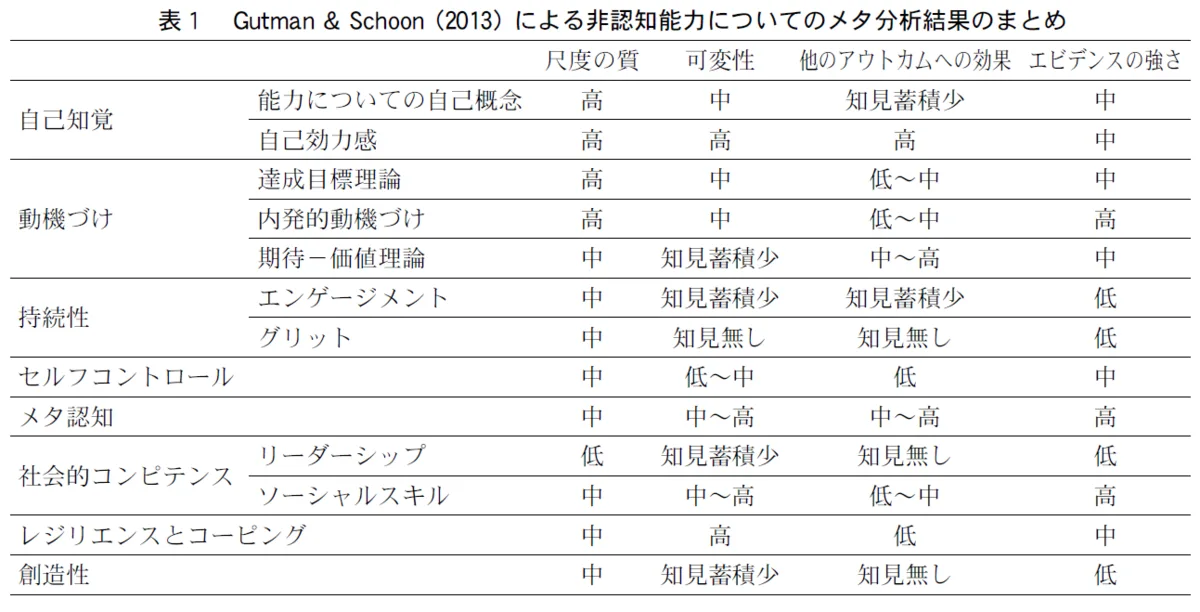
Trends and Issues in Research on Non-Cognitive Abilities (2019)
However, changing such first-year education is extremely difficult and would require the president's authority and persuading those around. In that case, if the evidence from the research results described above can show that the educational effect is high, it should serve as at least one persuasive argument.
First-year education in making things and making products
The conclusion of our research is that the ability to "make something" is almost essential as a foundation for nurturing entrepreneurship. So I think it is more effective to hold classes on making things and making products in the first year, acquire the ability to make some kind of product, and then receive entrepreneurship education.
At the University of Tokyo, the "Mono Seminar" and the like can be cited as an example that fulfills this function.
First-year career education
It has been pointed out that career awareness is highly correlated with learning motivation, study time, learning and proactive learning attitudes, and abilities (Nakahara and Mizokami, Exploring Successful Organization Members). Putting effort into career education in general should support learning effects.
On the other hand, I think it is also necessary to convey the career of entrepreneur. In Japan, not that many people aim to become entrepreneurs. So I think career-education elements that tell students that the career of entrepreneur exists are needed. If they do not understand why they are learning about starting a business, they will not learn in earnest.
If we want to increase the number of entrepreneurs, raising entrepreneurial intention could be one goal (though there is debate over the merits of raising entrepreneurial intention).
Basically, I think we would follow the content of career education while raising entrepreneurial self-efficacy. Presenting role models (such as senior entrepreneurs) and actual work experience are, I believe, effective. So internship experience at startups may also be effective.
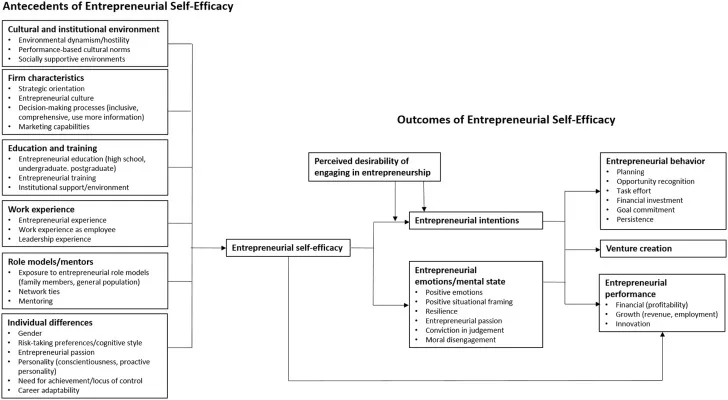
Entrepreneurial self-efficacy and entrepreneurial intention (Newman, 2019)
Long term
This means five to ten years.
Establishing research institutions for entrepreneurship
If we want entrepreneurship education and learning to take root, I think we need a mechanism to set up research labs and train researchers year after year. Although there are now many accelerators and the like, when market conditions worsen, such accelerators will close. The risk that know-how is lost at that point is the risk of leaving it to the market.
So I think we need to establish, in fields such as pedagogy, labs that can conduct research targeting entrepreneurs and entrepreneurship education.
A product school
In engineering, classes on making products are thin on the ground. Even so, making it a design school would merely be a copy of other countries and a race to simply catch up with them. So I think one option is to take a uniquely Japanese path, aiming to produce product managers in the form of a product school centered on products. In fact, many entrepreneurs come from PM backgrounds.
Conclusion
These are just my personal views and do not represent the opinion of any organization I belong to.