Entrepreneurship Education for 10,000 People
This article was machine-translated from Japanese by AI (Claude). It may contain errors. Read the original Japanese article.
The OECD's Education 2030 project summarizes which abilities will be needed around 2030 (and what kind of education we should provide for them). Its concept note names three key competencies: "Creating new value," "Reconciling tensions and dilemmas," and "Taking responsibility."
The first phrase in the explanation of "Creating new value" is "Creating new value refers to a person's ability to innovate and act entrepreneurially." In other words, acting entrepreneurially is regarded as an ability that will be needed from now on. Against this background, entrepreneurship education is likely to grow in importance.
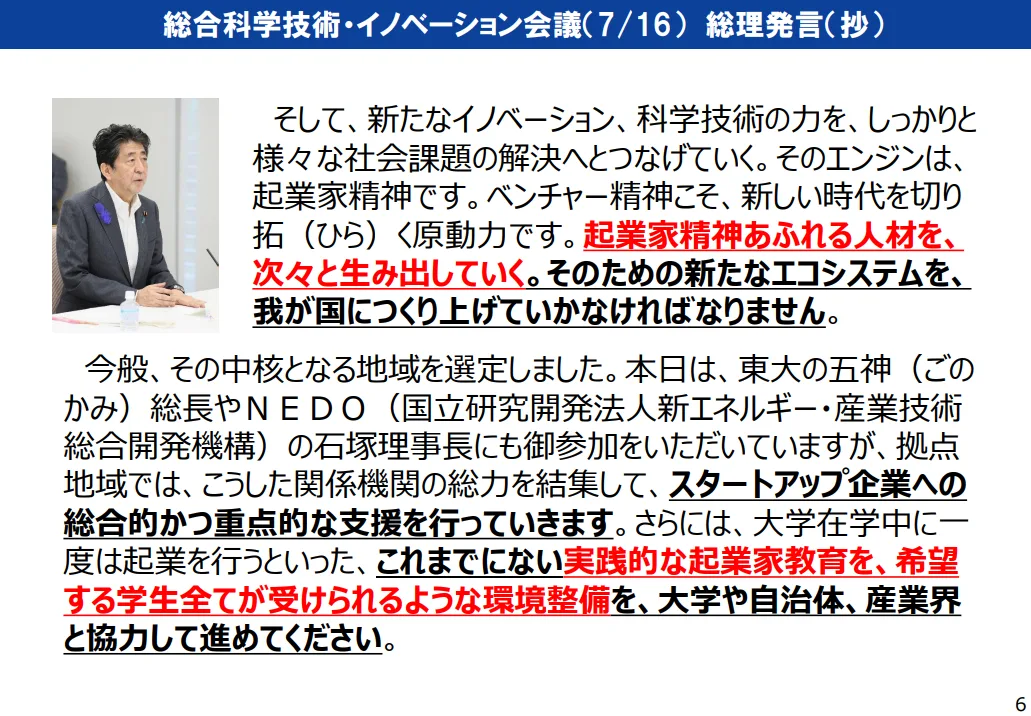
The EU has been ahead of the curve, having organized a competency list and workbooks known as EntreComp, and education that makes use of them is under way. In Japan, too, "entrepreneurship education" was included in the Integrated Innovation Strategy 2020 and has been mentioned at the Council for Science, Technology and Innovation, so its importance seems to be gradually gaining recognition.
The challenge: a shortage of instructors and programs
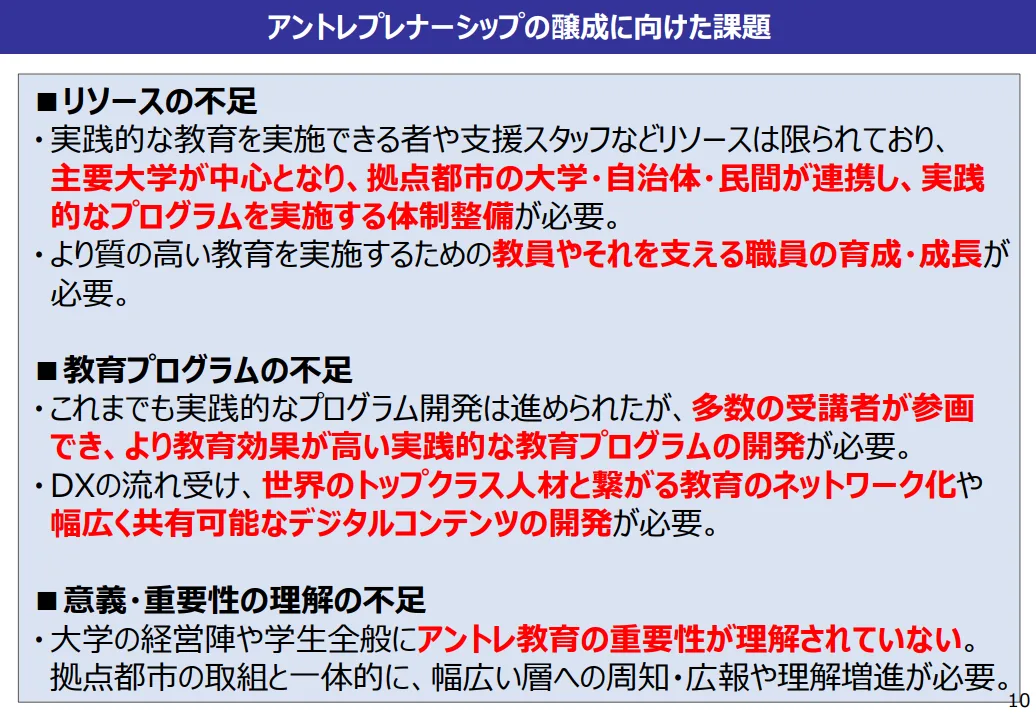
However, I also hear voices saying that universities and schools lack the instructors to provide entrepreneurship education.
There are said to be about 800 universities and about 5,000 high schools in Japan. Ideally, each school would have a full-time instructor and offer entrepreneurship education, but training that many instructors would take more than ten years. And even if we invited practitioners to teach, it is easy to imagine that without a proper educational background, it would be hard to achieve educational impact in something as holistic as entrepreneurship education.
The solution: online, active-learning-style classes
We want to offer education to many people, but there are not enough people to provide it. That is the current situation. As a solution, I think entrepreneurship education for 10,000 people online may be possible. Moreover, I think it is possible precisely because of the present moment.
The background is the COVID-19 pandemic, which has continued since 2020. Over the past year, the tools needed for online classes have made great progress. It is not only the tools: students have also acquired the habit of taking part in online classes. In other words, both tools and literacy have improved all at once. As a result, large-scale active learning online is becoming possible.
In fact, in our entrepreneurship education in the 2020 academic year, we ran active-learning-style classes online with several hundred participants. And even online, we saw learning effects comparable to those of the in-person classes in the 2019 academic year (the effects were lower on some measures and higher on others).
System configuration
Based on this track record, in our classes for the 2021 academic year we are planning to run online active-learning-style classes on an even larger scale. Specifically, we are currently considering the following system configuration.
- Class portal: Google Classroom
- Class delivery: Zoom
- Homework management: Google Classroom
- Pre-class study of lectures (flipped learning): YouTube
- Group work: Discord (because Zoom allows at most 50 breakout rooms)
- Group work: Scrapbox (because, online, interaction through writing is important)
By reusing this configuration, I believe entrepreneurship education for 10,000 people across the country is possible. By using Discord and Scrapbox alongside Zoom, small-group work also becomes possible1.
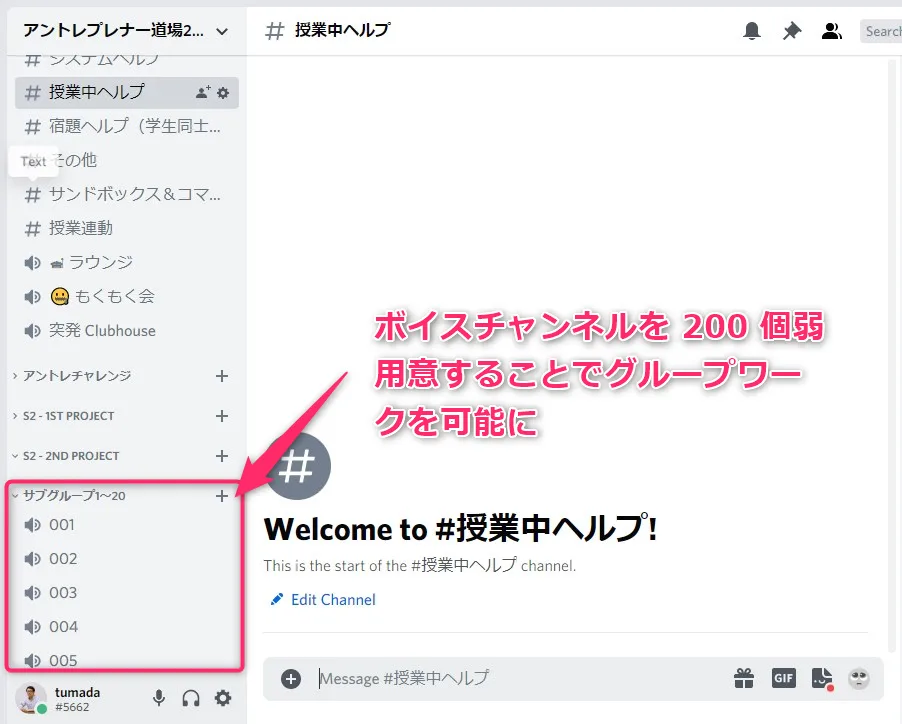
System assistants and teaching assistants will increase linearly with the number of participants, but they should not increase explosively. I think that in the end, a staff of around 10 people could support 10,000 students.
Benefits
This initiative has benefits beyond simply allowing many people to take the course.
First, if students across the country can take it all at once, it will promote connections among students beyond regional boundaries. They will also inspire one another.
Furthermore, I believe this will also lead to the development of instructors. The reason is that I think such large-scale active-learning-style classes become even more effective when they are combined with offline activities rather than completed entirely online. If we build into the course content a mechanism in which participants sometimes gather offline at each university, adjunct instructors would be asked to facilitate at those offline sessions. That would lead to the development of instructors at each university. It would also lead to the formation of a community among instructors.
As mentioned above, I personally believe that, ideally, entrepreneurship education should be provided by people from within each region. In reality, however, that is probably impossible. So, as a stopgap until instructors are trained, I think such large-scale online classes could be one means. That should make it possible to provide entrepreneurship education to more than 10,000 university and high school students every year. And having many people acquire entrepreneurship will not only contribute to creating new things, but should also lead to increasing the number of people who actively embrace new things.
If we continue to improve over several years, conducting research on the effects of large-scale active-learning-style classes in parallel, Japan's entrepreneurship education, which has so far lagged behind, could suddenly reach a level on par with the world. And this initiative seems possible precisely now, one year after the pandemic began.
Our classes in 2021 should also serve as a touchstone for this initiative. The preparation is demanding, but I will do my best to deliver results.
Footnotes
-
However, if we scale to 10,000 people, Google Classroom limits each class to 1,000 people, so we will need to think of a workaround. We should also switch Zoom to something like YouTube Live or Niconico Live. ↩