What Education and Educational Institutions Can Do to Increase the Number of Entrepreneurs
This article was machine-translated from Japanese by AI (Claude). It may contain errors. Read the original Japanese article.
With startups seen as one of the keys to economic growth, there seems to be growing attention on increasing the number of entrepreneurs. In that context, I have increasingly been asked for my views, especially from the perspective of educational institutions.
So I would like to set down, strictly as my personal opinion, what I currently think education and educational institutions can do to increase the number of entrepreneurs.
- The current state of universities
- 1. Short-term measures
- 1.1 Implementing a university version of Entrepreneur in Residence (EIR)
- 1.2 Implementing I-Corps-style training programs
- 1.3 Online training for entrepreneurs across universities
- 1.4 Providing internship opportunities at small startups
- 1.5 Promoting joint research between small startups and universities
- 2. Medium term
- 3 Long term
- Summary
The current state of universities
Let me begin by organizing the current situation.
Great expectations are placed on universities to produce science and technology startups, but in all likelihood, if things continue as they are, science and technology startups will not increase sharply from universities in the short term.
The reason is that there are far too few researchers at universities.
Let me look at this with a somewhat rough calculation.
The absence of researchers
I believe that the number of non-tenured researchers (assistant professors and project researchers) per laboratory is one or two. It is not hard to imagine that, in this situation, researchers who start companies are unlikely to emerge.
The actual numbers need to be properly surveyed, but let me check this figure with a simple calculation.
Looking at the number of faculty and staff at the University of Tokyo as of May 2022, there are 1,355 professors and 967 associate professors. If all professors and half of the associate professors have a laboratory, the number of laboratories comes to about 1,800. (Note: this includes the humanities, which are less relevant to starting companies.)
Let us assume that professors and associate professors on the tenure track do not start companies. The candidates for entrepreneurs then become those who are not tenured. Specifically, these are assistant professors, lecturers and project researchers. At the University of Tokyo, there are about 1,600 assistant professors and lecturers combined and about 1,000 project researchers, for a total of 2,600.
Dividing the number of researchers by the number of laboratories gives 2,600/1,800 = about 1.4. Hence the figure of one or two per laboratory mentioned above.
In fact, when I look at the member lists on the websites of several science and engineering laboratories, the number of project researchers is about one or two, so I think the calculation above is probably not far off. (However, such project researchers tend to be concentrated in laboratories with large budgets, and on rare occasions some laboratories have seven to ten researchers.)
In a situation with almost no researchers like this, it is close to impossible to increase science and technology startups from inside universities. If those people were to start companies, there would be no one left to carry on the research. Besides, it is excellent research that produces excellent startups, so promoting entrepreneurship at the expense of research capability would undermine long-term competitiveness.
The situation of doctoral students
So what about students? There are quite a few people who start companies in fields other than their own research, but let us consider only those that make use of their own research or technology.
Master's students in science and engineering are still in the middle of studying their specialty and have not fully acquired expertise, so I think it is a bit too early for them to be the bearers of entrepreneurship. I will therefore exclude them here.
What about doctoral students, who are further along?
Looking at the numbers, of roughly 6,000 doctoral students, about one third, around 2,000, are international students. The reality is that it is very difficult for people of other nationalities to start companies, owing to visas, language and other factors, and the same applies to international students taking jobs at startups (a similar visa problem also occurs in the United States). Unless this changes, entrepreneurship among international students is unlikely to increase much.
In addition, about 750 doctoral students are currently on leave of absence. Considering that international students almost never take a leave of absence, of the remaining roughly 4,000, about 3,000 are students of Japanese nationality who might start companies. If we assume that half of them are in applied science and engineering fields close to entrepreneurship, that leaves 1,500 as the target group.
Among them, judging from my conversations, I think about 5% of doctoral students are interested in starting a company. Those who are actually taking some kind of action are fewer still, I get the impression about 1%. Most people are in doctoral programs to finish the degree and become independent researchers, not to start companies, so I do not think this percentage is very surprising.
If it is 1%, that is 15 of the 1,500 doctoral students. If it is 2%, it is 30, but that is still only about that many.
If we want more, we need some other approach
Even the University of Tokyo, one of the largest universities, is in this situation, so to increase entrepreneurship from universities, there are first of all not enough researchers. If we want to increase entrepreneurship from universities under these conditions, I believe that unless we build mechanisms for getting people outside the university involved in the university's technology well (though in a form different from joint research, since joint research with large corporations makes things harder for startups), and unless we think in the medium to long term and undertake some kind of large-scale initiative, entrepreneurs who carry science and technology will be unlikely to increase from universities as they are now.
Bearing that background in mind, let me consider several major measures in terms of the short, medium and long term. Please note that this is written strictly from the perspective of startups, on the premise that it is not about ordinary entrepreneurship.
1. Short-term measures
Here are several measures that seem likely to be effective in the short term.
1.1 Implementing a university version of Entrepreneur in Residence (EIR)
Some VCs run EIR programs, and this would be a university version of that. It is a program in which people are paid a salary while looking for the seeds of a startup.
As a similar mechanism, Germany has a program called EXIST, which has been running since 1998. It includes an entrepreneur scholarship scheme, under which a scholarship covering expenses plus living costs is provided for one year, as well as a support program for research and technology transfer. (For other references, see here.)
Simply hiring people has no effect, so I think training and programs need to be carried out in parallel. The I-Corps program below is one idea.
However, although several private VCs have tried EIR programs, many seem not to have continued them, so I think we need to investigate the factors behind their success and failure.
1.2 Implementing I-Corps-style training programs
Similar programs are already being run in Japan to some extent, but I think it is necessary to revisit the mechanism of NSF I-Corps and study that program anew.
In the United States, the SBIR mechanism and the I-Corps mechanism appear to be working well together. In Japan too, now that SBIR has changed significantly to focus on startups, I think that studying and introducing the I-Corps mechanism afresh would make it possible to make better use of the Japanese version of SBIR.
Gap funds and the like mainly provide funding to bridge research and business, but if training programs like I-Corps are run at the same time, then even if the researchers themselves do not start companies, I think this could produce researchers who understand entrepreneurship.
1.3 Online training for entrepreneurs across universities
As part of FoundX's activities, we ran the Fellows Program online for alumni, and we have also offered the on-demand Online School. Until now we have limited these to University of Tokyo alumni, but originally we had thought that if FoundX's activities went well, we might expand them to other universities, and I think doing so is one option. Of course we do not have to be the ones to do it, and so that anyone can put it into practice, we have made our support content public.
What matters here is that this is training, not education. Providing this kind of training is likely to be effective for people who already intend to start a company.
Our program still has a number of challenges (in particular, how to get people to hold big ideas remains a challenge), but I think trying to solve those challenges while expanding is one way forward.
1.4 Providing internship opportunities at small startups
Experience working at small companies tends to promote entrepreneurship. Actively providing students with internship opportunities at startups is expected to lead to more startups in the short to medium term.
The key is whether there is an opportunity to work right next to the founder. Even if students go to a startup that already has dozens or hundreds of employees, they would be far from the founder and would end up as just a person handling one task, so I suspect the effect of raising their intention to start a company would be weak.
So one approach is to put in place a mechanism for students to work part-time at truly early-stage startups. For example, one approach would be to subsidize part-time wages so that students can earn more than they would from tutoring.
By working at a startup, students may develop an interest in entrepreneurship, and they might also meet people to start a company with at that workplace.
That said, universities cannot tell which startups are not exploitative, so I think it would be better to set several conditions, such as limiting it to portfolio companies of VCs that have done the vetting, or to startups within the university.
1.5 Promoting joint research between small startups and universities
Besides internships at small startups, joint research is another opportunity for collaboration. In fact, I have heard that in Boston, for example, bio-related laboratories do a lot of joint research with startups.
Through joint research, startups can refine their own technology further, and I think it could also change the opinions about startups held by students in the laboratory.
The government can promote such collaboration by providing subsidies or vouchers, and in fact it seems that some local governments are doing so. NEDO also has an initiative called Wakasapo, and I think startups need to make use of such mechanisms as well (though outside the bio field, I suspect the business fit is often poor).
2. Medium term
These are measures that could be started right away, but whose effects would appear in the medium term.
2.1 Promoting recurrent education
To bring new people into universities, promoting recurrent education for people with work experience would increase the number of people with business experience within universities. I think quite a few of them would choose the path to entrepreneurship.
In fact, there is a finding that recent graduates are about twice as likely to start companies as professors, so I think that increasing the number of people who are familiar with research is effective in raising the number of startups.
What is important in recurrent education is not to settle for training. To learn things properly, a long learning period and a preceding period of unlearning are necessary, and I think it would be effective to promote recurrent education in which people attend a university or vocational school for a fairly long period (two years, for example).
That means we need to encourage people to quit their jobs or take leave once. For that, in addition to strengthening social security, we will need to provide support for education costs.
In particular, with a recession expected ahead, some companies, including startups, are likely to carry out layoffs through restructuring. When that happens, if social security and education serve as a safety net, it would also increase the number of people who can create new industries toward the next economic recovery, and I think it could also function as startup policy in a downturn.
As something of an unconventional idea, if we are going to promote recurrent education, wouldn't it be good to start with civil servants? For example, if each ministry introduced a drastic mechanism whereby bureaucrats must, every seven to eight years, study at a university for two years and obtain a new degree, it would serve as a model for private companies, and policies could be based on the latest research. I think it could also become an occasion for talent exchange, different from the revolving door.
2.2 Promoting startups that use science and technology
To produce high-value-added industries and new discoveries in the future, we need to produce many people with doctoral degrees. Therefore, as a target of recurrent education as well, we need to set a goal of increasing the number of students entering doctoral programs.
However, simply increasing the number of doctorate holders is not enough, and the labor market after that must be properly developed. If there is no market in which highly skilled people are valued, there is no incentive to become such a person.
When there are not enough academic posts, no one wants to go on to a doctorate. Yet with population decline unavoidable, academic posts are unlikely to increase.
So we need to build, more broadly within the private sector, a labor market in which people who have retrained are recognized for their value. Startups that use advanced technology seem to me a promising choice as employers.
Ordinarily, large companies would be expected to make use of expert talent, but for large companies centered on membership-based employment to change would probably take a long time. Startups, on the other hand, are likely to be able to adopt new forms of employment, and if such startups keep emerging, they could become a destination for highly skilled people.
Furthermore, if such startups succeed, the cycle of "more people with advanced technology → more advanced industries" will start to turn.
I think recurrent education, the development of this kind of labor market, and the establishment of the advanced industries that shape that labor market should proceed in parallel. For that reason, I believe that among startups, we should strongly promote startups that use science and technology.
2.3 Increasing the number of students entering doctoral programs
In parallel with the flow of recurrent education and the creation of a labor market described above, I think we need to increase the number of people entering doctoral programs in order to develop people with advanced expertise. Without this foundation, the number of entrepreneurs will not grow easily.
2.4 Online entrepreneurship education across universities
I envision this as an extension of what we carried out last year. The initiative last year seems to have been reasonably effective. In particular, I think one reason for its effect was that we were able to offer such opportunities to university students who had not previously had access to such education.
I think many students have also become accustomed to online active learning over the past two years. Combining online and offline to provide scalable education is surely important precisely in the field of entrepreneurship education, where there are few instructors.
3 Long term
These are initiatives whose effects are expected to appear over the long term.
3.1 Expanding STEM education
Expanding STEM education increases the number of engineers and, among them, the number of people who choose the path of entrepreneurship. Having seen many startups, what I notice is that the entrepreneurial options available differ greatly depending on whether one has studied STEM as a solution.
Increasing the number of people in science and engineering seems important both from the viewpoint of being a nation built on science and from that of entrepreneurship.
3.2 Increasing talent in green fields
Toward carbon neutrality by 2050, what is needed is business and talent in fields that contribute to greening.
However, technology fields that contribute to greening, such as materials and chemistry, have become less popular among students over the past several decades, and talent is dwindling. Also, perhaps because of a strong preference for stability in these fields, I get the impression that there are not many people with a high affinity for startups. Yet new technological innovation is expected in these fields, and we need to increase the talent in them.
I also hear voices from the corporate side that companies are confused because it is unclear what they should study. For such fields, I think it would be more efficient to learn at a common place of learning such as a university, rather than having individual companies make their own efforts.
Looking overseas, Stanford University will establish a "School of Sustainability" in 2022. It is the first new school in 70 years, reflecting a commitment to this field.
Steering more talent toward this field more strongly seems effective as industrial policy as well.
3.3 Providing opportunities to study abroad
An experience that greatly changes one's mindset after one has become reasonably grown-up is a stay abroad. In fact, results showing that studying abroad has a positive effect on entrepreneurship can be found here and there.
Studying abroad and entrepreneurship are not directly connected, but providing this kind of steady transformative experience is thought to lead to more entrepreneurs in the long term.
At the same time, we will also need to create an environment in which people who studied abroad can easily start companies after returning home. I think we also need to work over the long term on increasing such examples.
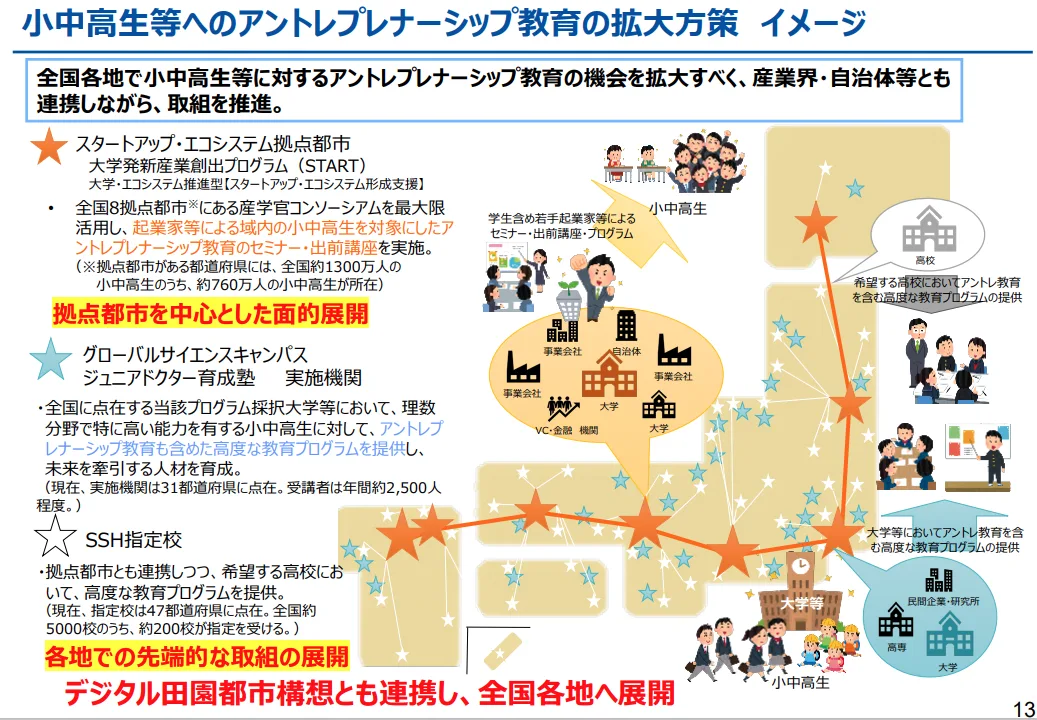
3.4 Entrepreneurship education from primary and secondary school
Career perspectives are largely formed before university, and being exposed to entrepreneurship education at an early stage is likely to have a large effect. If we want to increase the number of entrepreneurs, it is effective to learn at an early stage that the career of entrepreneur exists and to encounter that occupation with a reasonably high level of engagement.
For university students, one-off guest lectures alone probably have little effect (and there is even a possibility of a backfire effect), but for elementary and junior high school students, there may be some effect after all.
Note that entrepreneurship here includes not only starting a business, but also cultivating the abilities common to people who "start something" in various ways, such as social entrepreneurs, policy entrepreneurs, intrapreneurs, institutional entrepreneurs and civic entrepreneurs. Expectations for people who walk such career paths are rising, so I think entrepreneurship education in primary and secondary school is one possible measure.
3.5 Creating an entrepreneurship school
I think there could also be an entrepreneurship school as a professional school beyond primary and secondary education.
From what I hear about business schools overseas, they serve as opportunities to interact with the latest technologies while aiming for a career change. For example, I hear that in contests such as MIT $100k, MBA students effectively do much of the actual work (it seems that running the contest also lets them meet a variety of people, which is useful for finding jobs or starting companies).
Making use of business schools in Japan is also one approach, but as the name "Master of Business Administration" suggests, an MBA is basically education aimed at producing business managers. Looking at the early 1900s, when MBAs became more common, it can be considered a learning mechanism for training managers who were lacking in the organizations then emerging, the "large corporations."
So, to suit the present era, I think creating an educational program equivalent to a professional graduate school in a new genre such as an "entrepreneurship school" is one possible approach. For example, one could imagine building a mechanism in which students earn a degree while actually starting a company in the process.
A characteristic of national universities in Japan in particular is that many are comprehensive universities. As a result, they tend to have good access to technology. So I think a number of devices are conceivable, such as offering tuition benefits to those who put the university's research to practical use alongside their education, or allowing students to earn a degree by summarizing the process of commercialization in a thesis.
Now that Japan has fallen behind in business schools and design schools, I think launching a new form of education is one option. At the same time, conducting research on entrepreneurship and entrepreneurship education could also accelerate those efforts.
Note that entrepreneurship here is envisioned to include not only business entrepreneurs as mentioned earlier, but also social entrepreneurship, policy entrepreneurship, civic entrepreneurship, intrapreneurship and so on, teaching various kinds of entrepreneurship.
Of course, some universities already have business school mechanisms, so making use of those is also one option.
Summary
I wrote this quickly with limited time, so there are probably various gaps. More consideration and verification are needed before actually starting anything, but I am putting it together as what I am thinking now.
There may be mistakes or misunderstandings. If so, I would be grateful if you would point them out without hesitation.
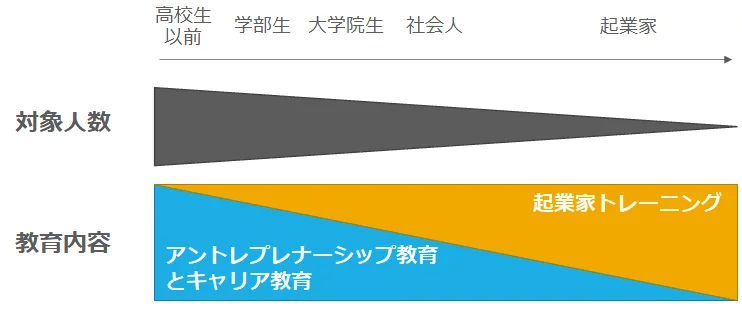
As one of the people involved in programs for entrepreneurs and entrepreneurship education, what I feel is that education alone does not increase the number of entrepreneurs.
For example, not so many people would decide "I'll become a scientist" simply because they received a science education. Rather, there must be more people who were influenced by their surrounding environment.
Moreover, it seems that hard skills are not what is holding back entrepreneurship. It is not enough to simply teach knowledge about business and entrepreneurship (in fact, learning it properly can even lower the rate of starting companies —although learning seems to raise the success rate after founding).
As I have said in several articles so far, let me stress that entrepreneurship education sometimes produces counterintuitive results, and it is better to proceed while properly consulting past research.
Policies to increase the number of entrepreneurs include various measures, such as expanding safety nets and increasing the diversity and supply of risk money (I expect that Professor Hiroshi Shimizu's forthcoming "Entrepreneurship" and Professor Kato's "The Economics of Startups" will probably cover much of this). Those should be considered together, and education is not the only means.
That does not mean education has no influence at all. It can give a push to people who say "I was hesitating about starting a company," and it can influence the gradual change of the surrounding environment. If done well, education can also become a leverage point for change.
As someone who works at an educational institution, I hope to fulfill that role well.
Other related articles are here.