On Measures to Expand Entrepreneurship Education in Elementary, Junior High, and High Schools, Discussed at the April 2022 Council on Economic and Fiscal Policy
This article was machine-translated from Japanese by AI (Claude). It may contain errors. Read the original Japanese article.
The Council on Economic and Fiscal Policy meeting held on April 27, 2022 mentioned measures to expand entrepreneurship education in elementary, junior high, and high schools.
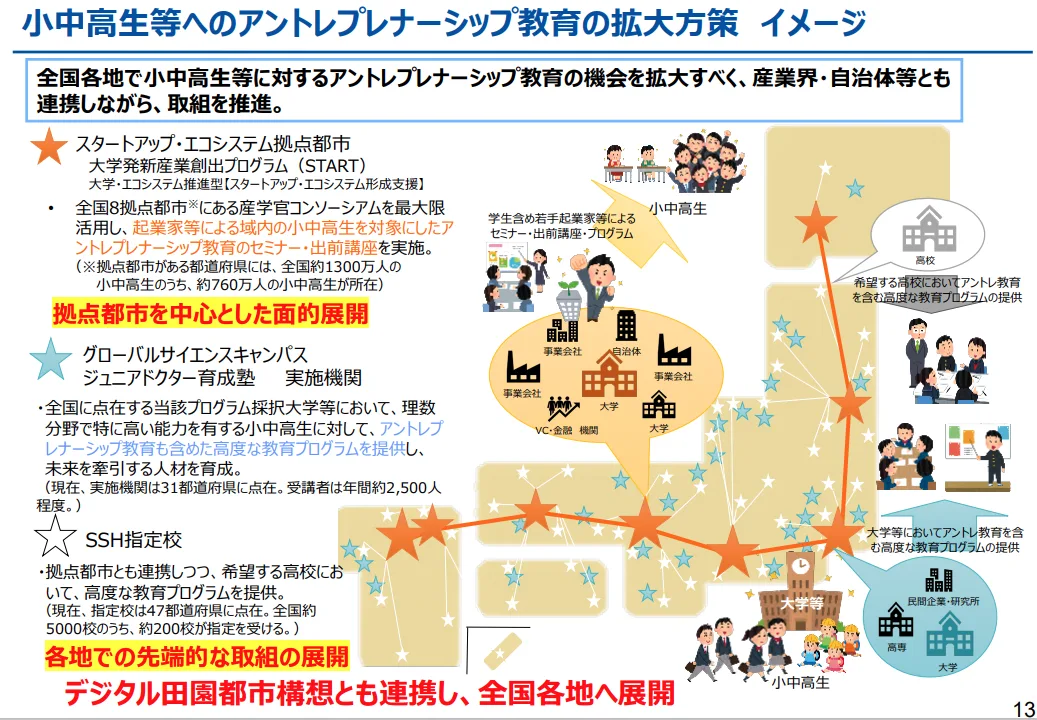
If the aim is to promote industry by increasing the number of entrepreneurs, I think entrepreneurship education for young people has a certain effect.
However, as I have written in several articles on entrepreneur education and entrepreneurship education, entrepreneurship education is rather hard to pin down, and I think that as we consider expanding it in Japan, we need to keep a few points of caution in mind.
This is because, if such education is carried out without much thought and in a way that has little effect, there is a fairly high chance that it will leave the impression that "it didn't work after all" or "it was pointless." So, as someone who both practices entrepreneurship education and is involved in research on it, I would like to offer a few opinions.
1.1 Separating from Business Education
The Ministry of Education, Culture, Sports, Science and Technology also seems to be running a program to promote entrepreneurial experiences, and I also see curricula for entrepreneur education in other regions. Looking at the content of these programs, some of them are merely business education.
For example, teachers make arrangements with local stakeholders, and students plan something, do marketing, and report on revenues and expenditures. This is an experience of business activity, but it is hard to call it the activity of "starting a business" under high uncertainty.
Activities that spark interest in business and entrepreneurial activities share some parts and differ in others. If we only provide plain business education, I think the number of people going to business or economics departments may grow, but the number of entrepreneurs will not increase much.
I have also heard that, for some time, a fair number of schools have been carrying out business-like activities, such as mock shops, during periods of integrated study. It is precisely because such activities did not increase the number of entrepreneurs very much that the number of entrepreneurs is now a problem, and I think that merely expanding the conventional activities will not change the startup environment in Japan very much.
(※However, education alone does not change every person and every environment, so I am not saying that education is the only thing at fault.)
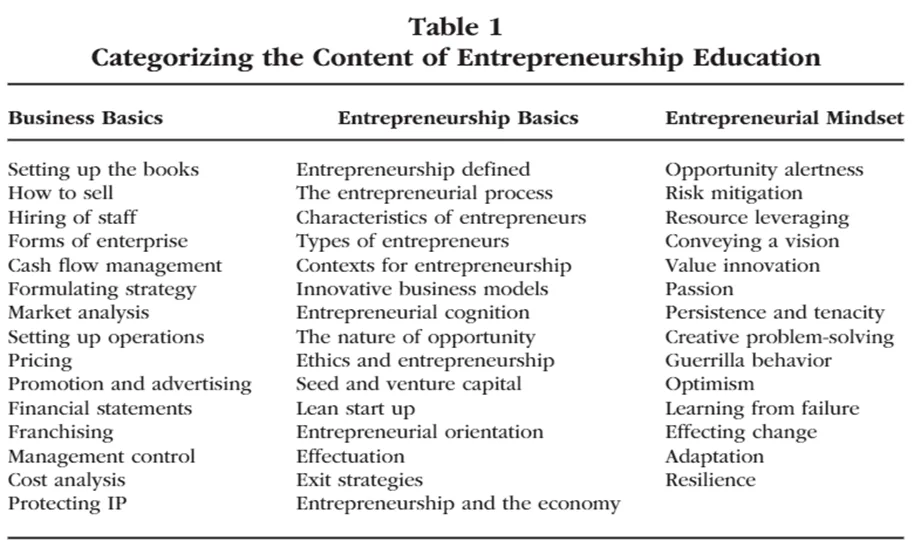
Of course, entrepreneurship can also grow through business. But when we want to be effective, I think that developing entrepreneurial abilities and supporting the formation of an entrepreneurial view of careers need to be considered, to some extent, separately from business education.
For example, Kuratko and others summarize the difference between business and entrepreneurship as follows[1].
1.2 Considering Which Abilities to Develop
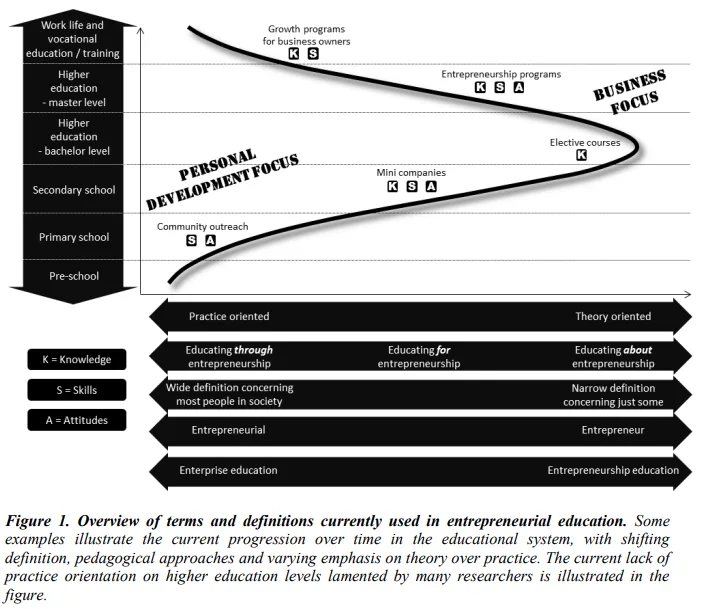
From the perspective of education for young people, I think we should focus on developing abilities closer to non-cognitive skills rather than knowledge.
Knowledge about business can be acquired later. Rather, I think entrepreneurship education is better built around abilities that can be developed precisely because people are young (and are harder to develop after adolescence), such as proactive behavior and communication skills, as well as a view of careers.
A similar point is made in the OECD's report on entrepreneurship education, which proposes changing the content of entrepreneurship education according to the stage of development.
So what kind of effects should we expect? One idea, for abilities, is to refer to the EU's EntreComp and consider which abilities a curriculum has been designed and developed to cultivate.
If we implement something without thinking about "what kind of effects we expect," we could end up with "this class was good because the students said they enjoyed hearing from an entrepreneur (but their abilities did not grow)."
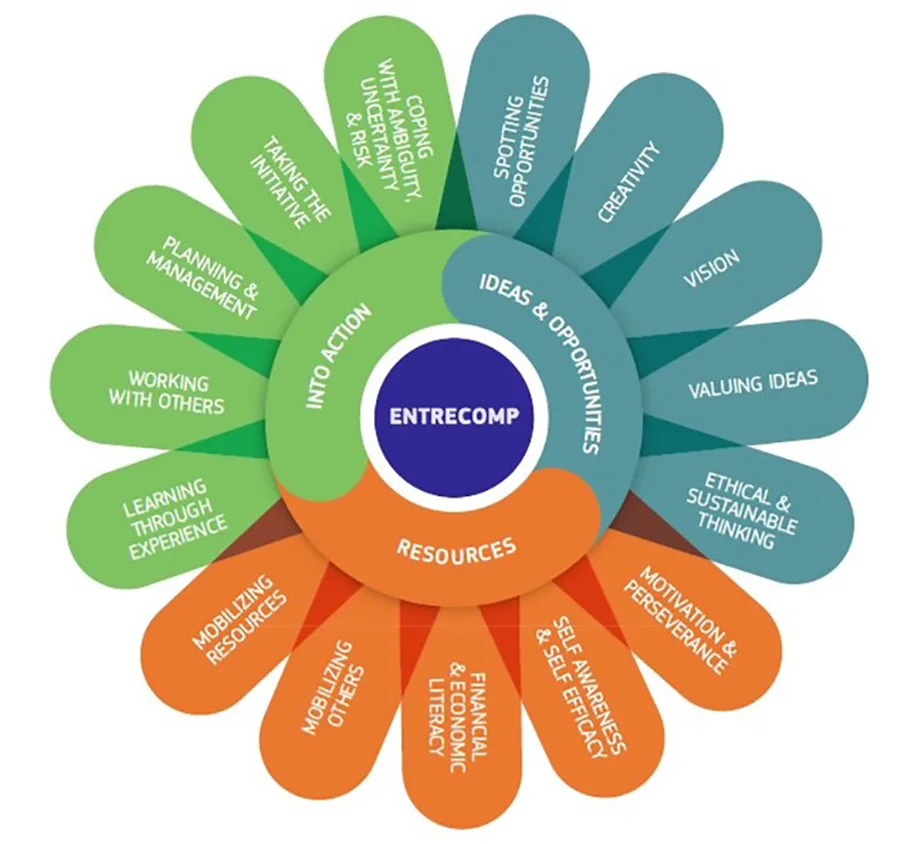
EntreComp consists of the following 15 competences, each divided into 8 levels.
- Spotting opportunities
- Creativity
- Vision
- Valuing ideas
- Ethical and sustainable thinking
- Self-awareness and self-efficacy
- Motivation and perseverance
- Mobilising resources
- Financial and economic literacy
- Mobilising others
- Taking the initiative
- Planning and management
- Coping with uncertainty, ambiguity and risk
- Working with others
- Learning through experience
Note that each of these items is "entrepreneurial" in nature. For example, businesses also spot opportunities, but the quality of that activity differs somewhat in the context of entrepreneurs.
EntreComp is only one example, but I think the quickest way is to start by making use of existing frameworks like this.
1.3 Classes Taught by Entrepreneurs
Classes taught by entrepreneurs can be effective if used correctly, but otherwise we may not be able to expect much effect.
For example, regarding the effect of presenting role models, there are so far results showing both an effect and no effect. When a close relative such as a parent is an entrepreneur, a tendency for that person to start a business more easily is clearly observable, but there are also a fair number of reports that role models with only slight involvement, such as guest lectures, show no visible effect.
Looking back, I think many of us remember receiving visiting classes from people involved in traditional performing arts. Of course, some people saw those traditional arts and actually set out on that path, but I suspect they are not very many. If such a rate is acceptable, visiting classes may be fine, but if not, we should think about how to do it.
As a general principle, learning from experts requires experience and observation in the field. Experts are not necessarily good at teaching. Scaffolding is also needed in education. Senior entrepreneurs are experts, but even if an entrepreneur talked to elementary and junior high school students about fundraising, it would probably be gibberish to them. Instruction from senior entrepreneurs seems to be reasonably effective after starting a business, but I think it is hard to say that it is effective for students in primary and secondary education.
Listening to faculty members with practical backgrounds, a fair number of them tend to think that "education means providing knowledge." However, I feel that entrepreneurship education is somewhat different from that kind of knowledge-transmission education.
From the perspective of increasing the number of entrepreneurs, I think classes based on that kind of deficit model will not work well, so I think we need educators who consider the curriculum as a whole to decide in what form entrepreneurs should take part in education.
1.4 Conclusion
I have introduced a few perspectives for building effective classes. My own opinions are still developing in some respects.
Still, if we are going to do it, I think it is better to make something better, and I think that those of us who engage in research and educational practice can contribute greatly to laying the groundwork for that. Personally, I also want to contribute.
Also, if entrepreneurship education like this is to be expanded in Japan going forward, I think we also need an organization that conducts research, development, and practice on such education.
For example, unless somewhere takes on functions such as conducting Faculty Development for teachers and practitioner-faculty involved in entrepreneurship education, and measuring the effects of classes practiced nationwide in order to improve their content, we will only see "plausible-sounding" classes based on passing ideas repeated over and over.
There are now suggestions that such classes have no effect or are even counterproductive. If more entrepreneurs are needed within industrial policy, I think it is increasingly necessary to expand entrepreneurship education while accumulating knowledge about it.
[1] Kuratko, D. F., & Morris, M. H. (2017). Examining the Future Trajectory of Entrepreneurship. Journal of Small Business Management, 56(1), 11–23. doi: 10.1111/jsbm.12364