Mapping Entrepreneurial Support Activities
This article was machine-translated from Japanese by AI (Claude). It may contain errors. Read the original Japanese article.
When universities discuss entrepreneurship education, training for entrepreneurs, and startup support with one another, the people they support and their goals differ from one university to the next, so I feel it would be better to sort out each other's activities before discussing them.
To do that, I am considering preparing two maps like the ones below, and having a conversation only after we have each placed what we are doing on them.
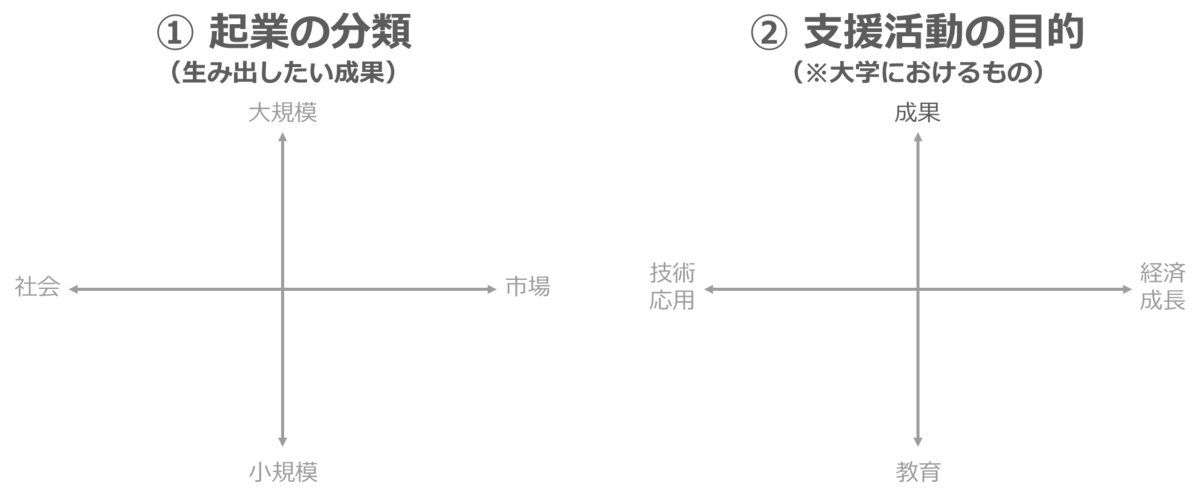
① Classifying Startups
This classifies the kinds of startups that a support organization aims to produce as outcomes of its support. I think about it along the following two axes.
- The "social ⇔ economic" axis
- The "small-scale ⇔ large-scale" axis
First, the "social ⇔ economic" axis. Of course, the social and the economic are not opposites. Still, as in Alter's spectrum of social enterprises from nonprofit to for-profit, there is a gradient, and I think it is easy to classify by which side a venture puts more weight on.
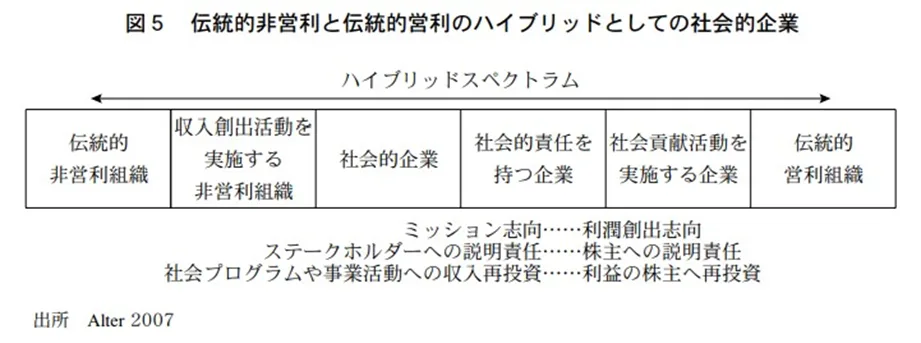
The "small-scale ⇔ large-scale" axis, meanwhile, is about the scale a company is "aiming for."
I think it is better to sort this out not by current status but by where a company is aiming to go in the first place. For example, there are cases where a company starts small in a local area and, because there is demand, gradually grows from small to large. But where it sits on this axis changes depending on whether it was intended that way from the start or simply turned out that way.
By large-scale, I mean a scale where the number of people affected is in the hundreds of millions and revenue is in the hundreds of billions of yen.
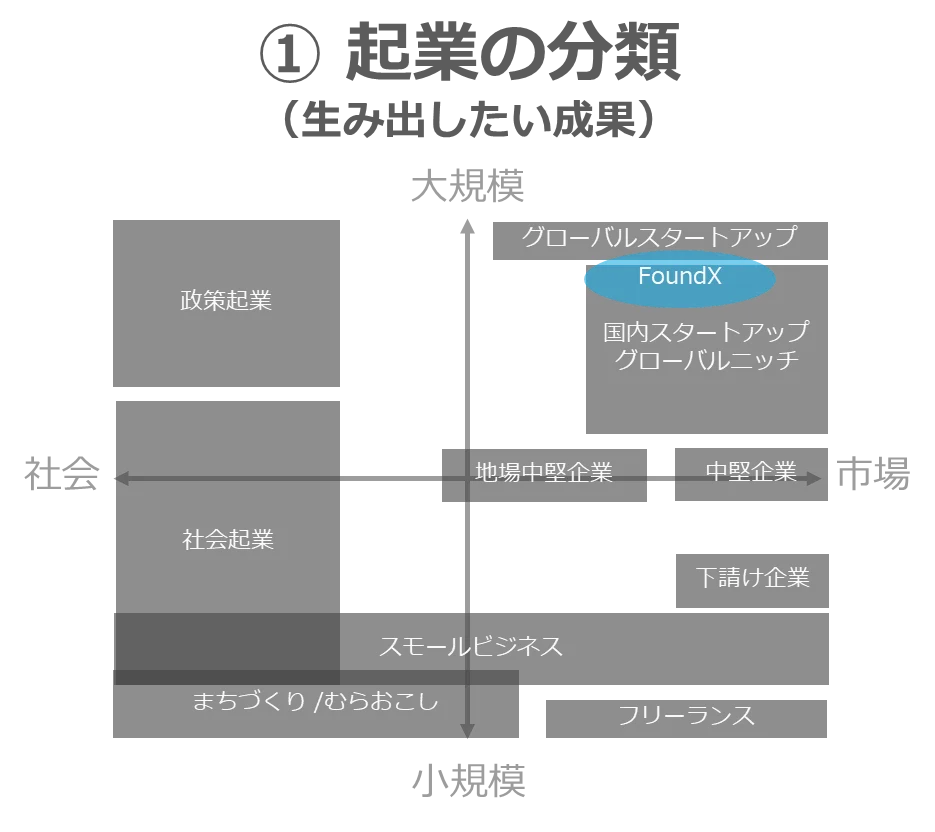
With this classification of companies, I think the kinds of startups can be roughly mapped as follows.
For example, global startups sit in the upper right, while efforts such as village revitalization are small in scale and close to social contribution, so they sit in the lower left. FoundX supports ventures near the upper right (though I don't think anything is fine as long as it makes money, so we keep the social side in mind too).
② The Purpose of Support Activities
Universities hold technologies developed through research, and they are also expected to contribute to economic growth. At the same time, they are educational institutions: they provide education, and they also have people who have received it. Because they have so many different aspects, their support activities tend to have a broad range of targets and purposes.
I have prepared the following two axes.
- The "outcomes ⇔ education" axis
- The "technology utilization ⇔ economic growth" axis
First, the "outcomes ⇔ education" axis. I divide this axis according to whether the support activity seeks one of the startups classified above as an outcome, or aims at educating people connected to the university. A single piece of support or a single class might be able to do both, but I don't know how (if the method of throwing someone into a ravine and telling them to climb back out were acceptable, perhaps it could do both...).
The "technology utilization ⇔ economic growth" axis may be unfamiliar. The reason I set up technology utilization as one pole is that universities hold technology seeds, so they tend to think in that direction. As a result, I think there is also support that takes the view, "as long as the technology seeds can be given back to society, the economic impact doesn't matter so much (though the bigger, the better)."
On the other hand, universities are also expected to have their researchers and graduates create startups that drive economic growth, so that can become the main focus in some cases.
I think the support activities I am involved in fall into the classification below. The gray parts are things I used to do and have since stopped.
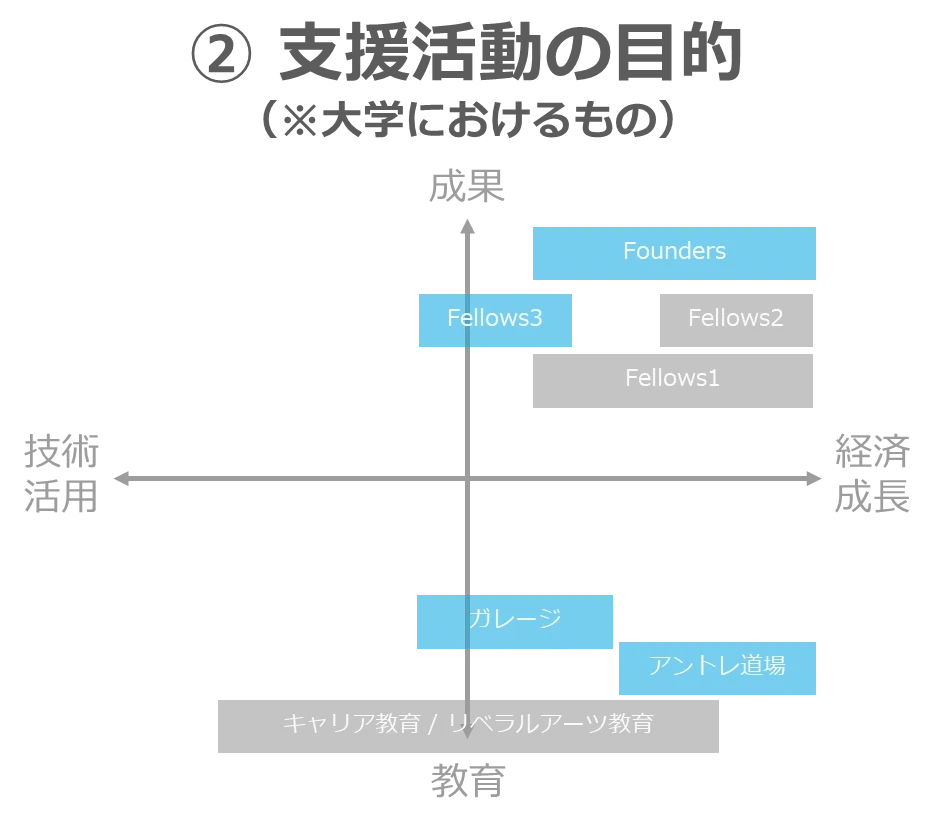
My understanding is that I fundamentally work on both the outcome-oriented and the education-oriented sides of producing startups designed to grow rapidly and drive economic growth.
Note that FoundX selects many technology-based startups. That is because we consider technology essential for growth in many businesses, but it is not necessarily tech-transfer-type technology.
(※The upper left may look empty, but my understanding is that the Division of University Corporate Relations at The University of Tokyo does a great deal in that area as well.)
Giving Concrete Examples
Beyond the mapping itself, it becomes easier to understand in more detail if you add concrete stories, such as the team for which your support was most effective, or an account of support that did not go as well as expected.
Hearing concrete examples tells you which part of the map someone is trying to work on, and I think it also reveals the main target of each support activity.
Summary
There may be such a thing as a single form of support that encompasses everything. But rather than something that broad, I think it is better to narrow the focus a little and carry out support activities after making clear "to produce what kind of outcomes" and "with what purpose" the support is provided. And when supporters exchange information with one another, I hope that by making clear "which part of the map we are mainly talking about" before discussing, we can have a fruitful exchange of information.
[1] Quoted from http://oisr-org.ws.hosei.ac.jp/images/oz/contents/662-05.pdf