Expectations for the Kishida Administration's Startup Policy
This article was machine-translated from Japanese by AI (Claude). It may contain errors. Read the original Japanese article.
Asked in the LDP leadership race, "What is Japan's growth industry?", Prime Minister Kishida answered "startups" on a flip board. Since I think expectations are also placed on startups within the "new capitalism," I am writing down my personal opinion.
Personally, I support the "new capitalism," which is conscious of redistribution. Growth and redistribution can go together, and I believe that correcting inequality through redistribution is necessary for growth as well. As I wrote before, I also think that, in the context of growth, startups can contribute.
This time, I will write about three policy directions in particular that I am hoping for.
- 1. Evidence-Based Startup Support
- 2. Investment in Entrepreneurship Education
- 3. Promoting Locally Rooted Entrepreneurship
1. Evidence-Based Startup Support
Startups have been few in number until now, and I think policy tended to be built on anecdotes. Ten years ago, that may have been fine. But evidence has accumulated over the past decade, and I think it is becoming possible to build evidence-based / evidence-informed startup support policies to some extent.
For example, Nesta and IGL conduct surveys and research on startups as part of their work on innovation policy. Research on accelerators has also been increasing. There is also research on what kind of training is effective.
We should not fail to use these research results in startup support. If startup support policies are formulated on the basis of such evidence, more effective support should become possible. I would like to cooperate toward that end as well (though I say this in a lofty way, I am still learning every day myself...).
Of course, there are areas where the evidence is thin. In that case, I think we can conduct research in Japan as needed and build the evidence ourselves.
Please forgive me that this one alone is more abstract than the other two.
2. Investment in Entrepreneurship Education
I believe what the current Japanese startup ecosystem lacks most is the number of entrepreneurial people. As for financial policies for startups and mechanisms such as sandboxes, I think Japan has reached a sufficiently advanced level (of course it is not perfect, but thanks to the efforts of those who came before us, I think it has been put in good order). Also, when I talk with VCs, I hear them say that money is being raised but the number of investment targets has not grown as much as expected.
Developing people is one of the things that takes the most time. Money can be raised in a short time, but people do not grow quickly. Investment over a period of several years is necessary.
Looking at education as a whole, I think entrepreneurship education in primary and secondary education, such as elementary, junior high, and high school, is also important. It is often said that entrepreneurs are likely to have entrepreneurs among their relatives (just as politicians are likely to have politicians among their relatives). Rather than abilities simply being inherited, wouldn't it be better to think that, from a young age, having real examples of people in such occupations around them makes people more likely to consider it as a career option?
I also think that gaining, through experiences such as selling things on Mercari at a young age, a sense of self-efficacy that one can live by means other than being paid for hours worked, and thereby developing career awareness, is important for producing the entrepreneurs of ten years from now. In Sweden, it has been confirmed that providing entrepreneurship education during secondary education increases the number of entrepreneurs.
Moreover, although high career awareness raises study time, which is a good effect, career awareness does not change much after the second year of high school, so raising career awareness early is important. It has also been pointed out that currently half of people see no change in their "qualities and abilities," including communication and leadership skills, from high school to university, so I think earlier education is more effective in terms of the basic abilities entrepreneurs need as well.
On the other hand, even if entrepreneurship education is provided at universities, the number of entrepreneurs will probably not increase much. In fact, the effect of entrepreneurship education at Stanford University was rather to let people who were already interested realize whether they were suited to it, and to make them give up the career of entrepreneur. At the same time, however, the classes also contributed to raising the success rate of those who took on the challenge. If one wants to increase the number of startups through education at university and beyond, it seems to me that giving students experience studying abroad, and having STEM students take non-STEM education is more likely to lead to entrepreneurship. Also, I think entrepreneurship education should not be confused with vocational, training-like entrepreneur education or entrepreneur training, and that education on matters such as capital policy should not be included in university education.
For those who have decided on a career as an entrepreneur, education closer to training is better. Providing subsidies and support is also important. I have expectations for Japan's SBIR, which has come closer to the American SBIR. Personally, I think that in addition to that, rather than just giving out grants, it is preferable to attach education along with the grants, as in I-Corps.
In educational programs, it is essential to run them in batches and to build a cohort. If education is provided at the same time as funding, then even if the funded business fails, the educated people and the connections among the entrepreneurs born within the program remain, and this also serves as a safety net. We are doing this at FoundX as well, and we feel we are getting results (we have made all of our support methods public).
Of course, various kinds of support are necessary for startups to grow. But the most important point right now is the number of entrepreneurs, the number of people taking on challenges. And I think that it takes ten years for the results of entrepreneurship education to appear in university education, and twenty years in primary education. But precisely because it takes long, I think we should get started early.
3. Promoting Locally Rooted Entrepreneurship
Promoting startups in regional areas is difficult in many ways. This is especially so for IT, which is attracting attention now. This is because even when a startup born in a region is on its way to success, it often moves to a hub city to find talent for rapid growth.
To begin with, IT does not create that many jobs. Even during the COVID-19 pandemic, a move to the suburbs, at a distance where one could "meet if it came to it," was seen, but there seems to have been little movement out to regional areas. Attracting remote workers will also become a case of local governments eating into one another if every one of them does the same thing (just like tourism in regional revitalization).
So after all, we come back to the obvious point that, even when we speak of startups and entrepreneurship, it is important to properly build industries suited to each region. Recently, too, Dan Breznitz, co-director of the Innovation Policy Lab at the University of Toronto, in his recent book "Innovation in Real Places," sounded an alarm about cities' policies of specializing in high tech, as every city has done. And he argues that since each region has an advantage in at least one part of the global production process, it is better to bring about innovation that draws on that specialization. In fact, German cities are developing in that direction.
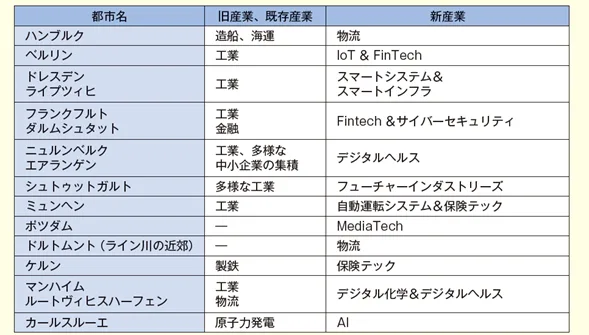
From https://www.projectdesign.jp/201812/area-future-vision/005752.php
I think the important position belongs to educational institutions such as universities and technical colleges (kosen). Universities and kosen can function as places that produce global businesses that make use of research results and educational results (= human resources) that could become a region's foundational industries.
Entrepreneurship does not merely promote startups; it also contributes to energizing the local economy. Much consumption takes place within local economic areas. Moreover, there are many social issues in regions. It is social entrepreneurs who will solve those issues. Startups are by no means the only form of entrepreneurship.
Entrepreneurship in retail and food service creates economic circulation in the region, energizes it, and creates jobs. Social entrepreneurs solve the region's issues and revitalize it. I believe that aiming to create one startup-like company that can generate 10 billion yen in sales, while at the same time aiming for 100 companies in the region that can each generate 100 million yen in sales, is the way to make a region prosperous1. For that purpose too, places that can provide such education are necessary.
Such industrial revitalization has been advocated in regional revitalization efforts until now, but what differs from before is that the green growth strategy toward carbon neutrality, the accompanying structural transformation of industry, and the rollout of services through digital technology could also lead to scenarios that create business opportunities in regional economies. Redistribution policy may also support this (for example, expanding the safety net appears to raise the rate of entrepreneurship).
If a structural transformation of industry toward greening occurs, a transformation of the employment structure will also be necessary, and the importance of recurrent education and reskilling will grow. I do not know whether current universities will take on that role, or vocational schools and junior colleges (as with community colleges in the United States), or places like professional graduate schools within universities, but I think it is such educational institutions that will contribute to local economic areas.
I ran out of time toward the end, but I have written down my personal expectations.
Footnotes
-
That said, I think that creating 100 companies with 100 million yen in sales would be unlikely to lead to major regional revitalization, and would probably serve only to put some brake on the shrinking of regional industry. So if one does only this, the region will merely keep shrinking over the medium to long term, which I think makes the balance difficult. ↩