Four Types of Entrepreneurial Ventures
This article was machine-translated from Japanese by AI (Claude). It may contain errors. Read the original Japanese article.
Entrepreneurship education is attracting attention, but the kinds of businesses that people mean by entrepreneurship vary widely. Some people start businesses out of necessity, just to make a minimum living, while others start startup-style businesses that take risks and grow rapidly.
However, it seems that when we discuss the concept of entrepreneurship today, all kinds of entrepreneurship are lumped together.
Perhaps with this situation in mind, Morris, Kuratko, and colleagues divided ventures into four types based on the nature of the business in a 2016 paper.
- Survival
- Lifestyle
- Managed growth
- Aggressive growth
To explain each briefly:
- Survival - Businesses to make a living
- Lifestyle - Entrepreneurship for freedom or hobbies. Relatively small in scale, with little thought given to expansion
- Managed growth - Aiming for steady growth
- Aggressive growth – Aiming for rapid growth
It has also been pointed out that about 85% of entrepreneurship in developed countries is probably survival or lifestyle businesses.
When providing entrepreneurship education, it seems necessary to be aware, to some extent, of "what kind of businesses the entrepreneurs we are trying to develop will create."
For example, the skills needed differ from one type of business to another.
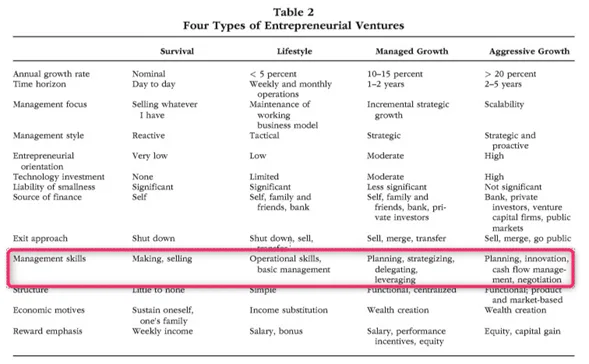
Considering the table in the same paper, for survival, skills in making and selling may be enough, but if one is aiming for aggressive growth, one may need to acquire skills related to innovation, and one will need to know methods such as raising funds through equity. For lifestyle, on the other hand, knowledge of borrowing may be sufficient for financing.
It has been pointed out that entrepreneurs who start each type of business differ in entrepreneurial identity (EI) and other respects. Entrepreneurs who started survival businesses have a low EI, followed by those who started lifestyle businesses, who also have a low EI. Meanwhile, EI tends to be high for both managed growth and aggressive growth.
If we want to increase the number of entrepreneurs who build growth-oriented businesses, education that intervenes in EI may be one approach. However, if such businesses account for only 15% of all businesses, we also have to consider whether such education should be provided.
I think entrepreneurship education needs to be designed and delivered after considering what kind of businesses the entrepreneurs are being trained to start, and for what purpose. This typology should serve as a useful hint in such cases.