The Difference Between Entrepreneurship Education and Entrepreneurship Training
This article was machine-translated from Japanese by AI (Claude). It may contain errors. Read the original Japanese article.
Entrepreneurship education covers a wide range of things. Some of the literature[1][2] draws a sharp distinction between Entrepreneurial Education and Entrepreneurial Training.
Entrepreneurial training improves performance in a specific activity and provides the skills and knowledge needed to run a business. Its audience is mainly potential entrepreneurs and people who have already started businesses.
Entrepreneurial education, on the other hand, is broader education, such as nurturing an entrepreneurial spirit and acquiring a wide range of knowledge and skills, including problem finding, and its audience is not limited to entrepreneurs.
Of course, education and training are partly inseparable, and the two are often referred to together as Entrepreneurial Education and Training (EET). Still, I think it is worth considering which side of the gradient between the two a given program leans toward. I also think the emphasis should change depending on who is being taught (as in the figure below).
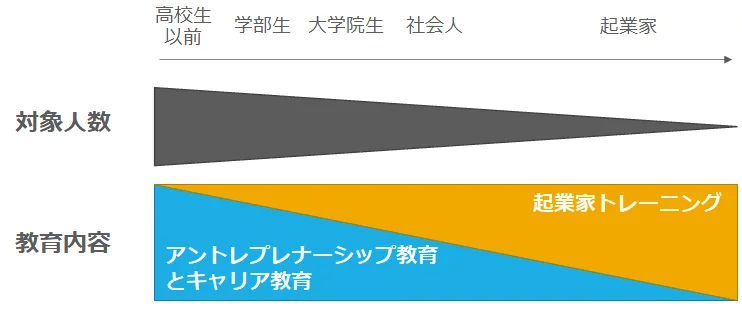
For example, most courses that teach how to raise funds are training rather than education, because they aim to improve performance in one specific activity, fundraising. However, if a course aims, through acquiring the knowledge and methods of fundraising, to improve the more abstract "ability to obtain resources from outside," it could be called education. Even so, because the two have different educational purposes, the way they are taught should differ as well.
Much of what is offered as "entrepreneurship education" out there seems to be closer to training. How to raise funds, how to write a business plan, marketing methodologies: most of these are training, or instruction, meant to help people carry out a specific activity well. They are useful and important skills for running a business, but connecting them directly to the acquisition of broader skills and attitudes beyond that is difficult unless the program is designed quite carefully.
With attention to entrepreneurship education rising these days, I think it is somewhat dangerous to confuse giving mere business training to junior high, high school, and university students with "entrepreneurship education." Under the name of entrepreneurship education, entrepreneurial training could end up running rampant in secondary and higher education. That content should properly be taught at vocational schools and professional schools.
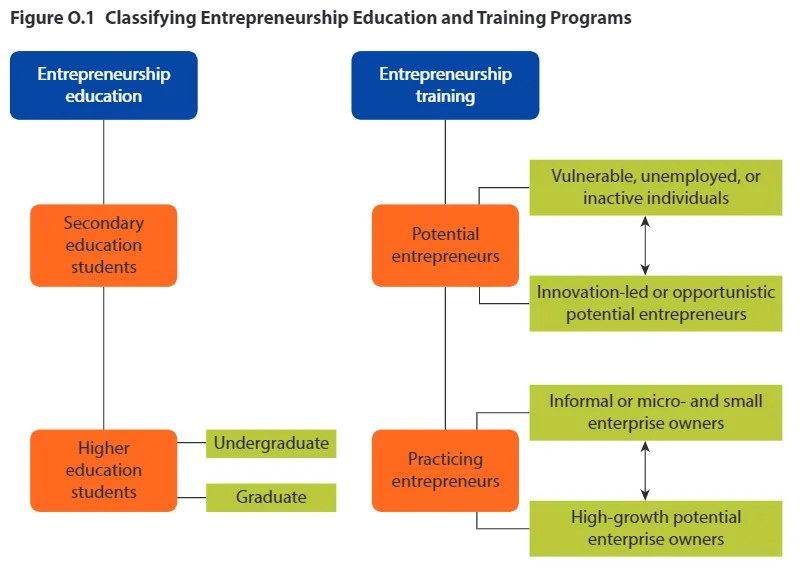
Figure from [2]
For example, many of the slides I have published are closer to training than to education. In fact, when I teach in settings such as university classes, I often make slides different from the ones I publish for working professionals, and I think that may be the difference between training and education.
Personally, I think it would be better to translate Entrepreneurial Education as "entrepreneurial spirit education" and position it as education for nurturing entrepreneurship in the broader sense. However, doing so raises other difficult questions, such as what entrepreneurship actually is and whether it can be learned. Still, I also think that only when such questions can be answered adequately can something be called entrepreneurship education.
[1] Hynes, B. (1996). Entrepreneurship education and training ‐ introducing entrepreneurship into non‐business disciplines. Journal of European Industrial Training, 20(8), 10–17. doi: 10.1108/03090599610128836
[2] Valerio, A., Parton, B., & Robb, A. (2014). Entrepreneurship Education and Training Programs around the World: Dimensions for Success. doi: 10.1596/978-1-4648-0202-7