Judging a Startup Idea by the Benchmark of 10 Billion Yen in Revenue
This article was machine-translated from Japanese by AI (Claude). It may contain errors. Read the original Japanese article.
Many aspiring founders have probably been told by an investor that "the market looks too small for a startup." Behind such comments lies a simple calculation. Knowing that logic may help you judge, to some extent, whether your own startup idea is a good one.
So in this article, I will explain that logic using B2B SaaS, where the number of startups in Japan has been growing in recent years, as an example.
- 10 billion yen in revenue as a milestone
- Thinking about market size
- Thinking about price per customer and number of customers
- Thinking about the distribution needed to reach 10 billion yen
- Strategy based on price per customer
- Aim for 50 million yen in revenue in the first two years: setting goals on the assumption of T2D3
- Summary
- Useful resources
10 billion yen in revenue as a milestone
A startup is said to be a company that grows rapidly. So what size of company is a startup actually expected to become?
One of the target waypoints is said to be 10 billion yen in annual revenue (ARR $100M). In Japan, a company can list on the Growth market with revenue an order of magnitude smaller, but growth is still expected after listing, so aiming for 10 billion yen doesn't change much.
Let's look at 10 billion yen in revenue from another angle.
A startup would aim to list at a market capitalization of around 100 billion yen.
For SaaS, the going market capitalization after listing is said to be around 10 to 20 times PSR (the ratio of market capitalization to revenue). Taking the lower figure of 10 times, a market capitalization of 100 billion yen requires 10 billion yen in revenue.
PER (the ratio of market capitalization to profit) also tends to be around 15 to 20 times. At 20 times, reaching a market capitalization of 100 billion yen requires roughly 5 billion yen in profit. Few businesses have a 50% profit margin, so the judgment is that it would be difficult without at least around 10 billion yen in revenue.
So if you want to build a startup that receives investment from VCs, whether the idea could plausibly reach 10 billion yen in revenue in the future (even if the likelihood is low) is the key to telling whether it is a startup idea.
Thinking about market size
For that, there must of course be a market of more than 10 billion yen.
To research the size of a market in Japan, you can use the Market Size Map, or, for more finely divided markets, reports published by research firms. Calculating what percentage of that market you would need to capture to reach 10 billion yen gives you a simple sanity check. Note, however, that in research firms' reports the market size (especially forecasts) tends to come out on the large side.
This is a truly simple top-down calculation, and it only looks at roughly the theoretical limit. It is too early to judge from this number alone whether something qualifies as a startup idea.
What you should do is a bottom-up sanity check. Let's look at whether it works as a startup from a bottom-up perspective.
Thinking about price per customer and number of customers
A simple calculation of the price per customer and number of customers needed to reach 10 billion yen in annual revenue gives the following.
Price per customer (annual) | Customers needed |
10 billion yen | 1 company |
1 billion yen | 10 companies |
100 million yen | 100 companies |
10 million yen | 1,000 companies |
1 million yen | 10,000 companies |
100,000 yen | 100,000 companies (people) |
10,000 yen | 1,000,000 companies (people) |
(Note that this is the annual price per customer, not the monthly one.)
Some of you may have seen the following figure, which expresses the same thing as the table above (it was updated in 2019, by the way).
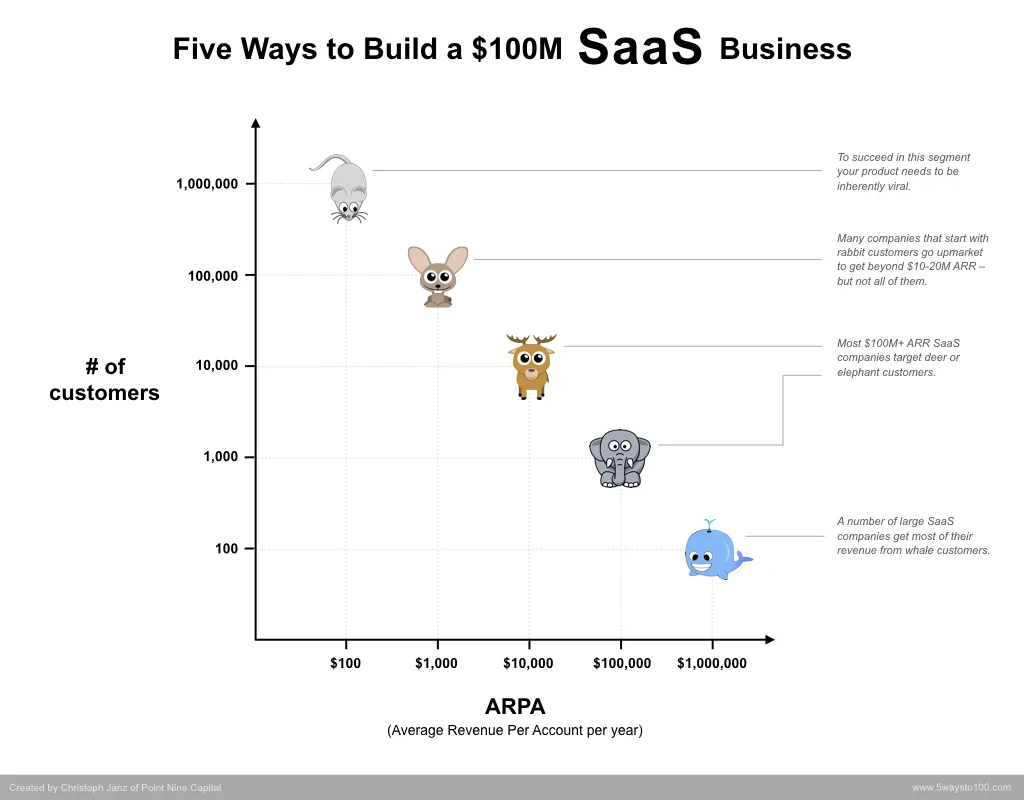
It goes without saying that the larger the annual price per customer, the fewer customers are needed to reach 10 billion yen, and conversely, the smaller the price per customer, the more customers are needed.
For example, a company like Slack starts at a price of 850 yen per month (about 10,000 yen a year). So to reach 10 billion yen in annual revenue, it has to sell to 1 million people. It currently has about 90 billion yen in revenue, so it is presumably actually selling to several million people. Incidentally, Slack, which was released in 2014, reached 10 billion yen in revenue in 2016 (it had about 1.2 billion yen in revenue in its first year).
On the other hand, a company like Palantir reportedly earns an average of 60 billion yen in revenue per customer from 125 customers (though it may be hard to call it SaaS). You could say this is an example of winning a 10-billion-yen deal from a single company and thereby reaching 10 billion yen in revenue.
In other words, there are many ways to reach 10 billion yen.
The size of the price per customer is the size of the problem
Here, the size of the price per customer can also be said to be the size of the problem for the customer.
The size of a problem is roughly determined by the "depth of the pain" and the "frequency" with which the problem occurs. For frequency, following Google's "toothbrush test," consider something that happens about three times a day to be high frequency. Expense reimbursement happens once a month, so it is relatively low frequency, and travel, at about once every six months, is low frequency.
Please read what follows with the understanding that as the price per customer grows, the problem to be solved grows too.
Price per customer of 10,000 yen a year
This price range is where you solve relatively small problems, or problems that can be handled with cheaper alternatives or free workarounds.
A SaaS or B2C service at 1,000 yen a month would bring in 12,000 yen a year. In the table this corresponds to the bottom row, and requires paying customers from a broad range of about 1 million companies (people). However, at this price you would likely charge per seat, as Slack does, rather than per company. Even then, that is 1 million users.
If you consider an industry-specific SaaS at this price, the first question is whether that industry has 1 million workers. Even within a single industry there are salespeople and engineers, and not everyone will use it, so be careful. That makes it hard to reach 1 million with an industry-specific product.
In other words, a price of 1,000 yen a month is a very difficult price range to make work unless you are a horizontal startup that spans industries or one that assumes overseas expansion.
Price per customer of 100,000 yen a year
Apart from daily necessities, a service that people pay 100,000 yen a year for is, for individuals, one that solves a pressing problem (learning, beauty, dating), or entertainment (manga, travel), or something social (gifts, for example).
For businesses, email delivery systems such as Mailchimp fall in this price range. 100,000 yen is for a problem with a fair amount of urgency, but you would need 100,000 customers who have such an urgent problem.
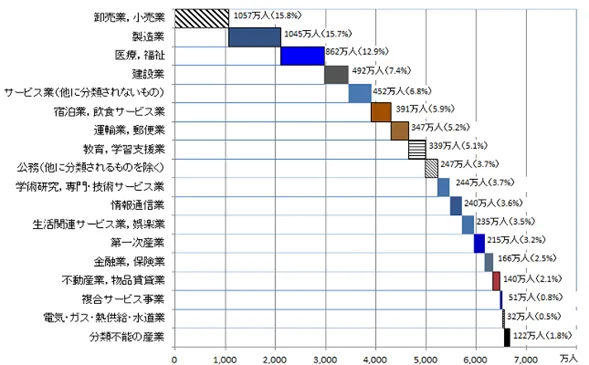
Even for business services, the question arises whether the industry has enough companies. For example, even manufacturing, which is thought to have many companies, has about 660,000 companies nationwide. "Manufacturing" is too broad a category, so if you look at it in finer divisions, no sector has 100,000 companies. I wrote that a price of 100,000 yen requires 100,000 companies, but it seems few sectors could satisfy that. Here too, you would need to think about overseas expansion and the like.
Price per customer of 1 million yen a year
A service at 100,000 yen a month (1.2 million yen a year) is, for B2C, something essential to life such as housing costs, and for B2B, a tool for improving operational efficiency or increasing profit by more than 100,000 yen a month. Even then, you need 10,000 companies.
I will skip prices from 10 million yen a year and up, but the way of thinking is the same. The problem gets bigger and the number of customers needed gets smaller.
----
Startups look at the market 5 to 10 years ahead, so there doesn't need to be this many users or companies right now. But at this price, whether you can achieve this number of customers and this price per customer 5 to 10 years from now is the first criterion for judging whether something is a startup idea.1
So far we have seen that how you aim for 10 billion yen in revenue differs greatly depending on the price you set. From here, let's consider how feasibility changes depending on where you set the price.
Thinking about the distribution needed to reach 10 billion yen
When thinking about feasibility, I focus on distribution. This is because distribution is very important for growing a business and cannot be avoided. And the distribution methods available change greatly depending on the price.
Distribution methods for a product priced at 10,000 yen per customer
The distribution methods available for a product in this price range are limited. Basically it is marketing and self-serve.
Distribution methods for a product priced at 100,000 yen per customer
Here too it is basically marketing and self-serve. This is a price range where adding people, even for inside sales, will basically put you in the red.
Distribution methods for a product priced at 1 million yen per customer
There is also the option of winning 10,000 companies at a price of 1 million yen a year. But in this price range, sales channels are limited, and it tends to be a hard fight.
An LTV/CAC of 3 or more is said to be healthy unit economics. Suppose customers stay on a 5-year contract on average. Even at 1 million yen per customer per year, LTV is 5 million yen, and the CAC you can spend is 1.67 million yen. If the sales cycle is very short you might be able to use direct sales, but with 10,000 companies they are often geographically dispersed, so the main means of acquiring and retaining customers would basically be inside sales or marketing.
However, not many companies can run a product at this price well with these distribution methods. So you will need responses such as making the product excellent and easy to sell, or making it sticky enough that once a customer adopts the service they won't switch for a while no matter what, thereby extending LTV.
Distribution methods for a product priced at 10 million yen per customer
At 10 million yen and above, you can finally use a variety of distribution methods. You can also combine direct sales and inside sales.
And once you reach this price range, closing contracts gets harder, but the churn rate goes down. It is a price range where, once you're in, customers tend to keep using the product for a long time.
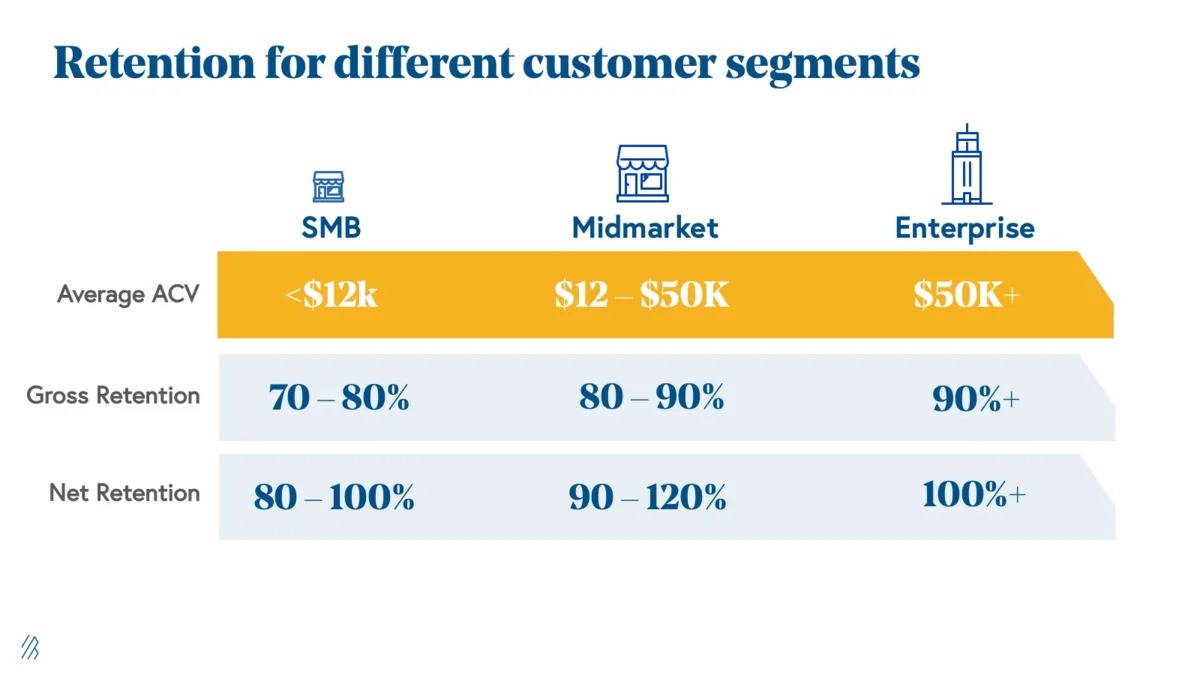
The price ranges beyond this are similar, so I will omit them, but please keep in mind that the distribution methods available differ depending on the price per customer.
Strategy based on price per customer
So far we have considered feasibility and so on. If you are aiming for a startup such as the SaaS example used here,
(1) Take on a big problem where you can aim for 10 million yen in annual revenue per company from the start
is, in fact, a well-balanced and realistic approach.
From listening to people, many seem inclined to think of a model that sells to many people at a low price. One factor may be that, as individuals, they usually only come into contact with B2C or horizontal services like that. But it is hard to reach 10 billion yen with that way of thinking, so raising the price range seems likely to improve feasibility.
A service at 10 million yen a year may sound expensive, but from the customer's side, in some industries that is about what it costs to hire two employees. Seen that way, it should be an amount that customers will pay if they are convinced.
That said, there are of course other ways. For example,
(2) Build a strategy that lets you enter with a low-priced product and later move to a higher price range
With this, you can lower the initial price and target SMBs and the like, then once you have a track record move on to enterprise, drawing a scenario of gradually aiming for higher prices. Salesforce seems to have taken this approach. You can also use one product as a starting point and connect it to high-value-added products around it. For example, taking the invoicing space first and then moving into the financial business around it.
However, if such an expansion scenario isn't reasonably convincing, it will be seen as an extension of the current pricing, and the judgment may be that reaching 10 billion yen in revenue looks unlikely. Incidentally, I gave combining with finance as an example above, but be careful: casually combining with finance tends to draw the reaction "Are you serious? Or is this a pipe dream?"
In addition,
(3) Aim for a business model that doesn't charge per person (= seat)
is another option. The maximum number of people working in an industry doesn't change that rapidly, but distribution volume or total usage other than seats might change. In fact, startups with usage-based pricing have been increasing recently.
Each of these has its own difficulties, though.
For (1), big problems usually remain unsolved precisely because they are hard to solve. Moreover, those who can pay this amount are enterprises, so the number of companies is limited and it takes a long time to get to the first contract.
In the case of (2), the strategy for moving to a higher price range becomes very important. For example, to enter cheaply and raise prices later, you need to be convincing about what strategy you will use to take those steps. Also, however good that strategy is, if the first product, the first step, doesn't succeed, it goes nowhere, so naturally the quality of the first product is also scrutinized. If you raise the price of a single product, it is hard to raise it to 100 times the initial price later within a single product line, so you may need to aim for around 1 million yen a year from the start.
In the case of (3), the take rate you charge, or how much you charge as usage-based pricing, determines how much total transaction volume is needed, so people look at whether it is a domain with that much transaction volume or usage.
Aim for 50 million yen in revenue in the first two years: setting goals on the assumption of T2D3
Next, let's look at the timeline to reach 10 billion yen in revenue.
SaaS startups are told to aim for the growth rate of T2D3. In T2D3, T stands for Triple and D for Double, meaning annual growth rates of 3x, 3x, 2x, 2x, 2x. Growing exactly this way gives a total of 72x growth in 5 years. This is the growth rate in a fairly successful case.
If you get onto the T2D3 growth trajectory from 50 million yen in revenue, then if all goes well, revenue is 3.6 billion yen five years later. After that, if you grow 1.4x for three years, it is about 10 billion yen. That takes 8 years in total.
If it takes about 10 years from founding to listing, the calculation goes: you reach 50 million yen in revenue in roughly the first 2 years, grow at T2D3 for 5 years, and then in the remaining 3 years, even if growth slows a little, you can just about reach 10 billion yen. SaaS tends to take time at the start, so it is not strange for the first stage to take about 2 years.
However, this changes depending on where T2D3 starts, so please consider it only as an example. Still, I don't think the numbers are far off, so it is worth treating whether you can generate 50 million yen in revenue from the product within 2 years of founding as one checkpoint.
Summary
So, when thinking about a SaaS startup idea, I think it will become clear whether you should pursue the opportunity or drop the startup idea you are currently considering if you check for yourself:
(a) Whether it could become 10 billion yen in annual revenue
(b) Which path (price) you choose as the way to get there
(c) Whether you can reach 50 million to 100 million yen in revenue within a few years and then grow at T2D3
There are a few caveats.
This calculation is based on thinking about SaaS in the US. In Japan, some ways of thinking and numbers may differ a little, and the calculation is considerably simplified. Even so, I think the basic way of thinking is the same. I wrote this because I thought that when you come up with an idea, doing a simple calculation like this might give you a hint for choosing a good market (ten years from now).
Also, for businesses with lower margins than SaaS, a somewhat different perspective may be needed, such as looking at profit rather than revenue (looking at PER rather than PSR). Labor-intensive businesses such as recruitment agencies will also differ somewhat from this calculation, so please note that this is only about IT businesses with good margins. Conversely, for hard tech companies, PSR can be even higher because of expectations for the technology.
The exceptional startups that appear once every few years don't fit into this kind of calculation. When some tectonic shift is under way, it is better to think differently. But for many of the startup domains people are working on now, especially industry-specific ones, I think this is a useful reference calculation.
Finally, most ideas do not meet this standard. But that doesn't mean an idea that doesn't meet it is a bad idea. There are many wonderfully meaningful businesses that are not startups, and even among SaaS, it seems better for most businesses to proceed without taking investment from VCs. Please take this discussion as being only about what it would take if you aim to be a startup that raises funding from VCs.
Useful resources
- Nine Business Models and the Metrics Investors Watch (Startup School 2019 #06) - FoundX Review - Know-how for Entrepreneurs and Startups
- Business Models That Grow Bigger Than Advertising: Having Multiple Revenue Streams as Product Strategy - FoundX Review - Know-how for Entrepreneurs and Startups
Footnotes
-
B2C can see users increase all at once, that is, more people may change their behavior, but in B2B the number of employees doesn't change that much. For the number of workers and employees by industry, statistical materials are a useful reference. ↩
-
From State of the Cloud 2019 · Bessemer Venture Partners (bvp.com) ↩