Start from 'Business Blueprint,' Not 'Customer Problems' – Moving Beyond the 'Problem-Solving Paradigm'
This article was machine-translated from Japanese by AI (Claude). It may contain errors. Read the original Japanese article.

The Changing Playbook for Startups
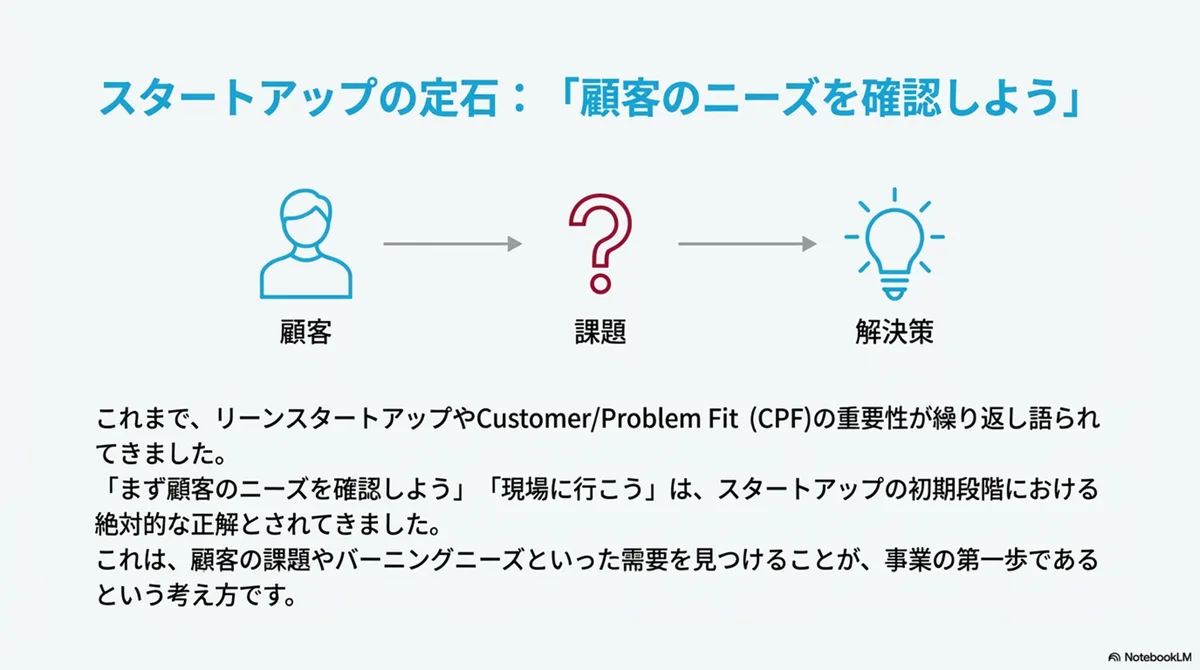
I have repeatedly talked about the Lean Startup methodology and the importance of Customer/Problem Fit (CPF), telling people to "confirm customer needs first" and "go to the field." Even now, I don't think that exploring customer problems itself has become unnecessary.
However, in the past few years I have stopped saying "start by validating the customer's problem" as often as I used to.
The reason is simple: I feel that in the early stages of recent startups (B2B ones in particular), the emphasis has shifted from the "discovery of customer problems" itself to the "business blueprint" — a set of hypotheses that includes the choice of market and the design of strategy and the path to winning.
The Era When "Solving Problems = Rapid Growth" Was Easy to Achieve
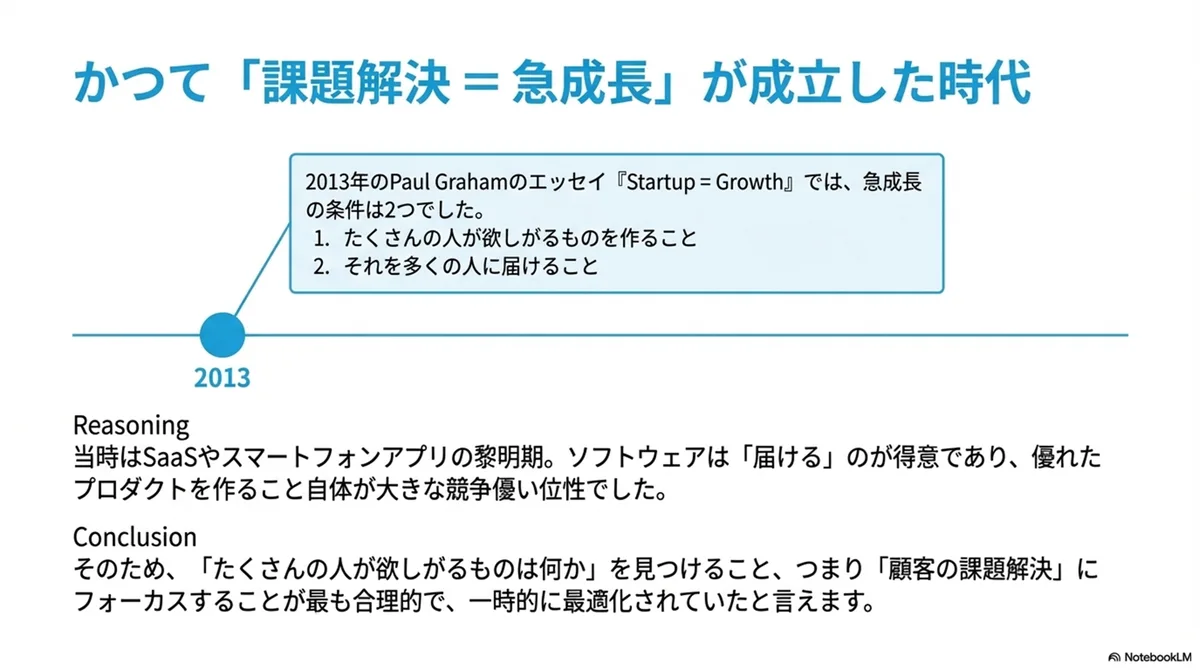
In his 2013 essay "Startup = Growth," Paul Graham named the following as conditions for rapid growth:
- Make something a lot of people want
- Deliver it to a lot of people
Looking back, around 2013, when SaaS and smartphone apps were emerging, "making something a lot of people want" was the most important thing. This was because software is good at "delivering," so the second condition was relatively easy to satisfy (though in practice there were difficulties such as sales and retention).
For that reason, it can be said that a simple entrepreneurial environment had come into being: as long as you met the condition of "making something a lot of people want," rapid growth was possible, and all you needed to do was focus on finding out what a lot of people want. In terms of supply and demand, supply is easy for software, so if you could capture large demand, you could grow big.
So finding demand — customer problems, burning needs — was what you should focus on at the very beginning, and it can be said that this was, for a time, the right optimization.
What Has Changed Now
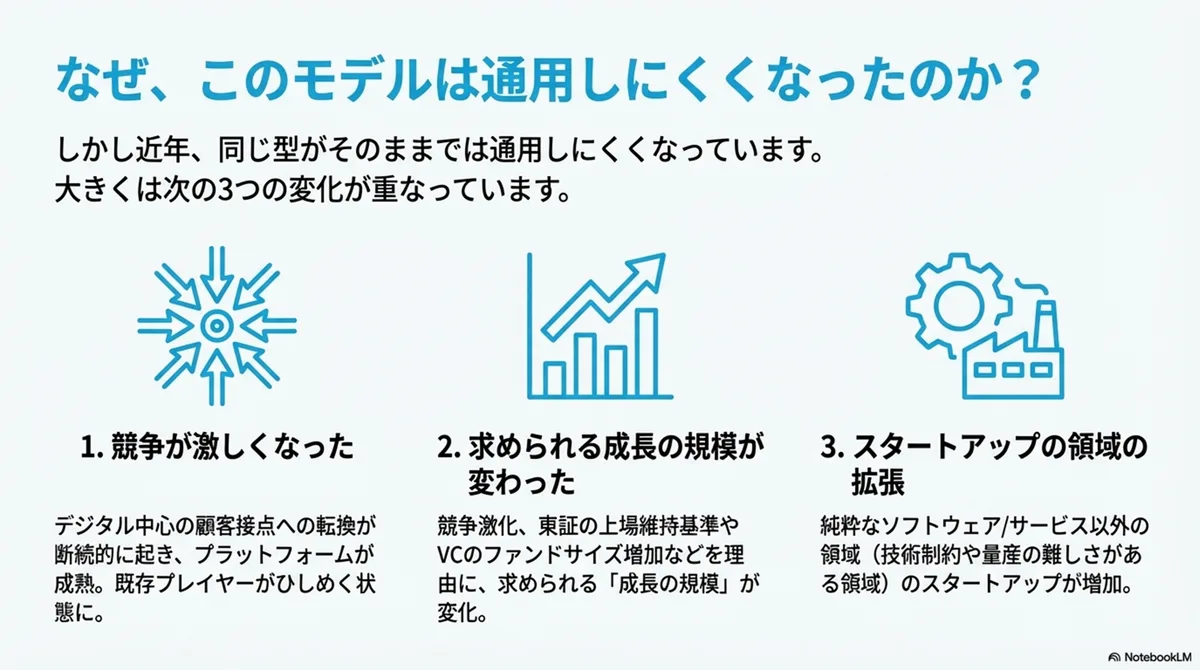
In recent years, however, the same playbook no longer works as it is. Broadly speaking, the following changes have overlapped.
(1) Competition has intensified
Over the past twenty years or so, there have been several intermittent shifts in customer touchpoints centered on digital (analog → web → smartphone), and each time there was a platform shift, so in a sense the competitive environment was reset over short spans. Now, however, every platform has incumbents, and domestic and foreign competitors crowd the field. (Emerging areas such as generative AI may be an exception.)
Also, over the past few years, starting a company has become easier and more familiar, and competition has intensified accordingly.
(2) The scale of growth demanded has changed
When competition intensifies, rapid growth becomes difficult. On the other hand, the "scale of growth" demanded of startups has also changed, owing to factors such as the Tokyo Stock Exchange's listing maintenance criteria and the growing size of VC funds.
(3) The expansion of startup domains (beyond pure software)
Startups in the realm of pure software and services have reached a lull, and startups in other domains are increasing. As a result, they have to face the difficulty of "delivering to many people" — for example, technical constraints, the difficulty of mass production, and constraints on the supply of capital.
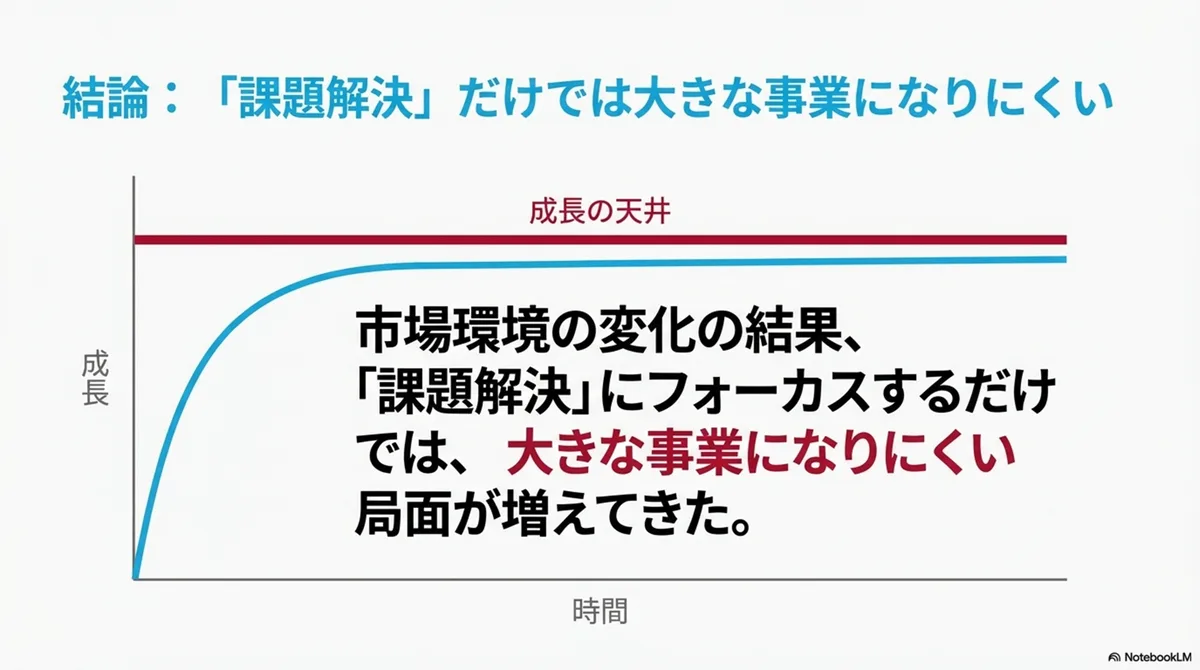
As a result, my current hypothesis is that there are more and more situations in which focusing only on "problem solving" is unlikely to produce a large business.
Starting from "Problem Solving" Tends to Keep You in Small Business
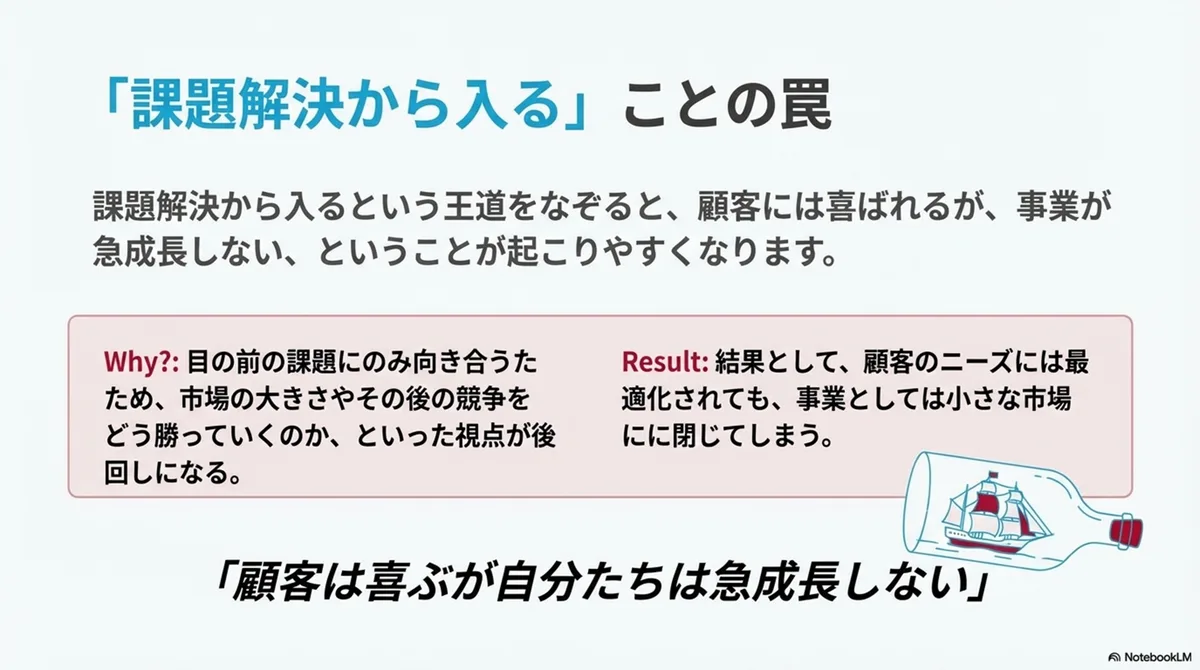
Starting from problem solving is regarded as the royal road, and following that pattern is considered correct. Moreover, by facing problems this way you find an anchor in the needs right at your feet, so you can proceed with peace of mind — and that is what makes this structure complicated. Yes, customers really do have problems, and there are customers who will be happy if you solve them.
But once you start from needs and problem solving, matters such as the size of the market and how to win the competition afterward get neglected. As a result, it has become easy for "customers to be happy but for us not to grow rapidly" to happen.
In particular, if you explore customer problems and needs without a business direction, you seem to converge easily on a small business. Customer needs have a strong gravity, and you end up optimizing toward them.
In short, even if you manage to find a customer's problem, if the business blueprint has not been well developed, the ceiling on growth can be set at an early stage. The point is that cases have increased in which starting from problem solving turns out to be optimal for a "small, good business" but is unlikely to lead to "rapid growth."
That Is Why You Spend Time First on the "Business Blueprint (Market × Strategy)"
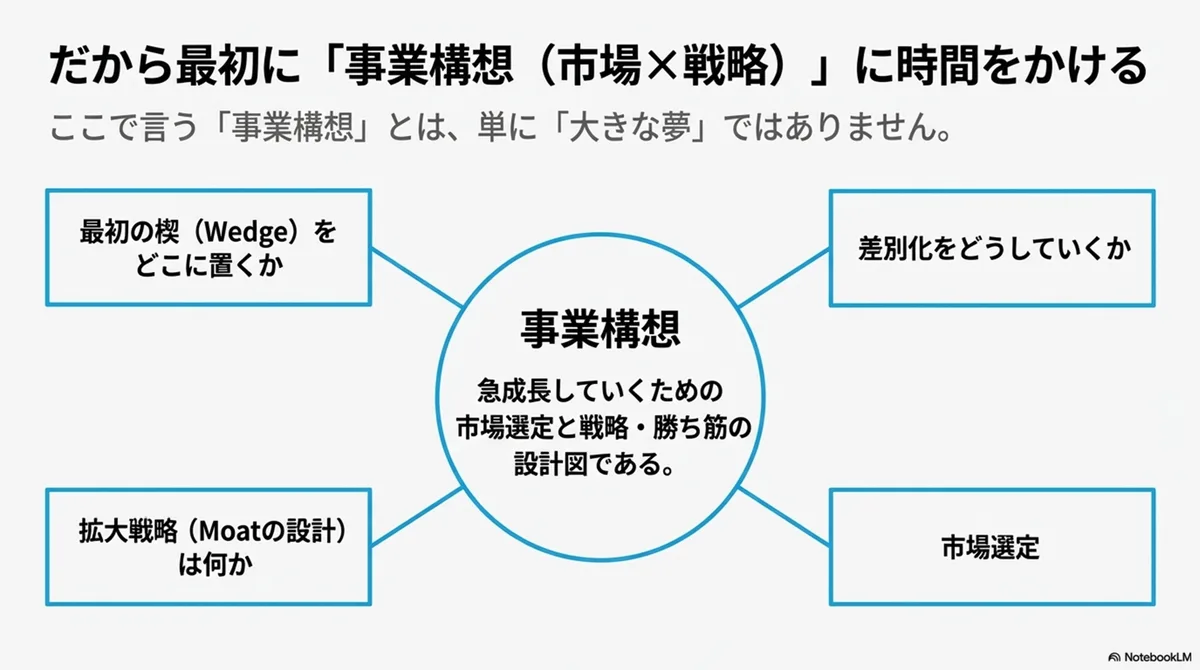
The business blueprint I mean here is not simply a "big dream." It is a blueprint for market selection and the design of strategy and the path to winning in order to grow rapidly.
For example, even if you go multi-product, there is a big difference in how the moat is designed depending on whether you had that vision from the start or build products by looking at the needs at your feet. Whether or not you have a design for where to place the first wedge, how to differentiate, and what the expansion strategy is makes a big difference in how a business is evaluated.
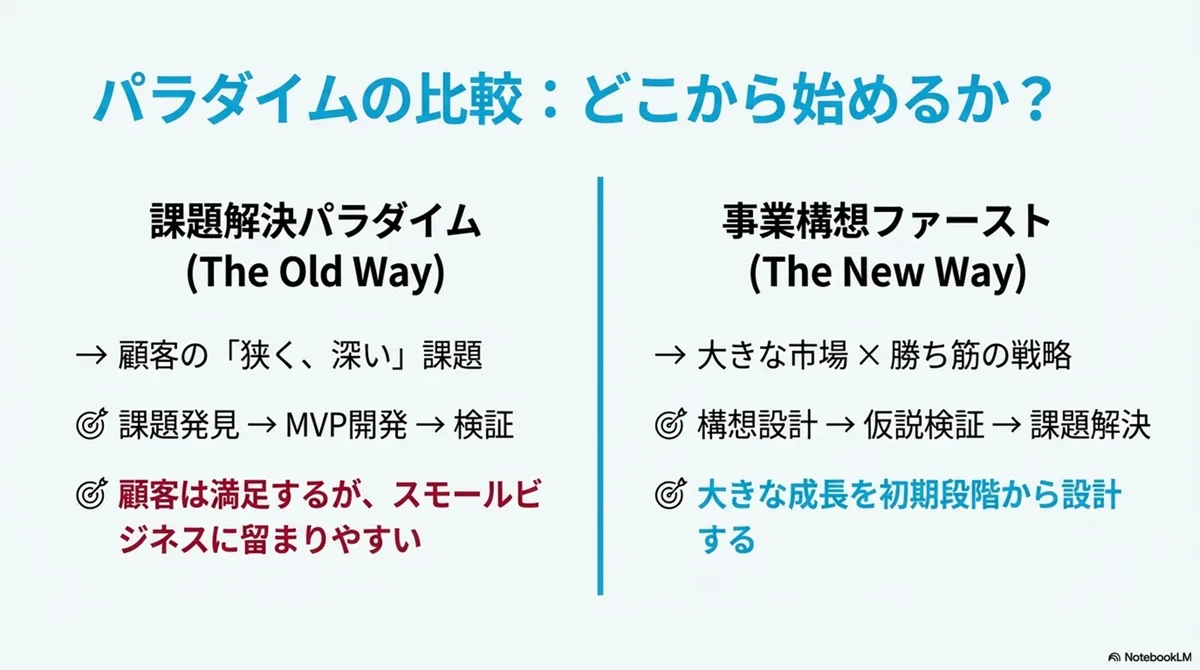
In fact, among the founders I support, there have been cases where, even though validation of the customer needs at hand had not progressed very far, they raised funding on the order of hundreds of millions of yen, on the strength of the size of their vision and the state of validation of their hypotheses (and the appeal of the founder). I think that young people who aren't even serial entrepreneurs can obtain that much funding because few people can draw up a big vision, and such visions are precisely what is rare and valuable.
There is also the argument that, whether the business blueprint is big or small, the difficulty of the path to success for a new business does not differ as much as the business scale does.
In that sense too, I feel that when starting a new business, how to draw a big vision is becoming more important.
However, What You Do After the Blueprint Ends Up Being "Solving the Problems at Your Feet"
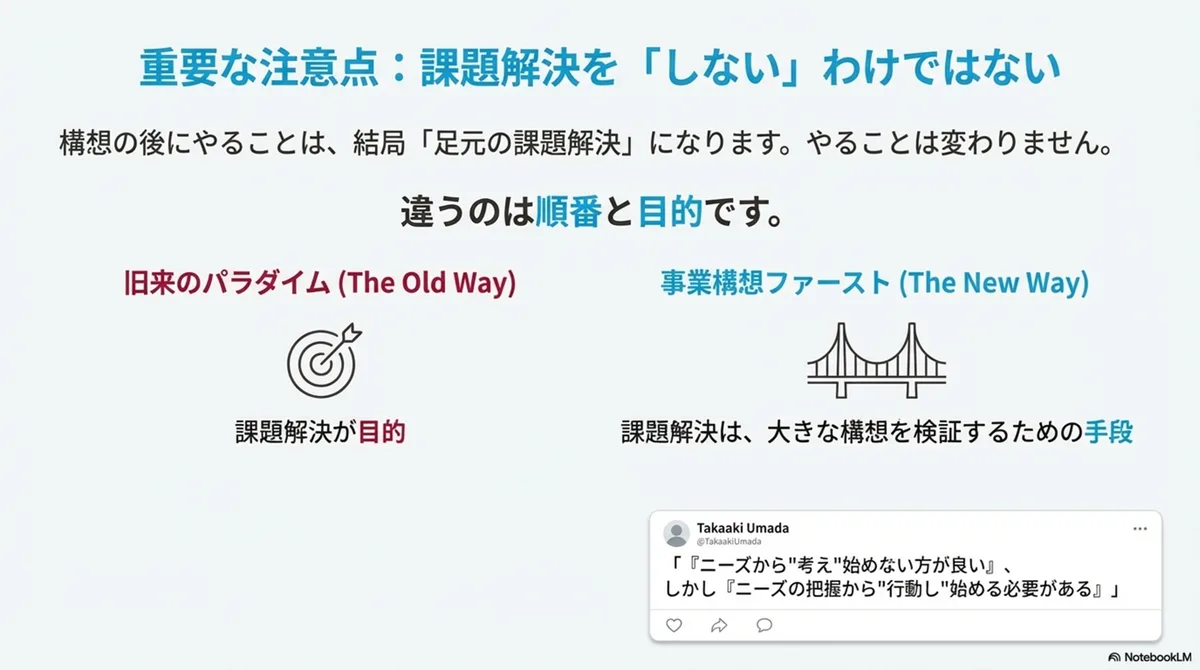
This is the point that is easy to misunderstand: what you do after creating the blueprint is continuous with conventional startup methodology. You go into the field, grasp the needs, and validate problem hypotheses. What you do doesn't change.
What differs is the order and the purpose.
It was with this intention that I recently tweeted that you should not "start thinking" from needs, but that you do need to "start acting" from grasping needs.
From the perspective of high-growth startups, I think this is a situation where I have to say "it's better not to start thinking from needs," but the action you take after thinking is also that "you need to start acting from grasping needs," and it's hard to convey this nuance…
— Takaaki Umada 🐴 (@tumada) December 19, 2025
Moving Beyond the "Problem-Solving Paradigm"
Extending the discussion so far by one more step, the recent moves of VCs also seem to be shifting toward "not starting only from problem solving." For example, they seem to be turning their eyes to cultural domains and taking a more industrial perspective.
This does not mean problem solving is unnecessary; I take it to mean that, for rapid growth, the customer's problem does not necessarily "come first."
On the other hand, the expectations of society and those around us are still strongly inclined toward "startup = problem solving." As a result,
- Startups want to aim for rapid growth
- But the proposals that come from those around them are often "small, good problems"
- As a result, a mismatch of expectations occurs
I think this kind of pattern is easily bound to occur.
That is exactly why I think we need to retell, in somewhat different words, the value and meaning that high-growth startups bring to society. Communicating that meaning carefully should reduce discrepancies among stakeholders and, as a result, lead to good outcomes for everyone.
Summary
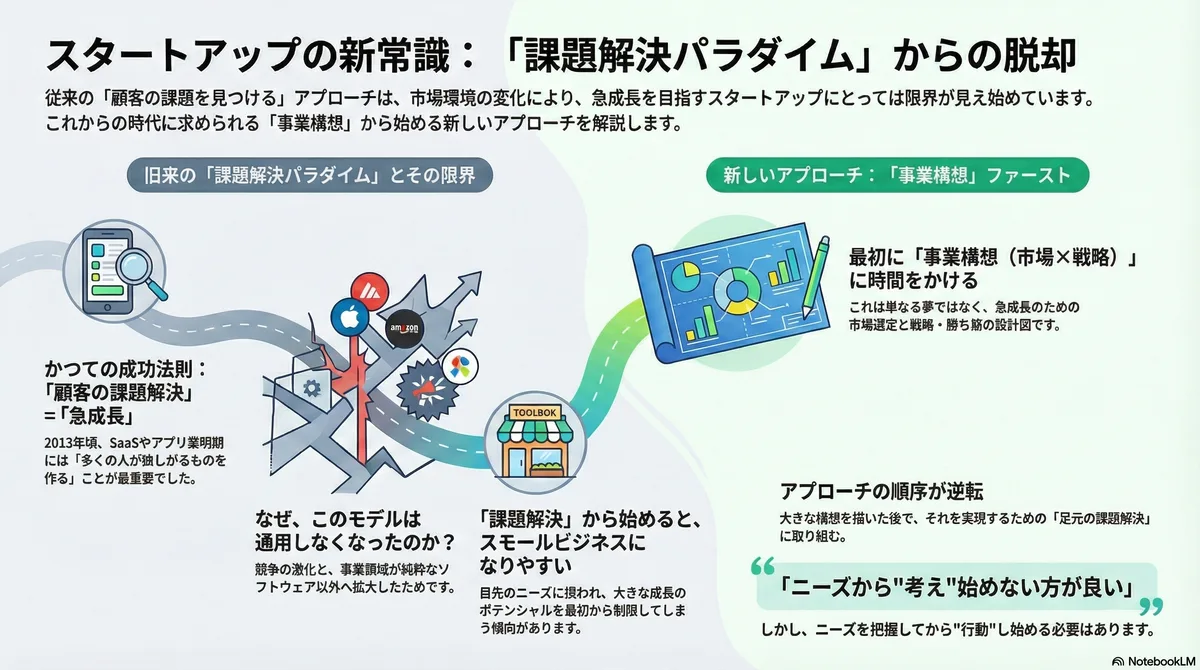
Summary by NotebookLM
Customer problems and problem solving are still important. But now that the ground beneath us has changed significantly, I think there are more cases where problem solving alone is not enough. Of course, in the realm of starting small businesses, Lean Startup and problem-solving methodologies can still be put to good use, but as a methodology for high-growth startups, I think they have become somewhat dated.
I believe I have been writing about the limits of Lean Startup in blog posts and elsewhere since around 2021, and I have also substantially updated the Startup Fit Journey. I feel that this still hasn't come across sufficiently, so I am putting it into an article once again.
Summary by NotebookLM
Related article