The Diversification of "Entrepreneurship" Is Under Way: The Startup Ecosystem in the Late 2020s
This article was machine-translated from Japanese by AI (Claude). It may contain errors. Read the original Japanese article.

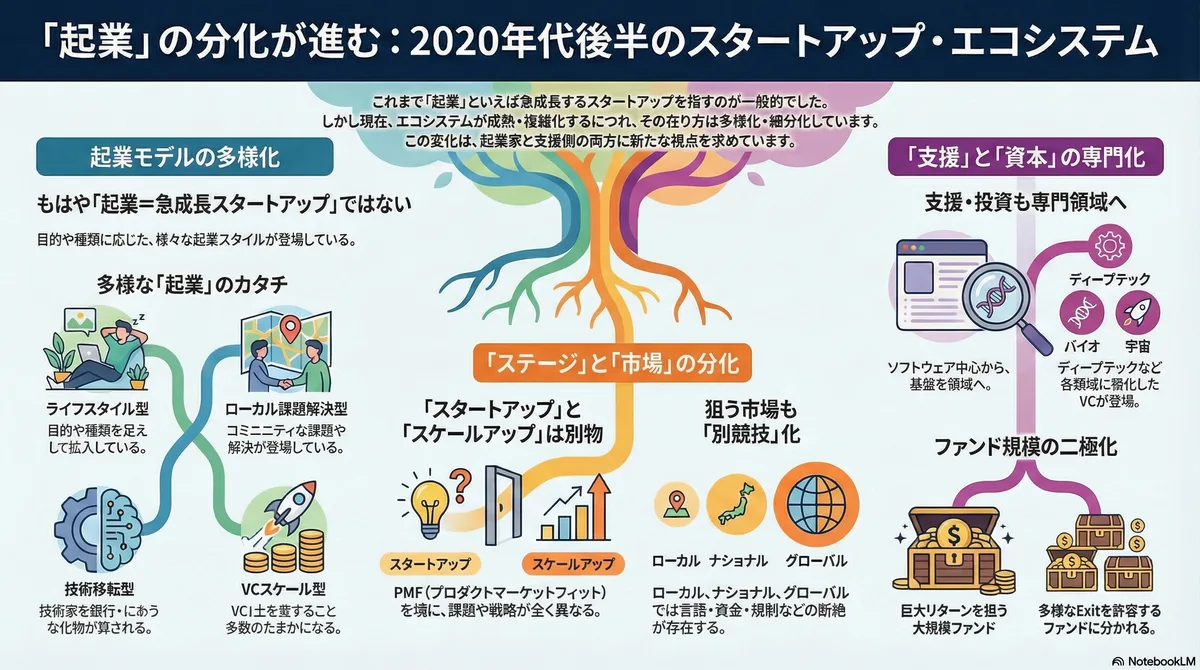
Summary in slides by NotebookLM
Over the past decade, I think there has been, in a sense, a rough perception and narrative in the air, something like "entrepreneurship means a fast-growing startup." The energy and capital supply that narrative generated had great value.
On the other hand, the situation has changed a little recently. My sense is that, on the ground in entrepreneurship and its support, several kinds of "diversification" are under way. I think this is not a mere trend but a phenomenon that is occurring as a result of the ecosystem maturing and becoming more complex.
In this article, I organize what kinds of diversification I feel are happening mainly along four axes.
- Growth model
- Stage
- Target market
- Capital
1. The "types of entrepreneurship" are diverging (diversification of growth models)
Recently, I feel that for students and young people who aim to start businesses, too, entrepreneurship that prioritizes early profitability and reliable revenue has come to be seen as a more natural option, rather than only "entrepreneurship = a fast-growing startup."
I don't think this is a bad thing; rather, I take it to mean that our resolution of the act of "entrepreneurship" is improving. This is because entrepreneurship can have, for example, the following "differences in purpose and type."
- Includes the design of one's life and way of working (lifestyle type)
- Solves problems of a region or a specific community (local problem-solving type)
- Steadily advances the commercialization of technology (technology transfer type)
- Solves social problems through a nonprofit business (nonprofit type)
- Competes in the capital markets on the premise of a high growth rate (VC-scale type)
In practice, what you do differs by type, and so does what you emphasize: whether it is "current profit and cash flow" or "growth potential, even at the cost of running at a loss." The time horizon assumed also differs, so the appropriate management advice differs depending on the type of entrepreneurship.
Therefore, I think it is good for both entrepreneurs and those who support them that these types are being discussed in more finely divided terms.
However, this diversification also has a side to it where choosing becomes harder for beginners in entrepreneurship. Before deciding what to choose, they tend to lack the material to judge "which of these is closest to what I want to do." In that sense, I think that going forward, people who play a "pilot" role will become more important in nurturing entrepreneurs as well.
2. "Startups" and "scaleups" become different things (diversification of stages)
Startups increasingly remain in the private market for a long time. As that happens, there are more companies of an age that is hard to call "startups."
More fundamentally, the nature of the challenges is different.
- PMF before (exploration): identifying customer problems, value proposition, product validation, unit price and retention rate
- PMF after (expansion): hiring and organization, repeatability of GTM methods, supply capacity, quality, capital policy
By separating this difference in terms and calling the latter "scaleup," the design of support and investment becomes clearer.
However, for scaleups too, the moves to make change depending on "which market (national or global)," and not every company is suited to global scale. We should note that it is not a simple matter of more scaleup support producing large companies. (Rather, I think that the possibility and the form of scaling up are already determined to some extent at the time of the initial founding.)
3. The gaps between local, national, and global are widening (diversification of target markets)
The markets that entrepreneurship targets are also becoming "different sports" at the local, national, and global levels.
In Japan, local to national still looks continuous, whereas from national to global there are multiple gaps, such as language, funding, hiring, sales, regulation, and governance. Within each venture, which markets to target, or in what order to attack markets, will increasingly be discussed in more differentiated terms.
Various parties in Japan are also working hard to produce global startups, but what matters there is that if you aim at the global market from the beginning, you need an answer to "why start in Japan?" (Why Japan). In drug discovery in particular, there may be cases where it is more rational to incorporate overseas from the start and proceed with fundraising and development there, and I have actually heard of several examples.
Also, even if a company starts in Japan, the emergence of incentives for headquarters functions to move overseas during the growth phase has been repeatedly pointed out as a problem in Europe as well (the Draghi Report points out that, of 147 EU unicorns born between 2008 and 2021, 40 relocated their headquarters).
I think the issue is not only "stopping relocation" but designing which parts of the value chain remain in the home country (R&D, manufacturing, IP, HQ functions, and so on).
4. Deep tech is being subdivided (diversification of target markets)
Looking at investment trends in Japan and abroad, attention is starting to turn to areas beyond software, and heavier deals in defense, quantum computing, energy, and the like are increasing. Deep tech is also drawing attention within Japan.
Perhaps because of that tailwind, I think the breadth of "deep tech," and the recognition that it is better to consider each part separately, are gradually spreading. The recognition that life sciences and healthcare differ from other deep tech fields (weird) seems to be spreading, and beyond that, materials, energy, robotics, and so on also differ greatly from one another: materials are rather similar to drug discovery, energy is heavily regulated, and so on. Each has a different character.
It is natural that business methods differ because the industries differ, but the situation seems to be improving somewhat from one where everything is perceived under the rough category of "deep tech." Going forward, I think it is healthier to adjust expectations and support design for each type rather than place hopes on the convenient term "deep tech" as it is.
Also, regarding the idea that "commercializing cutting-edge technology makes you a high-growth startup," it is gradually becoming clear that this is not so, so I hope that we will also move toward thinking separately about "commercialization of technology premised on a small business" and "commercialization of technology aiming at rapid growth as a startup."
5. Support and VCs become specialized (diversification of markets)
If entrepreneurship and fields (markets) diversify, so do the supporting and investing sides.
VCs are the ones most closely tied to high-growth startups, and among VCs, a trend of forming teams by field has begun, represented by a16z and others. Firms that used to focus on software are gradually starting to move into other fields and are beginning to need specialists in each of them. Considering that it is quite difficult for a software investor to evaluate a drug discovery deal, this is only natural.
In Japan, however, the absolute number of investment deals is not as large as in the US, so specialization is not necessarily possible, and the firms that can do it will be limited.
If such specialization does progress in Japan, I think a good arrangement would be for supporters other than VCs to specialize in fields such as software, energy, and materials and team up with VCs, but this does not seem to be happening yet (most support measures seem to implicitly assume software).
6. Fund size and investment scale diverge (diversification of capital)
When market scope and growth models diversify, whether to make a VC fund "smaller or larger" also becomes a strategic fork. In general, the larger the fund, the larger the size of the return required, so the scale of exit it demands from its portfolio companies changes.
For example, with a fund of 5 billion yen, if one company has an exit of 100 billion yen and the fund holds about 15% at that time, it can return a sufficient amount. But with 50 billion yen, an exit of 1 trillion yen is needed. (Of course, in practice the design varies depending on stage, follow-on investments, co-investment, secondaries, and so on.)
Furthermore, the structure in which a small number of huge deals determine returns (the so-called Power Law) becomes more pronounced as fund size grows.
When Facebook went public in 2012 at about 10 trillion yen, it was said that "Facebook returned more than all the other startups of five years combined." This is exactly what suggests the Power Law of VC investment.
It also means that, the larger the fund, the more "whether you were able to invest in Facebook" decides win or loss, and nowadays, whether you were able to invest in OpenAI or Anthropic decides the contest.
Furthermore, it is becoming a consensus that, rather than diversifying investments in the hope that home runs will turn up probabilistically, you cannot generate commensurate returns unless you hold a commensurate share of the equity in the winners. In that sense too, I think that going forward the amounts invested in startups will, if not polarize, at least develop large differences between big and small.
Now that fund sizes have grown even in the US, the size of the returns required is more than ten times what it was ten years ago. OpenAI trying to raise funds at a market capitalization of about 130 trillion yen may also be pulled along by the returns demanded by the supply side of capital. (That said, OpenAI today is past the phase in which VCs lead.)
If overseas investors are looking for portfolio companies with that kind of outlook, then drawing in overseas investors means that unless we produce startups that contribute to a Power Law that remakes the world, it will be hard to pull in huge overseas pools of investment capital. (Specialized VCs and the like may be a different matter.)
However, this does not mean that "only giant startups are the right answer." It is only that, as a matter of the logic of capital, such dynamics are strengthening.
So, what is a startup?
I think a maturing ecosystem means progressing diversification. In that case, what is needed next is for society, policy, and industry to review what they expect from each of the diversified kinds of "entrepreneurship."
In the high-growth field in particular, which is where I mainly work, it is time to ask anew, "What is expected of Japan's high-growth startups?" Is it employment, exports, technological supremacy, or the metabolism of industry? If expectations differ, the design of support and the KPIs naturally change as well.
The Japanese government's Five-Year Startup Plan has also reached its midpoint, and it is coming time to reflect on it and consider the next measures. I think it is good to have a variety of support measures for entrepreneurship, but when the purposes and the "entrepreneurship" targeted differ, the targets and methods of support also change, so it seems necessary to think again about what purpose to support for and how.
For example, going forward, I think some ingenuity will be needed, such as designing separate tracks by purpose rather than talking about "entrepreneurship support" as a single menu. For example, the following:
- A track to increase implementations that solve local problems
- A track to increase national-scale scaleups
- A track to go after industries through global x deep tech
Finally: Will we create startups from an industry perspective, or take a uniquely Japanese path?
Personally, I feel that an "industry perspective" becomes important again here.
Big winners such as OpenAI, with a market capitalization of over 100 trillion yen, or SpaceX, with over 200 trillion yen, do not stop at a single company; they give rise to groups of companies around them. These encourage M&A and reinvestment and give depth to the ecosystem.
It is not only that winners win; the challenges around them pile up, and dynamism arises through acquisitions, mergers, and spinouts. I feel that only with this kind of industry-scale dynamism is the value of small ventures amplified, and companies that can win globally gain even more value.
If Japan's startup ecosystem aims for the US model and the global market, it will have to be designed to include that industrial dynamism (M&A, capital circulation, talent mobility, reinvestment). Conversely, if it aims for a uniquely Japanese startup ecosystem, it will need to articulate and choose in what form that works for the Japanese economy.
I think the diversification of entrepreneurship in the late 2020s is also a sign that forces us to make such a choice.
Summary by NotebookLM