Startups That Help Solve the "Supply Shortage" Problem: Making Social Maintenance More Efficient and Creating High-Value-Added Industries
This article was machine-translated from Japanese by AI (Claude). It may contain errors. Read the original Japanese article.
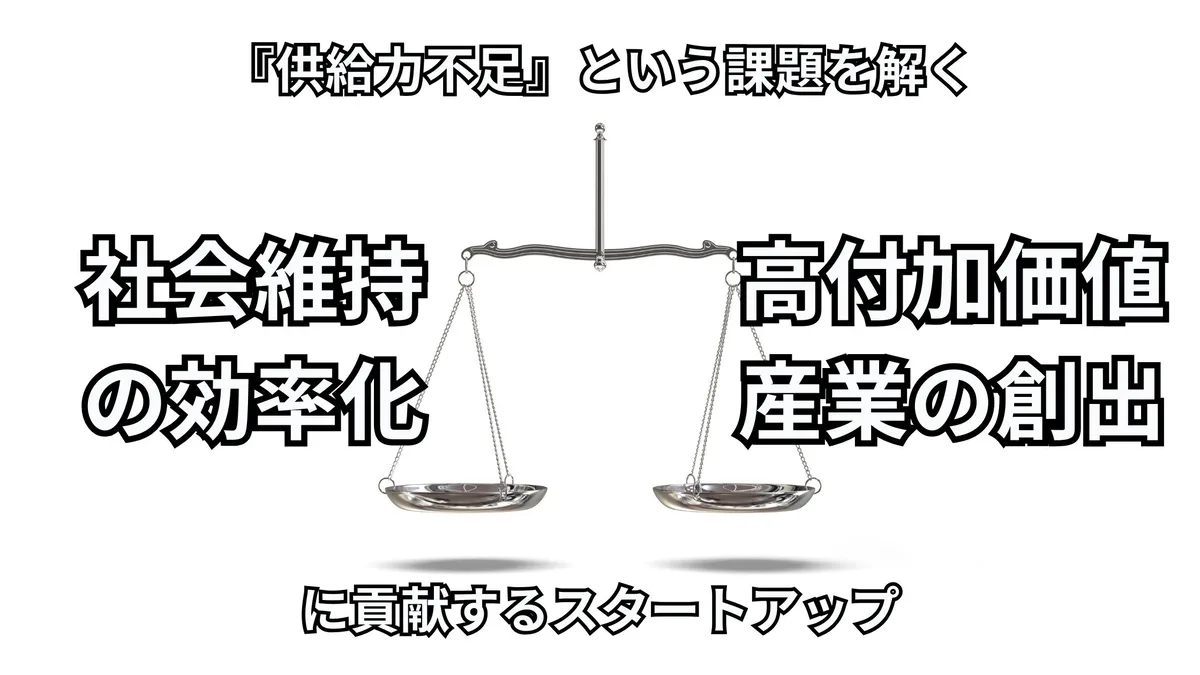
Summary by NotebookLM
Social problems caused by a shortage of supply capacity are beginning to emerge.
I believe that solving these social problems and creating new added value is what we expect of new ventures, startups first among them. However, I get the sense that the urgency of this problem is not widely shared, so in this article I will put together a few rough numbers.
The topic I take up this time is an easy-to-grasp one: the "labor supply shortage." It is a subject that has already been covered in places such as Recruit Works Institute's report on 2040, but I want to discuss it again.
The Current Labor Supply Shortage
First, at present, although Japan's population is declining, the labor force (employed plus unemployed) is increasing. This is thought to be due to an increase in women and seniors working part-time, and as a result the labor supply shortage has been eased somewhat in the short term.
Even so, labor shortages are being loudly lamented. The reasons for this are several problems, as follows:
- Limited increase in labor input per person (working hours) - Even if the number of people working grows, if they work short hours, total labor input does not increase much
- Changes in the quality of demand (job openings) - Openings for clerical jobs and the like are decreasing, while jobs requiring skills are increasing (for example, the current ratio for general clerical work is 0.3)
- Changes in the quantity of demand (job openings) - Work that used to be covered by long hours per person is now subject to time limits under work-style reform, so even for the same amount of work, the number of people hired increases
- Regional mismatch - Some occupations have many openings in rural areas, but there are no young people in those areas
- Occupational mismatch - Certain occupations, such as nursing care, construction, and transportation, are extremely short of workers
- Mismatch in conditions - Wages, flexibility of working hours, and so on do not match
The Employment Policy Study Group Report (2024) divides these into three categories, "excess demand," "friction," and "structure," and states that each requires a different solution.
In other words, the labor supply shortage occurring now is by no means a problem that can be solved simply by increasing the absolute quantity of labor supply.
Having said that as a preface, from here on, for the sake of clarity, I will discuss things with a focus on the quantity of labor supply.
Population Changes from 2025 to 2045
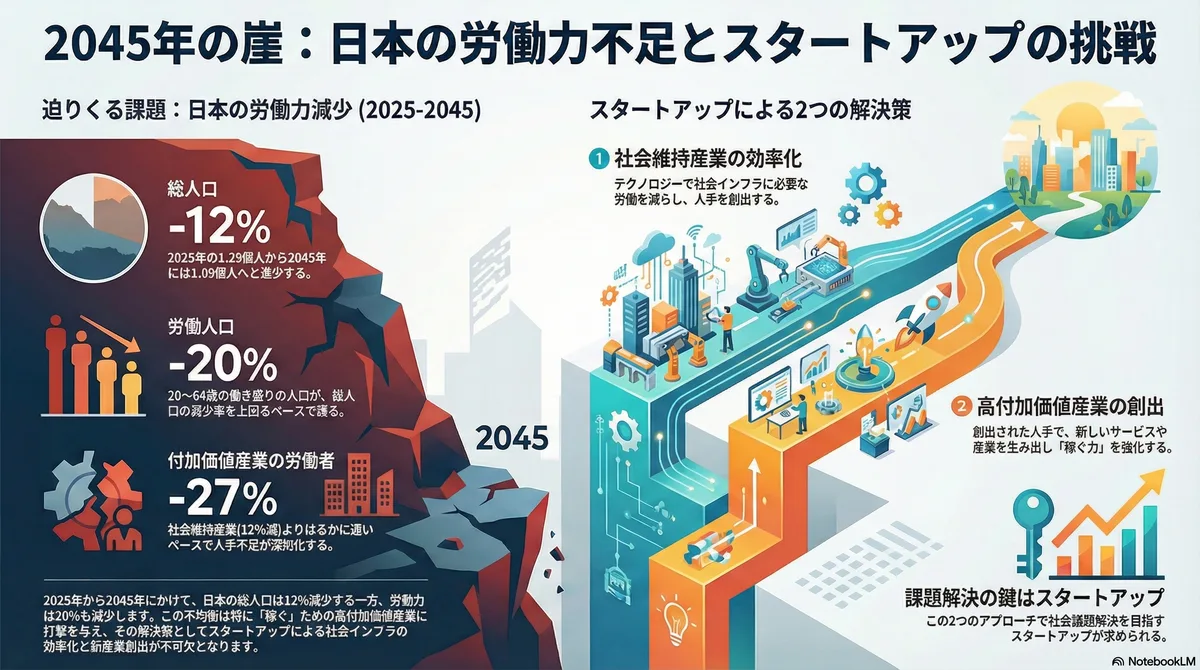
First, according to the Population Projections for Japan (2020 Census, results released in 2023), Japan's total population is projected to fall by about 12% over the 20 years from 2025 to 2045.
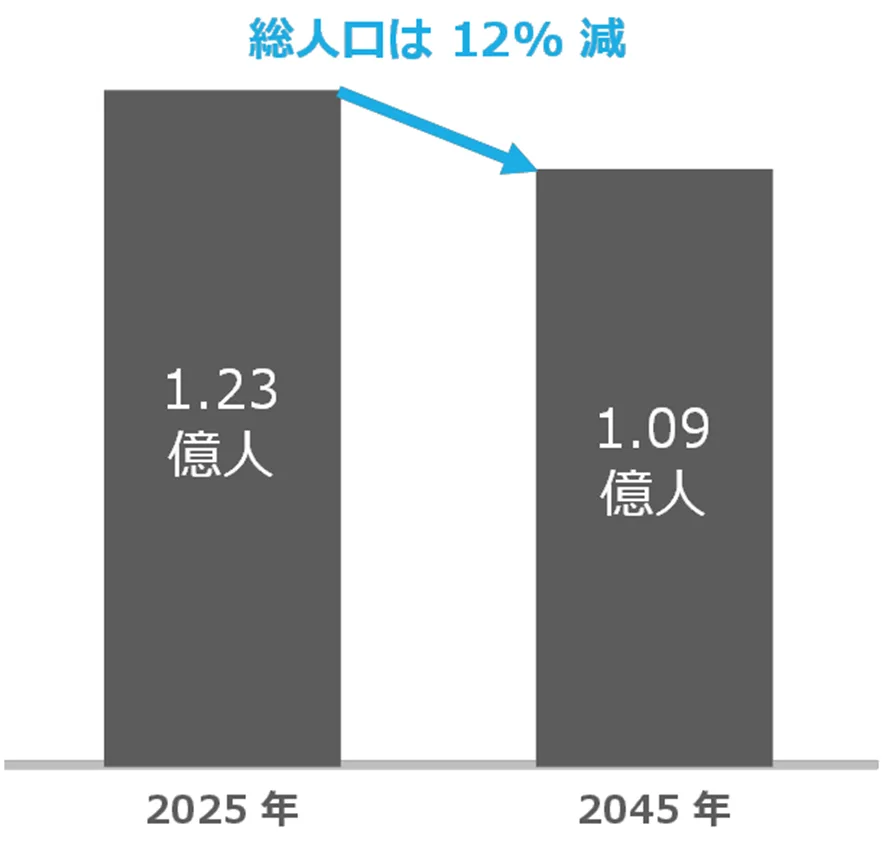
From the data in the Population Projections for Japan (2020 Census, results released in 2023)
Let us look at the breakdown. The population of people aged 20 to 64, the prime working years, falls by about 20% (even if we extend the retirement age and assume people work until 69, the working population appears to fall by 17%. I could use the standard category of ages 15 to 64, but since the rate of advancement to higher education is already around 80%, I have used 20).
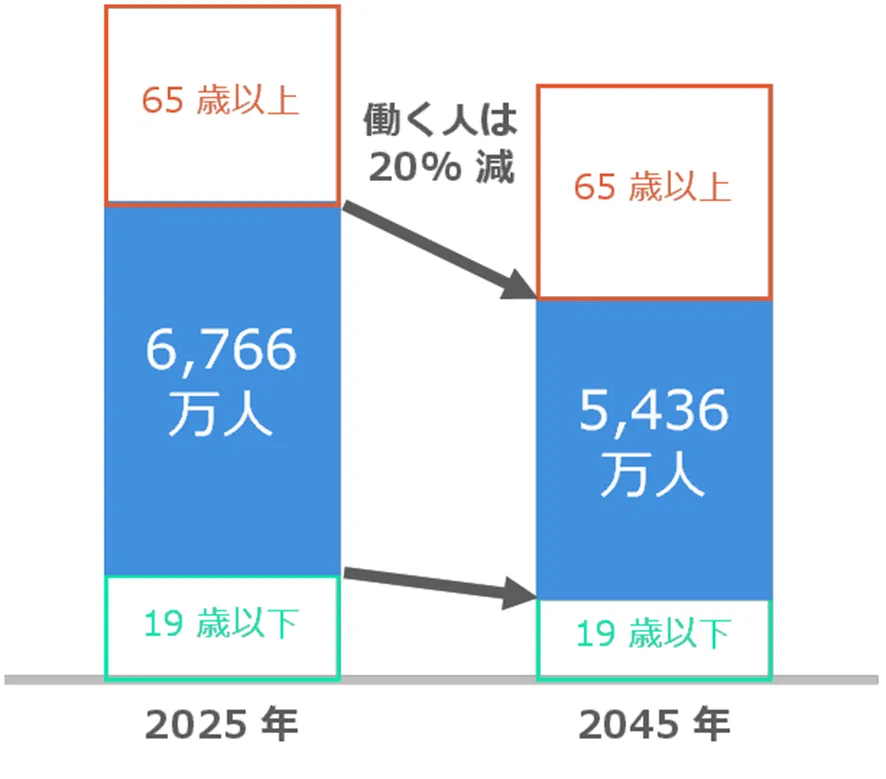
From the data in the Population Projections for Japan (2020 Census, results released in 2023)
The point here is that if we roughly treat population as domestic demand, there is an imbalance: overall demand itself falls by only 12%, but the number of workers who supply to meet that demand falls by 20%. In such circumstances, if the current mismatch between labor demand and supply occurs, things become even harder.
Looking further at industries and labor reveals even harsher numbers.
Industries for Maintaining Society and Industries for Added Value
First, let us divide industries broadly into "industries for maintaining domestic society" (social maintenance industries) and "industries that create added value, such as by earning foreign currency" (value-added industries). In doing so, let us roughly group the following industries as "social maintenance industries"1.
- Construction
- Electricity, gas, heat supply and water
- Transport and postal activities
- Wholesale and retail trade
- Medical, health care and welfare
- Public service
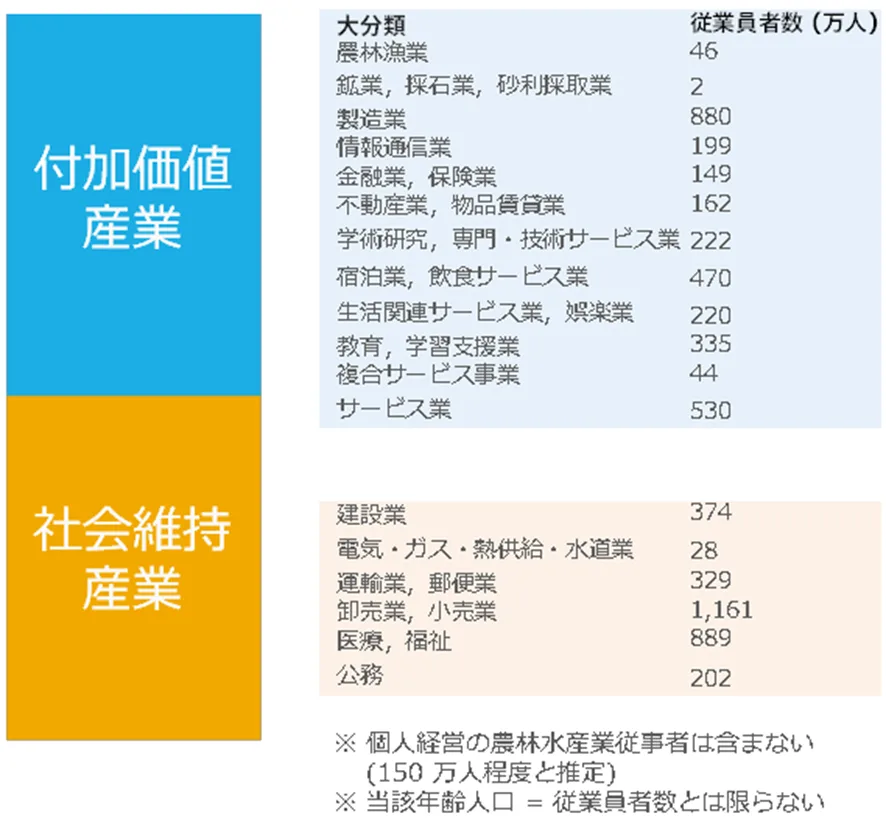
From the data at https://www.stat.go.jp/data/e-census/2021/kekka/index.html
According to the 2021 (Reiwa 3) Economic Census, which includes the number of people in "public service," 32.59 million people are employed in value-added industries and 29.85 million in social maintenance industries.
Assuming that this ratio of employees by industry continues in 2025, let us consider it together with the population figures.
I assume that the labor needed in social maintenance industries decreases in reasonable proportion to demand. That is, since the population falls by 12%, I assume that the current society can be maintained even if the number of workers also falls by 12%. (In reality, because of population aging, demand for nursing care and the like may well increase instead.)
On the other hand, the population of working people aged 20 to 65 falls by 20%. Calculating the number of workers in value-added industries on the basis that
Workers available for value-added industries = total workers − workers in social maintenance industries
the conclusions drawn are as follows:
- The total number of workers aged 20 to 65 falls by 20%
- But social maintenance industries shrink by only 12%
- In other words, the workers who can be allocated to value-added industries fall by 27%
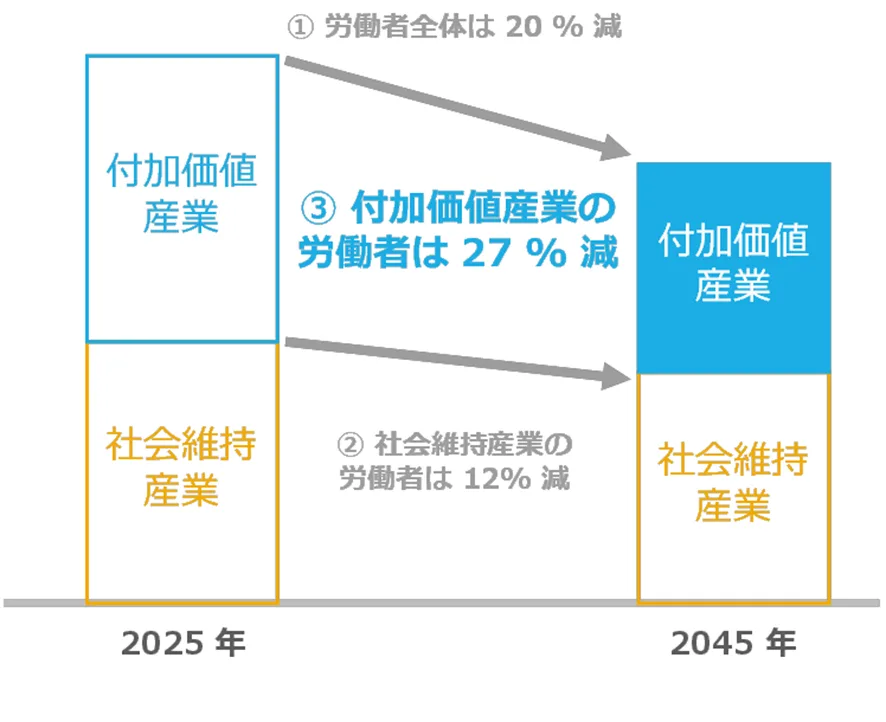
In other words, the number of people who can be allocated to the industries that earn our living falls considerably.
To add a figure from the perspective of total working hours rather than headcount, according to materials from the Ministry of Economy, Trade and Industry, total working hours were 102.2 billion hours in 2021 and are estimated to become 82.8 billion hours in the 2040 base case. That means the time that can be input becomes roughly 4/5.
(Incidentally, according to the Ministry's New Axis materials, total working hours in 1994 were 117.8 billion hours, so they have already fallen considerably from then to now.)
From here, the challenge we face can be said to be a dilemma:
- Do we allocate people to earning?
- Or do we allocate people to maintaining society?
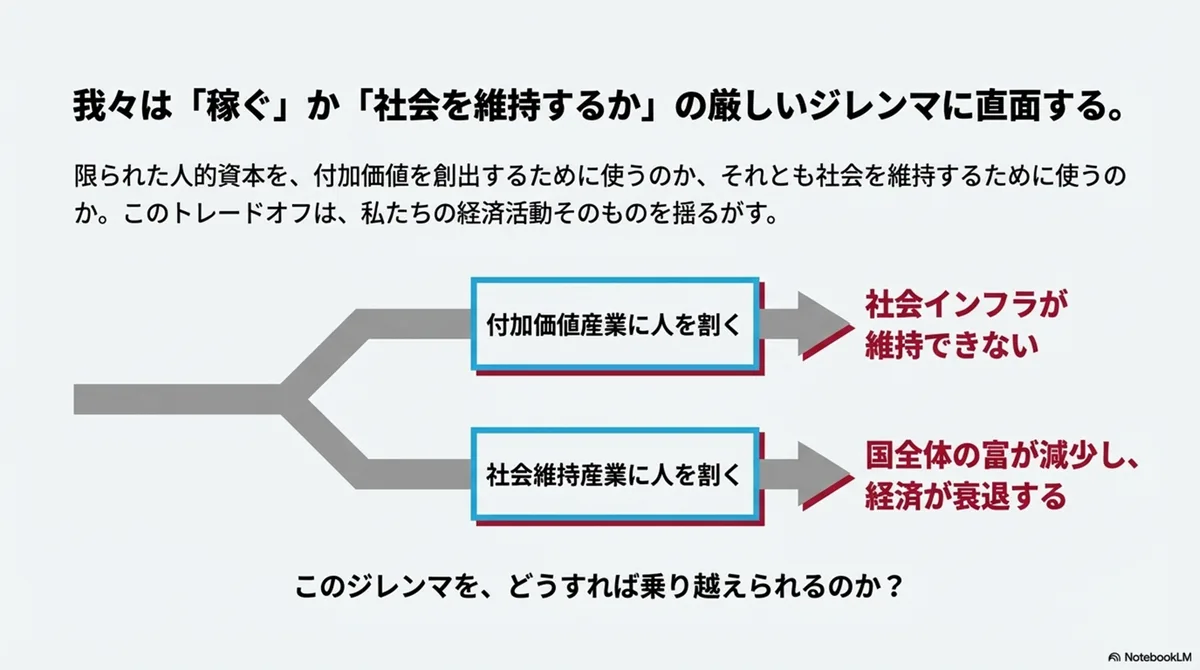
Demand for social maintenance is resilient, but if supply gets pulled toward that demand, supply will no longer reach the places that bring added value and keep the economy turning. To ease this dilemma and maintain our current economic situation, one or both of the following responses is necessary:
- Increase the labor that can generate the same added value as today with 27% or fewer of today's workers
- Reduce the labor needed for maintaining society by making social maintenance industries more efficient
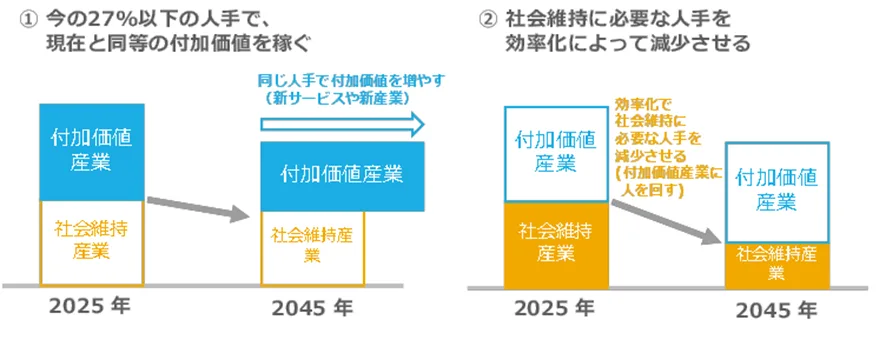
Achieving this is quite difficult, but unless it is achieved through some kind of technology or the like, we will not be able to maintain our present way of life. (However, the situation can also be changed through immigration policy, policies that increase the care burden on families, and so on, so it is not something that must be solved by technology alone.)
In terms of startups, this means that two kinds are needed:
- Startups for making social maintenance more efficient
- Startups for creating high-value-added industries
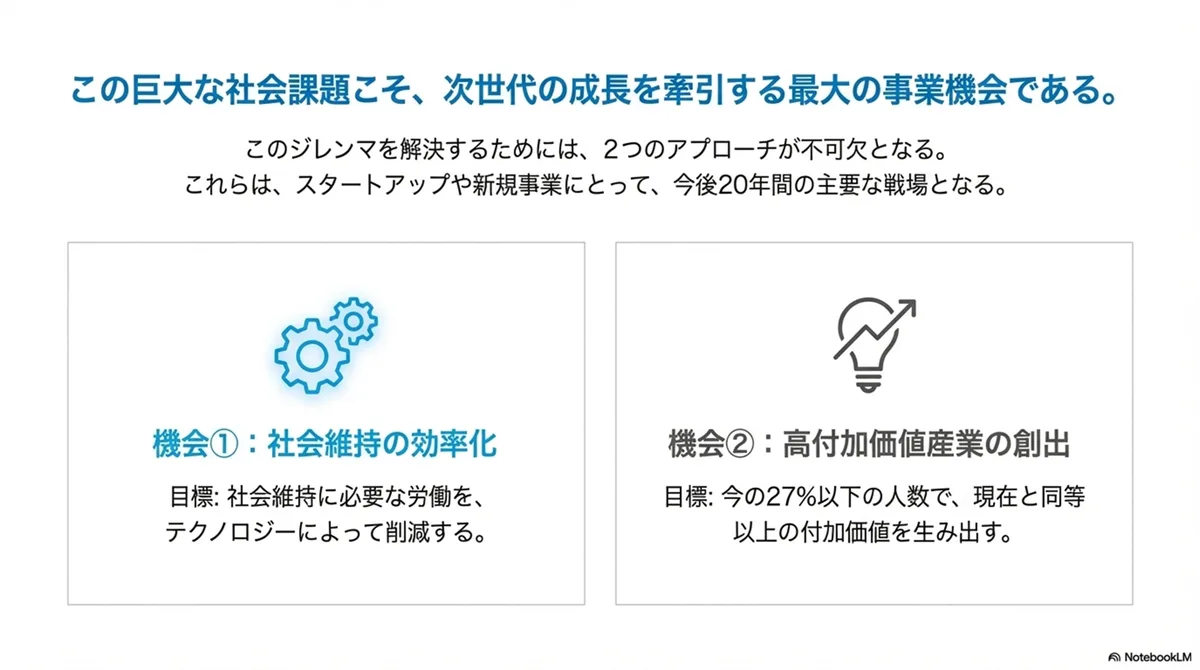
Of course, reality varies with productivity, wages, and so on, so this is only a simplified model. Still, I think it can be said that we have to think about these matters.
Changes Are Steeper in the Regions
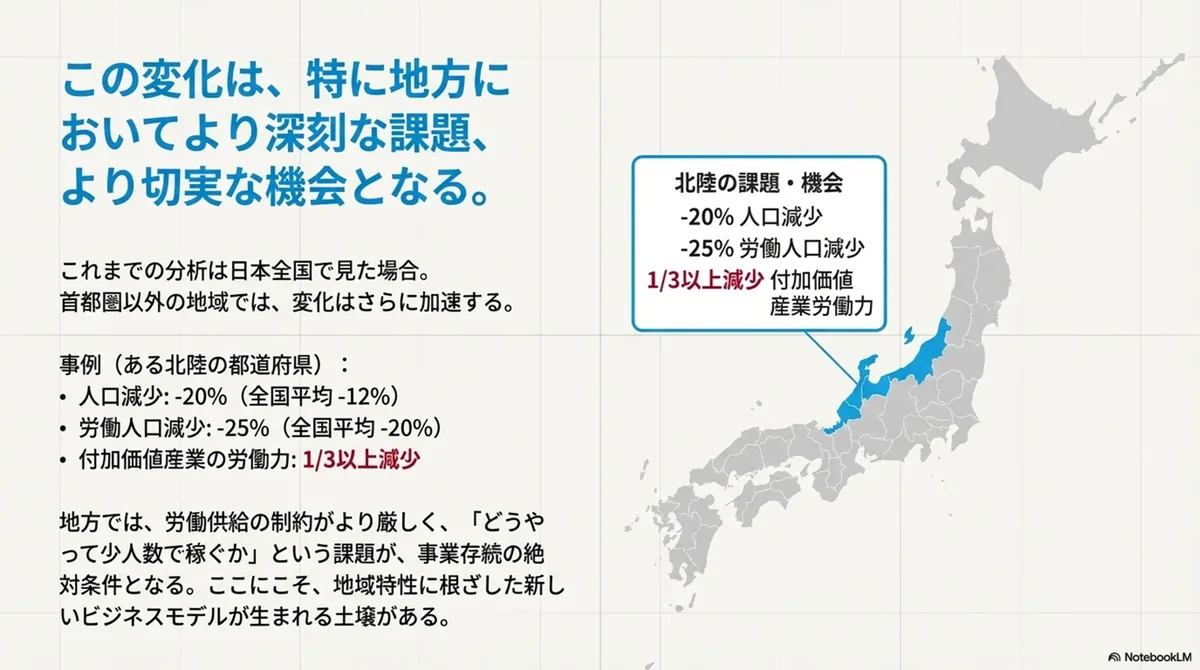
The numbers so far are for Japan as a whole. Looking at regions outside the Tokyo metropolitan area, even larger changes will occur.
Looking at one prefecture in the Hokuriku region, the population falls not by 12% but by 20%, and the number of people aged 20 to 65 falls by 25%. As a result, the number of people who can be allocated to value-added industries falls by more than one third.
Also, because labor supply tends to be more constrained in regions outside the Tokyo metropolitan area, "how to earn a lot with a small number of people" becomes a more pressing issue.
Looking at industries as well, regions have it harsher. High-value-added industries such as IT and finance are gathering in the Tokyo metropolitan area, whereas in the regions manufacturing is almost the core of high-value-added industry. (Expectations are gathering around tourism, but the accommodation and food service industries that belong to tourism, while they absorb labor, are not high in added value, and in fact labor productivity has fallen over the past 30 years (see the figure below). So I think that if the number of workers there increases, it will conversely be difficult from the standpoint of "earning with a small number of people.")
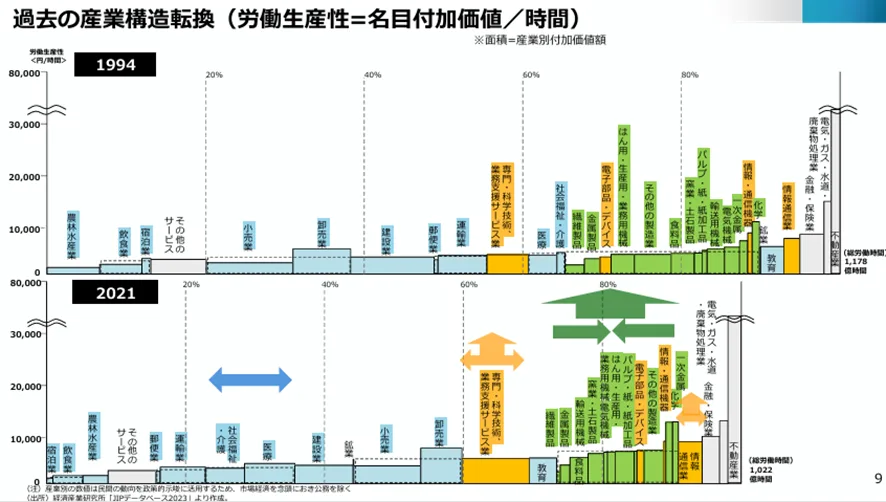
https://www.meti.go.jp/shingikai/sankoshin/shin_kijiku/pdf/20250603_2.pdf Accommodation and food service industries are at the lower left
For such manufacturing to maintain its competitiveness as emerging economies, China first among them, catch up would be a very difficult battle, and it means we need to build answers to that.
Do Not Misjudge Which Occupations and Tasks to Make More Efficient
Up to now, the targets of B2B startup services have mainly been the automation of clerical procedures that "can be made more efficient with software alone."
But as I said at the beginning, for general clerical work and the like the ratio of job openings to applicants is already low, and what is in short supply is rather physical work, the work of so-called non-desk workers. For example, if you try to tackle the problem of the "labor shortage in the construction industry" head-on, you have to approach the parts where people are truly lacking, namely site supervision and construction management.
Of course, software may be able to reduce a little the clerical work that also arises for non-desk workers, but that alone is probably unlikely to improve the labor shortage significantly. (There may also be cases where one starts from making such a partial task more efficient and goes on to change the whole, so I am not necessarily rejecting that on its own.)
To respond to a supply shortage this large, we will have to think not only about partial optimization but about how to optimize entire workflows and value chains, and depending on the case, we will need to consider changes to regulations on inspections and the like, as well as means such as robots.
Summary
Summary by NotebookLM
If time passes like this, we will slowly decline and new challenges will become harder to take on. In that sense, I think one of the things our generation should do now is precisely to solve social problems like these.
If we fail, we will no longer be able to maintain our present standard of living, and it is quite foreseeable that the resulting anger will be directed at politics and at the weak in society. Before that happens, we have to do something.
There is not much time left. Creating new high-value-added industries and dramatically making today's social maintenance workflows more efficient and transforming them require a long period of about ten years. There are only a little under 20 years left until 2045, and the period during which the participation of women and seniors in the workforce keeps increasing probably will not last that long either.
I think this is a time when, unless businesses too seriously consider how to respond to this supply shortage in the short time that remains, the social structure that is the premise of business continuity will collapse. I hope that the number of startups searching for some kind of answer to it will grow, and I think it is important that, if there are people who turn their attention to these matters and think about problems and solutions, we give them generous support of some kind.
Supplement
By having many people work until age 75, the number of workers itself can be increased. In fact, the age of exit from the labor market is said to be currently about 67 (66.9 for men, 64.7 for women), and the number of people who work longer will probably increase. However, because of physical limits, I think that work will likely shift to light work such as clerical tasks and cleaning. For these, the ratio of job openings to applicants is below 0.4, and there is already an oversupply.
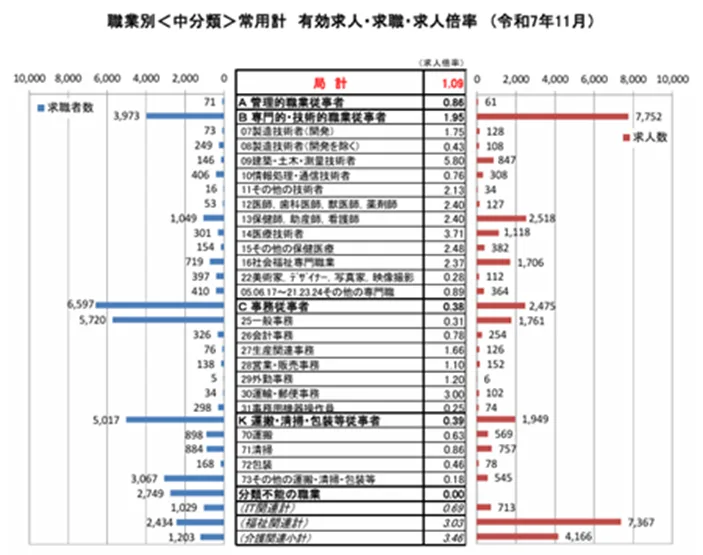
Pieced together from partial excerpts of https://jsite.mhlw.go.jp/kumamoto-roudoukyoku/content/contents/002503692.pdf
On the other hand, seeing that the average age of agricultural workers is just under 68 and remains high without rising further, I think that around this age is the physical limit for work involving manual labor.
Considering that the age at which people start receiving nursing care is around 82 (the average age of first-time certified persons), working until 75 seems rather hard, and on that assumption I have derived the figures for ages 20 to 65 or 70.
Footnotes
-
In Recruit Works Institute's survey these are called "life-maintenance services." I used that as a reference but adopted a different classification so that I could use the figures for the major industry divisions of the Economic Census ↩