It's Time to REBUILD: Startups Rebuilding a Creaking Japan
This article was machine-translated from Japanese by AI (Claude). It may contain errors. Read the original Japanese article.
- Japan Is Creaking
- The Need to Rebuild
- The "Rebuilding" Japanese Startups Are Taking On Now
- How This Differs from the Past
- Aligning with the National Agenda
- Rebuilding Together with the Government
- Moving the Government Requires Challengers Who Go First
- Rebuilding the Startup Ecosystem in This Direction
- Summary
- Addendum: The Rebuild Agenda
Summary of this article by NotebookLM
In April 2020, when anxiety over the COVID-19 pandemic was growing, an essay by Marc Andreessen titled It's Time to Build (Japanese translation) became a hot topic.
Starting from the problems America faced at the time, such as a shortage of masks and a shortage of gowns, the essay points to deeper problems: shortages in the supply of housing, education, and healthcare; America having lost the power to build; and, at root, a lack of the "will to build". In response, it calls on us to "Build."
Five years have passed since then. Andreessen Horowitz seems to have refined this awareness of the problem and, tying it to security and the strengthening of industrial competitiveness, arrived at the theme of "American Dynamism."
Also in the United States in 2025, around the same time, books such as "Abundance" and "Why Nothing Works: Who Killed Progress—and How to Bring It Back" were published by liberals and progressives, taking up "building" and "supply" as themes.
What these books have in common is the argument that unless we review various regulations and increase the supply of housing, energy, infrastructure, and the like, and unless the state accomplishes larger projects and builds public goods, we cannot solve today's social problems.
Looking at Japan too, I feel that the importance of building, that is, supply capacity, is becoming a theme in the contexts of industry, terms of trade, security, and more.
However, when we have this kind of discussion in Japan, I think it may be better not to talk only about simple building (Build), but to make "Rebuild" the theme.
Japan Is Creaking
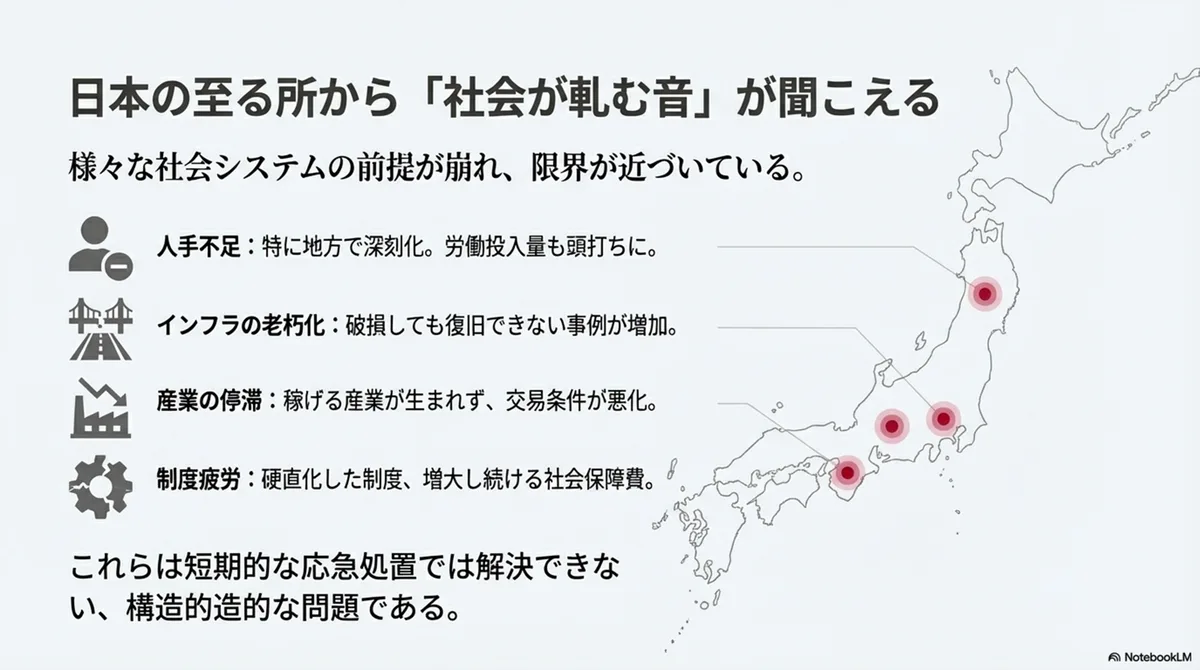
In Japan today, I think various social systems are approaching their limits.
One sign of this is that the sound of society as a whole creaking has begun to be heard loudly across the country.
For example, we have begun to hear complaints from all quarters: there are not enough people (especially in rural areas), damaged infrastructure cannot be restored, electricity is expensive, and there are no industries that can earn money.
In addition, the problems that have long been pointed out, such as institutions that have ossified and cannot be changed and social security costs that are too heavy, seem to be bearing down on many people with a growing sense of urgency.
Thanks to the efforts of many people, we have managed to get through these problems so far. For example, looking at labor supply, the number of people in employment had been increasing, though not in full-time jobs, thanks to the participation of seniors and women, so in total we had somehow maintained labor input. But that increase is now plateauing.
Likewise, the "premises" of social systems that were built on various assumptions, such as past population growth, a certain level of industrial competitiveness, and trust in government bonds, are slowly changing, and the systems are beginning to wear out. Going forward, in the wake of the development of AI, we will probably also begin to see things such as a mismatch between education and entry-level employment.
As such changes pile up and the conventional social systems become unable to withstand them, voices of anger and anxiety from the public grow louder. That is precisely the sound of society creaking.
In particular, when voices of anger and anxiety grow, some people and politicians profit by stoking them, so society will become unstable at an accelerating pace, as in the United States and the EU today.
Many of those voices and demands tend to call for short-term remedies. Merely continuing to answer them in the short term leads to postponing the fundamental problems of the system, and when it can no longer bear the strain, collapse will come.
The Need to Rebuild
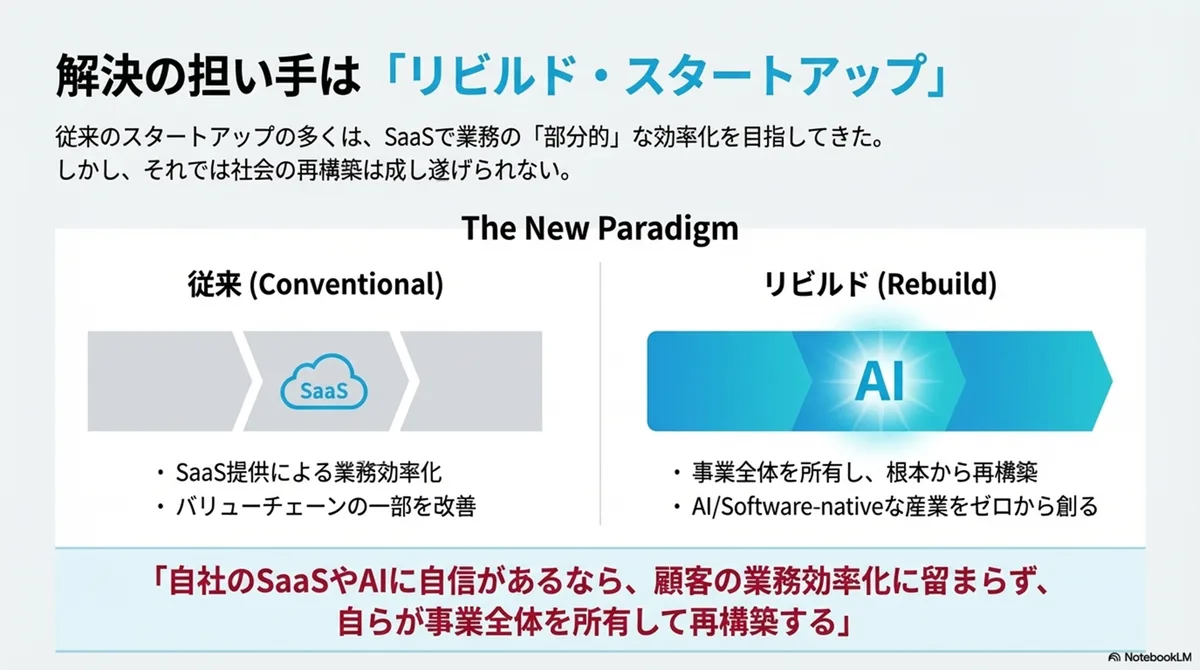
If the existing mechanisms can no longer bear the strain, what is truly needed is not short-term first aid but to review the existing mechanisms and bring about change that goes beyond mere efficiency; in other words, to rebuild. In some cases, this will include rethinking the outcomes that social systems guarantee.
For example, if there is a labor shortage, we need to review existing processes that assume the use of people and save more labor. If simple efficiency gains cannot keep pace with the speed at which the number of people is shrinking, we should also consider building things anew in a modern way.
Another option is to give up on old industries and land them softly, while building new ones.
I feel that Japan today increasingly needs to carry out this kind of rebuilding across various industries and mechanisms. Not only businesses and industries but also security, infrastructure, energy, and mechanisms of self-governance seem to be at a point where rebuilding should be considered.
And within this rebuilding, I believe that, from the perspective of industry, there are areas where startups can contribute.
The "Rebuilding" Japanese Startups Are Taking On Now
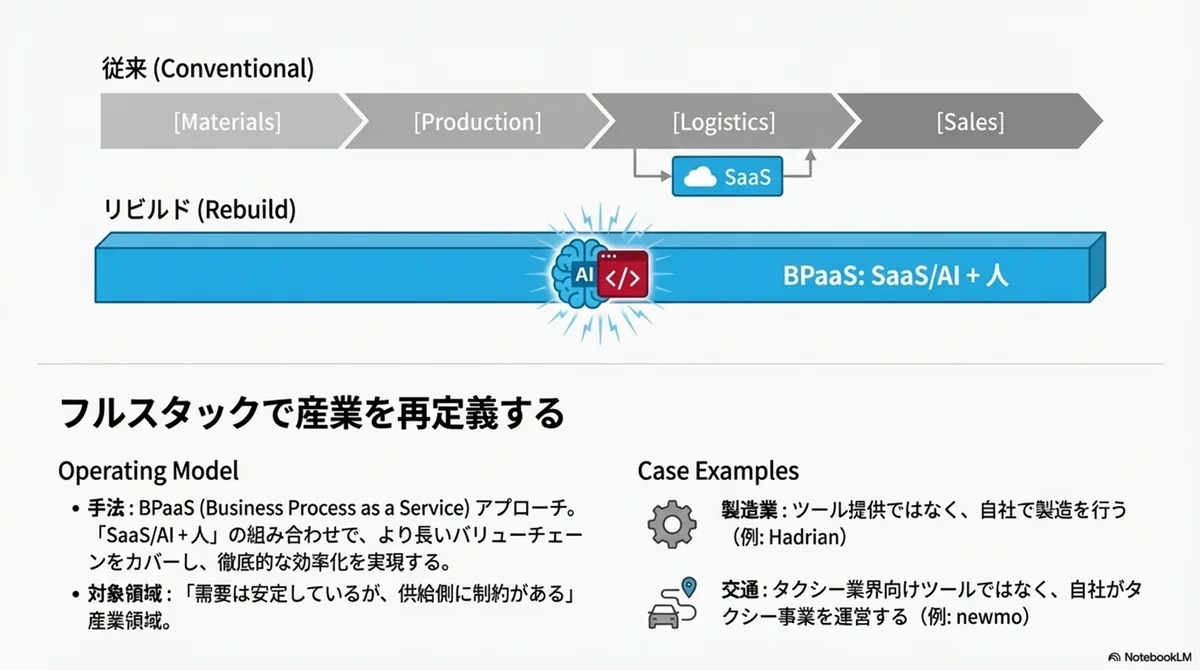
Most B2B startups to date have offered SaaS or software that makes some part of the work in the value chain more efficient. But that approach faced the problems of not only slow expansion into the market but also difficulty in becoming a business that can deliver large returns.
In response to these problems, some startups have emerged that take on the global market from the start, and there are also moves to overcome them through multi-product and compound approaches.
Furthermore, recently, B2B startups in the US and the EU have been using roll-up strategies and attempting to build from scratch.
Examples include the following.
- Instead of providing tools for manufacturers, building their own manufacturing (Hadrian)
- Instead of making tools for the taxi industry, running a taxi business themselves (newmo)
- Instead of investing, VCs rolling up companies and running the businesses
These can be said to follow the direction of "if you truly have confidence in your own SaaS or AI, then rather than using SaaS to make part of your customers' work more efficient, own the entire business yourself and rebuild it."
These are what are known as full-stack startups. It is an effort to rebuild companies and industries as Software-native / AI-native in various industrial areas.
I think BPaaS is an effort in line with this direction. It is an attempt to produce greater value by covering a longer value chain as a business with "SaaS/AI + people" and making it thoroughly efficient.
Of course, I think the areas where this approach works are limited to business areas with the characteristics of "demand above a certain level and constraints on the supply side." Still, by taking on such efforts, one can gain benefits such as:
- Making a longer part of the value chain more efficient on the premise of digital and AI (DX)
- Going greener to clear the cutoff line demanded by the market or to add value (GX)
- Integrating businesses to gain labor savings and economies of scale, enabling a response to population decline (M&A)
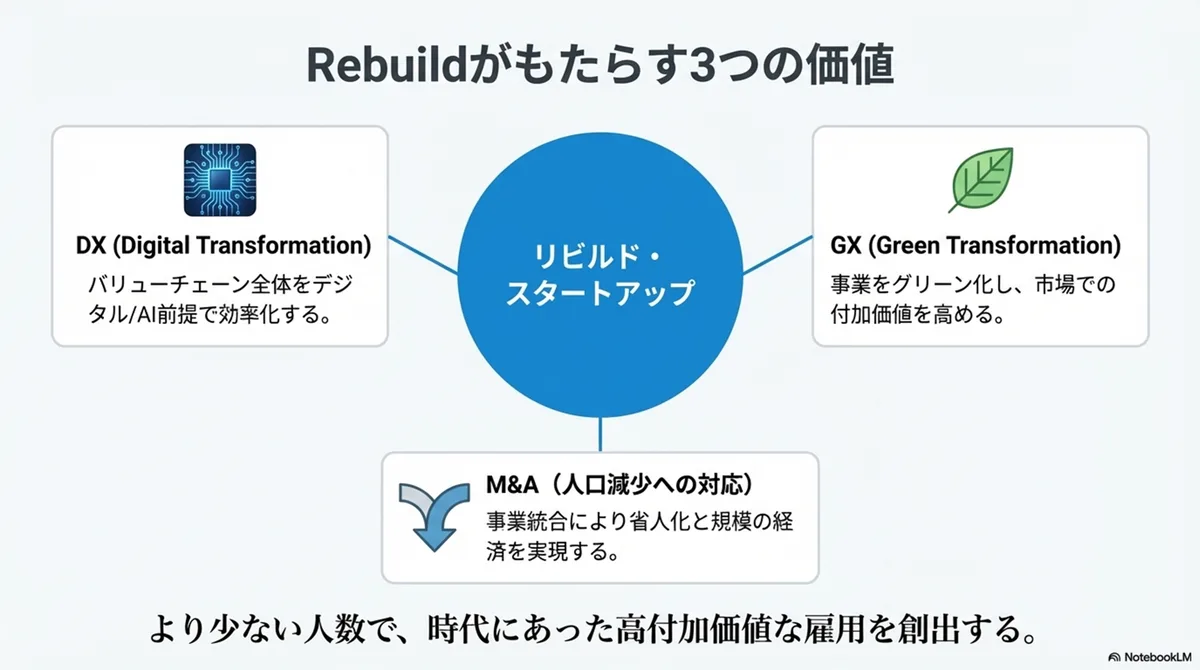
And if it goes well, not only can change happen faster than if existing companies adopt new methods, but it may also be possible to create higher-value employment suited to the times with fewer people.
Now that the industrial structure of 2040 is being discussed in venues such as the Industrial Structure Council's New Direction subcommittee on economic and industrial policy, I think that startups that go beyond merely improving efficiency and rebuild (rebuild startups) are exactly what the country needs right now.
And indeed, it looks as if several startups are working in this direction.
How This Differs from the Past
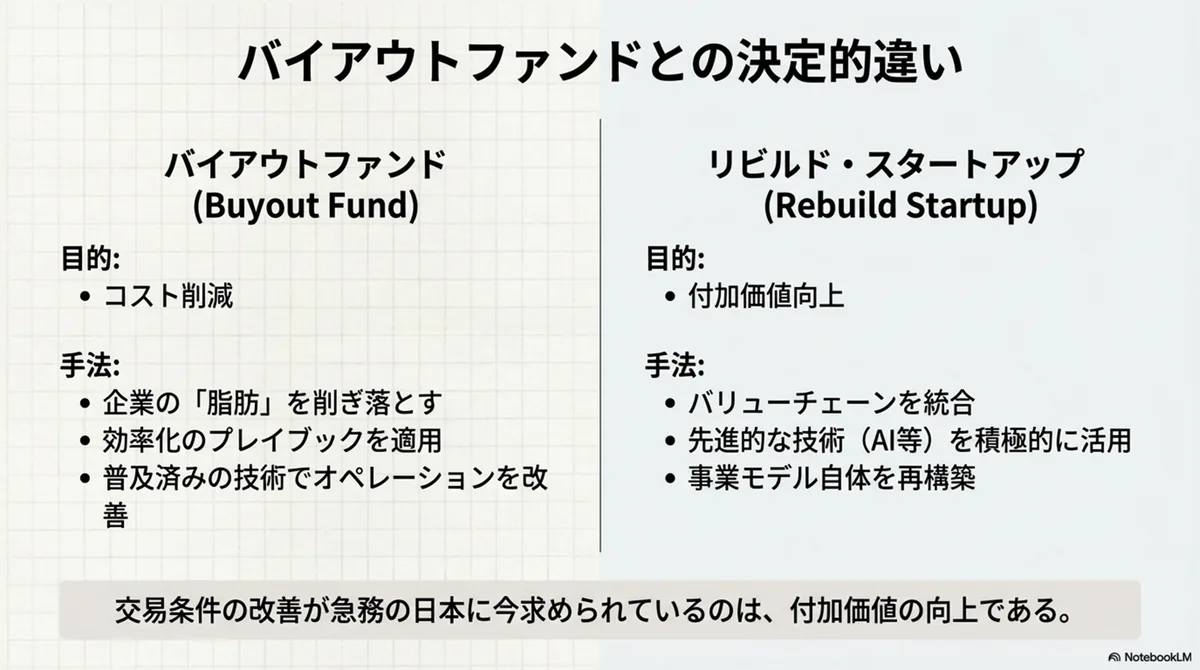
The difference between traditional buyout funds and these startups' approach is probably whether they pursue cost reduction or added value.
In terms of general characteristics:
- Buyout - Cut costs by trimming the fat from the acquired company, then apply an efficiency playbook and, in some cases, make operations even more efficient with technologies that are already widespread
- Startup - While integrating companies and value chains, raise added value using advanced technologies
That is the difference.
There are risks in using various cutting-edge technologies, but in Japan, which right now needs an improvement in its terms of trade, what is called for seems to be the direction that aims to raise added value.
Aligning with the National Agenda
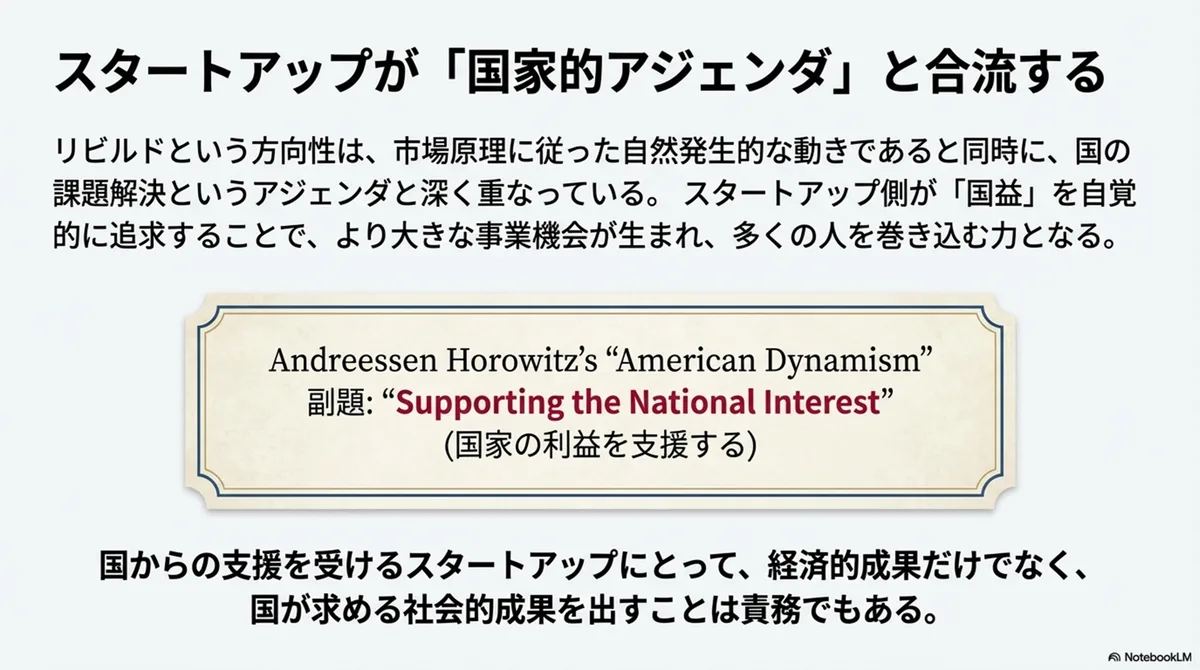
I think startups heading in this direction is, to a large extent, a spontaneous development that follows market principles. At the same time, this approach overlaps with the country's challenges and agenda.
Now that the two are converging, it is possible for startups to carry out activities and businesses with a stronger awareness of the national agenda, and I believe there are business opportunities there as well.
And I think that if startups become conscious of that national interest and align with that direction, they will be able to draw in more people.
Andreessen Horowitz's American Dynamism also has the subtitle "Supporting the National Interest."
And I think that is also a kind of duty.
Now that startups are taken up in many national councils and receive support from the government, it would be a healthy relationship for startups to deliver, in response to those expectations, not only economic results but also the social, environmental, and ethical results that the country seeks.
Rebuilding Together with the Government
However, it is not all good news.
To run businesses that carry out this kind of rebuilding, funds are often required. And these efforts are not in the asset-light territory that investors such as traditional VCs have preferred to invest in.
Moreover, at the time of listing, such companies may be positioned not as "software companies" but as "slightly more efficient manufacturing or service companies," and their multiples may be low. In such a situation, investment may be hard to come by, and things may not move forward.
The aforementioned It's Time to Build also says the following.
Building is not easy.
It is indeed not easy; it is an extremely difficult undertaking.
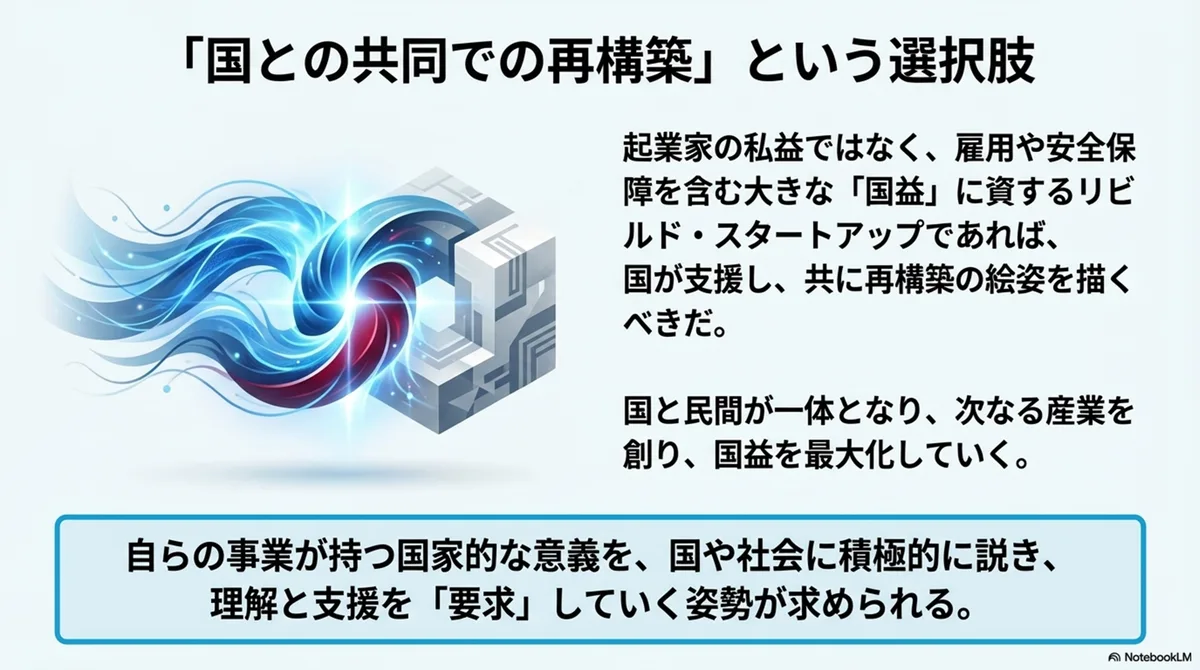
But in Japan, the problems of business succession and industrial competitiveness weigh heavily. So if a rebuild startup contributes greatly to the national interest, it should be fine to draw up the picture of the rebuilding together with the government, while receiving its support.
Of course, the recipients of such support should be limited not to mere economic benefit, much less to efforts that maximize the entrepreneur's private gain, but to large national interests, including employment and security.
To that extent, I think it is time for the government and the private sector to work together to create the next industries and to rebuild existing ones, and thereby build the national interest.
In other words, both for the growth of startups and for the national interest, startups should pursue the following:
- Choose a large business area that has significance at the national level
- Rebuild it
The passage from It's Time to Build quoted earlier continues like this.
We need to demand more from our politicians, from our CEOs, from our entrepreneurs, from our investors. We need to demand more from our culture, from our society.
And, we need to demand more from each other. We all need to be needed, and we can all contribute.
As this says, if you believe you are doing something meaningful for the country and society, explaining its significance to the country and society and making demands of them seems to be exactly the attitude that is needed. (But only to the extent that the significance is truly large.)
Moving the Government Requires Challengers Who Go First
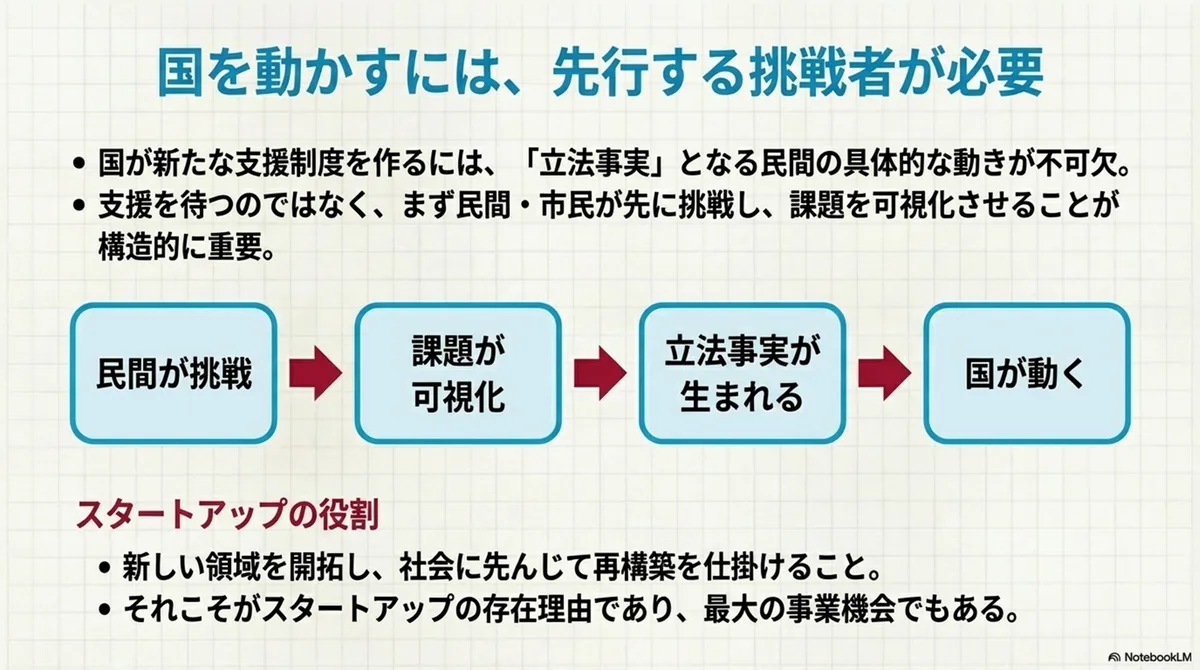
On the other hand, when the government creates a support menu, it is hard to make progress without developments on the ground that serve as a legislative fact.
That is why the private sector and citizens need to take on challenges first and bring the problems to the surface. Structurally, asking for support first rarely gets anywhere.
Opening up new territory is, I think, precisely the role of startups as well.
In other words, I believe that pursuing rebuilding ahead of the government and society, and trying to be the first to change a creaking Japan, is one of our reasons for existing, and that thinking about business from this perspective can also be a good business opportunity for startups.
Rebuilding the Startup Ecosystem in This Direction
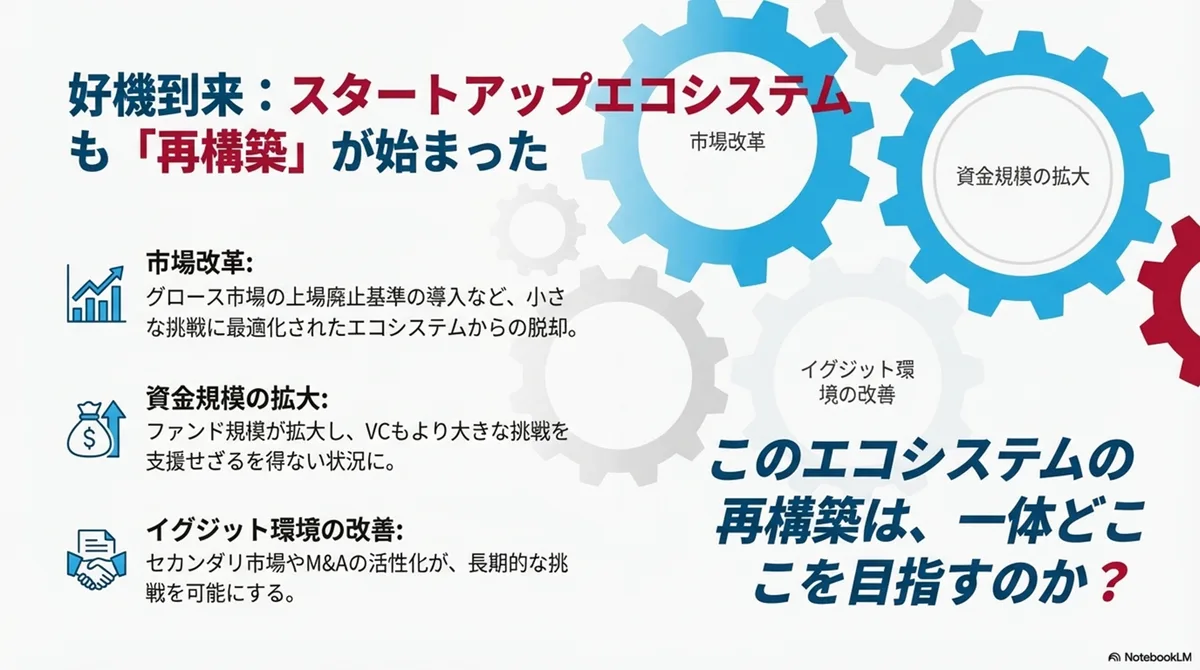
Fortunately, at about the same time, the rebuilding of Japan's startup ecosystem is also beginning.
The main example is the delisting criteria for the Growth Market, which can be seen as a kind of challenge that forcibly changes a Japanese startup ecosystem that was becoming optimized for small challenges.
The growing size of funds is another factor. Because they cannot return capital without taking on large challenges, a growing number of VCs are trying to back larger challenges. If exits for investors, such as the secondary market and M&A, also improve, it may become easier for investors to invest, and entrepreneurs may also be able to take on longer challenges.
In the midst of such a rebuilding of the ecosystem, what should really be discussed is where Japan's startup ecosystem is aiming.
Without that, we lose sight of what kind of adjustments to make. Moreover, merely solving the ecosystem's problems that have already surfaced would amount to symptomatic treatment and would not resolve the fundamental problems.
One direction for rebuilding that ecosystem is precisely what I have been writing about so far: confronting and rebuilding the national challenges of a creaking Japan.
Many startups may already think that "the problem we are working on is a national problem." Unfortunately, in many cases that is not so, and even if it is, stopping at efficiency gains will not solve the problem in a big way.
If so, then conversely, by rethinking what the national problems are and how our own business contributes to them, we may be able to expand our business ideas. I think it is worthwhile to consider these national problems not in terms of investment efficiency but from the viewpoint of trying to take on larger problems.
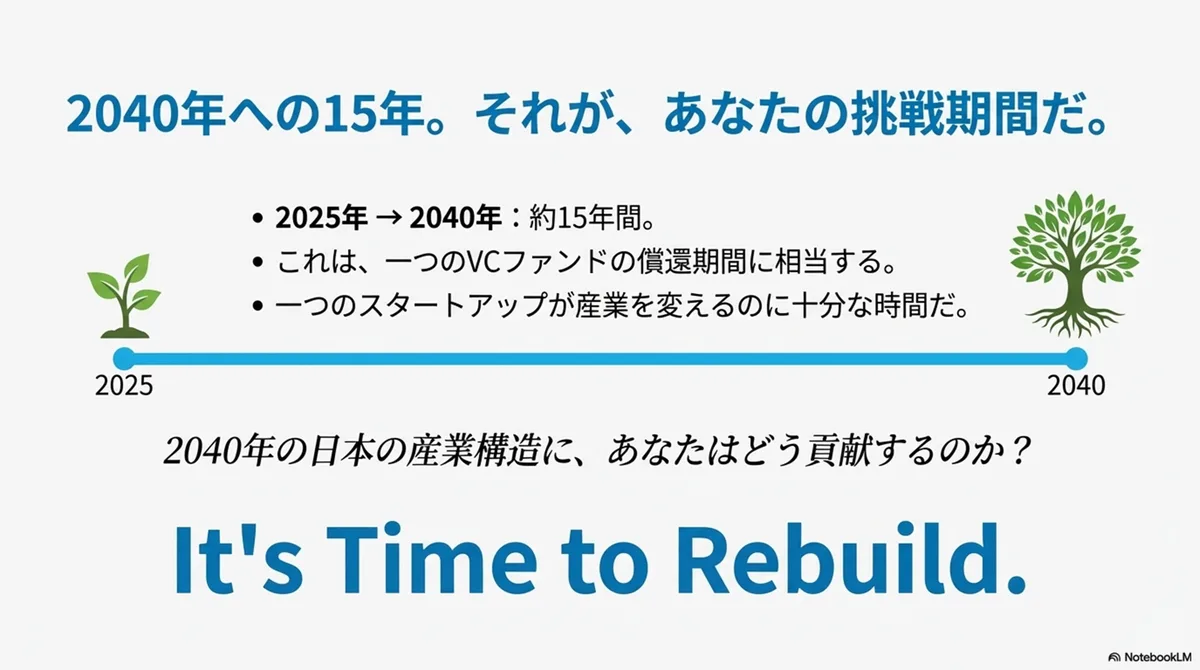
From 2025 to 2040, the year being debated in the New Direction subcommittee and elsewhere, there are about 15 years. That period roughly corresponds to the redemption term of a somewhat long VC fund. Conversely, it also means we have only 15 years.
If so, what startups that begin from now should do is think about how they will contribute to the industries of 2040 during these 15 years. I believe that is one question being asked of us, and one challenge.
Summary
Rather than building tools for partial tasks, we should greatly change the way businesses operate and the industrial structure, and rebuild this creaking society. I believe that this kind of big challenge is what is asked of startups in particular.
I previously wrote an article titled "Build What the Future Needs," but we must build that future before the current systems collapse.
It's Time to Rebuild.
To Build and increase supply, and to increase what could be called public goods. And at the same time, to Rebuild Japan's existing industries and society.
I hope to work on something together with people who take on such big challenges.
Addendum: The Rebuild Agenda
Other items on the rebuild agenda that I have in mind include the following.
- Industrial competitiveness
- Infrastructure
- Energy
- Regulation
- Social security
- Security
- International relations
- Self-governance
- NPOs
- Democracy
- Redistribution
- Liberal thought
Now that the regime that followed the Cold War is changing, I think we need to reconsider these and rebuild them.
Some of these agenda items differ greatly from business, but I think there are parts that startups can take on, and even if not directly, I believe startups can have a positive influence.
I hope to share discussions on these topics, on some occasion, with people who are interested in them.