Entrepreneurship Education in KOSEN and Regional Japan
This article was machine-translated from Japanese by AI (Claude). It may contain errors. Read the original Japanese article.
I was asked for my views by people in government on entrepreneurship education in regional areas, and in KOSEN (colleges of technology) in particular, so I am turning the materials I submitted into this article1.
- Entrepreneurship education differs from school to school
- The role KOSEN have played so far
- Thinking about regional industrial policy
- KOSEN education that takes regional industry into account
- Entrepreneurship education in KOSEN
- 'Embedded entrepreneurship education' for practicing entrepreneurship education within the existing curriculum
- Summary
Entrepreneurship education differs from school to school
As a premise, I believe that entrepreneurship education should differ somewhat from school to school.
This is because I think the entrepreneurship education a school provides strongly reflects the expectations of the stakeholders connected to that school and of society.
A school is a kind of nonprofit organization, and schools (universities in particular) are run on the basis of self-governance by faculty, staff, and students. At the same time, for national and public schools, the state, the government, local governments, and the public are also major stakeholders, and such schools are established and operated with funding from taxes in exchange for taking on certain roles and expectations 2.
For example, the University of Tokyo is a university expected to cultivate Japan's elite, and I personally think it is a school expected to train researchers and bureaucrats, to produce people who are active globally and serve as bridges to Japan, and to develop people who will create the next industries in Japan.
If entrepreneurship education is carried out at a school with such a role, it would have the task of cultivating the people who can be active in those areas, and the kind of entrepreneurship suited to those areas, and of sending such people out into the world.
For example, if we take business startups, which are entrepreneurship in the narrow sense, as the subject matter, the focus would be on high-growth startups that create the next industries, and on producing next-generation large companies and high-value-added employment. It may also be necessary to produce entrepreneurs who solve major social problems or run businesses that serve the public interest.
In other words, I believe that those of us involved in education have a responsibility to think about and provide the content of entrepreneurship education that is conscious of a more public role and public expectations, rather than entrepreneurship that supports the maximization of the private interests of individual students or individual faculty and staff.3
On the other hand, regional universities and schools are expected to serve their regions. If so, a different form of entrepreneurship will probably be needed. Promoting social entrepreneurship to solve social problems in the region is one example.
Of course, I think there are competencies common to entrepreneurship, such as methods of problem solving. But even when trying to cultivate the same competencies, the goal can be achieved with different subject matter, and by taking such context into account, I believe the content should rightly differ.
For schools such as commercial high schools and some private schools, which are expected by both students and the community to produce people for commerce, I think general business startups, including small businesses, are what is asked for from inside and outside, so entrepreneurship education along the lines of business startup education is fine at such schools.
But for most other schools, I believe it is important to reconsider the expectations that the local community and the country place on the school, and to provide entrepreneurship education suited to the role expected of that school (entrepreneurship education other than business startups)4.5
The role KOSEN have played so far
So what about KOSEN? I think KOSEN are schools and an educational system that were created quite strategically and industrially. In more abstract terms, they are schools that contribute to regional innovation.
It was manufacturing that drove the Japanese economy in the 1960s, and in particular innovation in mass production. Many engineers were needed for that, and KOSEN were created as schools to train engineers in a short time. They were also expected to contribute to regional industry, and each school established departments with their own distinctive character. This model was a success, and I hear that it is now being exported to Southeast Asia as the KOSEN model.
However, compared with around 1960, the innovation that is needed has changed greatly.
Japan's mass-production sites have moved to China, and regional industries are gradually changing as well. The innovation needed to generate high added value in Japan is probably different from what was demanded when KOSEN were first established, and the kind of people needed now are not the kind of people needed in the 1960s.
KOSEN graduates, who originally often found jobs in their own regions, seem to increasingly choose to work or go on to further study in the Tokyo metropolitan area. As the country has entered a phase of population decline, and a "100% job placement rate," which was an advantage in an era of surplus labor, has become a matter of course, what students expect from KOSEN is probably changing too.
Of course, creating an information science department, whether in line with the wishes of students and their families who seek better employment or simply to follow a trend, is one option. But graduates of information science departments tend to find jobs easily in the Tokyo metropolitan area. If a school becomes one that sends talent to the Tokyo area, it will eventually lose the trust of the region and, in turn, support such as tax-funded subsidies.
Similarly, if startups in KOSEN are promoted carelessly, companies such as contract software developers will end up relocating to the Tokyo area. As was the case in Atlanta in the United States, startups with weak ties to their region tend to relocate (in Atlanta, home of Georgia Tech, one study found that 40% of high-tech startups moved out of the state within 3 years, 60% within 5 years, and 75% within 10 years).
If we regard KOSEN as schools for regional industry and innovation, we need to think about what kind of innovation is needed in that region now. For that, we need to take into account regional industrial policy and, these days, the policy of regional revitalization.
In other words, in thinking about entrepreneurship education in KOSEN, we need to go back to regional industrial policy. Given their origins, KOSEN in particular seem to be educational institutions with a conspicuous need to coordinate with regional industrial strategy.
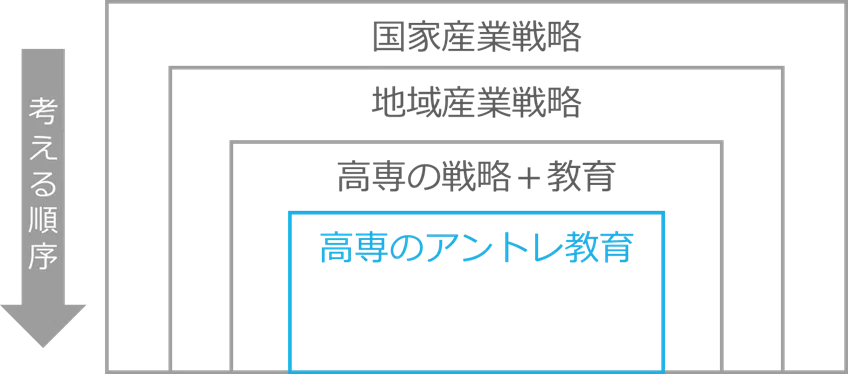
Thinking about regional industrial policy
Thinking about regional industrial strategy is too heavy a task, and it is outside my field, so I will not go deeply into it, but I can offer a few hints.
First, a useful reference for thinking about regional industrial policy and innovation policy in the age of globalization is the book Innovation in Real Places, which I introduced in 2021 and 2022. The book also won the 2021 Donner Prize (a Canadian award that selects the best public policy book of the year), and I hear it has become required reading for people involved in innovation policy in Canada.
In this book, Professor Breznitz of the University of Toronto argues that innovation is not the same as invention, that innovation can occur without high tech plus entrepreneurship, and that the key is to pursue the form of innovation appropriate to each region.
Many regions and governments are trying to imitate the Silicon Valley startup model, but there are other paths that generate innovation and create high-value-added employment.
You should be able to get a reasonable grasp of the book's details by, for example, asking ChatGPT's Deep Research for a summary, so I will leave that to it. The book's organization of innovation is roughly the following typology.
Type | Main activity | Typical examples | Required regional capabilities |
① Novelty | Creating world-first products and technologies | Silicon Valley, Israel | Cutting-edge research institutions, VC, highly skilled people, risk tolerance |
② Design, prototyping, and production engineering | Turning ideas into prototypes | Taiwan's ICT industry, Italian luxury shoes | Clusters of specialized small and medium-sized firms, applied research and engineer training institutions |
③ Second-generation / component improvement | Continuously improving existing products | Constant improvement of internal combustion engines, etc. | Existing industrial base, continuous improvement, component industry |
④ Mass production and assembly | Efficiently mass-producing a wide variety of products | Electronics manufacturing in China's Pearl River Delta | Large-scale production infrastructure, logistics, global access |
At the time KOSEN were established, Japan's industry centered on ③ and ④, and I think KOSEN produced engineers suited to that.
On the other hand, the recently popular imitation of the Silicon Valley plus startup model is an attempt to create ① in a region. But realizing ① is extremely difficult, and it is said that even when it succeeds, the benefits tend to concentrate among a small number of entrepreneurs and investors, the ripple effects on the regional economy as a whole are limited, and it tends to widen socioeconomic inequality, which calls for caution.
Israel, for example, is often cited as a case that succeeded in creating high-tech startups using foreign VC funding. But looking closely at what is inside, it has also been pointed out that although successful Israeli companies did go public in overseas markets and earn enormous profits, more than 95% of the capital was foreign, so much of the profit flowed back to investors abroad and productivity and wages in the country's other industries stagnated; what had once been an egalitarian society became one in which only a few people made money, the gains did not spread to other industries, and the share of the population in relative poverty is high. (The OECD has also pointed out that Israel's redistribution is weak.)
Unless startups are promoted with careful thought, the same thing will happen between Tokyo and the regions: a model in which people in Tokyo profit and the regions are exploited. I think this possibility is especially high in the software domain.
There may be ways to make a living through ③ and ④ instead of ①, but ④ is probably dominated at present by China and developing countries (which is exactly why the KOSEN model is being exported), and ① is difficult unless a region has research institutions strong in R&D, so I think ② and ③ are about the industrial strategies that many regions can take while achieving high added value.
(That said, Breznitz's book was also written before the free-trade economy ended up in the kind of situation we see in 2025, so I think it needs to be reexamined somewhat, taking into account dynamics such as economic security.)
KOSEN education that takes regional industry into account
If we assume such a regional industrial strategy is adopted and that KOSEN are schools for innovation, KOSEN would produce innovation talent for ② and ③ in the region (though this is an assumption that holds if the region adopts such a strategy. Other options are also conceivable, such as globalizing and attracting talent from overseas).
In fact, KOSEN themselves seem to share this understanding, and a similar classification to the table above has been made.
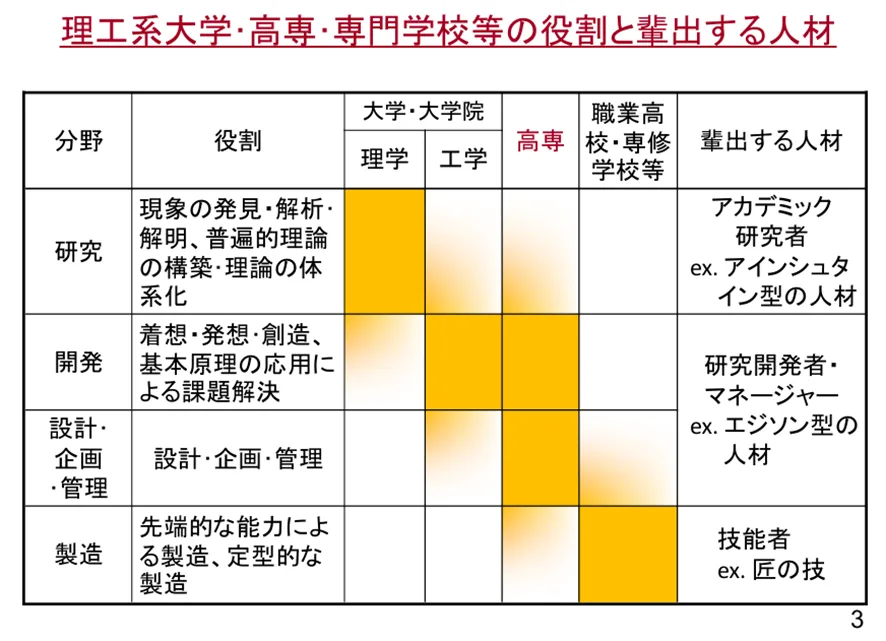
However, whereas branches and factories of large companies used to exist and absorbed KOSEN graduates, as the employment that served as that destination disappears from the region, simply producing graduates will not work.
If we want to keep people who contribute to a region in that region, launching new businesses there will be required more than before, and at that point entrepreneurship in the narrow sense, that is, starting companies, will be called for.
A relatively successful example is Germany. In Germany, it seems that new industries are being created by combining old industries with digital. As a regional ecosystem, they build hubs, and educational institutions coordinate with the region.
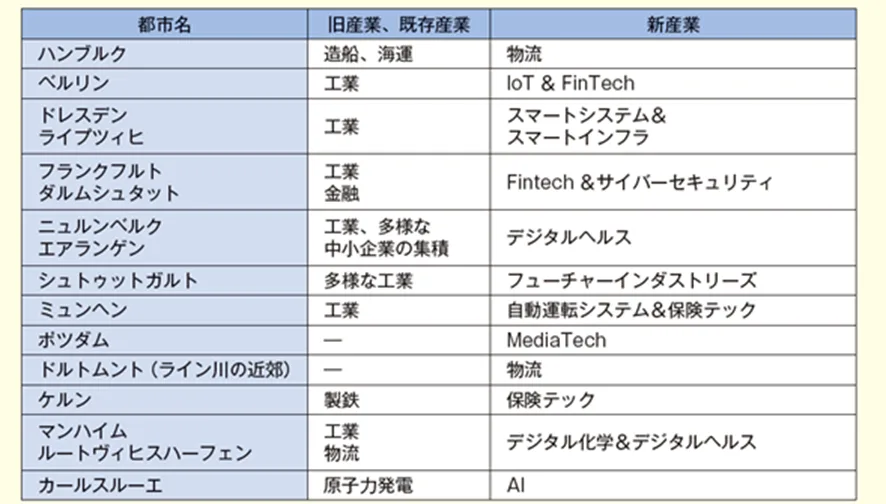
https://www.projectdesign.jp/201812/area-future-vision/005752.php
So I think that KOSEN today could make a new contribution with the positioning of "solving regional industrial issues and regional social issues with technology (including technology other than software), and contributing to the region's industry and society."
Also, when pursuing that kind of innovation, starting a company is one major option now and in the near future, and entrepreneurship education seems important in that context as well.
Entrepreneurship education in KOSEN
If so, entrepreneurship education in KOSEN will be education that cultivates entrepreneurs as practical, creative people who, in close relationship with regional issues and regional industries, lead innovation in the region with technology.
Digital is only one option, but even if we take digital, KOSEN could become schools that produce new businesses that digitize each region's local industries and sell those digitized models and products to other regions and other countries. I also think they are schools capable of undertaking efforts that use knowledge beyond digital to solve regional social issues with technology.
In other words, entrepreneurship education in KOSEN in this context would be
- Regional industry tech startup education
- Regional society tech startup education
and so on, as subject matter, cultivating entrepreneurship while coordinating with the regional ecosystem. That is what I think it would look like.
A strength of KOSEN is that they can train students in "technology" as a solution in a short time while enabling practical problem solving that uses it. Moreover, compared with the education at regional universities, the content of education tends to be more practical and more closely tied to the region.
Their capacity to launch novel startups based on cutting-edge research may be weaker than that of the former imperial universities and the like, but they are more practical and creative in applying existing technology, so they seem especially well suited to solving this kind of regional social issue, and I think entrepreneurship education could also be put to use in that context.
'Embedded entrepreneurship education' for practicing entrepreneurship education within the existing curriculum
But class time is limited. Because KOSEN also aim to train engineers in a short time and maintain strict quality assurance through JABEE and the like, class periods are quite full. I also hear that the teachers are exhausted, since on top of research they have homeroom duties, club advising, and school administration, so additional extracurricular activities would probably be difficult.
So rather than adding entrepreneurship education or running it as a separate track, I think it may be possible to take an approach of 'embedded entrepreneurship education', in which elements of entrepreneurship education are incorporated into conventional subjects. For example, this report is one example from STEM.
Since the classes themselves would need to change a little, the initial burden may be large, but I still think it is better than adding classes (once you start, they keep getting added...), and if the region requires innovation for a new era, I think schools will be asked to take the initiative in providing education suited to it.
Moreover, precisely because KOSEN provide practical and creative education, I think they are schools where this kind of effort is easier to undertake. Still, there is no doubt that it is difficult. When taking on entrepreneurship education, I think it is a problem with a gradient: which difficulty do you take on, increasing the number of classes and extracurricular activities, or changing the content of the classes?
Summary
It is presumptuous for someone outside KOSEN to say anything about them, but from the viewpoint of entrepreneurship education, I thought I could offer at least some thoughts on how each school should think about it, so I have introduced that way of thinking. I suspect there are many points open to criticism from the perspective of the sociology of education and so on, but for now I will set it down as my own view.
Also, even though schools strive to meet the expectations of their stakeholders, it is necessary for the education side to hold a medium- to long-term perspective. This is because, in many cases, industry and individual students tend to express quite strong short-term expectations. Industry's demands in particular tend to be short-term.
I would add that when considering education on the basis of regional industry, we also need to consider the population that will turn 15 in that region in 2040 (that is, the number of children born in that region in 2025, this year), and the industrial structure at that time.
In regional areas in particular, population decline is faster than in Japan as a whole, and out-migration is expected to accelerate further. In some places the youth population may be halved. (For example, Aomori Prefecture, home of Hachinohe KOSEN, which has produced an excellent report, had about 9,500 births in 2009, but it seems there were 5,410 in 2024. In 15 years, the schools in the prefecture will be competing for that pie of about 5,410.)
In such circumstances, I think what entrepreneurship education is especially being asked is which regional industries to preserve, how regional industry and education should coordinate to that end, and what kinds of entrepreneurs (not limited to business entrepreneurs) to cultivate.
Footnotes
-
As with the meeting with former Prime Minister Kishida, I believe materials like this should be disclosed as far as possible. ↩
-
If a school tries too hard to meet society's expectations, it becomes more short-term and market-oriented and ends up preserving existing power, so I think education should also be able to take a critical stance toward that, but I will not discuss it here because it strays from the main subject. ↩
-
There may be teachers at the same university who think differently, but this is simply what I think. ↩
-
Personally, I often take a position against entrepreneurship education that uses business startups as its subject matter, both from the viewpoint of its educational effect on entrepreneurship and from the viewpoint of the role expected of schools. ↩
-
That does not mean high-growth startups should not be taught; it is a matter of degree. Also, I personally think that one common answer that can be handled in a wide range of schools is policy entrepreneurship using regional issues, but that is a separate topic, so I will write about it separately. ↩